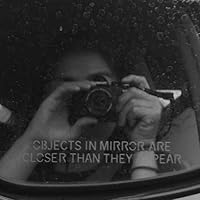
Elegiac and haunting, Mirror Nation by Don Mee Choi completes the KOR-US trilogy, along with Hardly War (Wave Books, 2016) and the National Book Award–winning DMZ Colony (Wave Books, 2020). Much like Proust's madeleine, a spinning Mercedez Benz ring outside Choi's Berlin window prompts a memory of her father on the Glienicker Bridge between Berlin and Potsdam, which in turn becomes catalyst for delving into the violent colonial and neocolonial contemporary history of South Korea, with particular attention to the horrors of the Gwangju Uprising of May 1980. Here, photographs, news footage, and cultural artifacts comingle with a poetry of grief that is both personal and collective. Inspired by W. G. Sebald and Walter Benjamin as well as Choi’s DAAD Artists residency in Berlin, Mirror Nation is a sorrowful reflection on the ways in which a place can hold a “magnetic field of memory,” proving that history doesn’t merely repeat itself; history is ever present, chiming the hours in a chorus against empire.
Born in Seoul, South Korea, Don Mee Choi is the author of DMZ Colony (Wave Books, 2020), Hardly War (Wave Books, 2016), The Morning News Is Exciting (Action Books, 2010), and several chapbooks and pamphlets of poems and essays. She has received a Whiting Award, Lannan Literary Fellowship, Lucien Stryk Translation Prize, and DAAD Artists-in-Berlin Fellowship. She has translated several collections of Kim Hyesoon's poetry, including Autobiography of Death (New Directions, 2018), which received the 2019 International Griffin Poetry Prize.
2.5 ---- Almost wish I had read the notes at the end before the bulk of the work. They were particularly insightful. Otherwise, I struggled to latch onto any poem's singular meaning or message, but that scattered approach may have been the intention. Perhaps Choi's work is too advanced/experimental for me. I'm not afraid to admit that.
Probably my favorite Don Mee Choi work thus far. She seems to improve as the trilogy goes on. Her poetry actively seeks, for the majority of these pages, to evade poetic turns: These are essays reenvisioned as prose poems held together until the language, in a very Jelinek-esque sense, cannot hold, and then a far more overt, unpindownable political lyric explodes onto the page, trilingual and derelict of immediate meaning. What she is so great at is using her multimedia anti-form to expose a neocolonial (KORUS) web that doesn't just linger into today but is very much active, an activity that rumbles within Don Mee Choi's being as she considers her emigrant history while discussing her father's photography, the Gwangju Massacre, her subjectivity in Germany, her links to English and the American military machine that has fractured her. But it doesn't read like an outcry or a work on identity in the typical sense. The rage simmers and spits and boils and bubbles through a profound intellect expressed in a manner no one else (that I know of) seems to share in contemporary American poetry. Her Yi Sang-like "공=o=5=0=zero" and her final poem and the recurrence of swans mostly elude me.
This felt sharper, more focused than her previous work! Tighter image bank - bridges, angels, clocks, marks - i thought the stuff on marks connecting across time and place was amazing, the 0 of an angels halo to a clock to a flag. I liked how focused it was on the gwangju massacre too. I think it could’ve been tighter, I don’t like her tendency of stringing quotes together and the stuff on swans and letters felt extraneous, but there is also something fascinating and haunting about her messy swirl of fury and grief… I wonder why she kept the beautiful stuff on imagining the future in the notes section??
This felt more like a museum exhibition than a book of poetry. It pushes the limits of what poetry is and what it can do. It is part history, part extended metaphor, part personal reflection. Very thought-provoking and not something to read lightly or for mere pleasure.
That said, this wasn't really my cup of tea, in style or approach. It is too repetitive at times and, because the main message is intentionally (?) evasive, it is unclear what Choi's goal is in writing this book. It seems like something only the writer is meant to truly understand, but doesn't that defeat the purpose of publication?
Don Mee Choi’s newest book of poetry Mirror Nation opens on a bridge in Potsdam, just outside Berlin. The last spy swap between East and West Berlin is taking place on the Bridge of Spies, and Choi is watching her father, a photojournalist, move around the bridge photographing the event. He’s easy to spot because he’s wearing a white winter hat with its ear flaps down.
Mirror Nation is replete with bridges. There’s the Eisener Steg, a footbridge that crosses the Main River in Frankfurt, where Choi lived in the 1980s. There’s the Langenscheidtbrücke in Berlin, which features prominently in Wim Wender’s film Wings of Desire. There’s the Glienicke Bridge between Berlin and Potsdam, which I just mentioned. In Korea, there are the Taedong Bridge in Pyongyang and the Hangang Bridge in Seoul. Choi lived near the latter and used to walk on it as a child. What she tells us at the outset of this book is that certain symbols, like these bridges or the Mercedes Benz advertising logo that she sees from her apartment window in Berlin, along with certain hours on the clock, can send her memory tumbling back in time. “Sometimes, the flow of time is reversed for no apparent reason,” and memories of grief return.
Written while living in Berlin (once a divided city, just as her native Korea remains a divided country), the main event of this book is the May 1980 Gwangju Massacre (as she calls it) or Uprising, when hundreds, if not thousands of students and civilians were killed by Korean soldiers after the newly-installed South Korean military dictator Chun Doo-hwan implemented martial law (with the full backing of the U.S. government). Thousands more were arrested and tortured. This event is threaded amongst moments plucked from Choi’s autobiography along with some free-form writing on a handful of topics like memory, angels, and time. Mirror Nation is the concluding volume of her trilogy of books that use both poetry and prose written in English and Korean, along with a somewhat adventurous use of type fonts, photographs, and other types of imagery. Collectively, the trilogy addresses Korean history during the turbulent 1950s and 1960s, racism, and the legacy of the Korean War and subsequent American involvement in Korea. These books are part autobiography, part activism, and part “disobeying history,” as she says in Hardly War. In Seattle’s Wave Books, she’s found a publisher that gives her the design freedom to present her hybrid form of text/image to its best advantage.
Choi’s father, a photojournalist, photographed and filmed events throughout the days of the Gwangju Uprising and Choi herself turned eighteen only months afterward. Eventually, the family emigrated, splitting up between Australia, Hong Kong, Germany, and the United States. Years later, her father related to her at length the frightening days he spent dodging soldiers as he photographed the clashes between protesters and government troops, documenting the dead and wounded. Several of his photographs are reproduced in the book, including a powerful sequence of full-page images. Also included in the book are several once-secret U.S. government documents demonstrating how American diplomats blamed Korean students for the protests and urged the Korean government to use violent force to put down the uprising.
Choi began this trilogy in 2016 with Hardly War, a bravura example of poetry and visual performance that more or less focused on the Korean War, although Choi’s books are never about just one thing. In 2018, DMZ Colony won the National Book Award. Its central theme was the succession of corrupt South Korean governments and the violence they have perpetrated on their own people, both before and after the Korean War. “How does this happen?” she asks. After Korea had been colonized by Japan and “neo-colonized by the US military machine,” it was easy. All the Korean regime needed was language to turn protesters into enemies of the state. “Not difficult to see each other as ‘scums of society,’ ‘commies.'”
Throughout the new book, Choi pays homage to other writers and artists who have influenced her work and Mirror Nation in particular. She quotes W.G. Sebald on “the silent lament of the angels, who have kept their station above our endless calamities for nigh on seven centuries” (Vertigo). There are references to Fritz Fanon, for his writings on post-colonialism, and to W.E.B. Du Bois, a co-founder of the N.A.A.C.P., who studied in Berlin in the 1890s. Walter Benjamin is invoked, of course, since Choi clearly abides by his belief of involuntary memories. But the presiding figures that hover over this book are the angels from Wim Wenders’ 1987 film Wings of Desire, his love letter to Berlin and to the angels that watch over that city.
After three books of war, incredible violence, and a family scattered across the globe, Choi, at the end of Mirror Nation, understands that she, too, is a divided country, a political person and a family person, one person who is consumed with history and grief and another person who stops to marvel at sparrows and swans. “While filming wars,” “[my father] said my sister and I often flashed before his eyes/we were a panorama of sparrows under Mother’s umbrella.”
Choi’s politically engaged, plurilingual, autobiographical, illustrated, and typographically bold trilogy is the worthy successor to her fellow countrywomen Theresa Hak Kyung Cha’s now classic book Dictee (1982), which is frequently called a “masterpiece” by reviewers. In terms of their construction, Choi’s books are more complex than Dictee. Reading Choi’s trilogy is like watching a juggler tossing up a plate and an apple and several other odd objects, one of which is a very sharp knife, as our emotions shift from horror to tension to laughter. She can take the reader from anger to childlike silliness over the course of a page or two. Like Dictee, each of Choi’s three books are meant to be considered as a whole, not as a collection of individual poems. This lets her set up a body of references that continually bounce off of each other throughout each volume and throughout the trilogy, giving the reader the kind of complexity and depth that is often only found in novels.
Choi seems to need to use a wide range of modes—to write in poetry and in paragraphs, to write in English and in Korean, to use images. Hardly War even includes a short play, complete with chorus. I think this is how she lets her divided self, her multi-sided-self, speak—her partisan self, her angry and persistent historian self, her family self, and the part of her that is still childlike. In this powerful and moving trilogy, she has turned a poetic mirror not only on Korea, but also on herself.
This is brilliant. Like what did I just experience? Cannot wait to read DMZ COLONY next.
Definitely poetry for academic poets tho. I can imagine novice poets struggling with this one. And that’s not to critique Choi or novice poets. I don’t even really fully think I was able to understand everything going on and that’s not a bad thing. Can’t wait to meet Choi for visiting writers soon!!!!
"There's no death on earth. There's just reality and light."—Arseny Tarkovsky
I don't usually read poetry this abstract and multimedia-y. There's a lot of good, fragmented political prose, but the whole thing doesn't fully cohere for me. It never meets the level of truth and serenity of its quotations with its own language; re: the Tarkovsky quote above. It's operating in that shattered space, that anti-colonial Guernica-esque trauma space, and as a third culture kid I appreciate the multicultural strains, but it felt too much an unclear offer in totality.
As my father scribbled the stars consciously or unconsciously, did he hear their silent lament? Or did they spontaneously appear to him? A star diving straight to earth, undoubtedly. A mysterious fingertip—possibly a zero—falling alongside the shooting star. The tail end of a comet above a star. I filmed this scene. The same stench of war. A fingertip or zero from the sky transfigures 200 into 2000. The boy who briefly stopped at the inn transposes Gwangju to Paris. The young man’s crisp skin. Strangely 20 degrees forward. Zero lament. A sliver of light from the window. I filmed this scene. The major’s language of American gestures. Index finger curls. Repeatedly. Thumbs-up. Thumbs-down. Repeatedly. A translator’s language of angels. A zero in the sky. A dead city below. Beautiful. I translate it. Sky exchange. (25)
I conclude that there’s no temporal magic to a stupid, stupid girl, a stupid sparrow with a pig’s freckle. (59)
=ARE YOU 4.19.1960?=I AM 5.18.1980= (77)
From NOTES: I adopted Sebald’s recurring arrangement of photos in threes as a syntax for the langusage of grief, as it might have been for Sebald, too. = is also a syntax, a syntax that enables multiple places and times to coexist simultaneously. I inherited = from Aimé Césaire and Gertrude Stein. = has a double function. It also functions as an anti-neocolonial sign, which is to say translation is an anti-neocolonial mode (see DMZ Colony). (101)
"Langenscheidtbrucke is above the rail tracks, legless, yet the angels still bathed in evening dew, singing and crying, perched on nearby trees as if they had been waiting for me. Sparrow, what took you so long? How was it that they could speak the rippling language of my childhood? How did they know to wave? That I would return? Spree O beautiful The gate the library the TV tower O marvelous! The overwhelming beauty of Berlin's panorama. I owe it entirely to the wings of utopia" (16).
"=I had talked to the angels, about the gestures of grief. Their arms flung back with splayed hands=" (35).
"Temporal magic frequently manifests as numbers, as zeros. They're like the pockmarks left on a face or FOIA page. They're entirely unavoidable.
Grief has a tendency to migrate from clock to clock, war to war, massacre to massacre, colony to neocolony. I notice grief has a lone wing, an absolute mark, resembling nothing else. What else can grief see? Saturn perhaps. Nine years later, a hand appears to adjust the clock, the hour of Little Boy" (42).
"When I went back to Benjamin's plaque with Sasha Dugdale, who was visiting me from West Sussex, she pointed out how the word suicide in German was Freitod--free death. At that moment, a panorama of free death appeared before my eyes" (68).
Archival poetry primarily sourced and concerned with the Gwangju Uprising. Her dad being a rather famous photographer during the student-led movements protesting Chun Doo-hwan's dictatorship was so interesting and accurate because she literally found him in archival footage. Some parts of the book I couldn't tell if it was the speaker or her father talking. Sometimes the language of the poetics didn't really make sense as much as the punctuation/form. Choi's personal writing seemed to be overshadowed by History and I am still wondering what more she thinks. I would imagine it must have been self-intimidating to have to follow DMZ Colony to write anything else in one's lifetime. The ideas about the mirror didn't feel as thorough as the ideas about nation/statehood, though I think she had potential with the clock, W. E. B. DuBois's "double consciousness" and Choi's birthmark that resembled South Korea. I love a relevant quote.
"Du Bois—..."two warring ideals in one dark body" "shut out from their world by a vast veil." The vast veil, when stretched across the Pacific Ocean, has a different function. Its militarization is ever heightened to contain the imagined enemy, to perpetuate imperial hegemonic control. The so-called Manifest Destiny is woven into its every fiber. The veil manifests as an endless barbed wire fence across the DMZ of two Koreas. The veil of unreasonableness. My twoness is born out of national division. My other is perpetually Red, ready to nuke or be nuked. My twinness manifests within unreasonable destiny, vast homesickness... When I went back to Benjamin's plaque with Sasha Dugdale, who was visiting me from West Sussex, she pointed out how the word suicidein German was Freitod—free death." (67)
The use of translation and multiple languages in the latter portion of the book in the convergence of empire and political power as poetic and linguistic anaphora is a rather clever move that emphasizes the ubiquity and spanning captivity of various forms of empire.
Chronology breaks down in this book, skipping back and forward between Don Mee Choi's time spent on Germany for residencies with her father's presence there prior. Bridges as a site of crossing mirror the function of border, and the destruction of bridges/ crossing of bridges reflects border traversal/ movement.
Vaikka runoilija ja kääntäjä Don Mee Choi on muuttanut aikuisena Koreasta Yhdysvaltoihin ja sieltä Berliiniin, hänen englanniksi kirjoittamansa runotrilogian kolmas osa Mirror Nation käsittelee ennen kaikkea Koreaa. Perinteisiä loppusoinnillisia runoja on turha odottaa, sillä Choi käyttää teoksessaan taitavasti myös kuvia ja muita dokumentteja vapaasti aaltoilevan tekstin tukena. Assosiaatiot vievät berliiniläiseltä sillalta Choin isän kokemuksiin ja tarinoihin Koreasta ja Gwangjun kansannoususta. Onko väkivaltaisesta historiasta mahdollista päästä irti vai toistaako se aina itseään? Surumielinen, koskettava, hetkittäin vaikeaselkoinen lukukokemus. Samaa teemaa käsittelevän runotrilogian muut osat ovat Hardly War ja DMZ colony.
Charmed circles — circling images — the potential origins of an image coming towards the end, bringing together the cloud of images — guiding you to the shape and sound of a letter, a colonial charmed circle, to where to look in the photos — to the photos that obscure meaning, doubled up, repeating in strange circling motions, odd bridges, = s, that which is and is not…fascinating to read next to Austerlitz but I can say quite confidently I didn’t understand
the authors detailing of her father and his work as a journalist really struck me. i admired her attention to detail when it came to time and grief and the return of grief. how grief is cyclical and time makes grief a never ending thing. especially when you are dealing with grief from war and unending displacement of people from their homes. i defiantly want to come back to this collection to read it again in the future. it feels very very relevant today.
"A stupid girl in the mirror. Now what? Grief tells me to live."
As a Korean American, I have been sheltered from war, though it lives in all of us. My mother left Gyeonggi-do in or around 1979, but my halmeoni stayed. We've never met. I wonder about the han that lives inside of her.
Here, Don Mee Choi uses more of her narrative voice, reaching into her personal life through her father, her emigration, and contextual history to expose Korea as a neocolony. While this voice tied things down, I felt like something was missing compared to her earlier works, in which there was something unique about her own poetics in what was ungraspable.
What I find most challenging in reading Mirror Nation is how the art of writing can be overwhelmingly conscious of the art of photography. Like how close can writing get to the simultaneity communicated by a photograph? How can her father’s personal narrative be imposed on the photographs he took to sharpen the critique they represent? There is a language to the visual that Choi pursues in the book, and there is a rhetorical sharpness language can evoke, a sharpness felt over the time it takes to actually read language, that distinguishes it from the visual. It’s a productive site for a book of poems. And given the unique position Choi has—a father who was an important photojournalist, her personal admiration for her father, the loyalty for a just Korean nationhood that they both share—Mirror Nation represents what feels like an ongoing engagement with Choi’s thinking on the relationship of political art to the solidity that involves political statement.
I am not the best reader, however, of Choi’s work when it’s in its staccato form. When the poetry feels more like Hardly War versus DMZ Colony. Though I see both books’ complicating “the written record,” as anything written immediately betrays a bias. Whether that’s the formal art of a writer or the supposed detachment of a chronicler, writing is an incapable instrument of pure documentation. How much can an “official record” be trusted? And yet an official record represents an effort to instantiate in writing a series of events that occurred. And so how could an “official record” not be consulted as a writer lays out all factual evidence towards finding an accurate history? She grapples with the facts. She adjusts the frame so facts are reported through what feels like a more trustworthy lens. How factual is a first-person account “channeled” from the poet’s father as he documents the Gwanju uprising?
Facts are troubling. The impossible task of writing about facts in their simultaneous nature makes a written anything abut facts even more troubling. And yet it’s facts that are supposed to bridge the past up to the present. But what about when the past has been reshaped by trauma, and that trauma can be reshaped by how you know of what caused the trauma, how you were perhaps very young as you learned about trauma. Mirror Nation is this constant negotiation between the poet submitting herself as evidence that all these distortions lead to knowing or not knowing. And, on one hand, this uncertainty serves as a general interrogation of history, it also serves as a sharp critique on colonial powers crafting a history that serves capitalist systems. The advantage capitalism takes to maintain power structures, and justify that maintenance, for the benefit of “order,” the menacing implications of “law,” the litany of euphemisms that could be read as a list of the benefits moneyed interests continually extend to their own interests.
But Choi recasts what is at stake in very personal terms. And it’s this personal angle that recolors the arguments for freedom. is unavoidably connected back to her past, and the past doesn’t exist as a fixed point, but fixed points that need to be arranged, perhaps rearranged, perhaps they will never be arranged right, and that’s what she’ll have to understand who she is, how her parents’ decisions will have shaped her life. And what is that supposed to mean?