Jump to ratings and reviews
Rate this book

Redeemer: The Life of Jimmy Carter

Rate this book
Whether rising to power or falling from grace, Jimmy Carter’s political fortunes were always tied to those of progressive Christianity. A former peanut farmer and born-again Christian, Carter won the presidency in 1976 thanks in large part to America’s evangelicals, who responded to Carter’s open religiosity and his rejection of the moral bankruptcy of the Nixon White House. But in 1980 evangelical voters overwhelmingly abandoned him in favor of Ronald Reagan, and in doing so rejected the long and noble tradition of progressive evangelicalism Carter represented.

Esteemed religious historian Randall Balmer presents a compelling new biography of the 39th President, showing how Carter’s defeat signaled the eclipse of progressive evangelicalism and the rise of the Religious Right, a political force that continues to reign today. In this fresh, insightful look at Carter’s life and career, Balmer reveals Carter as the embodiment of a liberal evangelical tradition, now sadly overshadowed by right-wing militancy.

304 pages, Hardcover

First published May 13, 2014

26 people are currently reading
525 people want to read

About the author

Randall Balmer

42 books67 followers
Randall Herbert Balmer, Ph.D. (Princeton University, 1985), is an ordained Episcopal Priest and historian of American religion, and holds the John Phillips Chair in Religion at Dartmouth College. He also has taught at Barnard College; Columbia, Rutgers, Princeton, Drew, Emory, Yale and Northwestern universities; and at Union Theological Seminary. Balmer was nominated for an Emmy Award for the PBS documentary "Mine Eyes Have Seen the Glory," based on his book of the same title.

Ratings & Reviews

What do you think?
Rate this book

Friends & Following

Create a free account to discover what your friends think of this book!

Community Reviews

5 stars
45 (21%)
4 stars
94 (45%)
3 stars
55 (26%)
2 stars
7 (3%)
1 star
5 (2%)
Displaying 1 - 30 of 43 reviews
Profile Image for Mara.
413 reviews310 followers
August 25, 2016
“A fundamentalist is an evangelical who's mad about something.” - Jerry Falwell

Jimmy Carter was not a particularly great president, and author Randall Balmer does not intend to change your mind about this. This story of Carter's life is interwoven with the evolution of the role of religion (evangelical Christianity, if we're being specific) in American politics. It's the story of how the most effusively religious president we've had, one who sought to further the goals of progressive evangelism , would be defeated by the juggernaut of the (then nascent) Religious Right .

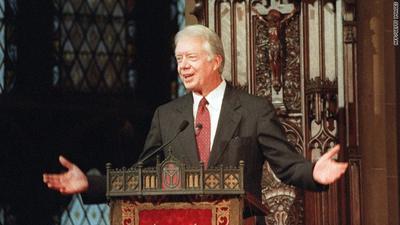
Jimmy Carter
“Identifying oneself as an evangelical” he [Carter] declared in one of his lessons, “entails more than claiming the label Christian. Instead, believers should emulate the life of Jesus, especially his example of love, and respect, and concern for others.”
Jimmy Carter's origin story is pretty well-known. Though he grew up in a religious household, he was "born again" at the age of 11 (a requisite experience for all evangelicals). When considering a career in politics (after serving in the Navy), Carter had to reconcile what was thought at that time to be almost a mutual exclusivity of the religious and bully pulpits.
Carter, though dedicated to the progressive evangelical principles of helping those on the margins of society, did not ascend in politics without moments of dubious morality (he tacitly leveraged white fright and race relations on his way to becoming governor of Georgia).

The circumstances of the 1976 presidential election were especially ripe for Carter's candidacy. While John F. Kennedy had effectively removed religion from campaigns, in the wake of Nixon's Watergate scandal, America was looking for a president with a strong and overt moral compass.

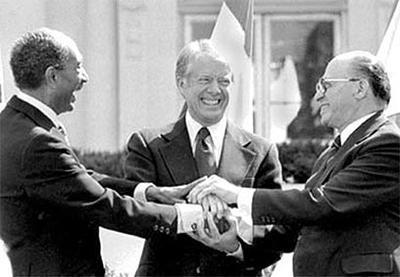
Carter's time in office was not devoid of achievement. The success of the Camp David Accords , the Panama Canal Treaties , and environmental conservation initiatives (I never knew he had solar panels installed at the white house) were among his most notable successes.

Sadat Carter and Begin Camp David accord

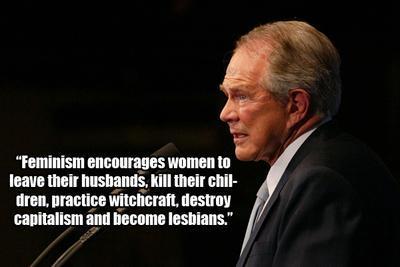
However, religious leaders with large television audiences who had supported Carter on his way into the oval office, were not all that pleased with his performance. The likes of Pat Robertson and Jerry Falwell felt Carter had failed to appoint evangelicals to his cabinet. Likewise, Carter's stance on abortion (which he thought was a state's rights issue), the Equal Rights Amendment (and its feminist implications), as well as the tax exempt status of universities that persisted in segregation, were not in line with those of the 700 Club.

Pat Robertson re Feminism

So, though he survived Ted Kennedy's challenge for the Democratic nomination, Carter was left facing a newly politically galvanized population of the Moral Majority . The Religious Right was on the rise, and they had a new pony in the race, and Jerry Falwell was all to happy to appear before audiences who he encouraged to:
“Vote for the Reagan of your choice.”
Jerry Falwell and Ronald Reagan

In many ways, Jimmy Carter's greatest work was accomplished in the years after his presidency. He went into office a man with strong faith, and exited in much the same way. In fact, he is a frequent Sunday school teacher and guest preacher to this very day.

Jimmy Carter interfaith service 1991

Carter's hands-on involvement with Habitat for Humanity , continued dedication to furthering international conflict resolution through his presidential library, and ongoing work to alleviate human suffering and advance human rights earned him the 2002 Nobel Peace Prize .

Jimmy Carter Habitat for Humanity 2010

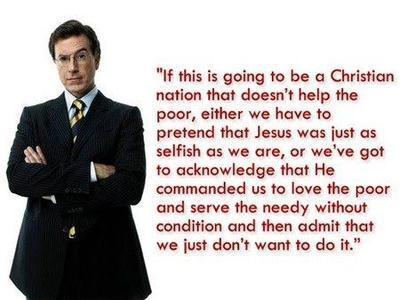
One can't help but admire a man who, at the age of 86 (above) puts into action the principles he has preached throughout his life. In an age where evangelism and conservative politics have become seemingly inseparable, it was refreshing (though at times heartbreaking) to read about a man who focused not only on the issues that have become so divisive today, but the underlying principles of Christianity. I guess I'll let Stephen Colbert close this one up.
Colbert re. Christian nation

3.5/5 stars for me on this one

Oh, one last note to the future, if you're running for president, you might want to forgo the Playboy interview. I've got no problem with it, but it definitely didn't help Carter any!
Profile Image for Russell Fox.
425 reviews54 followers
July 29, 2016
Randal Balmer's book about Jimmy Carter and his presidency is a fine and thoughtful review of one very small--but Balmer thinks, and I agree, very important--part of it: the way in which Carter, both intentionally and unintentionally, became the ultimate transition figure in the transformation of American evangelical Protestantism, and perhaps therefore America's civil religion in general. (Balmer himself doesn't go that far, but that's the conclusion which seems most obvious to me in reading the book.) Very briefly, in the 19th-century, going all the way back to its roots in the Second Great Awakening along America's early frontier settlements in the early 1800s, the very notion of "Evangelism" was tied up with reaching out into the broader and "unchurched" society and making it more Christian. Hence, missionary work, obviously, but also abolitionism, temperance, and ultimately much of the Social Gospel is part of the evangelical tradition. But as America modernized, the Biblical grounds for much evangelical Protestant moralizing came under attack, and so you saw a split: those mainline Protestants who stayed in the increasingly secular public sphere were less evangelical and Biblical, and those who remained strongly evangelical and Biblical had less to do with public life.

Jimmy Carter, an ferociously ambitious, very smart, highly talented, and deeply pious (and, unfortunately, all too often unhumorous, tone-deaf, and self-righteous) man, became the figure who transformed this split. He was moderately conservative in his cultural and moral perspectives, but in the American South of the late 1950s to the early 1970s, ones position on divorce or abortion or homosexuality or other "culture war" issues was simply not on the radar; he was the child of a yellow-dog, New Deal Democratic party culture, and that was his primarily political orientation. The fact that is was a "born again" Southern Baptist evangelical had little to do with it. But with the ugliness of the Nixon administration and the massive distrust the American people felt towards Washington DC following Watergate, Carter--who had been plotting moves from the George governor's mansion to the White House long before the right moment came--suddenly there was an opening. Jimmy Carter presented a "New South," an anti-Washington figure with new ideas and a deeply moral spirit. His presentation of that spirit on the national stage was something new (or, at least, something which hadn't been seen in national politics since the 19th century, long before the advent of the modern, media-savvy American public)--he was pious, talked about Sunday School, promised to never lie, and wore his religion on his sleeve. It wasn't enough to completely reverse political trends that were already building; his election over Ford (who swept all of the American west and competed with Carter strongly everywhere outside the South) was a squeaker. Still, America had an openly and unapologetically evangelical president....

....and his arrival coincided with (or created) the climaxing of several long, slow-burning changes in American culture. Balmer's research makes it clear that the catalyzing agent, at least as far as political movers and shakers were concerned, was racial. In 1971, the Supreme Court affirmed a lower court's decision that private schools which practice racial segregation (as plenty continued to do throughout the South) would not be able to maintain their tax exemptions. This, given the demographic realities of many whites-only Southern academies, meant that many evangelical Protestant schools and universities (most famously Bob Jones University) would suffer serious financial hardship if they didn't change their ways. Carter had nothing to do with the decision, but it was under his administration that the IRS really turned the screws on private religious schools which were dragging their feet. In a matter of a year or two, suddenly it all came together: a Democratic in the White House, all the painful and frustrating economic set-backs of the 1970s, the collapse of union power, the Sagebrush Rebellions pushing back against the high taxes inherited from the social aims of the 1960s, and most particularly, the idea that Nixon's conservative "Silent Majority"--the good Christian tax-payers (mainly from the South) who didn't dodge the draft during Vietnam and never did drugs--had no friend at the top. By the late 1970s, the "progressive evangelicalism" which Balmer sees Carter as representing seemed weak, irresponsible, even idolatrous. Carter's unwillingness to bash gays was seen as suspicious; his appointment of a divorced African-American woman to head a much-delayed White House "Conference on the Family" was seen as scandalous. The Bible-based evangelical vote, which had been mostly voting Republican but also most quiet for decades was reborn as the "Religious Right"--and Carter was hammered.

There's a lot more to the story than this, and a lot of it isn't in Balmer's book; he doesn't, to my mind, pay enough attention to everything else that was going on during the 1970s, to the way in which Carter's homespun but also naively technocratic approach to national problems crashed headlong into forces that were forcing choices upon the American people that no one (at least, no one ambitious enough to make it all the way to the presidency) probably ever could have ever articulated. (See Carter's "Crisis of Confidence" speech for vain yet admirable attempt to address such changes.) In that way, it fails to do justice to the man's whole situation, and makes us focus too much on just his own perspective, which isn't always pleasant. But still, the way in which the changes in America's sexual and social mores, throughout the 1960s and 1970s, eventually built up enough force to completely change the political character of a 150-year-old religious movement is, for all of Carter's other problems and for all the other issues in play, absolutely central to the story of Carter's career, and Balmer's documenting of them is valuable. It is good to be reminded that Carter was, and is, by all accounts a deeply good man, who really and truly wanted to serve the poor, heal the family, strengthen America, and most of all get people to trust one another and their system again. Maybe--probably--his own piety could have never accomplished that, even if all the catastrophes of the late 1970s hadn't been laid at his doorstep. But they were, and partly as a consequence, the mentality of one very large part of America's religious culture, at the exactly moment when one of their own had been elected president and could potentially have provided for believers everywhere a rallying point around the progressive strands of their own tradition, instead became obsessed with defeating Carter, liberals, intrusive government, civil rights legislation, and the whole nine yards. The culture war had begun.
Profile Image for matt.
97 reviews8 followers
April 9, 2021
I have a pro-Carter bias, so this isn’t a neutral review. Balmer’s book is a little repetitive in content and style, but that doesn’t take away from a feeling I’ve had for a long time: we would be a better, kinder, more just, better respected, and equitable society if we had followed the path laid out by Carter’s forward-looking goals. Energy independence (with renewable emphasis), universal health care access, robust public transportation infrastructure, strong public education, diplomacy over war, and balanced federal budgets.

I have admired Mr. Carter for my whole life, and think he is easily the best person to hold the office of President in my lifetime. That’s probably why he’s seen as an unsuccessful politician.
51 reviews4 followers
April 10, 2025
I was introduced to Randall Balmer in one of his articles debunking the myth that the Religious Right first unified in opposition to abortion in the early 1970s. Rather, the movement started as a protest against government interference in private schools; an assertion of religious freedom. Religious “freedom” to do what? For Bob Jones University to keep its tax-exempt status even while prohibiting interracial dating and marriage.

Balmer examines the progressive evangelical faith of Jimmy Carter as it showed up in his Plains, Georgia business, his stints as state legislator and governor, and ultimately, the White House and beyond. Carter doesn’t quite come off as a saint, but he’s close. Balmer shows us some of the influences on Carter (mostly Reinhold Niebuhr), the political tensions in Carter’s South between race-baiting, “states rights” language, and his aspirations to be biblically faithful to his Christian beliefs.

The most interesting part of the book for me is seeing how Carter transmitted his Christian values into policy: de-emphasizing militarism, facilitating diversity in his staff, encouraging environmentally friendly policies, emphasizing human rights, and working towards peace-making.

However, it’s also intriguing to see what historians will emphasize without providing additional context. As one minor detail illustrates, Balmer repeatedly notes that Reagan removed the solar panels installed on the White House. While it’s impossible to paint Reagan as environmentally friendly, one wouldn’t know that Reagan actually kept the panels up through his entire first term, only removing them in 1986. Balmer’s point stands about Reagan’s (anti) environmentalism, but I’m always left wondering what additional context or further facts might illuminate the broader picture of various historian axes to grind. I noticed something similar in Jill Lepore’s recent history of the United States when she quoted only a portion of a source. Turning to the actual source contextualized the quote much more fully and detracted somewhat from her point. But of course, now I can’t remember where it occurred in her book. This is hardly to say that some people/historians are biased while some aren’t. Every single person has point of view and perspective, and that’s not bad.

Overall, well worth the read.
Profile Image for Bryan Cebulski.
Author 4 books51 followers
July 19, 2017
Short biographies--especially short presidential biographies--better pinpoint a thematic focus and stick to it. Otherwise you risk telling a light, piecemeal narrative that doesn't get to the heart of the person at its center. Which can be not only boring, but downright insincere. Thankfully that's not the case for Redeemer.

Randall Balmer is an historian whose focuses have always been on the intersection of evangelicalism and American history and who, graciously, understands his background in approaching a subject like Jimmy Carter. He understands that his thematic focus should be on Carter's religious leanings and sticks to it accordingly. The result is somewhat narrow, as it focuses a great deal specifically on Carter's faith, its influence on its politics, and its influence on the evangelicalism in America. But what is told in brief shows a great deal. Balmer effectively shows the transformation of evangelicalism as a force of progress (toward slave emancipation in the 19th century, women's rights in the 20th, for example) to the bastion of the American religious conservative right, and how Carter was a victim as well as an unintentional cause of this shift. It's a fascinating history and one worth bringing to the forefront when talking about Carter's life, as he is someone whose entire character is largely dependent and illustrated by his religion.

A reader looking for thorough analyses, critiques, or defenses of his presidential tenure best look elsewhere. The information is present here, but not discuss extensively. Instead a lot of the time I found representative anecdotes about his political career--his interview with Playboy, for example; or his selling of his peanut farm to mark a contrast to the corruption of the Nixon presidency; or his policy philosophies marrying US energy self-determination with environmental concerns; or the ways he would explain his conservative views on abortion and LGBTQ citizens and then render them moot by his belief in women's autonomy over their bodies and to treat every American constituent as equal.

Carter was and is an impressive person, whose presidential legacy seems to have been overshadowed by the activism and philanthropy which followed his career at the helm of US politics. Redeemer is a very worthwhile biography, definitely worth your time if you have any interest in Carter or US culture and politics in the 1970s.

Sidenote: Reagan was a fuckboi and this biography only pulls out more receipts for that shit.
Profile Image for Alan  Marr.
448 reviews17 followers
November 26, 2014
This was an inspirational read. There is a quote on the book that said that Jimmy Carter "was the first President to use the White House as a stepping stone".This book is very well written with heaps of helpful footnotes. It is the story of a bloke who just wanted to live a Christian life doing what he was called to do. His commitment to baptist principles of liberty of conscience, religious freedom, separation of church and state etc made me proud to be a Baptist. However when I read of the duplicitous behaviour of those from within the Baptist family from whom he should have received support I felt ashamed to be one. I was particularly galled by the actions of Billy Graham who I always thought was more principled than some of the others.
And to think that they chose to campaign for that old rogue Reagan instead. .....Carter's response to his humiliating defeat is an exemplary tale of Christian grace and faithfulness. He joins my list of faith heroes.
Profile Image for Henry  Atkinson.
49 reviews
September 7, 2024
Randall Balmer is a respected theologian and historian. His book Reedemer is a good look at Jimmy Carter’s religious thinking and the recent history of progressive evangelicalism, but it falls short as a comprehensive examination of President Carter’s life and political philosophy. Balmer is also not at his best when he talks about Ronald Reagan and the conservative movement, although his skeptical assessments of Paul Weyrich and Jerry Falwell are probably accurate. President Reagan, the Rev. Billy Graham, and other conservatives are ascribed only negative and even sinister motives in their anti-Carter machinations. That being said, he is more objective when evaluating Carter’s life and family relationships. While this is not the best Carter biography on the market, Balmer does shed light on the importance of Christ and Christianity in the life of the 39th President. Rating 3/5.
83 reviews
December 14, 2014
Randy Balmer's biography of President Jimmy Carter focuses on Carter's embodiment of the ideals of progressive evangelicalism, that rarest of animals these days...at least as far as most people know. In fact, progressive evangelicalism is alive and well, but the movement gets much less popular attention than its more bellicose and belligerent sibling, conservative evangelicalism. While there are differences between conservative evangelicals and fundamentalists, in scholarly circles, in relation to Jimmy Carter they were able to cooperate to deny the president a second term.

Balmer nimbly tells the story of Carter's childhood, rise to political power, and dramatic fall from conservative evangelical grace, always building on Carter's almost lifelong self-identification as a born-again believer and disciple of Jesus Christ. For Carter, every decision he made as president had its foundations on prayer, faith, and a desire to "establish justice and fairness." The latter was Carter's interpretation of Reinhold Niebuhr's statement that "The sad duty of politics is to establish justice in a sinful world." (_Redeemer_, 20)

In practical terms, Carter's desire for justice and fairness led him to work tirelessly for peace around the world, to advocate for equal rights for women (one of his disappointments as president was the failure of the Equal Rights Amendment (ERA) to gain passage), to strive for racial justice and equality, and to try to reform the political landscape in the United States in the wake of the Watergate scandal. And, while Carter rode the crest of an evangelical wave of discontent into the White House, an intractable economy, the Iran hostage crisis, and the coalescence of the Moral Majority made sure that he would not have a second term to bring more of his vision to completion.

As always, Balmer's research is thorough and his ability to tell the story is on full display. _Redeemer_ is not an in-depth biography, but, rather, tells Carter's story from the point of view that Carter himself arguably would consider the most important, which is not to say that _Redeemer_ is hagiography in any way, or an "authorized" biography. Balmer shows Carter as a flawed human being who strives for lofty ideals in a messy world, and Carter is none the less admirable for it.

The part of the story that seems to be garnering the most attention has to do with the rise of the Moral Majority under the leadership of Paul Weyrich, a conservative political strategist, and Jerry Falwell, the firebrand Baptist minister from Lynchburg, Virginia. Balmer argues persuasively that the primary reason for the rise of the Religious Right was not the fight against abortion, as the Religious Right typically claims, but what the Religious Right considered an unfounded attack by the Internal Revenue Service on the tax-exempt status of private schools because of their racial segregation. Some reviewers seem to find this surprising, but Balmer stays with the documentary evidence and his assertion simply fits with that evidence. To be sure, Balmer does not claim that desegregation was the only issue that the Religious Right latched onto, only that it was the catalyst for the emergence of conservative evangelicalism as a political force. Once their opposition to desegregation drew conservative evangelicals together, there was a myriad of other issues they could adopt: abortion, the ERA, the nascent LGBT movements, and so on. The irony of it all, as Balmer capably points out, is that the IRS action began during Nixon's presidency and came into force during Ford's presidency. Carter had nothing to do with the IRS's rulings and decisions, and yet that was the issue that in some ways triggered the avalanche of evangelical opinion against Carter. A further irony is that Ronald Reagan, on whom the Religious Right placed all of their hopes, did nothing to overturn the IRS rulings, never actually pushed for an anti-abortion amendment to the Constitution, and plunged the United States deeper into debt. President Reagan worked assiduously to dismantle much of what President Carter had been able to accomplish.

Carter's life after his presidency serves as a confirmation of what Carter had attempted to do as president. The creation of the Carter Center, Carter's work on behalf of Habitat for Humanity, his continued support for equal rights for all people, and his ongoing participation in the life of his church, all point to his integrity and his work to "establish justice and fairness." As James Laney, president of Emory University from 1977 to 1993, once remarked, Jimmy Carter was "the first president to use the White House as a stepping stone." (_Redeemer_ 161)

_Redeemer_ is a fine, albeit brief, biography of a man whose life has been one of embodying redemption. Balmer has done a fine job of demonstrating the centrality of redemption in the life of President Carter.

[Full Disclosure: Balmer was my dissertation advisor at Columbia University.]
Profile Image for Adam Shields.
1,864 reviews121 followers
January 11, 2022
Summary: A religious biography of Jimmy Carter focused on his progressive Evangelicalism and the rise of the religious right.

I have begun to pay more attention to Jimmy Carter since I moved to Georgia 15 years ago. I was able to go to one of the quarterly report meetings of the Carter Center about seven years ago and was duly impressed, not just with the ongoing work of the Carter Center, but with Carter's sharp takes on current events. The event was a breakfast meeting at 7 AM. It followed an evening conference that Carter had hosted, which did not conclude until 10 PM the previous night. Carter has a murphy bed in his office at the Carter Center, so he would have slept in his office. As part of the question and answer time, Carter cited four different articles from several newspapers that he had read that morning before the breakfast meeting. He had compelling thoughts on questions as diverse as North Korean proliferation, Black Lives Matter organization, protests of police brutality,  environmental issues, and personal practices as a leader.


Part of what is fascinating to me isn't just Carter's post Presidental career, but how much of a transitional figure he has been to American politics. As I learned in the book, Carter was the first president born in a hospital. But his family home did not have running water until he was 11 and didn't have electricity until he was 14. Carter was on the local school board during the integration era after Brown v Board. And he was pressured to join the local White Citizen's Council, but resisted. He attempted to get his church to accept Black members in the 1960s, but there were only three votes in favor, including his and his wife's. His church was still segregated when he became President, and the pastor was fired in 1977 for attempting to integrate it. That led to a church split, and for the remaining two years, he alternated between the two churches when attending church at home. He joined the new, integrated church the week after leaving the White House. It is incredible to think that a sitting president, known for his racial activism, was still attending an overtly segregated church.


Jimmy Carter was born in 1924. Which made him was younger than Reagan (1911), who was older than Gerald Ford and Richard Nixon (both born in 1913). George Bush and Jimmy Carter were born the same year, but then George W Bush, Bill Clinton, and Donald Trump were all born in 1946, a generation younger.  The changes in the US since Carter's birth are significant.


Randall Balmer's primary thesis in Redeemer is well summarized in this quote from early in the book:


In the simplest terms, the brief recrudescence of progressive evangelicalism in the early to mid-1970s gave way to a conservative backlash, a movement known generically as the Religious Right, a loose coalition of politically conservative evangelicals and fundamentalists. The leaders of the Religious Right faulted Carter and his administration for enforcing the antidiscrimination provisions of the Civil Rights Act in evangelical institutions. They criticized his support for human rights abroad and equal rights for women and for gays and lesbians at home. Having joined the ranks of abortion opponents in 1979, the Religious Right castigated Carter for his refusal to outlaw abortion, despite Carter’s long-standing opposition to abortion and his efforts to limit its incidence. By the time of the 1980 presidential election, evangelical voters overwhelmingly abandoned Carter and threw their support to Reagan, the candidate who, with his faltering grasp of the essentials of evangelical theology and his episodic church attendance, had perhaps the most tenuous claim on the label evangelical.

Much of the book focuses on Carter's theology and religious practice. It tells his life story, but mainly as a way to explore how that life shaped his theology and practice. Carter ran and lost to segregationist Lester Maddox in 1967. Carter spent the next four years campaigning for Governor, this time winning. He won the governor's job in part by painting his primary opponent as a "liberal integrationist" and accepting Lester Maddox's endorsement, and endorsing Maddox as the Lieutenant Governor. But as governor, Carter was the most liberal person on matters of race in the office until that point. In addition to race, he reorganized the state government for efficiency and cost savings, significantly reformed education by providing funds for vocational education, reducing class sizes, and balancing funding across school districts.


As a sign of Carter's social progressivism, which was rooted in his theological commitments, he thought that government should play "an ameliorative role in society, that governing wisely would, in Niebuhr's words, advance 'justice in a sinful world.'" As part of that theolgically rooted progressivism, Carter supported of the Equal Rights Amendment, environmental concerns, and an anti-war stance on Vietnam.  As president, Carter was one of the few presidents in the last 100 years to not involve any troops in an armed conflict during his presidency.


As president, he continued many of the same political positions he started as governor. Carter had the most diverse appointments by gender and race of any president up until that time in both the Executive and Judicial appointments. He expanded the military's role in Europe but oriented it toward a defensive role. He strove after responsibility, as illustrated by his 1979 speech "Malaise Speech." Balmer includes the entire speech as an appendix to illustrate Carter's call for responsibility and social transformation.


In many ways, Carter was just unlucky at his presidential timing. He was president during widespread inflation, which continued through most of Reagan's first term. By the end of his presidency, Carter had a balanced budget, but Reagan disregarded that budget and significantly increased spending while also cutting taxes. There was little that Carter could do about unrest in the Middle East, although he did more than most presidents in addressing the Israeli/Palestinian conflict. Still, that did not help stabilize oil prices or supply. Reagan's team negotiated with Iran before his inauguration to not release the Iranian hostages until the afternoon of Reagan's inauguration. Carter worked for environmental policies and energy independence largely dismantled by Reagan.


And Carter was widely blamed for both the IRS's enforcement of anti-segregation policies, which had been put into place under Nixon and the Supreme Court's Roe v Wade, which also was decided before Carter's term, which was outside of his authority as president.


Balmer develops a thesis, turned into his famous Politico article in 2014 and then later his short book Bad Faith. The summary of Balmer's thesis is that the Religious Right got its first organizational start by organizing around the IRS's enforcement of anti-segregation policies that removed the tax-exempt status of segregated Christian schools, commonly known as segregation academies. These segregation academies arose in response to Brown v Board and were widespread. It was effectively recreating segregated schooling by removing most white students from the public school system and creating an alternative private whites-only Christian school system alongside the de facto Black public schools. It was only later that the Religious Right's political organizing shifted to abortion as a new topic.


The 1980 campaign with Reagan and the history of the Religious Right's rise has almost as much attention as the rest of Carter's presidency in the book. Balmer is using this biography of Carter also to tell the story about the short rise and then fall of progressive Evangelicalism, and that story is largely a story of the rise of the Religious Right as a backlash to the Civil Rights movement and the broader social progressivism of the late 1960s and 1970s. That is a significant historical development, but in some ways, I think it crowded out the biography of Carter, even if he was a prime example of Evangelical Progressivism.


Historians are re-evaluating carter. Balmer is part of that trend. It is a trend that will continue. Redeemer is a helpful, short book on Carter that pairs well with the longer recent books like The Outlier: the Unfinished Presidency of Jimmy Carter, His Very Best: Jimmy Carter, A Life, and President Carter, The White House Years. All three of those books, which I have not read, but which are well-reviewed, were published between 2018 and 2021 and were 750 to 986 pages.


Profile Image for Jean.
1,816 reviews803 followers
June 23, 2014
Redeemer by Randall Balmer is a biography of Jimmy Carter from childhood to receiving the Nobel Peace Prize. Balmer is a professor of American Religious History at Dartmouth University. Balmer appears to be reasonably adjective and unsentimental about Carters record as President. Balmer treats the details of Carter’s life succinctly and fairly. Balmer said Carter appointed an unprecedented number of women and minorities to his administration. The author points out that Carter was the only President in modern time that did not send troops into war. Balmer says Carter’s greatest success in the White House was the Camp David accords; bringing peace between Israel and Egypt. The author articulates Carter’s religious beliefs throughout the book. He states Carter followed the 19th Century progressive evangelist who interpreted the prophetic call for justice as a mandate for racial reconciliation and gender equality. The author contrasts this to the modern day evangelist who have become extremely conservative and in most ways the opposite of the 19th century viewpoint. Balmer points out toward the end of the book that Carter left the Southern Baptist Church over this difference in basic philosophy.
Carter brought religion into the national government more directly and intensely than any President before him in the 20th century. Balmer sees this as a redemptive response to the cynicism and venality of the Nixon years, and unquestionably there is some truth to that viewpoint. Balmer does indicate that Carter was his own worst enemy: self-righteous, humorless, and haughtily and aloof. Balmer says Carter never understood how to talk to the American people illustrated by his July 1979 address to the nation “Crisis of Confidence” speech. Balmer sets himself a clear task in the biography: to examine how faith influences the career of a man and to explain when an evangelical President fell out of step with voters so that a divorced Hollywood actor handily defeated him four years later. He fulfilled his task in an interesting an easily readable manner.
Balmer says Carter has done his best work since he left the Presidency, under the aegis of the Carter Center he and Rosalynn have become world-renowned humanitarians and fighters for women rights. He won the Nobel Peace Prize in 2002. I read this as an audio book downloaded from Audible. James Lurie did a good job narrating the book.
Profile Image for Luke.
142 reviews18 followers
July 17, 2019
I don’t feel the urge to give one star reviews often, as a wise woman once outlined to me why purely negative reviews like the one I am writing are not proper...maybe one day I’ll get off my high horse and take her advice. I’ll preface everything below with: blatant bias and arguments meant to appeal to emotion are my pet peeve. So perhaps this author is a very talented writer, I don’t mean to make judgment on his talents, but I was clearly not the audience he was targeting in this book.

If you are an evangelical who hates the religious right and wants to read endless praise on how Carter’s progressive evangelicalism perfectly embodies the the teachings of Christ, I’d recommend this.

I’m not religious and personally despise the religious right’s politics, so it wasn’t his flagrant bias against them that pushed it to one star. It was the fact that there was not one passage in the entire book taking an opposing view as serious, even in the non religious realm. In defending Carter’s handling of Iran hostage situation, there was one sentence that explained that the Reagan campaign negotiated with the Iranians to make sure the hostages stayed hostages until after the election....Even if I assume this is true, is this type of claim worth one sentence? The author hides behind the fact the book is focusing on the religious aspects of Carter, and throws these types of arguments in frequently.

If the bias wasn’t enough, the epilogue reminded me how much I didn’t learn about Carter throughout the book. When meeting Carter during one of his Sunday school preachings, the author explains that Carter gave exact numbers for the amount of times he preached to the crowd, and it was because he loved to quantify things...well that’s news to me! Then he talks about the road Carter walked down to sell his peanuts, maybe reflecting on childhood hardship or lessons learned...also new to me.

One positive: it has an audio book. I don’t think I could have finished without it.
Profile Image for Mark.
295 reviews7 followers
September 19, 2014
In Redeemer: The Life of Jimmy Carter, author Randall Balmer does not set out to evaluate whether Jimmy Carter was a good or bad president. Rather, Balmer focuses on the maelstrom of politico-religious forces rising up and swirling behind the scenes, offering illuminating insights into the machinations related to both of Carter’s campaigns as well as his four-year term sandwiched in the middle.

What most fascinated me in this book is how those who most viciously excoriated Carter were the very people whose self-proclaimed faith dictated that they should have been supporting and praying for him (1 Timothy 2:2-3). I would recommend Redeemer for these insightful stories alone. On the negative side, perhaps Balmer repeats excessively references to certain events which he sought to emphasize (some of which I list below). And, as with any good book, it is never a bad idea to hear the other side of the story--- how would those who come across poorly in this book explain their positions today?

What follows below are some of the most illuminating insights I take from this book (skip if you only want a brief review):

Balmer does not portray Carter as a perfect saint. For example, in his run for the governorship of Georgia Carter played dirty against his opponent Carl Sanders and sought to placate racists. He later deeply regretted these tactics, apologizing after the fact (pp. 30-34). And Carter demonstrated a competitive nature (sometimes to the point of being vindictive and vengeful?). Otherwise, Carter comes across as a man of high integrity.

The same cannot be said for those leading the forces against him. Although he later lost support from progressive evangelicals such as Ronald Sider who helped propel him into power, most of Carter’s opposition was from the religious right, which coalesced as the so-called “Moral Majority” around an issue one might not easily guess: “Despite the persistence of the myth that the issue of abortion is what galvanized the Religious Right into a political force to be reckoned with, many early leaders corroborated that it was in fact the defense of Bob Jones University and other institutions which was responsible…. The religious right did not get started in 1962 with prayer in school… And it didn’t’ get started in ’73 with Roe vs. Wade. It started in ’77 or ’78 with the Carter administration's attack on Christian schools… With the abortion issue having failed as an inducement to muster Christian conservatives into political action, Religious Right architect Paul Weyrich seized on the IRS’s pursuit of racially segregated schools. The fact that this action had begun under Nixon and that Nixon himself had authorized the policy of denying tax exemption to schools that discriminated on the basis race, did nothing to dampen the outrage of evangelical leaders. They blamed Carter, their fellow evangelical (p 110). Distressed by the IRS’s cancellation of tax exemptions for racially discriminatory schools, evangelical leaders directed their anger toward Carter, even though the policy was formulated at the behest of Richard Nixon and enforced during Gerald Ford’s administration, long before Carter became president (p. 138).

Even the honorable and usually politically-neutral Billy Graham got into the act, exercising duplicity as well as disingenuity. For example, one day he called Ronald Reagan’s campaign to say that he wanted to help any way he could short of public endorsement. Just eleven days later, he told Jimmy Carter’s religious liaison that “as you know, with the Lord’s help I am staying out of it”, adding that his refusal to be involved had cost him the support of some followers (p. 120). Furthermore, just a few weeks separated from his overnight stay at the White House after which Graham wrote the Carters that he and Ruth “came away with a new insight into the dedication of both of you to the cause not only of peace and justice in the world, but evangelistic urgency”, Graham convened a meeting of a dozen fellow preachers in Dallas for a so-called “special time of prayer” the unstated purpose of which was to rally behind someone in the election who could successfully challenge Carter. As another prominent evangelical (prosperity gospel church leader) noted: “No one was talking about Carter’s faith. It was his ability to lead” (p. 121).

And then there were the words and actions of Jerry Falwell. Falwell claimed that after a meeting at the White House Carter had said he supported gay rights. “Why do practicing homosexuals serve on the White House staff? Carter supposedly responded: “I am the president of all the American people and I believe I should represent everyone.” Falwell countered: “Why don’t you have some murderers and bank robbers and so forth to represent? Tape recordings proved that Falwell fabricated the entire exchange. Said Carter, decades later matter-of-factly and without rancor: “He just lied about it” (p. 122).

As the lies piled on, those doing the lying began to believe them more and more: “Convinced that Carter favored abortion, despite his clear denunciations and his attempts to limit abortions, leaders of the Religious Right hammered away at an issue that was beginning to capture the passions of rank-and-file evangelicals” (p. 134). As a result, rank-and-file evangelicals heard from the Religious Right for more than a year that legalized abortion was a moral abomination, that homosexuality was a perversion, and that the Equal Rights Amendment represented a threat to the integrity of the family. Jimmy Carter, they learned, favored all of these terrible things. At the same time, Reagan promised (or seemed to promise) to make everything all right again! (p 146)

Said an aide to Mark O. Hatfield: “It’s all scare… It’s all playing on people’s dark side. They say nothing about social justice. Nothing about the nuclear arms race. Nothing about our militarism or materialism.” (p. 138)

The right painted Reagan as a paragon of Christian virtue and Jimmy Carter as an anti-Christ. Reagan insisted in Feb 1980 to a television interviewer that he too was born again. Even as he struggled to master the vocabulary of evangelicalism, however, his campaign operatives attained perfect fluency, adeptly using evangelical code language just as they had employed racially coded language in Mississippi (p. 142).

In transmitting a draft of Reagan’s speech in advance of the National Affairs Briefing, a speechwriter for the campaign wrote: “Please note: there are an awful lot of code words, religious allusions, and whatnot built into this, which might be missed if one is not close to evangelical religion. It is not important, however, for the speaker to understand each and every one of them. His audience will. Boy, will they ever! (p. 144)

When George H.W. Bush was named as Reagan’s running mate, he immediately repented of his pro-choice views and pledged fidelity to the Republican platform condemning both abortion and the ERA (p. 140). Credible – albeit circumstantial – evidence later surfaced to indicate that Bush, former director of the CIA, and William Casey, who would become Reagan’s CIA director, had secretly arranged with the Iranians to keep the hostages captive until after the election (p. 149).

For the location of his first campaign event, Reagan symbolically chose Neshoba County in Philadelphia, Mississippi, site of the tragic murder of 3 civil rights workers with law enforcement acting complicity (watch the movie “Mississippi Burning”). The Reagan camp intentionally chose this location in order to help Reagan win the influence of racist segregationists who supported state rights.

Tim LaHaye was among other evangelicals who joined in Carter’s crucifixion: “ We have witnessed the presidency of a self-acknowledged, born-again leader who surrounded himself with amoral or immoral promoters during his campaign” (p. 154).

In the meantime Falwell, Robertson, and Reagan went forward with their own agenda: Their understanding of evangelical politics emphasized free-market capitalism, Reagan’s trickle-down “greed is good” economics, paid scant attention to human rights or the plight of minorities, and asserted the importance of military might as resistance to communism” (p. 155).

By the 1980 presidential election… politically conservative evangelicals had all but abandoned 19th century notions of benevolence in favor of a politician who, whatever his other qualities, ridiculed welfare recipients, suggested that homelessness was a choice, advocated significant cuts in public education, and celebrated unfettered capitalism. In their eagerness to embrace a new political messiah, evangelicals cast aside one of their own, effectively terminating their long-standing affiliation with progressive evangelicalism (p. 181).

After he was elected, Reagan moved immediately to undue many of Carter’s achievements. He appointed Ernest Lefever as his chief human rights official—he was on record as saying that the US “cannot export human rights.” (p. 186) Reagan ordered the removal of the White House’s solar panels that Carter had installed to call attention to the nation’s need for energy independence. He appointed J Watt as secretary of the interior, of whom Carter said he believed that wilderness was a parking lot with no yellow lines. Although Carter had finally proposed a balanced federal budget after years of deficits, Reagan pushed simultaneously for a reduction in taxes and increased spending for defense ( p. 165). Finally, after eight years of Reagan, the Moral Majority found that he had done very little to move their cause forward.

In summary, Carter’s failure to win a second term (or win his first more dramatically) could not always be blamed on his opponents. Errors included an interview with Playboy Magazine which hurt him badly in his 1st campaign, the ideas regarding "families" of those he placed in power around him, and his failure to appoint high-profile evangelicals to posts within his administration (and whatever happened to the list he asked for and received from Pat Robertson?)

Other difficulties Carter encountered would have victimized any president: the continuing energy crisis, persistent inflation, the Soviet invasion of Afghanistan, and especially the Iranian hostage crisis. Carter wondered aloud about what might have been if he had sent out just one more helicopter…

In 2008/09 Carter parted ways with the Southern Baptist Convention because of the conservative takeover, and the resulting emphasis upon submission to spiritual authority, and how ensuing legislation forbid the ordination of women. Carter found these views incompatible with his understanding of the bible, which taught that everyone is equal in the eyes of God (p. 176). Being an outsider to this denomination, I wonder how did they and/or Carter stand with regard to the new emphasis upon biblical inerrancy?

In presenting Carter with the Nobel Peace Prize on Dec 10, 2002 Gunnar Berge, head of the selection committee acknowledged that Carter would not be remembered as the nation’s best president, but he was confident that Carter was its finest former president (p. 179). The last chapter provided an excellent introduction to Carter’s activism through his Carter Center.
Profile Image for Kristel.
1,993 reviews49 followers
September 27, 2022
Reason Read: TIOLI, ROOT, Presidents
I purchased this when I was hoping to read something about each president. Jimmy Carter was president during my young adult years.

The writer is from the Evangelical Free Church, involved in Camp Shamineau Ministries, a graduate of Trinity and a professed Progressive Evangelical. So what is a progressive Evangelical. Progressive is a term to make the word “socialism” palatable. Because who wouldn’t want to be progressive? So far I am finding the book interesting because of the author more than his writing about Carter.

Carter was a one-term president. Being a progressive evangelical was not enough. He was too progressive for many Christians and the democrats did not stay loyal either. His interview with Playboy, even though it did not betray his values, hurt him. His Middle East involvement was also an area that hurt more than helped. Carter held firm to his human rights globally. Carter did win the Nobel Peace Prize even when the majority of US citizens had rejected him.

This was an interesting read and the revisit of the seventies was much needed refresher for me because I was so busy working and taking care of my babies that I don't think I spent much time pondering the state of the nation. Many of our same issues are alive and well today and in fact have grown out of all proportion. Not much has been able to stop the trend to focus on personal and social rights instead of running a strong country in the world.

I can't say whether I could support him today or if I even think he was a good president. I learned more about the politics of the evangelicals than I did about Carter. Progressive is such a positive sounding word but before you jump on the bandwagon of progressive "ism", be sure you know what you're doing. Its a socialism movement.
203 reviews2 followers
February 11, 2022
A biography of Jimmy Carter focusing on
the impact of his faith on his personal and political life. The author does a good job covering the highlights of Carter’s life and how his Christian views impacted each unfolding event. I am a big Jimmy Carter fan. I admire his ethics, his humanitarian efforts and I find his post presidential life the most productive and heroic of all modern presidents.

In out church class on civil religion, we recently watched a video lecture given by the author detailing the unfortunate rise of the religious right. It made me interested in reading some of Balmer’s books. I’m glad I did. I enjoyed learning about how Carter struggled with being a man of great honesty in politics. There were times he compromised his ethics, especially in order to win political office, first in Georgia and then nationally but these times were few. He has had a strong moral compass but he is not unbending and also honors other religions and points of view.

I also enjoyed reading about Evangelicalism’s early efforts to achieve a fair and equitable society. Cater comes from that old compassionate evangelicalism which contrasts
with the lack of empathy we are sadly seeing today among those in the religious right. Fascinating to see how that changed. As a progressive Christian, I struggle with what politics has done to make Christianity so unpalatable to so many. A thoughtful, very readable book.


Profile Image for Maria.
67 reviews2 followers
April 21, 2018
Next month, President Carter will be speaking at my daughter’s graduation and I when I heard that he was the commencement speaker, I realized that I don’t know much about him. This is the book I chose to begin to learn about the man. I have come away with much respect and admiration for his faith and his pursuit in applying his faith to all that he does. I am convicted by his boldness to stand up and advocate for what he believes.
I also found it so interesting to learn much about the beginnings of progressive and conservative evangelicals becoming more involved in the political process. This book spends a lot of time on that subject, which I greatly appreciated, as I am a follower of Jesus. It goes into depth of what the prevalent issue of the day was to bring the leaders of the Moral Majority/Religious Right together - and it wasn’t abortion as I had originally thought. I especially recommend those who consider themselves Christians or evangelicals to read this book for insight into how the modern evangelical movement into politics gained its’ footing.
I am thankful for the example President Carter gave during his Presidency and the example he continues to give.
Profile Image for Rick Theule.
61 reviews9 followers
January 20, 2019
I’d like to give this book 3.5 stars. While a good writer, the author repeatedly repetitive. A story or fact from one chapter appears again in another chapter a number of times. The understand particular chapters may have been written years apart, but the author (and editors) should have caught these repetitions. Assume the reader can remember a fact or anecdote two chapters after the first mention.
What brought this book rating down significantly was the unfortunate epilogue. The author made assumptions about President Carter’s actions. He makes it very clear that he believes Jimmy Carter has done work all his life because he feels the need to earn his salvation. I believe the author is dead wrong. I fully believe Jimmy Carter is rock solid in his belief that his salvation is not earned, but given by the grace of God through the sacrifice of His Son, Jesus. Jimmy Carter serves people BECAUSE he is saved, NOT to convince himself of his salvation.

Profile Image for Michael.
72 reviews
January 28, 2025
Jimmy Carter’s reputation as I saw it was a crappy president and a peace maker. I knew nothing of him. I saw his eulogy and became more curious of who he was and a friend passed this book along to me.
The book helped me understand the political environment I grew up in the early 70’s.
Jimmy Carter was out front on a lot of issues that we still face today, from racism, the Middle East, and women’s rights. I can see Jimmy Carter was a peaceful man who strived to make the world a more peaceful place.
Jimmy Carter was a religious man so the book talks a lot about his character and the Christian faith. His divide with the Baptist’s and evangelicals were well documented in the book. There is way too much religious talk for my liking and breezed by some of it as a result. There might be other books that describe history and more of what he did that would be better suited for others. I see his character and can see he was a good man who did his best with integrity and dignity.
Profile Image for Andy Fletcher.
93 reviews25 followers
March 27, 2023
I was raised in a conservative Christian home and the picture painted of Jimmy Carter was very narrow and negative. He was a failed president. He only served one term. He was not popular. This book was a very quick look at the life of President Carter. From his quiet upbringing as a lifelong Baptist from Georgia, to local government, to the statehouse of GA and eventually to the Whitehouse.
He never stopped living his faith publicly. We all know about his faithfulness to teaching Sunday School, but this book really explains how his entire time in public service was informed by his personal faith in Jesus. He put feet to his faith. Great book. Give it a read.
Profile Image for Brian.
227 reviews3 followers
January 7, 2025
Jimmy Carter is the only president to have attempted to explicitly lead a diverse nation by the teachings of Jesus. He made Tillich's commitment his own, "to be committed to a love for Christ and a love for the man who happens to be in front of us at any given time." The dynamic Balmer focuses on is the wavering support of the evangelicals and their rise to voter block dominance in the late 1970's via a duplicitous motivation-race (spoiler, it wasn't abortion). The stripping of tax exempt status for private, religious schools (post integration years) due to violation of racial segregation was the formative fire for political ambitions, not the sanctity of life. Very enlightening.
75 reviews1 follower
May 27, 2018
I am not very invested in politics but picked up this book to have a better understanding of a well-known philanthropist. Despite the necessary writings on the political history of Carter and progressive evangelicalism, I could not stop reading this book. I really learned a lot about the evolution of right wing politics. I have an admiration for Carter's never-ending pursuit of peace and health for others in the world. He allowed others to misunderstand him in order to stay true to his convictions.
Profile Image for Neil Spark.
Author 1 book30 followers
May 5, 2023
An inspiring and informative book about the United States' 39th president. Randolph Balmer has written a sympathetic, but objective portrayal of Jimmy Carter. Balmer explains why and how Carter's faith is his driving force. The biography sequentially covers the major events in Carter's life but it is also an account of the origins of today's powerful radical religious right wing political movement. History will be justifiably kind to Jimmy Carter and this book explains why.
235 reviews
January 29, 2018
I enjoyed the perspective Balmer used. I understand what progressive evangelism is and how Carter lives it out. I am shocked at the rise of the religious right and the way they used abortion to promote their bigotry. A great read.
Profile Image for Lisa Phillips.
114 reviews1 follower
December 3, 2018
The book reads like a textbook, so it was not as interesting as I had hoped it would be. I do love Jimmy Carter, and any knowledge gained about this wonderful man's life is a bonus. It is well worth the read.
Profile Image for Zach Waldis.
247 reviews9 followers
October 28, 2020
A better title might have been "Unredeemed: the rise of the American Religious Right". There is a fair amount about Carter here, and Balmer is deferential to him throughout, but a good chunk of the book is about Billy Graham, Jerry Falwell, Richard Nixon, Ronald Reagan, etc.
Profile Image for Robert Lowry.
75 reviews4 followers
January 4, 2025
Lifts up a good man and President if a flawed politician and holds,to,account the evangelical-industrial complex that formed out of fear that his ideas would carry the day.
36 reviews
February 1, 2025
Incredibly researched and well-written. Bogs down a bit given the extended focus on religion, but intriguing and insightful.
Profile Image for Andrew Greer.
Author 3 books6 followers
June 30, 2025
An intriguing look at how one of our most evangelical presidents became an outsider to those he called his own -- evangelicals. "They received him not ..."
Profile Image for Richard.
91 reviews2 followers
January 24, 2015
Right after the 1980 presidential election in which Ronald Reagan defeated Jimmy Carter, I sent the outgoing president a note expressing my respect for him and his efforts in office, including the Camp David Accords, his efforts on behalf of human rights around the world, and his attempt to engage the American people in serious conversation about our dependence on fossil fuels and foreign sources of those fuels. I knew that his positions and policies reflected his strong faith. Though he came out of an evangelical tradition and I from a more "progressive" foundation, I sensed a shared set of values. A few weeks later, I received a note from the White House thanking me for my words. It was signed by the president, and even though I suspect the signature was done by a signature machine, it remains a valued possession of mine.
I have always believed President Carter is a wonderful role model for people who would be disciples of Jesus Christ. So, I was eager to read Randall Balmer's biography of the man who grew in stature in the years after his term in office. This slim biography does not purport to be an exhaustive account of the life of the man from Plains, Georgia. Nor does it attempt to give a thorough analysis of every detail of Mr. Carter's terms as Governor of Georgia and president of the United States. The author's primary purpose is to examine the spiritual/faith connection to the events and actions of Mr. Carter's life. For me, it was a validation of my sense of the president's faith as a guide for his life and a foundation for his actions.
The most valuable part of Mr. Balmer's book is his description of "progressive evangelicalism," the branch of Christian faith that forms the heart of Jimmy Carter's living out of his faith. His roots in the Social Gospel and the true Baptist tradition of social responsibility as well as support for the separation of church and state, openness to all people, support for the equality of the genders and for women's rights formed a basis for a man of values and virtue.
In the middle of the twentieth century, the evangelical branch of Christianity was hijacked by radically conservative preachers and politicians and came to be aligned with the right-wing of the Republican Party. The strong Social Gospel tradition was lost, and men like Jimmy Carter and Mark Hatfield found themselves alienated from the people of faith who had once supported them. This shift led to the election of a man who capitalized on the work of people like Jerry Falwell and was able to convince evangelicals that he was one of them.
In his years since the White House, Jimmy Carter has continued to practice a compassionate discipleship based on the strong roots of progressive evangelicalism that have fed his faith for ninety-plus years. While it is unfortunate that the term "progressive evangelicalism" now sound like an oxymoron, we have the evidence and witness of Mr. Carter to remind us of the message of Jesus. I am thankful to Randall Balmer for writing a book that highlights this and makes the story accessible to all people.
877 reviews19 followers
February 17, 2017
Excellent writing. Framing a biography of Carter around his religion and what was going on with evangelicals was a perfect vehicle for examining Carter's life. It helped to create a vivid portrait of him. The Epilogue added a personal touch that was most welcome as well. The author manages to write this biography with remarkable objectivity even though he's dealing with the theme of religion, an emotionally charged subject.
Profile Image for Russell Sanders.
Author 12 books21 followers
September 9, 2015
Randall Balmer’s Redeemer: The Life of Jimmy Carter is an examination of how evangelicals got Jimmy Carter elected President of the United States in 1976 and how those same evangelicals kept him from a second term in 1980. It is a fascinating look at political machinations done by men—supposedly—of God. The book painstakingly relates all the derring do of many famous preachers, Billy Graham among them, as they plot to dump Carter and get Ronald Reagan elected. Reagan, who claimed to be a born-again Christian, played right into their hands: they wanted a President who was an elitist, who wanted to maintain racial separation, and who professed to be against abortion. The born-again Carter was their 1976 choice simply because of his profound faith, but his personal beliefs were counter to those of the men who placed Reagan in office. Balmer tells this tale while analyzing a remarkable man. Jimmy Carter, a man of faith and principal, might have been a good President had he had more cooperation from his supporters. Yes, he made some poor choices and perhaps he was a bit naïve, but his ideals and ideas were sound. He proved that in his after-Presidential years. He has made a second career out of caring for the poor, looking out for people’s interests throughout the world, focusing on curing diseases, and brokering peace deals. And for all that, in 2002, he was awarded the Nobel Peace Prize. This is a truly remarkable man who has accomplished more than any other ex-President of the United States. He is a national treasure. And Randall Balmer wants us to know that.
Displaying 1 - 30 of 43 reviews

Can't find what you're looking for?

Get help and learn more about the design.