

What do you think?
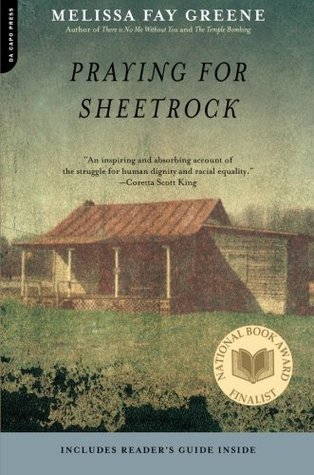
Praying for Sheetrock
Finalist for the 1991 National Book Award and a New York Times Notable book, Praying for Sheetrock is the story of McIntosh County, a small, isolated, and lovely place on the flowery coast of Georgia--and a county where, in the 1970s, the white sheriff still wielded all the power, controlling everything and everybody. Somehow the sweeping changes of the civil rights movement managed to bypass McIntosh entirely. It took one uneducated, unemployed black man, Thurnell Alston, to challenge the sheriff and his courthouse gang--and to change the way of life in this community forever. "An inspiring and absorbing account of the struggle for human dignity and racial equality" (Coretta Scott King)
335 pages, Paperback
First published January 1, 1991
About the author
Melissa Fay Greene
17 books102 followersMelissa Greene has been a contributor to NPR, The New York Times Magazine, The New Yorker, LIFE, Good Housekeeping, Newsweek, The Atlantic, Readers Digest, Ms., The Wilson Quarterly, Redbook, and Salon.com. She lives in Atlanta with her husband, Don Samuel, a criminal defense attorney. They have been married for 28 years and are the parents of nine children: Molly, Seth, Lee, Lily, Jesse (adopted from Bulgaria), Fisseha, Daniel, Yosef, and Helen (adopted from Ethiopia).
Ratings & Reviews
Friends & Following
Create a free account to discover what your friends think of this book!
Community Reviews
Displaying 1 - 30 of 225 reviews

April 17, 2007
This book is beautifully written and compelling. I definitely recommend it. My only problem is that Greene wasn't entirely forthcoming about her role in the events of the book--she was married to one of the lawyers. She completely wrote herself OUT Of the book. I think that revealing her own perspective might have given the book more depth. I loved this book, though. It complicates our textbook understandings of the Civil Rights movement and its consequences.
August 4, 2010
I have no memory of who recommended this book, but I would never have happened to choose it off a library shelf. It looks old, and gives no clue of the quality of writing inside. Greene tells the story of a poor, coastal town in Georgia in the 1970's, where despite the Civil Rights movement, one white sheriff holds sway over black and white citizens alike. Greene's fine grasp of description and dialogue read like a novel much of the time as, with the help of young Georgia Legal Services lawyers, a small group of African-American men find ways to stand up to the sheriff.
"Praying for Sheetrock was named one of the top 100 works of American journalism in the 20th century by a panel of judges under the aegis of New York University School of Journalism, won the Robert F Kennedy Memorial Book Award, and was nominated as a finalist for the National Book Award and the National Book Critics Circle Award."
Here's one example of Greene's lush description:
The secret life of the black people of McIntosh County unfolded inside closed cabins; and within the humble little Holiness churches, where perspiring worshipers in radiant clothing jumped and chanted in unison; and inside the weedy roadside juke joints, where moonshine and marijuana changed pockets by the light of neon beer signs; and at the icy metal tables of shrimp-processing plants, where old women in galoshes walked in place to get warm; and along the dirt roads that snaked through the twinkling pine woods and burst out under the vast white sky at the shoreline of the marsh; and at night on the ocean, where black captains tied their shrimp boats together, and drank whiskey and played cards in the hold, by the light of swinging kerosene lanterns, while the summer constellations slowly wheeled overhead.
"Praying for Sheetrock was named one of the top 100 works of American journalism in the 20th century by a panel of judges under the aegis of New York University School of Journalism, won the Robert F Kennedy Memorial Book Award, and was nominated as a finalist for the National Book Award and the National Book Critics Circle Award."
Here's one example of Greene's lush description:
The secret life of the black people of McIntosh County unfolded inside closed cabins; and within the humble little Holiness churches, where perspiring worshipers in radiant clothing jumped and chanted in unison; and inside the weedy roadside juke joints, where moonshine and marijuana changed pockets by the light of neon beer signs; and at the icy metal tables of shrimp-processing plants, where old women in galoshes walked in place to get warm; and along the dirt roads that snaked through the twinkling pine woods and burst out under the vast white sky at the shoreline of the marsh; and at night on the ocean, where black captains tied their shrimp boats together, and drank whiskey and played cards in the hold, by the light of swinging kerosene lanterns, while the summer constellations slowly wheeled overhead.

August 6, 2008
Most people think of the 1960s as being the era of the Civil Rights Movement, but in rural Georgia counties, it was the seventies before civil rights came into its own. I remember visiting a restaurant in Tatnall County in the early seventies where African-Americans were required to order their food to go at the back door. Around the same time that this book was written, the best shrimp restaurant in McIntosh county installed cast irons railings around its entrance to keep the sheriff from parking his car on the patio and blocking the front door for its other patrons. The story Melissa Faye Green recounts is positively captivating, absorbing, and uplifting. The black residents may have had a ten year wait for equal rights, but when it came in the guise of a hitherto compliant Thurnell Alston, it came with a vengeance.

April 12, 2013
The story is very interesting, a compelling story of corruption and race relations that should be told. But I can't help thinking that it would have been so much better in the hands of another writer. I just couldn't get past the writing style. There was too much (seemingly) irrelevant background information. I think the first 100 pages contained about 20 pages worth of interesting information. Had I realized that, I probably would have skipped entire chapters. It's also very repetitive in spots, and sometimes it's hard to tell whether what you're reading is narrative or quoted statements. Ultimately, I had to admit defeat and give up. I'd like to know if the sheriff got his comeuppance, but I just can't stomach the writing to find out. Oh well.

Read
February 17, 2015Okay, I started this and thought it was well-written. I know people who loved it. You know how sometimes there's an annoying noise that you don't hear until someone points it out, and then it drives you crazy. I don't want to ruin it for you, so stop reading this now if you'd like to read and enjoy it.
. . . .
What drove me crazy is that so many descriptions of the people seemed insulting or contemptuous. It felt like part of her humor was in making fun of the people whom she'd interviewed. If it were fiction, it wouldn't have bothered me, but since these were real people who presumably would read her words, it felt unkind. Once I started noticing, I couldn't stop, and it distracted me from the story that she was telling.
. . . .
What drove me crazy is that so many descriptions of the people seemed insulting or contemptuous. It felt like part of her humor was in making fun of the people whom she'd interviewed. If it were fiction, it wouldn't have bothered me, but since these were real people who presumably would read her words, it felt unkind. Once I started noticing, I couldn't stop, and it distracted me from the story that she was telling.

April 28, 2009
Coastal Georgia is a frequent destination for me. Whenever I have to be away from it, I am planning the next time I'll be able to smell the marsh, feel the sand in my shoes and hear the musical voices of the residents. I have been to Darien many, many times, but my first visit was in 1994, long after the initial events in this book took place. Reading PRAYING FOR SHEETROCK was educational, to say the least. What Melissa Fay Greene does in her narrative is show you the different Dariens - the black experience is (or was) far different from the one enjoyed by whites in this historic community.
It is said that there are two sides to every story; in SHEETROCK, there are significantly more than that to be found. McIntosh County is a prism, and the truth is refracted through every possible angle. Greene tries not to take sides. She offers as much of a journalistic approach as possible, starting with the early 1970s and the corruption in the local government, and ending with the changes in the life of Thurnell Alston, the man who, with others in his community, stood up to the status quo.
At times, Greene's writing approaches the poetic. Her use of language is nothing less than stunning. She evokes the true beauty of this part of the world, and reminds me, even in the bleak passages, why I love it so. Few other authors I've read have been so successful in bringing the environment to mind, even when describing the mosquitos and choking dust on a dry day. Almost anyone can write a beautiful sunset; it's a truly excellent writer who can narrate a lack of plumbing and make it interesting.
PRAYING FOR SHEETROCK may not prove to be interesting to everyone who reads it. Those who have ties to the McIntosh County will get the most out of it, I believe, and others may be bored. As someone who loves Coastal Georgia, and American history, I was fascinated.
It is said that there are two sides to every story; in SHEETROCK, there are significantly more than that to be found. McIntosh County is a prism, and the truth is refracted through every possible angle. Greene tries not to take sides. She offers as much of a journalistic approach as possible, starting with the early 1970s and the corruption in the local government, and ending with the changes in the life of Thurnell Alston, the man who, with others in his community, stood up to the status quo.
At times, Greene's writing approaches the poetic. Her use of language is nothing less than stunning. She evokes the true beauty of this part of the world, and reminds me, even in the bleak passages, why I love it so. Few other authors I've read have been so successful in bringing the environment to mind, even when describing the mosquitos and choking dust on a dry day. Almost anyone can write a beautiful sunset; it's a truly excellent writer who can narrate a lack of plumbing and make it interesting.
PRAYING FOR SHEETROCK may not prove to be interesting to everyone who reads it. Those who have ties to the McIntosh County will get the most out of it, I believe, and others may be bored. As someone who loves Coastal Georgia, and American history, I was fascinated.

August 2, 2012
This is quite the endeavor. The book is very wordy and full of narrative building up the character and environment in which involved the 50's - early 80's in McIntosh County, Georgia. I only give it three stars because it was tough to page through. You are always wondering how it is going to end but only because you are wondering how the multiple stories are going to fall into place to influence the main character. It is a true historical presentation of this part of Georgia but reading it I sometimes felt a sense of hopelessness by those trying to improve the situation. It is a story to me about forever continuing to try to improve against societal pressures and personal flaws.

February 12, 2021
‘Praying for Sheetrock’ is the true story of Darien, GA, from the years 1955-1975. If you’re from Georgia, or perhaps anywhere in the Deep South, this may resonate with you. It did not resonate with me.
I’ve never lived in Georgia. I strongly disliked living in the Deep South when the Navy sent me there. There is nothing about the milieu of this book that captures my imagination.
We needn’t feel close, personal connections with the subject matters of every book we read. Sometimes, the writing itself is enough to capture our imaginations and carry us along. I found the writing here to be overwrought, as though no one was willing to tell the author that she wasn’t Steinbeck and should just get on with the story.
It’s easy to write reviews of books one loves or hates, but it’s hard to write about books that never succeed in animating much of a reaction at all. This is one of those books. Nevertheless, many people did love it. It was a finalist for the National Book Award and made my reading list thanks to a glowing review in the paper. If you read this book, and it resonated with you, I’d be interested to understand why. What makes ‘Praying for Sheetrock’ work for you?
I’ve never lived in Georgia. I strongly disliked living in the Deep South when the Navy sent me there. There is nothing about the milieu of this book that captures my imagination.
We needn’t feel close, personal connections with the subject matters of every book we read. Sometimes, the writing itself is enough to capture our imaginations and carry us along. I found the writing here to be overwrought, as though no one was willing to tell the author that she wasn’t Steinbeck and should just get on with the story.
It’s easy to write reviews of books one loves or hates, but it’s hard to write about books that never succeed in animating much of a reaction at all. This is one of those books. Nevertheless, many people did love it. It was a finalist for the National Book Award and made my reading list thanks to a glowing review in the paper. If you read this book, and it resonated with you, I’d be interested to understand why. What makes ‘Praying for Sheetrock’ work for you?

November 16, 2024
I admit, Greene had me with the title before I had any idea as to what Prying for Sheetrock was about. Then as I read the first lines, I was mesmerized by the prose—dense and evocative and lilting with a dose of southern backwaters. It is the story of an unlikely hero, Thurnell Alston, whom Greene describes as “a tall, thin, chain-smoking black man with bushy blue-black hair; a long , rather sorrowful face; slate-black skin; and elegant, long hands. Through his life we witness the “large and important things happening in a very little place. While I lived through these times and spent a number of years in Georgia, where the events unfold, I was nearly oblivious to the story Greene presents of the end of the good-old-boy era and the rise of civil rights. It is history told as it should be sitting at the breakfast table in a gritty little backwoods cabin alongside those who lived it.
Painting the scene with words:
“In the tall, narrow Victorian houses of the area called The Ridge, window air conditioners drowned out the calls of the marsh frogs and march birds across the road.
But the blazing summer nights of 1975, as darkness dropped, were full of spitfire and shouting, hand clapping and rage, as the black people—dressed to the nines—stormed into the black churches after work. Ministers thundered at them from abo e, choirs unleashed gorgeous, piercing songs, and the stamp of feet and shake of tambourines lasted late into the night. While white Darien slept and an occasional truck rattled down Highway 17, the black county was wide awake, its front doors open, windows up, lights on, cars coming and going, and little one-room, white-washed churches lit up and filled with hollering.”
Painting the scene with words:
“In the tall, narrow Victorian houses of the area called The Ridge, window air conditioners drowned out the calls of the marsh frogs and march birds across the road.
But the blazing summer nights of 1975, as darkness dropped, were full of spitfire and shouting, hand clapping and rage, as the black people—dressed to the nines—stormed into the black churches after work. Ministers thundered at them from abo e, choirs unleashed gorgeous, piercing songs, and the stamp of feet and shake of tambourines lasted late into the night. While white Darien slept and an occasional truck rattled down Highway 17, the black county was wide awake, its front doors open, windows up, lights on, cars coming and going, and little one-room, white-washed churches lit up and filled with hollering.”
April 10, 2008
My parents recommended this book to me, which usually means I'll like it in a tepid sort of way.
This didn't fall into that pattern.
This book is really good. Really something. I don't want to say important, because what do I know (besides that if I say it's important you'll say I'm pretentious). But it's impressively evocative, not just telling a story of a place I've never heard about, but painting a picture so clearly that I can taste the sounds. That's right, chilluns, I get synaesthesia from reading that mofo.
While we just hit the 40th anniversary of MLK's assassination, we retell the story of 1960s civil rights that we all know. But (as I now know) those personal fiefdoms of white sheriffs down in wee parts of Georgia didn't evolve until the 70s, and they didn't transform with marches and television. They changed in ways...well, in ways you'll just have to read about. You know, because it's important.
This didn't fall into that pattern.
This book is really good. Really something. I don't want to say important, because what do I know (besides that if I say it's important you'll say I'm pretentious). But it's impressively evocative, not just telling a story of a place I've never heard about, but painting a picture so clearly that I can taste the sounds. That's right, chilluns, I get synaesthesia from reading that mofo.
While we just hit the 40th anniversary of MLK's assassination, we retell the story of 1960s civil rights that we all know. But (as I now know) those personal fiefdoms of white sheriffs down in wee parts of Georgia didn't evolve until the 70s, and they didn't transform with marches and television. They changed in ways...well, in ways you'll just have to read about. You know, because it's important.

June 14, 2020
This is a well-researched but readable book about McIntosh County in coastal Georgia in the 1970s. Tom Poppell, the white sheriff, wielded all the power, controlling everything and everybody. Justice in the courts was defined by the sheriff as well. It was one man Thurnell Alston, an uneducated and unemployed black man, who challenged the sheriff and his courthouse gang successful and changed the community forever.
As I read the reader reviews of this book I noticed comments of surprise that such injustices still could occur in the 1970s, shock at how the African race was treated, etc. But based on events such as the recent murder of Ahmaud Arbery in Georgia (how many weeks before the shooter and his accomplice were arrested and charged...and then only because the shooting had received national attention on a massive scale?) we know that not all that much has in fact changed.
As I read the reader reviews of this book I noticed comments of surprise that such injustices still could occur in the 1970s, shock at how the African race was treated, etc. But based on events such as the recent murder of Ahmaud Arbery in Georgia (how many weeks before the shooter and his accomplice were arrested and charged...and then only because the shooting had received national attention on a massive scale?) we know that not all that much has in fact changed.

June 11, 2025
So interesting! Loved how this true story is told in majority via the direct quotes of the people who were present in McIntosh County, Georgia at the time. I can’t imagine the amount of archival research, interviewing, etc. that went into putting this account together. You get the voices and perspectives of so many members of the community, both those who were directly involved in Thurnell Alston’s life and political activities, but also those more on the sidelines, content with observing and commenting. The story of the community and the county itself, with its apparent isolation from much of the rest of the country, is super interesting. Greene puts it best in her prologue. It is a “chronicle of large and important things happening in a very little place”. “Whether you see the place as a footnote or as the front lines”, the Civil Rights movement was happening in McIntosh as well, and it was sparked within its little bubble, isolated from outside influence.

January 29, 2020
This is probably a 3.5 for me, so I'll round up.
Some of the reviews of this book take issue with the writing style, and how some of the chapters don't really tie into the main story. I think all of it, the meandering off into stories like the title chapter, is the story. It's more of a picture of a rural county and its coming into racial equity, rather than the story of Alston.
We forget that those who fight are also human. I'm glad the author told the whole story of Alston, his rise and fall, although reading about his fall hurt a little.
Of course, my favorite part of the story is when GLSP filed suit on behalf of the black community, back in the good ol days when we could file class actions and just shake up the system. Those were the days.
Some of the reviews of this book take issue with the writing style, and how some of the chapters don't really tie into the main story. I think all of it, the meandering off into stories like the title chapter, is the story. It's more of a picture of a rural county and its coming into racial equity, rather than the story of Alston.
We forget that those who fight are also human. I'm glad the author told the whole story of Alston, his rise and fall, although reading about his fall hurt a little.
Of course, my favorite part of the story is when GLSP filed suit on behalf of the black community, back in the good ol days when we could file class actions and just shake up the system. Those were the days.

May 15, 2022
adolph reed mentioned this book and the odd title made me look it up and the description hooked me - a mixture of traditional reporting and fly-on-the-wall new journalism, with a sort of oblong narrative that satisfied me with its unruly messiness/tragedy. part "old weird america" part true crime part civil rights, done in a hit or miss but mostly hit literary style. makes me want someone (casey cep preferably) to do a whole book about phenix city AL as a vice playground. thurnell and his satin suit he wears to all events is an indelible american doomed weirdo - like if dickens had time traveled to 1970s rural black georgia. minus one conceptual star for being a little repetitive and 75 pages too long (all books are 75 pages too long)

March 19, 2022
Since finishing this book 5 days ago I have thought about it every day since. I have lived in the south since the early 70's and not far from Darien and yet...much of the descriptions of how many people lived (and probably still do) were a shocking eye opener. It is as if there was a third world country just an hour away. Unfathomable conditions. Disregard for human dignity. Evil law enforcement. Unfair and unethical working conditions, and so much more. The winner of the Robert F. Kennedy Book Award, this is a book that I wish high school students would be required to read and then discuss. The laws, civil rights, and the determination of people (and one man in particular) to make a better way is heartbreaking, especially when we consider that determination is never enough on its own to insure LASTING change. Also, for anyone considering a path to a career in law, I highly recommend this book. The earnest young lawyers and their understandable idealism is an introduction to reality.

December 12, 2024
This is easily in the top 5 books I've ever read. There was clearly a lot of research done, and I love the connections with places I know, even if it's for things I'm not proud of the south for. Despite it being historical, it reads like fiction with a beautiful setting and very tangible characters. At times, the author's loyalties beyond presenting the facts are noticeable, but overall she acknowledges the failures and successes of both sides of the story.
It's been fun to notice the similarities between Indonesian and southern Black culture, to feel connected with my roots but also with where I am, and to educate myself on a hugely important topic.
It's been fun to notice the similarities between Indonesian and southern Black culture, to feel connected with my roots but also with where I am, and to educate myself on a hugely important topic.

January 27, 2026
Fantastic reread, always thankful to Dr. Bullock and Southern Politics for bringing me this book

May 4, 2023
Middle section was easiest to read.
Beginning vignettes were a little out of main plot so reading them was fun but I kept trying to contextualiza what was happening chronological and it kinda doesn’t matter. Ending was…
Beginning vignettes were a little out of main plot so reading them was fun but I kept trying to contextualiza what was happening chronological and it kinda doesn’t matter. Ending was…

July 22, 2023
A couple months ago (May 2023) I was going through my notebooks from a dozen years back and found this title, jotted down to nourish my novel then in the works about renovating an old house. I finally read "Praying for Sheetrock" -- and discovered it isn't about drywall or sheetrock at all. But it's definitely worth the read. "Praying..." is now on my bookshelf along with "Warmth of Other Suns." A must-read for citizens who want to better understand this southern place (McIntosh, Georgia) in the 1960s and the politics of small town power. It's about a sheriff's quest to keep the status quo and convince black citizens he's their friend while keeping them in their place. It's about a perhaps unlikely leader rising in the black community and the flaws that brought him down. Greene is an excellent writer and a thorough researcher. She uses beautiful language to draw out character and setting. Some of her descriptions (of women especially) would not fly today as they read overly judgmental. There could be paring back some of the wordiness and repetition, but all in all it is a remarkable book. I am happy I read it.
January 22, 2026
1970s and 80s, coastal Georgia, incredible poverty, racism - great topic with lots of interesting tales but the presentation is scattered. There is so much background information that the main story almost gets lost. And there is repetition - how many times do we have to read about the sloppy house-keeping at Thunell's house?

October 15, 2007
Melissa Faye Green builds masterful story structures -- even when the story is sprawling and almost impossible to corral. This book is so thoroughly reported and researched, I can’t discern the point in the story at which the author began to witness the events. Toward the end of the story, a few small details led me to believe that she had entered the story quite late, something I found astounding. Melissa Fay Greene, of course, ignores – couldn’t care less about – the conventions of creative nonfiction or the essay. She is a journalist, telling her story in a nearly omniscient, third-person voice. Though I think the book started in the wrong place, and could/should have been 50 pages shorter, I was nonetheless riveted.

April 6, 2011
(2.5) I feel guilty giving only a 2 (2.5) to a really well-written book, by an author I think is amazingly talented. But I just didn't love Praying for Sheetrock. I didn't find the story especially compelling, or its subject, Thurnell, exceptional or even likable. As I was reading the account of Thurnell Alston, I kept wondering why Greene had chosen him as the subject of a book. Later I read that her husband worked as his attorney at one time and Greene herself worked at the Georgia Legal Services Program, often referenced in the book. After that it made more sense to me that she had seen the idea for a book in Alston's experiences.

February 17, 2009
I read Praying for Sheetrock shortly after my move to Georgia in the mid-1990's. For me, it was a potent reminder that I was no longer in Iowa-- and whatever I thought I might know about the politics of race in places like McIntosh County in the 1970's could fit on the head of a pin. Greene has a gift for writing nonfiction that places you in the center of a true story. I have read all of her books except for one--and I'm saving it to savor during spring break. Simply one of the best authors I've ever read!

January 25, 2012
This is a beautiful and elegant history from below, allowing the people of McIntosh County, Georgia, to tell their stories, to unravel the everyday life of the deep South's racial and class hierarchies, of injustice, inequality, poverty and loss - as well as the sheer richness of community, love and delight that accompanies those other dynamics we too often concentrate on. There is no sanitising here, but their are rich and rounded lives and characters revealed by Greene's abilities to let them tell their stories.

April 12, 2012
This nonfiction should serve as a primer on Southern racial politics. The account of how a rural, coastal section of Georgia existed through the civil rights upheaval of the 1960's is told in such an engaging way that draws you though a story that you might not have picked out on your own. The local situation was unique but the problems the story showcases can be applied throughout the South. Very logical development with ironic twists, it not only held my interest but showed me how interesting an isolated incident can become when investigated by a skilled journalist.
December 1, 2019
Greene's book is a masterpiece. For anyone who wants to obtain a less conventional understanding of not just the civil rights movement, but the culture and the history of the Deep South itself, Greene's book is the apogee of such literature. Her prose is raw and compelling; her research thorough and meaningful. I cannot recommend this book enough. I look forward to reading more of Greene's works.
August 21, 2014
As a work of non-fiction, this book was an enjoyable read - it felt like a novel. The stories offered real insight into a world I won't ever know. The characters were well described. But having read other books like The Invention of Wings, I did not find this book to be the page-turner that kept me up at night. I recommend it. I'm glad I read it. But I don't need to put in on my own bookshelf.

April 6, 2008
A well-written true to story of southern Georgia and the beginning of the civil rights movement. A sad, but enlightening story of intertwined lives of people, who were just trying to survive and make the world a better place, but then got caught up in the very badness they were fighting.

July 7, 2015
Very interesting story that is true. I did not know so much about our little neighboring county on the coast.

September 10, 2015
This happened right around where I live today.
In fact, my boyfriend's family is related to the sheriff, mentioned in this story.
Very good book. I'm going to look into reading more from this author.
In fact, my boyfriend's family is related to the sheriff, mentioned in this story.
Very good book. I'm going to look into reading more from this author.
Displaying 1 - 30 of 225 reviews