What do you think?
Rate this book


256 pages, Paperback
First published January 26, 2010

"...We have all seen clips of the Arirang mass games in which scores of children of the same height, body type and hairstyle dance and leap in unison. These games are not the grim Stalinist exercises in anti-individualism that foreigners (such as the makers of the aforementioned documentary) often misperceive them as, but joyous celebrations of the pure-bloodedness and homogeneity from which the race’s superiority derives..."
"...Paranoid nationalism may well be an intellectual void, and appeal to the lowest instincts—there is nothing in North Korean ideology that a child of twelve cannot grasp at once—but for that very reason it has proven itself capable of uniting citizens of all classes.."
"...the Americans’ evil can be “read” in their big noses, large breasts and sunken eyes. The old jackal’s spade-shaped eagle’s nose hung villainously over his upper lip, while the vixen’s teats jutted out like the stomach of a snake that has just swallowed a demon, and the slippery wolf-cub gleamed with poison like the head of a venomous snake that has just swallowed its skin. Their six sunken eyes seemed … like open graves constantly waiting for corpses..."
“…the southern masses are acutely aware that were it not for the DPRKs military first policy, the Yankees would long since have plunged them into another ruinous war., They owe their material comfort to the self sacrifice not only of the Dear Leader, but of all the heroic citizens of the DPRK…”
"...if anything, the famine may have strengthened support for the regime by renewing the sense of ethnic victimhood from which the official worldview derived its passion. Many migrants remember a widespread yearning for war with America during the famine..."
“…Pyongyang negotiates with Washington not to defuse tension but to manage it, to keep it from tipping into all-out war or an equally perilous all-out peace. Ignorant of this, because ignorant of the North’s ideology, Americans tend to blame problems in the US-DPRLK relationship on whoever happens to be in the Oval Office, thinking him either too soft or too hard on Pyongyang…"
'...Gallucci: “We respect you. The future peace not only of the Korean peninsula but also of Asia, the Pacific Region, depends on us, on the US and [North] Korea.”
Mun: “Whose words are those? Yours?”
Gallucci. “The words of the White House.”
Mun: “That amounts to saying that we’re a superpower too.”
Gallucci: “That’s right, you’re a superpower. A superpower like America!”
Now Korea was on an equal footing with the United States, the world’s only superpower. Asia’s small country Korea, which had once lost its luster on the world map..."

“…Let us turn now to [DPRK domestic propaganda’s] treatment of the ongoing nuclear dispute. Here too the contrast to Soviet propaganda is stark. Where Moscow always professed a respect for international law, the North Koreans reject the notion that a pure race should be bound by the dictates of an impure world. [DPRK domestic propaganda] thus cheerfully admits that the DPRK joined the Non-Proliferation Treaty in 1985 only to “use” it for the country’s own ends, whereupon it “ignored” or “scorned” the treaty’s stipulations…"
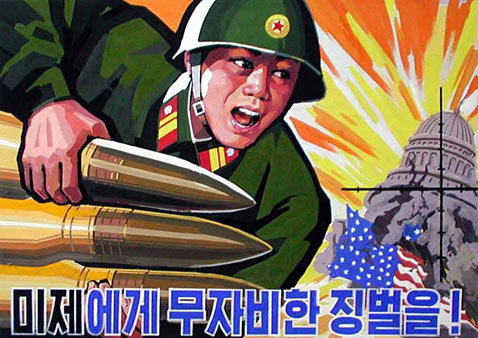
"...Suffice to say that there is no trace of fear of any adversary in [DPRK domestic propaganda] (One is struck by the contrast to anti-American propaganda in East Germany during the 1980s, which constantly raised the specter of nuclear war.) On the contrary, the child race is depicted as itching for a “holy war” or sŏngjŏn—once a common term in Pacific War propaganda—in which to kill Yankees and reunite the motherland..."