Jump to ratings and reviews
Rate this book

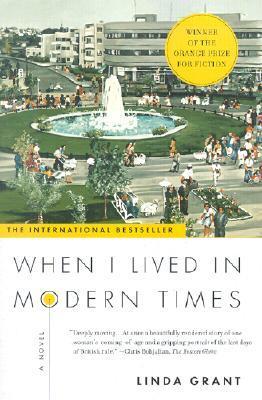
When I Lived in Modern Times

Rate this book
Winner of the Orange Prize for Fiction

In the spring of 1946, Evelyn Sert stands on the deck of a ship bound for Palestine. For the twenty-year-old from London, it is a time of adventure and change when all things seem possible.

Swept up in the spirited, chaotic churning of her new, strange country, she joins a kibbutz, then moves on to the teeming metropolis of Tel Aviv, to find her own home and a group of friends as eccentric and disparate as the city itself. She falls in love with a man who is not what he seems when she becomes an unwitting spy for a nation fighting to be born. When I Lived in Modern Times is "an unsentimental coming-of-age story of both a country and a young immigrant . . . that provides an unforgettable glimpse of a time and place rarely observed" ( Publishers Weekly , starred review).

272 pages, Paperback

First published January 1, 2000

52 people are currently reading
3234 people want to read

About the author

Linda Grant

96 books212 followers
Librarian Note: There is more than one author in the Goodreads' database with this name. See this thread for more information.

Linda Grant was born in Liverpool on 15 February 1951, the child of Russian and Polish Jewish immigrants. She was educated at the Belvedere School (GDST), read English at the University of York, completed an M.A. in English at MacMaster University, Hamilton, Ontario and did further post-graduate studies at Simon Fraser University, Vancouver, Canada, where she lived from 1977 to 1984.

In 1985 she returned to Britain and became a journalist. From 1995 to 2000 she was a feature writer for the Guardian, where between 1997 and 1998 she also had a weekly column in G2. She contributed regularly to the Weekend section on subjects including the background to the use of drug Ecstasy (for which she was shortlisted for the UK Press Gazette Feature Writer of the Year Award in 1996), body modification, racism against Romanies in the Czech Republic, her own journey to Jewish Poland and to her father's birthplace and during the Kosovo War, an examination of the background to Serb nationalism.

Ratings & Reviews

What do you think?
Rate this book

Friends & Following

Create a free account to discover what your friends think of this book!

Community Reviews

5 stars
362 (18%)
4 stars
793 (39%)
3 stars
644 (32%)
2 stars
164 (8%)
1 star
48 (2%)
Displaying 1 - 30 of 196 reviews
Profile Image for Hannah Greendale (Hello, Bookworm).
804 reviews4,194 followers
Read
December 8, 2021
The year is 1946, and twenty-year-old Evelyn Sert sets sail for Palestine in search of her "new self" and "the new Jew." What follows is a meager exploration of identity.

When I Lived in Modern Times is too didactic and insubstantial to be of much interest.
I know that people regarded me in those days as many things: a bare-faced liar; an enigma; or a kind of Displaced Person like the ones in the camps. But what I felt like was a chrysalis, neither bug nor butterfly, something in between, closed, secretive, and inside some great transformation under way as the world itself - in that strangest of eras just after the war was over - was metamorphosing into something else, which was neither the war nor a return to what had gone before.
Profile Image for Hugh.
1,293 reviews49 followers
October 24, 2021
Another of my occasional longer term reading goals is to read all of the Women's Prize winners (when this book won in 2000 it was the Orange Prize), so this book was an obvious one to pick up when I saw it in my local library. It also made for an interesting comparison with another book I read recently, Muriel Spark's The Mandelbaum Gate, as both help to explain how Israel became what it is today. Grant's setting is earlier, in the last years of the British mandate, the period that led up to Israel's independence, and it is written with much more hindsight.

Grant's choice of narrator is an interesting one - Evelyn is an orphaned Jew from London who decides to emigrate to the nascent Zionist project in Palestine, initially by deceit using a tourist visa. After a short and somewhat painful spell at a kibbutz, she moves to Tel Aviv and finds work as a hairdresser, and becomes involved in political intrigues and eventually gets drawn into helping a nationalist group who flirt with terrorism.

The writing and characterisation is strong, but I am not sure I found Evelyn's story entirely convincing.
Profile Image for Rebecca.
4,178 reviews3,436 followers
September 22, 2020
Some settings have been done to death, but here’s one I don’t think I’d ever encountered before: Israel in the final year before statehood. Grant dramatizes the contrast between Palestine, a doomed British colony, and the Jewish hope of a homeland. In 1946 twenty-year-old Evelyn Sert leaves her home in London, masquerading as a Gentile tourist (though she has Latvian Jewish ancestry) so as to jump ahead of thousands of displaced persons awaiting entry visas. With her mother recently dead of a stroke, she takes advice and money from her mother’s married boyfriend, “Uncle Joe,” a Polish Jew and Zionist, and heads to Palestine.

After six weeks on a kibbutz, Evelyn sets out to make her own life in Tel Aviv as a hairdresser and falls in with Johnny, a Jew who fought for the British. It’s safer to be part of the colonial structure here, so she once again passes as Gentile, dyeing her hair blonde and going by Priscilla Jones. In a land where all kinds of people have been thrown together by the accident of their ethnicity and the suffering it often entailed, one man’s terrorist is another’s freedom fighter. For Evelyn, who’s never known anywhere apart from suburban London and arrived in Palestine a virgin, the entire year is a journey of discovery. Will a place of ancient religious significance embrace modern architecture, technology and government?

Grant really captures this period of transition for an individual and for a nascent nation of exiles. I loved the supporting characters and the nostalgic look back from half a century on.

Favorite passages:

“In a country with its face turned towards the future, our stories sat on our shoulders like a second head, facing the way we had come from. We were the tribe of Janus, if there is such a thing.”

“With hindsight it always seems easy to do the right thing, but we were trying to decide something in those days that people don’t often get a chance to have a say in and it was this: would we be a free nation after two thousand years of wandering or would we always be a subject race? Would we be ghetto Jews or new Jews?”


Originally published on my blog, Bookish Beck.
Profile Image for Holly.
1,069 reviews290 followers
April 7, 2017
I really liked this. At first I thought it seemed rather too didactic, too much a historical lesson in fictional form, but by 50 pages in I was completely won over. Yes, her characters sometimes seem to be mouthpieces, each taking an iconic role exemplifying the Jews of disparate nations and the assorted Brits in postwar British Mandate Palestine - the ostjuden, the Irgun fighter, the spies, the British wives, the kibbutz members, the Zionists, and the all-but-forgotten Arabs - but what each had to say was so fascinating and nuanced that'they became singular individuals; representatives rather than mouthpieces. Grant draws the tumultuous, violent, complex, idealistic world of 1946-47 and she also seems particularly good at evoking the physical atmosphere and mood of Tel Aviv - the new white city, and its heat, sunlight, gender dynamics, and political complexities.
Profile Image for Daniel Chaikin.
593 reviews68 followers
September 26, 2015
Re-read this for a bookclub. The book was my recommendation. I loved it the first time mainly because I loved learning about all the different Jewish peoples who made up Israel in 1947, just before independence, and I was fascinated by the different reactions. Israel was a tough change for most of these people - the Russian communist idealists in the kibbutz, the Holocaust camp survivors whose desperate survivalist mentality is horrifyingly maintained in Israel, the German and Eastern European Jews who were unable to shed their formalities, make use of the former professions, or find comfort in Israel, and who had their own intellectual idealism. Then there are those born and raised in Palestine, the optimistic Americans, and the British occupiers with all their curious British traits. There is a lot in here. Grant used letters from the period to help shape the language and personalities. She brings in an assortment of complex stuff into her Pre-Israel Tel Aviv background, and white Bauhaus city overwhelms the other parts of the novel, about the main character's experiences with changing identities.

Re-reading it I was again swept away by Grant's descriptive passages where she waxes on and on. But I was also nervous, wondering whether the rest of the book club who buy in and maybe get swept away too, or whether they would be bored to tears. Crossing my fingers.
Profile Image for Robert.
2,302 reviews256 followers
April 30, 2016


When I Lived in Modern Times is an interesting story as it chronicles a sort of reverse diaspora. There are novels about Jews leaving their homeland and adapting to a new life in the U.K. and U.S. but rarely do you read about a second generation Jew returning to her homeland and attempting to live there?

Evelyn Sert has lived in London for 20 years and she decides to move to Jerusalem in order to find a job. The thing is it is 1947 and there are riots in order to get the British to evacuate Jerusalem. Also this is post holocaust so Jews are still feeling the after effects of what has happened to them as a nation.

After working in a Kibbutz, Evelyn decides to move and with the help of Johnny lives in Tel Aviv, which was an up and coming city. Evellyn then assumes different identities in order to survive. As she continues to discover the secrets of her home country, she finds out more dangerous ones. Then it is up to her to survive.

When I Lived in Modern Times questions identity: what it is to be a Jew, how to escape being a Jew and the post war suffering that Jews had to go through. She also mentions Jews who did make a name for themselves - Max Factor, Vidal Sassoon, Saul Bellow and so on. One thing I liked was that Evelyn returns to Tel Aviv once again in order to see the changes and still leaves her puzzled about her national identity. This is a clever novel.

There are flaws though, actually one. I felt that there could have been more. I felt that there was a sort of emptiness reading this book, in a way it felt like the whole thing was written quickly but this could be my impression.
Profile Image for Joby.
21 reviews
July 1, 2020
I really enjoyed reading this book about a young Jewish woman finding herself after WW2. It was story telling at its best and I read it over 2 days - a real page turner with many elements woven into this tale. It kept me captivated. A love story set against a backdrop of the the historical political situation of Jews in Palestine at the time. Mostly set in Tel Aviv - there was enough mention of political movements and cultures for you to learn what was happening without it being too confusing and without overshadowing the story - but I was grateful for my phone to quickly check references. There were evocative descriptions of a place and time. I did feel there was a dismissiveness of the Arab state/people’s position at the time and considered giving it 4 stars for this reason but I felt this was because of the time the novel was set and the narrator’s naivety. I hadn’t fully realised the British role in Palestine between 1920’s to 1948. We know the outcome and conflict that exists today, but I realise I do not know enough about the long lead up to Israel being created.
Profile Image for Vico.
26 reviews
May 29, 2022
para mí lo que destacó en este libro, es el manejo de los temas como la identidad cultural, el exilio, el duelo, feminidad, el idealismo juvenil… la redacción es excelente, cariñosa, femenina y te llena de nostalgia en cada página ❤️ por otro lado la trama me pareció un poco diluida. Problemático además que se refiera a los árabes tan negativamente… sin embargo creo q es el precio que tuvo que pagar la autora para darle una voz auténtica a personajes sionistas de la época, dudo q haya tenido la intención de difundir una ideología lol
Profile Image for Shilpa Nayak.
12 reviews7 followers
August 11, 2020
To a large extent I found Linda Grant to be honest and open. The birth of Israel is not a black or white story and she paints the grey, which is pretty bold for anyone to do when it comes to their own culture or religion or country. It may not be a complete or entirely objective perspective though, but it did show me new dimensions.

It took me a while to decipher what she meant by “modern times”. I guess she means literally the Modernist era until 1940’s when art moved to abstract and the World Wars & Industrial Revolution shaped new social & political views. Figuratively it’s probably the phase of her life too when she witnessed the birth of a Modern Jewish Country, in the prime of her youth when love was passionate and dreams were bold.

I’ve personally felt that Israel is testimony to the fact that racism begets racism, although of an evolved kind. Jews reacted to extreme bigotry & racial extermination by creating a country that celebrated one race. Some of them chose orthodoxy when the world was moving towards secularism. The birth of Israel is also the oppression of Palestine. Landing at Tel Aviv airport always makes me immensely aware of how wary & protective this country is. They don’t take their existence for granted and acknowledge their geographic fragility.

Linda Grant shows this: the dark side & violence, the subtle disdain the early Israelis felt towards the Arabs, the extremism of the socialist Kibbutz. And she balances this by exposing the privileged & patronising colonists, honestly accepting the decay of Tel Aviv after the formation of Israel and showing the split religious & political views within the Israelis because you know, after all this is a country of people belonging to over 90 distinct regions of the world.

It’s a book that makes you let go of judgement and really look at a slice of the complex history of Israel. But there are parts which don’t make for good story telling and honestly pretty random- like Evelyn getting her period: not an essential point at all..and there are many more like this. That’s why this book doesn’t make the cut of a 4 or 5, but a good read nonetheless!
Profile Image for Val.
2,425 reviews89 followers
December 6, 2017
This is the story of the founding of the state of Israel as told by a young Jewish Englishwoman and it is her story. Unusually for a book about twentieth century Jewish history, none of the major characters is a holocaust survivor or suffering from survivor guilt.
The foundations of what is now Israel were laid down before WWII by idealists, nationalists, dreamers, intellectuals, visionaries, who turned themselves into practical hard-working pioneers and created a white city and communal farms in the harsh desert environment. The kibbutz system was, according to one of Linda Grant's characters, the only successful practical application of Bolshevik socialism in the world. They did not seize land, they bought it, and mostly lived in harmony with their Arab neighbours. The country built on those hopeful foundations was uglier, like the modern city of Tel Aviv.
Most peoples who were victims of Roman oppression were scattered and assimilated, losing their separate identity. Wherever they went in the world the Jews managed to keep their identity, while absorbing the culture of the countries they lived in. They had two identities, as Russian, German, English, Somali, Greek, etc. and as Jews. Much of the book involves double identity.
Several of the characters in the book tell their life stories and expound their ideas and philosophies. Jews love telling stories, says Linda Grant as Evelyn, just try and stop them. They do so in a way that seems completely natural.
Some of this history I did not know before. It was interesting. It is also a very good story.
Profile Image for Pamela.
113 reviews2 followers
July 4, 2018
When I Lived in Modern Times and Evelyn’s experiences captivated me from the moment I began reading it. The book provided a profoundly personal recognition for me as I also lived in Tel Aviv for a number of years in my twenties. It’s a period of one’s life when the characters one meets can have a serious influence on a young often naïve person searching to become an adult. I relished every part of Evelyn’s journey.

Grant weaves an authentic telling of the city and country at that specific time. Those who suffered loss and had to sacrifice their stable foundations relied on each other to find a new style of living. Tel Aviv remains a unique city in that it is constantly changing because of the mix of established and new residents. When I visit every few years I see how neighborhoods have been restored along with new architecture changing the look of the city.

The novel doesn’t provide all the historical facts but enough clues are supplied to give the reader much to research along the way. I will continue to think of the "lost years" not described in the book. Its realism and conclusion seemed a perfect story for me and I know that I will want to reread it and think often about its characters.
Profile Image for Jenny Yates.
Author 2 books13 followers
March 27, 2010
I loved this book and recommend it whole-heartedly. I think it should take its place among the classics of English-language Jewish literature. It’s written beautifully: thoughtful, wry, occasionally poetic.

It’s the story of a young British woman coming to Israel after the war, before it was called Israel, before it was a country, when the British were running around in khaki shorts trying to govern it. The heroine, Evelyn Sert, is young, orphaned, and used to being different from the people around her. She’s not only Jewish, but illegitimate, with no clear family history. In order to reinvent herself, she goes to a country which is also in the process of inventing itself.

The atmosophere in this book is so powerful that you feel that you’re eating, drinking, smelling and touching Tel Aviv. Besides being a love song to the city, this novel has a gripping plot. And the author has a way of sketching a character in just a few words and making the person come alive.

649 reviews4 followers
August 20, 2021
I’ve never read any fiction about Palestine before the establishment of Israel in 1947 so this took me into new territory.I knew the history but this took me inside the feelings of a young woman seeking her identity.It was a worthwhile experience.The book is insightful,presenting the views of a variety of participants in the chaotic years after WW II - the British,the kibbutzniks,the variety of Jews she meets,her lover -and blends them into a compelling story.It ends on a reflective note as she weighs up her life.A serious and intelligent story and short too.
Profile Image for Gavin McGrath.
154 reviews6 followers
August 26, 2017
A thought provoking novel about the significance of our 'past' affecting our present identity. The lens through which this talented writer looks is the pre-1947 Palestine. The novel gives an insight into Jewish struggles but transcends above one ethnic, religious, or nationality identity. There is a sadness and poignancy to this book: but such makes sense for both, to me, echo a maturity without cynicism.
Profile Image for Ilya.
277 reviews32 followers
July 16, 2022
I adored this book. I like how it has the quality of an (edited) oral history, of an ordinary-extraordinary person (they are all around us.) I particularly admire how the narrator shows us her naivete, moving boldly, foolishly, to and through Mandate Palestine; and how it is only in time that we see she has plenty of smarts, even if she can't cut it on a kibbutz and has only rudimentary Hebrew. The twist at the end really affected me.
Profile Image for Cheryl .
1,096 reviews148 followers
September 4, 2014
After the end of World War II, 20 year old London native Evelyn Sert travels to Palestine in search of a meaningful life. Once there, she meets a wide assortment of people and becomes an unwitting participant in an organization fighting to establish a new Jewish nation.
Profile Image for George.
3,238 reviews
November 10, 2025
An interesting historical fiction, coming of age novel about Evelyn Sert, a 20 year old Jewish woman from London who, after her mother dies, moves to Palestine in 1946 to start a new life. She begins her time in Israel by joining a Kibbutz, but finds the life in the Kibbutz extremely harsh. She moves to Tel Aviv where she finds reasonable accommodation and work as a haridresser. She had learnt the hairdressing trade in her mother’s hair salon. She falls in love with a man who is not what he seems. She unwittingly becomes a spy for a Jewish underground army that carries out terrorist activities against the British army.

A memorable read with good plot momentum, interesting characters, and a thought provoking account on how history affects ordinary people.

Here is a quote from the book that I particularly liked:
‘I know that people regarded me in those days as many things: a bare-faced liar; an enigma; or a kind of Displaced Person like the ones in the camps. But what I felt was a chrysalis, neither bug nor butterfly, something in between, closed, secretive, and inside some great transformation under way as the world itself - in that strangest of eras just after the war was over - was metamorphosing into something else, which was neither the war nor a return to what had gone before.’

This book won the 2000 Women’s Prize for fiction.
Profile Image for Iuliana.
52 reviews5 followers
April 4, 2025
O carte deosebit de interesantă pentru mine, mai ales pentru că am vizitat Palestina și Israel, așa că mi-a oferit ocazia să aflu mai multe despre istoria acelor locuri. Evelyn, o tânără evreică din Londra ajunge în Palestina anilor 1946-47, o țară plină de provocări. Scrisă cu eleganță, narațiunea se remarcă prin descrieri atât de vibrante ale locurilor și oamenilor, încât te transportă aproape fizic în orașele și peisajele din Palestina.

Este foarte bine descris sentimentul de izolare al personajului într-o țară aflată în plină schimbare și mi-a plăcut mai ales felul în care autoarea explorează diversitatea comunității evreiești din Palestina și felul în care oamenii se raportează la trecutul lor și la viitorul nesigur al regiunii. Deși nu e o lectură cu mari emoții, este captivantă și îți menține interesul până la final. O poveste intersantă despre căutarea identității într-un context istoric complex.
Profile Image for Philippa.
Author 3 books5 followers
August 20, 2021
A really good read and set mainly in a place and period of history I knew little about - Palestine, as it was called then, in 1946-47. Jews from various places in Europe, Middle East and the US were converging to create a new/old homeland, and the main character Evelyn Sert is one of them. At the age of 20 she arrives from London to be part of the new movement, and first goes to work on a kibbutz. From there she goes to Tel Aviv, the "white city" - which symbolises the inception of the modern Jewish state - where she lives a bit of a double life.
The tensions between the different peoples are clear, and Evelyn has to walk a fine line to stay safe.
An engaging read with great characters and an excellent sense of place and time.
Profile Image for Amarpal.
507 reviews3 followers
September 24, 2020
The political backdrop and approach of a reverse diaspora was interesting but overall it was definitely too didactic and I didn’t find it particularly compelling.
Profile Image for Rose.
44 reviews
February 6, 2021
while lacking a bit in style, the vivid descriptions of location made me yearn for the mediterranean. Also when she dyes her hair and shaves her eyebrows - iconic. really quite a nifty commentary on identity. finished it feeling really heartened.
Profile Image for Penelope.
199 reviews1 follower
May 3, 2024
This is the first book I’ve read about the birth of Israel as a nation. It begins with British colonization and goes through the formation of Israel as an independent nation. The story is told by a young American woman who is discovering herself and her heritage.
Profile Image for Geraldine.
527 reviews50 followers
February 2, 2016
This was a very readable book, and easy/quick to read.

The great strength of the writing was to evoke a time and a place. A part of history I know little about (and suspect I'm not alone). I partly mean the birth of the state of Israel but especially the immediate Post War period. It was only through reading this book and poking around a bit on the internet that I realised I have never thought - after the concentration camps were liberated, where did people go? And not just camp survivors. All my life I've known former Displaced People - the old classmate's father who fairly recently talked about how he came to Britain from Poland, via Iraq and India.

I knew, because we all 'know' that many Jewish people from Europe went to Israel and I know about the Right to Return. But this book shows that it wasn't easy. It mentions a 'Displaced Persons' camp in Cyprus. I passed a sign in Cyprus pointing to a refugee camp, and assumed it was a left over from the 1974 conflict there. Or was it because of the millions fleeing Syria and Iraq, and Eritrea and Somalia. Current events in the Mediterranean underline the perennial problems of displaced Persons.

Evelyn, the main character in this book was not a DP. She travelled to Palestine from London. I admit a slight irritation. She didn't feel that she belonged in England - and her experience of anti-Semitism is not to be sniffed at. But she was in London because England had accepted her refugee grandparents and she was safe there - notwithstanding the Blitz - but she wouldn't have been safe in Latvia, or anywhere else. Should I expect her to be grateful? Of course not.

The little I know of the founding of Israel is a fascinating story and this book makes reference to this. Those people who are the Weimar Republic in exile; those that came from the Soviet Union (or pre Soviet, the lands that went on to be part of the USSR), with an idealistic collectivist, socialist secular ethos. I have read other stuff about the early years of Israel, a young optimistic nation founded on admirable principles.

Or were they? There are passing references to Arabs, and they are dismissed as being lesser people, and almost not human. Yes, they're hidebound in a rigid religious culture that harks back to pre-Mediaeval times. And that makes me despair as much as it does the secular Jews. But it's no way to treat people. Then she describes the attitudes of the petty British bureaucrats administering the Mandate, and that makes my blood boil, too. Exactly the attitudes you read in literature about India pre-1948, and I'm sure it would be just the same if I read about Kenya, Rhodesia or Malaya.

This book, a fiction, only scrapes the surface of the politics of the time; what is now history. People have strong views on the Middle East, very few views are informed and rounded. This story is just a snapshot of the unintended consequences of history. I recently read Daughter of the Desert: The Remarkable Life of Gertrude Bell which described the carve up of the lands of the former Ottoman Empire post WW1. This novel takes us forward 20-30 years after that. In between, of course, was the Holocaust. And you cannot examine the history of the State of Israel whilst ignoring the Holocaust. But the creation of the Israeli state, and even more so, its territorial expansion had consequences, and continues to have consequences today. Those consequences are inflamed by lies, half-truths and propaganda from all sides.

This book doesn't have the answers, nor should I expect it to. But it has further provoked my awakening curiosity to study the aftermath of war, and the resettlement of Displace Persons. Difficult to find readable sources. I'm not interested in reading military strategy, and I'm not that interested about statesmen meeting in rooms to carve out areas of influence and quotas. I want to find out more about the human stories of ordinary people and how their lives were uprooted and moved.
Profile Image for Fragmentage.
390 reviews10 followers
July 9, 2012
I picked this up as a Kindle deal a couple of weeks back as I liked the idea to read more about the founding period of the State of Israel from a young woman's perspective.

When Evelyn Sert, a 20-year-old hairdresser from Soho sets out to support the Zionist cause in Palestine she has no idea what she's up against. At first she's sent to a Kibbutz where she experiences hard work and a almost communist ideal of shared property and a meager lifestyle she cannot identify with. In Tel Aviv, life's a little more "modern" but here she encounters identity issues and finds herself torn between the familiar way of her British clients and her new Jewish acquaintances. As the tension between various Jewish underground organizations and the British officials rises, Evelyn has to face a reality that the Zionist ideal she heard and read about in England has not prepared her for.

"When I lived in modern times" is a well-written enjoyable read. The main character is developed well and very likeable given her personal circumstances. As a former resident of Tel Aviv, I loved the detailed descriptions of how that intriguing city must have looked 60 years ago. It's hard to imagine that "once upon a time" when all the buildings were brand-new, Tel Aviv really was a white city. Overall I would have liked to get more background on the resistance movement against the British mandate but I guess that's what makes the difference between a history book and a novel and "When I lived in modern times" is a novel through and through. It's got romance (though I didn't like the guy much), a pretty tough heroine and interesting supporting characters. You cannot ask for much more than that in a book, can you?

(I found the font in the Kindle edition annoying. It switched between cursive and regular and gave me quite a headache)
Profile Image for Zac.
6 reviews5 followers
February 26, 2009
It's hard for me to get into the mind of a young girl, never having had that experience, but the author captivated me with her description and character development. She also is very uninhibited when it comes to dealing with sexual issues, and the fact that the main character is a hair-dresser, and the extent to which she describes some of the old processes by which they colored and treated hair is an interesting aside.

The plot flows pretty naturally from London to a kibbutz in Palestine and begins to pick up once she starts to live in Tel Aviv. Finally the denouement brings us to the character having to be sheltered by her Jewish terrorist boyfriend who she's helped with lists of British officers' addresses taken from the books at the salon where she works.

Grant deals with the ambiguity of both the Israeli freedom movement and the perceptions of a somewhat naive young girl. No side is particularly blameless for all the violence. The British come across as sad dupes. Grant's character is closer to the violent, terrorist side of the independence movement, the Irgun, and this is highlighted most prominently by the King David Hotel bombing in 1946. She seems apologetic about it, telling the story in the present as an old woman, but at the time seemed indifferent and turned on by the power of it all. The Arabs seem a backdrop, but they are mentioned within the framework of what she saw at the time, which was little of them.

This is a recommended book for anyone interested in Israeli history, but also just a coming of age story of a young woman. The writing is superb. It's a little hurried at the end, but it's more of an epilogue.
Profile Image for Amy.
680 reviews21 followers
April 1, 2015
2.5
I picked up When I Lived in Modern Times as it was a women's prize winner and was also cheap on Kindle. It follows Evelyn, who after being exposed to various Zionist propaganda, decides to move to Israel from Britain before it becomes Israel, in order to establish the new state in the dying days of the British mandate.

On the positive side, Grant is great at creating a sense of place. Her descriptions of the cities in which the action takes place is wonderful. There were also parts of When I Lived in Modern Times that really filled in some blanks in my knowledge of the history of Israel. I was especially surprised by the amount of kibbutz's which were very much inspired by systems in the USSR, despite the fact that Israel went on to be supported by the US.

However, I just didn't really feel that attached to the characters. I did feel for Evelyn, in the sense that she did just lack an understanding of her place in the world, but she did seem a little too naive to be believable at times. Also, despite the important events going on in the novel it still felt like a bit of a slog to get through; and it bothered me (although perhaps this was intentional) that there was little mention of the Palestinian population.

Profile Image for Maia.
233 reviews84 followers
October 15, 2010
Wow, I actually read from cover to cover an entire Orange Prize winner which I didn't want to hurl across the room! And while I wasn't moored by it (still too much 'lyricism' and still not enough structure) I enjoyed it and admired its underlying strength and sense of conviction. And I definitely rate it above the favorite for this year (2000), 'White Teeth' by Zadie Smith.

This is a coming-of-age story of a young Jewish hairdresser from London woman post-WWII who, as many then did, goes to find herself in Israel. What she finds is her destiny and her Englishness (which supersedes her Jewishness, as it well should) through the lens of understanding the new-found Israel. This in turn drives her to 'become' someone else--almost a London caricature, a sort of character, within whose skin she feels safe. Throughout all her experiences, she has conflicting alliances--is she English? Is she a Jew who will become Israeli? What does she think of Zionism?--which represent the conflicts in ideology, thought and change prevalent in the post-war period.

The writing has grit, is unsentimental (surprising for an Orange contender) and entirely believable.
Profile Image for Bryn.
2,185 reviews37 followers
June 22, 2021
It took me a little while to find my way into this book, but once I was underway I enjoyed it very much -- it has the texture of life, with the main character navigating her way through various opportunities, making choices and choosing paths but without any real sense of where she was trying to end up, and meanwhile all sorts of things going on around her that she doesn't quite understand or have the ability to weigh properly. The novel left things open in a way that I mostly liked, although there were a few pieces that I felt unconvinced about -- the reasons for some of the lies, mostly, but then again, I am not certain the protagonist had actual reasons, it may have been more instinct and reflex than anything else. A very interesting book & I am glad I read it, I will try more by Grant although I have a bit of a worry that they will all be the same sort of thing, and what is lovely once might not bear repetition.
Profile Image for Leah Beecher.
352 reviews30 followers
July 27, 2014
I really thought I would enjoy this book. It won the Orange Prize for Fiction, and is set in a time and place that I knew nothing about: the Zionist movement in Jerusalem in Post WWII. The heroine Evelyn, seemed like she would be a good meaty character. I just could not stand how Ms. Grant chose to tell the story: all retrospect; it was a lot of telling not describing. Usually rule number one of how not to write. For me it made it impossible to get into. A supposed, raw, coming-of-age-story of an immigrant English girl, who really is not British at all, set in the tumultuous times of the 1940s in Israel, that ran on with lots of past tense descriptions. I held to my 50-page-rule: if I don't care what happens to the main character after 50 pages I abandon it.
Displaying 1 - 30 of 196 reviews

Can't find what you're looking for?

Get help and learn more about the design.