Jump to ratings and reviews
Rate this book

Opera, or the Undoing of Women

Rate this book
An incisive and impassioned examination of women’s treatment in opera.

Catherine Clément analyzes the plots of over thirty prominent operas-Otello and Siegfried to Madame Butterfly and The Magic Flute-through the lenses of feminism and literary theory to unveil the negative messages about women in stories familiar to every opera listener.

"Is any book about opera more startling and acute than Catherine Clement’s Opera, or the Undoing of Women? Clement’s bitter, uncomfortable insights into ‘this spectacle thought up to adore, and also to kill, the feminine character’ are only now, nearly 25 years after their initial publication in France, beginning to gain currency within the relentlessly male world of music scholarship and criticism. Clement’s impassioned, densely argued study makes the case for a single, obvious, repressed truth: that opera, as Susan McClary argues in the introductory essay, is ‘an art form that demands the submission or death of the female character for the sake of narrative closure,’ a genre in which women who deviate from traditional gender roles-powerful, angry, or sexual women-are abused and destroyed to the accompaniment of irresistibly seductive music."

— Women’s Review of Books

224 pages, Paperback

First published January 1, 1979

12 people are currently reading
291 people want to read

About the author

Catherine Clément

127 books69 followers
Catherine Clément (born February 10, 1939) is a prominent French philosopher, novelist, feminist, and literary critic. She received a degree in philosophy from the prestigious Ecole Normale Supérieure, and studied under such luminaries as Claude Lévi-Strauss and Jacques Lacan, working in the fields of anthropology and psychoanalysis. A member of the school of French feminism, she has published books with writers Hélène Cixous and Julia Kristeva.

http://en.wikipedia.org/wiki/Catherin...

Ratings & Reviews

What do you think?
Rate this book

Friends & Following

Create a free account to discover what your friends think of this book!

Community Reviews

5 stars
27 (36%)
4 stars
24 (32%)
3 stars
17 (22%)
2 stars
6 (8%)
1 star
1 (1%)
Displaying 1 - 8 of 8 reviews
Profile Image for Roger Brunyate.
946 reviews743 followers
January 16, 2019
 
Seeing Stars
Opera is not forbidden to women. That is true. Women are its jewels, you say, the ornament indispensable for every festival. No prima donna, no opera. But the role of jewel, a decorative object, is not the deciding role; and on the opera stage women perpetually sing their eternal undoing. The emotion is never more poignant than at the moment when the voice is lifted to die. Look at these heroine. With their voices they flap their wings, their arms writhe, and then there they are, dead, on the ground. Look at these women who fill the theater, accompanied by penguins in uniforms that scarcely vary: they are present, they are decorative. They are present for the dispatch of women like themselves. And when the curtain closes to let the singers take their last bow, there are the women kneeling in a curtsey, their arms filled with flowers; and there, beside them, the producer, the conductor, the set designer. Occasionally, a . . . But you wouldn't know how to say it: a produceress? A conductress? Not many women have access to the great masculine scheme surrounding this spectacle thought up to adore, and also to kill, the feminine character.
I have worked in opera for fifty years, and while I read books in my field, I would not think of reviewing them as I would a novel or book of poetry. Besides, I consider myself tone-deaf to philosophy, yet here is a philosopher—and a French one at that—writing so lucidly that she illuminates my world. And while I respect feminism, I find so much feminist writing, especially on the academic front, either strident or sterile; for precisely this reason, I would advise you to skip the introduction here by Susan McClary. And yet Catherine Clément herself (brilliantly translated by Betsy Wing), totally committed to her gender's cause, is charming, outspoken, surprising, and totally honest. The twenty-page Prelude from which the paragraph above is taken is a free-flowing confession from one who is captivated by opera, in love with the men who created it and accompany her to it, yet horrified by its underlying assumptions and treatment of her sex. As an essay, it is a literary marvel. I would recommend it to anyone, whether they are interested in the subject or not.
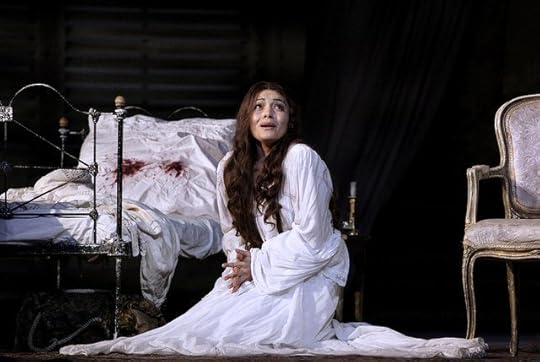

La traviata : the death of Violetta.

The disarming brilliance of Clément's confessional mode will return in her Finale, "In Praise of Paganism." In her seven intervening chapters, she looks into a number of operas, mainly from the 19th century, grouped according to their treatment of their female characters. We have: "Prima Donnas, or the Circus of Women" (Lulu, The Tales of Hoffmann, Tosca, and—as a kind of exception—Don Giovanni); "Dead Women" (Madama Butterfly, Carmen, and Tristan and Isolde); "Family Affairs, or the Parents Terribles" (La traviata, Don Carlos, The Magic Flute, and Elektra); "The Girls Who Leap into Space (Eugene Onegin, La Bohème, Lucia di Lammermoor and other bel canto operas, and a glance at Così fan tutte). "Furies and Gods, or Wanings of the Moon" (Turandot, Norma, Pelléas et Mélisande, and Der Rosenkavalier).
One can also die of youth—of too much flame wasted when everywhere is cold, when no stove is hot enough to warm what is inside and life slips away quietly, without warning. You can did like that, on tiptoe, while all around you everything swirls and whirls. This time there are no parents around. In La Boheme all the characters are desperately young. No one is evil; it is the opera of innocence. A woman loses her life in it, of course. But it is as if there were no responsibility, as if nothing happened other than this great cold, freezing them all, which one of them, a woman, cannot withstand.
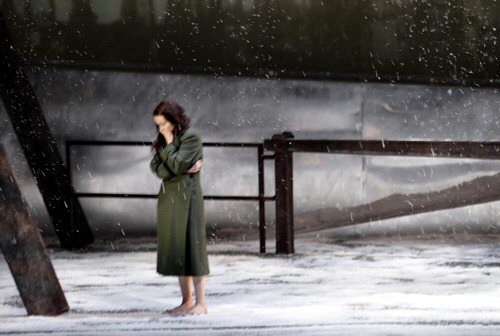
La Bohème : "…too much flame wasted when everywhere is cold."

Clément's method is to introduce each opera in a capsule paragraph such as this one, then give a brief synopsis of the plot, then go through it in more detail. She banishes names and dates to an appendix. She offers no musical analysis. She is not bound by the rules of first-this-then-that. Instead, she deals in impressions, supported by flights of imagination touching on other forms of theater, literature, myth, psychoanalysis, ethnography, physiology, and personal reminiscence. The more famous the scene, the more obliquely she is likely to come upon it. Her section on Isolde, for example, begins with a note on the sarigue, a South American opossum, continues with a disquisition on "Sickness, stink, poison… all that is feminine," and leads to this one extraordinary adjective describing the moment of her death:
She will just barely have time, coming to her senses when everyone thinks she is already dead, to get up again and sing the famous, rotten love-death. It is a confused discourse in which death, the sea, waves, light, and heaven produce an apotheosis for her that is mystical and musical, in which it is her turn to die alone, despite the final chord when the chromatics are resolved in the only major key in the opera.
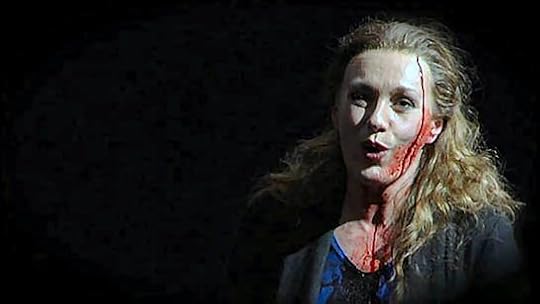
Tristan und Isolde : Isolde's Liebestod.

It will be seen from the list above that Clément does not confine herself exclusively to female victims. In her sixth chapter, "Madmen, Negroes, Jesters, or the Heroes of Deception," she looks at male characters who are also outsiders, for one reason or another, and share some aspects of the feminine fate; she covers Rigoletto, Otello, Falstaff, and Hans Sachs in Die Meistersinger. This last is suprising, because Sachs is central to his opera, and one would not think of him as its victim. Yet her case is as persuasive as it was for the Marschallin in Der Rosenkavalier in an earlier chapter.


Rigoletto : the death of Gilda.

Clément's glances at Wagner prepare for her final and most substantial chapter, "The Tetralogic of the Ring, or the Daughter Done for." It is a superb, virtually standalone essay, that could hold its own with Wagner criticism anywhere (and I have read a lot of it). She goes through the entire Ring, not once, but three times, cycling back again and again over the same material, much as Wagner himself does. She tells the story as drama, imagining an entirely innocent listener. She looks at it again through the lens of family, which in this case involves various degrees of incest. She goes back again to listen to the music, to consider its power to evoke emotion and anesthetize at the same time, telling a story also, but not necessarily the same one as the words and actions. I am not sure how easy this chapter would be for a Wagner neophyte, but for an old hand like me (I made my Hajj to Bayreuth at age 17), it got me thinking all over again.


Götterdämmerung : the feminist ending of the Copenhagen Ring.

And then there is Clément's Finale, confessional once more but never sappy, stimulating, shocking, bringing intellectual ideas into a superb balance with personal feeling. Never more so than when she reclaims that old misogynist slur—hysteria—as a source of pride:
One day I became aware that opera did not come to me from my head. And, although I have often used the word heart, it was because of some leftover sense of propriety and prudence in a world where women are still held—in respect or contempt. Opera comes to me from somewhere else; it comes to me from the womb. That is no easygoing sexual organ. The uterus, which is where hysteria comes from, is an organ where the thought of beings is conceived, a place where powerful rhythms are elaborated; a musical beat that is peculiar to women, the source of their voice, their breathing, their spasmodic way of thinking. There and there alone history is expressed in the first person. There buried centuries are revived, just as Michelet, Diderot, and Freud in certain flashes that were quickly picked up on, were able to see. The hysteric knows how to rediscover the rebellions against Rome in her womb, as well as mythical Sabbats; these days the hysteric is able to make herself consumptive, just like in the last century, and die of it if it is necessary. But this past is no bittersweet nostalgia. As the present forms of numerous and disorganized movements in which feminine revolt is incoherently expressed prove, it is the thrust of the future. The projection of the future depends on this return of the womb. And the imitation dead women who haunt me sow bits of a world in which, perhaps, one day I shall feel free. […]

Just as you always stretch your arms when you leave the darkness, these women will always sing.
Profile Image for Bill FromPA.
703 reviews47 followers
July 9, 2020
I found this extremely tedious reading: Clément approaches some interesting issues, but never alights on them long enough for analysis in depth, a butterfly fearful above all of being pinned down. Her default tone is rhapsodic, which is wearying.

It would be interesting to contrast the roles of women in opera with the actuality of their real-life contemporaries: nuns, prostitutes, divas, etc. But then there are the fancy-dress fantasy roles: priestesses, valkyries, mermaids, queens; do these speak to contemporary womanhood?

Her bibliography of 2+ pages has works of musicology in the minority, outnumbered by anthropology, philosophy, and psychology; Adorno is there, no doubt a baleful influence on this book.

Clément's allusions are almost exclusively Gallic: Tintin, Cocteau, Charles Trenet, and not to forget Lacan and Levi-Strauss. This is fine and appropriate, but may add an unintended alienation effect for the Anglophone reader.

Comments as I read:

Prelude: Clément makes a great deal of paying attention to the words of the libretti of the operas she analyses. This has the welcome effect of her giving equal billing to librettists, but also some odd aspects. She speaks of her attention to texts as something transgressive - something opera devotees avoid and disdain; but she writes in French, the very language of a number of the operas she examines. She calls attention to this
Of course, in one's own language it is rare that one can avoid the meaning. ... There is no getting around it. One has to understand. I think that that is the secret cause of resistance to French opera: meaning exists, no more mystery, so long exoticism.
But she is translated into English, a language with no operatic tradition to speak of, at least in the period she concentrates on: late 18th to early 20th century: Purcell is too early and Britten too late.

1. Prima Donnas, or the Circus of Women

Tales of real and fictional prima Donnas. She brings in the father-rapists of Freud's patients but does not convincingly find them in the operatic texts. Clément begins her operatic Baedeker with summaries of:

The Tales of Hoffmann
Don Giovanni
Tosca

The second does not really fit into a chapter on prima donnas and Clément makes no effort to tie it to the topic. The 3 women of Don Giovanni are a conjugation of seduction: past, present, and future, but "seduction" is actually rape, as seen with Donna Anna and Zerlina.

2. Dead Women

Madam Butterfly
Carmen
Tristan and Isolde

In addition to straight summaries, Clément tends to write dramatic descriptions of scenes from the operas, almost like mini-novelizations, which she seems to offer in the place of analysis. On Isolde, though, she goes off into some anthropological parallel, evidently inspired by Levi-Strauss, with an Amazonian tribe's mythology that only tenuously connects with the opera, despite her assurances. The connection seems to be the association of women as poison-producers: deadly, but essential to the tribe's fishing practices.

Alluded to at the end, but not summarized: Pelléas et Mélisande.

3. Family Affairs, or the Parents Terribles

La Traviata
Don Carlos
The Magic Flute

Like Bergman, she sees Sarastro and the Queen of the Night as Pamina's parents; uses the opera as a means of exposing the sexism and class prejudice of the Enlightenment.

Alluded to at the end, but not summarized: Elektra.

4. Women Who Leap into Space

Eugene Onegin
La Bohème
Lucia di Lammermoor
I Puritani
La Sonnambula

Metaphoric rather than literal leaps, evidently, into love or madness. She follows the observations of Kierkegaard's seducer throughout the chapter.

At the end, back to Don Giovanni: a childhood memory of the baritone tumbling down a stage staircase during his serenade. She mentions,but does not summarize, La fanciulla del West and Cosi fan tutte, attributing the former's lack of popularity to the fact that Minnie the barkeep gets her man at the end and rides off with him.

5. Furies and Gods, or the Wanings of the Moon

Turandot
Norma
Der Rosenkavalier
Pelléas et Mélisande

"Just imagine that Norma is Turandot grown old." Claims that Norma tells the same story as Rosenkavalier, an older woman relinquishes her lover to a younger. End of chapter riffs on Khovanshchina, Aida, Götterdämmerung, and Parsifal.

6. Madmen, Negroes, Jesters, or the Heroes of Deception

Otello
Falstaff
Die Meistersinger

She does not relate Otello to Monastatos. The men in these operas are supposed to be "trickster" figures. Is Clément sure she has this whole anthropology / comparative mythology thing right? Rigoletto is mentioned in the opening section, but the opera is not summarized. Evidently, because he is not white, uxoricide Otello must be a victim rather than victimizer. Hans Sachs seen in role similar to the Marschallin: yielding a (potential) lover to a younger rival.

7. The Tetralogic of the Ring, or the Daughter Done For

The book's longest chapter, devoted to Wagner's Ring. Clément miscounts the valkyries, giving Brünnhilde only seven sisters. She wants traditional productions: bearskins and armor, and live animals, horses and rams, though she doesn't explicitly call for ravens and a bear. Her main analysis is along generalized familial lines: fathers are portrayed this way, mothers that way, and so on among brothers, sisters, sons, daughters, husbands, and wives.

Finale In Praise of Paganism

Leaving the opera house, she disdains
a man who, from the height of his scholarly perch, will think this or that, will do his work as a critic.
Her description recalled for me comments from gay writers on opera:
The opera formed an enclave, an Indian reservation where wildness was permitted, a transitory and painful promised land. Music for me was an unthought refuge.
Profile Image for Andrea.
38 reviews15 followers
February 25, 2013
By far the weirdest academic book I've read. Yes, it is academic; it's been researched and has notes and everything, but the writing is personal and often poetic. It is nonfiction, but it's more narrative than research. If you can figure out how best to interpret it, you can glean a lot of useful insights from it.
Profile Image for Gabrielle George.
39 reviews
November 26, 2021
Disclaimer: did not finish, could not finish
This book might actually be the worst thing I've ever read before. It has so many gratuitously sexual analogies, which I mean normally those would be fine in small doses, but they come off as forced and bizarre stretches of someone whose mind exists on a different realm than mine does.

I gave up once I realized that every sentence, in fact, even within every sentence, there flowed such illogical sequential thinking that it came out more as someone stream-of-consciousness-ing at a book about all of these ranty vaguely opera-related opinions. Paragraphs did not seem to have much to do with previous paragraphs, sentences did not have much to do with previous sentences, comparisons within a sentence bore no relation to each other and did not seem to add to what the author seemed to be saying. Even individual words (hymen??? Why is the author so obsessed with hymens???) were bizarrely picked and didn't make any sense in context.

I'm very disappointed because this author seems to know so much about opera, and clearly has some very interesting developed feelings on it, but their way of communicating these thoughts is totally unreadable. I was hoping for a boring textbook-like criticism of opera, and was very prepared for boring, but this meandering style is just not what I want in my feminist critique books.
Profile Image for Carmen.
275 reviews1 follower
September 10, 2021
Perhaps a bit too Freudian, but a great jumping off point for a feminist reading of opera (and how a lot of opera resists that)
54 reviews3 followers
June 2, 2007
yes, it is a translation and if i were more confident with my french i would read the original. but clément's voice is so unique and so jarring... and..well, i read the whole book straight through, pretty much. go for it.
Displaying 1 - 8 of 8 reviews

Can't find what you're looking for?

Get help and learn more about the design.