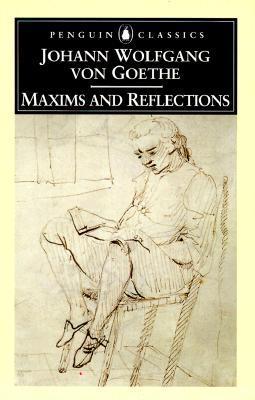
Goethe was probably the last true ‘Renaissance Man’. Although employed as a Privy Councillor at the Duke of Weimar’s court, where he helped oversee major mining, road-building and irrigation projects, he also painted, directed plays, carried out research in anatomy, botany and optics — and still found time to produce masterpieces in every literary genre. His 1,413 maxims and reflections reveal not only some of his deepest thought on art, ethics, literature and natural science, but also his immediate reactions to books, chance encounters or his administrative work. With a freshness and immediacy which vividly conjure up Goethe the man, they make an ideal introduction to one of the greatest of European writers.
A master of poetry, drama, and the novel, German writer and scientist Johann Wolfgang von Goethe spent 50 years on his two-part dramatic poem Faust, published in 1808 and 1832, also conducted scientific research in various fields, notably botany, and held several governmental positions.
George Eliot called him "Germany's greatest man of letters... and the last true polymath to walk the earth." Works span the fields of literature, theology, and humanism. People laud this magnum opus as one of the peaks of world literature. Other well-known literary works include his numerous poems, the Bildungsroman Wilhelm Meister's Apprenticeship and the epistolary novel The Sorrows of Young Werther.
With this key figure of German literature, the movement of Weimar classicism in the late 18th and early 19th centuries coincided with Enlightenment, sentimentality (Empfindsamkeit), Sturm und Drang, and Romanticism. The author of the scientific text Theory of Colours, he influenced Darwin with his focus on plant morphology. He also long served as the privy councilor ("Geheimrat") of the duchy of Weimar.
Goethe took great interest in the literatures of England, France, Italy, classical Greece, Persia, and Arabia and originated the concept of Weltliteratur ("world literature"). Despite his major, virtually immeasurable influence on German philosophy especially on the generation of Georg Wilhelm Friedrich Hegel and Friedrich Wilhelm Joseph von Schelling, he expressly and decidedly refrained from practicing philosophy in the rarefied sense.
Influence spread across Europe, and for the next century, his works inspired much music, drama, poetry and philosophy. Many persons consider Goethe the most important writer in the German language and one of the most important thinkers in western culture as well. Early in his career, however, he wondered about painting, perhaps his true vocation; late in his life, he expressed the expectation that people ultimately would remember his work in optics.
Thoughts and quips from Germany's most prolific polymath - 590 in all - plus a bonus section of wonderful reflections on Mother Nature. Also features critiques on writers from Kalidas to Shakespeare.
Very difficult to cull these faves : -------------------
9. Unqualified activity, of whatever kind, leads at last to bankruptcy.
12. Our plans and designs should be so perfect in truth and beauty, that in touching them the world could only mar. We should thus have the advantage of setting right what is wrong, and restoring what is destroyed.
17. In botany, one species of plants is termed "incompletæ." In the same way some men are incomplete and imperfect. Their desires and struggles are disproportional to their actions and achievements.
25. From all sides he is threatened by the spirit of the day, and nothing is more necessary than to make him see early enough the direction in which his will has to steer.
30. If I am to listen to another man's opinion, it must be expressed positively. Of things problematical I have enough in myself.
33. Everything that frees our spirit without giving us control of ourselves is ruinous.
65. Generosity wins favor from everyone, especially when accompanied by modesty.
81. What a man does not understand, he does not possess.
108. It is as certain as it is strange that truth and error come from one and the same source. Thus we're not free to do violence to error, because at the same time we violate truth.
147. The masses cannot dispense with men of ability, and such men are always a burden to them.
152. Ingratitude is always a kind of weakness. I have never known men of ability to be ungrateful.
209. Despotism promotes general self-government, because from top to bottom it makes the individual responsible, and so produces the highest degree of activity.
211. Enthusiasm is of the greatest value, so long as we are not carried away by it.
222. There is no use in reproving vulgarity, for it never changes.
239. To live in a great idea means to treat the impossible as though it were possible. It is just the same with a strong character; and when an idea and a character meet, things arise which fill the world with wonder for thousands of years.
249. In the world people take a man at his own estimate, but he must estimate himself at something. Disagreeableness is more easily tolerated than insignificance.
264. A man's manners are the mirror in which he shows his portrait.
276. Fools and wise folk are alike harmless. It is the half-wise, and the half-foolish, who are the most dangerous.
278. Difficulties increase the nearer we come to our aim.
291. By nothing do men show their character more than by the things they laugh at.
300. Passions are good or bad qualities, only intensified.
309. The real scholar learns how to evolve the unknown from the known, and draws near the master.
319. Where I cannot be moral, my power is gone.
323. To praise a man is to put oneself on his level.
330. The greatest difficulties lie where we do not look for them.
332. Nothing is more highly to be prized than the value of each day.
335. If a man lives long in a high position, it's true he does not experience all that a man can experience... but he experiences things like them, and perhaps some things that have no parallel elsewhere.
358. "I stumbled over the roots of the tree which I planted."... said a very, very old forester.
375. It does not look well for monarchs to speak through the press, for power should act and not talk.
389. The public must be treated like women: they must be told absolutely nothing except what they like to hear.
414. A man who has no acquaintance with foreign languages knows nothing of his own.
415. We must remember that there are many men who, without being productive, are anxious to say something important, and the results are most curious.
417. Some books seem to have been written not to teach us anything, but to let us know that the author has known something.
461. If one has not read newspapers for some months, but then suddenly reads them all, one sees - as one never saw before - how much time is wasted with this literature type.
467. What a day it is when we must envy the men in their graves!
481. The Beautiful is a manifestation of secret natural laws, which, without its presence, would never have been revealed.
489. Nothing is more frightful than imagination without taste.
532. Ignorant people raise questions which were answered by the wise thousands of years ago.
566. There is nothing more odious than the majority; it consists of a few powerful leading men, accommodating rascals, submissive weaklings, and the masses who trot after them without knowing their own mind in the least.
571. If a man devotes himself to the promotion of science, he is first opposed, and then informed that his ground is already occupied. Men first value nothing we tell them, and then they behave as if they knew it all themselves.
To communicate is natural; to accept what is communicated is an acquired art. -
What kind of shortcomings are we allowed to keep, indeed cultivate in ourselves? The kind that flatter, rather than hurt, other people. -
Passions are faults or virtues, only heightened ones. -
There is no way of more surely avoiding the world than by art, and it is by art that you form the surest link with it. -
It is easier to imagine the mental state of a man who labours under total error than the state of mind of someone deluding himself with half-truths. -
Anyone who doesn’t know foreign languages knows nothing of his own. -
What you don’t understand, you don’t possess. -
A person who doesn’t rate himself too highly is worth much more than he imagines. -
No wonder that we more or less prefer to be surrounded by mediocrity because it leaves us in peace; it gives us the cosy feeling of consorting with the likes of our own selves. -
There is nothing more dreadful than active ignorance. -
You have to distance yourself from beauty and intelligence if you don’t want to become their vassal. -
What friends do for us and with us is also a part of our living experience because it strengthens and furthers our personality. What enemies undertake against us is not part of our own living experience; it merely comes to our knowledge; we repudiate it and protect ourselves against it as we would against frost, storm, rain and hail, or other outer evils which are to be expected. -
In the works of man as in those of nature, what most deserves notice is his intention. -
When you praise someone, you are putting yourself on a par with him. -
You only know those who cause you suffering. -
You only keep a watch on those who cause you suffering. If you want to remain unknown to the world, all that’s needed is not to hurt anyone.
I enjoyed the intro essays—especially regarding the composition of and distinction between maxim/aphorism/apophthegm/adage/proverb. Here, I just thought I liked a clever and wise saying!
I appreciated how this book was organized into subjects, and found myself spending the most time considering what was said about “science.”
I’ve just included a new participant in Anjie’s Ideal Dinner Party Guest List: Goethe!
It made me happy that he could be all flowery and super eloquent in one breath, and then smack me with a more humorous truth, GrouchoMarx-Style. Bam. 💥
Full of beautiful observations/insights on nature, life, and writing. There are some religious and political bits that didn't appeal to me. But there was so much that did resonate with me and inspire me.
Goethe is a combination Emerson, Whitman, James, Franklin, and whoever might be America’s best playwright. He is the kind of artist for whom the adjective Renaissance was invented: poet, playwright, novelist, scientist, philosopher, and engineer. He probably did windows and could parallel park a coach pulled by six horses as well. This slender volume is filled with aphorisms, observations, maxims, and various other nuggets of wisdom. Witness some randomly pulled examples: “Error is continually repeated in action and that is why we must not tire of repeating in words what is true.” “The senses don’t deceive, judgment deceives.” “Behavior is a mirror in which everyone shows his image.” “When a rainbow has lasted as long as a quarter of an hour we stop looking at it.” “You ask which form of government is the best? Whichever teaches us to govern ourselves.” “Somebody said: ‘Why do you bother about Homer? Especially since you don’t understand him?’ I don’t understand the sun, the moon, the stars high above my head, and I recognize myself in them even as I look at them and contemplate their wonderful regular course, wondering as I gaze whether I too might one day come to some good.”
The reflections run a gamut of topics and themes, from art to science, literature to politics, culture to religion. Goethe had a richly philosophical mind and the various thoughts here cover both the range and depth of his thinking and make provocative reading.
'To communicate is natural; to accept what is communicated is an acquired art.
Sensuous man often laughs where there is nothing to laugh at. Whatever stimulates him, his inner contentment shows itself.
Association with women is the basic element of good manners.
Individuality should actually be heightened by good manners. Importance is what everybody wants, but it is not to be disturbing.
Behavior is a mirror in which everyone shows his image.
There is a courtesy of the heart; it is akin to love. From it comes the most comfortable courtesy of outward behavior.
Voluntary dependence is the best of all possible states to be in [Pure Land], and how could this be possible without love!
In the face of another's great excellence the only possible salvation is love.
There is no way of more surely avoiding the world than by art, AND it is by art that you form the surest link with it.
Even at the moment of highest bliss and of highest distress we need the artist.
Art deals with what is hard to bear and what is good.
Seeing difficulties handled with ease gives us a sight of the impossible.
Art is a serious business, most serious of all when it deals with noble sacred subjects; but the artist stands above art and above the subject: above [art] because he uses it for his purposes, above [the subject matter] because he treats it in his own personal way.
Art is in itself noble: that is why the artist has no fear of what is common. This, indeed, is already ennobled when he takes it up, and so we see the greatest artists boldly exerting their personal right of majesty.
In every artist there is a potential foolhardiness without which talent is inconceivable; this is more particularly activated when there is an attempt to constrain a gifted man and to hire his services in one-sided ways...
Humor is one of the constituent elements of genius, but as soon as it predominates, it is no more than its surrogate; it goes hand in hand with art in decline and in the end destroys and annihilates it.
It is easier to imagine the mental state of a man who labors under total error than the state of mind of someone deluding himself with half-truths.
The greatest respect an author can have for his public is never to produce what is expected but what he himself considers right and useful for whatever stage of intellectual development has been reached by himself and others.
It is not easy for people to know one another, even with the best will and determination; for, moreover, there is bad will, which distorts everything.
What you don't understand, you don't possess.
Let memory fade so long as our judgement remain intact when needed.
People are put out because truth is so simple; they should remember that even so they still find it hard enough to use and apply truth for their own profit.
A false doctrine cannot be refuted because it is, of course, based on the conviction that false is true. But one can, may, and indeed must, again and again, stress the opposite truth.
Certain minds have to be left to their private illusions.
We rightly describe as our masters those from whom we can go on learning. Not everyone from whom we learn deserves this title.
The novel is a subjective epic in which the author begs permission to describe the world in his own way. So the only question is: does he have a way?- the rest will come in due course.
A merry companion is like a cart to give us a lift as we wander along on our way.
The happiest man is one who can link the end of his life with its beginning.
A partial truth goes on working for a time, but then, instead of complete enlightenment, a dazzling error suddenly intrudes; the world makes do with that and in this way whole centuries are duped.
In the sciences it is very worthwhile to seek out and then develop a partial truth already possessed by the Ancients.
Opinions tentatively broached are like counters moved forward in a board game; they may be defeated, but they have set in motion a game that will be won.
It is as certain as it is wonderful that truth and error spring from the same source; frequently, therefore, error must not be attacked because this would *also* mean attacking the truth.
Truth belongs to man, error to time. This is why it was said about an extraordinary man: "The misery of the times caused his error, but the strength of his soul delivered him from it with glory."
A person who doesn't rate himself too highly is worth much more than he imagines.
I'm sorry for people who make a great to-do about the transitory nature of things and get lost in meditations on earthly nothingness. Surely we are here precisely so as to turn what passes into something that endures; but this is ONLY possible if you can appreciate both.
One phenomenon, one experiment, cannot prove anything; it is the link in a great chain, only valid in its context. If someone were to cover up a string of pearls and only show the most beautiful one, expecting us to believe that all the rest were like that, it is very unlikely that anyone would risk the deal.
Illustrations, verbal description, measurement, number and sign still do NOT constitute a phenomenon.
One must repeat one's confession of faith from time to time, actually state what one condones, what one condemns; for the opposing camp isn't silent either.
At the present time no one should be silent or give in; we must talk and be up and doing, not in order to vanquish, but so as to keep on the alert; whether with the majority or the minority is a matter of indifference.
It used to happen, and still does, that I dislike a work of art because I'm not up to appreciating it; but if I sense some merit there, I try to get at it and this often leads to the happiest discoveries: new qualities are revealed to me in these things, new capacities in myself.
However ordinary life may look, however readily it appears to put up with what is common, everyday, it yet goes on secretly nursing higher demands and looks round for ways of satisfying them.
It is much easier to recognize error than to find truth; the former lies on the surface, this is quite manageable; the latter resides in depth, and this quest is not everyone's business.
When we are called to learn something great, we at once take refuge in our native poverty and yet have still learnt something.
You can neither protect nor defend yourself against criticism; you have to act in defiance of it and this is gradually accepted.
When a landscape is described as romantic, this means that there is a tranquil sense of the sublime in the form of the past, or, what amounts to the same, of solitude, remoteness, seclusion.
Beauty is a manifestation of secret natural laws which without this appearance would have remained eternally hidden from us.
I can promise to be candid, not, however, to be impartial.
A collection of anecdotes and maxims is the greatest treasure for a man of the world - as long as he knows how to weave the former into apposite points of the course of conversation, and to recall the latter on fitting occasions.
Where concern is lost, memory fares likewise.
The world is a bell that is cracked: it clatters, but does not ring out clearly.
One must put up kindly with the pressing overtures of young dilettantes: with age they become the truest votaries of art and of the master.
[For the LLM age:] Intelligent people are always the best encyclopedia.
There are people who never make mistakes because they never have sensible projects.
Knowing my attitude to myself and to the world outside me is what I call truth. And so everyone can have his own truth and yet it remains the self-same truth.
What is particular is eternally defeated by what is general; the general has eternally to fit in with the particular.
No one can control what is really creative, and everybody just has to let it go its own way.
Anyone to whom nature begins to unveil its open mystery feels an irresistible yearning for nature's noblest interpreter, for art.
Man never understands how anthropomorphic he is.
If one had to study all laws, one would have no time at all to transgress them.
One can't live for everyone, more especially not for those with whom one wouldn't care to live.
Mysteries do not as yet amount to miracles.
Reckless, passionate favoritism of men of talent was a failing of my younger years of which I could never completely rid myself.
No matter whether you're high rank or low, you can't avoid paying the price of your common humanity.
But where we have to look for liberality is in people's attitudes and these are their feelings come to life.
Excellence is unfathomable; tackle it in what way you will.
I was intent on pursuing what is general until such time as I came to comprehend the achievement of outstanding people in what is particular.
The unreasonable thing about otherwise reasonable people is that they don't know how to sort out what someone is saying when he's not really put it as precisely as he should have done.
Because he speaks, everyone believes that he can also speak about language.
There is something magical about rhythm; it even makes us believe that the sublime is something of our own.
Art can be furthered by no one except the master.
'Clarity is a suitable distribution of light and shade.' Hamann, take note!
Beauty can never be clear about itself.
Great talents are a rarity, and it is rare that such people recognize themselves for what they are; but vigorous unconscious action and thinking have such highly gratifying, but also ungratifying results that a significant life may well be consumed in a conflict of this kind.
I *don't* venture to talk about the absolute in a theoretical sense: I *may,* however, be allowed to state that anyone who has seen and recognized it as a phenomenon and always kept it in view will experience very great gain.
How little of all that has happened has been recorded in writing, how little of this corpus of writings has been preserved! By its very nature, literature is fragmentary; it contains monuments of the human spirit insofar as these constitute written texts and have ultimately survived.
And yet, in spite of all the incompleteness of the literary scene, we find repetitions multiplied a thousandfold, which shows how limited are man's mind and his destiny.
Books, we find, are like new acquaintances. To begin with, we are highly delighted if we find an area of general agreement, if we feel a friendly response concerning some important aspect of our life. It is only on closer acquaintance that differences begin to emerge, at which point the great thing is not immediately to recoil, as may happen at a more youthful age, but to cling very firmly to areas of agreement and fully to clarify our differences without on that account aiming at identity in our views.
The counter-reaction of a really childlike being is even passionate, its intervention firm.
The great difficulty about psychological observation is that you always have to look on the inner and outer sphere as being parallel or, rather, as interwoven. There is constant systole and diastole [c.f. time and being and beings], a breathing in and a breathing out of the living organism; even if you cannot actually pronounce on this, you must observe it precisely and bear it in mind.
The ONLY way to see absurdities of the day in proportion is to compare with them the great masses of world history.
You really only know when you know little; doubt grows with knowledge.
It's really a person's mistakes that make him endearing.
Envy and hatred limit the observer's view to the surface even if this is also associated with acumen ; if [acumen], however, goes hand in hand with kindliness and love, the observer can see right through the world and mankind; indeed, he can hope to reach the Allhighest.
The SUBJECT MATTER is visible to everyone, CONTENT is only discovered by him who has something to contribute, and FORM is a mystery to most.
People's inclinators favor what is vitally alive. And youth again forms itself by youth.
We may get to know the world however we choose, it will always keep a day and night a night aspect.
Error is continually repeated in action, and that is why we must not tire of repeating in words what is true.
Thoughts recur, convictions perpetuate themselves; circumstances pass by irretrievably.
Our whole achievement is to give up our existence in order to exist.
Experience can be extended into infinity... the universe is open in all directions...
Truth is contrary to our nature, not so error, and this for a very simple reason: truth demands that we should recognize ourselves as limited, error flatters us that, in one way or another, we are unlimited.
At all times ONLY individuals have had an effect on scientific knowledge, NOT the epoch.
This is true symbolism, where the particular represents the general, NOT as dream and shadow, BUT as a live and immediate revelation of the unfathomable.
If you can seek out good advice, it's as though you yourself have the capacity for action.
Nothing in the human situation is as unstable or fleeting as power not born of its own strength.
The sum total of my inner activity has turned out to be a lively process of trial and error, a heuristic process acknowledging an unknown intuitively surmised rule, an endeavor to find one of this kind in the outer world, and introduce it into the outer world.
There is an enthusiastic way of reflecting which is of the greatest value, provided only that you don't let it carry you away.
Error is related to truth as sleeping to waking. I have observed that when one has been in error, one turns to truth as though revitalized.
One acts for others so as to share in their enjoyment.
We really only learn from books we cannot judge. The author of a book we could really judge ought surely to be learning from us.
The battle of what is old, established, continuous against development, against further or against new formation, always remains the same. All order finally issues in pedantry; to get rid of the latter one destroys the former, and it takes a while before people realize that there has got to be a return to order.
Everything excellent limits us momentarily because we feel unable to match up to it; only insofar as we subsequently accept it into our own culture, absorb it as belonging to our own mental and temperamental powers, do we come to love and value it.
You don't have to censure vulgarity; for this remains eternally true to itself.
We cannot get over a contradiction in our own make-up; we must make an effort to reconcile it. If other people contradict us, that's not our concern, that's their business.
The absurd, tastefully presented, arouses repugnance and admiration.
Of the best kind of society one used to say that its conversation is instructive, its silence formative.
There is nothing more dreadful than active ignorance.
Mysticism is the heart's scholastic learning, the dialectic of feeling.
One is indulgent towards old people as one is towards children.
Great pristine forces, developed from all eternity or within time, work irresistibly, whether usefully or destructively is a matter of chance.
An 'idea' is something eternal and unique; it is NOT correct to use this term in the plural. Everything that enters our awareness and that we can talk about is no more than the manifestation of an 'idea'; we express concepts, and to that extent 'idea' is itself a concept.
In the context of aesthetics it is NOT apt to speak of 'the idea of beauty'; in this way you isolate the concept of beauty, which surely cannot be thought of as a separate entity. You can have a concept of what is beautiful and this concept can be transmitted.
The manifestation of the idea as beauty is just as fleeting as the manifestation of what is sublime, witty, amusing, ridiculous. This is what makes it so hard to talk about such topics.
He who is and remains true to himself AND to others has the most attractive quality of the greatest talents.
Art is the conveyor of the inexpressible; it therefore looks like folly again to attempt conveying it by words. But our effort to do this enriches our understanding in many ways, and this, in turn, is good for our potential.
All real and half-poets make us so familiar with love that it would have become trivial had it not constantly and by its very nature renewed itself in full power and splendor.
All love is connected with presence; what is agreeable to us by its presence always shows itself always shows itself [in a different way] when it is absent and constantly makes us want its renewed presence, and, when this wish is granted, we are accompanied by lively delight; when this joy persists we are filled with an ever-equal happiness - this is what we really love, and this means we can love anything that can enter our presence...
Inclination is closely related and not rarely develops into love. It is cognate to a pure relationship which resembles love in every way except that it does not necessarily demand continued presence. This kind of inclination can point in many directions, be connected with many people and objects, can really make a person happy in a continuous process if he knows how to keep going...
What friends do for us and with us is also a part of our living experience because it strengthens and furthers our personality. What enemies undertake against us is not part of our living experience; it merely comes to our knowledge; we repudiate it and protect ourselves against it as we would against frost, storm, rain and hail, or other outer evils which are to be expected.
...there are, in fact, few things of greater advantage than learning to appreciate the good points of your opponents: this gives you decided superiority over them.
The most attractive form of metempsychosis is when we see ourselves reappear in someone else.
The higher form of empiricism relates to nature just as human reason relates to practical life. [an empiricism that 'optimizes nature'... for subject and object's sake]
When basic primitive phenomena appear unveiled to our perception, we feel a kind of timidity, even fear [the sublime]... but along comes reason, that busy pander hurrying to mediate in its own way between the noblest and the most vulgar instincts.
Art is the true mediator. To speak about art is to try to mediate the mediator, but all the same this has brought us much delight.
Similarly in the sciences you really know nothing, you always have to do, to act.
Every true insight is part of a sequence and leads to a sequence. It is a link in a great chain mounting creatively.
Nature has given us the chessboard beyond which we cannot and would not wish to operate; nature has carved the counters whose value, moves, and potentiality gradually become known to us: it is our part now to make moves which hold a promise of gain for us; everyone tries to do this in his own way and doesn't relish interference.
Begin by instructing yourself, then you will receive instruction from others.
Immediate perception of primeval phenomena makes us react with something akin to fear: we feel our inadequacy; it is only when they come alive through the eternal interplay of empiricism that we can react with joy.
The magnet is a primeval phenomenon where mere naming already serves as an explanation; that is how it becomes a symbol for all the rest for which we need not seek a name or work.
Everything that is alive surrounds itself with an atmosphere.
Nature has managed to keep enough freedom so as to prevent us from getting at it radically with our knowledge and science or actually cornering it.
"In some quiet hour when they were sociably together, Faith, Love and Hope felt an urge to fashion something new; they set to work together and created a lovable new quality, a higher kind of Pandora: Patience."
This book was quite ineffective. I don't know what I really expected when I got it from the bookstore and saw it's cheaper compared to other books. Subconsciously, I was probably hoping for another perspective a la Marcus Aurelius' Meditations. To be fair, Goethe's 1,413 Maxims and Reflections criticizes and reflects on a wide spectrum of things from literature, art, relationships, and life but it was lacking due to how some seemed to be incomplete in thought and meaning. They were derived from Goethe's voluminous works and he could be criticizing an author from his era then praising an artist in another which some rang a bell but with others, I have limited knowledge with. Nevertheless, the division is well-structured and organized although I noticed some maxims/reflections were repeated in some form or another. Still, Goethe's wit is infectious and wonderful. It is comparable with someone's attempt of creating a symmetrical face by cutting off facial parts from magazines. Quite symmetrical but odd-looking. I did feel that reading Penguin's Little Black Classics, Sketchy, Doubtful, Incomplete Jottings would suffice.
I loved the sections POSTHUMOUS: On Literature and Life, POSTHUMOUS: On Nature and Natural Science, FROM ART AND ANTIQUITY: Vol. I, issue 3: Naïvety and Humour, and FROM ART AND ANTIQUITY: Vol. V, issue 3: Individual Points.
Some things to reflect on: ** "Our passions are a genuine phoenix. As the old one burns down, the new one immediately arises out of the ashes." ** "We don't get to know people when they come to us. We have to go to them to discover how things stand." ** "We are never further away from our desires than when we imagine we possess what we desire." ** "No one is more of a slave than the one who thinks he is free without freedom." ** "It's really a person's mistakes that make him endearing." ** "You ask which form of government is the best? Whichever teaches us to govern ourselves." ** "The most attractive form of metempsychosis is when we see ourselves appear in someone else." ** "A great failing: to see yourself as more than you are and to value yourself at less than your true worth." ** "You can't get rid of what really belongs to you, even if you throw it away." ** "When you praise someone, you are putting yourself on a par with him." ** "It doesn't do to dally too long in the realm of the abstract — what is esoteric is damaging when it strives to be exoteric. Life is best taught by what is alive." ** "We look back on our life as a thing of broken pieces, because our mistakes and failures are always the first to strike us, and outweigh in our imagination what we have accomplished and attained."
Truly wondrous bits and pieces from a great mind. This bulk of work was my companion during the past few months. Anyways, without further ado, I will just list the reflections I loved the most.
"It is sad to watch an outstandingly talented man battling frantically with himself, his circumstances, his time, without ever managing to get anywhere."
"People are at a loss with regard to themselves and one another because they use means as ends, and then, because of sheer busyness, nothing whatever happens or perhaps, even worse, something which is disagreeable."
"Botanists have a plant-category which they call ‘Incompletae’; similarly one can say that there are incomplete and uncompleted people. These are the ones whose longings and strivings are out of proportion with what they actually do and what they achieve."
"Human nature needs to be numbed from time to time, but without being put to sleep; hence smoking, spirits, opiates."
"Our passions are a genuine phoenix. As the old one burns down, the new one immediately arises out of the ashes."
"There is no way of more surely avoiding the world than by art, and it is by art that you form the surest link with it."
"Books, too, have their life-experience which cannot be taken away from them."
"The most attractive form of metempsychosis is when we see ourselves reappear in someone else."
"All we devise and do is exhausting; happy the man who doesn’t get weary."
"Art is the conveyor of the inexpressible; it therefore looks like folly again to attempt conveying it by words. But our effort to do this enriches our understanding in many ways, and this, in turn, is good for our potential."
"Outstanding people are therefore in a worse case than others; as we don’t compare ourselves with them, we try to catch them out."
"The novel is a subjective epic in which the author begs permission to describe the world in his own way. So the only question is: does he have a way? – the rest will come in due course."
“We look back on our life as a thing of broken pieces, because our mistakes and failures are always the first to strike us, and outweigh in our imagination what we have accomplished and attained.”
“Reading ought to mean understanding; writing ought to mean knowing something; believing ought to mean comprehending; when you desire a thing, you will have to take it; when you demand it, you will not get it; and when you are experienced, you ought to be useful to others.”
Each aphorism in this book is fully true only at a certain moment in life… They are not, nor could they ever be, simultaneously true, for if they were, they would stand in opposition to life itself, destroying it at its very foundations… Just as Shakespeare looked only to the stage of the English theater when he wrote and lived his plays, and just as Craig Thomas, the creator of How I Met Your Mother, put nothing on the screen that did not belong to television as an art form, Goethe, in writing these reflections, looked only to life in its entirety, and to nothing beyond it… This is what sets these three great writers apart; what they share, however, is a perpetually living desire to understand, coupled with an uncompromising need to experience life to its fullest. In other words, detached from life, reduced to thought and study, this book suddenly becomes useless, and often dangerous…
An exercise of imagination: half in jest, half in earnest, the person who could reap the greatest benefit from Goethe’s reflections is none other than Forrest Gump…
[Fiecare aforism al acestei cărți este pe deplin adevărat doar într-un anumit moment al vieții… Ele nu sunt, și nici n-ar putea fi, simultan adevărate, căci, dacă ar fi fost, s-ar fi opus vieții înseși, distrugând-o din temelii… Așa cum Shakespeare se uita doar spre scândurile teatrului englez când își scria și își trăia piesele, așa cum Craig Thomas, autorul serialului How I Met Your Mother, nu a pus pe ecran nimic din ceea ce nu poate aparține televiziunii ca artă, Goethe, scriind aceste reflecții, privea doar viața în totalitatea ei și nimic altceva… Asta îi și diferențiază pe cei trei mari scriitori; în schimb, ceea ce îi aseamănă este o dorință mereu vie de a înțelege și o nevoie de a trăi din plin, fără niciun rest… Altfel spus, ruptă de viață, redusă la gândire și studiu, această carte devine brusc inutilă, ba chiar periculoasă adeseori...
Exercițiu de imaginație: mai în glumă, mai în serios, cel mai mare profit de pe urma reflecțiilor lui Goethe nu poate să-l aibă decât Forrest Gump...]
Goethe's shower-thoughts. Maybe best enjoyed by reading 1-10 maxims each day ("a motivational quote to start the day"), because the whole thing in itself is all over the place and most of the maxims etc. do not relate to one another at all. The ones concerning the author's thoughts on the scientific method (as well as his opinions on the methods of his scientist contemporaries) are interesting to read even from the viewpoint of the modern reader. Accompanying this, a lot of talk about art and the culture around it in Germany and France during Goethe's time, which for the most part went over my head due to a total lack of context.
All in all, I'm not too impressed, but I'm also an uncultured swine: I've not read anything else by Goethe and I'm all around ignorant on what was going on in the world in the early 1800's.
A great book of 1413 maxims from various Goethe works and sketchings
Some samplers: “Wisdom is to be found only in truth” “The smallest hair casts its shadow” “Hindus in the desert vow never to eat fish” “We all live on the past and perish by the past” “We very seldom satisfy ourselves; all the more consoling, therefore, to have satisfied others” “What is esoteric is damaging when it tries to be exoteric” “A thinking man’s greatest happiness is to have fathomed what can be fathomed and to revere in silence what cannot be fathomed”
Includes many which are fleshed out to encompass paragraphs of thought: art, science, philosophy, love. Goethe’s renaissance man spirit is on show.
One of the last polymaths and the greatest literary figures of Germany, and yet his maxims are rarely mentioned. Honestly its not hard to see why, firstly they just aren't on par with his more famous works. Secondly and most importantly, in this area of literature Nietzsche sets a high a bar in quality and quantity that Goethe just cant compete with. So unless you are particularly interested in Goethe as a person you can safely give this a miss.
That said there was something strangely fun about reading his jabs at geology and mountain climbing.
This book convinced me finally that the modern media seek to dissuade from and to perplex those who seek knowledge of life and, in short, to envenom the quest for enlightenment by constructing a haze of abstractions about the nature of the subject. Bravo to Goethe, for giving a voice on the delight one experiences when witnessing the emergence of the divine Being of the natural world which, he maintains, is the site of the only joy man can attain in this earthly life. Three stars.
maxims and reflections will always be a mix of hits & misses for each individual, but goethe certainly has more hits than misses. will be stealing from him to sound smart at dinners
If you are reading this review you will know who Goethe is and therefore that whilst anything of his is intrinsically worth reading, the maxims and reflections which that great personage noted down to guide his own conduct will be of particular interest in anyone of the same human type. Given that these are personal reflections, the language and form are not always harmonious and beautiful, some are very idiosyncratic (the collection ends with a rhapsody on ‘Nature’ as an almost-embodied Goddess) but there is tremendous value in here. What follows are some of my favourites, grouped together in general categories:
Self knowledge
Goethe offers some incisive and damning - for one to whom these things may seem a struggle - judgement on focus and memory: "When you lose interest in anything, you also lose the memory for it.". Later he further observes "It is only because we have not understood a thing that we cannot repeat it without alteration," or, put in another way, "Every man hears only what he understands." A great polymath like Goethe did not have to force himself to remember anything, it came naturally out of love. If you struggle with memory and passion, perhaps you are forcing your interest in an unnatural direction. After all, “a man is not deceived by others, he deceives himself."
Self reflection in this regard is also made difficult by language. “Let every man examine himself, and he will find this a much harder task than he might suppose; for, unhappily, a man usually takes words as mere make-shifts; his knowledge and his thought are in most cases better than his method of expression. False, irrelevant, and futile ideas may arise in ourselves and others [...] let us persist in the effort to remove them as far as we can, by plain and honest purpose." Our thoughts are constructed by means of our too too solid language, and it is challenging to effectively perform self-reflection and analysis to the required level of precision. So how do we know what is right for US?
"How can a man come to know himself? Never by thinking, but by doing. Try to do your duty, and you will know at once what you are worth. [...] But what is your duty? The claims of the day." Goethe became the man he was through action and exploration. "It is not enough to know, we must also apply; it is not enough to will, we must also do." But the germ of a thought or intention, if firmly held, cultivated and defended from the rain and frost of countervailing impulses and idleness, will always give rise to the growth of action: "strictly speaking, everything depends upon a man's intentions; where these exist, thoughts appear; and as the intentions are, so are the thoughts."
Good conduct
This love of, and focus on, action runs throughout these reflections and maxims. Goethe is a well-wishing and personable man, and this humanity springs joyfully from the page. To act well is also to act courteously and politely: "A man's manners are the mirror in which he shows his portrait." Furthermore, "Ingratitude is always a king of weakness. I have never known men of ability to be ungrateful." To act as is proper, internally and externally, is for him the essence of greatness. To do so across time is to girder one’s life against mischance and obtain self-knowledge as above. "Memories may vanish so long as the moment of judgement does not fail you"
Action towards ideal
One of the first maxims presented in this collection is: "Against criticism a man can neither protect nor defend himself; he must act in spite of it, and then criticism will gradually yield to him." This is a quote which has obtained some reach on its own merits, not least because it is true. Having obtained self-knowledge through action and refined conduct, Great Men (though Goethe would not define himself as one he is deservingly a Great Man of the Arts) are distinguished by their action towards an ideal. At first, aspirations of greatness are perceived as terrifying boundaries to achievement: "A great work limits us for the moment, because we feel it above our powers; and only in so far as we afterwards incorporate it with our culture, and make it part of our mind and body, does it become a dear and worthy object."
Indeed,"It is no wonder that we all more or less delight in the mediocre, because it leaves us in peace: it gives us the comfortable feeling of intercourse with what is like ourselves." Furthermore "It is with history as with nature and with everything of any depth, it may be past, present, or future: the further we seriously pursue it, the more difficult are the problems that appear. The man who is not afraid of them, but attacks them bravely, as a feeling of higher culture and greater ease the further he progresses." For this reason, "every phenomenon is within our reach if we treat it as an inclined plane, which is of easy ascent, though the thick end of the wedge may be steep and inaccessible."
"To live in a great idea means to treat the impossible as though it were possible. It is just the same with a strong character; and when an idea and a character meet, things arise which fill the world with wonder for thousands of years." All Great Men of history have had impossible dreams, acted towards them relentlessly without surrender and, regardless of the end result, achieve greatness. As such, "Higher aims are in themselves more valuable, even if unfulfilled, than lower ones quite obtained."
Society and nature
Particularly in the sections on art and science, two recurrent areas of focus emerge. Whilst Goethe is a lover of people and society, for him (and here he speaks from the specific perspective of science) "there is nothing more odious than the majority; it consists of a few powerful men to lead the way; of accommodating rascals and submissive weaklings; and of a mass of men who trot after them, without in the least knowing their own mind".
Whilst society is a source of personal joy, in the arts and sciences it is the agent of dogma, and in contrast "every man should remain in the path he has struck out for himself, and refuse to be overawed by authority, hampered by prevalent opinion, or carried away by fashion". The same holds for people: "We do not learn to know men if they come to us; we must do to them to find out what they are."
Rather, Goethe sees Nature as the ultimate source of truth in action, the arts and the sciences, noting that "The beautiful is a manifestation of secret laws of nature, which, without its presence, would never have been revealed."
***
All in all, we are treated to the luscious vistas of one of the most fertile minds in history. To end, I offer this uplifting reminder: "we look back upon our life only as on a thing of broken pieces, because our misses and failures are always the first to strike us, and outweigh in our imagination what we have done, and attained".
Nah, I don't know. This book irked me. I got a lot of neat sayings from it - I'll type them up later & add some, if I remember - but it's just not me. It had little spurts of things that resembled sweet pathways to me, but a lot of it felt like a slog. I think the big difference is that Goethe was an old man, & I am a young man. Also, I think it's fair to say I much more enjoyed the maxims than the reflections. Some of them being broken apart made no sense to me - they literally don't work without one another & quite obviously were just broken in half when in fact the text continues imperceptibly.
Would I recommend this book to others? I'd say to flick through a few different sections - if you find stuff you like, it's not really a long read, so it could be worth going through. I'm not sure I found any of his ideas revolutionary (but I'm not 100% sure on that - there might have been one or two minor revolutions of the mind. But even minor revolutions of the mind are revolutionary & not to be swept under the rug) but there were definitely dozens of great nuggets to take home to the wife & kids on a hungry night.
The introduction makes an excellent accidental case that this is a printout of Goethe's Facebook status updates:
"Goethe probably regarded his reflections as miniature creative language events to be shared with his readers, reflecting the time- and life-sequence of his personal reactions."
So, you have wonderful little maxims like this:
"How could a man claim to be a master of his subject if he has taught nothing that's unnecessary!"
and
"Bonus vir semper tiro."
And you also have head scratchers and weird little lines like these:
"One brother broke pots, the other brother broke pitchers. Destructive goings-on!"
or
"As soon as good works and their merits cease, sentimentality immediately takes over in the case of Protestants."
I wish there was an option to give a book "0" stars. I just don't believe that one man is responsible for 1413 maxims and reflections that all seem to be cleverly obvious. I couldn't finish this, but it's possible I will since Experiment #6 for Creative Non-Fiction Workshop has to be influenced by one of these. There's got to be a few good ones...
"There is no surer way of evading the world than by Art; and no surer way of uniting with it than by Art" Evasion I have done much of, but for the sake of uniting, in brief moments, with genius minds such as Goethe's. If, indeed, "Man is the image of his god," then please, God, let me be even a modicum like Goethe. Amen.
Some real bangers in here. A few below. Many more left out
“At all times it has not been the age, but individuals alone, who have worked for knowledge. It was the age which put Socrates to death by poison,”
“Error is related to truth as sleep to waking. I have observed that on awakening from error a man turns again to truth as with new vigour.”
“Every man hears only what he understands.”
“Literature decays only as men become more and more corrupt.”
“Shakespeare’s Henry IV. If everything were lost that has ever been preserved to us of this kind of writing, the arts of poetry and rhetoric could be completely restored out of this one play.”
“When Nature begins to reveal her open secret to a man, he feels an irresistible longing for her worthiest interpreter, Art.”
“Higher aims are in themselves more valuable, even if unfulfilled, than lower ones quite attained.”
“A man avails himself of the truth so long as it is serviceable; but he seizes on what is false with a passionate eloquence as soon as he can make a momentary use of it; whether it be to dazzle others with it as a kind of half-truth, or to employ it as a stopgap for effecting an apparent union between things that have been disjointed. This experience at first caused me annoyance, and then sorrow; and now it is a source of mischievous satisfaction. I have pledged myself never again to expose a proceeding of this kind.”
“Our advice is that every man should remain in the path he has struck out for himself, and refuse to be overawed by authority, hampered by prevalent opinion, or carried away by fashion.”
“The thoughtful and honest observer is always learning more and more of his limitations; he sees that the further knowledge spreads, the more numerous are the problems that make their appearance.”
In relation to ‘Nature’:
“She rejoices in illusion. If a man destroys this in himself and others, she punishes him like the hardest tyrant. If he follows her in confidence, she presses him to her heart as it were her child.”
“Her crown is Love. Only through Love can we come near her. She puts gulfs between all things, and all things strive to be interfused. She isolates everything, that she may draw everything together. With a few draughts from the cup of Love she repays for a life full of trouble.”
"Hope is the second soul of those who are unfortunate."
"Our whole achievement is to give up our existence in order to exist."
"Human nature needs to be numbed from time to time, but without being put to sleep; hence smoking, spirits, opiates."
"The person who wants to do better than everybody else is generally deceiving himself: he is just doing all he can and then is pleased to fancy that this is as much and more than everybody else can do."
"Certain minds have to be left to their private illusions."
"When I see a misprint I always imagine that there has been some new invention."
"The world is a bell that is cracked: it clatters, but does not ring out clearly."
"A right answer is like a loving kiss."
"You can’t love anyone unless you can be sure of his presence when you need him."
"You can’t get rid of what really belongs to you, even if you throw it away."