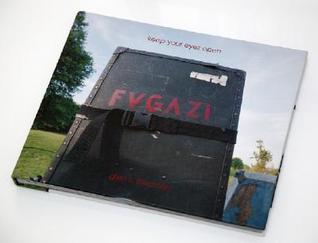
Fugazi, one of music s most revolutionary and gloriously indefinable bands, played their first concert on September 3, 1987. KEEP YOUR EYES The Fugazi Photographs of Glen E. Friedman was released by Burning Flags Press exactly 20 years later. The 112-page, 9 x11 hardcover book presents the best of Friedman's unparalleled photographic documentation of Fugazi's members in almost 200 color and black & white images captured by Friedman onstage and off between 1986 and Fugazi s last U.S. concert in 2002. As Fugazi's Ian MacKaye "While most photographers were taking photos of Fugazi, Glen was making photos with us." Fugazi evolved from Washington, DC's hardcore punk scene of the late 1970s and early 80s. While it would be impossible to fully capture Fugazi in any one medium, Friedman's book effectively complements the band's Dischord Records catalog, including seven studio albums, one soundtrack, three EPs and hundreds of live concert CDs produced from Fugazi s own soundboard recordings. Fugazi's dedication to democratic self-management, including complete artistic and financial control, has allowed the band to offer direct-mail service of its music catalog and the catalogs of many other artists from MacKaye's own Dischord Records. On indefinite hiatus since late 2002, Fugazi also directly booked its tours worldwide, and was often the first band to perform in unconventional venues around the world in order to maintain ticket prices that averaged just $5, a practice that opened many new venue doors to other touring artists. In addition, Fugazi has never marketed or licensed its name or likeness for posters, t-shirts, pins or other ancillary merchandise items. Fugazi's unwavering respect for its audience is one of the band's most indelible marks on modern music.
Glen E. Friedman, (Born 1962) considered one of the most important photographers of his generation, became well known for working with such rebellious artists as Fugazi, Black Flag, Ice-T, Dead Kennedys, Minor Threat, Misfits, Bad Brains, Beastie Boys, Run-D.M.C, KRS-1, and Public Enemy, as well as old school skateboarders like: Tony Alva, Jay Adams, Alan "Ollie" Gelfand, Duane Peters, and Stacy Peralta, among others. Many of his photographs are recognized as the subjects' definitive portraits. His graphic documents of the movement in culture reveal the science of defiance upon which all are based. Friedman's photos reflect the spirit of progression and angst that defined an era. Not only was he in the right places at an extraordinary number of appropriate times, Friedman has helped define the moment and movements he was caught up in. His process was much more incendiary than it was documentary. According to Henry Rollins "The bottom line is that he was there at the beginning of so much cool stuff in so many different areas it's not funny."
"Inspiring people, with integrity and rebelliousness."
For the past quarter century, Friedman has been doing just that.
- Los Angeles Times
"One of the greats of his generation."
- Washington Post
"The most prolific photographer of his generation."
- American Institute of Graphic Arts
"The esoteric political and aesthetic conscience of his generation..."
- Juxtapoz magazine
Glen E. Friedman's captivating images demonstrate his remarkable eye for raw reality, talent and aesthetic beauty. He is, without doubt, one of this generation's most discerning and important photographers, Friedman has documented like no one else.
The very fact that this book exists makes me happy. Any book collecting the work of Glen E. Friedman is worth searching out. But a book dedicated to his history working with arguably the greatest band of the past 20 years? That is a prize. This book is fantastic. The photos are phenomenal, as is most of Friedman's work, and the accompanying essay by Ian Sevonius (?) about the philosophical, economical, musical, and historical aspects of Fugazi leaves you scratching your head with glee, even when you think you agree with what he is saying. This book is a must, a MUST for any fan of this amazing photographer or the seminal band that is represented here.
great photo book for those of us who remember this time / wish we remembered this time / just missed the chance to remember this time.
friedman's photos actually help place the gradeur that was fugazi in a frozen moment. i've tried to explain that they were huge to people who missed them completely. and the photo of the concert in dupont circle. that drives it home in a way that i dont think i could.
and i'll freely admit i never got to see them. and this book makes me wish i had.
The clarity in Glen E. Friedman’s vision played an important and integral part in 1980s/90s punk and hardcore, providing an uncompromising platform to stand on in the era of the witness as activist in punk communities. Glen’s work plunged into the passion of a scene, creating a stoic notion that we could take part in a photograph just by soaking it in. If the composition of a photograph could somehow include the many viewers of its landscape — both then and now — that’s what Glen did. In this book, the open degrees of personality in the framework and storytelling are magnified tenfold in an arc of eras, and you get to be there too, not merely telling on the years but shouting, blowing the proverbial whistle before the opening of a glorious surprise birthday party. Happy Birthday to the viewer; keep your eyes open.
glen e. friedman is probably the greatest music photographer of all time, no one elses photos look like his. the intro essay by ian f. svenonius is so incredible too, i would let him chat my ear off
Even though it’s a photography book, it’s Ian Svenonius’ essay that is the reason to check this out. Friedman’s photos are fine, and a few of them are iconic (Guy contorted and upside-down with the mic!), but many of them don’t lend themselves to coffee table status– a lot of portraits of the band just sort of standing there awkwardly. Svenonius is in top form, deadly serious and entirely unserious at the same time. The interview at the end with the photographer and Ian MacKaye is kind of sad. Friedman is gracious, clearly grateful for being able to have been at the right place at the right time to become Fugazi’s chronicler. And MacKaye comes off as such a jerk, talking about which photos of Friedman’s that he hates and is still bitter about. He sounds straight-up petulant.
Perhaps the definitive visual chronicle of Fugazi's decade and a half storming stages, Keep Your Eyes Open was first published in 2007. Now, the book is back in print with a new afterword by Friedman and a joint interview with the photographer and Ian MacKaye. I reviewed Keep Your Eyes Open for The Current.
If you're a massive fan of Fugazi then it goes without saying that you'll like any scrap of new material related to them... even if it's just a coffee table book of nice pictures. Also includes an essay by the never-less-than-wonderful Ian Svenonius.