Jump to ratings and reviews
Rate this book

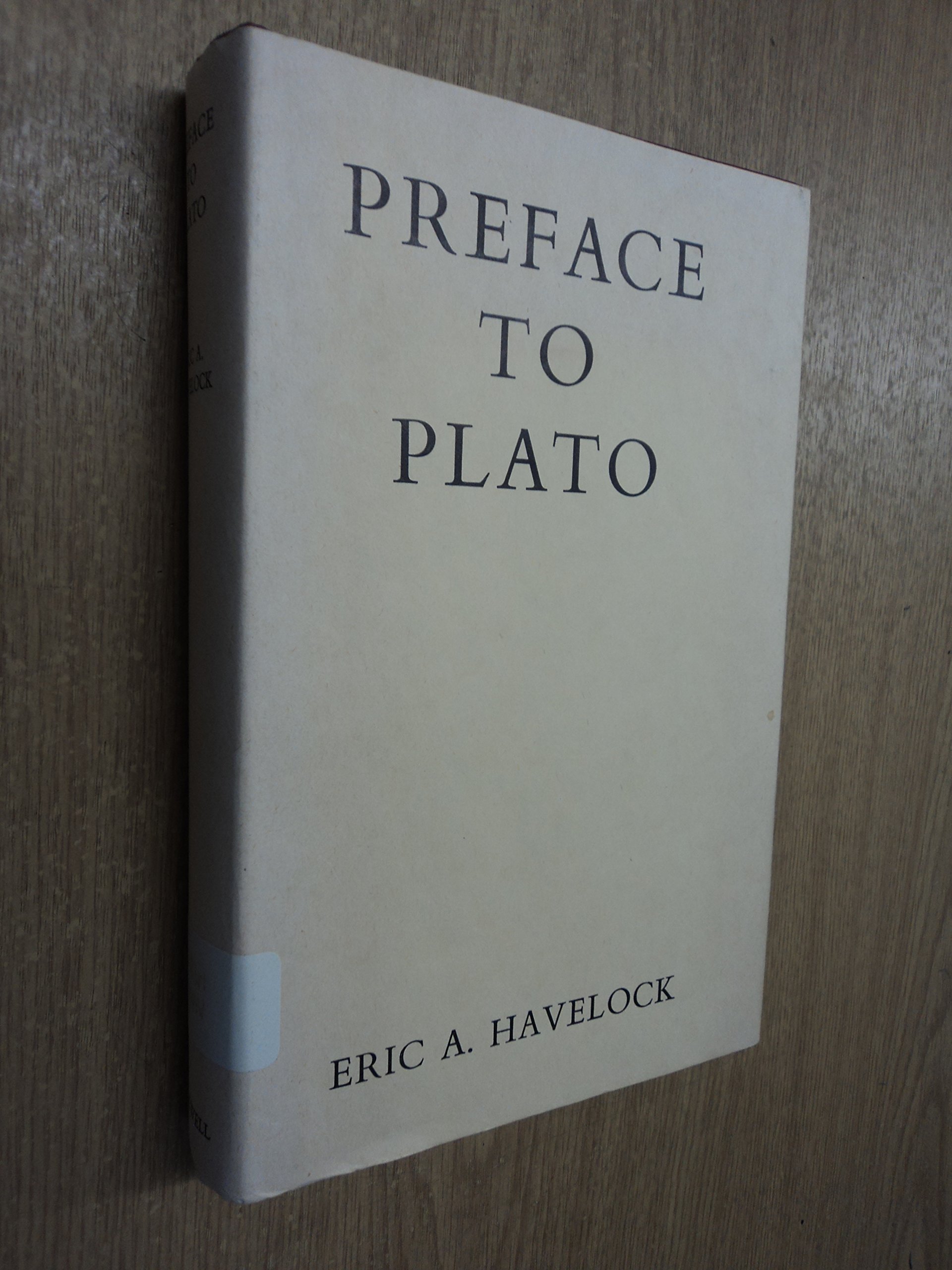
Preface to Plato

Rate this book
Plato's frontal attack on poetry has always been a problem for sympathetic students, who have often minimized or avoided it. Beginning with the premise that the attack must be taken seriously, Mr. Havelock shows that Plato's hostility is explained by the continued domination of the poetic tradition in contemporary Greek thought.

The reason for the dominance of this tradition was technological. In a nonliterate culture, stored experience necessary to cultural stability had to be preserved as poetry in order to be memorized. Plato attacks poets, particularly Homer, as the sole source of Greek moral and technical instruction--Mr. Havelock shows how the Illiad acted as an oral encyclopedia. Under the label of mimesis, Plato condemns the poetic process of emotional identification and the necessity of presenting content as a series of specific images in a continued narrative.

The second part of the book discusses the Platonic Forms as an aspect of an increasingly rational culture. Literate Greece demanded, instead of poetic discourse, a vocabulary and a sentence structure both abstract and explicit in which experience could be described normatively and analytically: in short a language of ethics and science.

344 pages, Hardcover

First published January 1, 1963

40 people are currently reading
867 people want to read

About the author

Eric Alfred Havelock

15 books14 followers
Eric Alfred Havelock was a British classicist who spent most of his life in Canada and the United States. He was a professor at the University of Toronto and was active in the Canadian socialist movement during the 1930s. In the 1960s and 1970s, he served as chair of the classics departments at both Harvard and Yale. Although he was trained in the turn-of-the-20th-century Oxbridge tradition of classical studies, which saw Greek intellectual history as an unbroken chain of related ideas, Havelock broke radically with his own teachers and proposed an entirely new model for understanding the classical world, based on a sharp division between literature of the 6th and 5th centuries BC on the one hand, and that of the 4th on the other.

Much of Havelock's work was devoted to addressing a single thesis: that all of Western thought is informed by a profound shift in the kinds of ideas available to the human mind at the point that Greek philosophy converted from an oral to a literate form. The idea has been very controversial in classical studies, and has been rejected outright both by many of Havelock's contemporaries and modern classicists. Havelock and his ideas have nonetheless had far-reaching influence, both in classical studies and other academic areas. He and Walter J. Ong (who was himself strongly influenced by Havelock) essentially founded the amorphous field that studies transitions from orality to literacy, and Havelock has been one of the most frequently cited theorists in that field; as an account of communication, his work profoundly affected the media theories of Harold Innis and Marshall McLuhan. Havelock's influence has spread beyond the study of the classical world to that of analogous transitions in other times and places. (wiki).

Ratings & Reviews

What do you think?
Rate this book

Friends & Following

Create a free account to discover what your friends think of this book!

Community Reviews

5 stars
116 (49%)
4 stars
71 (30%)
3 stars
36 (15%)
2 stars
8 (3%)
1 star
2 (<1%)
Displaying 1 - 17 of 17 reviews
Profile Image for Tim.
109 reviews
May 18, 2010
For those billions of you loosing sleep each night trying to figure out why Plato was so hostile to poetry in the Republic, this book will give you sweet dreamless sleep, whiter teeth, and shrink your waistline while you feast on chocolate and pork rinds. And it might even be half true!
Profile Image for Arman Raina.
3 reviews
June 24, 2015
My summer project of reading Ancient Greek Philosophy got off to a rough start when I stumbled through Plato’s Republic. Expecting an insightful, albeit idealistic political solution, I was sorely confused. Interspersed between polemics against Poetry and Homer, I found traces of a simplistic, totalitarian regime. Even the running of this regime was not elaborated upon, except in the branch of education.
After scouring the internet wildly for answers, I found two likely solutions to my quandary. The first, was the following review: https://www.goodreads.com/review/show...
The second was this book.
From what I understand, Havelock’s fundamental aim is to trace the transformation in the Greek Mind through Plato’s writing. The main premise is that Plato’s society was still largely illiterate, and thus Plato’s attack against Poetry is in fact an attack on a ‘pre-literate’ source of knowledge that is lacking in logical consistency and factual correctness, that we take for granted in our own encyclopaedias. Havelock is arguing that Ancient Greeks literally ‘believed’ in Poetry, and this is the rational for Plato’s attack. From this perspective, the state that is constructed in Plato’s Republic is simplistic because it is brought in only for the sake of the argument on Poetry. The details in education are given because of the role Poetry played in Ancient Greek education, and this is the aspect of Poetry that Plato is attacking.
Havelock makes a lot of other insightful points about vocabularly etc, half of which went over my head. Aside from the the Republic and Homer’s Odyssey, I haven’t read any of the other sources he quotes. Further I do not understand Greek. For these reasons, it’s possible that the evidence Havelock brings to support his claim is faulty. However, the construction of his hypotheses, whether they are validated by fact or not, is intriguing in itself. He really made me think, and question in a way I was not used to. For example this is how it starts:
“It sometimes happens in the history of the written word that an important work of literature carries a title which does not accurately reflect the contents. A part of the work has become identified with the whole, or the meaning of a label has shifted in translation. But if the label has a popular and recognisable ring, it can come to exercise a kind of thought control over those who take the book in their hands. They form an expectation which accords with the title but is belied by much of the substance of what the author has to say. They cling to a preconception of his intentions, insensibly allowing their minds to mould the content of what they read into the required shape.
These remarks apply with full force to that treatise of Plato's styled the Republic. Were it not for the title, it might be read for what it is, rather than as an essay in utopian political theory. It is a fact that only about a third of the work concerns itself with statecraft as such. The text deals at length and often with a great variety of matters which bear on the human condition, but these are matters which would certainly have no place in a modem treatise on politics.”

Where have you been all my life? Not only is he answering my concern about the lack of political theory, he is making the seemingly obvious hypothesis that maybe it is not about political theory at all. The presentation of this hypothesis, however, disguises its sheer brilliance. Through all my confusion, I not once doubted that Plato aimed to write on political theory.
“So it is that the long sleep of man is interrupted and his self-consciousness, separating itself from the lazy play of the endless saga-series of events, begins to think and to be thought of, 'itself of itself', and as it thinks and is thought, man in his new inner isolation confronts the phenomenon of his own autonomous personality and accepts it.”

This comes at the end of the chapter in which he draws a link between the transformation from an oral to written culture, and how it results in a realization of self. Not sure if I buy it completely, however, it asks really interesting questions about the impact of our means of communication on our fundamental thinking. The way he describes the process of self-realization is equally fascinating.
“Yet the day would come when the original drive of the Platonic method would revive, and the phenomenal flux would once more be examined and penetrated and subordinated to categories of explanation which possess a wholly abstract integrity. And when this day came, science would awaken again.”

While this is slight less original, in that he seems to be merely documenting the return of ‘rationalism’. However, while few people claim to be Platonic idealists, the way we continue to describe our world in abstractions definitely has deeper parallels to Plato then I initially thought. Once again, his description of this historical process is in itself, thought-provoking.
Ultimately, Preface to Plato not only helped me understand Plato’s Republic better, as an exposition of hypotheses, it is commendable.
Profile Image for Ted Newell.
Author 4 books10 followers
July 22, 2016
Simply excellent. Makes sense of the transition involved in thinking by memorized narratives versus writing -- that is, abstraction. I'd say "page turner" but that'd be way too strong. Still, many juicy bits like the singing Turkish soldiers of W W 1 who, still part of the narrative epic culture, spoke in near rhyme.
Profile Image for Pedro.
26 reviews1 follower
April 22, 2020
Es un estudio que trata de poner sobre relieve algunos asuntos del texto La República del filósofo griego: la confrontación entre mito y logos, entre el poeta (conciencia de oyente) y el filósofo (otra forma de conciencia, otra psyche).
Profile Image for Mikey.
263 reviews
December 31, 2023
LITERATURE in PUNK ROCK - Books #57-58
------------------------
SONG: The History of the Concept of the Soul
BAND: Mr. T Experience (MTX)
ALBUM: Night Shift at the Thrill Factory (1988)
BOOKS:
- Preface to Plato by Eric Havelock (1951)
- The Greeks and the Irrational by ER Dodd (1953)
https://youtu.be/a_BiQkZSXhQ?si=natrA...
------------------------
"The History of the Concept of the Soul" by MTX is frequently reported as the "punk rock song" version of the lead singer's thesis or doctoral dissertation. However, a 2021 blogpost by Frank Portman, lead singer of MTX, clarifies the song development as a "stunt" to "...condense an undergraduate essay into a three verse, one minute twenty second punk rock song, with notes."
While the lyrical (sung) footnotes cite "The Greeks and the Irrational" by ER Dodd, the majority of lyrical content (1st and 2nd verse) is comparatively focused on theories of orality and literacy espoused in Eric Havelock's Preface to Plato.
According to Havelock, Plato's Republic is argument against a Homeric (oral/pre-literate) State of Mind, a collective-memory enforced through Poetic Repetition/Mimesis. The dominant Homeric oral-poetry-as-a-cultural-medium is contrasted with an embattled shift towards a Platonic State of Mind, in which mathematics and paper-writing (via introduction of the alphabet) establishes an abstraction for self-reflection and critical analysis (i.e.: separation of the knower from the known).
Akin, the 1st and 2nd chorus progress from how "Early Greek thought played a role, in the complicated history of the soul" towards the development Platonic State of Mind in which "Modern thought was (now) possible, in the complicated history..."
Havelock's theory coincides alongside lyrical juxtaposition (3rd verse) with ER Dodd's view on the influence of nascent Pre-Socratic Naturalist thought (i.e. Pythagorean or Orphic doctrines) as contemporary views on the soul whom were eclipsed in the absence of comparative "mystic" Platonic metaphysics.
This is the incredible
Complicated history of the concept of the soul
Rock and roll!
https://drankf.medium.com/too-vague-t...
Profile Image for Davide Di Tullio.
109 reviews
May 30, 2024
Saggio di una chiarezza strepitosa! Havelock di conferma un grande intellettuale e un fine conoscitore della civiltà greca. In questo viaggio dalla Grecia arcaica fino a Platone, l'autore ci svela come la è cambiata la comuicazione e quali sono le ragioni che hanno portato al tramonto del poema epico, soppiantato dal logos moderno. Un viaggio che segue passo passo la progressiva imposizione della comunicazione scritta che sostituisce quella orale degli aedi e dei rapsodi. Un viaggio lungo almeno tre secoli, che ha così imposto il dominio del "concetto" e dato vita alla figura moderna del Filosofo, classificatore del mondo, al posto del Poeta, interprete dello stesso. Un'invenzione, quella della scrittura alfabetica, che ha avuto risvolti etici capitali e rivoluzionato un mondo, gettando le basi della cultura occidentale.
Profile Image for aa.
76 reviews35 followers
August 23, 2024
Maybe Plato hated poets because the ancient epics were from a pre-literate era, and literacy leads to abstract thought, which Plato's forms were all about.

Probably not. This idea is very unpopular now, and is seen as elitist for relegating oral traditions to an inferior status. I've also heard that Havelock's claims about literacy and abstraction are not backed by the research.

Interesting that the book is rated very high on Goodreads despite its low reputation in academia. Maybe it's Havelock's depiction of stark differences in subjectivity or worldview. It's interesting to try thinking about what other supposed states of consciousness are like.
285 reviews5 followers
October 14, 2017
Compelling argument focused on the transition from a society dominated by the oral transmission of knowledge to one where the written word is the principle vehicle of knowledge. Got me to think in new ways about Homer and Hesiod, as well as about Plato and the world Plato imagined was possible. I would like to know a bit more why Classists were less than enthusiastic about it.
Profile Image for s.
83 reviews4 followers
July 2, 2022
speculative but compelling attempt at charting the transition from oral to literate philosophical culture through a creative reading of plato's attack on 'poetry', sometimes veers close to bicameralism-style thinking but the substance of it is deeply interesting even if you have to think around that stuff.
Profile Image for Pablo.
Author 18 books96 followers
Read
July 4, 2022
MECLAP reading
Profile Image for Tomás García.
Author 2 books4 followers
October 6, 2024
Imprescindible para entender a Platón y el origen de ese “amor al estudio” y “resistencia a la presión social”, de esa “música suprema” llamada filosofía.
Profile Image for David.
41 reviews
August 29, 2024
al principio no me convencía nada, menos mal que no lo abandoné porque menudo espectáculo de libro
Profile Image for Brett Matthews.
23 reviews1 follower
August 25, 2025
Havelock writes here an extremely ambitious book, and he writes it pretty well. Havelock cites copiously, both primary and secondary sources. But his main text stands alone, with almost no demand on the reader to know any of the cited work. His writing is thorough and systematic, and compared to his contemporaries like Harold Innis or Marshall McLuhan, who often struggle to make sense, it is a dream to read. He is at least as good a scholar as Walter Ong, and a better writer. He somehow manages to take a narrower and superficially more constrained topic than Ong's "Orality and Literacy" and transform it into a book that has, if anything, a more ambitious scope.

At the heart of the book is Havelock’s thesis that Plato’s major work, "Republic", was principally a passionate attack on poetry – conflated by Plato with almost all education and learning that took place in his culture. The attack was passionate because - as literacy was rapidly spreading among the male citizens of Athens, Plato felt it to be impossible to clear the ground for the rise of a rationalistic, scientific and literate culture without throwing out poetry first.

Key to his critique is the concept of ‘mimesis’. This was a kind of experience in which those listening to the revered bards of the day, playing their lyres and telling their stories, became at one with the characters and the situations. Mimesis is more than empathy – it is complete identification. Plato was arguing that this approach to learning his culture's content, and to handing it down from generation to generation, effectively ruled out science, rationality, and genuine learning.

Plato’s critique was not of poets in a general sense, but the whole institutional infrastructure surrounding poets and poetry in Athenian society. Plato makes this sound more like a religion than the art we today association with Homer. His critique parallels the demands from atheists that we rid the world of religion, often for very similar reasons.

But I'm also reminded of how Robin Wall Kimmerer, in "Braiding Sweetgrass", reacted to her formal studies of biology. How she deeply respected and diligently learned the content, but felt that something important was missing; something she found by celebrating nature – and experiencing a kind of mimesis in nature - through her indigenous traditions.

There is no question that dissociation from a topic can lead to deep insights that would otherwise be impossible. Exactly this sort of dissociation from nature by science has not only supported tremendous growth in human knowledge, but tremendous increases in the power of scientifically-minded societies. But at what cost? And is it possible, as Kimmerer appears to believe, to have both – to maintain both identification and dispassion in the same person?

Was Plato advancing a false dichotomy? Is the required separation really so sharp, so unambiguous? This is one reason the social and human sciences become so problematic – it is impossible for us as humans to be dispassionate about ourselves.

Is there not a better science, waiting for us to find it, that marries the best of orality and literacy?

Havelock argues that every piece of important information in an oral society must be phrased memorably, with poetic effect, in order for it to be retained. He implies that the advent of writing and print freed us from this imperative. Yet riding on the subway today I was reminded that this is not true.

“Help keep the TTC safe. If you see any suspicious activity, notify TTC staff, or a police officer. If you see something, say something.” This final line is the one people are expected to carry away with them, and it fully fits the parameters of poetic and memorable that apply to oral cultures. This line is violently anti-rationalistic and anti-scientific. People see things all the time, but the notice is not asking people to report everything they see. We accept as a matter of common knowledge that “if you see something” has a very specific meaning. That is precisely why the phrasing is so memorable.

Why, in an era of rationalism and science, do we still use this sort of phrasing?

Because it still has power, no matter how much science and rationality whittle away at this type of power.
16 reviews
October 10, 2007
This book completely transformed my world view. It was originally recommended by an ancient languages scholar at U. Mich. after I asked how one could tell which parts of the Old Testament were transcribed later from an oral tradition vs. which ones were "only" written.
Profile Image for Jesse Whyte.
43 reviews2 followers
April 9, 2014
One of those books that I encountered too late. But when I did, it suddenly synthesized years of related reading. Coupled with Luc Brisson's "How Philosophers Saved Myth", and it's the perfect preparation for reading Plato and Aristotle.
Profile Image for Egor xS.
153 reviews55 followers
November 20, 2012
If an enlightening enterprise in archaealogy of knowledge into the Platonic Revolution, then a bit tautological one.
Displaying 1 - 17 of 17 reviews

Can't find what you're looking for?

Get help and learn more about the design.