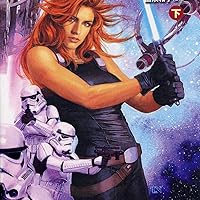
The thrilling look into the High Republic era of Star Wars continues!
After the destruction of STARLIGHT BEACON, the JEDI have faced one devastating blow after another! Who survived the catastrophes brought on by the DRENGIR, the NIHIL and the NAMELESS and who died? And most importantly who will step up to the forces causing chaos in the galaxy? YODA is joined by unexpected allies to form a council prepared to wage the ultimate war for justice and peace! Following the best-selling story set in the golden age of the Jedi.
COLLECTING: Star Wars: The High Republic - Shadows of Starlight (2023) #1-4.
Charles Soule is a #1 New York Times-bestselling novelist, comics author, screenwriter, musician, and lapsed attorney. He has written some of the most prominent stories of the last decade for Marvel, DC and Lucasfilm in addition to his own work, such as his comics Curse Words, Letter 44 and Undiscovered Country, and his original novels Light of the Jedi, The Endless Vessel, The Oracle Year and Anyone. He lives in New York.
This is a collection of comics that tells the effects the downfall of Starlight Beacon had on various characters. This event happened at the end of the Phase I of the High republic series. This collection leads us into Phase III which takes place after Phase I.
I didn't think that this was anything special as it is basically a position piece for characters. When the next phase hits these characters might be in a different situation than the one at the end of the last time we saw them. This collection tells how these characters got there. So nothing really happens in this collection. Anything of importance will happen in the subsequent offerings. We just see how everyone is devastated from the disaster and that they are not done fighting. Good for them but I somewhat believe the first novel in Phase III should have handled this. I can see why the powers to be did it this way as it saved on exposition in the first book if they saved it for that. But there is no excitement or drama. Just a bunch of sorry sacks that need vindication. The highlight for me was the artwork which was not perfect. Issue two had some major issues with a bunch of panels. It looked like they were drawn against a deadline with very little detail.
Nothing really special here. The only reason to read this would be if you know exactly where every character was at the end of the first phase and you would be confused why they were in a different spot in the new phase. I would have not noticed this with the characters so this really was not for me. I want to be entertained when reading in this universe. This was not as it is the definition of a set up piece.
Son cuatro números separados que cubren el periodo posterior a la novela "Estrella caída", pueden ser inmediatamente después de la destrucción del Faro Starlight o un año después. Los jedi se están reagrupando en Coruscant. Allí hay una gran reunión donde presiden los Grandes maestros Pra-Tre Veter, Lahru y Keaton Murag, Oppo Rancisis, Ada-Li Carro, Teri Rosason y Yarael Poof implementa los Protocolos Guardias que son una serie de medidas extremas para acelerar entrenamientos de padawans y convertirlos en caballeros, Etc. Elzar quiere ir a buscar a Avar pero Yoda dice que no. Además este trae a Azlin Rell, un caballero jedi que abandonó a la orden y aparentemente conoce a los "Sin nombre". En el segundo número están Avar Kriss y Elzar Mann compartiendo sus pensamientos luego del desastre. Elzar le cuenta lo de Chancey Yarrow. Avar decide no ir a Coruscant y buscar a los Nihil. En el tercer número nos cuentan lo que sucede con Bell Zettifar y cómo se vuelve caballero con Burryaga. En el último número se nos cuenta la perspectiva de Marchion Ro. Él sigue con Ghirra Starros y están juntos en Hetzal. Tratan de llegar a un acuerdo con la generala Abediah Viss.
A great set of stories after the fall of Starlight Beacon. Great stories, great artwork, and character development for later as well.
How will the Jedi react? What is Yoda's desperate gambit? Facing failure is new for Avar Kriss. Will she return with the other? Young Bell has lost so much and so many to Nihil. Can he get someone back? Marchion Ro has had his greatest triumph so far. What will he do next? Who will he be at his side?
There is so much going on and so much potential for things to come. There is a lot to look forward to, and blanks to fill in from the books and comics of Phase 3. The book finishes with a huge varient cover gallery.
Review ⭐⭐⭐⭐⭐ Die Hohe Republik: Im Schatten der Starlight
Mit einer Miniserie erleichterte Marvel Comics den Lesern den Übergang von der zweiten in die dritte Phase der Hohen Republik und beantwortete eine entscheidende Frage, die „Gefallener Stern“ aufwarf: Wie sieht die Galaxis ein Jahr nach dem großen Sieg der Nihil aus?
Die Handlung:
In vier abgeschlossenen Teilen begleitet der Leser Yoda, Elzar Mann, Bell Zettifar und Marchion Ro, die alle ihre ganz eigenen Sorgen und Befindlichkeiten nach dem Sturz der Starlight Station haben. Die Jedi aktivieren die Wächter-Protokolle und rufen alle vom Meister bis zum Padawan nach Coruscant. Die Suche nach Überlebenden und Freunden und nach dem namenlosen Jedi-Killer dauert an. Marchion Ro will sich ins Gedächtnis der Republik mit einer „Feierlichkeit“ zum einjährigen Jubiläum der Katastrophe zurückrufen.
Meine Meinung:
„Im Schatten der Starlight“ ist perfekt gelungen und man hofft eigentlich noch mehr dieser Hefte irgendwo zu finden. Charles Soule ist es gelungen die Geschichte der Hohen Republik ereignisreich und gleichzeitig logisch fortzusetzen. Als wiederkehrender Leser findet man sich schnell in die Story zurück, die die erste Phase zurückließ. Die Schicksale der Jedi sind ergreifend und vielfältig. Der Umstand, dass ihnen seit langer Zeit ein scheinbar übermächtiger Feind entgegensteht, wird überdeutlich und dramatisch dargestellt. Darüber hinaus hat Soule einige nette Querverweise eingebaut. Die künstlerische Gestaltung wirkt gekonnt und lässt nichts zu wünschen übrig.
Fazit:
Ein Must-Have für den Beginn der dritten Phase - sowohl als Reminder als auch als Einstimmung. Künstlerisch und erzählerisch gekonnt.
Werbung: Vielen lieben Dank an Panini für die Bereitstellung des Rezensionexemplares!
Shadows of Starlight was primarily the flashbacks and backstory from the "Eye of Darkness" novel, but it was amazing to be able to reconnect with the graphical representations of the characters from Phase One. Phase Two was good, but way too long, and I was glad to read this for the reconnection. Recommend. Great way to reconnect Phase One to Three.
The biggest issue I’ve had with The High Republic books is the overload of characters and information all at one time. This one steps back and expounds upon what we have known to have already happened with some characters we’ve already been introduced to. I really enjoyed this volume because of that and also the threat that is looming very seriously over the Jedi.
A really good collection of stories that show us what some of the main characters of The High Republic were doing in the year following the fall of Starlight Beacon.
I really enjoyed these, especially the first issue with Azlin Rell. He was an extremely interesting and tragic character in Phase 2 and I’m excited to see how his story plays out in Phase 3.
This comic series did a fantastic job at getting me pumped for Phase 3! On to the next!! 4.5/5 stars 🤩
This collection does a great job of showing what the different characters were up to after the fall of Starlight Beacon. Everyone is so flustered and emotional, and they’re just charging into situations without fully thinking of the consequences. It’s such an interesting take on the Jedi and shows how much the Nihil have messed up the entire Jedi order.
A series of 4 issues laying the foundations for the next novel. Nothing ebourrifying as such - it's too short and a simple prelude - but a priori important for grasping the starting situation of The eye of darkness.
I read the first two waves of the third phase of the High Republic era before I read this, which serves as a transition from the first to the third phase. I understood everything perfectly in the novels of the third phase: My mind was able to fill in the gaps. So this seems kinda superfluous to me?
6/10. + Some nice Marchion Ro stuff. - Mostly just repeats story beats from The Eye of Darkness and For Light and Life. - No cohesive story or bridge between the minor plots.
Star Wars: The High Republic - Shadows of Starlight seamlessly picks up the narrative in the aftermath of the catastrophic events that have shaken the High Republic era. The destruction of STARLIGHT BEACON has left the Jedi grappling with immense challenges from the DRENGIR, NIHIL, and the NAMELESS. This gripping continuation of the High Republic saga introduces unexpected allies as Yoda leads a council determined to restore justice and peace to the galaxy. The comic masterfully explores the aftermath of the previous conflicts, shedding light on the fates of key characters and building anticipation for the battles ahead. With engaging storytelling and captivating artwork, this installment proves to be a compelling addition to the High Republic narrative, delivering an immersive experience for fans eager to witness the Jedi's resilience in the face of adversity.
This mini series covers the year between Phase 1 and Phase 3 of the High Republic Era (of course with Phase 2 taking place about 100 years before Phase 1). This series documents the Republic and Jedi response to the fall of the Starlight Beacon and the Nihil setting themselves up as not just raiders but a contending galactic state to rival the Republic. It sets up this interesting story with the Nihil Storm Wall which acts like a space dome locking off a huge chunk of the galaxy so that only Nihil can pass through. This series single handedly renewed my love for the High Republic and has inspired me to catch up with the novels so I can read Phase 3 when it continues this year.
I was late to catching up with this one, I had already read The Eye of Darkness and Defy the Storm and felt like I was missing some pieces, which this collected provides. These 4 issues jump around to different people and locations to show how the aftermath of The Fallen Star affected them. This makes it so that each issue mostly focuses on a perspective with some others thrown in. This way we end up with rather brief episodes of these characters making for often hurried arcs and key moments. Something I have been critical of in Scott’s mainline High Republic comics. That said, I did enjoy the glimpses we got, they add a lot to the transition of Phase 1 to Phase 3 and includes some essential events that lead up to The Eye of Darkness.
Issue #1 mainly deals with how the Jedi at large dealt with The Fallen Star events, the activation of the Guardian Protocols which echo the struggles of the Jedi during the Clone Wars and shows obvious trends that would later determine standard Jedi doctrine and protocols we see in the prequels. The latter half focuses on Yoda bringing forth Azlin Rell to help with the Nameless problem which had some fantastic moment!
Issue #2 focuses on Avar and especially Elzar’s struggles coping with his trauma and insecurities. It is very interesting to see him slip down to the state we find him in The Eye of Darkness.
Issue #3 had Bell’s perspective, I like him and Burryaga, but felt the first half was kind of unnecessary, most of that story is told adequately enough in Tales of Light and Life and The Eye of Darkness, with page space coming at such a premium. That, said, it does include some absolutely amazing Pra Veter moments.
Issue #4 deals with the growth of the Nihil in the year after The Fallen Star. It highlights Marchion’s apathy and gives fantastic intros to his close council, or ministers, as we find them in The Eye of Darkness. Reintroducing General Viess was awesome.
So, like Scott’s other comics, I sometimes felt less connected to the character as I might have been if they’d gotten more time to naturally develop. The short glimpse format makes this especially jarring at times. But I did also really enjoy seeing all those people deal with the traumatic events in their own way and do consider this to be a very important read to bridge Phase 1 and 3. The art was often great, which is always important to a comic.
Finally got around to reading the first comic in the series this evening. It seemed longer than some of the other comics in the High Republic era have, but perhaps that makes sense because there are only four projected comics for this series and it is one of the transitional entries that we have to first establish and set up for Phase III of the High Republic era.
I think that we are seeing more of that transformation of the Jedi from Phase I into the PT Jedi. Lightsaber styles are being simplified, and the Jedi Order is centralizing on Coruscant, basically abandoning the outposts and relying on droids to staff them and relay reports of where the Jedi are needed back to the Temple on Coruscant. Even if these changes are envisioned as being temporary, it seems that some might have become permanent and stuck around even after the Nihl threat is eliminated.
Also, some of the Protocols of the Guardians stuff that was being invoked with regard to introducing younglings to lightsaber fighting at an earlier age and the urge to Knight Padawans earlier than they would have under other circumstances reminds me a lot of what happened during the Clone Wars. It wouldn't surprise me if there are some significant consequences for the Jedi Order as a whole and for some of the Jedi who are Knighted too early and too quickly in particular.
This comic definitely whetted my appetite for Phase III and made me want to re-read some of the Phase III transitional content from the Tales of Light and Life book as some of the characters seemed familiar to me from there.
Yoda did really annoy me in this comic, though. Perhaps even more than he annoyed me at the end of Phase II when I ranted about how he and Creighton Sun basically unilaterally decided to hide the information about the Nameless when the Path of the Open Hand was defeated on Dalna because they thought the Jedi would panic and whatever. Now he is making all these sanctimonious statements about delving into the secrets of the past to understand the present, and I'm like, "Yoda, you made those secrets of the past, and you still aren't being forthright with even your fellow Jedi Council Members about that." And I think he even comments about needing to do research in the Archives, and I was like, "Uh, Yoda, remember when you and Creighton Sun made that executive decision to not preserve the information in the Archives because you didn't want the other Jedi to panic so there is nothing for you to research there." It just really rubbed me the wrong way to see Yoda being so smug about finally getting around to doing research into the Nameless about a century too late, and still not being forthright with even the most senior-ranking of his fellow Jedi even now that his past secrecy is coming back to bite his fellow Jedi in the backside.
It's not a negative in terms of the comic itself (which I enjoyed and ranked 4 stars on Goodreads), but it definitely doesn't cast Yoda's character in a particularly positive light to me.
Looking forward to the rest of the series and to Phase III as a whole!
This graphic novel collects issues 1-4 of The High Republic Phase III Volume 3: "Shadows of Starlight". While given the Volume number of 3, it is actually also its own set of stories, taking place after the events of Phase I, but written as a segue into the events of Phase III. The graphic novel features four different snippets of events directly after the fall of Starlight Beacon and spanning across the year between the fall and the birth of the Stormwall.
Issue 1, "The Guardian Protocols," brings all the Jedi back to Coruscant with a change in Jedi protocols and procedures. It is a key set-up for the Jedi Order moving forward, including insights from Elzar Mann, Grandmaster Yoda, Reath Silas, and Azlin Rell (boy those are quite some name drops!!). Issue 2, "A Resonance of Hope," is more focused on Elzar and Avar Kriss. After the fall, Avar does not follow the call to Coruscant, but rather continues to help those afftected by the Nihil how she can. The emphasis on Elzar and Avar's relationship shows a side that the Jedi should not succumb to, yet demonstrates the humanity within everyone, no mater what you believe or follow. After the Stormwall goes up, Avar is among the "missing," yet she is right where she needs to be: behind the wall, listening for the song of the Force, and ready to bring down the Nihil. Issue 3, "The Will of the Force" follows Bell Zettifar, who is reluctant to leave the remains of Starlight behind, with a hunch that Burryaga is still alive, even though he is among the missing. Bell still doesn't give up, and while reluctant to attain Knighthood before, events have shaped who he is and who he now wants to become as a Jedi. And we can't forget about his charhound, Ember! Issue 4, "Ever Victorious" is neat because it features Marchion Ro and the Nihil perspective between their celebrations of the fall of Starlight Beacon and the rising of the Stormwall.
I found this particular collection absolutely phenomenal. I love the detail in the art, especially how the costuming and expressions emphasize the characterization. Not only that, but they do a great job of showing the passage of time through the art as well, with hair style/growth (including facial hair) or hardened features to show younger characters as having physically matured. The fall of Starlight Beacon is a major detriment to the Jedi Order and operations, yet there is still a remnant of hope for those mereley missing and not confirmed dead. This is a driving force for many of the Jedi and is a key element leading into the Phase III events. What I really like about this collection is everything it brings in from Phase I and even Phase II. It connects the present to the past with iconic characters from both Phases, while also setting the stage for the events with bringing down the Nihil and the Stormwall. I loved seeing Reath, Bell, and Azlin all in the same set of events, bringing tohether the Young Adult and Adult narratives from the new canon. While it fills in some gaps, others are left untold here, but the reader is reffered to Tales of Light and Life for some more filling-in of events. I'll be making my way to that collection soon!
A great kickoff to Phase III! Picking up right after the fall of Starlight Beacon, we get updates on where everybody is and what they do in the year since Starlight's destruction before Eye of Darkness picks up. Avar, Elzar, Bell, Yoda, everybody.
We also get plenty from Marchion and the Nihil. They want the Jedi out of their business, so they implement a Stormwall around a large chunk of the Outer Rim. The Jedi and Republic can't get through it. Hyperspace jumps only result in destruction, and the Nihil will attack anyone who tries to enter otherwise. They've almost truly succeeded, but they need to keep the Jedi and Republic out permanently. Of course, they're working on that
Things are worse than they've ever been, and the Republic and Jedi are hard-pressed for a solution. In response to the Nihil threat, the Jedi Council authorized the use of Guardian Protocols. These are meant to protect the Jedi from the Nihil and the Nameless. It also loosens to standards for Padawan promotions to full-fledged Jedi Knights. It's my assumption that these were also implemented during the Clone Wars. The protocols' existence makes sense, and this would be the best time to use them, if ever.
Azlin Rell from Path of Vengeance makes an appearance. I thought he would be important since he was a new, named character. I look forward to more of him. He's so interesting.
Also, I recommend reading Bell's short story in Tales of Light and Life before starting this comic. It's something close to "A Jedi Walks Their Own Path."
This entire review has been hidden because of spoilers.
Opening in 229 BBY, a year after the fall of Starlight Beacon, this book flashes back through that year to reveal the state of the galaxy and the Jedi in particular in the run up to Phase 3 of The High Republic publishing programme. With the Nihil having claimed a large section of the Outer Rim, the Republic and the Jedi Order are reeling from their defeats and struggling to find their way forward. Whilst most Jedi are recalled to Coruscant, some choose to stay to combat the Nihil and become trapped behind Marchion Ro's hyperspace Stormwall.
This book's real-world purpose is so painfully obvious that it immediately detracts from enjoying the content within. Due to the insane way the High Republic publishing programme has worked (they thought they were being clever by mirroring how the Skywalker Saga was released... they weren't) it means that many readers will have totally forgotten the who/what/where of the end of Phase 1, which is all stuff you need to know for Phase 3. So this book then is here to remind us of those things. That's not entirely a bad thing, but I definitely felt that a proper cohesive story which trusts its readers to extrapolate the backstory would've been better.
The one thing I really did like about this book is that, for the first time, it shows the High Republic stories having a larger impact on the Star Wars universe. Instead of just being isolated from the rest of the Star Wars narrative here we see things that contribute to the status quo of the galaxy two centuries later, in particular the Jedi Order adopting a more centralised, militant and Republic-led way of operating.
One alarming question this book also posed, that I still haven't reconciled my feelings on, is that Yoda might not only be a bad Jedi, but might be personally responsible for everything that goes wrong with the Order. Among his many mistakes here are a) standing right next to a Jedi talking about how little the Order knows of the Nameless without saying a word, when he was the one who covered-up their existence 150 years earlier (in Phase 2), b) giving a self-confessed Dark Jedi the tools and opportunity to commit mass murder and c) disappearing for long periods of time just when the Order most needs leadership. Now I'm reassessing his entire character arc through the Star Wars Saga in a much more suspicious way (again, it's him who suggests hushing-up Dooku's connection to the creation of the clone army in The Clone Wars...).
Blogger Note: This is the first time I've ventured into The High Republic timeframe in any form so I can't speak to it's connection to anything before these graphic novel collections nor any connection to the new Disney series, The Acolyte, so I'll just review as is. (EDITED NOTE: I have since discovered the chronological order and that I have read a couple out of that order. However, like the movies long as you are able to read a particular story arc together the rest isn't that important, just something to keep in mind.)
In Shadows of Starlight we get to see different journeys following the Starlight Beacon's destruction. Some characters are known to me from Phase 1, some are new(to me at least as I've only recently dived into The High Republic era), and then of course there is Yoda who we all know and love.
There are questions left open from Jedi's End we see answered but there are others we see begin. We also get to see where Marchion Ro and the Nihil are "putting down roots". I loved looking into the year following Starlight's fall from multiple angles but I'd love to see more too because yes, answers were given but a few more questions were presented. Perhaps Phase 3 will bring some of those forward, so I guess I better head off to start Children of the Storm. Again, another great look at the history in the SW Universe.
I want to rate these higher but a consistent problem I’ve been having with this whole High Republic series by way of Marvel’s contributions is that I can’t remember what is going on, who the characters are, and who has died from series to series. I know Burryaga was in some of the kids books (like picture books), so I’m also really thrown by what degree all their content is feeding one into the other. Maybe this is my own fault for not reading the novels but as they’re written in the comics, I just really have so little connection to these characters and what they’re doing. Marchion Ro and Boolan are really the two other characters I recognize beyond Avar Kriss. And Kriss has just…done very little and her narrative here ends on something of an unclear cliffhanger in the middle of the TPB. Am I just missing threads connecting to other content outside these comics I should be aware of?
A follow-up to the events of earlier Phase 1 titles, Shadows of Starlight serves as a sort of After Action Review of the catastrophic events that occurred to the Jedi in the culmination of the earlier titles. Though it's not the strongest graphic novel in the series, Shadows fills in some gaps in preparation for the Phase 3 books.
My biggest criticism of this and all of the High Republic comic titles as they have metastasized is how hard it is to keep track of them all! Marvel should release a flowchart showing how these titles relate from all perspectives - release dates, chronology, and narrative tie-ins. I dropped a half-star or so for this ever-increasing confusion, but this title is still highly recommended for fans of the series.
This was pretty solid. It collects 4 standalone stories that help fill in the cracks between the fall of Starlight Beacon and the current timeline that Phase 3 of the High Republic kicks off in.
Those who aren't reading the main series might not find a lot here for them. It does correct one of the main flaws in Phase 1 and 2 in that the stories were almost completely reliant on reading the novels to understand the plot of the comics series. The stories in this volume overlap a bit with some of the most recent novels and give comics readers some of that context that's much needed.
Phase 3 is off to a much better start than Phase 2.
There’s something about Soule’s writing that usually grips me. Love the way he tells a story (see his Daredevil run), and he skill is in full force here.
This was a great series of stories that both advances the overall Nihil and Marchion Ro plot along while filling in a gap of time in universe.
I just wish the issue with Bell had shown in detail how he found Burryaga (because I don’t want to go and buy a whole other High Republic book of short stories [referring to the For Light and Life book]).
Anyway, this four issue series was important and just well written sci-fi. Give Soule any Marvel book he’ll do right by it.
As the leadoff series for Phase III of The High Republic's story arc, this series does exactly what it needs to do. It takes a wide-angle view of the galaxy in the aftermath of the destruction of Starlight Beacon and catches the reader up with the key characters from Phase I. This short series sets the stage for the next moves by Marchion Ro and the Nihil, as well as the surviving Jedi, while introducing a new obstacle--the Stormwall that the Nihil have constructed to partition off their own section of Republic space. There are plenty of individual and galactic-scale challenges to look forward to in Phase III.
fills in some of the gaps of what happened in the aftermath of the fall of Starlight beacon. Each issue focuses on different jedi or group of jedi, however it does this through a snippet there, and a snippet here, with the snippets being different times, often a snippet being just two pages. so while it is good in that it fills in some gaps, I think I would have enjoyed it more if we experienced more of the jedi’s’ journey, rather than just seeing the results, 3 months later, 6 month later etc.