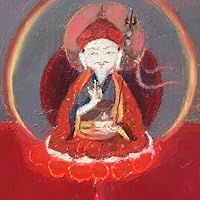
A comprehensive selection of texts central to the Kadam lineage of Tibetan Buddhism, including topics like Mind Training, Stages of the Path, and esoteric tantric instructions.
The Treasury of Precious Instructions by Jamgön Kongtrul Lodrö Taye, one of Tibet’s greatest Buddhist masters, is a shining jewel of Tibetan literature, presenting essential teachings from the entire spectrum of practice lineages that existed in Tibet. In its eighteen volumes, Kongtrul brings together some of the most important texts on key topics of Buddhist thought and practice as well as authoring significant new sections of his own. The Kadam lineage derives from the teachings and practices taught by the Indian master Atiśa and his Tibetan students. Atiśa spent twelve years in Tibet and left a scholarly and devotional lineage that would be significant to all traditions of Tibetan Buddhism, but particularly the Geluk, the tradition of the Dalai Lamas, which fashioned themselves as the New Kadam tradition. Jamgön Kongtrul’s catalog to The Treasury of Precious Instructions classifies Kadam literature into five treatise, instruction, esoteric practice, ancillary works, and associated works. The first two are the main topics covered in this Lamrim, or Stages of the Path, and Lojong, or Mind Training. These two Kadam teachings continue to exert a significant influence on Tibetan Buddhism and therefore represent the legacy of the Kadam tradition. The first centers around “The Lamp for the Path to Enlightenment,” written by the eleventh-century Indian master Atiśa who spent twelve years in Tibet, and this volume also includes stories of Atiśa’s life and travels. The second set of teachings consists of aphorisms known as the Seven-Point Mind Training, meant to be used as contemplative practices to develop compassion and transform the mind. These selections show not only the foundational texts of the Kadam tradition but also the widespread impact these teachings continued to have across traditions.
The first Jamgon Kongtrul, Jamgön Kongtrül Lodrö Thayé (འཇམ་མགོན་ཀོང་སྤྲུལ་བློ་གྲོས་མཐའ་ཡས་ 'jam mgon kong sprul blo gros mtha' yas), was one of the preeminent scholars in 19th century Tibet, often referred to as Jamgon Kongtrul the Great. The name Kongtrul is a contraction of Kongpo Bamtang Tulku, of whom he was held to be an incarnation. He also was a tertön, or "revealer of Dharma treasures," and in that capacity was given the name Pema Garwang Chimé Yudrung Lingpa.
He was also a respected physician and diplomat. He is credited as one of the founders of the Rimé (རིས་མེད་ ris-med "unbiased" or non-sectarian) movement of Tibetan Buddhism, and he compiled what is known as the Five Great Treasuries.
"A Lamp For The Path To Enlightenment A Mahāyāna Scripture on the Stages of the Path by Atiśa
Homage to the bodhisattva Mañjuśrī, appearing as a divine youth.
...Through being lesser, middling, or supreme, three types of person are to be understood. I shall write individual descriptions that clarify their defining attributes.
One who by various means seeks only the happiness of samsara for him- or herself is known as a lesser person.
Turned away from the happiness of samsaric existence with a nature that avoids evil deeds, one who seeks only peace for him- or herself is said to be a middling person.
One who, through the suffering of his or her own continuum, truly desires to terminate completely all the suffering of others is a supreme person.
...and with devout faith in the Three Jewels, and after placing your knees upon the ground and joining your palms together, first go for refuge three times.
Following that, preceded by the attitude of loving-kindness toward all sentient beings, examine the entire world of beings who suffer in the three lower realms, through birth, and so forth, and by falling downward when they die, and so forth.
Then, with the desire to liberate the world from the suffering of suffering, suffering, and the causes of suffering, generate the enlightenment mind that makes an irreversible pledge.
...If the merit of enlightenment mind were to become form, after completely filling the realm of space, there would be an excess of even more.
Between a person who would give to the guardians of the world buddha fields filled with excellent jewels, equal in number to the sand grains of the Ganges
and a person who, having joined the palms together, would turn his or her mind to enlightenment, this latter act of worship is superior and one that has no limit.
...One who is skilled in the ritual for the vow who possesses a nature that abides in the vow, who is able to confer the vow, and is compassionate is understood to be an excellent guru.
...I shall not strive here to attain enlightenment in a swift manner. I shall remain until the furthest end of time for the sake of even a single sentient being.
I shall purify a buddha field that is immeasurable and inconceivable. I shall cause my name to be celebrated throughout the ten directions.
...All the buddhas agree that the cause for completing the accumulations, whose natures are merit and wisdom, is to develop supernatural knowledge.
Just as a bird that has not grown feathers cannot fly into the sky, one who lacks the power of supernatural knowledge cannot accomplish the welfare of beings.
The merit gained in a day and a night by one who possess supernatural knowledge is not gained even in a hundred births by one who lacks supernatural knowledge.
...One who has not attained quiescence will not develop supernatural knowledge; therefore, exert yourself repeatedly in order to attain quiescence.
...Once a meditator has attained quiescence, he or she will also achieve supernatural knowledge. However, without the practice of perfection of wisdom the obscurations cannot be destroyed.
...Because both wisdom without means and means without wisdom were declared to be bondage, do not abandon either of them.
...Excluding the perfection of wisdom, all the other virtuous qualities of the perfection of generosity, and the rest, were declared by the victors to be means.
One who meditates upon wisdom with a nature influenced by cultivation of means will attain enlightenment quickly, not by meditating on selflessness alone.
Wisdom is explained to be the knowledge of emptiness regarding an essential nature, which realizes the nonorigination of the heaps, constituents, and bases.
It is not reasonable for an existent thing to arise; it is also not for a nonexistent one, like a sky-flower. Nor can that which is both come into existence because then both errors would follow.
Entities do not arise from themselves; they also do not from something different than themselves, or from something that is both, without a cause. Therefore, they lack an inherent essence.
Alternatively, when all entities are examined with regard to being a unity or a multiplicity, because no inherent nature can be perceived, it is determined that they lack a real essence.
...Therefore, this very meditation on the selflessness that is the nonapprehension of an essence in relation to the totality of entities is meditation upon wisdom.
Just as with all entities, regarding which wisdom does not see an essence, meditate in a nonconceptual manner on that very wisdom that has been analyzed with discerning awareness.
This existence, which arises from conceptual thought, has the nature of conceptual thought. Therefore, the complete abandonment of conceptualization is supreme nirvana.
Moreover, the Bhagavān declared this in the following manner: 'Conceptual thought is the great ignorance that causes one to fall into the ocean of samsara. One who abides in the concentration that is free of conceptual thought shines like the stainless sky.'
...Having ascertained the unoriginated and insubstantial nature of all entities on the basis of scripture and reasoning, one should meditate free of conception.
After meditating on reality in this way, and successively achieving Heat, and the rest, Joy, and the rest, will be attained, and a buddha's enlightenment will not be far off."