Jump to ratings and reviews
Rate this book

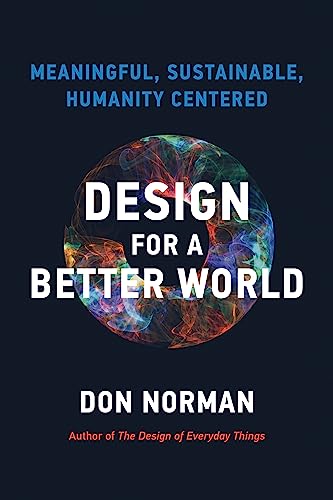
Design for a Better World: Meaningful, Sustainable, Humanity Centered

Rate this book
How human behavior brought our world to the brink, and how human behavior can save us.

The world is a mess. Our dire predicament, from collapsing social structures to the climate crisis, has been millennia in the making and can be traced back to the erroneous belief that the earth's resources are infinite. The key to change, says Don Norman, is human behavior, covered in the book's three major meaning, sustainability, and humanity-centeredness. Emphasize quality of life, not monetary rewards; restructure how we live to better protect the environment; and focus on all of humanity. Design for a Better World presents an eye-opening diagnosis of where we've gone wrong and a clear prescription for making things better.

Norman proposes a new way of thinking, one that recognizes our place in a complex global system where even simple behaviors affect the entire world. He identifies the economic metrics that contribute to the harmful effects of commerce and manufacturing and proposes a recalibration of what we consider important in life. His experience as both a scientist and business executive gives him the perspective to show how to make these changes while maintaining a thriving economy. Let the change begin with this book before it's too late.

376 pages, Paperback

Published April 2, 2024

165 people are currently reading
2868 people want to read

About the author

Donald A. Norman

37 books1,556 followers
Donald Arthur Norman is an American researcher, professor, and author. Norman is the director of The Design Lab at University of California, San Diego. He is best known for his books on design, especially The Design of Everyday Things. He is widely regarded for his expertise in the fields of design, usability engineering, and cognitive science, and has shaped the development of the field of cognitive systems engineering. He is a co-founder of the Nielsen Norman Group, along with Jakob Nielsen. He is also an IDEO fellow and a member of the Board of Trustees of IIT Institute of Design in Chicago. He also holds the title of Professor Emeritus of Cognitive Science at the University of California, San Diego. Norman is an active Distinguished Visiting Professor at the Korea Advanced Institute of Science and Technology (KAIST), where he spends two months a year teaching.
Much of Norman's work involves the advocacy of user-centered design. His books all have the underlying purpose of furthering the field of design, from doors to computers. Norman has taken a controversial stance in saying that the design research community has had little impact in the innovation of products, and that while academics can help in refining existing products, it is technologists that accomplish the breakthroughs. To this end, Norman named his website with the initialism JND (just-noticeable difference) to signify his endeavors to make a difference.

See also Don Norman

Ratings & Reviews

What do you think?
Rate this book

Friends & Following

Create a free account to discover what your friends think of this book!

Community Reviews

5 stars
40 (21%)
4 stars
66 (35%)
3 stars
51 (27%)
2 stars
20 (10%)
1 star
7 (3%)
Displaying 1 - 30 of 35 reviews
Profile Image for Brian Clegg.
Author 161 books3,171 followers
April 10, 2023
Don Norman is, without doubt, one of the most influential figures in design - and particularly in making designs fit for human use. In his definitive The Design of Everyday Things he identified designs that 'probably won a prize' but that totally fail to make clear to the user how to use them. He pointed out that something as simple as a door, for example, had opportunities for design failure. Whether it was glass doors that couldn't be distinguished from windows, or doors you had to push that were fitted with a pull handle, he showed how a focus on appearance over usability could make for terrible design.

In this book he attempts to take on an even bigger target - the way that we move the world away from its natural state, what can go wrong with that and how better design - and more inclusion of design in our approach - could change things.

In principle, this is great, but unfortunately the book fails to deliver beyond broad brush concepts. Norman addresses how to communicate in meaningful ways, the importance of sustainability, moving from 'human centred' to 'humanity centred', transforming human behaviour and the possibilities for action. And in each of these areas, he comes up with some good ideas, but part of the problem is that the book itself falls over on the design front.

I'm not talking about the dull cover, or even that the font is just a bit too small to read comfortably. It's more that designing a piece of writing to get a message across effectively involves making the text well structured and readable. It means telling stories well. But that just doesn't happen here. The whole thing is verbose - Norman doesn't get past the introduction before page 57. The text is extremely repetitive and feels very thin on detail. It simply doesn't read well.

There are a few other issues. Some of the arguments seem forced. A central message is that, while STEM is extremely important, we drive things too much from science and maths. Norman gives the example of the seasons, claiming the four seasons are arbitrarily based on astronomical data and don't reflect real experience. This is certainly true in some countries - but in the UK, certainly, no one cares about the astronomical seasons, but there are four very clear, very different periods in the year from a combination of weather and the behaviour of nature. There are also one or two oddities in the science Norman mentions. It's not too bad that he seems to say that tides are higher because the Moon is full, rather than because of the same reason that the Moon is full. At one point, though, he describes hydrogen as a power source like wind and solar, where it's actually an energy transmission medium.

I am a huge fan of Don Norman's work on design, but for me, this book doesn't do what I'd hoped it would in giving clear design-based guidance on building a better world for humanity. In some ways, this book parallels aspects of Hans Rosling's remarkable book Factfulness. It even overlaps in places, where Norman argues for better presentation of data rather than meaningless single figures like GDP, and gives examples of ways of presenting data that aren't as good as Rosling's. It's a shame Norman ignores Factfulness, rather than building on its starting point, which could have produced a much stronger outcome. In the end this isn't the design-based manifesto for the future that it might have been.
Profile Image for Noah.
32 reviews18 followers
March 25, 2023
Admittedly disappointed. This is a book that mentions a lot of great topics while delving into few and making none actionable. It might be a great book to someone who didn’t read any design-related books in the past 20 years. In other words, it’s a book that’s about 20 years too late and emotionally unnecessary – especially given the rich literatures we ve got over the past two decades. Don Norman merely has nothing new or useful to say. His best work is “Living With Complexity”.
13 reviews
April 2, 2025
I found this book to be very practical despite what some of the more popular reviews say. I understand the criticism that compared to other books he has written, this feels less “practical” in the sense he didn’t provide principles. But he stated what the book would and wouldn’t be right at the beginning and he was true to that. If you are looking for a Step by step guide to making a better world, this isn’t it. It’s much more of a philosophical read because the concern for the environment today is very much about getting people on the same page. I feel his argument lies in trying to recover a sense of humanity that was lost. His ideas about STEM in many ways are boiled down to this: Just because you have the ability to bring new and “exciting” tech into the world doesn’t mean that you should. Our schooling system praises STEM education but the social sciences should be equally important when becoming a decision maker. The everyday person may not be able to do much in the fight against climate change, but those with the power to enact change should find ways to incorporate a cyclical economy, one that not only pays to produce but also to return products back into the earth. The other practical information I got was that we can’t measure the economy based on the tangibles, but we need to include in intangibles as well, which points to his discussions about social sciences. Application may vary quite a bit from circumstance to circumstance, but the message is applicable: not every metric is helpful and not everything that is helpful is a metric, so pay attention to everything and bring the highest level of good wherever you go, be that getting people aligned on the importance of the environment over other issues or ending projects that world doesn’t need.

Compared to Bill Gates’s climate book, I thought this was much more thorough. However, he did rant a bit on his politics, which I felt were only partly applicable.
40 reviews
April 30, 2024
It is hard to write a book that tries to inform people to change, to move away from the convenience of wastage and being environmentally unfriendly. A great attempt, albeit very tiring to read.
It's as if he just got up one day and decided to actually listen to the fuss being made about climate change, waste production, and more. Then it dawned upon him that it is making sense, and he should actually join in and say something about it too. But not for the sake of it. He has done a lot of reading and research and his passionate plea for change resonates throughout the book, urging readers to take responsibility for design choices and to create a more sustainable future.

Consumers today are overwhelmed with choice, and the 'Keeping up with the Jones' mantra seems to drive them to buy more and more. Social media videos and photos only spur this on. There are so many sustainable and eco-friendly brands out there, but they will never be able to compete with the variety and prices offered by the use-and-throw culture that has been inculcated in us by the leading names. Hedonism is easy to adopt, especially if one prioritizes short-term happiness. The short spurts of joy one feels purchasing a new gadget, wearing a new dress, or holidaying in a new country, and then receiving likes and admiration for this seems to be the go-to resort for many. This is not a judgment or criticism, but rather an obvious observation. You cannot expect to make informed choices and prioritize environmental sustainability if you want to have the latest of everything and tick off experiencing the most exotic holiday destinations.
In my point of view, no one has to justify their choices. However, when you feel the world is heading towards environmental degradation with global warming and excessive waste, and you're attributing this to industries, capitalist companies, influencers, social media, or other sources, it would be wiser to take a step back and ask yourself if you are sure that you are not playing a major role to contribute to this as well.
Profile Image for Gabriele Maffoni.
11 reviews1 follower
May 10, 2023
Interesting book, loads of different concepts here and there. However, it doesn’t feel like it’s giving us real conclusion. It just says “go, do something”, but doesn’t really give the tools to do it. Might be worth do an appendix with tools for designing for a better world.
Profile Image for Zainab Chaudry.
24 reviews
May 19, 2024
Good points but unnecessarily long. Also not a lot of original content so for someone who has already read the likes of Victor Papanek, this felt useless to read.
Profile Image for Alejandro Teruel.
1,335 reviews253 followers
November 21, 2024
Donald Norman is a well known psychologist and designer whose ideas and work helped develop user-centered design. His first and extremely readable book on design The Psychology of Everyday Things (1988) later revised and expanded as The Design of Everyday Things (20133) was insightful, timely and inspired several generations of designers. He has published other important books on design such as Things That Make Us Smart: Defending Human Attributes In The Age Of The Machine(1993), The Invisible Computer: Why Good Products Can Fail, the Personal Computer Is So Complex, and Information Appliances Are the Solution(1998), Emotional Design: Why We Love (or Hate) Everyday Things (2005) and Living with Complexity (2010).

In my opinion, Design for a Better World is not as good a book as the ones I have just quoted. It is simplistic to the point of naive, and overly optimistic.Norman overdefines design to the point where it becomes confused with engineering on the one hand and making on the other.
If you have even a nodding acquaintance with feedback loops, behavioral economics, criticism on neoliberalism, the meaningfulness of the Gross Domestic Product index, at least one proposed alternative or compement to the GDP such as the Human Development Index (HDI), information management dashboards, circular economics, agile engineering, designing with stakeholders, and DIY approaches you'll find very little new in this book.

If you are not aware of of such ideas, Norman overviews their bare bones to provide some basic references to possible design principles for a rather grandly termed humanity-centered approach to design. He approvingly and very shallowly refers to the United Nations' Sustainable Development Goals initiative. Missing from the book are important initiatives and topic such as the European Union's Responsible Research and Innovation, Design Justice, value-based and value-sensitive systems design, Boehm's ideas on reconciling plan-based and agile (software) engineering, and frugal engineering. Urban city planning is not even mentioned even though this discipline probably has the most experience and expertise in tackling lage complex sociotechnological systems. Environmental and social impact studies are not mentioned.

Although Norman likes agile methods, he does not seriously address its scaling up problems. His proposal to break down large system design into the development of modules that satisfy input-output requirements (functional requirements) is sadly inadequate by ignoring the last thirty or forty years years of systems architecture design and the constraints and complications of so-called non-functional requirements such as safety, security, usability, testability, maintainability, robustness, extensibility and scalability. His throwaway ideas on scaling down do not even hint at the development of product lines and personalized product engineering, as in say personalized or precision medicine, precision agriculture or fine chemistry.

His ideas on design education are wooly and unhelpful -the suggestion he makes that break down semester or quarter long courses into shorter and possibly variable-length modules is not new – French university courses have been mixing different-length courses for years.

Occasionally Norman simply passes on outrageous claims. For example he blithely writes:
The Brookings Institution reports that digitizing cash delivery can address the UN Sustainable Development Goal of ending poverty.
The report in question, Michael Faye and Paul Niehaus' Ending Poverty with Electronic Payments, says, among other things:
Let us then imagine a world of completely ubiquitous electronic payments. A world where a few clicks of the mouse could send digital cash to all 2 billion of the world’s extreme poor. A world where we didn’t need to wait for humanitarian cargo planes, but could deliver electronic money directly to beneficiaries minutes after a disaster[...]
This is breathtakingly wrong. After a disaster, without the humanitarian cargo planes, there may be nothing for people to acquire!

Even if it is, in my opinion, repetitive and would benefit from pruning and tightening up, Norman's book may be useful, perhaps at a junior or sophomore level, as an awareness raising starting point for discussion and debate on what should be considered in responsible, ethical-sensitive design compared to mere profit-based design.
17 reviews
September 30, 2023
I found this book to cover a wide range of potential areas design could help improve the state of the world.

In the book Mr Norman lays out the artificial nature of our world, empowering us with the notion, if we can make it, we can change it.

Then moving on to talk about the ways in which we can change our metrics to be less about numbers and more about humans, i.e. make them more meaningful.

After he delves into changing the system from a wasteful one. He explains what designing for circular economies might look like. Finally offering how we might flip from human centered design to a humanity focus.

I complemented the book with listening to podcasts where Mr Norman had been interviewed, which helped to pick up on further context. Quite an interesting individual offering what he can to help the situation we are in.
52 reviews6 followers
December 30, 2024
I'm giving this 4 stars, partially because I think people who don't read about design or who are focused on design-adjacent fields (engineering, business development) are more likely to read a name they recognize, like Norman's.
Like a few of the other reviewers, I found the writing to be a bit of a slog and not action-oriented. (How do we get from the systems we have now to what we need to be sustainable?) But I also found it a logical arrangement of the topics, with plentiful citations. (I'm actually going through the works cited for what or who to read on this next.)

Oddly enough I finished reading this while reading john a. powell's The Power of Bridging, which is focused on the human elements of change. And somehow I think the two need to be used in concert or we aren't going to create positive change.
Profile Image for Kerrin.
32 reviews
August 17, 2023
The core ideas behind the book — communicating effectively, sustainable design, and collaboratively designing with the people your solution is for are good concepts. But the delivery falls short. This book was a slog to get through. In an early chapter Norman talks about the importance of using stories to communicate effectively and then doesn't follow his own advice to make the concepts in the book memorable or interesting. Each topic is meandering, dry, and repetitive. He spends most of the book talking about what is wrong with the world from a design perspective and very little on what to do about it. I was hoping the book would provide me, as a designer, with actionable ideas of how to design for a better world, but the ideas felt too lofty and generic to be inspiring.
Profile Image for Anwer Ali.
19 reviews
May 11, 2024
Don Norman brings a wealth of useful and practical information in his writings. He is insightful and visionary, and the position he holds in the contemporary design world can be a dream for any successful designer. His parallel influence in academia and industry has given him a heroic status. A transformation towards climate and planetary concerns from traditional design learning cannot be completed without studying Norman. He has made a valid criticism of the sheer scientific approaches in dealing with human and planetary issues. According to Norman climate change is a human issue and you cannot deal with human issues solely with science.
Profile Image for Niklas.
74 reviews8 followers
August 4, 2025
Initially, I thought I’d give this book 3 stars, because for me, around 70% is a recap of how we got to the current ecological and economic crisis. He even describes the principles of degrowth without explicitly calling it that. The rest of the book explains how design skills can help shape politics and companies into more sustainable versions of themselves.

In the end, it’s a good starting point for these kinds of topics, but it’s not for you if you’ve read Bill Gates’ book or other more focused material. Still, I’m impressed that he wrote this book at his age.
Profile Image for Scott Schneider.
728 reviews7 followers
April 18, 2023
Don Norman has been an important thinker and made significant contributions. This was an interesting book but I didn't learn much new. He basically makes a plea for designers to be involved in all our world crises like climate change because they are "humanity-centered." He has a great vision of where we want to go and recommendations for how to get there. The problem is "human behavior" which has to change, which is always difficult.
Profile Image for Oksana Martynkova.
12 reviews
November 22, 2024
Ця книга з першого погляду для дизайнерів, але насправді для всіх, кого лишає небайдужим тема життя на нашій планеті. Ми живемо у штучному світі, проектованими людьми. Технології розвиваються настільки швидко, що наслідки майбутніх техногенних та екологічних катастроф можуть здаватись вже не такими далекими. Ми, як дизайнери, повинні про це пам’ятати, і переносити рішення на більш емпатичні, орієнтовані на людство рішення.
Profile Image for Lookchin.
11 reviews2 followers
February 15, 2025
Nice book, but totally no ideas what to do

It's good to know there is a book that calls-out the problems directly but the possible solutions are a bit optimistic which is understandable as a principle. But as a professional designer, I find it a bit difficult to get started with the mentioned core principle that design with the people while they are treating designers as nothing nowadays.
Profile Image for Michael Norwitz.
Author 16 books12 followers
July 30, 2023
Don Norman's new book is an assessment of how to use intelligent design principles to solve human problems ... with a particular focus on climate change. The book is informative, a bit 'high level' but does offer extensive references and notes directing the reader to a variety of other, more narrowly applied analyses and problem-solving.
Profile Image for Seb Swann.
246 reviews4 followers
January 20, 2025
Read this if you like books at the intersection of design, sustainability, and complex systems—this was a little too general and surface-level for my liking and lacked the specifics I thought it might include. Potentially a good primer for people with limited previous exposure to these topics.

StoryGraph: https://app.thestorygraph.com/reviews...
Profile Image for Lina Nuñez.
9 reviews
April 7, 2025
El diseño es entendido por el autor como la disciplina transformadora para cambiar la manera en como vivimos y creamos. Es indispensable crear desde la sostenibilidad para ofrecer a las nuevas generaciones y a las actuales diseños con propósito que entienda y resuelva las necesidades e intereses de las personas con relación a su entorno.
Profile Image for Kasper.
96 reviews2 followers
Read
December 16, 2023
I didn’t read this through, so I cannot rate it accurately. But I did not want to read on because the first two parts did not match my expectations about Norman’s usual great prose and clear arguments.
Profile Image for Amanda Cox.
1,106 reviews4 followers
December 18, 2023
A design book for the new century.

I love Don Norman - he's a legend! And I loved his course (about the same topic as this book). I guess I just find him better in small videos, than the long book. It felt like a slog.
Profile Image for Mikaela McShane.
40 reviews
March 4, 2024
Great concept, poor execution.

This book spends so much time ineloquently stating problems and occasionally describing possible solutions. Some interesting points but not worth a read unless you’re in public policy maybe.
Profile Image for Carolina Delgado.
36 reviews1 follower
March 30, 2024
Waste is not Design's only problem. Origins, races, genders, social backgrounds and economies are externalities that must be studied for a better world. Instead of man-centered design, it should be significantly holistic, sustainable and humanity-centered.
Profile Image for Sophie.
292 reviews
October 23, 2023
I would say this book is more like a philosophical reflection than other design books talking about design principles.
Profile Image for Zdravko Zhelev.
2 reviews
May 20, 2024
For a book about design - it's very poorly formatted and designed.

Content-wise it was really interesting and touches upon some great topics, a bit repetitive.
Profile Image for Karla Kitalong.
409 reviews4 followers
March 2, 2025
I have read most of Norman's books and taught his concepts during a career-long interest in human-centered design (which he calls humanity-centered in this book).
Displaying 1 - 30 of 35 reviews

Can't find what you're looking for?

Get help and learn more about the design.