

What do you think?
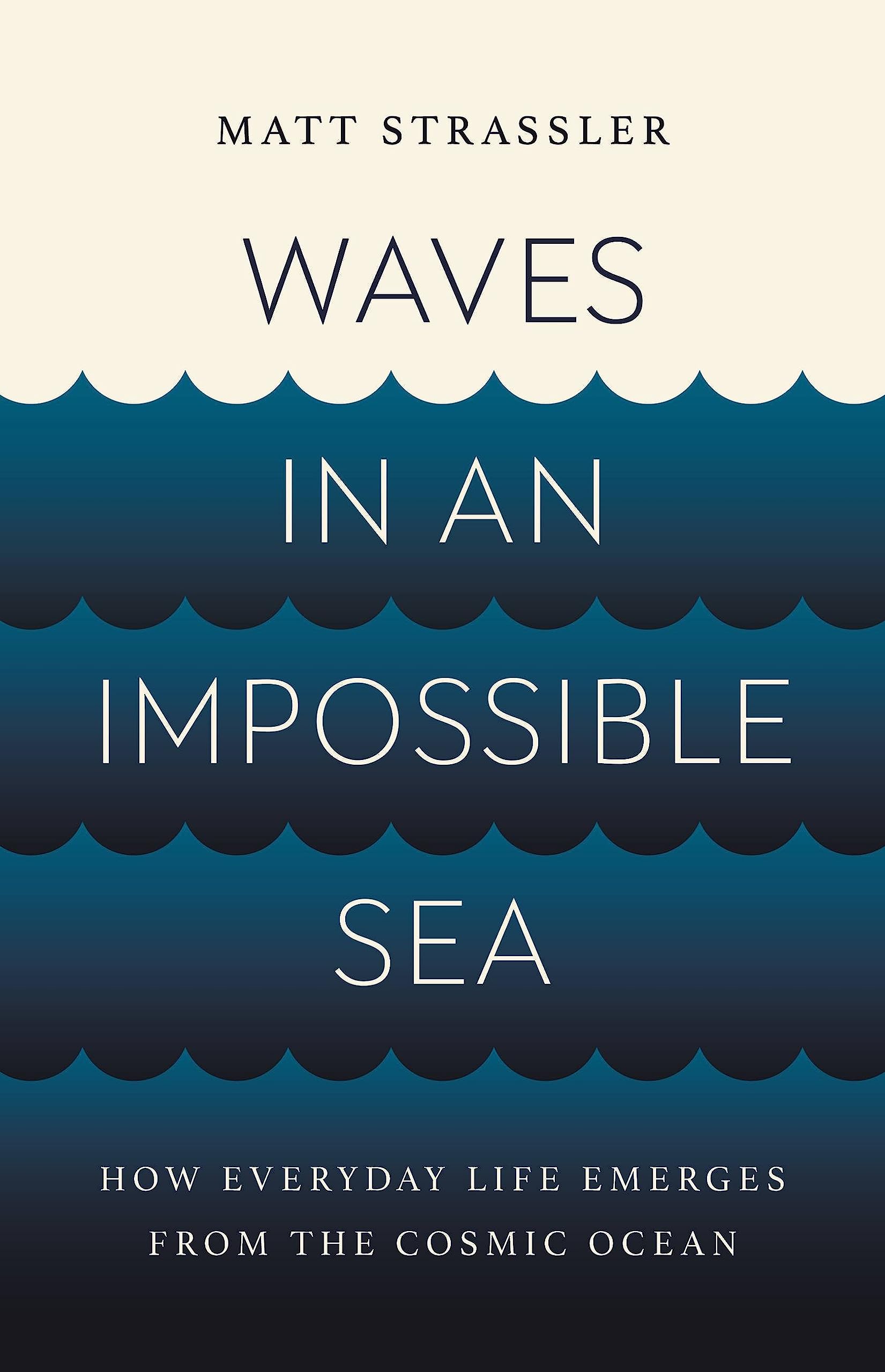
Waves in an Impossible Sea: How Everyday Life Emerges from the Cosmic Ocean
A theoretical physicist takes us on an awe-inspiring journey from relativity to the Higgs field, showing how the universe creates everything from what seems like nothing at all
In Waves in an Impossible Sea , physicist Matt Strassler tells a startling tale of elementary particles, human experience, and empty space. He begins with a simple mystery of motion. When we drive at highway speeds with the windows down, the wind beats against our faces. Yet our planet hurtles through the cosmos at 150 miles per second, and we feel nothing of it. How can our voyage be so tranquil when, as Einstein discovered, matter warps space, and space deflects matter?
The answer, Strassler reveals, is that empty space is a sea, albeit a paradoxically strange one. Much like water and air, it ripples in various ways, and we ourselves, made from its ripples, can move through space as effortlessly as waves crossing an ocean. Deftly weaving together daily experience and fundamental physics—the musical universe, the enigmatic quantum, cosmic fields, and the Higgs boson—Strassler shows us how all things, familiar and unfamiliar, emerge from what seems like nothing at all.
Accessible and profound, Waves in an Impossible Sea is the ultimate guide to our place in the universe.
In Waves in an Impossible Sea , physicist Matt Strassler tells a startling tale of elementary particles, human experience, and empty space. He begins with a simple mystery of motion. When we drive at highway speeds with the windows down, the wind beats against our faces. Yet our planet hurtles through the cosmos at 150 miles per second, and we feel nothing of it. How can our voyage be so tranquil when, as Einstein discovered, matter warps space, and space deflects matter?
The answer, Strassler reveals, is that empty space is a sea, albeit a paradoxically strange one. Much like water and air, it ripples in various ways, and we ourselves, made from its ripples, can move through space as effortlessly as waves crossing an ocean. Deftly weaving together daily experience and fundamental physics—the musical universe, the enigmatic quantum, cosmic fields, and the Higgs boson—Strassler shows us how all things, familiar and unfamiliar, emerge from what seems like nothing at all.
Accessible and profound, Waves in an Impossible Sea is the ultimate guide to our place in the universe.
384 pages, Hardcover
First published March 5, 2024
Ratings & Reviews
Friends & Following
Create a free account to discover what your friends think of this book!
Community Reviews
Displaying 1 - 30 of 90 reviews

November 21, 2024
The first half of this book is a shallow end of physics that, in an accessible way, introduces readers to basic ideas and dispels myths. I could dog paddle there and enjoyed it. It differentiates mass (property) from matter (substance), clarifies the cosmic speed limit, points out that illustrations of atoms are wrong, because they show the nucleus as way too large (it is actually like a grain of sand in a classroom, because atoms are mostly empty), discusses the theoretical progression from Galileo to Einstein (while calling out common myths about the latter), introduces gravitational mass and rest mass (the latter arises from stored energy), and explains why steady motion in a straight line (in a closed bubble) is undetectable (e.g., flying inside an airplane). There's the cool fact that your protons and neutrons (in your body) could power a lightbulb for about 10 billion years. And there's a funny joke about moon diets and the difference between losing weight and mass.
"We are aspects of the universe, as seismic waves are aspects of rock and as sound waves are aspects of the air."
However, the last half is the deep end of quantum field theory, and there I drowned. I'm just not smart enough to follow discussions of wavicle creatures, the Luminiferous Aether, the distinction between ordinary and everywhere fields, or the implications of combining Einstein's relativity and quantum physics. (I did find the discussion of how whales sing differently over the Mariana Trench to be interesting, and I found the idea of a future Higgs-field apocalypse to be thought-provoking.) Basically, from about the middle of the book on, everything was over my head.
"The remainder of this book, a story of fields found throughout the cosmos, implicitly rests on the assumption that empty space exists. But keep in mind that it might not."
"We are aspects of the universe, as seismic waves are aspects of rock and as sound waves are aspects of the air."
However, the last half is the deep end of quantum field theory, and there I drowned. I'm just not smart enough to follow discussions of wavicle creatures, the Luminiferous Aether, the distinction between ordinary and everywhere fields, or the implications of combining Einstein's relativity and quantum physics. (I did find the discussion of how whales sing differently over the Mariana Trench to be interesting, and I found the idea of a future Higgs-field apocalypse to be thought-provoking.) Basically, from about the middle of the book on, everything was over my head.
"The remainder of this book, a story of fields found throughout the cosmos, implicitly rests on the assumption that empty space exists. But keep in mind that it might not."

July 13, 2024
I can still remember the terrifying feeling when, halfway through my final year of school, I realised I wasn't understanding Physics at all. It was photons that did me in. Particles I could understand. Waves I thought I could understand (I couldn't). But photons were both or neither, and the whole edifice came crumbling down around me. Of course, in your final year of school, edification, truth and the beauty of the universe matter far less than scraping into the uni course of your choice, so I womaned (girled) up and asked my parents for tutoring. They enrolled me in this camp, where a nice young man consoled me with the fact that photons had defeated many before me.
There is a number of decades and a lot of reading between me and that kid. I could have a stab at explaining the basic concepts of quantum mechanics, special and general relativity, field theory and even possibly things like supersymmetry. But fundamentally, if I had a time machine, the thing I'd most want to say to teenage me is that, actually, you're not exactly wrong. Photons really don't make a lot of sense. But that's ok - lots of things don't entirely make sense. Physics is as much about using what we do know to narrow down on what we don't, where the narrowing tools are usually mathematics.
But mostly, if I'd had a teacher as good as Strassler, I reckon I might have made my piece with the wavicle. Waves in an Impossible Sea is a long book which covers, in popular physics book terms, just a few things. Strassler ultimately wants to get the lay reader to an understanding of the Higgs field, and why it matters so very much. To do this, he deploys no formula. Unsurprisingly, he instead leans heavily into an analogy, but with a few analogies very carefully chosen and detailed explanations about where they diverge. There is a lot of guitar string discussion, for example. Strings in general, in fact, get a good workout. The result is a tiring, intense read but one which does provide a solid grounding in relativity, field theory and particles. This took me a good week to read, at a time I am usually finishing books in a couple of days.
He doesn't shy away from the mind-bending aspects that even basic physics raise - that matter isn't solid, that time and motion are relative, not absolute, concepts, and the inescapable lurking feeling that the way we feel the world to be is more of a construction of our senses and our nuerons than an innate qualia of the universe. But his careful approach also reveals the wonder of human discovery - the astonishment of a species which could build the Hadron Collider and have it perform as expected. The thrill of being able to see, even dimly, part of the construction of what is around us.
There is a number of decades and a lot of reading between me and that kid. I could have a stab at explaining the basic concepts of quantum mechanics, special and general relativity, field theory and even possibly things like supersymmetry. But fundamentally, if I had a time machine, the thing I'd most want to say to teenage me is that, actually, you're not exactly wrong. Photons really don't make a lot of sense. But that's ok - lots of things don't entirely make sense. Physics is as much about using what we do know to narrow down on what we don't, where the narrowing tools are usually mathematics.
But mostly, if I'd had a teacher as good as Strassler, I reckon I might have made my piece with the wavicle. Waves in an Impossible Sea is a long book which covers, in popular physics book terms, just a few things. Strassler ultimately wants to get the lay reader to an understanding of the Higgs field, and why it matters so very much. To do this, he deploys no formula. Unsurprisingly, he instead leans heavily into an analogy, but with a few analogies very carefully chosen and detailed explanations about where they diverge. There is a lot of guitar string discussion, for example. Strings in general, in fact, get a good workout. The result is a tiring, intense read but one which does provide a solid grounding in relativity, field theory and particles. This took me a good week to read, at a time I am usually finishing books in a couple of days.
He doesn't shy away from the mind-bending aspects that even basic physics raise - that matter isn't solid, that time and motion are relative, not absolute, concepts, and the inescapable lurking feeling that the way we feel the world to be is more of a construction of our senses and our nuerons than an innate qualia of the universe. But his careful approach also reveals the wonder of human discovery - the astonishment of a species which could build the Hadron Collider and have it perform as expected. The thrill of being able to see, even dimly, part of the construction of what is around us.

January 31, 2024
This book is a wonderful dive into physics & the universe!
Physics was not a strength of mine in academia, but it was a course I greatly enjoyed. I can say the same for this book! The writing grabbed my attention immediately and captivated me. I had so much fun reading this! Fun! While reading about physics! I think this is a great book to conceptualize the subject at hand. Nothing is too hard to understand, no matter how much knowledge you have before reading. The author did a fantastic job in communicating complex topics in a digestible, easy to understand way for those of us readers who aren’t well versed with physics.
And I just loved the little dive into linguistics & science communication! Great reminder for those of us working in science communications.
I am looking around with different eyes & understanding since finishing. I always love to walk away from a book with new knowledge & information to ponder.
Physics was not a strength of mine in academia, but it was a course I greatly enjoyed. I can say the same for this book! The writing grabbed my attention immediately and captivated me. I had so much fun reading this! Fun! While reading about physics! I think this is a great book to conceptualize the subject at hand. Nothing is too hard to understand, no matter how much knowledge you have before reading. The author did a fantastic job in communicating complex topics in a digestible, easy to understand way for those of us readers who aren’t well versed with physics.
And I just loved the little dive into linguistics & science communication! Great reminder for those of us working in science communications.
I am looking around with different eyes & understanding since finishing. I always love to walk away from a book with new knowledge & information to ponder.

January 16, 2025
if you like his blog, you'll like this. goes much deeper into the Higgs than most popsci i've seen, especially its relationship to the top quark. good stuff.
April 21, 2024
I discovered this book because the author appeared on the March 4, 2024 episode of Sean Carroll’s Mindscape and the March 4, 2024 and March 6, 2024 episodes of the Daniel and Jorge Explain the Universe podcasts. I highly recommend listening to those episode if you are interested in reading the book and want to get a taste before you dive in.
I have read a lot of popular science books in my day (including several written by the hosts of the aforementioned podcasts) and this book has very quickly found its way to the top of the pile. The author is an incredible communicator and is very adept at taking complex, hard to understand, and often unintuitive topics, and breaking them down to easily digestible bits.
Be patient, because he starts slow, with chapters focused on the fundamentals: motion, relativity, mass, energy, fields, waves, and more. Carefully explaining the layman’s definition of these terms and how the scientific meaning of these terms differs. At the same time, he is busy dispelling some common physics fibs scientists use to simplify complex topics for a mass audience. When getting into the depths of the universe, those fibs fall apart, and you need to know how things actually work to move forward. This is the first ~60% of the book. Don’t race through it though, because he is laying the foundation for the fun stuff.
In the end, I think he manages to achieve his goal. I now, as a layman, have a pretty good idea how we think the universe works, and it is much simpler than I thought, all those fibs I was told to make things easier to understand just muddied the water.
Highly recommended.
I have read a lot of popular science books in my day (including several written by the hosts of the aforementioned podcasts) and this book has very quickly found its way to the top of the pile. The author is an incredible communicator and is very adept at taking complex, hard to understand, and often unintuitive topics, and breaking them down to easily digestible bits.
Be patient, because he starts slow, with chapters focused on the fundamentals: motion, relativity, mass, energy, fields, waves, and more. Carefully explaining the layman’s definition of these terms and how the scientific meaning of these terms differs. At the same time, he is busy dispelling some common physics fibs scientists use to simplify complex topics for a mass audience. When getting into the depths of the universe, those fibs fall apart, and you need to know how things actually work to move forward. This is the first ~60% of the book. Don’t race through it though, because he is laying the foundation for the fun stuff.
In the end, I think he manages to achieve his goal. I now, as a layman, have a pretty good idea how we think the universe works, and it is much simpler than I thought, all those fibs I was told to make things easier to understand just muddied the water.
Highly recommended.

January 3, 2025
Needs a good edit. And the most frustrating aspect is when Strassler uses dialogue for examples, it’s almost always a woman in the role of the ignorant or misguided. Very frustrating. 1st half of the book is ok, standard walk through. The second half is much more interesting, but still suffers from the ham fisted narrative style.

July 24, 2025
Space is not an empty frame in which objects bang about, as Newton conceived. According to Strassler, “everything” is made of energy, manifest as waves, wavelets, and wavicles (posing as particles). Energy waves, like photons, move at the speed of light unless the Higgs Field “stiffens” the medium in which they wave. That slowing becomes apparent to us as mass, ordinary objects, and ourselves. Therefore, everything in the universe is ultimately waves of energy.
It's a lucid description of quantum field theory, connected by analogy to cosmological theories, all the more remarkable because it does not use any mathematics. One could argue that quantum field theory IS mathematics and little else, but Strassler presents a more humanly intuitive point of view that will be welcome to the average reader.
Who that reader is supposed to be is unclear. At times, the author belabors the simplest points, like the difference between inertia of rest and inertia of motion, as if the reader was at square zero. But such a reader would never pick up this book, so such explanations, analogies and thought-experiments become tedious. Nevertheless, I appreciated most of his coverage of basic Newtonian physics in the first 125 pages, though the book would have been fine without it.
The writing tends to the obvious and repetitive, with a few annoying quirks, like labeling everything small as “microscopic.” Protons are “microscopic.” Quarks are "microscopic." That would be some special microscope.
The language is also not consistent. For example, he debunks the idea of the Big Bang as a cosmic explosion because there was no pre-existent space into which anything could explode. Yet he does not hesitate to discuss the speed of light in early cosmic inflation, without recognizing that “speed” cannot be defined without reference to movement in space.
The author is also blind to his own subjectivity and his own body, as are nearly all physicists. He seems to believe that an observation is an objective fact (about a “real” entity) if it comes from a scientific instrument but not from unaided biology. That’s because apparently, biology is individualistic, associated with individual psychologies, which are biased and easily fooled. Instrumental observations on the other hand, belong to nobody (or everybody) and are therefore free of bias, infallible, and objective.
He does not consider that every instrument was designed and build by individual humans, from a theoretical context, for specifically-targeted observations. The idea that instrumental observation is intrinsically unbiased is ludicrous. Further, every instrumental observation must be interpreted by a person with attitudes, theoretical precommitments, and biases (though subsequent discussion can produce consensus, which belongs to nobody and voila, the observation is objective again.) Such closed-minded thinking is is endemic in science, but since Strasser is keen on debunking scientific dogma, he should be held to a stricter standard.
Ultimately the thesis of a universe made of waveforms is plausible and interesting but flawed by inconsistent, circular, and self-refuting language, and a narrow band of ontological thinking. Perhaps that is the inevitable cost of presenting a mathematical theory without mathematics.
Strassler, Matt (2024). Waves in an Impossible Sea. New York: Basic Books, 370 pp.
It's a lucid description of quantum field theory, connected by analogy to cosmological theories, all the more remarkable because it does not use any mathematics. One could argue that quantum field theory IS mathematics and little else, but Strassler presents a more humanly intuitive point of view that will be welcome to the average reader.
Who that reader is supposed to be is unclear. At times, the author belabors the simplest points, like the difference between inertia of rest and inertia of motion, as if the reader was at square zero. But such a reader would never pick up this book, so such explanations, analogies and thought-experiments become tedious. Nevertheless, I appreciated most of his coverage of basic Newtonian physics in the first 125 pages, though the book would have been fine without it.
The writing tends to the obvious and repetitive, with a few annoying quirks, like labeling everything small as “microscopic.” Protons are “microscopic.” Quarks are "microscopic." That would be some special microscope.
The language is also not consistent. For example, he debunks the idea of the Big Bang as a cosmic explosion because there was no pre-existent space into which anything could explode. Yet he does not hesitate to discuss the speed of light in early cosmic inflation, without recognizing that “speed” cannot be defined without reference to movement in space.
The author is also blind to his own subjectivity and his own body, as are nearly all physicists. He seems to believe that an observation is an objective fact (about a “real” entity) if it comes from a scientific instrument but not from unaided biology. That’s because apparently, biology is individualistic, associated with individual psychologies, which are biased and easily fooled. Instrumental observations on the other hand, belong to nobody (or everybody) and are therefore free of bias, infallible, and objective.
He does not consider that every instrument was designed and build by individual humans, from a theoretical context, for specifically-targeted observations. The idea that instrumental observation is intrinsically unbiased is ludicrous. Further, every instrumental observation must be interpreted by a person with attitudes, theoretical precommitments, and biases (though subsequent discussion can produce consensus, which belongs to nobody and voila, the observation is objective again.) Such closed-minded thinking is is endemic in science, but since Strasser is keen on debunking scientific dogma, he should be held to a stricter standard.
Ultimately the thesis of a universe made of waveforms is plausible and interesting but flawed by inconsistent, circular, and self-refuting language, and a narrow band of ontological thinking. Perhaps that is the inevitable cost of presenting a mathematical theory without mathematics.
Strassler, Matt (2024). Waves in an Impossible Sea. New York: Basic Books, 370 pp.

November 5, 2024
The author has admirable intentions. But for anyone who has even a little background of reading in popular / mass market physics books, Strassler’s verbose invention of new terms and phrases is incredibly distracting. Just a sampling include: Higgsiferous, polymotional, amotional, everywhere-medium, Higgs phib, moving energy (instead of kinetic), stored energy (instead of potential), internal energy, physics energy, energy-of-being, the “coasting law,” intransigence (rather than inertia), drag method, wave speed method, the “nightmare property,” cosmic certainty limit, zero point energy, bending field, MSM (Minimal Standard Model), Cheshire Cat field, leaning field.

June 27, 2024
Superb book. This is what I wanted the Sean Carroll book to be - this served my curiosity and questions very, very well.
Also mightily impressed with the clarity with which he explains and rebuffs explanations. There is some hand waving involved here especially with fields and how they "vibrate" and what standing waves really is when it comes to electrons and other elementary particles, but this is also THE active field of research.
There was also a little less focus on gravity and spacetime in general, and how light behaves but these are minor gripes.
Also mightily impressed with the clarity with which he explains and rebuffs explanations. There is some hand waving involved here especially with fields and how they "vibrate" and what standing waves really is when it comes to electrons and other elementary particles, but this is also THE active field of research.
There was also a little less focus on gravity and spacetime in general, and how light behaves but these are minor gripes.

April 26, 2024
Disappointing. Strassler sets out to provide accessible approaches to arcane issues concerning the nature of the subatomic physical world. Having read numerous approaches to similar issues, I found myself thinking that the examples would probably be misleading for readers who didn't already have a foundation. It's a tough genre and I'm sure Strassler knows what he's talking about but I'd start with Brian Greene.

March 25, 2024
A very excellent volume on understanding the Higgs field and Higgs boson, in addition to explaining aspects of quantum physics and quantum field theory. The author has clearly spent a great deal of time thinking through the best learning approaches, and it shows throughout the text. I have also been a proponent of "wavicle" for the known fundamental units of quantum physics, and so was glad to see a champion of that who is an actual particle physicist. The author covers what fields are [in physics], excitations of fields, how the Higgs field gives certain objects rest mass, and a bit of cosmology at the end.
[My only caveat is that the history involving Galileo and pre-1700 science and astronomy is simplified too much into "phibs" (physics fibs, as the author calls them). (Galileo was not the first to state the so-called Galilean principle of relativity for example). These aspects are not really pertinent to any of the physics discussions, and so do not harm the book's discussion. I would continue to caution that one should never believe the physics history in a physics book.]
[My only caveat is that the history involving Galileo and pre-1700 science and astronomy is simplified too much into "phibs" (physics fibs, as the author calls them). (Galileo was not the first to state the so-called Galilean principle of relativity for example). These aspects are not really pertinent to any of the physics discussions, and so do not harm the book's discussion. I would continue to caution that one should never believe the physics history in a physics book.]

November 17, 2024
This book needed to be like half as long. I don’t consider myself particularly bright, but if a reader needs fifteen entire goddamn pages to understand what a “wave” is, we probably shouldn’t be reading the same book.
I’ve followed Strassler for ages—his blog is called “Of Particular Significance” and it’s one of the last really interesting sites on whatever the internet is becoming. I hope he finds a better editor and keeps writing.
I’ve followed Strassler for ages—his blog is called “Of Particular Significance” and it’s one of the last really interesting sites on whatever the internet is becoming. I hope he finds a better editor and keeps writing.
June 24, 2024
Learned that the Higgs field is the gravy of the universe, and a lot of other things. Prof. Matt Strassler does an excellent job at coming up with analogies to explain particle physics without going into mathematics.

October 9, 2024
A fascinating and enlightening book on quantum field theory and how the Higgs field gives mass (to be more precise, the rest mass) to the particles found in the Standard Model of particle physics. Except, as the author points out, particles don't exist: the best way to understand modern physics is to see the particles as confined standing waves with different level of interactions with the Higgs field.
The first part of the book gives an introduction to physics, starting with Newton's laws of motion and Galilean relativity, which states that the laws of motion are the same in all inertial reference frames, followed by Einstein's Relativity. This would lead to the author's way of looking at the world, in terms of waves, fields and mediums, necessary to understand how modern quantum field theory describes the world. The author admits that we don't really know what kind of medium 'empty space' is: it is the medium that the particles of the Standard Model interact in. For this reason, the author concentrates more on fields (as do other scientists).
Now, the reader has to make the leap, guided by the author, to understand that what we consider as particles are actually standing waves vibrating in the various fields: an electron is a standing wave in an electron field. Protons and neutrons are composites, made up of standing waves of quarks and gluons that vibrate inside the protons and neutrons. And it is the Higgs field, which interacts with these fields, that make the standing waves possible. The frequency (and energy) of these standing waves are what give the 'particles' their rest mass. The photon does not have a rest mass because it does not interact with the Higgs field, so it has no standing wave, but must keep moving (as a travelling wave) at, of course, the speed of light. Once this is accepted by the reader, the rest of the book, briefly covering cosmology, the puzzle of vacuum energy, and so on, should be more easily understood.
By the end, the reader should be able to get some understanding of how modern quantum field theory views the world in terms of fields and waves. The puzzle of the medium of 'empty' space that the field and waves operate in will have be left for future physicists to try to answer.
The first part of the book gives an introduction to physics, starting with Newton's laws of motion and Galilean relativity, which states that the laws of motion are the same in all inertial reference frames, followed by Einstein's Relativity. This would lead to the author's way of looking at the world, in terms of waves, fields and mediums, necessary to understand how modern quantum field theory describes the world. The author admits that we don't really know what kind of medium 'empty space' is: it is the medium that the particles of the Standard Model interact in. For this reason, the author concentrates more on fields (as do other scientists).
Now, the reader has to make the leap, guided by the author, to understand that what we consider as particles are actually standing waves vibrating in the various fields: an electron is a standing wave in an electron field. Protons and neutrons are composites, made up of standing waves of quarks and gluons that vibrate inside the protons and neutrons. And it is the Higgs field, which interacts with these fields, that make the standing waves possible. The frequency (and energy) of these standing waves are what give the 'particles' their rest mass. The photon does not have a rest mass because it does not interact with the Higgs field, so it has no standing wave, but must keep moving (as a travelling wave) at, of course, the speed of light. Once this is accepted by the reader, the rest of the book, briefly covering cosmology, the puzzle of vacuum energy, and so on, should be more easily understood.
By the end, the reader should be able to get some understanding of how modern quantum field theory views the world in terms of fields and waves. The puzzle of the medium of 'empty' space that the field and waves operate in will have be left for future physicists to try to answer.
December 29, 2024
Really good book in terms of how it takes a complex topic, and simplifies it for those who are not as well versed. That said, the topic being as complex as it is means the simplified version is still incredibly complex and hard to get the average mind to wrap around.
The book attempts to get you to and guide you through the understanding of quantum physics. With my very lacking understanding of physics overall, I learned a ton. However the concepts of the quantum realm had me struggling, and the last 1/4 of the book I unfortunately found myself lost. Still, it presented a perception of the universe that I really found fascinating, and for that reason I would recommend giving the book a try.
The book attempts to get you to and guide you through the understanding of quantum physics. With my very lacking understanding of physics overall, I learned a ton. However the concepts of the quantum realm had me struggling, and the last 1/4 of the book I unfortunately found myself lost. Still, it presented a perception of the universe that I really found fascinating, and for that reason I would recommend giving the book a try.

April 6, 2024
If you're curious about physics, especially this subject, then this book is a good read. It's a textbook of sorts; I have a fondness for subjects like this, and this book satisfied that curiosity.
Did I actually enjoy a science book? Well, if gaining knowledge and satisfying curiosity count as enjoyment, then yes, I did.
I appreciate Matt's enthusiasm in writing such a book to cater to the needs of eccentrics like myself
Did I actually enjoy a science book? Well, if gaining knowledge and satisfying curiosity count as enjoyment, then yes, I did.
I appreciate Matt's enthusiasm in writing such a book to cater to the needs of eccentrics like myself

June 26, 2025
Absolutely one of the best popular physics book I have ever read. A must-read if you want to understand the Higgs boson discovery and the general state of particle physics at the moment. The balance of clarity and faithfulness to scientific material is astounding, especially as it describes, e.g., the relation between intertial and gravitational mass, the difference between a field and its medium, or wave-particle "duality". Please chain the author in a cave and make him write forever.
May 13, 2024
So far, the best science book of the year. Incredibly clear explanations of some very obtuse topics. The careful wording, clarity of invoked imagery and laser - like focus are outstanding. My physics background is a little dated (mid 80’s undergrad degree) but this was no impediment to this book which, most importantly, doesn’t dumb down the subject matter. Highly recommended.

February 26, 2025
This is the best book I've read on quantum physics. Dr. Strassler has somehow made an impossibly complex and confusing subject understandable. Read this book before you resign yourself to getting out the physics textbooks.
March 16, 2025
A masterclass in presenting ideas clearly and without jargon. The many examples are intuitive and clear. While it loses steam in some parts due to all the basic conceptual heavy lifting it needs to do, it manages to capture something beautiful about our existence.
4.5⭐
4.5⭐

July 27, 2026
I'll admit that some of this dragged on for me and went over my head as an absolute amateur in physics, but on the whole, I actually really enjoyed this book! The author was knowledge but great at explaining and such a teacher in the way he referred back to and connected ideas, which I really enjoyed. I also do feel like I learned quite a bit from this even if I couldn't make sense of all of it, so if anyone's interested in the Higgs Field or Quantum Field Theory, they should definitely check this one out!

October 19, 2024
Maybe a bit too advanced for me- I felt like a lot of it was waffle (which is probably because it went over my head), and maybe all of the GCSE prep has turned my brain to mush at this point, my attention span has been obliterated, but it was really interesting, I really enjoyed reading it. I loved the section at the end which talks about vacuum decay, that was exciting.

June 9, 2024
A broad overview of modern physics. This book dabbles in relativity, quantum theory and the minimum standard model. Most of this stuff I learned in college, except for the importance of the Higgs Boson and its relationship with dark matter/energy.

March 8, 2026
Essential read
What’a deceivingly simple name for such a complex topic: candidate for composite field: Higgs Field.
I read every chapter with awe and love. Analogies, debunking of fibs are superb. Importance and relations of everything from photons, Higgs Field, to history of quantum physics and entire cosmos are contained in this book with no non-sense structure.
What’a deceivingly simple name for such a complex topic: candidate for composite field: Higgs Field.
I read every chapter with awe and love. Analogies, debunking of fibs are superb. Importance and relations of everything from photons, Higgs Field, to history of quantum physics and entire cosmos are contained in this book with no non-sense structure.

February 26, 2025
I thought this was actually gonna be about waves lol DNF

August 13, 2026
I understand the universe, it's origins and quantum physics a little better now.

August 9, 2024
Καταπληκτικό βιβλίο!
Να μεταφραστεί πάραυτα και να μοιραστεί δωρεάν στα Γυμνάσια και τα Λύκεια και να είναι προαπαιτούμενο για κάθε μάθημα Φυσικής
Να μεταφραστεί πάραυτα και να μοιραστεί δωρεάν στα Γυμνάσια και τα Λύκεια και να είναι προαπαιτούμενο για κάθε μάθημα Φυσικής

August 6, 2025
BEST book I’ve read this year. Matt Strassler welcome to goat status. Figure 42 genuinely blew my mind to the point where I sent it to everyone and tried to explain it to everyone the moment I read it. Starting from square one and building each chapter with notes, illustrations, tables, and a glossary just makes this so accessible. PHYSICS IS COOL!!!!

September 8, 2026
A book that tries to explain quantum field theory to a lay audience. It does OK at it, although it falls in their weird space where I, and others with some background in physics, are going to find it too basic, and someone who has little to no background will probably find it hard to grasp. It also has these cheesy, made-up, anecdotes - "I was talking to a friend, and they were telling me how they thought it isn't possible that all things are made of waves. Au contraire I told them..." - that really stick out like a sore thumb. I'm not sure who I would recommend this to...

December 19, 2025
Nerd book! Huge nerd book! Great nerd book!
I loved it! It’s basic enough nerds like me can grasp most of it, but it’s probably a tad above a new nerd to the world of physics. Yet, it explains some concepts in a rather simple way that may actually help anyone new to physics.
The problem with physics is that even some of the basic stuff can feel like deep waters. Strassler doesn’t use a lot of time explaining what a quark is or a gluon, he kind of hits it and moves on. This is because while they matter in physics the reader doesn’t need intimate knowledge on what they are in order to understand the points he is trying to make. Therefore the reader hears about quarks, and gluons but never fully understands their part in all of the physics of the universe.
What the reader does get out of the book is a better understanding of the Higgs Boson particle and the Higgs Field! The reader leaves the book with a significantly better understanding of how the Higgs Field and Higgs Boson works, as well as its significance to physics.
There is significantly more to the book than that as well. The author explains how waves work, the different types of waves and the different types of fields. He discusses mass and how mass is both measured and increased or decreased and how the Higgs Boson and the Higgs field directly relates to the mass of an object.
Overall it’s very nerdy, but I found it to be lots of fun. Very entertaining if you enjoy physics. If not, it may not be the worst book to start with, but it’s difficult to say for sure. Physics gets deep really fast! Still, if someone told me they were interested in physics I would suggest this book. As for everyone else, don’t worry, I can explain it all to you at the next get together we have together and you can just take my word for it while leaving the get together with your mind so blown you can’t make a coherent thought. 😂😇
It’s fun. It’s cool. You just have to be interested to even pick it up and try to understand it. If you aren’t interested at all then you won’t understand any of it and it will be a waste for you!!
I loved it! It’s basic enough nerds like me can grasp most of it, but it’s probably a tad above a new nerd to the world of physics. Yet, it explains some concepts in a rather simple way that may actually help anyone new to physics.
The problem with physics is that even some of the basic stuff can feel like deep waters. Strassler doesn’t use a lot of time explaining what a quark is or a gluon, he kind of hits it and moves on. This is because while they matter in physics the reader doesn’t need intimate knowledge on what they are in order to understand the points he is trying to make. Therefore the reader hears about quarks, and gluons but never fully understands their part in all of the physics of the universe.
What the reader does get out of the book is a better understanding of the Higgs Boson particle and the Higgs Field! The reader leaves the book with a significantly better understanding of how the Higgs Field and Higgs Boson works, as well as its significance to physics.
There is significantly more to the book than that as well. The author explains how waves work, the different types of waves and the different types of fields. He discusses mass and how mass is both measured and increased or decreased and how the Higgs Boson and the Higgs field directly relates to the mass of an object.
Overall it’s very nerdy, but I found it to be lots of fun. Very entertaining if you enjoy physics. If not, it may not be the worst book to start with, but it’s difficult to say for sure. Physics gets deep really fast! Still, if someone told me they were interested in physics I would suggest this book. As for everyone else, don’t worry, I can explain it all to you at the next get together we have together and you can just take my word for it while leaving the get together with your mind so blown you can’t make a coherent thought. 😂😇
It’s fun. It’s cool. You just have to be interested to even pick it up and try to understand it. If you aren’t interested at all then you won’t understand any of it and it will be a waste for you!!
Displaying 1 - 30 of 90 reviews