Jump to ratings and reviews
Rate this book

복어

Rate this book
For readers of Han Kang and Sheila Heti, an atmospheric, melancholic novel about a successful sculptor who decides to commit suicide by artfully preparing and deliberately eating a lethal dish of blowfish.

Blowfish is a postmodern novel in four parts, alternating between the respective stories of a female sculptor and a male architect. Death is the motif connecting these parallel lives. The sculptor’s grandmother killed herself by eating poisonous blowfish in front of her husband and child, while the architect’s elder brother leapt to his death from the fifth floor of an apartment building. Now, both protagonists are contemplating their own suicides. The sculptor and architect cross paths once in Seoul, and meet again in Tokyo, while the sculptor is learning to prepare a fatal serving of blowfish.

The narrative loosely approximates a love story, but this is no romance in the normal sense. For the woman, the man is a pitstop on the road to her own suicide. For the man, the woman forestalls death and offers him a final chance. Through the conflicting impressions they have of one another, the characters look back on their lives; it is only the desire to create art that calls them back from death.

Evoking the heterogeneous urban spaces of Seoul and Tokyo, Blowfish delves into the inner life of a woman contemplating her failures in love and art. Jo’s fierce will to write animates the novel; the lethal taste of blowfish, which one cannot help but eat even though one may die in doing so, approximates the inexorable pains of writing a novel.

352 pages, Paperback

First published January 1, 2010

52 people are currently reading
2089 people want to read

About the author

Kyung-ran Jo

6 books36 followers
Jo Kyung Ran (this is the author's preferred Romanization per LTI Korea) is a South Korean writer.

Jo’s work is famous for taking trivial, mundane, and everyday occurrences and delicately describing them in subtle emotional tones.

Her work has won the Munhakdongne New Writer Award, the Today’s Young Artist Award, The Contemporary Literature Award (for the 2003 novella A Narrow Gate), and the Dong-in Literary Award(2008).[12] Her work has been translated into French, German, Hebrew and English.

Ratings & Reviews

What do you think?
Rate this book

Friends & Following

Create a free account to discover what your friends think of this book!

Community Reviews

5 stars
23 (9%)
4 stars
65 (25%)
3 stars
94 (36%)
2 stars
55 (21%)
1 star
18 (7%)
Displaying 1 - 30 of 115 reviews
Profile Image for Alwynne.
944 reviews1,637 followers
September 14, 2025
Kyung-ran Jo’s intricate novel follows two unnamed characters. One a woman, the other a man. Their stories are told in alternating sections. The woman’s an artist based in Seoul; the man’s a Korean architect who now lives and works in Japan. They once met very briefly at a business dinner. When the artist takes up a temporary residency in Tokyo they meet again, purely by chance, and realise they share an unlikely interest. They’re both overwhelmed by thoughts of death. The architect’s older brother died by suicide, now his father’s silent and withdrawn, his mother subdued. So, he’s moved back home to support them. When he sees the artist, he recognises her expression, it’s the same as his brother’s not long before he jumped to his death. The artist believes suicide is her legacy, just like her aunt and grandmother. She’s plagued by visions of a shadowy observer like a reaper from Korean legend: a psychopomp waiting to guide her spirit to the afterlife.

For the artist being in Japan has a special significance, it’s associated with blowfish, a potentially deadly delicacy. It’s also part of her heritage; her grandmother’s method of dying was toxic blowfish soup. The artist wonders if blowfish should be her own weapon of choice. The artist starts to make preparations; she befriends a specialist fishmonger who deals in different varieties of blowfish. She hires a death cleaner, one of the specialists who handle the aftermath of Japan’s many 'lonely deaths' transforming a possible ‘bad’ death into a ‘good’ one. The artist thinks about representations of suicide in art and in literature from Hemingway to Seneca. She dwells on facts about suicide in the wider culture. Death becomes her way of life, dominating her waking moments. Meanwhile the architect struggles to come to terms with losing his brother and tries to find a way to help his parents survive it. He contemplates the buildings around him, their design, the lifestyles and philosophies they promote. He thinks about the precision involved in mapping out a building versus grappling with chaotic emotions. He dreams of producing buildings that can withstand earthquakes, dependable, stable, capable of absorbing multiple shocks. But then he begins to think of saving the artist as a means of atoning for his inability to help his brother.

Kyung-ran Jo’s meditations on grief and intergenerational trauma are partly inspired by her family history, her own grandmother died after deliberately consuming poisonous, blowfish soup – its toxins can be ten times more deadly than cyanide. Kyung-ran Jo’s relatively unconcerned with plot, her focus is on character, mood, and setting. Her elegant, fluid narrative’s overflowing with discussions of art and aesthetics, images of light and dark. These recurring images reminded me of Korean myths about the sun and the moon. Stories that highlight duality, emphasizing a notion that the artist and the architect are two sides of one being, warring impulses striving for unity and balance. Kyung-ran Jo uses certain scenes to suggest that the artist might overcome her death wish, for example a street performance centred on a giant balloon – based on one she saw on a visit to Tokyo. A man is seemingly devoured by the balloon, disappearing then re-emerging as if reborn.

It's quite a topical novel given South Korea’s unusually high suicide rates. And, at its best, it’s an impressively vivid, visual piece, with a distinctly painterly feel. It’s also highly detailed. Although I found the recreation of routes through Tokyo and Seoul, the meticulous depictions of their cityscapes a bit too much at times. Kyung-ran Jo’s style’s intended to create distance between author and subject, narrative and reader. But the pace can be extremely languid and the perspectives slightly self-indulgent. I also found it quite an oppressive, claustrophobic reading experience. In many ways that fits with the territory, but it made it difficult to fully engage with the material. Overall, worth reading, just didn’t entirely work for me. Translated by Chi-young Kim.

Thanks to Netgalley and publisher Wildfire for an ARC
Profile Image for Marcus (Lit_Laugh_Luv).
498 reviews1,009 followers
May 12, 2025
Blowfish was in my top five most anticipated releases of 2025, and sadly, I must admit I did not love it. After 75% I am so bored and sick of wading through the superfluous writing that it is time I call it quits. The premise is interesting, but the dual narratives and lack of chronology make the reader detached from either protagonist. The female sculptor is infinitely more interesting than the man, whose chapters felt like a chore. In over 200 pages, virtually nothing has happened - there is no plot, little character development, and the relationship between our two protagonists has hardly evolved. Also I know ARCs aren't finalized, but my gosh the volume of typos and misplaced words were making some paragraphs borderline illegible. :(

There are some interesting remarks about death, autonomy, and dignity buried somewhere in here, but they become lost in the superfluous sentences that add nothing. Tension and a darker atmosphere feel forced by the writing, rather than arising organically. For example:

She exited her apartment quietly, closing the front door behind her. Umbrellas hung from each unit's windowsill along the hallway. The floor was puddled with rainwater. It had rained in the afternoon, and more was in the forecast for tomorrow. The forecast was often more accurate than not. She went down the emergency stairwell to the ground floor. The stairs were steep and dark. It smelled like a tire recycling plant.

This seems like a petty example, but it encapsulates how bloated this story is. The writing gets in its own way, and scenes are overwrought with detail that doesn't add anything. A good editor could have chopped out 50% of the word count and salvaged a more enjoyable read from this. As it stands, I don't need every action to necessitate a full paragraph - take those stairs and get out of the damn apartment, queen.

I've seen this book compared to Han Kang and while I think there is thematic overlap, Kang is ultimately a much stronger writer who weaves imagery and symbolism into her stories with meaning. This has the potential to be a decent novella or short story, but as someone who never shies away from plotless, slow books, this was too monotonous even for me. Thank you to the publisher for the ARC.
Profile Image for Paul Fulcher.
Author 2 books1,964 followers
July 15, 2025
“You don’t know what I was going to do with the blowfish,” she had said. “I got so close. I got something from it that you can’t get without touching it, without eating it. I’ve never experienced that before. I realized that death wasn’t the thing dragging me down, but the desire to live. That night the blowfish bones spoke to me. They said that sometimes life is something you have to work at with your whole being. The blowfish eyes spoke to me, too. They said that you have to look at and understand certain things before what matters to you ends up disappearing. And then I opened my eyes. What I saw when I opened my eyes—that’s what I'm waiting for right now.

"너는 내가 복어로 뭘 하려고 했는지 모르지. 가까이 갔어. 그리고 그것을 만져보지 않고는, 먹어보지 않고서는 얻을 수 없는 것을 얻었어. 그 이전에는 결코 해보지 못한 경험이었어. 왜냐하면 나를 압박하는 것은 죽음이 아니라 살고 싶다는 욕망이라는 걸 알아버렸으니까. 그 밤에. 복어의 뼈가 말했어. 온몸으로 밀고 가야만 하는 삶이 있다고. 복어의 눈이 말했어. 소중한 것이 사라지기 전에 똑바로 봐야 할 게 있다고. 그리고 나는 눈을 떴어. 내가 눈을 떴을 때 본 것, 그것이 지금 내가 기다리는 거야"

Blowfish is Chi Young Kim's translation of 복어 by 조경란 (Jo Kyung Ran).

I should start by review with a trigger warning as the novel centres around the issue of suicide.

It revolves around two, unnamed, characters:

A sculptor - The gallery was so bright that her eyes burned. The light didn't shine down so much as it splintered coldly, like radium. People in their finest gathered under those lights. She didn't like coming to galleries. Often a gallery was filled with exaggerations, with fal-sities. This time she was hoping for something different. She wanted to fill the space with objects that were closer to the truth. With things that were true but couldn't be readily seen or felt, like silence. For all she knew, this was a quality impossible to capture in sculpture. It was time to do something she'd never done before. Before it was too late. The more challenging the better.

It was the opening of her exhibition.


And an architect - At one time he'd found windows alluring.

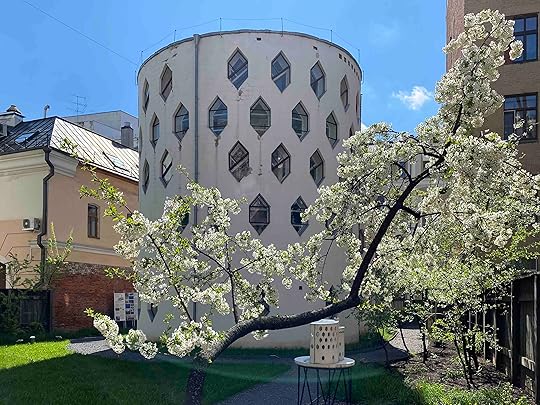
Some years ago he and Abe Kengo, who'd since become the CEO of the architecture firm, had accompanied the assistant director of TV Asahi to Konstantin Melnikov's house in Russia. It was for a documentary called The History of World Architecture. The house, which was in the heart of Moscow, resembled two white cylinders standing side by side. Melnikov was a key practitioner of Russian avant-garde architecture. The house was renowned for its orderly pattern of diamond-shaped windows. Even though sunlight was sparse in that northern country, light poured in from the third-floor windows. He'd had to lift a hand to shade his eyes. As with darkness, one needed time to get used to light. The dozens of hexagonal windows glittered like diamonds. They looked like doors through which wind and light and birds could come and go freely. They were what taught him about the beauty of architecture, not exteriors or large spaces or furniture or gardens. Later he would remember those windows. They'd gone to Melnikov's house in the fall of 2005. Everything changed the following March.


description

The architect lives in Japan, having moved there from Korea as a child with his parents, and the Korean-based sculptor goes there, ostensibly, on a three month residency, co-sponsored by the Tokyo Art Center and the Seoul Art Foundation, leading the two to meet as they move in similar artistic circles.

But each have a family history of suicide - in particular, in her case, a grandmother who deliberately ate blowfish soup where she had not removed the poison (actually based on the author's own family history), and in his case, his brother. But it leads them to an opposite stance - she has come to Japan to end her own life, while he, guilty that he may have ignored his brother's warning signs, senses her intent and wants to present it.

But this is not a direct dialogue they have - both seem to speak more to their lost loved one than to anyone else, and their conversation is facilitated by a 'death cleaner' who deals with the aftermaths of fatalities, and who was also present when they first met, and a blowfish dealer from the famous Tsukiji Market

And the novel itself is languid, with art and architecture as much of a feature of the text than the ostensible plot.

Her:

Some things were difficult to classify. Like abstraction and materiality, regularity and irregularity. The gradually lightening early morning sky. Now a crimson glow ribboned up between buildings, as if pulled from deep underground. Dark pink and light blue bled over dawn, and above that, a blue tinged with yellow spread out like pigment in water. Standing at the entrance to the fish market, she watched and felt deeply the many layers of colors, colors stacked below a sky that was still mostly gray. It wouldn't be possible to depict what she was seeing. What the colors connected to might not even be part of this world. There was something else she couldn't easily classify. When he asked her why she wanted to visit Tsukiji Market, she wondered, Am I drawn here because of Halmeoni or me? If neither, who? How many people drew me here? But she could not ponder those questions here. She was shivering too much. The market floor was damp, and her feet were already frozen solid. The smell of the fish was precise and vivid. He was walking with her. She kept forgetting she was with someone else.

Him:

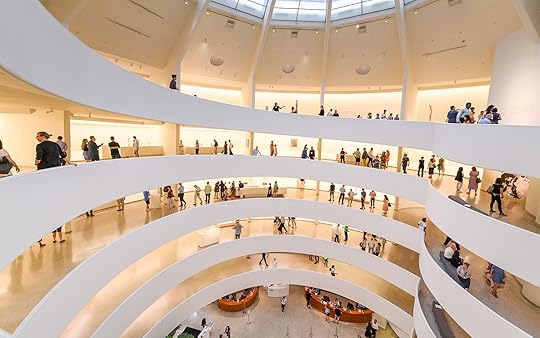
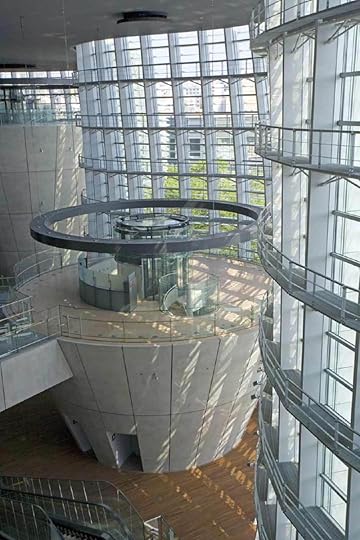
Every time he came to this Kurokawa Kisho-designed National Art Center, he was reminded of the Guggenheim in New York. Frank Lloyd Wright had puzzled over creating a space that could accommodate specific intentions and experiences in a form that was not an ordinary cube. In Wright's design, each space was separate but still contributed to an overall open concept. There was no clear beginning or end, and you could see both the lobby and the ceiling from anywhere in the building. The National Art Center was quite a different design from the Guggenheim, but because of the tempered-glass-clad exterior and steel support structure, it felt open to the outdoors. In both buildings, he found himself contemplating accommodation as a concept. The power inherent in a curved line. Accommodation and reinforcement— characteristics that needed to be carefully considered when designing a new space, especially one that transcended preexisting forms. He watched her. He thought about her. All along, ever since that evening at Tokyo Tower when he had seen her again.

description

description

Perhaps not the 'will-he-stop-her-before-she-eats-the-fish' book that one might expect, but the better for it.

Interview with the author and translator: https://www.hongkongreview.co/post/an...

Thanks to the publisher via Netgalley for the ARC
Profile Image for Darwin8u.
1,843 reviews9,045 followers
November 30, 2025
"Dying
Is an art, like everything else.
I do it exceptionally well."

- Sylvia Plath, Lady Lazarus

This novel hit me in all the right places. It was beautifully written. Careful and taut in its pacing. Character development was fascinating and the architecture/art, life/death, male/female, internal/external, parent/child, sibling/sibling dualities all seemed to work. Plus I really dug the Félix Vallotton painting used on the cover. Took a risk on this one, but it paid off. After my last several novels, I do need to escape the suicide motif for just a bit.
Profile Image for emily.
646 reviews555 followers
December 1, 2025
‘Memories didn’t pop up chronologically. Some memories got tangled with others. Some inflated, some flowed backward, and some emerged instantly, out of nowhere, and settled—like this.’


starts slow, but gets 'good' quick - rounded off to a five - rtc later

‘If I live. That was the title of his journal, a title that couldn’t have been written by an idealist or a mystic. His entries were disappointingly pedestrian and—could not possibly move or influence anyone. He had wanted such mundane and insignificant things. He had wanted to use his saw in a more laid-back manner, and to know all the names of the trees in the forests, and to develop a more discerning eye. Merely what any average carpenter might say once in his life. Dreams that could have been achieved—that would have been achieved—if he’d just lived longer. At least that was what she thought. They were nothing special or extraordinary. But his writings brought up an important question. And now this question was different from what she’d asked herself last spring in number 605 in Negishi—If I live. That question had stayed in her head. It was the first time that a single question—an incomplete phrase, really—had expanded like this in her mind, continuously and multilaterally—She thought about the dozens of ways she wanted to end that sentence.’

‘Death should be something that comes to you once in a while, not something you drag around with you all day long—What made you want to make art? You have to get a grip on yourself—You can’t come back to life once you’re dead. Nobody else can keep you safe.’

“You don’t know what I was going to do with the blowfish,” she had said. “I got so close. I got something from it that you can’t get without touching it, without eating it. I’ve never experienced that before. I realized that death wasn’t the thing dragging me down, but the desire to live. That night the blowfish bones spoke to me. They said that sometimes life is something you have to work at with your whole being. The blowfish eyes spoke to me, too. They said that you have to look at and understand certain things before what matters to you ends up disappearing. And then I opened my eyes. What I saw when I opened my eyes—that’s what I’m waiting for right now.”

‘She stood behind the figure, putting herself back to when she’d sketched it. The woman breathed. Seven minutes. It didn’t feel too long or too short. You would need at least that amount of time to see someone for the first time. The woman appeared to be deflating from somewhere invisible. She aged slowly. From a young woman to an old woman, from an old woman to an even older woman. Or from a girl to a woman, from a woman to an old woman. The woman slowly recovered. The distinctions among the different ages weren’t altogether clear. A woman turned into another woman, which was like a woman becoming the same woman. It wasn’t clear if she was the same woman or a different one. Seven minutes. The time it took for the woman to shrink and then recover. During those seven minutes, one viewer might see a young woman, and yet another might see an old woman. The only difference was time.’

‘Sadness and beauty and fear and death—I write about what overwhelms me. About what possesses me, about what doesn’t let me go—’ (Author’s Note)
Profile Image for Kate O'Shea.
1,342 reviews196 followers
July 22, 2025
3.5

I'm afraid this book really didn't land for me even though it is beautifully written and an interesting look at people's feelings about life and death. Suicide and suicidal feelings do play the main part of this novel. Or perhaps the reasons for not choosing death is what we should take away from the novel.

The novel is the story of a female sculptor whose grandmother committed suicide by eating the toxic parts of a blowfish. Her death had a toxic effect on the sculptor's father who had terrible nightmares every night. Once the sculptor moves out she begins to obsess about the use of the blowfish and she seeks out a fishmonger adept in understanding how to prepare the dangerous dish.

The second protagonist is a young architect whose brother committed suicide by throwing himself from a building. The young man also struggles with this knowledge and understsnding why his brother ended his life this way.

The two meet completely by chance but the effect they have on each other makes up the remainder of the book. The sculptor continues to learn more about blowfish and the sculptor seems to see it as his job to help her get over her losses.

There is also the recurrent character of the death cleaner although I'm still unclear whether this (or any of the other characters) are real or just figments of the two protagonists' imagination.

I'm afraid that although the writing is interesting, it just didn't move me. I think the only part of it that resonated was the statement that the only thing in your life you cannot recover from is death. Both characters seemed to want to change but inertia was the order of most days.

Not one for me but if you like an indepth look at death and suicide along with reasons not to carry it out then this book is for you. It is certainly introspective and very beautifully written.

Thankyou to Netgalley and Astra Publishing for the advance review copy.
Profile Image for Emily.
123 reviews30 followers
July 25, 2025
There’s a line somewhere in this book about life being a slow unraveling, and in many ways, that’s exactly how Blowfish reads. It’s quiet. Bleak. Occasionally elegant. But also… dull.

The blurb sets up a story about two people contemplating suicide, but that may be overstating things—one character (the sculptor) genuinely seems to be inching toward the edge, while the other (an architect) feels more like a grief-stricken outsider reflecting on his brother’s death. It’s less a dual study in suicidal ideation and more a meandering meditation on loss, detachment, and the tentative search for connection.

There are some truly beautiful sentences, wonderings, and a few moments that glint with emotional honesty. But they're buried beneath pages that feel forgettable even as you’re reading them. I don’t think I retained much, despite finishing the book within a few days. It’s not confusing or overtly flawed, it’s just incredibly slow and hard to stay invested in.

It’s worth noting that the English translation is riddled with strange typos (somebody out there hates a double "f," apparently). It doesn't ruin the experience, but it does make you wonder where the editorial attention went.

I didn’t hate this book. I didn’t feel the need to rage-read it or validate my disinterest by tearing it apart. I just didn’t feel much of anything. And for a book about life, death, and the loneliness that lingers in between, that might be its biggest shortcoming.

Thank you to NetGalley and Astra Publishing for the ARC.
Profile Image for loan.
68 reviews17 followers
July 10, 2025
I was so excited to read this novel. The premise--two main characters whose lives have both been impacted by suicides, with one of the characters now planning her own suicide by eating poisonous blowfish--was so promising. Unfortunately, the novel itself is very dull, long-winded, and awkwardly paced.

I love a slow, thoughtful book, but this was not that. The relationship between the male and female main characters should be what propels the story forward, yet they barely interact, and when they do, they hardly talk to each other. Instead of developing their relationship, pages and pages are spent describing the environment and other things that are of no consequence to the plot, like this:

"It was Sunday morning. Wind blew from the southwest through the streets of the still-slumbering city. Black plastic bags, newspapers, flyers, and playbills fluttered at knee height before settling back onto the ground. He couldn't spot the pigeons he always had to take care not to step on or the chickadees that would flit away in a panic. He passed by Hyehwa Station and headed toward Hansung University Station. From exit number six, he walked about a hundred yards to the three-way intersection. He turned right and began climbing the hill. It was about a mile to the Bugak Skyway trailhead. About a forty-minute walk. He walked briskly. He knew it was good to work up a sweat when he felt like this. He tensed his calves and swung his arms. When he stood at the observatory across from the Seongbuk-gu Community Center, he could see all of Dobongsan. This was where the trail began."

Scenes go on and on and on like this. It's very tedious to read so many of these descriptions, and to have so little of the best parts of the book, which to me are the fish market and blowfish scenes.

It's also very strange to me that the synopsis spoils the nature of the main characters' relationship. There is just not enough chemistry between them, in my opinion. Honestly, this story might be better as a film or TV show adaptation, where the characters' chemistry could be more physically evident.

This novel had good bones. If a third of it had been cut and if it had focused more on the plot, this would've been a lot more compelling than it was.

Thank you to NetGalley and Astra Publishing House for the ARC!
Profile Image for Bella Azam.
651 reviews105 followers
August 23, 2025
Blowfish was quietly haunting. Death is all around us, with the female sculptor & the male architect ruminates in their thoughts of death constantly, one in the brink of suicidal attempts, another drowned in the grief of losing his brother. Its dark, depressing & slow. With alternate chapters between the two characters, delved into their thoughts & conversations of life, of wanting death yet its also the desire to keep living. Its bleak & dull as nothing happens, things stalled & meanders but that's just how life is.

Our protagonist is suicidal, moved to Japan in the hope of death by ingesting blowfish poison, an act that was committed by her grandmother, the apparition of this ghostly woman still follows her in Japan. Her thoughts are dark, harmful and filled with the notion of death as the means to an end. The male architect is haunted by her brother's death to suicide, his neurotic mother whom get anxious with life after the loss of her son and a father suffering from bouts of depression. He know the woman is in the same situation as his brother was, the kind of soul he wished to save. This is not a love story, its not a romance, its the connection that come so suddenly in the midst of one's own strategic and calculated death of her own choice. Its the meeting of two broken souls in a different country that led them to find each other in a heartbreaking way. Its slow, bleak and depressing. It jumps from one point to another with no clear distinction, it moved in its own pace.

E-arc courtesy Astra House
Profile Image for Morgan Wheeler.
275 reviews25 followers
May 3, 2025
Blowfish is a moody, atmospheric, and quietly devastating novel that lingers long after the final page. Both of the main characters—a sculptor and an architect—have been deeply marked by the suicides of loved ones, and they now move through life tethered to the notion of their own eventual deaths. What emerges is a narrative that uses the inevitability of mortality as both creative fuel and a slow, elegiac surrender.

I was especially drawn to the nonlinear structure and the way the story drifts between Tokyo and Seoul. These cities, while full of life and beauty, also carry a certain cold mysticism—perfect backdrops for this introspective, melancholic tale. As someone who often finds myself creatively stifled or emotionally overwhelmed, I found the novel’s tone deeply resonant. Its exploration of the intersection between art, despair, and longing was both painful and strangely comforting.

Despite its focus on suicide, Blowfish is not hopeless. There’s a fragile, haunting beauty in the way Jo portrays the characters’ inner worlds. It’s a dark book, yes—but also a work of quiet grace.

Thank you to NetGalley and Astra Publishing House | Astra House for the advanced eARC in exchange for my honest opinion.
Profile Image for Rachel Louise Atkin.
1,366 reviews613 followers
January 4, 2026
I loved the writing in this and found this to be the darkest and most captivating part of the novel. I thought the plot wasn’t super strong and if it wasn’t for the writing I wouldn’t have been grabbed by it but the surreal way the characters interacted with each other made it see almost otherworldly and strange. It’s definitely weird and I think maybe won’t click with some people but I loved the themes it explored and the macabre nature of the book. Giving it three stars as I did find the story to be quite stale at points and I didn’t always feel propelled to pick it back up, but I’d love to read more from the author.
Profile Image for Sookie.
1,336 reviews88 followers
July 12, 2025
One of my most anticipated releases of the year, and its sad that this book didn't work for me. While the slow movement of panels where splashes of their lives where narration switches between two protagonist. There is grief and sadness, there is loneliness and alienation, there is a strange camaraderie in this space that the two protagonists experience.

However the characters don't move past the two dimensional structure they have been given, the propose prolonging an experience to the point of exhaustion.

Thank you to Netgalley and Astra Publishing House for providing me with a free copy of this e-book in exchange for an honest review.
Profile Image for Megan Rose.
151 reviews11 followers
September 25, 2025
For readers of Han Kang and Sheila Heti, an atmospheric, melancholic novel about a successful sculptor who decides to commit suicide by artfully preparing and deliberately eating a lethal dish of blowfish.

Blowfish is a postmodern novel in four parts, alternating between the respective stories of a female sculptor and a male architect. Death is the motif connecting these parallel lives. The sculptor’s grandmother killed herself by eating poisonous blowfish in front of her husband and child, while the architect’s elder brother leapt to his death from the fifth floor of an apartment building. Now, both protagonists are contemplating their own suicides. The sculptor and architect cross paths once in Seoul, and meet again in Tokyo, while the sculptor is learning to prepare a fatal serving of blowfish.
The narrative loosely approximates a love story, but this is no romance in the normal sense. For the woman, the man is a pitstop on the road to her own suicide. For the man, the woman forestalls death and offers him a final chance. Through the conflicting impressions they have of one another, the characters look back on their lives; it is only the desire to create art that calls them back from death.
Evoking the heterogeneous urban spaces of Seoul and Tokyo, Blowfish delves into the inner life of a woman contemplating her failures in love and art. Jo’s fierce will to write animates the novel; the lethal taste of blowfish, which one cannot help but eat even though one may die in doing so, approximates the inexorable pains of writing a novel.

~~~~~~~~~~~~
Kyung-Ran Jo's book was quite the unique experience. With a deep story written in an easy, fluid way, Kyung-Ran Jo blends the pain of a life shadowed by the suicide of loved ones with the pain of living on without the latter. Kyung-Ran Jo discusses suicide with such a profound simplicity, showing the pain brought about by a loved one's death and the ever more painful process of living on and succeeding in life and one's career.

Although I enjoyed Blowfish, it is understandable why some DNFed it. It has a slow start, but once it picks up, the story becomes quite engrossing, with each character's emotions flooding the page even when they are not being discussed.

Overall, Kyung-Ran Jo's Blowfish is a beautiful story written so simply that you can breeze through it. I highly recommend it to anyone who wants a quick read for a rainy day.

Thank you, NetGalley and Astra Publishing House, for sending me an ARC in exchange for my honest review.
Profile Image for Frankie.
670 reviews180 followers
December 1, 2025
2.5 stars.

I'm sorry... I was so bored. The prose is gorgeous and poetic, incredibly visceral, so kudos to the author and the translator for effectively getting that across. Unfortunately, the novel is written in a vignette style. That ruined it for me. I think it would have been more effective if it was written in one continuous narrative, rather than each chapter being a random event that isn't even connected to the previous chapters. Sometimes, a chapter would end on an interesting note, and I would expect it to be explored in the next chapter, but nope, nothing, just back to zero. Almost four hundred pages of random scenes, with no beginning or end.

The female protagonist was more interesting. She's a suicidal Korean sculptor who moves to Japan and decides that she wants to kill herself by ingesting a toxic blowfish. She considers herself cursed and surrounded by death. Her father is disabled and traumatized by witnessing his mother's (her grandmother's) suicide firsthand as a child. She spends a lot of time interacting with a Japanese shopkeeper who specializes in blowfish. He's gruff and cold, but he teaches her how to prepare the fish correctly. Her closest friend has an undisclosed terminal illness and is running on borrowed time. I thought their relationship was most promising, because there's that strong contrast between a healthy woman who wants to die and a sick, dying woman who wants to live. Her friend calls her out, but of course none of this pierces our female protagonist -- it doesn't even offend her, just passes through her like mist.

The male protagonist is not suicidal, but his family is haunted by the death drive. Ever since his brother mysteriously killed himself, his father has become depressed and basically bed-ridden. When he meets the female artist, he realizes that she wants to die and so he tries to save her. But this novel isn't a love story, not really. They spend time together but they don't actually become romantically involved. And even though he's in love with her, he doesn't have much of an impact on her life, except for one scene near the climax. Honestly, his perspective was a drag to read, and as I went on, I started to despise him more... He felt very entitled to the female protagonist's life.

I felt like the concept was really promising but the execution was bad. This could have had a lot of interesting things to say about life, death, depression, and art, but -- forgive the term -- instead we got 400 pages of nothingburger.
Profile Image for Sam Cheng.
325 reviews59 followers
September 27, 2025
Published in Korean almost 15 years ago, now translated into English by Kim, Jo’s novel sustains her contemplation on death, autonomy, and expression. Her two main characters both create—her through clay and silicone sculpture; him through architectural drawing—and reinvent their lives in their close encounters with dying. Her halmeoni’s suicide happens in front of her husband and child (her 9 y/o abeoji) when she drinks a poisonous blowfish concoction, haunting Abeoji into adulthood; his younger brother ends his life by jumping from height, provoking him to wonder how he could have prevented it.

As a thought experiment, I found the female main character’s disposition (i.e., “more pessimistic than optimistic”), her family’s “legacy” of being obliterated by emotions, resulting in ending their life, and her career as a visual artist, a deeply intriguing premise. The author showcases her strength in this work through her ongoing manipulation of the already stretched-thin material to create a taut, mentally stimulating narrative. The female main character’s voluntary choice to die and her reflection on what dying means, which offers readers space to consider death as an idea, are aspects with which I wanted to continually engage. Death and one’s agency within one’s personal encounter deserve greater attention, given the ongoing legislative efforts to determine how physicians can assist in providing a person’s dignified death, and we ought to hear from a host of disciplines to inform our framework.

For me, the story begins to weaken when she decides to live and he seeks her out. Please don’t hear me say that building meaningful human connections that give rise to a desire for living is a poor point of resolution, whether in fiction or real life. I only mean that Jo could have positioned her characters in such a way (i.e., through dying) that would fit my need to spectate death with the help of visual artists. In other words, perhaps I wanted Blowfish to correlate with Toews’s A Truce That Is Not Peace but pre-death, to echo Akbar’s Martyr!, wherein the visual artist’s exhibit at The Brooklyn Museum centers around her imminent death—in her dying, we can narrowly stay our minds on death per se.

Instead, Jo’s novel offers a two sides of the same coin approach when the female main character decides to live. Truly, this is fine as such; I just didn’t expect it and wished the story had gone in a different direction (and maybe that’s not fair to the author). Therefore, to offer another point of assessment, though minor, is the purpose of the respective romantic partners, Baek and Sinae, and the colleague, Saim. As minimal as the cast is, these supporting characters still came across as extraneous.

I rate Blowfish 2.5 stars.

My thanks to Astra House and NetGalley for an ARC.
Profile Image for Maddie.
59 reviews1 follower
January 3, 2026
Far too high-concept for its own good, but an interesting idea nonetheless. I learned a lot about blowfish!
Profile Image for asv:n.
72 reviews3 followers
January 12, 2026
"when she had said her final goodbyes, Abe-san said one thing and one thing only, his face inscrutable: "Sayonara!"

Maybe he knew all along, the only reason she met him was to get closer to death.
the reason why she dedicatedly learnt about blowfish was not to be cautious about removing its poison, but to extract the precise thing, to build the final piece of art of her career- her own death.

BLOWFISH tells the story of two people, a successful sculptor who decide to commit suicide by artfully preparing a lethal dish of blowfish and consuming it, and a male architect- whose brother's suicide haunts him throughout his life. as life brings them together- two times- things inevitably gets entangled. Chaotic.

This book reeks of death. every page of this book carries the musty scent of death, blended with the warm blood of the blowfishes Abe-san cured for her. depressing, dark and hauntingly relieving. She orchestrates her death for her. As a final tribute to the life she led, to the eyes that watched her. To the world and fate that made her come to that decision.

I wouldn't say I enjoyed this book as a whole, but a million details, a million instances, a million times the characters made me reconsider the philosophy of my own life- this book is a strong literary piece. it's strong enough to claw your heart and hang onto it, when the arteries tear and bleed. i would say that i enjoyed this book as a million individual pieces, each having its own independent existence, relevance, and arrival in my life in the future.

"when she happened to look through his diary, she discovered that each entry began with "If I live".

BLOWFISH is the testimony of the darkest alley of the human existence, crawling through the gutters of disparity, lost hopes rotting at the far end of the dungeon. Kyung-Ran Jo crafted this novel as a masterpiece, where the blowfish swimming passively in the tank representing the woman's contemplation of failures in life, love, and art.
"Isn't half of life embarrassment? And the rest of it fear and greed?"

This book pulled me back to the time when i read 'The Vegetarian' by Han Kang and now i'm excited to read the other works of Kyung-Ran Jo.

But before that, i need to learn how to cook a Blowfish.
Thank you Astra Publishing House and NG for sending the Advance Reader Copy of this book.
Profile Image for Sophie.
165 reviews4 followers
June 1, 2025
Sadly DNF -64% I’ve reached my limit.

Ordinarily I love translated fiction, especially quiet and introspective works where not a lot necessarily happens. Unfortunately for me this is just too disjointed, I don’t know if it’s the constantly swapping POVs or if something has been lost in translation. I’m finding myself confused more often than not and a little bit bored; the female POV was definitely stronger than the male, but not strong enough for me to continue soldering on.

I’m disappointed because I had expected to love this based on the description. I might return to it at some point, but right now it’s putting me in a reading slump trying to force through it.

Thank you NetGalley and Headline for the ARC in exchange for an honest review.
Profile Image for Amy ☁️ (tinycl0ud).
609 reviews30 followers
July 16, 2025
This is a melancholic book about people contemplating and then carefully planning suicide so do take care before choosing to start.

A sculptor believes that suicide runs in her family and that she is next. Aside from her art, there isn't much else that makes her life worth living. She tidies up her affairs in Seoul, goes to Tokyo, gets a manicure, and plans to exit the world the way her grandmother did: by consuming the fatally poisonous blowfish. I know the socially acceptable response is to reprove her actions and the potential harm it will cause her surviving family members, but it becomes apparent that she has given this a lot of thought and isn't acting recklessly. She does her research and makes an effort to "understan[d] her environment" so as to "find a purposeful, flawless method." She also makes sure she has achieved her artistic goals before "actively choosing death," out of respect for life.

Concurrently, an architect thinks about buildings, houses, and windows. He had lost his elder brother to suicide, so when he meets the woman again, he recognises in her the desire to die and tries to intervene. He figures out what she's planning but does not manage to prevent her from acquiring an actual blowfish through not-so-legal means.

I was quite invested in the story even thought it felt as if there was no possible happy ending. After all, it's not a love story, and either way, life has no happy ending. The man's desire to save the woman is not enough. And often, love is not enough. I think that's what this book shows very well. Living has to be a decision, just as dying sometimes is. The narrative perspective shifts frequently, not allowing the reader to dwell on one particular scene, but I found the prose elegiac and lyrical for all its talk of death and dying.
Profile Image for Lindsay Andros.
360 reviews37 followers
May 7, 2025
“Pain and sadness and despair and happiness were everywhere. But passion was the kind of thing that darted away if you weren’t paying close attention.”

In alternating chapters, the two suicidal narrators muse on life, art, death, and love. For her, he is just one more detail in a life that will end with a fatal meal of blowfish, which she is learning to prepare. For him, she means a new lease on life, a postponed death. As the characters look back on their own lives and the lives of their families, their inner musings and the ways in which their lives become intertwined become more apparent.

I loved a lot of things about this book, particularly the descriptions of depression and suicidal ideations and how those things compound generationally. This book has a ton of really great writing that stopped me in my tracks. It is truly beautiful.

But, good lord, is it slow. I love a good character study, especially ones that deal with internal lives and psychology, but SOMETHING needs to happen. I could have dealt with the lack of plot and maybe even loved this book if I had connected with the characters in some way. The constant switching back and forth in perspective made it very difficult to get into either of their psyches, even though that model typically works for me. I think it was the short chapters coupled with the multiple pages each one took to establish itself; I felt like very little time was spent with our protagonists. The lack of distinct voices, vague details, and short chapters ensure that a reader will not adequately become attached to these characters.

Overall, a beautiful novel that suffers from its lack of plot and meaningful characterization. Three stars.
Profile Image for Gaby.
93 reviews2 followers
August 2, 2025
This novel is a quiet whisper, the feeling of holding in your breath between inhale and exhale. It is wintry and cold, and delves deep into depression and suicidal ideation. Definitely proceed with caution, as it contains graphic details about death.

Told through the dual perspectives of a death-obsessed sculptor and an architect who is scared to love, Blowfish examines life and death in Korea and Japan. I found the novel’s imagery beautiful and rich, but wished the characters were given names. The reader is kept at a distance, learning about how depression and death impact the characters’ every thought and action. Blowfish contains equal parts truth and reserve, and I’d recommend this translated novel to those who enjoy contemplative fiction.
Profile Image for RavenCantRead.
81 reviews6 followers
April 7, 2025
Blowfish was a beautiful and intense study of two characters whose lives are vastly different and yet they share the same desire…to no longer exist in this world. I loved the psychological examination of both characters, as well as the non linear (ish) story telling. Learning about past experiences of not just the main characters but their families and friends was both heartbreaking while somehow being hopeful at times. It goes without saying that the subject matter is heavy and could be triggering for some readers (myself included) so keep that in mind if you’re picking up this book. Overall, this was a fantastic translation of a story that I think many people may find relatable. 4.5/5 stars!

Thank you to NetGalley for sending me this eARC in exchange for my honest review!
Profile Image for Marwa Hussain.
29 reviews
July 2, 2025
Like why would you bring an Israeli up at a time like this? Smh. DNF-ed this ARC 12% in, aka, I noped right tf outta there.
Profile Image for PhantomBeanie.
81 reviews3 followers
July 26, 2025
First and foremost, I would like to thank NetGalley and Headline for granting me an Advanced Reader Copy. All opinions in this review are honest and solely belong to me.

Blowfish by Jo Kyung-ran had a fascinating premise of a sculptor preparing to commit suicide by consuming a lethal dish of blowfish and the architect who she crosses path with during this time.

I'll start off with what I liked about the book. I really appreciated the experimental parallel chapters for the two protagonists: the sculptor and the architect in that order. There were some sections of the prose that I really loved in the book due to how viscerally vivid some of the descriptions were - the preparation of a blowfish by the blowfish seller was really well done and it did make me feel a lot of sympathy for the poor blowfish.

Now, I love reading about themes of death in novels because it is an inevitability of life and this is definitely present in this book, however, I expected something more in regards to it. Don't get me wrong there were quite interesting discussion about death, life, the autonomy of one's life and death, of art and of spaces to be used for art etc., but somehow it all ended up feeling repetitive as I read on. The story felt too slow, disjointed, and unclear for me. Nothing really happened much which I'm not too sure if that was the point but it definitely left me feeling nothing about the story or the main characters for example.

In terms of the latter, the two protagonists are nameless which I think was intentional but I felt that they felt distant and I couldn't really feel like rooting for them due to how I didn't really get to know them as realised people despite the detailed backstories of their relation to death in their family. There wasn't also really sufficient build up for the relationship between the sculptor and the architect and it just felt like they just suddenly started meeting up after seeing each other the first time. I didn't think they were developed enough as well as their relationship. It simply left me not caring about them even until the end.

If this book was possibly edited and shortened a bit more and focused more on going in-depth with the interactions between the sculptor and the architect then it may have felt less dull. I felt like the sculptor actually had a deeper relationship with the blowfish seller than the architect. Sadly, this was not for me and I really wish I enjoyed it more but I will say that at least I came away with knowing more about blowfish than I anticipated, and for that I am glad.
Profile Image for hans.
1,162 reviews152 followers
October 12, 2025
A quiet and fragile plot with both numbness and despair in its setting and tone, alternatingly told in between two narrators; a male architect who is still grieving with his brother’s suicide and a female sculptor who goes to Tokyo to learn on how to prepare blowfish as she contemplates in ending her life. Their paths crossed at a point with each history of grief and the chaos of thoughts captured in vignettes; of one’s emotional journey and trauma, on familial, art and the stillness after loss with a triggering temptation of death that cunningly go lurking in between.

Both narratives lured me in through their dark, devastating backstories, felt moody and intense yet I liked how each drowned me into their piercing day-to-day emotional struggles; lots of grieving and loneliness rants with a trip to delicacy of eating blowfish that wrapped the sculptor’s mind in unraveling the truth about her grandmother’s suicide as well for the architect to traverse me through his guilt and the traumas surrounded his parents after the tragedy.

“Legacy. For her there was always something following her around, making her think about death.”

“Anxiety tailed him like a white string destined to be attached to him forever.”

Loved the sculptor’s interactions with the blowfish’s seller as well how both narratives interlaced as the architect sees the sculptor’s face having the same expression as his brother and became anxiously wanting to save her. A plot that entirely explored on how people lost their reason to live yet slowly and quietly searching for a reason to stay— there was sadness and fear as well a chilling existential tale with a trigger warning for its vivid and imagery suicide scene(s), depression, self-harm and emotional neglect.

An affecting read throughout for me. Not really a read for everyone, I think, but if you are drawn to themes of grief, existential reflection or despair and appreciates a quiet, depressing character-driven fiction then perhaps you might enjoy this as much as I do.

"There were two kinds of lives. A life you were born into and a life you built. It was all a question of choice."

(Thank you Pansing Distribution for the gifted review copy!)
Profile Image for BizzyReader⋆。°✩.
85 reviews2 followers
June 4, 2025
3.75/5 - Thank you to Netgalley and the publisher for this ARC in exchange for an honest review!

Synopsis: Blowfish is a melancholic literary fiction novel that follows two characters (a man and a woman) and their relationship with one another, and their family's history of suicide and depression. The woman is a well-known sculptor in the art world whose grandmother committed suicide by consuming blowfish and whose father had struggled with depression since his childhood due to this. The man is an architect whose brother mysteriously committed suicide and who lives with his parents as the family struggles with the new family dynamic and his father's depression.

What I liked: I appreciate how, although this novel revolves around the relationship dynamic between the female sculptor and the male architect, this is not a romance novel. The story continues to explore the ephemeral quality of art and its relevance to the decision to live through the development of familial relationships and the development of each character. There are also several discussions on suicide, highlighting historic cases where artists take their lives and how their reasoning relates to their artistic endeavors. These discussions directly relate to the novel's plot, particularly with the female sculptor's obsession with death and growing intrigue with blowfish.

What I didn't like: I believe the way the novel is translated has made it confusing to read. There are several spelling mistakes, with words being smushed together (example: "takingaway" instead of "taking away") and words missing letters (example: "cofee" instead of "coffee"). The way that some sentences have been framed can also make certain paragraphs seem superfluous and unnecessarily long.

Takeaway: This novel is extremely introspective and handles topics of guilt, depression, and grief. I really hope the grammatical errors and sentence framing can be cleaned up because I did find this book to be interesting, and I think Kyung-ran Jo is an impactful writer.
Profile Image for Kasvi.
176 reviews3 followers
August 6, 2025
Blowfish is a novel shaped by grief, haunted by memory, and steeped in silence. It circles ideas of death and survival, yet somehow left me feeling more detached than moved. There’s a precision to the prose and an emotional stillness that might appeal to some readers, but I found it difficult to connect with.

The story centres on two characters whose lives have been shaped by suicide. A sculptor fixates on the poisonous blowfish after her grandmother’s death by ingesting it, her obsession growing as she learns to prepare it herself. Meanwhile, an architect lives in the shadow of his brother’s suicide, trying to make sense of it in the quiet aftermath. Their paths eventually cross, and the novel shifts to explore what it means to witness another’s pain.

Despite the promise of that premise, the execution didn’t quite hold for me. The pacing drags, and the characters feel more like ideas than people. Their conversations are sparse, their emotional arcs felt a bit muted. There's a lot of space here, between lines, between moments, but little of it is used in a way that deepened my investment. Even the more intense elements (like the blowfish scenes) felt dulled by the book’s overall restraint.

Stylistically, the writing is often lovely. Lyrical in places, with a soft melancholic rhythm, but the atmosphere tends to overwhelm the story itself. It’s hard not to notice how much time is spent lingering on inconsequential details, while the heart of the novel feels under explored. I was particularly disappointed by the lack of tension in the central relationship, which the synopsis suggests is more emotionally charged than it ever feels on the page.

I kept waiting for something to shift, for the characters to open up, or the narrative to crack, but the novel remains emotionally static throughout. I appreciate the ambition and themes, but ultimately, Blowfish didn’t reach me.

Thank you to NetGalley and Astra Publishing House for the eARC.
Profile Image for Kehinde 𐙚 ⋆˚。⋆ ♡.
235 reviews9 followers
July 15, 2025
2.5 ⭐️

“There were two kinds of lives. A life you were born into and a life you built.”

💭: i was instantly drawn to this book the moment i read the blurb, it had the kind of premise that hooks you in and doesn’t let go. naturally, i dove in with high expectations. but honestly? this ended up being a bit of a slog for me. there were several points where i almost gave up on it entirely.

the premise was strong, undeniably so, and that’s what kept me reading till the end. but the execution didn’t quite land. the pacing dragged in places (perhaps intentionally?), but instead of building tension or depth, it left me feeling mentally exhausted. The non-linear structure, which i usually enjoy, felt disjointed here. i struggled to connect with the characters in any meaningful way, and as a result, i felt emotionally ‘detached’ from their journeys.

being an ARC, the grammatical errors were expected, but they were still distracting enough to pull me out of the narrative more than once. that said, there were flashes of brilliance throughout, moments that felt thoughtful, even poetic. i just wish those moments had been given more room to breathe.

i also found myself wishing for more clarity and directness. the consequences of the characters’ choices felt muted, as though the story was dancing around the emotional core instead of digging into it. everything felt a little too vague, too out of reach.

still, there’s something haunting about the way the book explores suicide and emotional isolation. at its heart, it’s about someone clawing their way out of the dark; a slow, uncertain attempt at self-preservation. that’s a powerful theme, and when it surfaced, it resonated deeply.

in the end, this was a book with an important message and a compelling idea. but for me, it got a little lost in its own structure.

many thanks to netgalley for this ARC!
Profile Image for Ember.
150 reviews3 followers
August 18, 2025
TRIGGER WARNING: MENTIONS OF PERSON NOT WANTING TO LIVE ANYMORE AND DOING SOMETHING ABOUT IT, ALSO A MENTAL ILLNESS ASSOCIATED WITH IT. (This is a serious warning, if that stuff triggers you, please don't read this!)

This book was exactly 3 star worthy for me. Not a single bit less, but nothing more either.

It's basically the story of a woman who wants to unalive herself, because ...reasons. And honestly, I got a bit of a vibe that she was depressed? (I mean the actual mental illness by the way, not as a joke.) I thought that was the theme going on in the story because of some other characters and their descriptions and stories too, but it wasn't directly stated or even implied, I think. And I'm no psychologist or a patient, so I can't say anything for sure. I am mentioning it because I have read about the thing, and it seemed to match the pattern.

Anyways, so the FMC doesn't want to live anymore, and decides to do something about it, and makes very elaborate plan on HOW to go about it. We get to understand what she's feeling AND what it seems like to someone else, someone who really observes her and tries to understand her. I did find myself really invested in her character, especially as some of the things were very realistic.

The melancholy and the hurt expressed by the characters in the story really resonated with me at points, and I liked that.

I can't pinpoint what exactly made me not LOVE it, to be honest. But I think it was just the melancholy in the story? Or maybe because it's a translation? I don't know, really. But I just didn't feel myself FULLY immersed in the story even until the end.

I'd say, overall, it was a nice and intriguing read, but not very gripping for me. Interesting enough to not make me wanna drop it, but not interesting enough to not make me count the number of pages left.
Displaying 1 - 30 of 115 reviews

Can't find what you're looking for?

Get help and learn more about the design.