

What do you think?

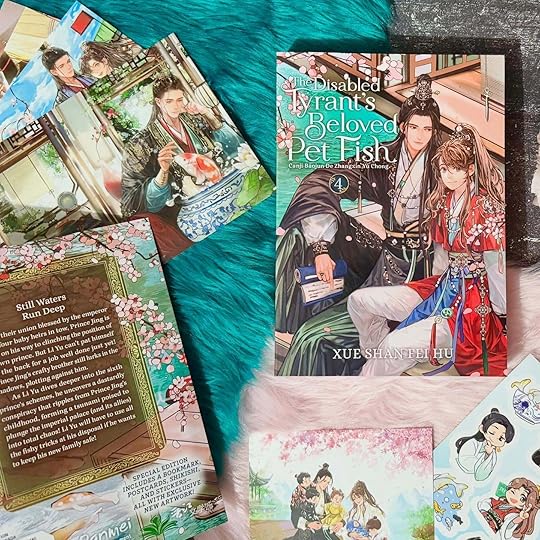
The Disabled Tyrant’s Beloved Pet Fish: Canji Baojun De Zhangxin Yu Chong (Novel) #4
เมื่อผมกลายเป็นปลาตัวโปรดของอ๋องทรราช เล่ม 4
With their union blessed by the emperor and four baby heirs in tow, Prince Jing is well on his way to clinching the position of crown prince. But Li Yu can't pat himself on the back for a job well done just yet! Prince Jing's crafty brother still lurks in the shadows plotting against him.
As Li Yu dives deeper into the sixth prince's schemes, he uncovers a dastardly conspiracy that ripples from Prince Jing's childhood, forming a tsunami poised to plunge the imperial palace (and its allies) into total chaos! Li Yu will have to use all the fishy tricks at his disposal if he wants to keep his new family safe!
As Li Yu dives deeper into the sixth prince's schemes, he uncovers a dastardly conspiracy that ripples from Prince Jing's childhood, forming a tsunami poised to plunge the imperial palace (and its allies) into total chaos! Li Yu will have to use all the fishy tricks at his disposal if he wants to keep his new family safe!
420 pages, Paperback
Published January 1, 2023
About the author
Xue Shan Fei Hu
11 books142 followersAssociated Names:
* 雪山肥狐 (Chinese)
* Xue Shan Fei Hu (English)
* เสวี่ยซานเฝยหู (Thai)
* 雪山肥狐 (Chinese)
* Xue Shan Fei Hu (English)
* เสวี่ยซานเฝยหู (Thai)
Ratings & Reviews
Friends & Following
Create a free account to discover what your friends think of this book!
Community Reviews
Displaying 1 - 30 of 413 reviews

March 24, 2025
Li Yu is so based for using his power as empress to bring only two things to ancient china: women’s rights and condoms

April 1, 2025
In the wise words of protagonist Li Yu, sob sob sob it's over.
This has been such a warm hug of a series, with precious characters, an adorable romance, lots of humor, and the perfect happily ever after for our lovers and their family. It has brought me so much joy, and I highly recommend it.
This has been such a warm hug of a series, with precious characters, an adorable romance, lots of humor, and the perfect happily ever after for our lovers and their family. It has brought me so much joy, and I highly recommend it.

April 29, 2025
I love when authors commit to the bit and get that man pregnant

Read
June 18, 2025I know this is a beloved series but sadly it’s not for me 😔. There were SO many super cute moments and a very satisfying ending but it’s just not enough for me to love it.
I’m glad this story exists and I’m glad I read it but I’m also glad to be done with it 🥴
✔️comfort read
✔️cutie pie MC
✔️green AF ML
✔️adorable, healthy relationship
✔️humorous
✔️low-stakes
✔️light-hearted
✔️uncomplicated
✔️unserious
🐠I don’t really care for mpreg and I don’t really care for kids in my books (sorry) so it is definitely on me for reading this this series knowing what it was about.
I’m glad this story exists and I’m glad I read it but I’m also glad to be done with it 🥴
✔️comfort read
✔️cutie pie MC
✔️green AF ML
✔️adorable, healthy relationship
✔️humorous
✔️low-stakes
✔️light-hearted
✔️uncomplicated
✔️unserious
🐠I don’t really care for mpreg and I don’t really care for kids in my books (sorry) so it is definitely on me for reading this this series knowing what it was about.

April 20, 2025
Sometimes fluffy, fishy fun is reason enough to read a book. The fourth volume of “The Disabled Tyrant’s Beloved Fish” by Xue Shan Fei Hu is heart-warming with only the slightest tinge of danger. It is essentially a healthy, reciprocal relationship that is threatened by some court intrigue and some frustrated characters who try to advance themselves by causing harm to others. These books are not deep, but they are sweet.
The main premise is that Li Yu has transmigrated into a novel that he was reading in the modern world and by the fourth volume he has fallen in love with Prince Jing whom he has married and now they are the proud parents of four sons. The number of babies may sound like a lot, but since Li Yu is a fish in the setting of the novel, he was able to lay eggs rather than undergo a pregnancy with four babies. Li Yu’s life in the novel is controlled by an unpredictable and mercurial fish-scamming computer system and so he was able to choose a fish pregnancy rather than a human one. In this volume, Li Yu however makes a mistake and ends up with a human pregnancy, resulting in the painful birth of a daughter. So the series contains both fish preg and mpreg as well as fish transmigration. Surprisingly, all of these tropes seem quite normal in the world of the novel. But the confluence of so many tropes might not be everyone’s cup of tea…
Most of this fourth and last volume in the series is plot-driven. The emperor realizes that one of his sons is bad news and the son whom he had believed was disabled is the person best able to rule. This lesson feels satisfying, because Prince Jing has behaved well both as a loving husband and father as well as a son. Also, as it turns out he was poisoned as a baby rather than being unable to speak from birth. It is perhaps a little sad that the inability to speak in itself disqualifies him from power but the books are set in the world of ancient China so it is acceptable enough because of the chronological distance.
The main attraction of this series is the main couple, Li Yu and Prince Jing. They have some character development but mainly they discover the positive aspects of their significant other throughout the novels. This is not a series with psychological depth or shocking plot twists but it is a sweet exploration of two people who fall in love and have a family. They meet obstacles along the way but they overcome them together, because they are decent people.
There is a brief interlude in the modern world, where Prince Jing also acquires the ability to turn into a fish. This is fun but not especially significant. It does, however, explain the ending of the series, because Prince Jing has built a vast underwater, crystal palace and people often observed that, “This koi fish was always playing with a large, black fish. Sometimes, they would be surrounded with a few smaller fish. At first there were four of them; then it became five” (p. 426). So, the main family are both humans and fish; transmigration has given the whole family the opportunity to live their lives both as humans and fish, thus allowing them to stay together forever.
The main premise is that Li Yu has transmigrated into a novel that he was reading in the modern world and by the fourth volume he has fallen in love with Prince Jing whom he has married and now they are the proud parents of four sons. The number of babies may sound like a lot, but since Li Yu is a fish in the setting of the novel, he was able to lay eggs rather than undergo a pregnancy with four babies. Li Yu’s life in the novel is controlled by an unpredictable and mercurial fish-scamming computer system and so he was able to choose a fish pregnancy rather than a human one. In this volume, Li Yu however makes a mistake and ends up with a human pregnancy, resulting in the painful birth of a daughter. So the series contains both fish preg and mpreg as well as fish transmigration. Surprisingly, all of these tropes seem quite normal in the world of the novel. But the confluence of so many tropes might not be everyone’s cup of tea…
Most of this fourth and last volume in the series is plot-driven. The emperor realizes that one of his sons is bad news and the son whom he had believed was disabled is the person best able to rule. This lesson feels satisfying, because Prince Jing has behaved well both as a loving husband and father as well as a son. Also, as it turns out he was poisoned as a baby rather than being unable to speak from birth. It is perhaps a little sad that the inability to speak in itself disqualifies him from power but the books are set in the world of ancient China so it is acceptable enough because of the chronological distance.
The main attraction of this series is the main couple, Li Yu and Prince Jing. They have some character development but mainly they discover the positive aspects of their significant other throughout the novels. This is not a series with psychological depth or shocking plot twists but it is a sweet exploration of two people who fall in love and have a family. They meet obstacles along the way but they overcome them together, because they are decent people.
There is a brief interlude in the modern world, where Prince Jing also acquires the ability to turn into a fish. This is fun but not especially significant. It does, however, explain the ending of the series, because Prince Jing has built a vast underwater, crystal palace and people often observed that, “This koi fish was always playing with a large, black fish. Sometimes, they would be surrounded with a few smaller fish. At first there were four of them; then it became five” (p. 426). So, the main family are both humans and fish; transmigration has given the whole family the opportunity to live their lives both as humans and fish, thus allowing them to stay together forever.

April 9, 2025
"Xiaoyu, you saved me. I remember now. My life is yours. If it's you, it's all right."
I had a really sweet time with this volume, even with the parts that felt a little too easy. It gave me exactly what I’ve come to expect from this series: romance, fluff, baby chaos, palace drama, fish-body absurdity, and a happily ever after that wraps everything up very neatly. It has the same chaotic feeling as the previous installment, where serious danger and ridiculous comedy are constantly bumping into each other, and I still found that mix charming. I don’t think this is the volume to pick up expecting a really complicated political finale, though. The palace drama is fun and emotional, but it never felt especially deep to me. A lot of the problems get solved quickly and conveniently, so while I was satisfied and happy to see everyone get closure, I also wished some conflicts had been allowed to feel messier for a little longer.
What made this volume work for me was Li Yu and Mu Tianchi. Their relationship feels so much more settled now, and I loved seeing them as true partners. Li Yu is still chaotic, funny, impulsive, and softhearted, but he also felt more active here, which I really appreciated. He gets involved, pays attention, thinks through danger, and uses every card he has to protect his family and the people connected to them. I liked seeing how capable he is when love, fairness, and loyalty are on the line. Mu Tianchi is still the quieter and steadier one, but his devotion is so clear through his protection, patience, and complete acceptance of every strange, messy, loving part of Li Yu. Their romance feels special because of all the little details: the small acts of care, the shared jokes, the private fears, and the comfort they have with each other. They are tender, playful, loyal, and wonderfully domestic, and that softness is easily my favorite part of the book.
I also really enjoyed how much this volume leans into family. The children bring so much chaos, and I mean that in the best sense. There is a lot happening here, from secrets and investigations to court trouble, reform work, strange magical-system nonsense, and a visit that made the story feel even more ridiculous and heartfelt. Some of it is very silly, and some of it resolves so cleanly that I had to just accept the story on its own fluffy terms. I can see readers being disappointed if they wanted sharper palace politics or more complicated consequences. I can also see some readers having mixed feelings about the handling of Prince Jing’s mutism. For me, this was still a warm and satisfying ending. It made me smile, gave me the domestic devotion I wanted, and left Li Yu and Mu Tianchi in a place that felt funny, loving, and complete. (3rd Read Review)
Date Read: 2025.04.09
Re-read: 2025.06.23
Re-read: 2026.04.23
I had a really sweet time with this volume, even with the parts that felt a little too easy. It gave me exactly what I’ve come to expect from this series: romance, fluff, baby chaos, palace drama, fish-body absurdity, and a happily ever after that wraps everything up very neatly. It has the same chaotic feeling as the previous installment, where serious danger and ridiculous comedy are constantly bumping into each other, and I still found that mix charming. I don’t think this is the volume to pick up expecting a really complicated political finale, though. The palace drama is fun and emotional, but it never felt especially deep to me. A lot of the problems get solved quickly and conveniently, so while I was satisfied and happy to see everyone get closure, I also wished some conflicts had been allowed to feel messier for a little longer.
What made this volume work for me was Li Yu and Mu Tianchi. Their relationship feels so much more settled now, and I loved seeing them as true partners. Li Yu is still chaotic, funny, impulsive, and softhearted, but he also felt more active here, which I really appreciated. He gets involved, pays attention, thinks through danger, and uses every card he has to protect his family and the people connected to them. I liked seeing how capable he is when love, fairness, and loyalty are on the line. Mu Tianchi is still the quieter and steadier one, but his devotion is so clear through his protection, patience, and complete acceptance of every strange, messy, loving part of Li Yu. Their romance feels special because of all the little details: the small acts of care, the shared jokes, the private fears, and the comfort they have with each other. They are tender, playful, loyal, and wonderfully domestic, and that softness is easily my favorite part of the book.
I also really enjoyed how much this volume leans into family. The children bring so much chaos, and I mean that in the best sense. There is a lot happening here, from secrets and investigations to court trouble, reform work, strange magical-system nonsense, and a visit that made the story feel even more ridiculous and heartfelt. Some of it is very silly, and some of it resolves so cleanly that I had to just accept the story on its own fluffy terms. I can see readers being disappointed if they wanted sharper palace politics or more complicated consequences. I can also see some readers having mixed feelings about the handling of Prince Jing’s mutism. For me, this was still a warm and satisfying ending. It made me smile, gave me the domestic devotion I wanted, and left Li Yu and Mu Tianchi in a place that felt funny, loving, and complete. (3rd Read Review)
Date Read: 2025.04.09
Re-read: 2025.06.23
Re-read: 2026.04.23
April 1, 2025
4.5/5
The ending was super cute! I really needed a long side story. (If you know, you know!) I may have cried
This series is such a good read after getting through some angsty and soul-wrenching stories! Prince Jing's love for Li Yu is so sweet it's almost tooth-decayingly so! And the adorable fish babies just add to it! I don't really know how to review this novel, but I loved it regardless! I'm mostly an angsty person at heart, but there are moments when you need a good, sappy love story to cleanse your soul! Anyway, if you want a cute, happy, and sappy story that will make you smile, please give this a read
The ending was super cute! I really needed a long side story. (If you know, you know!) I may have cried
This series is such a good read after getting through some angsty and soul-wrenching stories! Prince Jing's love for Li Yu is so sweet it's almost tooth-decayingly so! And the adorable fish babies just add to it! I don't really know how to review this novel, but I loved it regardless! I'm mostly an angsty person at heart, but there are moments when you need a good, sappy love story to cleanse your soul! Anyway, if you want a cute, happy, and sappy story that will make you smile, please give this a read

March 26, 2025
Everything wraps up nicely in the finale for this series. I especially liked the twist involving the sixth prince which was a highlight for me.
In Vol 3, Li Yu gives birth to 4 sons while as a fish who then become human. In Vol 4, the m-preg continues sadly and he gives birth to a daughter while as a human. This went on for too long unlike in vol 3 and was really unnecessary, which is why I'm not giving this 5*.
Is this series perfect?
No. Some parts are definitely filler and it does drag at times. Vol 1 is the strongest in the series imo and contains the most humour.
Would I recommend it still?
Yes. It never failed to put a smile on my face and the characters are really likeable. I can see myself re-reading it when I want to escape the 'cold harsh reality of life'.
In Vol 3, Li Yu gives birth to 4 sons while as a fish who then become human. In Vol 4, the m-preg continues sadly and he gives birth to a daughter while as a human. This went on for too long unlike in vol 3 and was really unnecessary, which is why I'm not giving this 5*.
Is this series perfect?
No. Some parts are definitely filler and it does drag at times. Vol 1 is the strongest in the series imo and contains the most humour.
Would I recommend it still?
Yes. It never failed to put a smile on my face and the characters are really likeable. I can see myself re-reading it when I want to escape the 'cold harsh reality of life'.
This entire review has been hidden because of spoilers.

April 5, 2025
A wholesome and funny series overall. This volume had a lot of drama and plot twists, and some of them were sold very quickly, but that's pretty much the pace of this story.
I do have two things I'm salty about.
The modern day story was a lot of fun.
I do have two things I'm salty about.
The modern day story was a lot of fun.
April 1, 2025
THIS SERIES IS SO ADORABLE. AH! THE BABIES! ESPECIALLY DABAO!🥰
I'm so sad it's over but Seven Seas seems to be releasing more transmigration books this year (they're my favourite) so I know I'll be well fed.
I'm so sad it's over but Seven Seas seems to be releasing more transmigration books this year (they're my favourite) so I know I'll be well fed.
April 15, 2025
omg what can I say.. I loved this series!
it had me laughing the whole way through, and it was cute, fluffy fun, and yes, I enjoyed the whole fish mpreg scenario. I loved the babies they were adorable, and the ending was perfect ! 🥰 I just wish there was more - sob sob sob hahaha 🐟🐠
it had me laughing the whole way through, and it was cute, fluffy fun, and yes, I enjoyed the whole fish mpreg scenario. I loved the babies they were adorable, and the ending was perfect ! 🥰 I just wish there was more - sob sob sob hahaha 🐟🐠

March 18, 2025
Okay, the ending brought me to tears of joy 💕😭 What a cute and beautiful book and ending! My heart ♥️

September 14, 2026
Whew! There was a lot going on in this volume, but I am not complaining. 😄 It was a terrific ending to a great series. Prince Jing was the perfect example of a danmei- coded love interest with his unwavering love and devotion to Li Yu.
The story started out as this silly transmigration story that I couldn't take seriously and became one that I was totally invested in and needed to finish. It wasn't the emotional roller coaster that I'm used to experiencing when it comes to this genre, and that made reading it a unique experience. And that itsn't to say that "bad" things never happened; people were poisoned, tortured, beaten, and killed. It just wasn't dwelt on and usually took place off page. Also, with only one execption, none of these things happened to the main character or his love interest.. something I am definitely not used to. 😮💨
With the explosion in popularity of danmei during the last few years, I know that there are plenty of similar stories with official english translations available, and I can't wait to discover them. 4.5 stars
Vol. 1: 4.5 stars, rounded up
Vol. 2: 2.5 stars
Vol. 3: 4 stars
Vol. 4: 4.5 star, rounded up
The story started out as this silly transmigration story that I couldn't take seriously and became one that I was totally invested in and needed to finish. It wasn't the emotional roller coaster that I'm used to experiencing when it comes to this genre, and that made reading it a unique experience. And that itsn't to say that "bad" things never happened; people were poisoned, tortured, beaten, and killed. It just wasn't dwelt on and usually took place off page. Also, with only one execption, none of these things happened to the main character or his love interest.. something I am definitely not used to. 😮💨
With the explosion in popularity of danmei during the last few years, I know that there are plenty of similar stories with official english translations available, and I can't wait to discover them. 4.5 stars
Vol. 1: 4.5 stars, rounded up
Vol. 2: 2.5 stars
Vol. 3: 4 stars
Vol. 4: 4.5 star, rounded up

March 7, 2026
“We'll be married for a hundred lives; this is just a first.”
When I first started reading this series, I was so happy. I loved the bubbly characters, their sweet interactions, and the silly little twists. I had never read anything quite like it before, so for a while it completely entrapped me. But looking back now, it’s definitely one of the most basic stories out there. Yes, it has its fun moments and feel-good vibes, but unfortunately that’s not enough for me. Most of the time, what I expect from my books is beautiful prose and a solid plot. This book ended up giving me neither of those, though I do like the main characters. Believe me, I tried, but from volume three onward it all went downhill. The whole thing became so repetitive that it almost turned unbearable.
This volume is better than the previous one and didn’t torture me as much. The babies are growing up well, there’s a daughter too and both Prince Jing and Li Yu are in love and healthy. Isn’t that a dream ending? Li Yu is a feminist, which is definitely a plus point, and Prince Jing is a complete green forest. I love their silly little interactions. Honestly, I don’t have much else to say. I’m happy for the characters, and happy for the readers who loved it. It’s just not something I’ll ever re-read.
P.S. The Chu family curse strikes again. Honestly, I don’t like seeing anyone with the surname Chu suffering, but this one kind of deserved it. ★: 3.5
When I first started reading this series, I was so happy. I loved the bubbly characters, their sweet interactions, and the silly little twists. I had never read anything quite like it before, so for a while it completely entrapped me. But looking back now, it’s definitely one of the most basic stories out there. Yes, it has its fun moments and feel-good vibes, but unfortunately that’s not enough for me. Most of the time, what I expect from my books is beautiful prose and a solid plot. This book ended up giving me neither of those, though I do like the main characters. Believe me, I tried, but from volume three onward it all went downhill. The whole thing became so repetitive that it almost turned unbearable.
This volume is better than the previous one and didn’t torture me as much. The babies are growing up well, there’s a daughter too and both Prince Jing and Li Yu are in love and healthy. Isn’t that a dream ending? Li Yu is a feminist, which is definitely a plus point, and Prince Jing is a complete green forest. I love their silly little interactions. Honestly, I don’t have much else to say. I’m happy for the characters, and happy for the readers who loved it. It’s just not something I’ll ever re-read.
P.S. The Chu family curse strikes again. Honestly, I don’t like seeing anyone with the surname Chu suffering, but this one kind of deserved it. ★: 3.5
April 9, 2025
"The emperor, who once turned his entire manor into a giant pond, insisted on renovating the palace so that it could be an even more majestic pond. Apparently, beneath the water, there was a beautiful miniature palace, aptly named the Crystal Palace. Inside the Crystal Palace lived the pet fish that the emperor had had back when he was just a prince. It was a silver koi with flecks of gold; people saw it often.
This koi fish was always playing with a large, black fish. Sometimes, they would be surrounded with a few smaller fish. At first there were four of them; then it became five.
Everyone said these pets took after their masters; the emperor's seven pet fish looked extremely like the emperor, the empress, and their five royal children."
What a precious way to end a novel. 🤍🖤 It was so cute. I'll have to decide what to rate the whole novel. This one was definitely very wholesome.
4.5/5 🌟
I loved how even the Tianchi and Xuebao weren't left behind in the fish adventures and Tianchi got his own fish turning scale.
🖤ღ´͈ ᵕ `͈ )♡⃛(´͈ ᵕ `͈ ღ
I really liked how the author wrapped up everything the last 6 chapters. Including the future and what it held for the empire, even enough to empower women in the sexist society of dynasty times.
There was a time in this volume that I thought it dragged or seemed to repeat the circumstances again and again, and that was a little frustrating, but nothing terrible. I certainly loved the couple's relationship. It made me feel like love truly exist. (。•́‿ •̀。) Onto the next adventure.
Also, Chu Yanyu deserved better, his ending left a sour taste in my mouth. 😩
This koi fish was always playing with a large, black fish. Sometimes, they would be surrounded with a few smaller fish. At first there were four of them; then it became five.
Everyone said these pets took after their masters; the emperor's seven pet fish looked extremely like the emperor, the empress, and their five royal children."
What a precious way to end a novel. 🤍🖤 It was so cute. I'll have to decide what to rate the whole novel. This one was definitely very wholesome.
4.5/5 🌟
I loved how even the Tianchi and Xuebao weren't left behind in the fish adventures and Tianchi got his own fish turning scale.
🖤ღ´͈ ᵕ `͈ )♡⃛(´͈ ᵕ `͈ ღ
I really liked how the author wrapped up everything the last 6 chapters. Including the future and what it held for the empire, even enough to empower women in the sexist society of dynasty times.
There was a time in this volume that I thought it dragged or seemed to repeat the circumstances again and again, and that was a little frustrating, but nothing terrible. I certainly loved the couple's relationship. It made me feel like love truly exist. (。•́‿ •̀。) Onto the next adventure.
Also, Chu Yanyu deserved better, his ending left a sour taste in my mouth. 😩
This entire review has been hidden because of spoilers.

May 14, 2025
This was one of the weirdest experiences of my life. Had fun. Would recommend.

April 22, 2025
My hot take: Li Yu could survive transmigrating into Proud Immortal Demon Way, but Shen Yuan could not survive transmigrating into The Tyrant and his Delicate Concubine. Anyway this was the most wholesome way to wrap up this series. This book was straight up cavity inducing sweetness. I love this series, I'm so sad it's over now.

January 30, 2026
SOB SOB SOB IT'S OVER!!!
My first ever danmei series and it's already over...!! :( I already miss Li Yu and Mu Tianchi and the babies so much as if they were my own family. It's funny, even though this series is so absurd and a bit heavy-handed at times, it's already taking up a very fond and precious place in my heart. I feel like this book is really responsible for getting me to love reading again. For the first time since my childhood I spent my weekends sunrise till sundown nose-deep in these books, and it really reminded me of how good being gripped by an entertaining and exciting story feels. I feel really grateful to this series for that, to the point where any little flaws I felt were present in this book or in this series in general, are very inconsequential and easily forgotten. It's fun. Just plain, pure fun.
I'll do my best to review this volume on its own merit, though. Despite the fact that I had a wonderful time, this volume was probably my least favorite of the bunch, if only because we had a lot of loose ends to tighten up. I feel like each of the first three novels had very clear directions and themes, but this volume had to take care of a lot of different issues and plotlines, making it feel a bit more scattered and all over the place. Because of this, after the main conflict in this novel is resolved, there's a lot of random cleaning up to do, plot-speaking. But I still really, really enjoyed it. I felt especially that the last bunch of chapters were very strong because we were just focused on Tianchi and Li Yu again, and when the focus is on them, everything feels simple and right. I just adore their dynamic.
I do feel like this series is best when it focuses on just simple character relationships. I found Li Yu's dynamic with everyone he met in ancient times to be just precious, and I wanted more and more of that. I think the novel is at its weakest when it's handling more complex plots. I thought that the Princess of Loulan plot that this novel introduces to be the weakest thing about the series, because it's very complicated, appears out of nowhere, and is gone as soon as it came up, leaving it to be a bit of a head-scratcher. As a twist, I found it surprisingly dull, because our twist villain rarely had a role in the previous books in the first place, so I couldn't bring myself to care too deeply. I think it would have been more interesting if more seeds had been planted beforehand. The whole time I was a little disinterested in it, and excited to move on with the rest of the plot.
But really, that was the only part of the book that I didn't enjoy. Watching Tianxiao finally get it right between the eyes, especially after the way he hurt Lady Liang, was so satisfying. That guy really sucks. And when we finally reach our conclusion, it feels so, so earned. Which I love, because when you look back on the first book, it's hard to imagine that silly fishy and the cold tyrant making it to where they get to... but they sure do. I already want to reread the series now with the ending in mind!!
This series is just special. I can seriously only describe it as great fun. I grinned, laughed, and kicked my feet all throughout. I'm sad to leave these characters, but I feel like I'm leaving on a really wonderful note. I'm wishing Chiyu 100 lives of happiness, and I'll miss them dearly. <3
My first ever danmei series and it's already over...!! :( I already miss Li Yu and Mu Tianchi and the babies so much as if they were my own family. It's funny, even though this series is so absurd and a bit heavy-handed at times, it's already taking up a very fond and precious place in my heart. I feel like this book is really responsible for getting me to love reading again. For the first time since my childhood I spent my weekends sunrise till sundown nose-deep in these books, and it really reminded me of how good being gripped by an entertaining and exciting story feels. I feel really grateful to this series for that, to the point where any little flaws I felt were present in this book or in this series in general, are very inconsequential and easily forgotten. It's fun. Just plain, pure fun.
I'll do my best to review this volume on its own merit, though. Despite the fact that I had a wonderful time, this volume was probably my least favorite of the bunch, if only because we had a lot of loose ends to tighten up. I feel like each of the first three novels had very clear directions and themes, but this volume had to take care of a lot of different issues and plotlines, making it feel a bit more scattered and all over the place. Because of this, after the main conflict in this novel is resolved, there's a lot of random cleaning up to do, plot-speaking. But I still really, really enjoyed it. I felt especially that the last bunch of chapters were very strong because we were just focused on Tianchi and Li Yu again, and when the focus is on them, everything feels simple and right. I just adore their dynamic.
I do feel like this series is best when it focuses on just simple character relationships. I found Li Yu's dynamic with everyone he met in ancient times to be just precious, and I wanted more and more of that. I think the novel is at its weakest when it's handling more complex plots. I thought that the Princess of Loulan plot that this novel introduces to be the weakest thing about the series, because it's very complicated, appears out of nowhere, and is gone as soon as it came up, leaving it to be a bit of a head-scratcher. As a twist, I found it surprisingly dull, because our twist villain rarely had a role in the previous books in the first place, so I couldn't bring myself to care too deeply. I think it would have been more interesting if more seeds had been planted beforehand. The whole time I was a little disinterested in it, and excited to move on with the rest of the plot.
But really, that was the only part of the book that I didn't enjoy. Watching Tianxiao finally get it right between the eyes, especially after the way he hurt Lady Liang, was so satisfying. That guy really sucks. And when we finally reach our conclusion, it feels so, so earned. Which I love, because when you look back on the first book, it's hard to imagine that silly fishy and the cold tyrant making it to where they get to... but they sure do. I already want to reread the series now with the ending in mind!!
This series is just special. I can seriously only describe it as great fun. I grinned, laughed, and kicked my feet all throughout. I'm sad to leave these characters, but I feel like I'm leaving on a really wonderful note. I'm wishing Chiyu 100 lives of happiness, and I'll miss them dearly. <3
March 29, 2025
---- ⭐⭐⭐⭐⭐

hualian invented love but dare I say JingYu keeps it alive
-----------------------------------
I FINALLY GOT IT <3333

hualian invented love but dare I say JingYu keeps it alive
-----------------------------------
I FINALLY GOT IT <3333

March 29, 2025
3.75/5stars
What a fun end to a very silly and fun series! I will always say I think this story was a little long, but I also thoroughly enjoyed most of it! I love Li Yu and Prince Jing so much and THE BABIES <3333 seriously had just such a blast keeping up with this story for the past year:)
What a fun end to a very silly and fun series! I will always say I think this story was a little long, but I also thoroughly enjoyed most of it! I love Li Yu and Prince Jing so much and THE BABIES <3333 seriously had just such a blast keeping up with this story for the past year:)

March 30, 2025
"This koi fish was always playing with a large, black fish. Sometimes, they would be surrounded with a few smaller fish. At first, there were four of them; then it became five. Everyone said these pets took after their masters; the emperor's seven pet fish looked extremely like the emperor, the empress, and their five royal children."
SONO DISPERATA 😭 non avevo idea che una lettura che mi aveva incuriosito per i tantissimi meme che si erano stati costruiti sopra, mi avrebbe sorpreso così tanto. ovviamente, già dai primi volumi, avevo capito quanto questa storia sarebbe stata speciale per me. i personaggi, Li Yu e Mu Tianchi in particolare, sono davvero così carini che è impossibile non volere loro bene 😭 e ovviamente lo stesso vale per i figlioletti e ovviamente l'ultima arrivata, la principessa.
ho apprezzato tantissimo la prima parte che ha visto risolversi i vari dramma di palazzo che apprezzo sempre tanto, e con questo pizzico di funny moments nel mezzo, è stato ancora più piacevole.
tutti i capitoli dopo sono stati di una tenerezza incredibile, dal parto fino all'arrivo nel mondo moderno di Li Yu, che ha permesso a lui di essere finalmente sincero sulla sua condizione (e ho AMATO il fatto che venissero spiegate le nostre tecnologie e Mu Tianchi lmao) e così anche il nostro tiranno è diventato un pesciotto, that's cute 😭
menzione d'onore per Li Yu e il suo voler aiutare le donne di quel periodo con quella associazione, il nostro pesciotto femminista ha passato un bel messaggio e ne sono super super felice!
5 ⭐️ anche se ne avrei date di più per questo romanzo finale, mi è piaciuto davvero tanto tanto, una delle letture più dolci e cute di quest'anno 😭☀️ consiglio TANTISSIMO a tutti, è una lettura proprio perfetta per staccare la mente ma senza essere trash o altro! super super cute 🫶🏻🫶🏻
SONO DISPERATA 😭 non avevo idea che una lettura che mi aveva incuriosito per i tantissimi meme che si erano stati costruiti sopra, mi avrebbe sorpreso così tanto. ovviamente, già dai primi volumi, avevo capito quanto questa storia sarebbe stata speciale per me. i personaggi, Li Yu e Mu Tianchi in particolare, sono davvero così carini che è impossibile non volere loro bene 😭 e ovviamente lo stesso vale per i figlioletti e ovviamente l'ultima arrivata, la principessa.
ho apprezzato tantissimo la prima parte che ha visto risolversi i vari dramma di palazzo che apprezzo sempre tanto, e con questo pizzico di funny moments nel mezzo, è stato ancora più piacevole.
tutti i capitoli dopo sono stati di una tenerezza incredibile, dal parto fino all'arrivo nel mondo moderno di Li Yu, che ha permesso a lui di essere finalmente sincero sulla sua condizione (e ho AMATO il fatto che venissero spiegate le nostre tecnologie e Mu Tianchi lmao) e così anche il nostro tiranno è diventato un pesciotto, that's cute 😭
menzione d'onore per Li Yu e il suo voler aiutare le donne di quel periodo con quella associazione, il nostro pesciotto femminista ha passato un bel messaggio e ne sono super super felice!
5 ⭐️ anche se ne avrei date di più per questo romanzo finale, mi è piaciuto davvero tanto tanto, una delle letture più dolci e cute di quest'anno 😭☀️ consiglio TANTISSIMO a tutti, è una lettura proprio perfetta per staccare la mente ma senza essere trash o altro! super super cute 🫶🏻🫶🏻
This entire review has been hidden because of spoilers.

March 9, 2025
The delightful and silly story of a transmigrating fish in a book about ancient China comes to an end in this volume. It doesn’t go out in a bang or with high emotions. It ends with a sweet happily ever after.
The last volume is slightly uneven. The main story about those plotting against the emperor comes to an end already during the first third of the book. There are some surprises in store for the reader and Li Yu both, but thanks to his ingenuity, a coup is thwarted and the emperor survives another day. As a reward, Prince Jing is finally named the crown prince.
It’s what Li Yu had been tasked to do by the fish scamming system, but apparently it isn’t enough. The final tribulation isn’t over. The rest of the book meanders to that goal with small side steps that include people realising Li Yu and the beloved pet fish might be the same.
Mostly, it’s about family stuff. The biggest drama comes from another pregnancy. This time Li Yu accidentally chooses the wrong option and has to go through it in human form. He is not happy, sob, sob. A little girl is born and instantly made a princess by the happy emperor. But it appears she’s not able to turn into a fish like her brothers and fish father.
And then, finally, the last tribulation comes to an end. Li Yu learns that the only reason it hadn’t was because Prince Jing was afraid it would make Li Yu leave. But he promises to stay forever. As a reward, Li Yu is now a human that can turn into a fish, not a fish that can turn into a human. And he’s given an option to return to his life and not remember what took place in the book world. Obviously, he refuses. But he’s given a chance to visit once, and he can take someone with him. It’s a nice side quest, but it could’ve been better.
The book ends with a brief description of the happily ever after for the pair. A prosperous empire and a good rule follow when Prince Jing becomes the emperor instead of the tyranny of the original story. And finally, no family member is left behind when it comes to fishy antics. The end.
This was a delightful ending, but much of it was just fillers to make the required word count. The reader slightly disconnects from the story, and while there are cute moments, they remain a bit distant. There are barely any fishy antics and the children are sidelined from the action. But the love between Prince Jing and Li Yu is wonderful and their happily ever after is well deserved. All in all, a lovely, delightful story.
The last volume is slightly uneven. The main story about those plotting against the emperor comes to an end already during the first third of the book. There are some surprises in store for the reader and Li Yu both, but thanks to his ingenuity, a coup is thwarted and the emperor survives another day. As a reward, Prince Jing is finally named the crown prince.
It’s what Li Yu had been tasked to do by the fish scamming system, but apparently it isn’t enough. The final tribulation isn’t over. The rest of the book meanders to that goal with small side steps that include people realising Li Yu and the beloved pet fish might be the same.
Mostly, it’s about family stuff. The biggest drama comes from another pregnancy. This time Li Yu accidentally chooses the wrong option and has to go through it in human form. He is not happy, sob, sob. A little girl is born and instantly made a princess by the happy emperor. But it appears she’s not able to turn into a fish like her brothers and fish father.
And then, finally, the last tribulation comes to an end. Li Yu learns that the only reason it hadn’t was because Prince Jing was afraid it would make Li Yu leave. But he promises to stay forever. As a reward, Li Yu is now a human that can turn into a fish, not a fish that can turn into a human. And he’s given an option to return to his life and not remember what took place in the book world. Obviously, he refuses. But he’s given a chance to visit once, and he can take someone with him. It’s a nice side quest, but it could’ve been better.
The book ends with a brief description of the happily ever after for the pair. A prosperous empire and a good rule follow when Prince Jing becomes the emperor instead of the tyranny of the original story. And finally, no family member is left behind when it comes to fishy antics. The end.
This was a delightful ending, but much of it was just fillers to make the required word count. The reader slightly disconnects from the story, and while there are cute moments, they remain a bit distant. There are barely any fishy antics and the children are sidelined from the action. But the love between Prince Jing and Li Yu is wonderful and their happily ever after is well deserved. All in all, a lovely, delightful story.
April 6, 2025
Nice fun finish to this book . An easy read but NGL I did find the focus on the fish children and the way they were written to be slightly annoying. I much preferred the interaction between the MC and ML and wish more time was spent with them then the kids . Cute modern chapter at the end too
This entire review has been hidden because of spoilers.

May 25, 2025
my first completed danmei 😩 write this down in the history books
May 21, 2025
Honestly, the palace drama left a bit of a bitter taste in my mouth. It felt like it was dragged on too long, and although there were subtle hints earlier, the sudden introduction of new characters, antagonists, and hidden plots that tried to remedy the plot holes didn’t really work for me. It felt forced, and I believe the politics could’ve wrapped up in a more sensible and emotionally satisfying way.
That said, I still absolutely love this book. Prince Jing continues to be the epitome of a loving husband, he’s literally so down bad for Li Yu, and it’s beautiful. The way he cares for Li Yu and their children just melts my heart. Who doesn’t love a man who loves his spouse with everything he’s got?
And Li Yu? He’s not just a cute and witty protagonist but he’s also a literal advocate for women’s rights. Founding a society to support women, pushing back against oppressive norms... he’s out here doing the work, and I love that for him so much.
Moving to Chu Yanyu... my heart breaks a little for him. He was used most of his life and just wanted someone to cherish him. Yes, he did awful things, he even tried to hurt Li Yu and the children, but I still wish the author gave him a more thoughtfully written arc. There was so much potential in his character that just didn’t fully get explored.
Despite my issues with the palace politics and anything else, the story remains sweet, soft, and deeply satisfying. I just wish we had a few extras or side stories—something to let us spend more time with their adorable little fish family. Still, I’m happy. This novel may not be perfect, but it gave me characters and moments I’ll cherish.
That said, I still absolutely love this book. Prince Jing continues to be the epitome of a loving husband, he’s literally so down bad for Li Yu, and it’s beautiful. The way he cares for Li Yu and their children just melts my heart. Who doesn’t love a man who loves his spouse with everything he’s got?
And Li Yu? He’s not just a cute and witty protagonist but he’s also a literal advocate for women’s rights. Founding a society to support women, pushing back against oppressive norms... he’s out here doing the work, and I love that for him so much.
Moving to Chu Yanyu... my heart breaks a little for him. He was used most of his life and just wanted someone to cherish him. Yes, he did awful things, he even tried to hurt Li Yu and the children, but I still wish the author gave him a more thoughtfully written arc. There was so much potential in his character that just didn’t fully get explored.
Despite my issues with the palace politics and anything else, the story remains sweet, soft, and deeply satisfying. I just wish we had a few extras or side stories—something to let us spend more time with their adorable little fish family. Still, I’m happy. This novel may not be perfect, but it gave me characters and moments I’ll cherish.
February 16, 2026
I know crack doesn't make sense and it's fiction but there are certain things I would of liked to know more. Like how the hell did he give birth? I get the system makes adjustments but still. what.
4.5 but will rate it 5. I overall really enjoyed all the books.
4.5 but will rate it 5. I overall really enjoyed all the books.

Read
June 22, 2025I have so many questions but I don't think I want any of the answers
March 28, 2025
“Tianchi, if you could speak one day, what would you want to say?”[…]
Prince Jing had actually thought about this before. He smiled as he wrote, I would want to say “Royal Father”, and call out to the children. Most of all… most of all, I want to call your name.
questo penso che sia il danmei, tra quei pochi che ho letto finora, che più mi abbia scaldato il cuore e fatto emozionare e pensare che sia già giunto al termine mi fa provare un po’ di malinconia. in questi pochi mesi mi sono davvero affezionata tantissimo alla storia ed ai suoi personaggi e sono davvero felice e grata a me stessa di aver cominciato a leggere questo romanzo (grazie meme del fish mpreg). detto questo, consiglio davvero tantissimo questo romanzo a chiunque abbia bisogno di leggere una storia dolce e leggera con i suoi momenti di gioia ma anche di tristezza. per quanto mi riguarda 5⭐️ più che meritate!!🐟🩷
(gli ultimi capitoli dove Li Yu porta Tianchi nel mondo moderno vivranno rent free nella mia mente per sempre)
Prince Jing had actually thought about this before. He smiled as he wrote, I would want to say “Royal Father”, and call out to the children. Most of all… most of all, I want to call your name.
questo penso che sia il danmei, tra quei pochi che ho letto finora, che più mi abbia scaldato il cuore e fatto emozionare e pensare che sia già giunto al termine mi fa provare un po’ di malinconia. in questi pochi mesi mi sono davvero affezionata tantissimo alla storia ed ai suoi personaggi e sono davvero felice e grata a me stessa di aver cominciato a leggere questo romanzo (grazie meme del fish mpreg). detto questo, consiglio davvero tantissimo questo romanzo a chiunque abbia bisogno di leggere una storia dolce e leggera con i suoi momenti di gioia ma anche di tristezza. per quanto mi riguarda 5⭐️ più che meritate!!🐟🩷
(gli ultimi capitoli dove Li Yu porta Tianchi nel mondo moderno vivranno rent free nella mia mente per sempre)
This entire review has been hidden because of spoilers.

April 22, 2025
Edited to 3.25 stars
All in all the whole series was an okay read for me.
I loved the start and I remember how much I giggled, reading the first volume. Yet, I’m not a big fan of mpreg and honestly found the many genius children exhausting (like they were one and already starting to write - wth?). Also, one weird pregnancy was more than enough but we got another one (and countless more children were looming on the horizon) and this whole huge family spiel was way too much for my liking.
Another thing I didn’t like in this last volume: How one baddy showed up after the other but the level of obstacle to overcome them didn’t rise equally. Also, the main villain was just disappointing to me (what a meagre explanation was that?).
I liked the trip to the modern world our MC and ML took and I also enjoyed the overall sense of humour in this story.
Mostly - unpopular opinion incoming - this story felt overrated and forgettable to me. I’ve seen so many praising reviews and can’t relate to them. Honestly, I’m glad I only bought the ebooks and didn't spend more money on these books.
All in all the whole series was an okay read for me.
I loved the start and I remember how much I giggled, reading the first volume. Yet, I’m not a big fan of mpreg and honestly found the many genius children exhausting (like they were one and already starting to write - wth?). Also, one weird pregnancy was more than enough but we got another one (and countless more children were looming on the horizon) and this whole huge family spiel was way too much for my liking.
Another thing I didn’t like in this last volume: How one baddy showed up after the other but the level of obstacle to overcome them didn’t rise equally. Also, the main villain was just disappointing to me (what a meagre explanation was that?).
I liked the trip to the modern world our MC and ML took and I also enjoyed the overall sense of humour in this story.
Mostly - unpopular opinion incoming - this story felt overrated and forgettable to me. I’ve seen so many praising reviews and can’t relate to them. Honestly, I’m glad I only bought the ebooks and didn't spend more money on these books.

May 16, 2025
4 stars, rating and review for the entire novel
Well, wasn't this one of the most self indulged things I've ever read. This silly novel has, for the most part, been like a therapy of sorts for me. After the usual angst and tragedies and trauma the other books usually cause me, this low to no stake novel that's lowkey just fluff and ridiculousness was everything I needed. It was so fun, I really didn't take anything I read too seriously (even though I still really dislike one scene in volume 2), and just enjoyed the ride. Tianchi and Li Yu are two jealous but loving freaks, and they made me laugh a lot, very happy that there was no fish fish bones or fish ash in sight.
Well, wasn't this one of the most self indulged things I've ever read. This silly novel has, for the most part, been like a therapy of sorts for me. After the usual angst and tragedies and trauma the other books usually cause me, this low to no stake novel that's lowkey just fluff and ridiculousness was everything I needed. It was so fun, I really didn't take anything I read too seriously (even though I still really dislike one scene in volume 2), and just enjoyed the ride. Tianchi and Li Yu are two jealous but loving freaks, and they made me laugh a lot, very happy that there was no fish fish bones or fish ash in sight.
Displaying 1 - 30 of 413 reviews