

What do you think?

Bloody Foreigners: The Story of Immigration to Britain
The story of the way Britain has been settled and influenced by foreign people and ideas is as old as the land itself. In this original, important and inspiring book, Robert Winder tells of the remarkable migrations that have founded and defined a nation.
602 pages, Paperback
First published January 1, 2004
About the author
Robert Winder
16 books8 followersRobert Winder, formerly literary editor of The Independent for five years and Deputy Editor of Granta magazine during the late 1990s, is the author of Hell for Leather, a book about modern cricket, a book about British immigration, and also two novels, as well as many articles and book reviews in British periodicals. Winder is a team member of the Gaieties Cricket Club, whose chairman was Harold Pinter.
Ratings & Reviews
Friends & Following
Create a free account to discover what your friends think of this book!
Community Reviews
Displaying 1 - 30 of 46 reviews

July 24, 2011
One of the ironies of British political discourse is that I am not considered an immigrant – I am white, a native English speaker, son of a Scots born migrant to New Zealand and on the other side of a second generation of NZ-born descendants of Scots, but deeply foreign. My formative experiences, cultures, landscapes, and subsequent outlooks are formed in a British-but-not-British settlement colony and everyday I am reminded that I am alien (after 10 years). Discussions of immigration in Britain do not include me or people like me – yet I am as much a migrant as many others who packed up their lives and shifted half-way round the world for a new life, a new job, or new opportunities. Robert Winder has done something remarkable in this book – he has written a popular, accessible social history of immigration to Britain that is inclusive, politically progressive (well, liberal and enlightened), and engaging. He is rigorous and meticulous as well as telling really good stories about individuals or groups that encapsulate his point (almost always that immigrant groups are diverse, their experiences different but similar, and that they have enriched us – noting that I use the language of us – indigenous – when I am one – immigrant). Highly recommended.

March 19, 2013
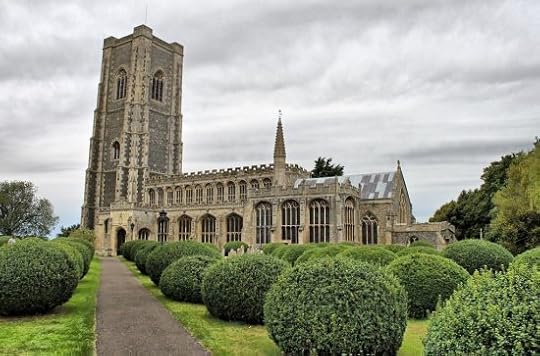 St Peter's and St Paul's Parish Church, Lavenham, book sale.
Dedication:
To Hermione, Luke and Kit
Opening: The very first immigrant to arrive in the British Isles, some 25,000 years ago, would have been hard put to say exactly where he was, and not only because he could barely speak.
P23: From 'The River's Tale', Kipling 1911
But the Romans came with a heavy hand,
And bridged and roaded and ruled the land,
And the Romans left and the Danes blew in -
And that's where your history books begin.
From wiki: Robert Winder, formerly Literary Editor of The Independent for five years and Deputy Editor of Granta magazine during the late 1990s, is the author of Hell for Leather, a book about modern cricket, a book about British immigration, and also two novels as well as many articles and book reviews in British periodicals. Winder is a team member of the Gaieties Cricket Club, whose chairman was the late Harold Pinter.
Totally readable and very interesting as an overview. Loses a star because after WWII it becomes rather a statfest. Found spur lines for further reading and wonder if there is a book dedicated to the British Italian icecream wars...

February 5, 2018
interesting book looking at immigration over the centuries from ice age to modern day and how they integrated into the community even after violence and harassment

January 20, 2015
This is a very good book indeed, 4.5+ stars. Very readable. Brilliant if flawed.
I'll tackle the flaws first. At one stage, when he was listing several Dutch immigrants my mind began to swim and I feared it would turn into a book of lists. It didn't.
I think he glossed over some of the more violent aspects of racism. On anti-Semitism he stated that anti-Semitism was utterly awful elsewhere and in Britain it was considerably less than utterly awful, and implied therefore that it was ok for Jews in Britain. Ask me to cite precise passages, I can't, but it was an overall sense I got. Not that he was implying that therefore British Jews should forever give thanks that they were only treated moderately badly. This sort of repeated itself in his description of violence against Africans, Afro-Caribbean and Asians in the 1970s. However, I utterly applaud Robert Winder for stating again and again that the actual problem was the violence and stupidity of the uneducated white working class, including those in the police, and that politicians were not prepared to accept that (and won't nowadays).
He made passing reference to the Irish migrants. He correctly pointed out that although Ireland was part of the UK Irish people were treated as foreigners and immigrants. I found the coverage of Irish immigration disappointing. Perhaps too big a subject to tackle. He said 3/4 of 'English' people have huguenot blood, surely the figure must be as big for Irish. But compared to the coverage given to Dutch, Huguenots and 19th Century Jews, the coverage of Irish was sketchy.
I wrote after I finished my previous readWhen I Lived in Modern Times I reflected on my need to read more about post-World War 2 reconstruction, especially the enormous challenge of the humongous movememnt of people. That previous book alluded to the Displaced Persons of Europe, especially Jewish people; I watched a TV programme about the millions of displaced Ethnic Germans from areas no longer under German rule (Eastern Prussia in particular). This book tells of the mass movement of British Empire people, partly the windrush generation - young men from the Caribbean who had served in British forces, especially RAF, and who returned to the West Indies with no hope, especially in Jamaica which had been devastated by hurricane in 1944, and the bottom had dropped out of the sugar market. And then the movement of people in India and Pakistan after independence and partition, followed by East African Asians - and other East Africans - John Sentamu gets a name check.
In the big story he told, he didn't tell me anything didn't know, but a lot of the details were fascinating eg Britain owed it to East African Asians to provide a safe haven because this had been written into the independence of India - the Indians who had been settled in East Africa for generations would have recourse to London not Delhi. I am beginning to understand that there is a major story to be told about post-war Polish migrants, and the epic journeys they made. Some Polish women were on the SS Windrush, being collected from Mexico having tramped through Siberia, India and Australia.
And within these stories lies the story of numerous friends, acquaintances, classmates, colleagues and, increasingly, relatives. Sometimes those individuals can't or won't tell that story - British born sons and daughters of East African Asians (or those that came here as babies) often know as little as I do about their origins; a relative who escaped from Vietnam clammed up when I asked (in more conversational phrasing) "So tell me about your life?" - too horrible, I assumed.
This book is beginning to look dated, published in 2004 when the 8 former Eastern Bloc countries and Cyprus and Malta joined, and the issue of Free Movement of Labour became what it is. Currently, there is the much bigger problem of refugees from the failed states of Syria, Iraq and Libya fleeing from ISIS, and people fleeing from specific problems in countries such as Eritrea and Somalia (still). In my opinion, this mass movement of people is as significant as that which happened in the 1940s, and needs more vision than was applied then.
This book proves over and again that migrants coming to Britain is good for Britain and that the 'problems' caused by migrants are caused by British people - the thugs who like to pick on anyone who's not like them (gay people, disabled people, bookish people), the lazy lumpen proles who have grown up with a sense of entitlement and are still teaching their own children not to strive, not to study for their GCSEs, not to get a trade or marketable skill, not to leave their home town* for opportunity, and the poor vision of British government (the civil servants more than the politicians) who seem incapable of projecting demand for public services and allow huge housing developments to go up without schools and health centres, and then wring their hands and sit back when people blame 'immigrants' for queues at GP surgeries, overcrowded travel and shortage of school places.
I started reading this book as someone who supports immigration (with caveats*) and this book has given me reasons to support my views and a real insight into the reasons for migration and the experience of members of various groups of migrants. Perhaps if you start off with an anti-immigration frame of mind you will find evidence to support your views, too. But we must all learn that it's not a simple issue and isn't what it seems on the surface.
(* We don't want Islamist extremists or drug masters; we must do more to stamp out the trafficking of people for sex and other slavery; Government should take more steps to integrate people into British life - providing compulsory English lessons, better planning for the provision of public services, eradication of separatist schools, reduction in the ghettoisation of housing; stop pandering to the patronising and counter-productive concept of 'multiculturalism' - eg assuming that Asian heritage kids can't cope with learning English literature, European music and Art, and British hitory)
I'll tackle the flaws first. At one stage, when he was listing several Dutch immigrants my mind began to swim and I feared it would turn into a book of lists. It didn't.
I think he glossed over some of the more violent aspects of racism. On anti-Semitism he stated that anti-Semitism was utterly awful elsewhere and in Britain it was considerably less than utterly awful, and implied therefore that it was ok for Jews in Britain. Ask me to cite precise passages, I can't, but it was an overall sense I got. Not that he was implying that therefore British Jews should forever give thanks that they were only treated moderately badly. This sort of repeated itself in his description of violence against Africans, Afro-Caribbean and Asians in the 1970s. However, I utterly applaud Robert Winder for stating again and again that the actual problem was the violence and stupidity of the uneducated white working class, including those in the police, and that politicians were not prepared to accept that (and won't nowadays).
He made passing reference to the Irish migrants. He correctly pointed out that although Ireland was part of the UK Irish people were treated as foreigners and immigrants. I found the coverage of Irish immigration disappointing. Perhaps too big a subject to tackle. He said 3/4 of 'English' people have huguenot blood, surely the figure must be as big for Irish. But compared to the coverage given to Dutch, Huguenots and 19th Century Jews, the coverage of Irish was sketchy.
I wrote after I finished my previous readWhen I Lived in Modern Times I reflected on my need to read more about post-World War 2 reconstruction, especially the enormous challenge of the humongous movememnt of people. That previous book alluded to the Displaced Persons of Europe, especially Jewish people; I watched a TV programme about the millions of displaced Ethnic Germans from areas no longer under German rule (Eastern Prussia in particular). This book tells of the mass movement of British Empire people, partly the windrush generation - young men from the Caribbean who had served in British forces, especially RAF, and who returned to the West Indies with no hope, especially in Jamaica which had been devastated by hurricane in 1944, and the bottom had dropped out of the sugar market. And then the movement of people in India and Pakistan after independence and partition, followed by East African Asians - and other East Africans - John Sentamu gets a name check.
In the big story he told, he didn't tell me anything didn't know, but a lot of the details were fascinating eg Britain owed it to East African Asians to provide a safe haven because this had been written into the independence of India - the Indians who had been settled in East Africa for generations would have recourse to London not Delhi. I am beginning to understand that there is a major story to be told about post-war Polish migrants, and the epic journeys they made. Some Polish women were on the SS Windrush, being collected from Mexico having tramped through Siberia, India and Australia.
And within these stories lies the story of numerous friends, acquaintances, classmates, colleagues and, increasingly, relatives. Sometimes those individuals can't or won't tell that story - British born sons and daughters of East African Asians (or those that came here as babies) often know as little as I do about their origins; a relative who escaped from Vietnam clammed up when I asked (in more conversational phrasing) "So tell me about your life?" - too horrible, I assumed.
This book is beginning to look dated, published in 2004 when the 8 former Eastern Bloc countries and Cyprus and Malta joined, and the issue of Free Movement of Labour became what it is. Currently, there is the much bigger problem of refugees from the failed states of Syria, Iraq and Libya fleeing from ISIS, and people fleeing from specific problems in countries such as Eritrea and Somalia (still). In my opinion, this mass movement of people is as significant as that which happened in the 1940s, and needs more vision than was applied then.
This book proves over and again that migrants coming to Britain is good for Britain and that the 'problems' caused by migrants are caused by British people - the thugs who like to pick on anyone who's not like them (gay people, disabled people, bookish people), the lazy lumpen proles who have grown up with a sense of entitlement and are still teaching their own children not to strive, not to study for their GCSEs, not to get a trade or marketable skill, not to leave their home town* for opportunity, and the poor vision of British government (the civil servants more than the politicians) who seem incapable of projecting demand for public services and allow huge housing developments to go up without schools and health centres, and then wring their hands and sit back when people blame 'immigrants' for queues at GP surgeries, overcrowded travel and shortage of school places.
* There are lots of good reasons why people shouldn't leave their home town for work - they may be part of a caring network for an elderly or disabled relative; when they have their own kids they will depend on relatives for childcare; if everyone moves to London or other prosperous area there will be untold pressure on housing and other services; freedom to move includes the freedom to stay close to roots - the Germans have Heimat and the Welsh have a word. However, there are rarely strong excuses for people not moving temporarily or making an awkward commute to acquire the skills to make them master (or mistress) of their own destiny - some uproot across continents, some go to University, some live in a bedsit whilst learning a trade. And some moan that foreigners are taking all the jobs: even in South London, just a (cheap) bus ride from the West End and City of london, apparently 'there's no jobs' because of 'immigrants'.
I started reading this book as someone who supports immigration (with caveats*) and this book has given me reasons to support my views and a real insight into the reasons for migration and the experience of members of various groups of migrants. Perhaps if you start off with an anti-immigration frame of mind you will find evidence to support your views, too. But we must all learn that it's not a simple issue and isn't what it seems on the surface.
(* We don't want Islamist extremists or drug masters; we must do more to stamp out the trafficking of people for sex and other slavery; Government should take more steps to integrate people into British life - providing compulsory English lessons, better planning for the provision of public services, eradication of separatist schools, reduction in the ghettoisation of housing; stop pandering to the patronising and counter-productive concept of 'multiculturalism' - eg assuming that Asian heritage kids can't cope with learning English literature, European music and Art, and British hitory)

December 11, 2016
A fantastic book, with a broad perspective that reminds us Britain has been a land of immigrants and their descendants, ever since the Channel was formed some hundreds of thousands of years ago, cutting Britain and its original (Mediterranean) inhabitants off from mainland Europe. Despite some noticeable blemishes and blotches on our record, we have mostly welcomed or at least grudgingly made room for the constant waves of immigrants arriving since then - which have as often as not been out-numbered by our emigrants. The British characteristics of keeping calm, carrying on, and muddling through - not to mention the courtesy, self-restraint, and sense of fair play found in our passion for queuing - have seen us right time and again, despite our occasionally gritted teeth.
These thoughts do not minimise the present-day challenges for which we must still try to seek solutions, nor the fact that new challenges will arise to which our solutions must respond or evolve. But I think this book proves we can learn from the successes of the past as well as from the mistakes, and that overall we can take heart.
Apologies for the sombre and cautious tone, when actually I am feeling quite bright and hopeful about all this. But immigration is an issue it can be very hard to discuss usefully and cogently. Reading this book might help address that problem in and of itself. From there, surely much is possible!
These thoughts do not minimise the present-day challenges for which we must still try to seek solutions, nor the fact that new challenges will arise to which our solutions must respond or evolve. But I think this book proves we can learn from the successes of the past as well as from the mistakes, and that overall we can take heart.
Apologies for the sombre and cautious tone, when actually I am feeling quite bright and hopeful about all this. But immigration is an issue it can be very hard to discuss usefully and cogently. Reading this book might help address that problem in and of itself. From there, surely much is possible!

November 20, 2023
A HEFTY TOME.
Overall enjoyed and glad I read this. A few criticisms include: a very cursory glance over the horrors or chattel slavery (aka one chapter) and quite the consistent breezing over of (oftentimes) murderous racism (Whiteman-itis).
Was good to read a book that was more positive in tone, as I do often steer towards scathing critiques of our nation. Don’t get me wrong I still back a scathing critique of our nation but it was good to read something more positive about how we CAN enable and encourage immigration.
Obviously it’s not a radical imagining of a world sans borders (the dream) but for what it was (600 pages of staunchly capitalist and free-market liberalism) it was a good read.
The bits on pre-history were most interesting to me: and how the construction of race created new delineations of who was considered “other”. At one point a Cornish girlie was a foreigner to a Yorkshire girlie and a Protestant was bang to rights over a Catholic.
It was written in 2002 with an additional chapter added in the 2014 edition, which obviously gives it some dated elements. The early chapters felt more in depth and thorough, while the later chapters were more rushed. Which was fine by me because I read enough hostile Home Office policy in my day job, I don’t also need to be reminded of their callous ways in my leisure-reading.
I wonder what Robert Winder would think of where we’ve come since 2014, aka Operation Maximise or the Rwanda plan…
More chapters needed methinks.
Overall enjoyed and glad I read this. A few criticisms include: a very cursory glance over the horrors or chattel slavery (aka one chapter) and quite the consistent breezing over of (oftentimes) murderous racism (Whiteman-itis).
Was good to read a book that was more positive in tone, as I do often steer towards scathing critiques of our nation. Don’t get me wrong I still back a scathing critique of our nation but it was good to read something more positive about how we CAN enable and encourage immigration.
Obviously it’s not a radical imagining of a world sans borders (the dream) but for what it was (600 pages of staunchly capitalist and free-market liberalism) it was a good read.
The bits on pre-history were most interesting to me: and how the construction of race created new delineations of who was considered “other”. At one point a Cornish girlie was a foreigner to a Yorkshire girlie and a Protestant was bang to rights over a Catholic.
It was written in 2002 with an additional chapter added in the 2014 edition, which obviously gives it some dated elements. The early chapters felt more in depth and thorough, while the later chapters were more rushed. Which was fine by me because I read enough hostile Home Office policy in my day job, I don’t also need to be reminded of their callous ways in my leisure-reading.
I wonder what Robert Winder would think of where we’ve come since 2014, aka Operation Maximise or the Rwanda plan…
More chapters needed methinks.

November 19, 2011
You only have to pick up any paper on any day in this country to find some kind of polemic against immigration. Whther it's bogus asylum seekers, official government figures, racial tensions, bureaucratic screw-ups, deportations, there's always bound to be someone, somewhere complaining about immigration to this country.
So reading this book was like a breath of fresh air. Winder traces the roots of immigration to these isles all the way from prehistory onwards, making the point that at some level we are all immigrants; we all bear strains of DNA from Celts, Romans, Picts, Scots, Vikings, Danes, Normans, French, Germans, West Indians, Indians, Chinese, Africans. Institutions we think of as quintessentially British are the brainchildren of immigrants: Rothschilds, Harrods, Marks & Spencers, Tesco, the list goes on.
Winder argues that immigration itself is a self-selecting process: only those with the most education, the most drive and ambition, the most determination and perseverance, are likely to overcome to immense obstacles standing in the way of successfully reaching and settling in Britain. And these kind of people are likely to be an asset to any country, not just this one. Statistics prove that the level of education, the level of professional qualifications held are higher amongst immigrants than they are in the rest of the general population - and yet time after time we see immigrants and asylum-seekers dismissed as lazy, criminal, uneducated. And this is quite apart from the fact that immigrants make up only 4% of the general population - hardly the flood we hear about.
This book isn't all a rant against the anti-immigration brigade. Time and again Winder discusses the seemingly-typical British response to immigration - we will moan and complain and put every obstacle in the path of potential immigrants, but we will let them in anyway. There will be prejudice and racial tension and strife, but there are no pogroms, no massacres, very little violence. We are the most begrudging of friends to the immigrant, Winder argues, but even that is sometimes more than enough.
And in the end, what a compliment, surely? That people from all over the world want to come here, want to come and benefit from our freedoms, our liberty, our openness, our liberalism, our opportunities and culture and education. Those of us who were born here didn't choose our country, our nationality, but isn't it surely a compliment that people choose to be British of all the countries in the world?
So reading this book was like a breath of fresh air. Winder traces the roots of immigration to these isles all the way from prehistory onwards, making the point that at some level we are all immigrants; we all bear strains of DNA from Celts, Romans, Picts, Scots, Vikings, Danes, Normans, French, Germans, West Indians, Indians, Chinese, Africans. Institutions we think of as quintessentially British are the brainchildren of immigrants: Rothschilds, Harrods, Marks & Spencers, Tesco, the list goes on.
Winder argues that immigration itself is a self-selecting process: only those with the most education, the most drive and ambition, the most determination and perseverance, are likely to overcome to immense obstacles standing in the way of successfully reaching and settling in Britain. And these kind of people are likely to be an asset to any country, not just this one. Statistics prove that the level of education, the level of professional qualifications held are higher amongst immigrants than they are in the rest of the general population - and yet time after time we see immigrants and asylum-seekers dismissed as lazy, criminal, uneducated. And this is quite apart from the fact that immigrants make up only 4% of the general population - hardly the flood we hear about.
This book isn't all a rant against the anti-immigration brigade. Time and again Winder discusses the seemingly-typical British response to immigration - we will moan and complain and put every obstacle in the path of potential immigrants, but we will let them in anyway. There will be prejudice and racial tension and strife, but there are no pogroms, no massacres, very little violence. We are the most begrudging of friends to the immigrant, Winder argues, but even that is sometimes more than enough.
And in the end, what a compliment, surely? That people from all over the world want to come here, want to come and benefit from our freedoms, our liberty, our openness, our liberalism, our opportunities and culture and education. Those of us who were born here didn't choose our country, our nationality, but isn't it surely a compliment that people choose to be British of all the countries in the world?
May 2, 2013
There are two books in this volume which should, I feel, have been kept separate. The history of immigration into Britain is excellent, packed with detail which is seldom mentioned. But then Winder goes into a long essay on the benefits of immigration which is more opinion than fact. Not that I disagreed with him on much of it. But there are two areas of the story in modern times where he either glosses over facts or ignores them altogether. There's the real strain put on resources locally by large-scale immigration. And there's the effect of religion on the ability or willingness to assimilate. Both are very contentious, but Winder wants to just brush past them.
I'm grateful for the history, though.
I'm grateful for the history, though.

July 6, 2014
This book was striking in that it showed a continuity of racist and xenophobic rants from earlier centuries through to the present time- the silly and hateful arguments of the ignorant have not changed at all, and of course are as absolutely factually incorrect now as they always were. Also striking is the continuity of exploitation under capitalism, which the book perhaps inadvertently highlights. A great weakness of the book is that its author, middle-aged upper-middle-class white dude Robert Winder, has written a "history" pretty much entirely devoid of women. But then that's typical, isn't it? Also, he doesn't know his sociology, and probably should have checked that out before claiming that sociologists think ethnicity is a fixed category....
January 7, 2015
Outstanding book. I only give it four stars because I almost never give five. What would I do if Robert Winder came up with something even better?
A carefully documented, humane evaluation of 1,000 years of immigration into Britain. The book makes the point gently that we are, entirely, an immigrant, mongrel race. It's been fashionable in recent years to reserve that title for the USA; but actually, Britain was at it centuries before America even existed. And in very many cases, the newly-arrived generation is the first to jump up on those white cliffs of Dover, shouting 'Up yours Delors' at the next wave of immigrants.
Should be required reading for all politicians!
A carefully documented, humane evaluation of 1,000 years of immigration into Britain. The book makes the point gently that we are, entirely, an immigrant, mongrel race. It's been fashionable in recent years to reserve that title for the USA; but actually, Britain was at it centuries before America even existed. And in very many cases, the newly-arrived generation is the first to jump up on those white cliffs of Dover, shouting 'Up yours Delors' at the next wave of immigrants.
Should be required reading for all politicians!

August 8, 2013
An interesting premise rather let down by the author preferring to achieve his goal by bludgeoning the reader with endless facts, stats and nuggets of information. If he'd spent as much effort on creating an over-riding narrative or immersive human element, it would have been a much more enjoyable read. As it was, you feel like you can just skip entire chunks of what is a pretty thick book and not feel any detriment.
Nice idea, shame about the delivery.
Nice idea, shame about the delivery.

August 22, 2008
Am only about 1/5th of the way through, but a fantastic book about Britain's long history of invaders and immigrants, and how no one can truly claim to be 100% 'English'. Explores the way migrants are portrayed and how we think of them - thinking about my parents and British Poles, I identified with a lot of the author's points.

August 1, 2011
a long slog of a book, but full little known interesting facts, and puts what it means to be english into prespective.Good stuff should be required reading for all british nationalists, if there were not quite so many long words for them to misunderstand.

March 19, 2013
As the grandchild of Russian and Ukrainian jewish immigrants to the UK, I am fascinated by the story of immigration. The nationalities change but the stories remain the same....and yet almost every immigrant group wants to close the door behind them.
November 13, 2015
Interesting, informative and entertaining. One or two flaws (order of events) that I recognised from my own lifetime, but easily forgiven considering the quality of the work as a whole.

June 4, 2025
I bought this book almost a year ago now in a charity shop in Bath, it has sat patiently on my bookshelf until its time finally came.
I had no idea what to expect from this book, but was overall pleasantly suprised.
A little dull in some of the early chapters, by the middle (colonial days) and the end of the book, it was really a very enjoyable read.
It is also very relevant to the current political debate in the UK, with migration becoming more and more of an issue and 'Reform UK' projected to do very well at the next election. The authors points about how media and politicians dictate public opinion is very relevant nowadays, with social media having grown since this book was published. No better example is the current 'Stop the boats' outrages in England, which just a few years ago, being an almost unheard of issue.
4*
I had no idea what to expect from this book, but was overall pleasantly suprised.
A little dull in some of the early chapters, by the middle (colonial days) and the end of the book, it was really a very enjoyable read.
It is also very relevant to the current political debate in the UK, with migration becoming more and more of an issue and 'Reform UK' projected to do very well at the next election. The authors points about how media and politicians dictate public opinion is very relevant nowadays, with social media having grown since this book was published. No better example is the current 'Stop the boats' outrages in England, which just a few years ago, being an almost unheard of issue.
4*

May 27, 2018
I really enjoyed this book. Immigration is a challenging topic to cover, partly because of the vastness of its historiography and partly because of the controversial nature of it for many people. Winder addresses both of these issues well, going centuries back to paint both a broad picture as well as focusing on individual, specific anecdotes which add a level of personal interest which adds to the reading experience.
The way Winder writes is immensely readable, his language flows and is accessible, and although he presents both sides of the immigration argument you get a clear sense of his position, but in a way that does not reduce the reliability of this work at all.
The way Winder writes is immensely readable, his language flows and is accessible, and although he presents both sides of the immigration argument you get a clear sense of his position, but in a way that does not reduce the reliability of this work at all.

December 26, 2021
Sathnam Sanghera's comment that this book is 'peerless' and that '...if there is one book I would wish onto the school curriculum, this would be it' is spot on. I suggest the parents of those school children also read it.
We can all see our own lives reflected in this book to a greater or lesser extent, and those of us who are already here are so lucky. We should not be surprised by, or resent, those who also want to come here, and I hope we can one day soon find a way to manage their ambitions intelligently and with humanity - we will all be richer for it.
We can all see our own lives reflected in this book to a greater or lesser extent, and those of us who are already here are so lucky. We should not be surprised by, or resent, those who also want to come here, and I hope we can one day soon find a way to manage their ambitions intelligently and with humanity - we will all be richer for it.

November 25, 2018
Excellent history of immigration to Britain that manages to encapsulate centuries of people coming here and bringing new skills, ideas, and fresh blood. It's a reminder, and a timely one, that we're really a nation of immigrants, for all the popular narrative would have us believe otherwise. Plenty of telling, well-researched details, some quite obscure and enlightening. It's a massive topic to cram into one book, but Winder does it with assurance and a light, deft touch.

February 26, 2020
Highly informative, readable and succinct history of a very controversial topic. An absolutely cracking read to dip in and out of. I hadn't realised quite how many big name brands and famous businesses that are still going strong today were started by immigrants. A 'must read' book that everyone should find the time for. Just wonderful.
January 16, 2026
What a great book. So full of facts. so much so that it took an age to read but only because you want to keep going back over stuff to make sure you understood properly. I feel enlightened for reading it and feel that I know my place in this country more than I did. We are all just human beings trying to get by.
February 23, 2022
This book gives a detailed and comprehensive insight into migration to Britain from 1066 to the modern day, with interesting stories and viewpoints from the time and modern historians on different groups and communities throughout British history.

October 5, 2022
Wished I could rate this higher. Really comprehensive book but read more like a textbook. At just under 500 pages I found the first half of the book read like a list of names and it was hard to extract and retain the key information from it
November 25, 2023
A good and interesting book. Very traditional history and largely anecdotal. It labours recent events and gets a bit tedious. I was reading the 2013 edition, which has interviews comments in view of what has happened since.
July 27, 2017
I have learned so much from this one book about the UK than I did through my history lessons. Such a good read.

July 25, 2019
i really enjoyed this book, the writing is very good but I just wish it was more indepth. It skims over history but overall very interesting
April 22, 2021
A fantastic narrative history of the UK...we are all indeed bloody foreigners to this isle.

August 30, 2021
A must read if you want to understand better English identity and its culture. Highly recommended.
January 4, 2022
Not my scene

February 18, 2022
A fabulous history of Britain. Would recommend to anyone.
Displaying 1 - 30 of 46 reviews