I Am Asexual What is Asexuality? (Introductory notes) Common Questions About Asexuality (Common newbie questions) Possible Signs of Asexuality (A three-part rundown of some type of somewhat common experiences among aces) Personality and Identity Sex and Sexual Activities Interactions and Relationships Asexuality: Myths, Misconceptions and Other Things That Are Just Plain Wrong (Debunking ignorant statements) Things That Are Not Asexuality (A list of things that are often confused or conflated with asexuality) Symbols of Asexuality The Asexuality Flag (About the flag and its origin) Black Rings (About the black rings) Cake (About cake and its clear superiority over pie) A Bit of Attraction (Discussion of the many types of attraction, including sexual, romantic, and aesthetic) Under the Ace Umbrella: Demisexuality and Gray-asexuality (Talking about graces and demis) Celibacy, Abstinence, Asexuality (And how they’re not all the same) An Asexual on Sex (Talking about sex) “Don’t you all hate sex?” (More about sex) “But asexuals can’t masturbate!” (About masturbation) Personal Perspectives (More personal views and stories about various topics) What Asexuality Is To Me Option D: None of the Above (My “Coming Out” note) Q & Ace (My “Coming Out” followup) Sex Attraction Porn Love Forward Advances Glossary References
I finally got to read the copy of this book that I got when I went to the North American Asexuality Conference in Toronto in 2015. And though I'd read most of its text in bits and pieces through the Asexuality Archive site, I wanted to see how it worked as a book.
I like it better as a website in bite-sized chunks. Since a lot of the topics overlap each other and the author makes some of the same points in some of the same ways, it can be a little repetitious when reading all at once, but I don't honestly hold that against it too much--especially since books like this might be read out of order. I think the best thing is the humorous, light tone; you feel like you're hearing a real perspective from a real person, which makes it pretty easy to read. And you kind of want to hang out with the author and play video games or talk about nerdy stuff. If you're that kind of nerd. (I am.)
Now, other than the good stuff about the personality and the relatability, how does it stand up as an informational book? Fairly well, though I have some thoughts on how it could have been better. It's an intro and it knows it's an intro. It covers fairly basic topics, sometimes several times, in accessible language, and it does a good job reminding readers that attitudes vary across the community and across the spectrum on several axes. By the time we're done reading, we know some asexual people enjoy sex, some don't, and some won't try it (and it's all okay). We know some asexual people masturbate and some don't, some fantasize and some don't, some watch porn and some don't, some are religious and some aren't, some want relationships and some don't, some have sex-positive attitudes and some don't.
That's really good, and I think asexual people reading this when they don't know much (or anything) about asexuality might be relieved to see the sections about ace experiences that they will relate to--making up crushes so they can fit in, wondering why you don't think anyone's hot, feeling like everyone's talking about something totally uninteresting, worrying that not being sexually attracted to someone will make them think you don't love them, feeling like sex scenes in media are unnecessary and practically random--that sort of thing. (I totally used to skim the sex scenes in books thinking "okay, they're still boning--when do we get back to the story"--not even realizing that to a lot of people, those were the "good parts"!) And the history info on asexual symbols (the cake, the flag, the ace ring) actually told me some things I didn't already know.
I do have some gentle criticism, though. Probably the most significant thing I'd change was the gender terminology problem throughout the book. Having a penis was pretty consistently conflated with being a man or being male, and having a vagina and a uterus (and periods) was pretty consistently conflated with being a woman or being female--and though nods to agender and neutrois and other nonbinary identities did occur in the book (as well as mentions of being transgender), there were really frequent associations of "male anatomy" and whatnot with gender, and certain arousal experiences with being male, etc. A list of reasons for masturbation included "For women, it can help with period pain" and "For men, it can help with embarrassing issues like spontaneous erections or nocturnal emissions." And phrases like "opposite gender" to describe heterosexual orientations and "both genders" to describe bisexual orientations seemed strange for a book whose author clearly acknowledged the existence of other genders elsewhere. This isn't a problem JUST because a huge percentage of nonbinary people exist in the asexual community; cis people shouldn't be seeing gender in these terms either.
That was probably the biggest issue I had with it because it recurred throughout. But other than that, I'd say sometimes the defenses for or explanations for objections to asexuality were dismissive in one-dimensional ways; the misconceptions section was especially opaque sometimes, like when it said taking hormone supplements categorically doesn't change anything for people who are asexual (even though some asexual people do find that hormones might change their perspective on orientation; I've especially heard that narrative from a subsection of trans people in the community). I would have liked to see more nuance there, and I know the author is capable of it since he does stuff like referring to asexual people having functional genitals and throws in a mention that when an asexual person does NOT have functional genitals, that is not the sole definitive factor of them being asexual.
There are several places where non-asexual people especially might find the author's description of them unflattering, and that could be alienating for people who are trying to learn about asexuality from the book without personal experience or background knowledge. When sarcastically poking holes in misconceptions about asexual people, the author has a tendency to say stuff like "It doesn't mean that they want to be alone forever. It just means that they don't see someone and immediately want to jump their bones." That "immediately jumping their bones" thing comes up a couple times, and though we get that he's kidding and that he understands non-asexual people aren't always lusting after everyone they see or desiring sex with everyone they think is attractive, it's odd that this is contrasted with being asexual.
A couple other smaller things that are just personal pet peeves: He uses the "born this way" narrative (which I don't like for various reasons), and there's a REALLY HEAVY focus on sexual experience and masturbation, and at one point the author describes being asexual as "it's like being straight except I'm not into women," which I didn't understand unless "like being straight" is supposed to be understood as a default, neutral state (and I don't consider someone straight unless they're attracted to cross-sex partners). Writing-wise, the book was quite well-written except that the author has a comma splicing habit and once used "lead" when he meant "led."
But as mentioned, I did like how personal it felt, like someone was willing to let you see a no-holds-barred honest slice of their life to help you understand his asexuality experience, and the sort of off-the-wall personality can really make you chuckle sometimes. (I particularly liked when he made a list of the things he'd rather be doing besides doing sex.) Reading his weird little journey and relating to the atypical but very accessible descriptions of his life can make an asexual person feel like whatever they might have been through, someone else was there once too and came out on the other side happy with his identity. I do recommend a glance through the website and understanding the book as separate essays rather than a cohesive book.
Overall, this book was pretty good, but there was nothing special about it. Being ace, I'm almost always looking into things by other asexuals and trying to find more information on it as it slowly becomes more well known. But, I always find myself getting annoyed by what I find. Asexuality is the lack of sexual attraction. That's it. That is all it is. But, people can't seem to wrap their minds around it. They always go into something or other about sex, and it very much felt like that's what happened in this book.
The author even states in the beginning that "a lack of experiencing sexual attraction is the only thing that all asexuals have in common", but it felt like they sort of take a step away from that idea. I understand that the author is focusing a lot on personal experiences, but if they wanted to do that, the book should not have been called what it is. By saying it's "A Brief Introduction", this should include ALL aces, but the author continually draws back to their own life. I was more expecting a good "Brief Introduction", maybe something that would help me further explain asexuality to my rather close-minded family members instead of stories about this person's life.
I like reading about other people's experiences of being ace, especially since they're all pretty different, but it wasn't what I was expecting (or wanting) from this book.
This was pretty repetitive, but it is overall a good intro to learning what asexuality is and isn’t. It also clears up a lot of misconceptions people tend to have.
I'm an honest person,i really really disliked the LoveisLove hash tag.i'm not homophobe or something like that;the problem is that love is LOVE,it is not sex!
sexuality is about sex.homosexuals have sexual attraction to their own gender,while heteros have the sexual attraction to people of the other gender,or like bi people to both and pans to both genders plus the ones without it.
truth is that people exist who are asexual and they don't feel sexual attraction to anyone.it doesn't matter what is the gender,they are not like "hey what a hot person i wan't to have sex with" actually even if you make them sit to watch a porn movie they would be like "oh my God are they serious?is THIS what makes all of you crazy?please end soon i have books to read and video games to play(or whatever i do in my free time)" they even don't get the reason why there should be a sex scene in a book about the apocalypse,cause "hey the world is ending!ARE YOU CRAZY???"
this is why i didn't like the hash tag,cause love is not sex!love is about romance!if it was about sex so asexuals were going to not fall in love at all(and trust me they do)
so while people all around the world know so many things about other sexualities,asexuals are little understood by them.
this book is a very good book about asexuality.it was written by a man who is ace(we can call asexuals ace too) and contains even some of his personal experience which is good to read.
the problem with this book is that some facts are repeated SO much that it really makes you tired! like when he talks about the difference between celibacy and asexuality.you read about it in like every ten page or something like that and from some point it makes you roll your eyes and say "I REALLY KNOW IT NOW" out loud!
but still,i think that is good to read it and highly recommend it to anyone who wants to find out more about different sexualities.
To be honest, I was a tad disappointed with this book. The actual information was all good, as far as I can tell, and it conveyed a good idea of what life is like for the range of people who may identify as asexual. I also appreciated the humour. There should be more of all of that around.
I read the book from cover to cover (though not all at once), which may not be the best approach. The same information is used to answer questions in a number of different contexts, so it becomes rather repetitive if taken as a whole. It's more the kind of book to dip in and out of. If you access what you need via the particular interests or concerns you have, maybe that's all you need. So perhaps that's just the way this particular book works.
The one thing I felt was rather badly done was the tone to be found in some sections of the book. Obviously the author has been asked many of the same uninformed questions over time, and he replies to them in this book in a rather smart-aleck way. I'm sure we can all relate to how frustrated he feels in this regard. However, I sincerely believe this is not the time nor place to release your inner smartarse.
If people are asking, and are honestly interested in the answers, then they are the good guys. They are on our side. They don't deserve to be made to feel stupid or ignorant for not already knowing. This attitude is all the more surprising coming from someone who himself hadn't heard of asexuality, or identified himself as asexual, before he was 31 years old. There was a time in the recent past when the author was also asking questions to which he did not already know the answer.
OK, enough said.
If you would care to explore the topic of asexuality, I suggest starting at the author's site http://www.asexualityarchive.com/ and The Asexual Visibility & Education Network http://www.asexuality.org/home/ , and then deciding for yourself where to go from there.
To end on a positive note, I am very glad there is indeed more visibility around this sexual orientation these days, and I heartily support ace people as well as all on the GLBTQI spectrum. It's totally hip to be whoever we are! ♥
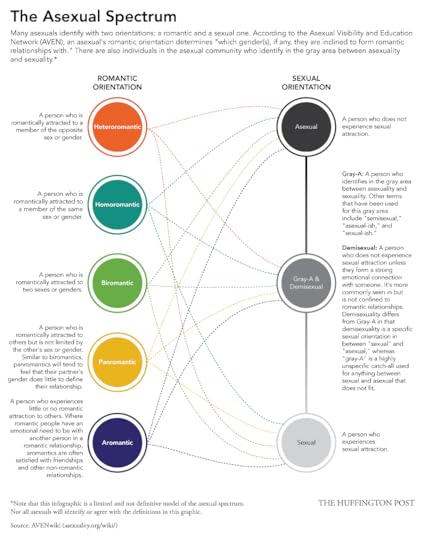
I read this book this morning & well aside from some new terms that I wasn't aware of (like celibacy , abstinence & aesthetic attraction) , it didn't have anything new for someone who's asexual & you may disagree with some parts too if you're one (like the cake-love thing lol ) . Tbh my problem with the book is that it was so repetitive & so focused on the personal experience of the author & not on aces in general . But nontheless it's worth reading if you're not familiar with asexually & want to know the difference between Demisexuality & Gray-asexuality in the most simple way . (Gray-asexuality , it's kinda complicated but it's as the name suggest , an area between sexuality & asexuality , so those who experience a few sexual attractions but not very frequent like any normal non-asexual person are referred to as gray-asexual while demi-asexuals are those who experience a sexual attraction only after having a firm bond with someone or just experience this attraction with the only person they love . My explanations sucks so you better check Wiki) & on a side note I'll need to fit purple into my clothes more (since the ace flag consists of Black , Grey , White & Purple and I kinda wear those 3 together usually but with the Purple :3) xD .
Не е лоша като за първо запознаване, ако нямаш особена обща култура по темата (каквато се оказа, че нямах и аз :D). Донякъде информацията се повтаря и е леко досадно, но предполагам е, в случай че читателят иска да прочете конкретни точки от съдържанието. Но според мен за наистина задълбочено разбиране на темата се изискват по-сериозна научна литература, а и както самото заглавие гласи - това е просто кратко въведение. Накратко:
1. Асексуалността се разглежда като сексуална ориентация, не като сексуална дисфункция.
2. Общото при всички, които се определят като асексуални, е постоянната липса на сексуално привличане към когото и да е било.
3. Асексуалността не е еквивалентна на невъзможност за постигане на сексуално удоволствие, нито на липса на сексуален живот.
4. Романтичната и сексуалната ориентация се разглеждат отделно, макар и често да съвпадат. В зависимост от пола, към който се наблюдава романтично влечение, което както може да се съпътства, така и да не се - със сексуално привличане, съществуват няколко типа романтични ориентации: хетероромантичност, хомо-, пан-, поли-, и аромантичност (липса или мн ниска степен на романтично влечение).
5. Съществува спектър между двете крайни точки асексуалност - сексуалност, наречен "грейсексуалност", към който се отнасят хора, изпитващи сексуално привличане при определени обстоятелства.
6. В този континуум влиза т. нар. подкатегория "демисексуалност" - при която хората са способни да изпитват сексуално влечение едва когато е налице дълбока емоционална връзка с партньора (в голяма част от случаите - романтична, но невинаги).
It is good to see a representation of Asexuality in literature. That alone made me excited to read this book.
Many valid points were brought up in this book. For the most part, I agreed with what the author had to say (I identify as Asexual to a degree). There were a few things I didn't agree with at the same time. Overall, the definition and representation that the author provided for Asexuality was rather good. :)
I just wish this book wasn't as repetitive as it was- the points were revisited multiple times which got a bit tiresome to follow. :/
Quite complete guide for whoever wants to understand about term "Asexuality". Written in light and humorous language, I cackled up several times and hollered, "That's true! I'll do that also!"
So yeah. Good book if you want to know more about what asexuality (or whether you are included in that term or not). :)
Eine sehr gute Einführung in das Thema, dass geduldig die Missverständnisse um Asexualität aufklärt.
Das ist jedoch auch einer meiner Kritikpunkte: Es wiederholte sich an vielen Stellen. Jedoch gehe ich auch davon aus, dass die meisten Menschen es nicht aus Recherchegründen und Interesse an einem bisher unbekannteren Teil des queeren Spektrums lesen und sich somit nur die Kapitel heraussuchen, die für sie in dem jeweiligen Moment interessant sind.
Sehr gut finde ich auch die persönlichen Erfahrungen des Autors, die hier einen wichtigen Einfluss haben. Denn er wusste lange nicht, was anders mit ihm ist und hat erst mit der Erkenntnis, dass es Asexualität gibt, erkannt, dass so viele Momente seines Lebens mit der Definition erklärt werden können. Das gibt sicherlich vielen Ace die Möglichkeit, sich mit jemandem zu identifizieren. Offenheit ist wichtig, um die Normalität zu zeigen.
Bald werde ich sicherlich zu der Anthologie greifen, die ich im selben Zug bestellte.
2,5 ⭐️ perché è (molto) ripetitivo e dà risposte punto per punto senza fare un discorso integrato. Ah e nelle pagine iniziali ho trovato anche una cosa che a me è sembrata bifobica (ma consultandomi con persone bi, mi dicono che è tipo tone-deaf). Non lo so, nella prima parte taglia molto con l’accetta le definizioni, il romanticismo, la repulsione per il sesso. Secondo me questo è dovuto al fatto che il libro sia uscito nel 2012, sono passati dieci anni che per ste cose sono molti. Se volete informazioni più entry-level, meglio le pagine insta che fanno divulgazione. Se invece cercate qualcosa di più strutturato, andate con ”Ace” di Angela Chen.
A great introduction to asexuality for someone who has no idea what it is or has a hard time wrapping their heads around it. It's formulated as Q&A style and lots of the questions they answered were the same questions I had. This book helped me understand asexuality more, however it was very repetitive and only scratched the surface of asexuality.
5 stars for someone who knows nothing about asexuality, but 4 stars overall because it was too repetitive and left me wanting to know more (Although that's probably the point)
I have a suspicion that I'm asexual. I sometimes talk about it to my friends. All of them say that they're not sure if I am, but I think so. That's why I decided to read this book, I want to find out if it's true or not.
The book is written in simple words and repeats the same kind of phrases, which makes it easy for me to read. What is more, the author is asexual himself. The good point is that he understands the difficulty of living as an asexual person. However, although he refers to many other documents, we have to know in advance that this is only his opinion.
All in all, I like this book, because I basically understood what asexuality is from this book. (What a shame, I didn't know about it very well even though I've identified myself as an asexual person.) Perhaps, it's a bit hard for heterosexual, homosexual or bisexual people to understand asexuality even with this book. Even though I read it from an asexual standpoint, there are some things I feel unclear about after reading it.
Anyway, the messages of this book are the following: 1. Asexuality is neither a disease, a disorder, abstinence nor impotence. 2. Asexuality doesn't means they don't masturbate or have sex. 3. Asexuality is an orientation, not behaviour, so asexual people don't feel sexual attractions to people.
Thanks to this book, I'm able to be proud of myself and put a black ring on my right middle finger.
This entire review has been hidden because of spoilers.
An interesting read into what asexuality means and the different aspects of this rarely heard of sexual orientation. This book gives the read a good amount of information about this sexuality, what those who are of this sexuality may feel or want out of a relationship and how people should support them.
The one bugbear I have with this book is after half way through, it began to repeat it's self, constantly; when really it could have easily just explained itself fully by saying the whole different aspects of asexuality and what it means to different aces. When the book began to repeat itself was the moment that I did want to just skim over it and see if there was any more information for me to know, but I choose to carry on reading it to the very end. Which was fine, but the repeat parts did really take away from what the author was trying to give out.
Basic introduction, information to asexuality, heavy emphasis on personal experiences. Despite repeatedly mentioning trans and non-binary identities quite cisnormative and also otherwise not especially intersectional. Recommendable to people with no previous knowledge of asexuality and those trying to determine if they could be asexual. There are better books out there (The Invisible Orientation: An Introduction to Asexuality), but this one is for free and not a bad starting point. http://www.asexualityarchive.com/wp-c...
I thought the author was very humerus. I liked that the book was written like an interview because it made it easy to reference certain questions that you had. With that said, when reading the book straight through, it did become repetitive at times, but if looking for the answer to a specific question it was great.
I really liked this book, because as an asexual Asexuality Archive helped me a lot in discovering and defining that. It's nice to have it in book form.
(The reason why it isn't five stars is that it's quite repetitive, although to be honest, it has to be. Asexuality really isn't hard to understand.)
I found it to be repetitive of itself, which was disappointing. But it is helpful and informative. It answered my questions and a lot I hadn't thought of. I liked the personal chat-like tone the author used.
There is a LOT of repeated information in here, which could have been condensed into a truly brief introduction to asexuality, but overall it was still very good on the informative side of things, and made for an easy read.
Wow. So first, I picked up this book at my public library book sale. I saw it and was curious. Above everything, I think the marketing of this book is very misleading. There are so many better introductions/discussions had surrounding asexuality that I would never recommend this book to anyone. While the author does discuss asexuality in a way that anyone would be able to understand, the repetitive nature of the book means that no one really needs to read the whole thing. If anyone were to read this they can just pick a section, read it, and get the content of the entire book. With that being said, this book does not say it has a single author. In fact, the author's name is never mentioned throughout the book. This book is from a single person's experience being asexual and it is also filled with his personal experience and way he has interpreted asexuality himself. This is not drawing upon experiences from a large group of people, though there are generalizations made that try to make it seem that the author is speaking for a group at large. I think one of the things I disagreed with the most about this book is the oversimplification of asexuality. This reduces asexuality to be someone who doesn't experience sexual attraction, but really asexuality is little to no sexual attraction. The issue is that by distancing asexuality from asexual identities such as gray/demi aces and can make these identities seem as though they are not "ace" enough and can alienate people in the ace community.
This is probably not the book to choose if you're genuinely interested in asexuality. Does it have information? Yes. But the book itself leaves me with the impression of someone with a personality disorder who was trying to make the book as long as possible.
It's very repetitive, and has the odd choice of being smug, condescending, and sarcastic towards the reader, whose questions were made up by the author. The author also describes 'normal people' in a way that is anything but normal. He seems like he spends way too much time on the internet and hasn't learned how to really understand humans, since every depiction of 'normal people' was more like a movie trope than real life. I found myself saying, in relation to 'common asexual experiences', 'Everyone does that!' and in relation to 'normal people behaviors', 'Almost nobody does that!'
I also felt it was unnecessary for the author to tell us so many times that he masturbates and is good at it, hinting that he masturbates quite a lot. It was also unsettling that he couldn't seem to imagine people outside of how he could use them in some fashion or another.
I would advise another book, though I know this niche has slim pickings.
While I appreciate this book’s publication, I feel those of us who identify as Asexual need more mature voices discussing the sexuality.
Most Asexual publications are cobbled together compilations of Tumbler blog posts and social media discussions.
The younger voices are discussing the orientation, which is great and awesome, but we need more mature voices to take these discussions and interpret them in a professional way.
The only ”serious” publication I could find on Asexuality is Julie Decker’s book ”The Invisible Orientation.”
So thank you for this book. People need the information and the confirmation of their sexuality.
But we need much better writers for Asexuality representation.
I'm sorry, I'm not being critical of you personally, just that the LGBTQ+ community and social scientists are ignoring us. And we need to argue our position much better.
I did not find lots of books in this subject, seeing some books in asexuality category for a better understanding of it made me happy. There are some people that know something is different about them, but not knowing about asexuality and other orientations make them thinking that they have a problem or they're not okay and other wrong ideas. In my opinion, these books can help them stop being shy and destructive about themselves and will give them a better vision of the concept. This book had one major problem, the repetition of questions and answers till it became a tiresome one after half of the book. But all and all, it was an informative book and an easy one to read. I didn't know some of the terms that were used in it. Also, there were some issues for me that I couldn't figure it out well, but getting some information from another person who is ace himself helped me to go through it.
I’m ace myself and have identified as such for about a decade now. I was really into the asexual community for years and I felt like I already knew the gist, so I decided to read this “Asexuality: A Brief Introduction” because I figured there might be still some things I could learn. And there was. I think it does its job as a “brief introduction”.
I did misunderstood about what this book would be. I thought it would be a collection of different ace-spec people sharing their thoughts on a particular subject and highlighting how much of a spectrum asexuality is. The author does touch on that, but since it’s highlighted on his own experience, it didn’t go as deep into other perspectives as I thought it would be.
I still found reading the author’s experience to be valuable, especially from a man in society that puts a lot of pressure on men to be hypersexual.
A solid primer for folks who have no idea what the "fourth orientation" is, but not an extensive text.
As usual, the narration comes across the best when the speaks from his own experiences. The stories shared get the points across well. Also, his humor is exactly my type so I was delighted when he snuck in a joke.
But it could also be repetitious. Key points are brought up again and again with little new information. One feels that a thorough essay, not a book, would have done the job just as well.
Still, most general questions were answered and the author brought a welcome approach to the text.
Like other reviewers have pointed out the book was repetitive and too much based on one person's experience. I would pull out the last 30 pages and seriously question how the topics of masturbation and sex were handled. That said, if you want to give something to your parents or a friend who's having trouble grasping the concept then this is an okay option, especially if they keep circling back to the start - the book answers their questions over and over again like a dutiful teacher.
Like others said this one is extremely repetitive. It was also informative and had a bit of humor, but after finishing “I am Ace” I find this one a bit lacking.
I was reading in other reviews that this was some sort of website serial smooshed into a book? And it definitely reads that way. like, I could see the questions being on a page and clicking to read the response? Nothing wrong with this one, it just wasn’t my favorite.