This work has been selected by scholars as being culturally important and is part of the knowledge base of civilization as we know it.
This work is in the public domain in the United States of America, and possibly other nations. Within the United States, you may freely copy and distribute this work, as no entity (individual or corporate) has a copyright on the body of the work.
Scholars believe, and we concur, that this work is important enough to be preserved, reproduced, and made generally available to the public. To ensure a quality reading experience, this work has been proofread and republished using a format that seamlessly blends the original graphical elements with text in an easy-to-read typeface.
We appreciate your support of the preservation process, and thank you for being an important part of keeping this knowledge alive and relevant.
Kate Greenaway (Catherine Greenaway) (1846-1901) was a children's book illustrator and writer. Her first book, Under the Window (1879), a collection of simple, perfectly idyllic verses concerning children who endlessly gathered posies, untouched by the Industrial Revolution, was a best-seller. The Kate Greenaway Medal, established in her honour in 1955, is awarded annually by the Chartered Institute of Library and Information Professionals in the UK to an illustrator of children's books. New techniques of photolithography enabled her delicate watercolors to be reproduced. Through the 1880s and 90s, in popularity her only rivals in the field of children's book illustration were Walter Crane and Randolph Caldecott, himself also the eponym of a highly-regarded prize medal. Amongst her other works are: A Day in a Child's Life (1881), Mother Goose; or, The Old Nursery Rhymes (1881), Little Ann (with Ann Taylor & Jane Taylor) (1883), Marigold Garden (1885), A Apple Pie (1886), Pied Piper of Hamelin (1888) and Kate Greenaway's Book of Games (1889).
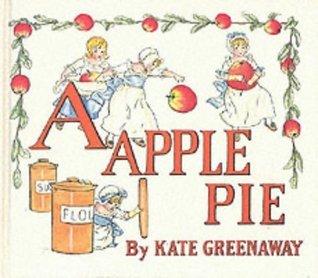
"A Apple Pie" is an ABC classic illustration book for young learners. The main theme is the apple pie and everything you can do with it, for it. As it is a classic, I think there is a deeper meaning to it rather than just teaching students ABC. Illustrations are done in Jane Austin Era. Adorable.
No, the title isn't a grammatical mistake. This is actually an alphabet book, and the title is based on the first page for the first letter.
This is actually pretty charming and not as dated as I feared. The whole book revolves around this massive pie. Letters of the alphabet are highlighted along with a verb (well, except for "A", of course) such as "eat", "knelt", and "mourned". Some of the words make more sense than others. The last page made me laugh because it seemed like the author was phoning it in (or whatever they did before they had phones):
UVWXYZ all had a large slice and went off to bed
Okay...
I kind of loved looking at the illustrations and seeing all the old fashions. There are a number of large knives, and a boy at one point is chasing the others away from the giant pie with a stick, so I'm not sure if it entirely passes today's standards for what's appropriate in children's books. But it's an interesting look at another time through the most basic of children's picture books: the alphabet book.
I like the original 1886 version in it's original color, not the overly exposed one that is circulating online. Everyone was lightened and brightened, changing their hair color. The publisher didn't re-colorize the book, it was people photoshopping it and putting it online that changed the coloring.
I finally found the Kate Greenaway edition. Hooray! I really, really liked it! Full of old-fashioned goodness--just like apple pie! ;-> I especially love the clothing on the characters--very Jane Austen-esque. One likes to imagine Elizabeth Darcy reading this to her great-grandchildren and reminiscing.
Features large pictures of each letter with a phrase from a classic ABC rhyme and illustrations of children in old-fashioned clothes performing each phrase.
Publisher’s Note explains the origins of the rhyme, dating it back to 1671 and John Eachard, also explaining that in those times I and J were “not differentiated” (hence why there is no “I” in the book).
Greenaway's iconic picture book explores how each letter of the alphabet can be applied to a larger-than-life apple pie. (Not adult me thinking of how long it would take to bake a pie that deep!) There's no I because the rhyme comes from a time when I and J served the same function in English. And if one doesn't read "E Eat It" as "E Et it," why are we even here.
Perhaps not the best choice to teach the alphabet to modern English speakers, but an excellent choice as one of many alphabet books for its richness in linguistic history. Clearly, it inspired the previous owner of my copy to practice her As on the flyleaf.
Walk through the alphabet with an immense apple pie and charming nineteenth century children. And after, you will most likely want a slice yourself.
Ages: 2 - 6
We had a little Johnny Appleseed/Apple celebration: watch my reel!
Content Considerations: nothing to note.
**Like my reviews? Then you should follow me! Because I have hundreds more just like this one. With each review, I provide Content Considerations, mentioning any objectionable content I come across so that parents and/or conscientious readers (like me) can determine beforehand whether they want to read a book or not. Content surprises are super annoying, especially when you’re 100+ pages in, so here’s my attempt to help you avoid that!
If you’re considering a book or looking for a new title to read, check out my highly categorized shelves, read my reviews and Friend or Follow me to spiff up your feed with clean, wholesome, living books.
As an alphabet book it was interesting because it uses a verb for each letter - unlike just about every other alphabet book that uses nouns. But as an alphabet book you might need to do some significant explaining about the history and development of the English language, as it is missing an I. I also thought the treatment of the bain of the alphabet-book creator's life, those pesky late-in-the-alphabet letters was a cop out!
I liked how each of the letters were anthropomorphised in the illustrations - but there really aren't any human characteristics of a letter to make this more than a curiosity.
At times it appears that the pie has been included as an after-thought, floating in the margins of the illustration. The illustrations themselves are beautifully detailed - it is interesting to consider what Kate Greenaway would be producing today with the cultural changes - and the technological changes that greatly increase the range of illustrative methods that can be used in mass-produced books.
"A Apple Pie" by Kate Greenaway tells the story of the many things you can do to an apple pie. The story chronologically uses the letters A-Z in the alphabet to describe the situations in which the pie can be used. For example the text starts off, "a apple pie, bite it, cut it, dropped it, enjoyed it, fought for it, got it, hoped for it”. The story continues this chronological pattern all the way through the letter Z. With each letter, there is an illustration displaying the content. For example, the letter M shows a young boy and girl happily munching on an apple pie.
After reading this book, I am impressed with the text layout and the story that the author tells about the apple pie. For example, I think that the author does a great job emphasizing every letter in the alphabet by starting each sentence on each sequential page with the next letter in the alphabet. I also like how the author changes the font of the letter by bolding the letter, altering the color of the letter, and changing the font size of the letter that she is emphasizing at each point in the story. With this being said, there is a great interplay between the text and the illustrations in this story. For example, the letter J is described in the text by a cat jumping over the apple pie, and the illustration shows a cat playfully “jumping” over the pie as a little girl looks on in amazement. However, one change that I would like to make to the illustrations is that I would like the author to have centered the pie in the middle of the page and added more color to the picture of the pie. To me, I think the pie is lost in the background because the wallpaper and table in the illustrations are all natural colors like brown and white. Therefore, the brown pie gets blended into the background. I feel like this design change would help draw the reader’s attention to the main element in the story. Furthermore, I do not really like that the illustration for the letter K. The picture has one person "kneeling" on the ground in the middle of the page while the pie is behind an audience of about ten people watching the one person kneel for the pie. Since the pie is the main focus of the story, I again feel that it should be front and center in the illustrations as well.
In continuation, I believe that this book is great for children first learning how to talk. I think this story is a great fit for children learning to speak because the alphabet is one of the first things a child memorizes. The alphabet is like a catchy song that kids can learn a great deal from, and this book can be used to teach a child this song as well. However, this story can also be used for older children. Older children who read this story can be challenged to use their creativity to think of an instance where each letter in the alphabet can be used to tell their own story. This would be a beneficial activity with this book because the child could look at the letter and build their vocabulary at the same time. Therefore, I recommend this story to children of all ages.
This book is ok but not my favorite theme for learning the ABCs. I think my son just tolerates it because he enjoys the ABCs but could care less about pie. He's a Chicka Chicka Boom Boom boy.
A good book to use with younger elementary age students. This book is written in ABC format and details all of the different ways the letters of the alphabet connect with the idea of apple pie. The pictures add humor to the words written on the page, and I often found myself laughing at different parts of this book. Some of the letters include words that might need to be explained and scaffolded by a teacher, however, it allows for students to utilize the pictures in order to develop what they feel is the correct word. Being an upper elementary teacher, I didn't find this book particularly thrilling, but I did think it was interesting to examine the format of this book. I read this book on ICDL and I found that it was nice to focus on one letter at a time in order for students to examine the words and pictures on the page. I think this book leads to a great activity that can be conducted with students that relates to them creating their own "ABC Book" with a different topic. Also, I think that this book would be a wonderful opportunity for students to compare and contrast the way the pictures were developed.
Very sweet illustrations and a fun idea to use a verb for each letter of the alphabet as it pertains to an apple pie. My only problem with the book is that for the letter 'K', the word used was 'knelt'. This would be a little confusing for little ones just learning their alphabet as they would not have been introduced to the multi-letter phonograms yet. To begin with they need to learn that 'K' says 'ck', not that 'kn' says 'n'.
This was a basic ABC book based on apple pie. It was really interesting because of all the old pictures and style of the book. Also, instead of making the last few letters U V W X Y Z to make new pages, they just added them all on one page and said "they all ate it". It was very basic, but cute. Could be helpful to a young child, but it looks fragile! And there aren't very many colors.
I found this book to be very simple. A simple ABC book. Children will see what the purpose of book is right away, it is a good book for kids to learn their ABC's. There are however many ABC books that can attractive more young readers. Overall this book did it's purpose, but I am not sure many children will go back to it as a favorite.
The book was educational for sure, but I found it outdated. I am not saying it was a bad book, just not to my personal liking. I prefer more modern and, honestly, more complex texts even for the youngest/lowest level students. They deserve to hear and glean larger vocabulary words, and a better, more creative plot even for an educational text like this. I was also not a huge fan of the pictures.
Tbh, could be better. I give it stars for it being from the 1800s I guess. The use of past tense is unnecessary but the vocab is ok. Still, the author was too lazy to do anything with u, v, x, y, and z and just listed them all next to each other on the last page without assigning them words or drawings smh
This book was short for me but might take a second for a student. This could be paired well with a lesson and easy to read/understand concepts. It is one of those books that goes through the alphabet with each let at the beginning of the sentence. I was so confused reading the title because I was like "shouldn't it be 'an'" but it made sense once I got into the book.
It is a simple book but not much enjoyment from it. It is probably good for pre-kinder and has some silly pictures. I think they should make a new version of the book because this one has old pictures that kids today will not understand. It was a good book but just a little boring.
I enjoyed the old-fashioned layout and theme of this book. It's not only a way of teaching kids their alphabet and what sounds the letters make, but it's not another "A is for apple" "B is for banana" kind of book. It actually tells a story and it is quite funny as well!
This book is clever in the way that it focuses on one subject (the apple pie) instead of having each letter be a different theme. However, there is a fight scene and it doesn't show equal time to each letter. UVWXYZ are all thrown onto one page.
This ABC book goes through the alphabet exploring all the things you can do to or with an apple pie from the familiar Eating it to Peeping in it and Singing for it.
First, I read it on Project Gutenberg! Thanks, Project Gutenberg, for existing and being so wonderful!
This book is a charming little thing. Often Alphabet Books are a bit of a bore, lacking narrative and oomph. But this odd book, about a community of mostly children and their reaction to the prescence of the Large Pie proved strangely compelling, with a story, of sorts, although the author eschewed the climax (and dealing with the last stream of inconvenient letters) by sending everyone to bed.
More than anything it reminded me of an Edward Gorey book. He might have changed the period, and rendered in monochrome, but the stiff poses, unexpected bursts of action, and surreal happenings all fit the later Gorey oeuvre. I must investigate if she were an influence upon him.
(Note: I'm a writer, so I suffer when I offer fewer than five stars. But these aren't ratings of quality, they're a subjective account of how much I liked the book: 5* = an unalloyed pleasure from start to finish, 4* = really enjoyed it, 3* = readable but not thrilling, 2* = disappointing, and 1* = hated it.)
I love classical literature and art, as well as Kate Greenaway, so I was happy to find this book. I wouldn't say it is the best for educational purposes because some of the verbs are a bit obscure for children. The letter E is also not a past tense verb like all the other letters. For instance, "B bit it" is past tense but "E eat it" is present tense. However, I wonder if it was originally meant to be pronounced as "E et it." The earliest rhymes for this came from 1671 and first printed in the 18th century so maybe "et" was used at some point.
I know UVWXYZ also don't have their own pages and are grouped together but it is done so humorously, I just found it fun. Once again, not the best for education but I love this historical, classical book. I love the old fashioned style and clothing. I will still share with my children and enjoy it myself no matter what.
(By the way, I saw many reviews saying the book doesn't have the letter I because I and J were not differentiated at the time. I also saw this was originally the case with U as well, since there wasn't a differentiation between V and U. My book must be an updated version because it has both I and U.)