

What do you think?

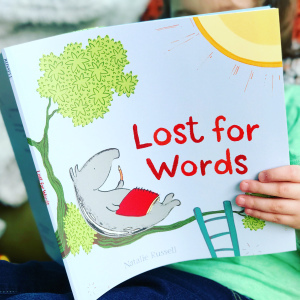
Lost for Words
Tapir wants to express himself, but he can’t find the words!
Tapir and his friends all have nice new notebooks, just waiting to be filled. Giraffe decides to write a poem, Hippo writes a story, and Flamingo composes a beautiful song. But poor Tapir can’t think of anything to write ―and the harder he tries the more upset he becomes! But everything starts to change when Tapir stops trying to write and begins to draw.
This gentle story from author and illustrator Natalie Russell will inspire even the littlest artists to find their creative spark.
Tapir and his friends all have nice new notebooks, just waiting to be filled. Giraffe decides to write a poem, Hippo writes a story, and Flamingo composes a beautiful song. But poor Tapir can’t think of anything to write ―and the harder he tries the more upset he becomes! But everything starts to change when Tapir stops trying to write and begins to draw.
This gentle story from author and illustrator Natalie Russell will inspire even the littlest artists to find their creative spark.
32 pages, Hardcover
First published March 1, 2014
About the author
Natalie Russell
25 books9 followersNatalie Russell is an author, illustrator, and printmaker whose work has been widely exhibited. When she's not in her studio creating books, she can be found at Dundee University in Scotland where she teaches illustration.
Ratings & Reviews
Friends & Following
Create a free account to discover what your friends think of this book!
Community Reviews
Displaying 1 - 30 of 81 reviews

March 29, 2014
There need to be more picture books about tapirs.

November 16, 2015
"Lost for Words" is a beautifully touching story which encourages children to open their minds to the concept that we are all different and not everyone is able to express their thoughts through the same channels. The aspect which makes the book particlarly potent is the way that this concept is put across; at the end of the story when Tapir is finally able to fill the blank pages of his notebook, he has fantastic ideas, and the reader is aware of this, but, better still the reader is sweetly presented with the understanding that Tapir's drawings are no less valuable than any of the stories, poems or songs written by his friends. You are left with concrete acknowledgement that it is absolutely okay to work in a different way to others - even if they are the majority - which is a truly inspiring message, and one which I think should be promoted in every classroom. Tapir's obstacle, however, is not easy to overcome. His struggle is evident from the outset, and also rather sobering when you consider that some children, as well as adults feel the way Tapir does on a daily basis. Ever persistent, he tries so hard, exploring various approaches, but to no avail. Heartbreaking as it is, Tapir makes use of his rough journey by getting so worked up about his difficulty with writing that he becomes so completely and utterly fed up, causing him to walk off to a quiet hilltop to think (and probably to let off some steam!), which is so stunning that it becomes a catalyst for the multitude of imagery that follows. As his confidence grows and the ideas continue to flow, the appreciation Tapir's friends give show their support of his ideas and respect for his way of expressing them. Tapir realises that he has found a way to say everything he wanted, but without writing a single word, and it works out perfectly. And so it should for any readers feeling the same way.

July 3, 2014
This book would be a great intro. to different writing forms (poetry, fiction, song) and also to the importance of illustrations in picture books. It celebrates all kinds of artistic expression. It's hard to find books about writing for little kids, this will be great for Poetry Month.

July 14, 2020
See my full review: https://www.yabookscentral.com/kidsfi...
LOST FOR WORDS is a sweet picture book about finding your own way to express yourself. Tapir has a new notebook and pencils, but he can't seem to find the words he wants to write. He visits his friends, who have written poems, stories, and songs. Then, Tapir thinks some more and decides to draw instead, finding something beautiful in his own art.
What I loved: This touching picture book gives value to art, whether written or drawn, and shows many different ways of expressing oneself. The message of finding your own way/what works for you is a great one for young readers. The illustrations are softly beautiful, and they depict the story perfectly. I also love the given examples of poetry, song, and story that add something extra to the story. The font is easy to read aloud, and the story is very cute and easy to grasp. There are also secondary themes of friendship and the value of feeling understood.
Final verdict: LOST FOR WORDS is a sweet picture book about expressing yourself with art. This is a great one to share with young readers from preschool through elementary school age.
Please note that I received a review copy. All opinions are my own.
LOST FOR WORDS is a sweet picture book about finding your own way to express yourself. Tapir has a new notebook and pencils, but he can't seem to find the words he wants to write. He visits his friends, who have written poems, stories, and songs. Then, Tapir thinks some more and decides to draw instead, finding something beautiful in his own art.
What I loved: This touching picture book gives value to art, whether written or drawn, and shows many different ways of expressing oneself. The message of finding your own way/what works for you is a great one for young readers. The illustrations are softly beautiful, and they depict the story perfectly. I also love the given examples of poetry, song, and story that add something extra to the story. The font is easy to read aloud, and the story is very cute and easy to grasp. There are also secondary themes of friendship and the value of feeling understood.
Final verdict: LOST FOR WORDS is a sweet picture book about expressing yourself with art. This is a great one to share with young readers from preschool through elementary school age.
Please note that I received a review copy. All opinions are my own.

December 18, 2017
I really enjoyed reading this story and see it as a useful resource for the classroom. It highlights the uniqueness of each person and how everyone has their strength's and weaknesses. It is really important that children are given the time and space to discuss matters such as these in their class, and so I would use this story as a springboard to such discussions. (Specifically, this book would be great to read when teaching early writing skills).

May 27, 2015
Tapir has a brand new notebook and some nice pencils. He stares at the first blank page wondering what he should write! He stares and stares but nothing comes to mind. His page looks empty and he has no idea what to write!
Tapir's friend, Giraffe has some pretty good ideas about writing. In fact, Giraffe was writing an excellent poem about a tree. Giraffe sure had a way with words!
Tapir's other friend Hippo is writing too.. Hippo is sitting in his nice muddy pool, making up a lovely rescue story with Hippo as the hero!
And then there is the lovely Flamingo. Flamingo is quite good with songs. This one poem that she currently writing about is how the sun shines brightly in the sky!
"I MUST be doing something wrong!" thought Tapir too himself. He felt quite lost for words Frown So he decides to find a nice quite spot, on the top of the hill, from where he could see a beautiful view and all his friends in it.. Maybe now he will find some ideas!
"Lost for Words" has a wonderful message. When Tapir finds himself comparing his abilities with the others, he suddenly feels quite incapable. But when he finds that nice quite corner to be alone and find confidence in what he can do.. he finds out that he could be quite unique too.. just like his friends! I also love the three writing techniques that the author presented. Children will find inspiration in different techniques in which to express themselves.
The bright and colorful screen-print style illustrations in "Lost for Words" are very child-like and likable. The double spread art work with sunny skies, blue and green landscape will make this a fun to read book for kids.
"Lost for Words" may not be unique in its theme, but is very unique in the way the theme is presented. The surprise ending will leave a smile on every readers face Smile
Tapir's friend, Giraffe has some pretty good ideas about writing. In fact, Giraffe was writing an excellent poem about a tree. Giraffe sure had a way with words!
Tapir's other friend Hippo is writing too.. Hippo is sitting in his nice muddy pool, making up a lovely rescue story with Hippo as the hero!
And then there is the lovely Flamingo. Flamingo is quite good with songs. This one poem that she currently writing about is how the sun shines brightly in the sky!
"I MUST be doing something wrong!" thought Tapir too himself. He felt quite lost for words Frown So he decides to find a nice quite spot, on the top of the hill, from where he could see a beautiful view and all his friends in it.. Maybe now he will find some ideas!
"Lost for Words" has a wonderful message. When Tapir finds himself comparing his abilities with the others, he suddenly feels quite incapable. But when he finds that nice quite corner to be alone and find confidence in what he can do.. he finds out that he could be quite unique too.. just like his friends! I also love the three writing techniques that the author presented. Children will find inspiration in different techniques in which to express themselves.
The bright and colorful screen-print style illustrations in "Lost for Words" are very child-like and likable. The double spread art work with sunny skies, blue and green landscape will make this a fun to read book for kids.
"Lost for Words" may not be unique in its theme, but is very unique in the way the theme is presented. The surprise ending will leave a smile on every readers face Smile

May 2, 2014
Tapir has a lovely new notebook, and yearns to fill it with something marvelous. If only he could think of something to write! Staring at the page, he tries to come up with of something, anything! But his head is as empty as his page.
Anyone who has suffered writer’s block will identify with this cuddly tapir’s dilemma. And how cute is this Winnie the Pooh-shaped tapir as a main character? He turns to his friends for inspiration, and finds Giraffe writing poetry, Flamingo composing a song, and Hippo writing a story. Poor Tapir! He tries imitating their methods, chewing leaves, wallowing in mud, and humming with his eyes closed. Alas – the harder he tries, the grumpier he gets.
Russell’s illustrations are fun and engaging, using soft lines and gentle blue, green and yellow earthy pastel tones. She draws distinct, beautiful suns over panoramic Central American landscapes and smudges realistic muddy textures onto Hippo and Tapir. The colorful pages are bright and filled with simply sketched details like dragonflies and curly, twisty plant life.
Tapir wanders off by himself to think atop a quiet hill, and finds a creative solution to his blank notebook problem. Although the ending may come as no surprise to experienced picture book readers, it is sure to delight young listeners. This sweet, warmhearted story will win artists of all sorts who observe, appreciate and develop their own creative inspiration.
Anyone who has suffered writer’s block will identify with this cuddly tapir’s dilemma. And how cute is this Winnie the Pooh-shaped tapir as a main character? He turns to his friends for inspiration, and finds Giraffe writing poetry, Flamingo composing a song, and Hippo writing a story. Poor Tapir! He tries imitating their methods, chewing leaves, wallowing in mud, and humming with his eyes closed. Alas – the harder he tries, the grumpier he gets.
Russell’s illustrations are fun and engaging, using soft lines and gentle blue, green and yellow earthy pastel tones. She draws distinct, beautiful suns over panoramic Central American landscapes and smudges realistic muddy textures onto Hippo and Tapir. The colorful pages are bright and filled with simply sketched details like dragonflies and curly, twisty plant life.
Tapir wanders off by himself to think atop a quiet hill, and finds a creative solution to his blank notebook problem. Although the ending may come as no surprise to experienced picture book readers, it is sure to delight young listeners. This sweet, warmhearted story will win artists of all sorts who observe, appreciate and develop their own creative inspiration.
March 4, 2014
I was so pleasantly surprised by this book! It is a great story for ECE and early elementary aged children because it emphasizes the importance of discovering exactly who you are and not who you think you should be. A wonderful book for writing skills and friendship. And the illustrations are wonderful!

July 3, 2014
A cute book about how sometimes it's easier to sketch your thoughts and feelings than it is to write them. Could validate some kids' struggles with writing by allowing them the freedom to draw to get ideas instead. Great book for writing workshop

July 22, 2014
Tapir has trouble coming up with an idea to write about. After seeing the different writing styles of his friends, he goes off searching for some solitude, and ends up coming up with an idea that was different than I thought it would be!

July 28, 2014
This is a good book to read when introducing writer's notebooks.
May 29, 2020
A lovely story about a Tapir who doesn't know what to write! This book is a great way to introduce different methods/styles of writing, including stories, poems and songs. It also celebrates that every character has different experiences to write about, and shows how we can use these experiences to influence what we write. It also encourages children to support their peers with their writing and also many ways of recording/retelling stories - not just with words. It could also invite children to think about peer-reviewing, thinking about how the Tapir could improve his work and what he would use when he begins to write.
May 16, 2024
A very sweet picture book about expressing yourself (and the challenges of a blank notebook!). Tapir is trying to express himself but can't quire finds the words that his friends can. But he does find his own way! Sweet illustrations (Tapir is so bunchy and adorable!) and a great selection of different artistic styles and ways to share your ideas/feelings. Can definitely see pulling it out for storytimes on imagination, art, friends, creativity... Would also be good for an older group as a starting point - 'here's your blank sheet, express your ideas about _____'
September 9, 2026
I had originally picked this book out to follow my theme of literary concepts (ex.Explanation Mark and 25 Questions). In seeing the title, “Lost for Words”, I figured it would be another fun tool to teach a literary concept. What I found instead was something more relatable: the struggle to formulate words and thoughts in writing. Additionally, this book showcases the struggle of self-comparison, a deep concept for young children to grasp. As a future school counselor, I would highly consider showing this to a future classroom.
January 21, 2022
Lost for Words is a great book for children to understand that not everyone has the same way to express themselves. It shows that it is okay to have different interests or different ways to express themselves. The illustrations really capture the meaning behind the book. I think this book would be a great read-aloud book for a classroom to show students not everyone will express themselves in the same way or have the same interests, and that is okay.

December 10, 2017
Really liked it, and would have loved it if Tapir had added labels or bravely spelled some words to go with his pictures. It would have been a perfect book for writer's workshop then. I don't want students to think their books are perfect if they don't have a single word.
November 6, 2019
I think this book is cute because it demonstrates that not everyone has to be amazing at everything, but instead that children should seek out their own strengths. I wish the illustrations were better.

April 19, 2018
A bit long for very young children but has a really good message.

February 4, 2019
What a cute little picture book!
I feel like Tapir and I have way too much in common. The image of him snapping the pencil is pretty much a self portrait. Lovely ending though.
I feel like Tapir and I have way too much in common. The image of him snapping the pencil is pretty much a self portrait. Lovely ending though.

August 1, 2019
Great for those who may love drawing more than writing

November 30, 2021
This is a great book for teaching about indivuality.

March 26, 2024
A beautiful story, learn not to judge and not to give up. Everyone is Special

April 10, 2020
This review was originally written for The Baby Bookworm. Visit us for new picture books reviews daily!
Hello, friends! Our book today is Lost For Words by Natalie Russell, an adorable tale about the talents that make us special.
Tapir is flummoxed. He has a brand new notebook with fresh blank pages and a new set of sharpened pencils at the ready. Yet when he sets pencil to paper, he cannot think of a single thing to put down; his brain feels as empty as the page. His friends aren’t having any trouble: Giraffe has composed a poetic ode to his favorite tree; Hippo, a thrilling story about a brave (and handsome) hippo; Flamingo, beautiful song about the bright, warm sun. Tapir is proud of his friends, yet wishes he could figure out how to express himself as well. Retreating to a hill, he looks out over the place and creatures he loves, and reflects… and suddenly, he knows just how to express the feelings within.
Lovely. This gentle, sweet tale covers some pretty classic kidlit subject matter: individual talents and skill, artistic block, frustration, and friendship. The lovely ending sees Tapir not only finding his talent, but using it to show appreciation for the ones he cares about, dovetailing the themes smoothly and with considerable warmth. The art manages to create the cuddliest-looking creatures out of simple lines and colors; JJ was especially fascinated by Tapir, an animal who rarely gets a starring role in kidlit. The length is perfect for a short storytime, and we both loved it. A loveable cast and an encouraging tale, and it’s Baby Bookworm approved!
(Note: A copy of this book was provided to The Baby Bookworm by the publisher in exchange for an honest review.)
Be sure to check out The Baby Bookworm for more reviews!

March 19, 2014
Tapir was so eager to write yet with pencil to paper he was as blank as the paper sitting in front of him. All of his friends were creative writers.
Giraffe was so very poetic in his writings.
Hippo knew the beginning and the end to his stories before he ever put pencil to paper.
The words to Flamingo's songs come to her easily as she hums a tune.
He tried all the muses that inspired his friends to write. His friends tried their best to encourage Tapir. Nothing worked. So he took off to find a place be alone and think. Then something came over him and the beauty of the sun began to inspire him.
What do you think was Tapir's muse? Did he have a hidden talent like his friends? Do you have a muse which inspires you?
Such a lovely story the author and illustrator has provided for our children! Words to encourage and illustrations to stimulate their imagination. She encourage children to find their hidden talent.
Friends and family can be a child's biggest cheerleader and sometimes unintentionally the cause for discouragement. Are you in tune enough to your child to recognize their talents?
I highly recommend this book.
I rated this book 5 out of 5.
Disclosure: I received a free copy of this book from Peachtree Publishers for review. I was in no way compensated for this review. This review is my honest opinion.
Giraffe was so very poetic in his writings.
Hippo knew the beginning and the end to his stories before he ever put pencil to paper.
The words to Flamingo's songs come to her easily as she hums a tune.
He tried all the muses that inspired his friends to write. His friends tried their best to encourage Tapir. Nothing worked. So he took off to find a place be alone and think. Then something came over him and the beauty of the sun began to inspire him.
What do you think was Tapir's muse? Did he have a hidden talent like his friends? Do you have a muse which inspires you?
Such a lovely story the author and illustrator has provided for our children! Words to encourage and illustrations to stimulate their imagination. She encourage children to find their hidden talent.
Friends and family can be a child's biggest cheerleader and sometimes unintentionally the cause for discouragement. Are you in tune enough to your child to recognize their talents?
I highly recommend this book.
I rated this book 5 out of 5.
Disclosure: I received a free copy of this book from Peachtree Publishers for review. I was in no way compensated for this review. This review is my honest opinion.

March 11, 2014
This cute picture book begins as Tapir gazes at a blank sheet of paper, holding his pencil, and trying to write. But sadly nothing is forthcoming. He is at "A Loss for Words" as the saying goes. But the real problem is he is lost because he has no words to put there on the paper.
His friends could. He couldn't. Why even the flamingo wrote her words and SANG them! Tapir was simply lost for words. He looked everywhere for words and couldn't find them. But the world was so beautiful to him. He looked. He picked up his pencil. He began to....... (well that would be telling, wouldn't it???).
Let's just say that Tapir found that words were not the only way to be creative. To express himself. To share his joy with others.
Lost for Words will help the age 4-8 child discover that he or she can be creative, too.
DISCLOSURE: I received a complimentary copy from Peachtree Publishers in exchange for my honest review. Opinions expressed are solely my own. No compensation was received for this review. The giveaway winner's copy is also provided by Peachtree and will be mailed directly to them.
His friends could. He couldn't. Why even the flamingo wrote her words and SANG them! Tapir was simply lost for words. He looked everywhere for words and couldn't find them. But the world was so beautiful to him. He looked. He picked up his pencil. He began to....... (well that would be telling, wouldn't it???).
Let's just say that Tapir found that words were not the only way to be creative. To express himself. To share his joy with others.
Lost for Words will help the age 4-8 child discover that he or she can be creative, too.
DISCLOSURE: I received a complimentary copy from Peachtree Publishers in exchange for my honest review. Opinions expressed are solely my own. No compensation was received for this review. The giveaway winner's copy is also provided by Peachtree and will be mailed directly to them.

March 3, 2014
Poor tapir is lost for words in this picture book about expressing one's self through writing. Tapir's friends -- giraffe, hippo, and flamingo -- can all write beautifully. When Tapir imitates them in the hopes that his own words will come, he ends up drawing instead. This book is great for featuring an unusual animal that many kids may not know, and I love how the bright illustrations depict a land that's most likely South American. I also love how the book shows that there are many different ways to write (poetry, stories, songs, etc.) and that you can still communicate through drawing even if you don't know how to write yet. What I don't love is the line, "Tapir didn't need words at all!" It works for the story, but I also don't want to discourage kids from learning how to write once it's time for them to do so. Still, this is an adorable story to share with a storytime crowd!

March 10, 2014
I found Lost for Words to be an adorable story about finding one's own voice. I really liked the fact that the author/illustrator used a tapir as the main character. I can't say as I've ever seen one of those in children's fiction before. I loved the way the story highlights the strengths of Tapir's friends and how Tapir struggles to find his own talent. Tapir tries to write poetry like Giraffe and a story like Hippo, but he can't come up with any words. It isn't until he follows his own innate feelings that he finds a way to express his appreciate for the beauty around him and his feelings for his friends. How many of us try to be as good at different things as our friends rather than developing the natural abilities God's given us? A sweet story with delightfully expressive illustrations. Highly recommended.

June 10, 2014
Tapir has a new notebook and really wants to write, but he can’t think of anything to write about! All his friends, Giraffe, Hippo, and Flamingo were writing stories and songs and poems. Tapir tried very hard to think of something to write, with no results. His friends were encouraging and Tapir found his inspiration in the perfect quiet spot with a beautiful view. Tapir found that words were not the only form of expressing one’s self creatively. Full page screen print illustrations perfectly match the simple text that has been carefully placed on each page. This is a story of encouragement for young writers and illustrators. Teachers might like this one for student journal writing/drawing sessions. If children are unfamiliar with the animal tapir, this could launch research about the animal. See “Tapir Scientist” by Sy Montgomery.

November 12, 2014
READING:
RL Standard 2: central idea/theme (Note: the standard for second/third grades mentions fables, etc. and this does not fit that category but could still support students’ understanding of theme)
Theme: everyone has their own way of expressing themselves; everyone has their own talents
Grade 5 example (5.2): challenge (struggles to think of something to write); responds (starts drawing)
WRITING:
also good for talking about writing process -- unique for everyone and sometimes frustrating, but perseverance pays off
narrative text model -- logical sequence, clear problem and resolution
RL Standard 2: central idea/theme (Note: the standard for second/third grades mentions fables, etc. and this does not fit that category but could still support students’ understanding of theme)
Theme: everyone has their own way of expressing themselves; everyone has their own talents
Grade 5 example (5.2): challenge (struggles to think of something to write); responds (starts drawing)
WRITING:
also good for talking about writing process -- unique for everyone and sometimes frustrating, but perseverance pays off
narrative text model -- logical sequence, clear problem and resolution
Displaying 1 - 30 of 81 reviews