Joseph Conrad was a Polish-British novelist and story writer. He is regarded as one of the greatest writers in the English language and, although he did not speak English fluently until his twenties, he became a master prose stylist who brought a non-English sensibility into English literature. He wrote novels and stories, many in nautical settings, that depict crises of human individuality in the midst of what he saw as an indifferent, inscrutable, and amoral world. Conrad is considered a literary impressionist by some and an early modernist by others, though his works also contain elements of 19th-century realism. His narrative style and anti-heroic characters, as in Lord Jim, for example, have influenced numerous authors. Many dramatic films have been adapted from and inspired by his works. Numerous writers and critics have commented that his fictional works, written largely in the first two decades of the 20th century, seem to have anticipated later world events. Writing near the peak of the British Empire, Conrad drew on the national experiences of his native Poland—during nearly all his life, parceled out among three occupying empires—and on his own experiences in the French and British merchant navies, to create short stories and novels that reflect aspects of a European-dominated world—including imperialism and colonialism—and that profoundly explore the human psyche.
Dosta sam čitao Konrada posljednjih godina i ova zbirka (sadrži 11 priča i jedan roman – posljednji koji je objavljen za života pisca) potvrdila je stav koji sam imao ranije – kod Konrada mnogo više mi se dopadaju priče i romani koje je smjestio na more, na palubu ili pod palubu broda, ili bar na neku daleku egzotičnu destinaciju, od onih koji se odvijaju na kopnu, u kontekstu evropskog, obično britanskog društva. Konradove stalne teme – čovjekova sudbina i moralni principi, kakvi su čast ili lojalnost – mnogo bolje funkcionišu izvan konkretnog društvenog okruženja, u mikrokosmosu broda, recimo. Neopterećene društvenom realnošću dobijaju na univerzalnosti i, uopšte, djeluju književno-umjetnički dopadljivo (iako nije teško shvatiti zašto je Nabokov odbacivao Konrada kao pisca za mušku omladinu). S druge strane, kad svoje teme prenese na poznate društvene okolnosti, Konrad pokazuje lice prilično antipatičnog viktorijanskog konzervativca, koji skoro panično odbacuje reformske ili, ne daj bože, neke revolucionarne ideje.
U skladu s ovim, i među ovih jedanaest, čini mi se dobro odabranih i najpoznatijih Konradovih priča, najviše mi se dopadaju dvije čija radnja se gotovo u potpunosti dešava na brodu: autobiografska Youth: A Narrative i, još više, dosta intrignatna psihološka priča The Secret Sharer. Od priča sa kopna zanimljiva je Amy Foster, ne toliko po čisto književnim kvalitetima, već po pesimizmu koji Konrad iskazuje kada je u pitanju mogućnost da se stranac integriše u englesko društvo. Vjerovatno to trebamo imati na umu kad nam se Konrad učini većim Englezom od mnogih rođenih na tom ostrvu, što se meni često dešava.
Drugu polovinu knjige zauzima The Rover, posljednji Konradov roman. Radi se o istorijskom i avanturističkom romanu smještenom u doba poslije Francuske revolucije i uspona Napoleona. Knjiga nije nezanimljiva, ali jeste književni anahronizam. Francuska revolucija je u književnosti velika tema, ali ako znamo da Konrad ovaj roman piše u istoj deceniji kada Džojs piše Uliksa, a Fokner Buku i bijes, The Rover djeluje gotovo komično staromodno.
My early encounters with Conrad left me ambivalent: I didn't get what all the fuss about The Heart of Darkness was for and I found The Secret Sharer moderately good but not thrilling.
I got this collection many years later as a way of trying to decide whether to bother with Conrad in a serious way and I found that the quality trended upward as the volume progresses - and since the stories are in chronological order of writing I suppose Conrad improved with practice. Over-all, I concluded I was sufficiently interested to try one of the novels.
The stories here almost all adopt Conrad's trademark framed narrative style, which seems to sometimes benefit the story and other times subtract from the immediacy of the telling without adding anything worthwhile. Again, mastery of this approach improved with time.
Genre is all over the place in this book (which is fun): we have Stephenson-esque Pacific tales, a Hardy-like pastoral romance, a reminiscent of Tolstoy story of Polish history and the sort of political-criminal-conspiracy thriller adopted by a zillion thriller writers. Never-the-less, they are all also eminently Conradian - and The Secret Sharer, upon re-reading, I find is actually really tense as well as an interesting moral poser.
Great selection of some of Joseph Conrad's short stories. Although settings range from the nautical (poop deck and all), to colonial peripheries, and to the European metropolis, Conrad's focus remains on morally compromised individuals negotiating hostile and disorientating environments. Even with his signature 'story-in-a-story' form, it's impressive how much mileage Conrad gets out of this relatively simple conceit: the gentle farce of Marlow's voyage on a continually flooding ship in 'Youth', the quiet humiliation of a holidaying Count in 'Il Conde', or the blackly comic goings-on in 'An Outpost of Progress'.
From Anarchists to Aristocrats, Conrad subjects them all to a coolly ironic doom. Good reading.
-39- الحمد لله الذي تفرد بجلال ملكوته، وتوحد بجمال جبروته، وتعزز بعلو أحديته، وتقدس بسمو صمديته، يبدو أن المصائب لا تأتي فرادى، وقديمًا قرأت في ثنايا الرواية الفريدة "الأرض الطيبة" للأمريكية "بيرل بك": "يبدو كما لو أن الآلهة إذا تخلت عن الإنسان مرة لا تلتفت إليه ثانية".. لا شيء يسير كما يراد له هذه الأيام، وفي ظل الحاجة للمال يقبض الناس أياديهم، في نفسي شيء من نفسي، يقول جان جاك روسّو "يولد النّاس أحرارًا، ولكنّهم يقَيّدون بالأغلال أينما ذهبوا"، وقال نجيب محفوظ - غفر الله له - "كتب على الإنسان أن يسير مترنحًا بين اللّذة والألم!"، أخاف أن أموت ولا يبقى لي أثر، قال المجنون: " وإن يَكُ عن ليلى غِنًى وتَجَلُّدٌ = فرُبَّ غِنى نفسٍ أشدُّ من الفقرِ!"، قال علي بن أبي طالب رضي الله عنه: (نِعمَ الشيءُ الهديةُ أمامَ الحاجةِ)، لبثتُ الأيام الخانقة الماضية في قراءة "مختارات من الأدب القصصي" لجوزيف كونراد، من سلسلة الألف كتاب الثاني، كنت قد اشتريته من فرع الهيئة المصرية العامة للكتاب بمعرض الكتاب بجنيه واحد، وهو في ثمنه الأصلي بجنيهين فقط، وبدأت فيها لعدد صفحاتها الصغير، غير أن حجمها خدعني فقد لبثت فيها وقتًا طويلًا أفك لوغيتارمات الترجمة ولولا أني آليت على نفسي منذ زمن بعيد ألا أدع من يدي كتاب دون أن أقرأه ولو لم أفهم معظم ما فيه، أمرر صفحاته على عيني حتى يستقيم لي سياقه أو أعرف كُنه الحكاية التي يريد الكتاب قصها والسلام، هذا الصبر على لأواء الكتب العويصة جعلني ذا دربة بإتمام الكتب دونما تعب ذهني عاصف، فأشد ما أكرهه أن تكون القراءة عبء ذهني يضاف لجملة أحزاني وتعاساتي الاجتماعية، "عدا كلب خلف غزال فقال له الغزال: إنك لا تلحقني، قال: لمَ؟ قال: لأني أعدو لنفسي، وأنت تعدو لصاحبك".. وكنتُ قد بدأت الانتباه لكونراد من إشادة القراء بروايته "قلب الظلام" التي نشرت مؤخرًا في سلسلة "إبداعات عالمية"، وفاتتني للأسف، ثم وجدت له رواية من جزئين في إصدارات مكتبة الأسرة بعنوان "اللورد جيم" تجاهلتها طويلًا، ثم عندما علمت أن هذا كاتب مخضرم فاتتني قراءته اشتريتها له، أما هذه المجموعة فتضم قصتين مترجمتين من جانب د. لطيفة عاشور، المترجمة ذكرت بالمقدمة مشكلة الترجمة لكونراد فهو كاتب ذو أسلوب خاص في الحكي بالإنجليزية وهي ليست لغته الأصلية، فالكاتب بولندي تعلم الإنجليزية بمجهوده الذاتي، وخاض في شبابه تجربة في العمل على إحدى السفن الإنجليزية، استقى من وحي هذه الفترة قصته الأولى في المجموعة بعنوان "زنجي السفينة نرجس"، والتي نرى فيها تعقيد أسلوب كونراد فهو يحكي عامية البحارة وتعبيراتهم السوقية وتشبيهات شديدة التكثيف لطبيعة عمل البحارة والمهمشين وعمال السفن والطوائف الدنيا، وقد أرادت المترجمة الوصول لقلب أسلوب كونراد فترجمت القصتان بالعامية القريبة للفصحى فجاءت محاولاتها شيء سيء للغاية، مجهد حقيقةً لأي قارئ ومستفز له لمواصلة القراءة، ولكني واصلت القراءة واستنتجت أن كونراد بالفعل كاتب ذو رونق خاص لا يمكن إغفاله، أدبه مختلف بعض الشيء، كان في حيثيات إهداء جائزة نوبل للأديب التريندادي "نايبول" أن أسلوبه الحكائي مثل أسلوب الكاتب القدير "جوزيف كونراد" من خلال الاهتمام بتفاصيل الثقافة الإفريقية والطوائف المهمشة من العمال والحرفيين والزنوج وغيرهم من ضحايا العنصرية، وهذا ما يبدو أن أدب كونراد قد اهتم به، وهذه القصة الطويلة "زنجي السفينة نرجس" تحكي عن الحياة اليومية لسفينة مبحرة في عرض البحر بعمالها بمختلف شخصياتها وتنوعهم ومنهم الزنجي "جيمي ويت" الذي يحل على السفينة عاملًا جديدًا يتظاهر بالمرض في بداية الرحلة حتى يعفى من شقاء أعمال البحارة ويعلن أنه في طريقه للموت، وما بين تعاطف بعض البحارة به، وسخرية الآخرين منه بصفته زنجي حقير لا فائدة حقيقية منه على ظهر السفينة تدور الأحداث، حتى ينتهي الأمر بموت جيمي بالفعل وحدوث ثورة مكتومة على السفينة من تناقض مواقف ضباط السفينة منه في أزمته المتراكبة، أسرف كونراد خلال تلك القصة في وصف أعمال البحارة على السفينة ومجابهتهم أفظع موجة مرت على السفينة في رحلتها حت كادت أن تغرق بما عليها من طاقمها وحجم شظف العيش الذي يرزح تحت نيره طاقم السفينة بالكامل، كما لو أن الرجل عايش كل هذه الأحداث من قبل على أرض الواقع، شيء مثير للبؤس وللقراءة، القصة الثانية "مستعمرة للتقدم" تقع أحداثها على أرض أفريقيا، أبيضان في مهمة استعمارية من أجل أسيادهما البيض يعانيان من الوحدة وسوء الأوضاع وترصد الزنوج لهما، ورغم أنهما يعلمان أنهما لم يعد يربطهما بوطنهما الأم المتقدم سوى بعضهما البعض، فالأمر ينتهي بقتل أحدهما رفيقه ثم الانتحار شنقًا، بسيطة للغاية ومعبرة عن ما فعلته أوروبا بأفريقيا، وكذلك بما فعلته بأبنائها من البيض الذين أرسلتهم للسيطرة على أدغالها واستنزاف ثرواتها، عامةً المجموعة طيبة، وأرجو أن أجد الترجمات القادمة لكونراد أفضل حالًا خاصة أن الكاتب أعجبني من الناحية الإنسانية، فالثراء الفني للكاتب من خلال كم التجارب الحياتية التي عاشها هي ما يشغف نفسي في الفترة الأخيرة خاصةً بعد قرائتي لهمنجواي وافتتاني به وبأسلوب قصّه، بدأت في قراءة قصة "الرجل البطئ" لكوتسي، وقطعت في قرائتي السريعة لها ثلث الرواية تقريبًا، وهي مميزة سأكتب عنها فور الانتهاء منها بإذن الله، سريعًا سريعًا أواصل القراءة قبل الموت، أخشى انقضاء أجلي قبل الانتهاء مما اشتريته من الكتب في مكتبتي، إلى الله المآل، يا كريم.. "كلما قلنا استرحنا جاءنا شغلٌ جديدُ، وخطوبٌ ينقصُ الصبرُ عليها وتزيدُ، وأرى الشكوى لغير الله شيءٌ لا يفيدُ".
This book includes eleven of Conrad’s twenty-six short stories, selected and commented on by Dr Keith Carabine of the University of Kent. In his introduction to the stories, Dr Carabine says that Conrad’s great distinction “lies in his ingenious and rigorous exploration of the undiscovered possibilities latent in one of the genre’s most familiar forms, namely the framed short story in which a first-person narrator (who is sometimes a member of the group) introduces, comments on and encloses another’s tale.” As Dr Carabine says, the theme of most of the stories is man’s fate, and they are often “teasing and enigmatic”. The framed construction of these stories introduces uncertainty in that the main narrator and the teller of the tale may have different interpretations of the events, leaving the reader to draw his own conclusions.
Two other general points I would make about Conrad’s writing. First, he does not take great pains to capture the interest and attention of the reader at the beginning of a story. The beginning may be a page of detailed description of the opening scene, with little information about the character who is present, and a considerable, almost poetic word picture of the setting. In fact, Conrad’s word pictures of scenes are remarkable in their shaping of the mood of the story: mysterious, uncertain, uncommon, unusual. Moreover, Conrad is lavish in the extent of his descriptions throughout a piece. Some of this may be attributable to his writing for commercial publication in up-market magazines, where his compensation would be based, at least partially, on the word count. Each of these stories has at least one principal character who is confronted with some sort of existential challenge and has defects in his character which contribute to his downfall. Nonetheless, the reader is drawn into his predicament, hoping all the while, that the right solution will be found.
The principal character in The Rover, which is set in the immediate aftermath of the French Revolution, is an ageing, sea-faring, privateer who has come ashore in the south of France to take his ease. There is also a dim-witted and committed old revolutionary, a young woman who has been psychologically damaged be the horrors of the revolution, a royalist French naval officer, and an aspiring young British naval officer, each of whom seeks his/her own solutions in the world. Who will succeed? The ingredients in the story include a plan to deceive the British fleet, as well as a search for love, and a re-ordering of the world between revolutionary-royalist lines, and a rough but beautiful Mediterranean sea coast backed up against a traditional rural society.
One comes to have sympathy for the dilemmas of each of the flawed but real characters, and one can sense the tensions between them, as well as having a sensation of being on the rough bucolic scene, or on board one of the ships. The Rover is an engrossing tale. The one aspect which I found annoying was the slow pace of the conclusion. One cold feel it coming, but Conrad was in no hurry to jump into it. There was much detailed scene setting and character back-story telling. We were familiar with the scenes, and the character enhancements should – I think – have come earlier. Nonetheless, The Rover is a satisfying and interesting tale.
I’ll write first about some things I noticed about Conrad’s famous lyrical writing and then I'll give some examples of the stories. Conrad likes to string words in lists – adjectives, nouns, adverbs….Here are some examples below.
“As to the lady, her gestures were unapproachable, better than the very thing itself in the blended suggestion of dignity, sweetness, condescension, fascination, surrender, and reserve.”
“Explosives were his faith, his hope, his weapon, and his shield.”
“…all of the beautiful and tender ghosts of ideals, remembered, forgotten, cherished, execrated; all the cast-out and reproachful ghosts of friends admired, trusted, traduced, betrayed, left dead by the way…”
“…above his head the sky, pellucid, pure, stainless, arched it's tender blue…”
Conrad also often uses a story technique I think common at the time (because you see it in other short story writers like Chekhov). A story is structured as told to someone by another person, often a stranger met in a restaurant or railroad station. Of course in Conrad 's case these stories are most often told in harbor bars. “Pass the bottle” is like punctuation.
I’ll also note that only about half of these stories are classic Conrad: sailing yarns and whites in colonial outposts.
In An Outpost of Progress two white men, “perfectly insignificant and incapable individuals,” are dropped off in wilds of Africa to run a trading post. A resupply ship may or may not ever come for six months. What could possibly go wrong?
Youth is the first story where Conrad introduces us to Marlow who reappears in Lord Jim and Heart of Darkness. It's a story of the impatience of youth. A novice sailor is burning to get to Bangkok to see the world. One thing after another brings his ship back to port and now he’s wasting away on a rusting hulk. Pass the bottle.
Amy Foster is one of a few stories that aren’t sailing yarns. A boatload of immigrants from Eastern Europe think they are under sail to America but they are being swindled and dropped off in England. One man survives the shipwreck. He has no idea where he is and his unintelligible language makes the locals treat him like a lunatic. Can Amy Foster save him?
Prince Roman is very different too. It’s based on a true story of a Polish rebellion against the Russians where the rebels are captured and sentenced to work in mines in Siberia.
Two of the stories are about anarchists. In An Anarchist a French man is captured and sent to Devil’s Island, the notorious French penal colony. He discovers that not even escape offers freedom from imprisonment. The Informer is a melodramatic story about anarchists in Paris where an upper-class woman is supporting the operation.
This collection also includes Conrad’s famous story, The Secret Sharer, which I’ve reviewed elsewhere.
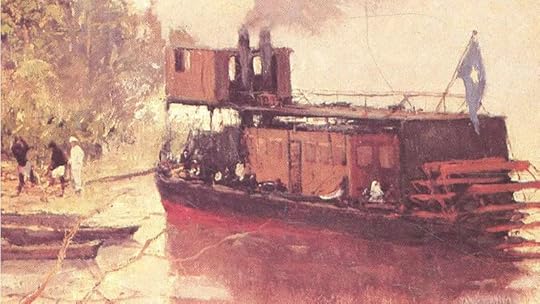
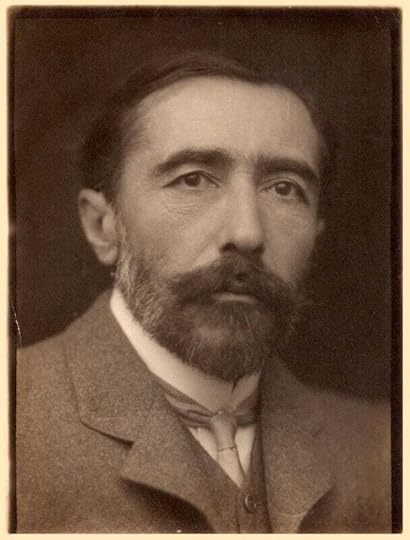
Top photo is a still from a movie clip from massolit.io The author (1857-1924) from npg.org.uk
My copy has the exact same cover, but is titled Selected Short Stories & The Rover, which is not available on Goodreads. Which is just as well, since midway through reading The Rover (neither a short story nor a novella, but a novel), I had made up my mind to do a separate review of it. This review is based on the 11 short stories in the book, which in his introduction Chairperson of the Joseph Conrad Society of Great Britain's Keith Carabine correctly describes "as often teasing and enigmatic, I strongly advise readers who do not know them to read them first and then to return to this Introduction." Illuminating words--I myself have since learned to avoid the spoilers which dot many a well-meaning introduction.
Most are tales of the sea, I should be seasick. Practically all stories are given a token narrator within the narration, a storytelling design I have come to associate with the short stories of one of my favorite writers, Somerset Maugham. And I look to Conrad in search of the same pleasure I derive from Maugham: for plot and prose. I find Conrad's deft, deliberate prose is best appreciated when read slowly, sometimes twice or thrice over. This is nothing short of amazing for a man who only learned English in his late twenties!
1 An Outpost of Progress - An engaging enough story which starts off light, only to reveal a desolate conclusion. 2 The Lagoon - A Tuptim and Lun Tha kind of love story, plus collateral damage. 3 Karain: A Memory - A worthy enough plot for a Twilight Zone or Amazing Stories episode. But I would have wanted to know: What happened to Karain? Was he able to drive his demons away? 4 Youth: A Narrative - A young, impressionable Marlow, before he became (my favorite) Lord Jim's jaded, cynical chronicler of sorts. It's my second or third time to read this. The older I get, the stronger I seem to resonate with Marlow's exuberance for adventure, and his palpable awareness of his fleeting youth, which must thus be spent steeped in adventure. 5 Amy Foster - A boy meets girl story that reminded me of Thomas Hardy's Far from the Madding Crowd. 6 An Anarchist (A Desperate Tale) - Owing to its setting, this reminded me of Franz Kafka's In the Penal Colony, only less interesting. It's the most forgettable story in the selection. 7 The Informer (An Ironic Tale) - A most unlikely tale by Conrad, as it takes place entirely on dry land, with no hint of ship nor sea. No wit, irony, nor compelling plot, either. 8 Il Conde (A Pathetic Tale) - Another unlikely tale by Conrad, and had I not known better, would have attributed to Somerset Maugham. Which means I delighted in this one. The locale, the setting in a respectable, if not top-of-the line Mediterranean hotel, Maugham's template of a typical teller of tales a'la Ashenden--all factors point to Maugham. Or Henry James. Only I don't recall detecting any homosexual overtures in their stories. But Il Conde's narration certainly gave a whiff of a respectable, dignified elderly man on the prowl a'la George Michael at a public park. This, Youth, and The Secret Sharer are the best in the lot. 9 The Secret Sharer - A story that moved me immensely on my first reading. As did the second. Curiously, this third time, despite discovering more layers in the story, wasn't as emotional for me. 10 Prince Roman - A tale of two countries--Russia and Poland--and the Venn diagramming of hearts, loyalties, and sentiments. Reminiscent of certain scenes from Leo Tolstoy's War and Peace, the story, likely based on a true, heroic character, clearly resonates with the exiled Conrad. 11 The Tale - An ambiguous captain sets out against an equally ambiguous counterpart. Forgettable.
**Note: This book was only marked for the story of "Il Conde", which we read in my English class for our unit. And this helps my challenge. :P
"Vedi Napoli e poi mori. [See Naples and then die.]"
This story is about a guy that everyone calls Il Conde. The narrator, which is not him, listens to the Count retell a story of a crime he encountered while the narrator was away. It involves him and a Cavaliere, or a Mafia man. What is this crime that he is talking about?
Well, for me, this was a bit confusing. In all honesty, I think it is well written, with the vocabulary and stuff, but not so much as sense. well, thats my opinion. I guess it's also well-written in the way that he explores the interest of human psychology, how someone thinks, acts, behaves, etc. He showed it with behavioral changes, weaknesses, duality, and other things. HE also explores the role of experience in personality development. We wrote essays on these topics in class. :P IF you're looking for a semi-eccentric tale of crime, "Il Conde" is the story for you!
Joseph Conrad combines three elements in his writing: compelling plots, evocative writing and dark subtexts. His settings are wonderful - African river banks redolent with freshwater mud in stifling humidity, Malay islands lush and forbidding, and the constant moral challenge of the high seas. His protagonists are rich and flawed and invariably surrounded by characters just as interesting. The drama is always perfectly pitched - races against time, ambitious deceptions, failures not yet realised. And his themes are fascinating and pessimistic - vanity, deception, weakness, temper. But what sets him apart for me is the precision of his writing. In his best stories he doesn't waste a single word while perfectly evoking scene and action, "Then, on a fine moonlight night, all the rats left the ship."
There are a few of his lesser stories in this collection, but it's a good enough place to start. "Youth" is a masterpiece, "Karain: a memory" is evocative of a time forever gone and "The Secret Sharer" is utterly compelling.
I had some conflict rating this book. If it were based on Conrad's writing style, use of murky or ambiguous ethical scenarios, mystery, and savagery, I would rate it five stars. I greatly enjoyed 'An Outpost of Progress,' 'The Lagoon,' 'Prince Roman,' and 'The Tale,' but the short stories selections from his collections titled "Youth: A Narrative and other Stories" and "Typhoon and Other Stories" did not really appeal to me. I guess I prefer his earlier and later short stories. Much more of Conrad to read, just picked up the entire Conrad Collection on the kindle for free; I intend to read Heart of Darkness a second time as I last read it when I was just a boy.
Conrad, seperti yang terlihat diwajahnya, menunjukan ketetapan hati, bahkan semacam kekerasan. Dalam, bahkan aku bilang hampir seperti Dostoevsky. Bedanya, Conrad is an Englishman. Hmm akan menarik menyimak Conrad dan Thomas HArdy hadir bersama dan bercakap-cakap....
Joseph Conrad = the man whose work affected me with seasickness and depression that would last some long years. But I might try his work again now that I think I've past that melancholy (sort of).