Irreverent, playful and prolific, Argentinean author César Aira has written over seventy books and has been acknowledged internationally to be one of the most original and provocative authors in world literature. Collected here are three of his most acclaimed books, to be published for the very first time in the UK.
In Ghosts, an immigrant worker's family are squatting on the haunted construction site of a luxury condominium building. All of the workmen and their families see the ghosts which float around the place, but one teenage girl's interest in them becomes so intense that her mother realizes her life is in the balance. An Episode in the Life of a Landscape Painter tells of a point in the life of German painter Johann Moritz Rugendas, when he visits Latin America to paint its spectacular landscapes. There, a strange episode interrupts his trip and irreversibly marks him for life. And in The Literary Conference, a young translator called César Aira travels to a literary conference, intent on world domination . . .
César Aira was born in Coronel Pringles, Argentina in 1949, and has lived in Buenos Aires since 1967. He taught at the University of Buenos Aires (about Copi and Rimbaud) and at the University of Rosario (Constructivism and Mallarmé), and has translated and edited books from France, England, Italy, Brazil, Spain, Mexico, and Venezuela. Perhaps one of the most prolific writers in Argentina, and certainly one of the most talked about in Latin America, Aira has published more than eighty books to date in Argentina, Mexico, Colombia, Venezuela, Chile, and Spain, which have been translated for France, Great Britain, Italy, Brazil, Portugal, Greece, Austria, Romania, Russia, and now the United States. One novel, La prueba, has been made into a feature film, and How I Became a Nun was chosen as one of Argentina’s ten best books. Besides essays and novels Aira writes regularly for the Spanish newspaper El País. In 1996 he received a Guggenheim scholarship, in 2002 he was short listed for the Rómulo Gallegos prize, and has been shortlisted for the Man Booker International Prize.
At first, reading Aira was a puzzling experience. After having read the first novel included into this book, i only knew one thing for sure: I wanted to sample more of his work. And after finishing five of them, I think I’ve finally created some overall impression. Aira’s books are very different from each other. Reading him is an exhilarating experience, but it might be a frustrating one as well. It feels sometimes like buying a lottery ticket (with a higher chance of a win though). However, the quality of a “win” is very high.
He has developed “a procedure” of how he writes. He calls it "Flight Forward" ((fuga hacia adelante). In his novel “Birthday” he describes it as follows:
“What has been written one day must be affirmed the next, not by going back to correct it (which is futile) but by pressing on, supplying the sense that was lacking by advancing resolutely. “
In practice, he does not try to prioritise the overall internal coherence of his story. Instead everyday he adds incrementally to his novel in progress and goes into the direction, the work takes him. As a result, his novels are often a mixture of stories within the stories, surreal symbols, short philosophical digressions, meta-fictional or personal observations. Irony is the one of his best tools. Even in the middle of the most serious, dramatic episodes, i was never sure whether he meant it or he would pull a rabbit out of his hat in the next sentence. In any case, he has made me wondering how a text could be densely packed with ideas and relatively accessible and funny at the same time.
The procedure” tends to deliver. However, “the procedure” is inherently prone to the game of chance. Also it is impossible to pay too much attention to the overall meaning of the work while one creates it in such a way. Therefore, these texts in many cases are wide open to interpretation, and it is up to the reader what to make out of them. They are also very different from each other in this sense. Some of them are more surreal, the others are more personal; some are even subversions of genre fiction such as a historical novel, for example.
Nothing of course is new under the Sun. And I believe his approach to writing was strongly influenced by the avant-garde surrealism movement of the beginning of the 20th century. Breton came up with the procedure for creating visual art "Surrealist automatism": “method in which the artist suppresses conscious control over the making process, allowing the unconscious mind to have great sway.” (Wiki). In Aira’s case, “the procedure” is similar, though probably without the subconscious bit.
In his essay “The New Writing” published in the “The White Review” Aira says:
Constructivism, automatic writing, the ready-made, dodecaphonism, cut-ups, chance, indeterminacy: the great artists of the twentieth century are not those who created works, but those who created procedures through which works could be made alone, or indeed, not made.
He went alone and created his procedure as well. This approach explains the quantity and variety of his output. I was reading an article another day and came across the expression “spontaneity is kind of revelation". I think this is exactly what i appreciate in Aira’s work.
On the other hand, his novels have reminded me a form of traditional oral storytelling performed in style, however. Something akin "1001 nights" when each time the teller has to start a new story to keep going. The difference is though that Aira always manages to finish promptly if relatively unexpectedly.
I think three novels included into this book is a good starting point into his oeuvre. I would stress again - they are different books. I would hardly believe they are written by the same author.
Ghosts - It is a gentle subversion of the magical realism's tropes and of the social realism for that matter, that ends up in a quite a moving story. Power of imagination, architecture, family, emigration and dreams are all here in a mix on the top floor of a building still under construction.
An Episode in the Life of a Landscape Painter - I gather it is considered Aira’s masterpiece. And, it is probably the most linearly told story I’ve read from him. But i’ve found it the hardest to understand. It is layered. And on the one level it can be read like a historical novel with another deeper layer is a commentary on the process of art creation. This second layer made me grapple with the novel. While the first was subversive, darkly funny romp. I plan to write a little separate review of it.
The Literary Conference - subjectively, the least successful of the three in this book but the most humorous. He creates a moral fable using surreal tools driven into the fifth gear. However, the moral of this fable is too obvious and the symbolism a bit too crude even if colourful.
My experience of reading Aira has created an impression that each of his novels is really a snapshot of his mind during the time of writing. I found it fascinating. But it also meant that reading just one of his novel would not be sufficient as putting those snapshots together is producing even more interesting unpredictable combinations just like in a kaleidoscope, but intellectually more appealing.
“For me, writing has always been a pleasure, a continuation of the system of reading.”─ César Aira
CERITA dalam Three Novels bukan cerita yang pertama-tama menggairahkan saya. Pesona Aira adalah alasan saya membaca novel karangannya.
Salah satu yang menarik buat saya, adalah kebutuhan Aira untuk berada dalam situasi yang agak berisik ketika menulis. Dalam satu interviu, Aira mengatakan: "I like writing in cafés. I'll write a little there, a page or page and a half a day, look around, watch people, things. I need to have a mixture of concentration and distraction when I write. I have tried writing alone at home but it doesn't work very well for me. There I'm looking at the wall, which I'm always looking at." Maka, "if a little bird enters into the café where I'm writing─it did happen once─it also enters into what I'm writing."
Saya kira karena sikap itulah cerita-cerita Aira terkesan lalu-lalang tanpa kekakuan pada satu arah bahasan. Dalam Ghosts, Aira menggulirkan waktu demi waktu yang dihabiskan keluarga pekerja imigran Chili di Argentina di tanggal 31 Desember, dari pagi sampai malam, di mana mereka menghadapi klimaks cerita yang berupa tragedi tepat di saat Tahun Baru. Aira mencuplik satu episode pendek dari perjalanan tokoh-tokohnya, dan memberi ruang yang besar untuk ide-ide cerita yang tak ada hubungannya dengan hantu.
Hanya dalam novel An Episode in the Life of A Landscape Painter Aira relatif memperlihatkan garis besar cerita yang setia pada pokok. Novel itu, berbeda dari Ghosts dan The Literary Conference, memberi konsistensi tentang secuil episode hidup Johann Moritz Rugendas, pelukis Jerman yang tinggal di San Felipe de Aconcagua, yang punya mimpi melukis situasi perang para suku Indian.
Dengan bacaan sastranya yang luas, Aira cenderung menempatkan diri pada sudut pandang ketiga yang serba tahu. Misal, tokoh Patri dalam Ghosts, remaja dari masyarakat kelas bawah yang tidur siang dan memimpikan segala yang diceritakan Aira, tidak mungkin mengetahui tentang istilah "provincial spinsters" dari Lévi-Strauss atau "mental city" dari James Joyce─Patri bukan gadis remaja yang rajin membaca, meski Aira menggambarkannya bercerita tentang karangan Oscar Wilde.
Meski demikian, bacaan-bacaan yang luas itu tidak membuat Aira sebagai peniru. Dalam salah satu interviu, Aira memberikan penjelasan bahwa ia memiliki metode membaca sastra tertentu yang membuatnya lepas dari meniru kekhasan pengarang tertentu. Ketika membaca satu karya seorang penulis, Aira akan terus menyelami karya-karyanya yang lain sehingga ia mengetahui ciri-ciri karangan seorang penulis. Pada gilirannya, pengaruh pengarang-pengarang yang ia baca mencair ke dalam dirinya, juga karangan-karangannya, sehingga tak ada jejak-jejak tertentu para tokoh yang ia baca. Seorang peniru, di sisi lain, lahir dari sikap tidak mendalam terhadap buku yang disukainya.
Dari sikap itu, Aira tidak hanya sekedar meneruskan gaya tertentu─ia memungkinkan dirinya untuk mampu menciptakan sesuatu yang baru. Aira "terlihat" karena ia, meminjam kalimat Zaim Rofiqi yang mengambil maksim Isaac Newton, "berdiri di pundak tokoh-tokoh sebelumnya". Yang dilakukan Aira, barangkali, sesuatu yang sama sekali lain dari raksasa-raksasa besar di dunia sastra sebelumnya.
Dengan kemampuan itu tulisan-tulisan Aira, saya kira dengan sengaja, punya kecenderungan "menyimpang": seringkali Aira memberikan judul yang tidak mencerminkan pokok karangan atau setidaknya plot utama cerita. Novel The Literary Conference, misalnya, berisi tentang upaya manusia untuk menghasilkan klon terbaik. Dalam Ghosts, hantu-hantu tidak muncul secara konvensional dalam bentuk makhluk supranatural yang menakut-nakuti sekelompok keluarga imigran Chili. Hantu malah muncul dalam percakapan hangat keluarga besar Viñas sebagai sesuatu yang diceritakan secara bergiliran buat mengisi waktu: Patri menyumbang cerita Oscar Wilde saat seorang putri sangat bosan dengan seluruh kerajaan dan sekelompok hantu mengundangnya untuk pesta Tahun Baru, meski untuk itu sang putri harus menerjunkan diri dari atas menara tertinggi. Di bagian lain, hantu bahkan digambarkan dengan lucu: Raúl Viñas, salah satu penghuni sementara apartemen, mengaku memiliki cara untuk membuat botol-botol anggur miliknya menjadi dingin tanpa masuk kulkas, yaitu dengan cara menyimpannya sementara di rongga dada para hantu─sebagaimana penulis Amerika Latin lain, tampak ada surealisme yang bekerja di sana.
Mungkin itu sebabnya karangan Aira tidak terabaikan: penggemarnya akan terus dibuat bertanya-tanya seperti apa plot yang ditulisnya dalam satu buku baru karena judul tak lagi memberi gambaran pokok dari isi. Dengan demikian, Aira menciptakan model pasar yang sama sekali lain dari model pasar cerita fiksi yang ada sebelumnya: yang ditawarkan Aira adalah ketidakpastian dan kerelaan pembaca untuk menerima apapun keinginan sang pengarang.
Termasuk ketika ada yang tak utuh: seperti cerita Rugendas yang berakhir bahkan sebelum dirinya berhasil menghasilkan karya impiannya. Di akhir novel, ia tengah mengamati suku Indian dalam pesta minum dan perang, menggambar sketsa, dan ketika kita mengharapkan klimaks yang akhirnya bahagia, cerita selesai di situ. Kita tak tahu apakah Rugendas selamat dalam perang itu─terhindari dari mati dan sketsanya menjadi berarti.
Mungkin karena Aira percaya bahwa pengetahuan bisa datang melalui novel, tapi bukan benar-benar dari novel. Kita tak bisa mengharapkan sesuatu yang total dan berlebihan: novel menyertakan pengetahuan yang eksis di ruang hampa, dan masalahnya adalah bagaimana kita akan memetiknya.
‘Three Stories’ by Cesar Aira encapsulate everything that I love about South American literature; the juxtaposition of the everyday with fantasy, the large than life characters and exploration of the human condition via an increasingly set of fantastical set of scenes-what I love about this set of stories is the sheer depth and variety of Aira’s prose.
‘Ghosts’ in many ways reminds me of the magical realist stories of Marquez and Allende; the coalescement of the soap opera with the surreal and magical, the narrative suddenly shifting between fantasy and reality until it become impossible to distinguish between the two. The Perecesque story explores the lives of a group of people who inhabit a flat in Buenos Aires (one of whom, Elisa Vicuña is surely a reference to the America Vicuña, the libidinous young love of Florentino in Marquez’s ‘Love in the Time of Cholera’), from the gawky and awkward Abel Reyes to the heroine of the novel; Patri. Patri, lugubrious and lonely and on the cusp of life between adolescence and adulthood, lurches lachrymosely around the house hoping to find some sort of meaning in life-something transcendent which will take her beyond watching her father’s daily battle with alcoholism or watching the soap opera with her mother. The tone of the story, ironic and playful, belies the tragedy lurking beneath the story-Patri is able to finally find meaning in life, but only via the ghost who inhabit her apartment. These ghosts bring her to the realisation that she is wasting her life on earth, in that mundane apartment in Buenos Aires, that she will only be able to find meaning in life via the ghosts and the key to unlocking their mysteries is via death. Not long before leaping off the roof of the apartment block on New Years Eve, Patri shares an Oscar Wilde (a character who Fermina and Juvenal glimpse in Paris in ‘Love in the Time of Cholera’) story about ghost which foreshadows her own leap into the unknown. Aira is able to transform what many would see as the suicide of a young girl as a tragic, yet beautiful account of a young girl trying to discover something effervescent in life, something transcendent, yet in seeking to escape life via fantasy, as many readers do, perhaps Patri is missing many of the unique and magical moments which in fact make her life worth living.
‘An Episode in the life of a Landscape Painter’ follows the life of Johan Moritz Rugendas, a landscape painter and kind of proto-impressonist, and his journeys through South America and who, like Patri in ‘Ghosts’ seeks to discover the inner essence of the world, but via nature and not the supernatural. The untamed landscapes of South America appeal to Rugendas for several reasons; firstly these areas were undiscovered and unexplored by Western art; Rugendas’s eyes were the first to behold the flatness of the Pampas or the wildness of the jungles, the first to depict their beauty, to discover the cacophony of colours which make-up the landscape-yet, again, like Patri, Rugenda’s search for meaning is not without a high price-he is left horribly disfigured by a lightning strike and turns into a morbid and monstrous (in appearance) being, whose sole purpose is to discover the secrets behind the South American wildness which disfigured him.
‘The Literary Conference’ reminds me of the fables and sci-fi pastiches of Aira’s compatriots, Borges and Bioy Casares. The protagonist of the story is Aira himself; a failed on mediocre scientist ,whose sole goal is to take over the world. Aira manages to solve a puzzle which allows him to discover a hidden treasure which gives him the resources to fulfil his lifelong dream, which he hopes to achieve by cloning a real genius; the writer Carlos Fuentes. The bumbling bumble-bee who he uses to capture the DNA of Fuentes instead clones Fuentes’s blue silk tie, which metamorphose into giant blue silk-worms which descend upon the city in which the literary conference is taking place. The story and characters are straight from a sci-fi B-movie, yet Aira’s playful pastiche of sci-fi tropes is at turns wonderful and irreverent.
The three novels capture Aira’s multi-faceted literary talents and the endless entertainment which his stories bring the reader-there are few modern writers who can match the range of Aira’s talents.
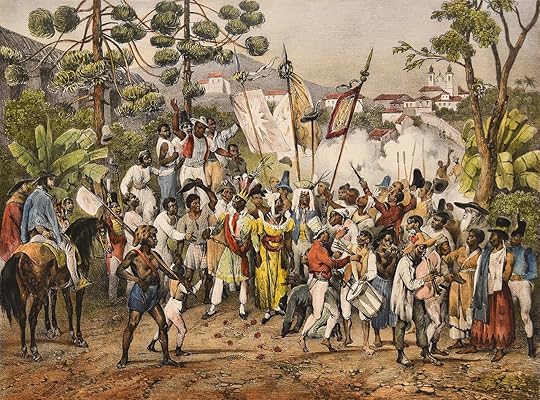
It's worth mentioning that the protagonist in the second story in this book "An Episode in the Life of a Landscape Painter" - Johann Moritz Rugendas - was a real person and his engravings of Brazil are pretty good.
I really liked the 1st novel titled "Ghost's". Although it was very descriptive and the characters were not fully developed it was still full of interesting traditions, opinions and beliefs. The other two were ok, not my favorite, as I don't like descriptive writing.
Writing a long-winded, wordy, tongue in cheek paragraph about keeping writing simple does not justify the long-winded, wordy way that the rest of this was written! I ended up skimming over lots of the very descriptive parts as they weren’t engaging enough for me to pay attention to. The plots of the stories were fairly interesting and seemed quite unique so I can see why he is a celebrated author. However, the writing style is definitely not for me.
Intriguing, often amusing, disrespectful of conventions and yet unable, or unwilling, to ignore them, because to write and to ignore them is impossible, an adroit juggling of genres, from wacky sci-fi to philosophical speculation. I'd have given it five stars but maybe it's all a little too playful to be entirely satisfying?
“ But in a way parties were serious and important too, she thought. They were a way of suspending life, all the serious business of life, in order to do something unimportant: and wasn’t that an important thing to do? We tend to think of time as taking place within time itself, but what about when it’s outside? It’s the same with life: normal, daily life, which can seem to be the only admissible kind, conceived within the general framework of life itself. And yet there are other possibilities, and one of them was the party: life outside life.”
I did not like it at all. Maybe it is because I am not as avant garde after all. But I was so disinterested in the whole thing that I fell asleep every time I tried to read it. Since it just went completely over my head I am not going to blame Mr. Cesar for this. Maybe it is just not for me, and he is actually very great like people say. The Literary Conference wasn't that bad.
Nope, not for me. Looking back, the actual stories weren't that bad, but the process of reading them was tedious, frustrating and exhausting. I enjoyed some of the magical realism but I mostly felt like César Aira wanted to show off all his deep thoughts and prove that he's superiorly intelligent.
GHOSTS was was set in an unfinished apartment block and was about the builders, the caretaker's family and lots of naked male ghosts that live there. The worst part was a 10 page incoherent ramble about architecture.
AN EPISODE IN THE LIFE OF A LANDSCAPE PAINTER is about some landscape painters travelling through Argentina in the 1800s, it felt like reading the description next to a painting in an art gallery, but it's 100 pages long.
THE LITERARY CONFERENCE is about a middle aged author who's also a mad scientist who makes clones and wants world domination, who got rich by finding a pirate's treasure chest and only falls in love with women in their early 20s. The ending was the worst part.
No idea what to make out of this book. It was quite an interesting experience, but I am not sure, if I am ready to repeat it anytime soon - the writing was attracting my attention pretty well, although the thoughts seemed sometimes too convoluted and vague for me, leaving me with sense of dispassion and emptiness similar to eating cotton candy.
Like a movie filmed in one continuous shot, or a train ride spent trying to snatch a cogent scene from the rapidly changing view outside the window, this kinetic narrative is unsettled until it ends.
This book tired me, the way of writing with such long paragraphs plus the fact of the over- descriptive scenes, could not keep me focused onthe main plot. I guess it was just not my type.