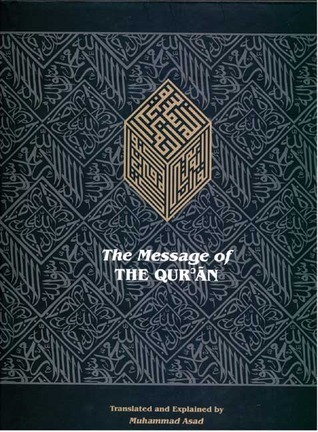
This was very difficult to finish and I must admit to skipping over the last chunk of shorter Surahs. Maybe it’s more appropriate to expand my review to not just this translation/version, and also not just the Quran in general, but my first surface level impression of Islam compared to Christianity and Judaism. I am secular, western, and have just recently read the bible (last year) so this is my reference point.
The text is very chaotic. The first block of longer Surahs was a pleasure to read. Each Surah jumps all over the place topic to topic like a stream of consciousness. Some have an elegant structure like the opener Surah 2, serving as a sort of stand-alone civilizational blueprint, some bounce around rough themes, some appear randomized. Once you reach the middle length chapters, it’s hard to remember where you are without a bookmark, although it’s likely meant to be browsed rather than read like a linear book. The repetition is charming at first, but extremely annoying, easy to forget if you’ve already read something and lost your place. I genuinely didn’t know if I had read some Surahs already at least 5 separate times. Not only is the phrasing repetitive, but many stories are almost exactly repeated such as Iblis, Joseph, Moses’ staff, Noah, Ab and Thamud. It’s comparable to reading the biblical chapters, chronicles and Kings, back-to-back to back-to-back like 5 or 6 times.
This brings me to the next point: the lack of nuance sort of alienates the reader. The Old Testament has the wisdom books, Job, Ecclesiastes, song of songs. We have the human condition laid bare, a glimpse into the problem of evil, existential despair, an ode to love and the joy of marriage. In the New Testament we see apostles fall short of perfect devotion, Thomas doubts, Jesus asks the father why he has forsaken him. In comparison, the Quran seems robotic. You can look up the biblical differences from the Quran in the shared stories, but my takeaway was the Quran shying away from depicting their characters as flawed, and instead emphasizing their piety compared to the unbelieving followers or enemies. Compare this with David, Solomon, Moses, etc. Divine justice on steroids, the good are rewarded, the bad are punished. Obviously, there is plenty of potential complexity in Islamic exegesis and theology, but there is a clear difference in style from the literary collection in the biblical text. The message easily compresses down to its catch phrases, but in my opinion sacrifices some character depth.
Allah is closer to the Old Testament god than Jesus, although he is sort of a synthesis. He is severe, but less wrathful than Yahweh, his mercy and forgiveness are constantly highlighted to soften his strict demands. He matches Aristotle’s pure actuality, as he isn’t embodied or personified, more like an eternal will or fabric of reality itself. The “oneness” of God and lack of personification are heavy theological points of distinction. These make the overall message and theology elegant rather than unsophisticated. He fits with divine simplicity cleanly. Islam avoids the trappings of trinitarian mysteries, and the emotional, fire and brimstone Yahweh.
The “new atheists” really want you to believe Islam is about war and subjugating women brutally, but this really isn’t the case at all. I found it to strongly emphasize an ethic of self-defense rather than violent Jihad, many Surahs explicitly state this theme. If anything, there was a sense of fatalism rather than a zealous mission to convert infidels. It’s sort of a hyper-Calvinism where anything that happens is the will of Allah. The non-believers are often seen as purposely misguided for some reason according to Allah's will, thus not chosen for salvation. The woman doctrines weren’t especially harsh for the times. Many rules and guidelines generously regulate behavior on their behalf, whether customs around marriage, remarrying, divorce or sexual norms. There’s a mainstream western caricature worth deflating about Islam treating women like chattel slaves and also the annoying progressive rebranding as hijab-feminism.
Overall, I felt a stronger difficulty reading this than the bible. Here we have an even higher epistemic challenge than Christianity. Skepticism is discouraged, the miracles are largely recycled from the past with a few exceptions (moon splitting), The Quran itself is considered a miracle, but its beauty and depth are inaccessible to non-Arabic speakers, there is no son sent to display a cosmic drama even secular historians affirm (Jesus dying on the cross). We are to trust in Muhammad and the eternal Quran and know its truth immediately when introduced to its message, but how can we distinguish truth from delusion or sociological religion? If we have doubt, we must not be chosen, hopelessly deceived by Iblis? If this is the case, reading this book is either horrifying or trivial. Probably 60% of the content is telling you of the severe punishment to come for you and the eternal bliss you miss out on. It seems like most of the motivating force is fear or bribery, a sort of emotional blackmail. Although apologists can repaint it as a merciful god, guiding those who answer to the truth -- it reads as a civilizational operating system, fine-tuned to manipulate people into good works.