One Kind of Freedom examines the economic institutions that replaced slavery and the conditions under which ex-slaves were allowed to enter the economic life of the United States following the Civil War. The authors contend that although the kind of freedom permitted to black Americans allowed substantial increases in their economic welfare, it effectively curtailed further black advancement and retarded Southern economic development. The new edition of this economic history classic includes a new introduction by the authors, an extensive bibliography of works in Southern history published since the appearance of the first edition, and revised findings based on newly available data and statistical techniques.
This is an extended review of this classic economic history of the South.
When Ransom and Sutch published the first edition of One Kind of Freedom in 1977, it stood squarely in the revisionist camp of historical writing that attempted to portray Reconstruction as something other than the corrupt and incompetent rule of the Republican Party instituted at bayonet point. Instead, the authors used a bevy of economic statistics and measurements in order to describe Reconstruction in an entirely different way. After performing thousands of calculations and applying their findings, they concluded that the economic misfortunes of the South that followed the end of slavery were, in fact, due almost exclusively to the Southern way of life and its institutions. Prominent among the causes they identified were the persistence of racism, lack of land redistribution, control of rural credit by southern merchants, and the subsequent result of widespread debt peonage throughout the South.
One of the great strengths of One Kind of Freedom is the ability of the authors to take a premise offered by the (in 1977) traditional school of Reconstruction history, and then dissect it with their economic analysis. After the reader overcomes any possible aversion to this logical, precise method of statistical analysis (it includes both graphs based on a logarithmic scale and a trigonometric analysis of merchants’ radius of local monopoly) the simplicity of the actual arguments are a thing of beauty. Consider their counter to the traditional portrayal of the South as prostrated by Northern interference following the Civil War. Between 1869 and 1899, the value added of Southern manufacturing increased by a factor of six, and capital investment in the region expanded by a factor of ten. Yet agriculture stagnated, and much of the book details the reasons why.
Topping the list of reasons for the lack of productivity in Southern agriculture was the persistence of racism. Despite a promising start with schools set up by the Freedman’s Bureau in many areas, the freedman’s efforts toward gaining an education was stymied by the need for farm labor, denial of most career paths by white racism, and physical violence. In an agricultural economic system that depended on credit, the racist of view of blacks as unreliable workers resulted in higher interest rates when purchasing supplies on credit.
The credit system in general comes in for severe criticism from Ransom and Sutch. Rural merchants had a virtual monopoly on supplying rural farmers, both white and black. Because most of these farmers were poor, and had no cash to buy supplies, the merchants advanced the supplies on credit, with a lien on the farmer’s crop at the end of the year. With no real competition, these merchants typically charged ruinous interest rates that kept farmers in debt from one year to the next. Because cotton was the most valuable crop on the market, the merchants would often refuse to extend credit if the farmers did not plant a certain acreage in cotton, which in turn made farmers even more dependent on credit to buy food because they weren’t growing food themselves.
This economic situation, combined with racism, made the land ownership that was a prerequisite for the freedman’s economic success a near-impossibility. “The ex-slave faced three major obstacles: he had inherited nothing from slavery with which to purchase land, the disorganized state of the credit market made it difficult for him to borrow the necessary capital, and he found whites hesitant – and in many cases openly hostile – to the idea of Negro landownership.” (81) All this analysis leads to a very straightforward conclusion. Southern agriculture, and with it the economic status of African Americans, required investment to grow. “Investment must be financed out of current income. The poor tenant farmer … was in no position to save and invest. The fact of the matter is that the South’s institutions removed the incentive to invest.” (186)
In other words, the poverty of the rural South was, largely, a choice. The racist desire to keep African Americans in poverty resulted in institutions that impoverished millions of whites as well. There’s no better argument for the historical damage caused by racism than this, and the fact that the authors demonstrate their claims through exhaustive use of statistics and logical analysis makes their book an important one today, just as it was when first published.
I'm not a fan of economic history but this book did actually interest me. By looking at the era of post-emancipation and its failures, Ransom and Sutch see its failures through the issues of race relations and most of all the economic institutions. The greedy rural merchants who kept sharecroppers and tenant farmers in debt allied with landowners--they become the focal point of much of the book.
Great read for anyone interested in economic history but it's full of graphs, numbers, basically anything that is to be expected from economic historians who love numbers and data analysis.
A. Synopsis: Ransom and Sutch concentrate on the cotton South (South Carolina, Georgia, Alabama, Mississippi, and Louisiana). This book has two foci. (1) It examines the “economic institutions that replaced slavery and the conditions under which ex-slaves were allowed to enter the economic life of the United States for the first time as free agents.(xi)” (2) It asks the question, why the South did not share equally in the general American economic expansion from the Civil War to WWI. The thesis is that the “lack of progress in the postemanciaption era was the consequence of flawed economic institutions (tenant farming, credit system) erected in the wake of Confederate defeat. (2)” Thus, the main goal of the book is to identify these flaws and assess the price Southerners (and the slow progress of blacks) paid as a consequence. B. One kind of freedom 1. In 1865, emancipation permitted blacks one kind of freedom. They advanced their material income, and increased their independence. But, this freedom was incomplete. It was incomplete in the 1860s and remains incomplete today. C. What did freedom mean? 1. Freedom meant the destruction of a 250 year old economic system in the South. A new society and economy would have to be reconstructed and rebuilt on a new design. Because these new institutions were fashioned in haste and in a context of racial animosity, they emerged deeply flawed. The blacks gained political freedom, yet were disenfranchised, the blacks gained social freedom but were outcast from white society by discrimination, the blacks gained economic freedom but became the poorest of the southerners. D. What was the legacy of slavery? 1. Did slavery (through paternalism) provide the slave with the skills necessary to exist in freedom and in a free economy? No. Slavery was a poor preparation for freedom. The slave was never exposed to negotiating a contract, borrowing on credit, determining a crop mix, marketing a cotton crop, or reading an agricultural journal. Slaves were mostly illiterate without the benefit of a formal education. The only skills that they possessed was that of a field hand. It is difficult to imagine an apprenticeship less valuable. E. The myth of the prostrate South. 1. The Civil War did devastate the South. Human life, work animals, destruction of homes, barns, bridges, railroads. This all crippled the economy. Can the economic backwardness of the South during the 50 years after the war be attributable to the wartime devastation? Many countries experience incredible economic resurgence after a devastating war (example Japan). The South did retain the skills and knowledge embodied in the population and the land itself remained relatively unharmed. Thus, the conclusion is that the destructive impact of the Civil War on Southern agriculture has been distorted and exaggerated. The main reason for the decline in per capita output, the decline in land value, the reduction of acreage of planted crops, are all a consequence of a decline in labor due to emancipation. There were less people working (black women stayed at home) fewer hours of the day. F. The demise of the plantation and the rise of tenant farming. 1. So if the Freedmen were without land or assets and the plantation owners were without workers, some agreement had to be reached. Blacks were able to prevent the creation of a labor system that would have replaced one method of exploitation with another. At the same time the landowners retained ownership of the land and thus prevented a collapse of the social and political hegemony that they controlled. The new economic institution was tenant farming (the reorganization of ante-bellum plantations into smaller tenancies, each operated by a single family). By 1880 the plantation system ceased to exist, blacks remained landless and economically subservient. G. Agricultural reconstruction 1. In an agricultural society the possession of land is the key to affluence, the source of economic security, and the basis of an estate to be passed on to one’s children. But, the freedmen’s desire for the land was not enough. The ex-slave faced 3 major obstacles: (1) He inherited nothing from slavery with which to purchase land. (2) The disorganized state of the credit market made it difficult for him to borrow the necessary capital. (3) Whites were at best hesitant and in many cases openly hostile to the idea of black land ownership. 2. The sharecropping agreement: The crops were almost always split 50-50. The main bargaining point was the amount of land given to each family. The landowners wanted to give a small share to each family so that they would try to maximize the lands productivity. A small plot would yield high output per acre, but low yields per man. The landlord provided land, housing, fuel, working stock, feed for the stock, farming implements and seed. The freedman and his family provided the labor and fed and clothed themselves. 3. The sharecropping system was not efficient. The landowners did not provide money to allow the sharecroppers to install improvements. The result was a lack of agricultural progress. H. Financial reconstruction 1. The financial and merchandising network that was developed to accommodate the ante-bellum cotton trade had to be completely rebuilt after the Civil War. With the institutional change replacing the slave-plantation with family operated farms, it was inevitable that new financial institutions would have to be developed. Unlike the reorganization of agriculture, the organization of new financial and marketing institutions received little contemporary notice. But, this financial reconstruction was to have more far ranging effects than the agricultural or political reconstruction’s. 2. The rural franchising merchant takes the place of the cotton factor. The cotton factor in the ante-bellum era was the link between the planter and the cotton manufacturers in New England and England. The sophisticated planter-businessman had close ties with the factor and this facilitated efficiency. The rise of tenant farming by inexperienced and illiterate farmers multiplied the number of farming units. The distant cotton factor could not deal with the individual units, o the task fell to the local (rural) furnishing merchant. The RFM owned the local store. Thus, some of the economic efficiencies of the ante-bellum system could thus be preserved despite the structural transformation. I. The emergence of the rural furnishing merchants territorial monopoly 1. Within several years after the Civil War the RFM had come to dominate the territory in which he operated. His influence (through his store) extended beyond the economic life of his territory to all aspects of rural culture. He was the hub of the local universe. He created the market place, the banking and credit source, the recreational center, public forum, and news exchange. The economic success of these rural stores seemed to be positive for the Southern farmers. The advantages of having a local supplier seemed to be numerous. But, as the merchant began to consolidate his power, he came to be seen in a different light. The storekeeper began to be seen as the oppressor who exploited and coerced his customers, and displaced the landowner as the leader of the community. The source of the RFM’s power was his new system of providing short term agricultural credit. He gained a territorial monopoly of the area which allowed him to control the social, political, and economic affairs that interested him. 2. The source of the monopoly power was credit. There were other stores in which food and supplies could be bought. But, the tenant farmers had no money when they started out. So the merchant extended the new farmer credit, if the farmer would do all of his business the merchants store. The dominating constraint that limited the willingness of outsiders to offer credit in rural areas was the great amount of expense required to watch over their investment. This secured the RFM. J. The trap of debt peonage 1. The monopoly power used by the RFM was used not only exploit southern farmers but to control southern agriculture. The merchant forced the farmer into excessive production of cotton by refusing credit to those who sought to diversify production. There was more at stake here than the farmer’s right to cultivate as he saw fit. Critics feared that the RFM’s insistence upon only cotton would doom the South to economic backwardness. K. The roots of southern poverty 1. The Civil War destroyed the cotton factor, plantation, and slavery. In its place came the RFM, the tenant farm, and the sharecropper. This transformation coincided with the virtual cessation of economic growth in the South. This situation lasted for 4 decades (until 1892) when another great shock hit the south: the boll weevil. In 1894, 1/2 of the crops were lost. An insect had finally accomplished what agriculturists had been urging in the New South for years: southern farmers reduced their concentration upon cotton and shifted to other crops. Thus, this insect ended the era the Civil War had produced
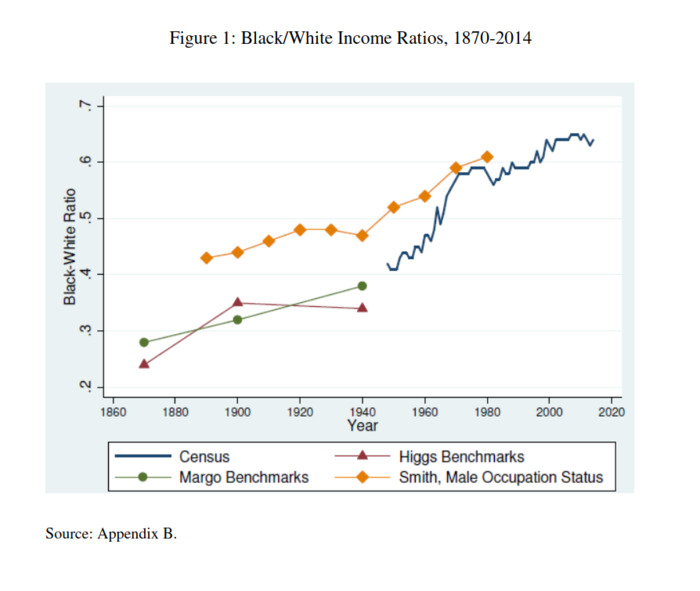
Eu gostei bastante desse livro e, apesar de ter lido sobre a economia do sul dos EUA antes, fiquei bastante surpreso com alguns dados apresentados aqui. Eu sabia, por exemplo, que na segunda metade do século XIX houve uma convergência relativamente forte dos níveis de renda entre a população negra e a população branca (ver gráfico). Ocorre que essa convergência não parece ter sido provocada por uma melhoria contínua da condição socioeconômica de negros em relação aos brancos, como eu imaginava. Na verdade, os dados apresentados no capítulo 1 do livro do Ransom indicam que essa melhoria estava quase toda concentrada na década de 1860 e ocorreu em função do simples fim da escravidão. Ou seja, quase todo aumento na razão de renda entre negros e brancos entre 1860 e 1900 parece ser explicado pelo fim da exploração do trabalho.
Houve significativa melhora relativa da educação da população negra no período, como comento nessa outra resenha. Mas essa melhora não se traduziu em melhorias nos indicadores econômicos. A possível razão para isso, como indicado pelos autores, é que capital humano apresentava um benefício limitado em uma economia essencialmente rural como o sul dos EUA.
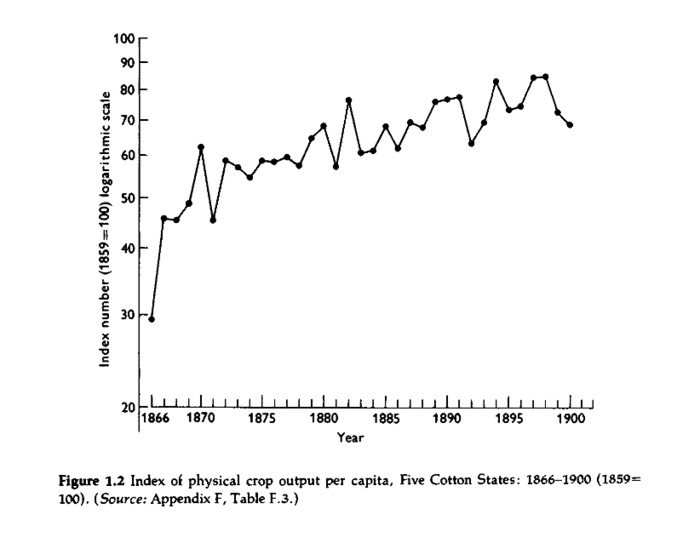
Aliás, é precisamente a dependência do trabalho rural que parece estar por trás da relativa estagnação da renda da população negra e da performance medíocre da economia sulista. Veja na figura abaixo que, mesmo em 1900, a produção de algodão no Sul era menor do que o nível pré-guerra civil.
Os autores argumentam que, após a guerra civil, o estoque de capital da economia sulista voltou rapidamente ao patamar anterior. Por essa razão, as raízes do atraso econômico relativo do Sul devem ser encontradas em outros aspectos economia. Dessa forma, os autores elencam três principais fatores que contribuíram para o desempenho econômico ruim da região. São eles: i) contração da oferta de trabalho pós-escravidão, ii) reorganização produtiva (i.e., fim do plantation e ampla aderência ao sharecropping) e iii) desestruturação do mercado de crédito que passa a ser dominado por comerciantes locais que gozavam de amplo monopólio o que gerou uma oferta de crédito caracterizada por juros elevadíssimos.
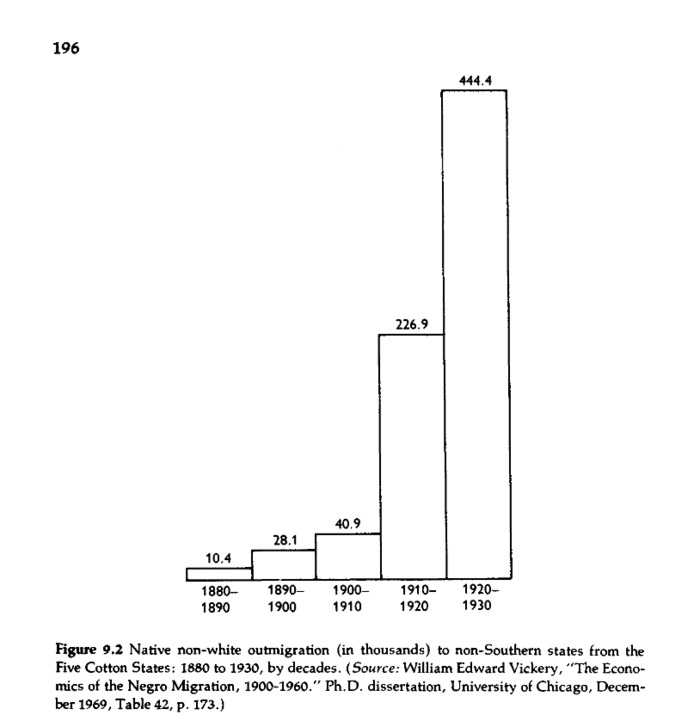
Esse marasmo econômico só terá fim no início do século XX, mas, talvez por impaciência e/ou respondendo ao crescimento da leis segregacionistas, a população negra usará as melhorias de renda e capital humano acumulados no período anterior para imigrarem para o norte do país.
Para muitos ex-escravos e descendentes o Sul só ficaria na memória. Muitas vezes negativa como sugere essa música de John Coltrane: https://www.youtube.com/watch?v=saN1B...