

What do you think?

The Visitors
Under the tablecloth, Frances's hand reached for mine and clasped it. I knew what it meant, that clasp and the mischievous grateful glance that accompanied it: it meant I was thanked, that there were secrets here. I could accept that. I too had secrets - who doesn't?
Sent abroad to Egypt in 1922 to recover from the typhoid that killed her mother, eleven-year-old Lucy is caught up in the intrigue and excitement that surrounds the obsessive hunt for Tutankhamun's tomb. As she struggles to comprehend an adult world in which those closest to her are often cold and unpredictable, Lucy longs for a friend she can love. When she meets Frances, the daughter of an American archaeologist, her life is transformed. As the two girls spy on the grown-ups and try to understand the truth behind their evasions, a lifelong bond is formed. Haunted by the ghosts of her past, the mistakes she made and the secrets she kept, Lucy disinters her past, trying to make sense of what happened all those years ago in Cairo and the Valley of the Kings. And for the first time in her life, she comes to terms with what happened after Egypt, when Frances needed Lucy most.
Sent abroad to Egypt in 1922 to recover from the typhoid that killed her mother, eleven-year-old Lucy is caught up in the intrigue and excitement that surrounds the obsessive hunt for Tutankhamun's tomb. As she struggles to comprehend an adult world in which those closest to her are often cold and unpredictable, Lucy longs for a friend she can love. When she meets Frances, the daughter of an American archaeologist, her life is transformed. As the two girls spy on the grown-ups and try to understand the truth behind their evasions, a lifelong bond is formed. Haunted by the ghosts of her past, the mistakes she made and the secrets she kept, Lucy disinters her past, trying to make sense of what happened all those years ago in Cairo and the Valley of the Kings. And for the first time in her life, she comes to terms with what happened after Egypt, when Frances needed Lucy most.
544 pages, Hardcover
First published February 1, 2014
About the author
Sally Beauman
39 books171 followersaka Vanessa James
Sally Kinsey-Miles graduated from Girton College, Cambridge (MA in English Literature) She married Christopher Beauman an economist. After graduating, she moved with her husband to the USA, where she lived for three years, first in Washington DC, then New York, and travelled extensively. She began her career as a journalist in America, joining the staff of the newly launched New York magazine, of which she became associate editor, and continued to write for it after her return to England. Interviewed Alan Howard for the Telegraph Magazine in 1970 in an article called 'A Fellow of Most Excellent Fancy'. (Daily Telegraph Supplement, May 29th.) Apparently a very long interview. The following year they met again, and the rest is history. After a long partnership Sally and Alan married in 2004. She has one son, James, and one grandchild.
Sally had a distinguished career as a journalist and critic, winning the Catherine Pakenham Award for her writing, and becoming the youngest-ever editor of Queen magazine (now Harper’s & Queen). She has contributed to many leading newspapers and magazines in both the UK and the USA, including the Daily Telegraph ( from 1970-73 and 1976-8 she was Arts Editor of the Sunday Telegraph Magazine), the Sunday Times, Observer, Vogue, the New York Times and the New Yorker. She also wrote nine Mills & Boon romances under the pseudonym Vanessa James, before publishing her block-buster novel Destiny in 1987 under her real name. It was her article about Daphne du Maurier, commissioned by Tina Brown, and published in The New Yorker in November 1993, which first gave her the idea for writing Rebecca de Winter’s version of events at Manderley – an idea that subsequently became the novel, Rebecca’s Tale. In 2000 she was one of the Whitbread Prize judges for the best novel category.
Sally Kinsey-Miles graduated from Girton College, Cambridge (MA in English Literature) She married Christopher Beauman an economist. After graduating, she moved with her husband to the USA, where she lived for three years, first in Washington DC, then New York, and travelled extensively. She began her career as a journalist in America, joining the staff of the newly launched New York magazine, of which she became associate editor, and continued to write for it after her return to England. Interviewed Alan Howard for the Telegraph Magazine in 1970 in an article called 'A Fellow of Most Excellent Fancy'. (Daily Telegraph Supplement, May 29th.) Apparently a very long interview. The following year they met again, and the rest is history. After a long partnership Sally and Alan married in 2004. She has one son, James, and one grandchild.
Sally had a distinguished career as a journalist and critic, winning the Catherine Pakenham Award for her writing, and becoming the youngest-ever editor of Queen magazine (now Harper’s & Queen). She has contributed to many leading newspapers and magazines in both the UK and the USA, including the Daily Telegraph ( from 1970-73 and 1976-8 she was Arts Editor of the Sunday Telegraph Magazine), the Sunday Times, Observer, Vogue, the New York Times and the New Yorker. She also wrote nine Mills & Boon romances under the pseudonym Vanessa James, before publishing her block-buster novel Destiny in 1987 under her real name. It was her article about Daphne du Maurier, commissioned by Tina Brown, and published in The New Yorker in November 1993, which first gave her the idea for writing Rebecca de Winter’s version of events at Manderley – an idea that subsequently became the novel, Rebecca’s Tale. In 2000 she was one of the Whitbread Prize judges for the best novel category.
Ratings & Reviews
Friends & Following
Create a free account to discover what your friends think of this book!
Community Reviews
Displaying 1 - 30 of 565 reviews

February 8, 2021
Historical fiction at its finest, The Visitors by Sally Beauman, is the story of the discovery of King Tut's tomb in 1922. There is an elegant mix of real and made up characters that blend well together and the story is lovely too. It is told from the viewpoint of a 12 year old girl, Lucy, who's recovering from typhoid and is sent by her rich relatives to Egypt with a family friend to recuperate. There, she finds a fast friendship with Frances Winlock, whose father Herbert Winlock was a real representative from the Metropolitan Museum. Both father and daughter were in Egypt in those years.
Frances knows and admires Howard Carter and Lord Carnavorn and his daughter Evelyn. Frances introduces Lucy to these famous people and she gets to know them and see the dynamics of their relationships and how it effected the discovery. There are many mysteries here besides the one of the famous King and the author knows how to involve us deeply in the lives of her characters. Lucy, as a child and as an adult is complex and very reserved. She does not let people in easily, but those she loves, she keeps close to her heart, even after their deaths.
This is a sad, but beautiful tale and I found myself crying for the loss that Lucy endures throughout her long life. She is a person doomed to live her life alone, but she cherishes the ghosts of her past.
Frances knows and admires Howard Carter and Lord Carnavorn and his daughter Evelyn. Frances introduces Lucy to these famous people and she gets to know them and see the dynamics of their relationships and how it effected the discovery. There are many mysteries here besides the one of the famous King and the author knows how to involve us deeply in the lives of her characters. Lucy, as a child and as an adult is complex and very reserved. She does not let people in easily, but those she loves, she keeps close to her heart, even after their deaths.
This is a sad, but beautiful tale and I found myself crying for the loss that Lucy endures throughout her long life. She is a person doomed to live her life alone, but she cherishes the ghosts of her past.

April 28, 2014
Books like The Visitors are why I don't like assigning ratings in reviews. At various points, I could have rated this book two stars or four stars (on a scale of five). Nothing about this book really works like it should, the cover description is somewhat misleading, character motivations are not always consistent; there are at least three different novels stuffed into one and yet the book is overly long by a hundred pages or so. Did any of that affect my enjoyment of the book? Not at all.
I have so many thoughts about this book that its difficult to know where to start. I suppose the most important part for potential readers to know is that while the book mainly focuses on the discovery of Tutankhamun's tomb, I wouldn't really say that the book is about that or even does a very good job of showing the reader the actual discovery.
Beauman makes the odd choice of looking at that time through the eyes of 11-year old Lucy and in many ways, this choice boxes her in. We get a lot of background on Egyptology and the insular little world of British expariates in Egypt from Lucy and her friend Frances. The girl's observations are far, far too sophisticated for children of their age and the adults include them in parties and discussions in a way that I doubt would have actually happened in the 1920s. So we end up reading a lot of info-dump heavy conversations between people. That said, Beauman nails the feeling of a little world of upper-class people and their jealousies and small intruiges. I never bored of the tea parties and dinners and sailing on the Nile and felt like I was immersed in that world.
Just when I started to feel comfortable, Beauman yanks Lucy out of Egypt and back to Cambridge to meet the woman who will become her new stepmother. This is more or less where Novel No. 2 begins - the story of a heartbroken girl on the cusp of growing up and her difficult relationship with a young, replacement mother figure. Parts of their relationship worked for me but there were changes in the relationship that made no sense and happened far too quickly. But the little psychological details of the relationship and the barbed dialogue kept me engaged. This section reminded of a Sarah Waters novel - all oppressive, over-heated English houses and dark undercurrents of anger and jealousy.
Then - once again - we're yanked back to Egypt and finally to the discovery of Tut's tomb in Novel No. 3. Unfortunately, Lucy only observes from afar when the tomb is finally discovered and I found myself longing to be in a novel narrated by Lady Evelyn, the daughter of Lord Carnarvon who financed the search for the tomb. She appears on the fringes of scenes but has a weighty emotional sub-plot that doesn't receive nearly enough attention.
All of this related in flashback by an older Lucy in what is more or less Novel No. 4. In the beginning, she is clearly grappling with unpleasant memories and an unsavory secret related to the discovery of the tomb. After hundreds of pages, the revelation of the secret was definitely a letdown for me. I was far more interested in the final 75-100 pages in which we find out what happened to Lucy in the rest of her life after the discovery of the tomb. This is Novel No. 5 and it was an interesting one - set in 1930s and 40s London and full of that pre-war atmosphere and filled with all sorts of potential given Lucy's personal and professional lives. It bears only a passing connection to the the discovery of King Tut's tomb but it's still a very interesting section.
And then somehow, all too soon and yet after a very long wait, the novel is over. I closed the book confused but most of all pleased that I had stuck with it. What will remain with me is the beautiful writing, the passages set in Egypt at night in silence as Lucy reflects on death and loss, the subtle connections between the treasures of Tut's tomb and the possessions that Lucy accumulates throughout her long life; the exquisitely detailed setting of 1920s Egypt. The Visitors is a strange, sad novel that I'm glad to have read.
Disclaimer: I received an advance copy from the publisher for review consideration.
I have so many thoughts about this book that its difficult to know where to start. I suppose the most important part for potential readers to know is that while the book mainly focuses on the discovery of Tutankhamun's tomb, I wouldn't really say that the book is about that or even does a very good job of showing the reader the actual discovery.
Beauman makes the odd choice of looking at that time through the eyes of 11-year old Lucy and in many ways, this choice boxes her in. We get a lot of background on Egyptology and the insular little world of British expariates in Egypt from Lucy and her friend Frances. The girl's observations are far, far too sophisticated for children of their age and the adults include them in parties and discussions in a way that I doubt would have actually happened in the 1920s. So we end up reading a lot of info-dump heavy conversations between people. That said, Beauman nails the feeling of a little world of upper-class people and their jealousies and small intruiges. I never bored of the tea parties and dinners and sailing on the Nile and felt like I was immersed in that world.
Just when I started to feel comfortable, Beauman yanks Lucy out of Egypt and back to Cambridge to meet the woman who will become her new stepmother. This is more or less where Novel No. 2 begins - the story of a heartbroken girl on the cusp of growing up and her difficult relationship with a young, replacement mother figure. Parts of their relationship worked for me but there were changes in the relationship that made no sense and happened far too quickly. But the little psychological details of the relationship and the barbed dialogue kept me engaged. This section reminded of a Sarah Waters novel - all oppressive, over-heated English houses and dark undercurrents of anger and jealousy.
Then - once again - we're yanked back to Egypt and finally to the discovery of Tut's tomb in Novel No. 3. Unfortunately, Lucy only observes from afar when the tomb is finally discovered and I found myself longing to be in a novel narrated by Lady Evelyn, the daughter of Lord Carnarvon who financed the search for the tomb. She appears on the fringes of scenes but has a weighty emotional sub-plot that doesn't receive nearly enough attention.
All of this related in flashback by an older Lucy in what is more or less Novel No. 4. In the beginning, she is clearly grappling with unpleasant memories and an unsavory secret related to the discovery of the tomb. After hundreds of pages, the revelation of the secret was definitely a letdown for me. I was far more interested in the final 75-100 pages in which we find out what happened to Lucy in the rest of her life after the discovery of the tomb. This is Novel No. 5 and it was an interesting one - set in 1930s and 40s London and full of that pre-war atmosphere and filled with all sorts of potential given Lucy's personal and professional lives. It bears only a passing connection to the the discovery of King Tut's tomb but it's still a very interesting section.
And then somehow, all too soon and yet after a very long wait, the novel is over. I closed the book confused but most of all pleased that I had stuck with it. What will remain with me is the beautiful writing, the passages set in Egypt at night in silence as Lucy reflects on death and loss, the subtle connections between the treasures of Tut's tomb and the possessions that Lucy accumulates throughout her long life; the exquisitely detailed setting of 1920s Egypt. The Visitors is a strange, sad novel that I'm glad to have read.
Disclaimer: I received an advance copy from the publisher for review consideration.

November 30, 2013
Sally Beauman begins her Acknowledgements by stating that The Visitors is a work of fiction.
It “has a framework and a core that is fictional but the chapters that relate of Egyptian archaeology 1922-1932 and Saranac Lake in the 1930s are based on fact and the documented lives of real people: they are as accurate as historically possible as I have been able to make them.”
I, myself, am left to ponder whether Lucy Payne, our narrator, is based upon Margaret Mace, daughter of Arthur Mace – the Met's assistant curator and senior conservationist who worked at Tutankhamun's tomb in the seasons of 1922-23 and 1923-24.
But, back to the story...
November 1922 and success! The steps to KV62 or Valley of the Kings tomb #62, that of an unknown Pharaoh is discovered under a workman's hut near the tomb of Seti11. All the main players are assembled; Howard Carter, Lord Carnavon, Evelyn Carnavon and Arthur Callander. The lesser-known archaeologists Lythgoe, Mace, Burton and Lucas, the foreman Ahmed Girigar and chemist Gardiner are also present in our story: don't fret – you don't need know all these names because Beauman thoughtfully provides you with a cast of characters cleverly divided via place and year. And within the context of the novel, everyone is easily recognisable and fits simply as the story is told.
Fictional character Lucy Payne is used to tell the story of this century's greatest find in the Valley of the Kings in November 1922. Very cleverly, Beauman creates a friendship between Lucy and the real life Frances Winlock, daughter of Herbert Winlock, American archaeologist and field curator of the New York Metropolitan of Art's excavations near Luxor. This is no dusty old history lesson; the author has woven a wonderful tale spanning Lucy and Frances' story from 1922 through to 2002. Lucy tells her story, firstly in 1922 and then from 2002, reminiscing about her life; her friendship with Frances, her visits to Egypt and America over the years, her relationship with her young English step-mother, the Blitz and being currently interviewed by a documentary maker.
January 1922 and Lucy Payne, daughter of a Cambridge don, has been sent to Egypt with her American governess/nurse to recover from typhoid which killed her mother. There, she meets Frances Winlock who is in the Valley of the Kings with her archaeologist father and heiress mother. A firm friendship forms between the two girls and this affords Lucy access to the excitement and expectation which is building about finding a new tomb. This is not their own childish excitement for they are staying in part at the American House which houses the archaeologists; the mood is palpable and electric. (In her research, I'm sure Beauman has used her access to diaries/letters of these people to the fullest extent).
I must confess to being totally enthralled by the Egypt part of the story and ventured many times to my laptop to peruse photos and filming of Carnavon and Carter and the tomb itself. I've read four or five of Beauman's other novels, all fiction, and I simply enjoy her writing style. She has the knack of enfolding the reader, you step into the world of her characters so very easily that often it is hard to extract yourself into the real world. This is definitely the case in The Visitors and this novel has the added bonus of being based on real life events: events that most everyone is aware of in reality. The topic is not a dim historical fact: you'd probably have to be living in a tomb yourself not have heard of King Tutankhamun's tomb. The novel flows beautifully, she blends her fictional and the factual characters incredibly well. My only negative comment would be about the cover; it says to me the pyramids mixed with some tropical island but I'm sure the publishers know what they are doing. 5★ for the topic, 5★ for the story, 5★ for the writing style.
Actual film from 1923 showing Carnavon, Carter and the tomb: http://www.youtube.com/watch?v=KQY7bv...
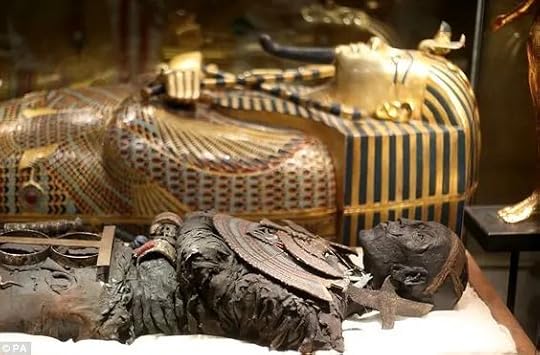
Information: Tutankhamun's tomb is the only one in a virtually intact state – the boy-king still rests there, some 3000 years after his death. On a sombre note, archaeologists have found more damage via mass tourism has been done in the Valley of the Kings in the past 9 decades than in the previous 3000 years . A full-scale replica was commissioned in 2009, using Lucida 3D laser scanner and made by the world's leading art-replica specialists, Factum Arte. But The BBC canvassed in the Valley of the Kings and found that tourists expressed a desire to see the real thing so the replica remain in storage in Cairo.
It “has a framework and a core that is fictional but the chapters that relate of Egyptian archaeology 1922-1932 and Saranac Lake in the 1930s are based on fact and the documented lives of real people: they are as accurate as historically possible as I have been able to make them.”
I, myself, am left to ponder whether Lucy Payne, our narrator, is based upon Margaret Mace, daughter of Arthur Mace – the Met's assistant curator and senior conservationist who worked at Tutankhamun's tomb in the seasons of 1922-23 and 1923-24.
But, back to the story...
November 1922 and success! The steps to KV62 or Valley of the Kings tomb #62, that of an unknown Pharaoh is discovered under a workman's hut near the tomb of Seti11. All the main players are assembled; Howard Carter, Lord Carnavon, Evelyn Carnavon and Arthur Callander. The lesser-known archaeologists Lythgoe, Mace, Burton and Lucas, the foreman Ahmed Girigar and chemist Gardiner are also present in our story: don't fret – you don't need know all these names because Beauman thoughtfully provides you with a cast of characters cleverly divided via place and year. And within the context of the novel, everyone is easily recognisable and fits simply as the story is told.
Fictional character Lucy Payne is used to tell the story of this century's greatest find in the Valley of the Kings in November 1922. Very cleverly, Beauman creates a friendship between Lucy and the real life Frances Winlock, daughter of Herbert Winlock, American archaeologist and field curator of the New York Metropolitan of Art's excavations near Luxor. This is no dusty old history lesson; the author has woven a wonderful tale spanning Lucy and Frances' story from 1922 through to 2002. Lucy tells her story, firstly in 1922 and then from 2002, reminiscing about her life; her friendship with Frances, her visits to Egypt and America over the years, her relationship with her young English step-mother, the Blitz and being currently interviewed by a documentary maker.
January 1922 and Lucy Payne, daughter of a Cambridge don, has been sent to Egypt with her American governess/nurse to recover from typhoid which killed her mother. There, she meets Frances Winlock who is in the Valley of the Kings with her archaeologist father and heiress mother. A firm friendship forms between the two girls and this affords Lucy access to the excitement and expectation which is building about finding a new tomb. This is not their own childish excitement for they are staying in part at the American House which houses the archaeologists; the mood is palpable and electric. (In her research, I'm sure Beauman has used her access to diaries/letters of these people to the fullest extent).
I must confess to being totally enthralled by the Egypt part of the story and ventured many times to my laptop to peruse photos and filming of Carnavon and Carter and the tomb itself. I've read four or five of Beauman's other novels, all fiction, and I simply enjoy her writing style. She has the knack of enfolding the reader, you step into the world of her characters so very easily that often it is hard to extract yourself into the real world. This is definitely the case in The Visitors and this novel has the added bonus of being based on real life events: events that most everyone is aware of in reality. The topic is not a dim historical fact: you'd probably have to be living in a tomb yourself not have heard of King Tutankhamun's tomb. The novel flows beautifully, she blends her fictional and the factual characters incredibly well. My only negative comment would be about the cover; it says to me the pyramids mixed with some tropical island but I'm sure the publishers know what they are doing. 5★ for the topic, 5★ for the story, 5★ for the writing style.
Actual film from 1923 showing Carnavon, Carter and the tomb: http://www.youtube.com/watch?v=KQY7bv...
Information: Tutankhamun's tomb is the only one in a virtually intact state – the boy-king still rests there, some 3000 years after his death. On a sombre note, archaeologists have found more damage via mass tourism has been done in the Valley of the Kings in the past 9 decades than in the previous 3000 years . A full-scale replica was commissioned in 2009, using Lucida 3D laser scanner and made by the world's leading art-replica specialists, Factum Arte. But The BBC canvassed in the Valley of the Kings and found that tourists expressed a desire to see the real thing so the replica remain in storage in Cairo.

December 6, 2016
A well-researched and beautifully conceived novel set in Egypt and England during the 1920’s and dealing with the excavation of the tomb of King Tutankhamen. The story is told from the point of view of Lucy Payne, at the outset a 12 year-old, who is present for and observes all the work and entangled lives of those involved in the find. Howard Carter, Lord Carnarvon, Evelyn Herbert (the Lord’s daughter), Herbert and Helen Winlock and their young daughter, Frances, are all historical figures and are portrayed within the context of a the novel in very believable and accurate fashion.
Beauman has a lovely writing style that is almost conversational. I felt at home right away with her characters and could feel their emotional surges, tensions and heartbreaks. Lucy is the perfect vehicle for the story, which must have read much differently had it been told by any of the adults at hand.
Had it not been for the persistence of Howard Carter and the Earl of Carnarvon, Tutankhamen might well still be buried in the Valley of the Kings, his treasure trove and self undiscovered. Few believed in the possibility of finding an intact tomb, and most would certainly have given up long before the treasures were found. Only private money could have financed such a search, and Carnarvon made a huge contribution by simply keeping the endeavor financially afloat. Still, it took quite a bit of ego and a certain sense of entitlement which might only have been possible in the exact era in which this dig took place. Without the spirit of colonialism, which was already on the wane, and the freedom afforded the wealthy at that time, the world might have never had a glimpse of the tomb, its inhabitants, and the history that was forthcoming with the find.
To say the least, the lifestyles and the world travels depicted in this novel make it fascinating and interesting. It is a way of life that is as remote and unattainable for us as Tutankhamen's was to them. It is no minor achievement that Beauman has managed to make these characters both real and approachable.
I enjoy a good and accurately set historical novel. I like to walk away feeling I have learned something about the period and place that I did not know before. This novel certainly filled that bill. It made me thirsty to know more about the real people and events, and I spent several hours doing some additional research online and viewing photos. I have had this on my Kindle for well over a year, and I am only sorry that I waited so long to get to it.
Beauman has a lovely writing style that is almost conversational. I felt at home right away with her characters and could feel their emotional surges, tensions and heartbreaks. Lucy is the perfect vehicle for the story, which must have read much differently had it been told by any of the adults at hand.
Had it not been for the persistence of Howard Carter and the Earl of Carnarvon, Tutankhamen might well still be buried in the Valley of the Kings, his treasure trove and self undiscovered. Few believed in the possibility of finding an intact tomb, and most would certainly have given up long before the treasures were found. Only private money could have financed such a search, and Carnarvon made a huge contribution by simply keeping the endeavor financially afloat. Still, it took quite a bit of ego and a certain sense of entitlement which might only have been possible in the exact era in which this dig took place. Without the spirit of colonialism, which was already on the wane, and the freedom afforded the wealthy at that time, the world might have never had a glimpse of the tomb, its inhabitants, and the history that was forthcoming with the find.
To say the least, the lifestyles and the world travels depicted in this novel make it fascinating and interesting. It is a way of life that is as remote and unattainable for us as Tutankhamen's was to them. It is no minor achievement that Beauman has managed to make these characters both real and approachable.
I enjoy a good and accurately set historical novel. I like to walk away feeling I have learned something about the period and place that I did not know before. This novel certainly filled that bill. It made me thirsty to know more about the real people and events, and I spent several hours doing some additional research online and viewing photos. I have had this on my Kindle for well over a year, and I am only sorry that I waited so long to get to it.

October 12, 2024
This novel was a fascinating story revolving around the discovery of the Tomb of Tutankhamun in the Valley of the Kings in 1922-1923. The story is told in retrospect by an 80s year-old Lucy Payne. In 1922, when she was 11 years old, Lucy along with her guardian, Miss Mack, is sent to Egypt to recuperate from typhoid. Her mother had died of this and her father was busy working in Europe on his study of the Greek poets. While in Egypt, Lucy befriends Frances, the daughter of an American archaeologist, who is also a cohort of Howard Carter. Through this connection, Lucy gains access to the Egyptologists working in the Valley of the Kings including Carter and his sponsor, Lord Carnarvon. Lucy soaks up the society of the Europeans who treat Egypt as their personal playground while Carter and Carnarvon are searching for a supposed lost tomb. Lucy returns to England in the off season but is able to go back to Egypt the next year and is present when the tomb of King Tut is found and opened. While this is the focus of the novel, there is so much more going on. The novel spans the period from 1922 up until WWII and then beyond as Lucy gets interviewed for her memories related to Howard Carter and the discovery of the tomb.
This novel really brings to life the atmosphere of Egypt in the 1920s as well as the aristocratic colonial society at the time. Part of the novel also tells of the center for the treatment of tuberculosis located at Saranac Lake, New York. One of the characters in the novel is afflicted with this deadly disease and Lucy spends time visiting there. The characters in the novel are mostly from real life and Beauman really makes a vivid portrayal of the search for King Tut's tomb and the people involved in this. I would give this one a high recommendation especially for anyone interested in Egyptology. I have read one other book by Beauman which I also enjoyed, Dark Angel. I'll look forward to reading more by her.
This novel really brings to life the atmosphere of Egypt in the 1920s as well as the aristocratic colonial society at the time. Part of the novel also tells of the center for the treatment of tuberculosis located at Saranac Lake, New York. One of the characters in the novel is afflicted with this deadly disease and Lucy spends time visiting there. The characters in the novel are mostly from real life and Beauman really makes a vivid portrayal of the search for King Tut's tomb and the people involved in this. I would give this one a high recommendation especially for anyone interested in Egyptology. I have read one other book by Beauman which I also enjoyed, Dark Angel. I'll look forward to reading more by her.

April 24, 2014
If you harbored a childhood desire to be an archaeologist and watched The Mummy movies for more than just Brendan Fraser, you may well enjoy this novel about the controversial discovery of King Tutankhamun’s tomb. Beauman does a great job with her 1920s Luxor and England settings, and it’s fun to see Highclere Castle, the residence of Lord Carnarvon, get another fictional use (it’s where Downton Abbey is filmed).
Rather than placing readers in the middle of the action with the explorers, though, Beauman takes a more oblique approach, filtering events through the perspective of an older woman reflecting on her childhood experiences. Lucy Foxe-Payne is 11 when she first travels to Egypt with Miss Mack in 1922. There are echoes of A Room with a View in this setup; like Forster’s Lucy Honeychurch, Beauman’s Lucy is a naïf in the charge of a well-meaning busybody. The major difference is that she is recovering from a typhoid outbreak that also killed her mother. As her hair grows back, she falls in with fellow Western visitors Frances Winlock and Lady Rose d’Erlanger, who prove to be her lifelong friends.
The novel rollicks along pleasantly enough, but Beauman’s failing is to throw way too much into the mix. There is an unnecessarily long interlude between Egypt sections when Lucy is back in Cambridge with her professor father and her scheming governess. Also, the insistence on following Tutankhamun’s ‘curse’ all the way through to discoverer Howard Carter’s death necessitates tedious sections tracing Lucy’s unhappy marriage and visiting a friend with tuberculosis. The World War II portion feels derivative of Sarah Waters’s The Night Watch.
This is like two novels in one: set one in Egypt and one in Cambridge and each would be perfectly good. Together, though, they make for one hugely overlong story. The Visitors could easily be cut by a third or more. Indeed, it is the length of Beauman’s books (such as her Daphne du Maurier sequel, Rebecca’s Tale) that has put me off trying her work before. However, I would have liked more of the nonagenarian Lucy’s (near) present-day reflections from her Highgate home, as an American documentary maker interrogates her memories.
No adventure story should be such a slog. The inclusion of a cast list at the start is your first clue that this one is too broad for its own good. If you have the patience, though, I suspect this novel might remind you of childhood days spent daydreaming about sarcophagi and buried treasure.
Related reading: Lives in Ruins by Marilyn Johnson.
Rather than placing readers in the middle of the action with the explorers, though, Beauman takes a more oblique approach, filtering events through the perspective of an older woman reflecting on her childhood experiences. Lucy Foxe-Payne is 11 when she first travels to Egypt with Miss Mack in 1922. There are echoes of A Room with a View in this setup; like Forster’s Lucy Honeychurch, Beauman’s Lucy is a naïf in the charge of a well-meaning busybody. The major difference is that she is recovering from a typhoid outbreak that also killed her mother. As her hair grows back, she falls in with fellow Western visitors Frances Winlock and Lady Rose d’Erlanger, who prove to be her lifelong friends.
The novel rollicks along pleasantly enough, but Beauman’s failing is to throw way too much into the mix. There is an unnecessarily long interlude between Egypt sections when Lucy is back in Cambridge with her professor father and her scheming governess. Also, the insistence on following Tutankhamun’s ‘curse’ all the way through to discoverer Howard Carter’s death necessitates tedious sections tracing Lucy’s unhappy marriage and visiting a friend with tuberculosis. The World War II portion feels derivative of Sarah Waters’s The Night Watch.
This is like two novels in one: set one in Egypt and one in Cambridge and each would be perfectly good. Together, though, they make for one hugely overlong story. The Visitors could easily be cut by a third or more. Indeed, it is the length of Beauman’s books (such as her Daphne du Maurier sequel, Rebecca’s Tale) that has put me off trying her work before. However, I would have liked more of the nonagenarian Lucy’s (near) present-day reflections from her Highgate home, as an American documentary maker interrogates her memories.
No adventure story should be such a slog. The inclusion of a cast list at the start is your first clue that this one is too broad for its own good. If you have the patience, though, I suspect this novel might remind you of childhood days spent daydreaming about sarcophagi and buried treasure.
Related reading: Lives in Ruins by Marilyn Johnson.

July 4, 2014
I absolutely adored this novel!! This is the first novel that I have read of Beauman’s but I am looking forward, now, to going back and reading her other books! This book is an absolute pleasure to read! The style reminds me a bit of some of my other favorite English authors (Phil Rickman and Sarah Rayne), but what makes this one so successful is the way that Beauman so seamlessly blends fact and fiction in bringing to life the discovery of King Tut’s tomb in Egypt. But the book is about much more than just event. Told through the eyes of Lucy, a woman who first experiences Egypt at the young age of eleven, the book also tells her life story - along with other subplots and more to the story between the lines.
It’s impeccably researched and also a page-turner. It makes the reader feel as though they too have journeyed with Lucy and witnessed the events. The level of detail is superb and it is so tightly written (though lengthy - which the author does insert some reminding passages to keep readers refreshed on earlier passages). I am really looking forward to backtracking through this author’s previous novels!
It’s impeccably researched and also a page-turner. It makes the reader feel as though they too have journeyed with Lucy and witnessed the events. The level of detail is superb and it is so tightly written (though lengthy - which the author does insert some reminding passages to keep readers refreshed on earlier passages). I am really looking forward to backtracking through this author’s previous novels!

February 18, 2015
4.5 ★s
At over 500 pages in a small font, closely spaced, my edition of this novel is a bit of a doorstop. I approached it with some apprehension, as I’ve had recent bitter experiences of books that are too long and poorly put together as a consequence. Thankfully, The Visitors kept my attention all the way through, which is a tribute to the author’s skills as a writer and to the lively story she has created.
The Visitors is a fictionalised account of all the goings-on and intrigue surrounding the discovery of the tomb of Tutankhamun in the Valley of the Kings by Howard Carter, British archaeologist and his team in 1922. A fictional character, Lucy Payne, narrates the story, firstly as a 12 year old present at Thebes when the historic events took place, and then as a 90 year old in 2002, as she is being asked to reminisce by a TV documentary maker.
Sally Beauman has skilfully blended known fact with imagined notions about what was said and done, to create an effective and palatable narrative of what happened, who did what, where, when and why…The characters are vividly drawn, especially those major players like Howard Carter and Lord Carnarvon, his sponsor. But also beautifully depicted are lesser known entities like Arthur ‘Pecky’ Callender, an engineer on the dig team whose particular skills were essential to getting access to the tomb and the various underground chambers, and Herbert Winlock, an American archaeologist excavating near Luxor for the New York Metropolitan Museum of Art. Beauman also brings to life the women who were present, including Lady Evelyn Herbert, Carnarvon’s daughter, and Mrs Minnie Burton, wife of the dig’s photographer, Harry. One of the most delightful of the fictional women is Miss Mack, Lucy’s governess, a spirited and engaging personality whose affection and care for Lucy is fundamental to her well-being.
Lucy Payne is a fictional invention, as are her pals Rose and Peter d’Erlanger, but her best friend at Luxor, Frances Winlock, really existed. I think it is a clever strategy by Beauman to use children as eyewitnesses to the events, as they were often overlooked, and could slip seamlessly through the social settings and geographical locations. Highly intelligent and bold, Lucy and Frances played ‘spy games’, and both saw and heard things which are pertinent to the core of the story.
One of the key issues of the book is the proposition that Carter and Carnarvon entered the tomb secretly before the official opening with the relevant government authorities and removed certain precious items. This alleged illegal act throws a cloud over the reputation of both men, who had achieved celebrity status at the time of the tomb’s discovery. They seemed to share some difficult personality quirks which did not endear them to the many lookers-on and the Anglo-American ex-pat community. As the novel progresses it becomes apparent that history has not been kind to either man.
I particularly liked Beauman’s sharp observations about the behaviours and morals of the British upper class and the wealthy elites of US society at a time when Imperialism was at its height. The sense of entitlement of those foreign overlords verges on the obnoxious, as is their casual racism and snobbery. Intrigue is added by the fact that in 1922 the first stirrings of national pride and independence are wafting through Egyptian society. It generates the dilemma for both archaeologists and local politicians as to whom actually owns the rights to significant heritage artefacts.
Following Lucy’s departure from Egypt, the story moves on to events in her subsequent life, including her time as a writer, her marriage to the unsuitable Eddie Vyne-Chance, a drunkard and closet homosexual, and her life in London over many decades. Of particular interest is the portrayal of her relationship with her step-mother Nicola, who is a complex, difficult character. As Nicola’s temperament and personality change over time, Lucy must regularly make adjustments.
In tandem with the historical fiction of the discovery of Tutankhamun’s tomb runs the story of Lucy’s life experiences and relationships. With such a rich assembly of characters and variety of events, Beauman has a wealth of material in which to explore personal relations. Was Howard Carter rejected by the British Establishment because his personality was just too abrasive for their liking? Or was he the victim of character assassination by the vindictive press of the day?
The two great loves of Lucy’s life are Frances and Peter, and both story lines are tinged with both joy and sadness. Thus the memories of 90 year old Lucy are bittersweet. Over time she has come to believe that certain ‘ghosts’ from her past come to visit, to remind her of the past. Rather than being afraid, she welcomes these visitors, and talks to them, while the rational part of her brain knows they are not real. In later life some of her stories are very poignant.
I thoroughly enjoyed this novel and feel that I have learned a lot about a period of world history that continues to be relevant today, as tourists continue to flock to Egypt to view its archaeological wonders. I give full credit to Beauman for her extensive research, which undoubtedly adds a strong feeling of authenticity to this historical fiction. But also it is a valuable contribution to the novelist’s endless preoccupation with the nature of human relations in all their multiple manifestations.
At over 500 pages in a small font, closely spaced, my edition of this novel is a bit of a doorstop. I approached it with some apprehension, as I’ve had recent bitter experiences of books that are too long and poorly put together as a consequence. Thankfully, The Visitors kept my attention all the way through, which is a tribute to the author’s skills as a writer and to the lively story she has created.
The Visitors is a fictionalised account of all the goings-on and intrigue surrounding the discovery of the tomb of Tutankhamun in the Valley of the Kings by Howard Carter, British archaeologist and his team in 1922. A fictional character, Lucy Payne, narrates the story, firstly as a 12 year old present at Thebes when the historic events took place, and then as a 90 year old in 2002, as she is being asked to reminisce by a TV documentary maker.
Sally Beauman has skilfully blended known fact with imagined notions about what was said and done, to create an effective and palatable narrative of what happened, who did what, where, when and why…The characters are vividly drawn, especially those major players like Howard Carter and Lord Carnarvon, his sponsor. But also beautifully depicted are lesser known entities like Arthur ‘Pecky’ Callender, an engineer on the dig team whose particular skills were essential to getting access to the tomb and the various underground chambers, and Herbert Winlock, an American archaeologist excavating near Luxor for the New York Metropolitan Museum of Art. Beauman also brings to life the women who were present, including Lady Evelyn Herbert, Carnarvon’s daughter, and Mrs Minnie Burton, wife of the dig’s photographer, Harry. One of the most delightful of the fictional women is Miss Mack, Lucy’s governess, a spirited and engaging personality whose affection and care for Lucy is fundamental to her well-being.
Lucy Payne is a fictional invention, as are her pals Rose and Peter d’Erlanger, but her best friend at Luxor, Frances Winlock, really existed. I think it is a clever strategy by Beauman to use children as eyewitnesses to the events, as they were often overlooked, and could slip seamlessly through the social settings and geographical locations. Highly intelligent and bold, Lucy and Frances played ‘spy games’, and both saw and heard things which are pertinent to the core of the story.
One of the key issues of the book is the proposition that Carter and Carnarvon entered the tomb secretly before the official opening with the relevant government authorities and removed certain precious items. This alleged illegal act throws a cloud over the reputation of both men, who had achieved celebrity status at the time of the tomb’s discovery. They seemed to share some difficult personality quirks which did not endear them to the many lookers-on and the Anglo-American ex-pat community. As the novel progresses it becomes apparent that history has not been kind to either man.
I particularly liked Beauman’s sharp observations about the behaviours and morals of the British upper class and the wealthy elites of US society at a time when Imperialism was at its height. The sense of entitlement of those foreign overlords verges on the obnoxious, as is their casual racism and snobbery. Intrigue is added by the fact that in 1922 the first stirrings of national pride and independence are wafting through Egyptian society. It generates the dilemma for both archaeologists and local politicians as to whom actually owns the rights to significant heritage artefacts.
Following Lucy’s departure from Egypt, the story moves on to events in her subsequent life, including her time as a writer, her marriage to the unsuitable Eddie Vyne-Chance, a drunkard and closet homosexual, and her life in London over many decades. Of particular interest is the portrayal of her relationship with her step-mother Nicola, who is a complex, difficult character. As Nicola’s temperament and personality change over time, Lucy must regularly make adjustments.
In tandem with the historical fiction of the discovery of Tutankhamun’s tomb runs the story of Lucy’s life experiences and relationships. With such a rich assembly of characters and variety of events, Beauman has a wealth of material in which to explore personal relations. Was Howard Carter rejected by the British Establishment because his personality was just too abrasive for their liking? Or was he the victim of character assassination by the vindictive press of the day?
The two great loves of Lucy’s life are Frances and Peter, and both story lines are tinged with both joy and sadness. Thus the memories of 90 year old Lucy are bittersweet. Over time she has come to believe that certain ‘ghosts’ from her past come to visit, to remind her of the past. Rather than being afraid, she welcomes these visitors, and talks to them, while the rational part of her brain knows they are not real. In later life some of her stories are very poignant.
I thoroughly enjoyed this novel and feel that I have learned a lot about a period of world history that continues to be relevant today, as tourists continue to flock to Egypt to view its archaeological wonders. I give full credit to Beauman for her extensive research, which undoubtedly adds a strong feeling of authenticity to this historical fiction. But also it is a valuable contribution to the novelist’s endless preoccupation with the nature of human relations in all their multiple manifestations.

April 7, 2024
Brilliant
4 1/2 Stars
I thoroughly enjoyed this book. My only complaint is that it was a little bit too long, but that certainly would not keep me from giving it a good review.
it was really special for me because I recently returned from Egypt and the valley of the kings. So, all of the scenes and interplay of this book could be easily imagined in my minds eye.
I loved it. It was fantastic – – just too long!
4 1/2 Stars
I thoroughly enjoyed this book. My only complaint is that it was a little bit too long, but that certainly would not keep me from giving it a good review.
it was really special for me because I recently returned from Egypt and the valley of the kings. So, all of the scenes and interplay of this book could be easily imagined in my minds eye.
I loved it. It was fantastic – – just too long!

September 29, 2014
When eleven year old Lucy Payne survives the typhoid that kills her American mother, her Cambridge academic father is unable, and unwilling, to cope with her. Taken by the redoubtable Miss Mack to Egypt to recuperate, this novel tells the story of Lucy’s life. We begin in Cairo in 1922 and travel through to the present, where an elderly Lucy is being questioned about her life for a documentary of the discovery of Tutankhamun’s tomb.
Much of this sumptuous novel is set in Egypt where Lucy makes friends with precocious Frances Winlock, the daughter of an American Egyptologist at a ballet class and, through her, Lady Rose Strathaven and her brother Peter. Over the years their lives intersect and, it is through her new friends, that Lucy meets Howard Carter and Lord Carnarvon. We follow Lucy back to Cambridge, where she finds Miss Nicola Dunshire – governess, housekeeper, enemy – installed in her mother’s place. Her desperate attempts to keep in touch with her friends and the way that Egypt, and the Valley of the Kings, draws her back are well realised. Obviously, the discovery of Tutankhamun’s tomb is central to the plot; so many of the characters revolve around those events and the people involved.
This novel is absolutely sumptuous. It is a saga, a love story, a tale of friendship, of longing, discovery and even murder. This is a book to curl up with and immerse yourself in. The author does a stunning job of showing you everything through Lucy’s eyes and I have no doubt that this is a novel that I will return to as I loved it so much.
Much of this sumptuous novel is set in Egypt where Lucy makes friends with precocious Frances Winlock, the daughter of an American Egyptologist at a ballet class and, through her, Lady Rose Strathaven and her brother Peter. Over the years their lives intersect and, it is through her new friends, that Lucy meets Howard Carter and Lord Carnarvon. We follow Lucy back to Cambridge, where she finds Miss Nicola Dunshire – governess, housekeeper, enemy – installed in her mother’s place. Her desperate attempts to keep in touch with her friends and the way that Egypt, and the Valley of the Kings, draws her back are well realised. Obviously, the discovery of Tutankhamun’s tomb is central to the plot; so many of the characters revolve around those events and the people involved.
This novel is absolutely sumptuous. It is a saga, a love story, a tale of friendship, of longing, discovery and even murder. This is a book to curl up with and immerse yourself in. The author does a stunning job of showing you everything through Lucy’s eyes and I have no doubt that this is a novel that I will return to as I loved it so much.

February 3, 2014
I wanted to like this book, and I did enjoy the descriptions of Egypt - Cairo, the Valley of the Kings etc, and life in the 1920s around Highclere Castle. But I felt like I was missing something all through the book - in the beginning we know there is some mystery that the general public was not aware of at the time, although we don’t even know what the mystery is, and if the mystery is what I think it was - it seemed a bit of an anticlimax (and didn’t seem to explain all of the cryptic remarks anyway), and if it wasn’t what I thought it was, then I just completely missed it!!
I have read some other reviews (which I don’t normally do before writing my own) and it seems that I am not alone in how this book made me feel. One review commented that it was like there were about 5 books rolled into one and it certainly did seem that there was a lot happening, with some bits left unresolved.
I still enjoyed reading it, on the whole, it just felt a bit scatty, unformed and lacking purpose.
I have read some other reviews (which I don’t normally do before writing my own) and it seems that I am not alone in how this book made me feel. One review commented that it was like there were about 5 books rolled into one and it certainly did seem that there was a lot happening, with some bits left unresolved.
I still enjoyed reading it, on the whole, it just felt a bit scatty, unformed and lacking purpose.

September 9, 2014
I loved this. I am a sucker for Egyptian historical fiction. Allen Drury's book, "A God Against the Gods" about my beloved pharaoh, Akhenaten, is my all time favorite but I can safely say that "The Visitors" is now in second place.
Those who might like this book:
1. An appreciation for slow moving stories with lots of detail (this truly began to blossom at the 150 page mark for me.)
2. An interest in ancient Egypt, 1920's-1930's Britain and archaeology.
3. Enjoy saga's. (Characters age as many as 8 decades from preteen into their 90's)
4. Like/don't mind a book told from a child's viewpoint.
This closely follows the true events of the discovery in 1923 of King Tutankhamun's tomb in the Valley of the Kings by Howard Carter. The details surrounding this are told by 12 year old Lucy, who has come to Egypt to convalesce and becomes friends with Rose, daughter of an Egyptologist. The story weaves back and forth through time as it reveals the story of Lucy's life, forever molded by her early trips to Egypt. I think the author did a great job of bringing everything to life...not only the characters and scenery but the time periods as well. Through Ms. Beauman's words, dialogue, descriptions I felt like I was there-in Egypt, England and the United States in those days. For me, it was magical. I lived this story in my mind most vividly and was able to rise above the shackles that bind me to the here and now.
Those who might like this book:
1. An appreciation for slow moving stories with lots of detail (this truly began to blossom at the 150 page mark for me.)
2. An interest in ancient Egypt, 1920's-1930's Britain and archaeology.
3. Enjoy saga's. (Characters age as many as 8 decades from preteen into their 90's)
4. Like/don't mind a book told from a child's viewpoint.
This closely follows the true events of the discovery in 1923 of King Tutankhamun's tomb in the Valley of the Kings by Howard Carter. The details surrounding this are told by 12 year old Lucy, who has come to Egypt to convalesce and becomes friends with Rose, daughter of an Egyptologist. The story weaves back and forth through time as it reveals the story of Lucy's life, forever molded by her early trips to Egypt. I think the author did a great job of bringing everything to life...not only the characters and scenery but the time periods as well. Through Ms. Beauman's words, dialogue, descriptions I felt like I was there-in Egypt, England and the United States in those days. For me, it was magical. I lived this story in my mind most vividly and was able to rise above the shackles that bind me to the here and now.

May 12, 2014
I received an uncorrected proof copy of this book from HarperCollins.
Beauman's historical novel recreates the true story of the hunt for Tutankhamun's tomb in Egypt's Valley of the Kings in the 1920s from the perspective of 11-year-old Lucy. Lucy is recovering from typhoid, which killed her mother. Lucy makes lifelong friends while in Egypt, and also gets to meet American archaeologist Howard Carter and his wealthy patron, Lord Carnarvon. Told in flashbacks, the elderly Lucy reminisces on her Egypt adventures, prompted by the visit of Dr. Fong, who is making a documentary of the fateful discovery of one of the most intact tombs ever found in Egypt.
I was really intrigued to read this story, because I love historical fiction based off of real events and was particularly interested in Egyptian history as a child. Additionally, I found the inclusion of Lord Carnarvon, lord of Highclare particularly interesting, since it is now best known as being the set for filming of the well known Downton Abbey show. "Oh, well, it's a castle of sorts, I suppose. That's Lord Carnarvon's place, Lucy. That's Highclere" (243).
However, the plot of this was all over the place and didn't seem to have a coherent structure or climax. Many large plot developments that I thought must surely figure heavily in the development of the storyline turned out to be events that were dropped into the story, never to be visited again. For example, the murder of Poppy, the mother of Lucy's friends Rose and Peter. Likewise, the angry outburst of Howard Carter towards Lucy. And the book written by Miss Mack, Lucy's guardian while in Egypt. And the fact that Lucy's father marries Nicola Dunsire. Or Lucy's relationship with Peter. This book read like a collection of odd events without a central storyline. The discovery of Tutankhamun's tomb is presumably a central storyline, yet for Lucy, her trips to Egypt itself seem more relevant that the famous tomb. In the author's defense, perhaps she included all of these assorted points because they all have historical basis. However, if so, they still should have been worked together more coherently.
I didn't really care for many of the characters in this book; I'm not even sure if I liked Lucy. I was particularly struck by the odd relationship between Nicola Dunsire and Lucy. "I taught you power, Lucy. I taught you how to get what you want. If you prefer not to go through this life getting trampled underfoot; if you wish to avoid being thwarted at every turn; if you wish to prevent your deepest desires being ridiculed or dismissed - then learn from it" (222). Does Lucy hate Nicola? Or is it love/hate? Is Nicola a lesbian? Is Lucy perhaps a lesbian? What is the significance of Nicola's relationship with Lucy and why does the author spend so much time alluding to the shadow nature of Nicola's character?
This was certainly an interesting historical event to focus on, and I appreciated the author's inclusion of so many historical figures, however, I couldn't get past the poor execution and the disorganized, rambling nature of the plot.
Beauman's historical novel recreates the true story of the hunt for Tutankhamun's tomb in Egypt's Valley of the Kings in the 1920s from the perspective of 11-year-old Lucy. Lucy is recovering from typhoid, which killed her mother. Lucy makes lifelong friends while in Egypt, and also gets to meet American archaeologist Howard Carter and his wealthy patron, Lord Carnarvon. Told in flashbacks, the elderly Lucy reminisces on her Egypt adventures, prompted by the visit of Dr. Fong, who is making a documentary of the fateful discovery of one of the most intact tombs ever found in Egypt.
I was really intrigued to read this story, because I love historical fiction based off of real events and was particularly interested in Egyptian history as a child. Additionally, I found the inclusion of Lord Carnarvon, lord of Highclare particularly interesting, since it is now best known as being the set for filming of the well known Downton Abbey show. "Oh, well, it's a castle of sorts, I suppose. That's Lord Carnarvon's place, Lucy. That's Highclere" (243).
However, the plot of this was all over the place and didn't seem to have a coherent structure or climax. Many large plot developments that I thought must surely figure heavily in the development of the storyline turned out to be events that were dropped into the story, never to be visited again. For example, the murder of Poppy, the mother of Lucy's friends Rose and Peter. Likewise, the angry outburst of Howard Carter towards Lucy. And the book written by Miss Mack, Lucy's guardian while in Egypt. And the fact that Lucy's father marries Nicola Dunsire. Or Lucy's relationship with Peter. This book read like a collection of odd events without a central storyline. The discovery of Tutankhamun's tomb is presumably a central storyline, yet for Lucy, her trips to Egypt itself seem more relevant that the famous tomb. In the author's defense, perhaps she included all of these assorted points because they all have historical basis. However, if so, they still should have been worked together more coherently.
I didn't really care for many of the characters in this book; I'm not even sure if I liked Lucy. I was particularly struck by the odd relationship between Nicola Dunsire and Lucy. "I taught you power, Lucy. I taught you how to get what you want. If you prefer not to go through this life getting trampled underfoot; if you wish to avoid being thwarted at every turn; if you wish to prevent your deepest desires being ridiculed or dismissed - then learn from it" (222). Does Lucy hate Nicola? Or is it love/hate? Is Nicola a lesbian? Is Lucy perhaps a lesbian? What is the significance of Nicola's relationship with Lucy and why does the author spend so much time alluding to the shadow nature of Nicola's character?
This was certainly an interesting historical event to focus on, and I appreciated the author's inclusion of so many historical figures, however, I couldn't get past the poor execution and the disorganized, rambling nature of the plot.

July 27, 2014
I waffled between one and two stars for this book, but am swayed by how badly I want NO ONE ELSE to suffer through it. If I can manage to not do ALL CAPS FOREVER, I shall review it!

October 3, 2016
Really 3.5 stars. It was fun reading about the discovery and opening of King Tut's tomb.

July 28, 2014
Wonderful book and a wonderful blend of history and fiction! For those of us who love anything to do with ancient Egypt and the finding of King Tut's tomb, this book might be right up your alley. All the names you so well know who were connected with the tomb are in this novel and the interweaving of a friendship between children privy to the goings on of the finding of the tomb and the dig are wonderful.
This is definitely a novel that explores the historical characters as well as bringing forward the concept of lifelong friendships and the ability to find love among the various foibles of human nature. One can very much understand and truly like most of the characters and though history has revealed much of what happened in the Valley of the Kings all those years ago, there are still mysteries to explore.
Truly enjoyable and a quick read even though it might he considered a long novel page wise.
This is definitely a novel that explores the historical characters as well as bringing forward the concept of lifelong friendships and the ability to find love among the various foibles of human nature. One can very much understand and truly like most of the characters and though history has revealed much of what happened in the Valley of the Kings all those years ago, there are still mysteries to explore.
Truly enjoyable and a quick read even though it might he considered a long novel page wise.

February 15, 2015
I loved this book! The story and setting were just wonderful. The author made Egypt and England come alive. The friendship between all the children and later, when they became adults, is what makes this story really good and had me flipping the pages. This is a story were you need a lot of free time to read it. I found myself reading and not realizing how long I had been reading, until looking up and seeing two or more hours had passed.
The ending wasn't what I was hoping for. I would have loved to see Lucy, the main character, to have become an archaeologist. But overall, this book was a breath of fresh air for me and one that I have placed on my favorites list.
The ending wasn't what I was hoping for. I would have loved to see Lucy, the main character, to have become an archaeologist. But overall, this book was a breath of fresh air for me and one that I have placed on my favorites list.

July 14, 2016
A View from the Fringe
I wanted to like this, I really did. I admired Sally Beauman from the magnificent afterword she wrote for the Kindle edition of Daphne du Maurier's Rebecca, a masterly piece of feminist polemic. I have visited Egypt and was certainly prepared to be interested in the story of Howard Carter, his sponsor Lord Carnarvon, and their discovery in 1922 of the intact tomb of the boy pharaoh Tutankhamun. And if the story was told from the perspective of a precocious prepubescent girl, well surely the unusual angle would only add to the human interest.
But that perspective is precisely the problem. Not so much in the earlier sections, when eleven-year-old Lucy Payne is taken to Egypt under the care of a chaperone to recover from the bout of typhoid that killed her mother. Lucy makes friends with eight-year-old Frances Winlock, daughter of a [real] American archaeologist, and soon they meet Carter and Carnarvon and are whisked off to Luxor to tour the Valley of the Kings, where excavations are in progress. Perhaps Beauman takes too long on the friendship of the girls, their ballet lessons, their spying on their elders, and a complex subplot involving the disappearance of a British socialite. But her exposition pays off in having the children credibly embedded in the adult entourage, and the glimpses of Carter's temper and surprising acts of kindness, the distant benevolence of the invalid Carnarvon, and above all the archaeological details are all convincing.
But Lucy returns to Cambridge on page 175. Her classicist father is a Fellow of Trinity College, and spends most of his week in his rooms there. He hires a young governess, Nicola Dunsire, to take charge of Lucy, who soon realizes that she is to be a pawn in this young woman's schemes. So from then until page 300, when Lucy is taken to Egypt once more, we are dealing with relative trivia, the highlight of which is a month in the country near Lord Carnarvon's estate of Highclere Castle, which is of course the setting for the BBC series Downton Abbey. But domestic tyrannies, fringe glimpses of Cambridge life, and the saga of an incontinent puppy pale beside the latent possibilities in Egypt. And I don't know how long Beauman expects to keep up the suspense of Lucy entering puberty without being in the least prepared for its physical changes. At this point, well over halfway through the book, I decided not to go back to Egypt with them, and gave up.
However, given the title, I wonder whether Beauman may not have had a larger purpose in mind: the theme of people in a place where they do not belong. Breaking into the tombs, for whatever reasons, is to disturb the sanctity of the dead; Carnarvon's death has often been taken as the first instance of King Tut's Curse. The portrayal of the colonies at the various luxury Egyptian hotels (Shepheard's, the Mena House, the Winter Palace) is no doubt accurate in its picture of Westerners treating Egypt as a kind of cultural spa. The governess Nicola enters Lucy's father's house like a succubus. And Lucy's view from the fringes is merely another aspect of that non-belonging. But if this was indeed Beauman's intent, she would require tighter writing, stronger editing, and more convincing characters (Frances, in particular, is impossibly knowing for an eight-year-old), if her book is not itself to become yet another example of gossipy irrelevance.

January 24, 2014
Lucy Payne was eleven years of age when she first visited Egypt. She spends the rest of her life re-visiting it, dreaming of it, and finally, in old age, reminiscing about it. But her memories are revealed reluctantly - at least to outsiders. Much that happened in her past is painful to recall, and some of it has been kept secret for most of her life.
Hers was a charmed childhood – one spent in the company of friends whose lives were so different from hers. It is in the company of these friends that she bears witness to the greatest archaeological discovery of the modern age – that of the unplundered tomb of King Tutankhamun by Howard Carter and Lord Carnarvon.
As the beautiful art deco style cover art of this book indicates, it is that luminous light and exotic allure of Egypt in the 1920s and 30s that is at the heart of Lucy’s life story. Nothing that came later would match those exciting times, or the friendships she enjoyed – with fellow Brits Rose and Peter, and the joyous American Frances.
Lucy’s life is one defined – and restrained – by the mores of the age. Her dry and disapproving father – a professor at Cambridge, her governess Nicola, and all the restrictions imposed on a curious and studious young woman – including one with a penchant for Egyptian tombs, antiquities and archaeology.
From the heady days of the excavations in Egypt, to the Depression in Europe and America and World War II and the London Blitz, Lucy’s life weaves its way to her old age present, and her home in Highgate over looking the cemetery. When, near the beginning of the book, an American scholar calls on her for information for a new book and documentary series on the discovery of King Tutankhamun’s tomb, Lucy’s memories, happy, sad, good and bad, come flooding back.
The Visitors is the story of Lucy’s life as she remembers it. While it is a novel, it is populated by real people, and real events, and author Sally Beauman has gone to considerable trouble and exercised care in incorporating them, some in pivotal roles, into her novel. Old secrets are revealed, mysteries solved, and long neglected peripheral individuals brought into history’s spotlight.
While it is overly long at over 500 pages, and does not have the gravitas to warrant being described as ‘gripping’ it is, nevertheless, a book that held me captive from beginning to end.
And, like Lucy, the descriptions of the Nile, the Pyramids, the Valley of the Kings, the Winter Palace and nights spent on a houseboat on the river, held me enraptured and are what will lure me back, no doubt, to spend time with The Visitors again.
Review by Kerry Hennigan
January 24, 2014
Hers was a charmed childhood – one spent in the company of friends whose lives were so different from hers. It is in the company of these friends that she bears witness to the greatest archaeological discovery of the modern age – that of the unplundered tomb of King Tutankhamun by Howard Carter and Lord Carnarvon.
As the beautiful art deco style cover art of this book indicates, it is that luminous light and exotic allure of Egypt in the 1920s and 30s that is at the heart of Lucy’s life story. Nothing that came later would match those exciting times, or the friendships she enjoyed – with fellow Brits Rose and Peter, and the joyous American Frances.
Lucy’s life is one defined – and restrained – by the mores of the age. Her dry and disapproving father – a professor at Cambridge, her governess Nicola, and all the restrictions imposed on a curious and studious young woman – including one with a penchant for Egyptian tombs, antiquities and archaeology.
From the heady days of the excavations in Egypt, to the Depression in Europe and America and World War II and the London Blitz, Lucy’s life weaves its way to her old age present, and her home in Highgate over looking the cemetery. When, near the beginning of the book, an American scholar calls on her for information for a new book and documentary series on the discovery of King Tutankhamun’s tomb, Lucy’s memories, happy, sad, good and bad, come flooding back.
The Visitors is the story of Lucy’s life as she remembers it. While it is a novel, it is populated by real people, and real events, and author Sally Beauman has gone to considerable trouble and exercised care in incorporating them, some in pivotal roles, into her novel. Old secrets are revealed, mysteries solved, and long neglected peripheral individuals brought into history’s spotlight.
While it is overly long at over 500 pages, and does not have the gravitas to warrant being described as ‘gripping’ it is, nevertheless, a book that held me captive from beginning to end.
And, like Lucy, the descriptions of the Nile, the Pyramids, the Valley of the Kings, the Winter Palace and nights spent on a houseboat on the river, held me enraptured and are what will lure me back, no doubt, to spend time with The Visitors again.
Review by Kerry Hennigan
January 24, 2014

April 17, 2014
The Visitors is the eighth novel by British-born author, Sally Beauman. Employing the narration of eleven-year-old Lucy Payne, a recent survivor of a bout of typhoid fever that claimed her American mother, Beauman plunges the reader deep into 1920’s Egypt as it stands on the brink of Howard Carter’s amazing discovery: King Tutankhamun’s tomb. As her father, a classicist Cambridge don is unable to cope with a young daughter, Lucy has been brought to Egypt by her guardian, Miss Mack, who is convinced it will help her to regain her zest for life. Encountering the British and American ex-pat community, she meets the rather precocious eight-year-old Frances Winlock, daughter of an American archaeologist, as well as ten-year-old Lady Rose Strathaven and her little brother, Petey (Viscount Hurst), children of the outrageous Poppy d’Erlanger, thus making lifelong friends, and finally starts to have some fun. Lucy’s narration follows events during her stay in Egypt, her return to Cambridge, vacation in Hampshire and her eventual return to the Valley of the Kings at the time of the great discovery. Occasionally, the narration switches to ninety-two-year-old Lucy, in her home in Highgate, London, looking back on her life, partly prompted by young Ben Fong, a documentary maker, and visits with the now elderly Lady Rose. In her old age, Lucy finds that “Grief’s talons are never sheathed, and its patient capacity to wound is unremitting”. Beauman’s novel takes the dry facts of the tomb’s discovery and brings them to life by inserting fictional characters and dialogue, along with a bit of drama and intrigue. The almost four pages of character summary (both real and fictional) will be much appreciated by readers, and the thirteen pages on people, places and provenance adds further to the interesting facts covered in the novel. Beauman’s pace is very measured and some readers may find it a little slow; the narrator is sometimes frustratingly unforthcoming, although this may simply be a device to build the story. Beauman expertly renders the feel of the early twentieth century in England and Egypt. She touches on several controversial topics: the ownership of the tomb relics; the curse of the tomb; the effect of tourism on the tombs. An interesting read.

July 15, 2014
I had a bit of a love/hate relationship with this book that left me feeling only lukewarm overall.
What I loved: There are bits of history sprinkled in to the story, with interesting characters and a backdrop of war and archaeological obsession of past years. I also loved that there were not necessarily all happy endings, which leads to a wonderfully realistic feel.
What I hated: Boy was this a tedious read - just way way way too much! Too wordy, many boring parts that could have been cut. I also didn't like how it would hop from past to present without any kind of indicator such as a chapter title to let you know, so I often had to muddle through and reread some parts to get myself in the right timeframe.
This was so-so. If you are interested in archaeology, you might be able to wade through some of the unnecessary parts and find it enjoyable. Otherwise, you might not make it through this overly wordy tome.
What I loved: There are bits of history sprinkled in to the story, with interesting characters and a backdrop of war and archaeological obsession of past years. I also loved that there were not necessarily all happy endings, which leads to a wonderfully realistic feel.
What I hated: Boy was this a tedious read - just way way way too much! Too wordy, many boring parts that could have been cut. I also didn't like how it would hop from past to present without any kind of indicator such as a chapter title to let you know, so I often had to muddle through and reread some parts to get myself in the right timeframe.
This was so-so. If you are interested in archaeology, you might be able to wade through some of the unnecessary parts and find it enjoyable. Otherwise, you might not make it through this overly wordy tome.
July 21, 2017
Overlong and completely disjointed. Skim read the last 200 pages. Didn't care about anyone or anything by the end.

April 21, 2014
"You're my only witness, Miss Payne. Everyone else is dead. But you were there. Those crucial three days when the tomb was found, when Carter breached the wall into its antechamber, looked through and saw his "wonderful things"…You were close by. You knew the people involved. You witnessed the events after that, you watched the story unfold. To me, your memories are like a treasure house."
- An interview with Lucy Payne in Sally Beauman's "The Visitors"
Sally Beauman delivers an amazing piece of historical fiction, in which she evokes a world of English colonialism with characters who have real depth and a vibrant pulse. Beauman finds a poignant balance of voice among her mostly youthful leads, intermingled with their English and American upper class parents, and some real-world stars of post World War I society.
The fulcrum on which the story is balanced, is the 1922 discovery of King Tutanhkhaum's tomb in the Valley of the Kings. A fictional Lucy Payne is recovering from typhoid that has taken her mother, and is introduced to non-fictional players that surrounded Lord Carnarvon and Howard Carter in the year leading up to his magnificent discovery. Lucy narrates her tale that bounces between her 11th and 12th years in Egypt and England and the present day where she's interviewed for a documentary on King Tut and Carter's discoveries.
"Too much past. So many lost people."
- Lucy, from "The Visitors"
Death Surrounds and permeates the story like a dank countryside mist: Egyptian mummies, Lucy's mother, Frances' brother, a family friend, and even more as the story progresses. The theme is at moments dark, but there's always a sense of renewal, of hope. At times haunting, "The Vistitors" thematically skips between ruminations on death, history, and the eye-awakening growth from childhood to adolescence and the leap into adulthood.
Beauman's prose is often poetic; equally strong in its ability to describe an Egyptian sunset over the Nile, as it is in it's sparing and affecting dialogue. Lucy considers her past, one marred with intense relationships and profound sadness, "I could feel ghosts gathering. They're now as familiar with my house as I am. They like to cluster, especially by the stairs. Today their mood seemed amicable; it is not always so."
"I never escape. I never shake the Valley off, it's always in my mind."
- Howard Carter comments during an offseason spent in the English countryside.
Howard Carter isn't quite a primary character, but his aura pervades the story, he's a constant influence. He's portrayed as visionary and temperamental. He's obsessed with his discovery and driven with his need to complete his quest. Another character puts a finer point on how Carter's perceived. "Maybe Carter's a genius with an ace up his sleeve. Maybe he's a misguided dreamer - and a fool."
While the story focuses on Lucy's journey through these key moments in her life, we get a glimpse of Carter's journey, viewed through the eyes of a twelve year old. And through her unique lens, we see a changing world as well. Discovery and science are moving past the 'gentleman explorer'. "The day of the amateur excavator is over...Welcome to the brave new world of the trained professional. Welcome to the universities and museums, to scientific exaction, performed by men bristling with doctorates," one character states. Egypt's fight for independence from British rule runs through the background, all too reminiscent of our own modern Arab spring.
Lucy's world is one that orbits an upper crust English society headed by Lord Carnarvon and filled out by an upper middle class that seems vaguely aware of the societal revolutions around them. There's a definitive "Downton Abby" vibe, as Beauman captures English Colonial era dialogue among the upper class gentry. Lord Carnarvon's real-life castle is, in fact, the location of Downton Abby itself.
Beauman strikes a perfect tone in establishing the relationships and emotions which make up the driving threads of the plot lines: Lucy and her friends Frances, Rose and Pete, her step-mother Nicola, and her nanny Miss Mack. Beauman also balances the thrill and tensions of the discovery itself, with the self-discovery we witness within Lucy.
There's a smidgen of romance, but the true romance of the story resides in its very unique timeframe and locations. The discovery of King Tut makes for a very particular place in history, and Beauman deftly encapsulates what it might have been like to live in that era. On the backbone of the fun and excitement of the Tut discovery, Beauman has built a fully developed set of characters.
With it's combination of discovery, exploration, and lifelike emotional characters, I couldn't recommend this book more strongly.
I received this book as part of the Amazon Vine program.
- An interview with Lucy Payne in Sally Beauman's "The Visitors"
Sally Beauman delivers an amazing piece of historical fiction, in which she evokes a world of English colonialism with characters who have real depth and a vibrant pulse. Beauman finds a poignant balance of voice among her mostly youthful leads, intermingled with their English and American upper class parents, and some real-world stars of post World War I society.
The fulcrum on which the story is balanced, is the 1922 discovery of King Tutanhkhaum's tomb in the Valley of the Kings. A fictional Lucy Payne is recovering from typhoid that has taken her mother, and is introduced to non-fictional players that surrounded Lord Carnarvon and Howard Carter in the year leading up to his magnificent discovery. Lucy narrates her tale that bounces between her 11th and 12th years in Egypt and England and the present day where she's interviewed for a documentary on King Tut and Carter's discoveries.
"Too much past. So many lost people."
- Lucy, from "The Visitors"
Death Surrounds and permeates the story like a dank countryside mist: Egyptian mummies, Lucy's mother, Frances' brother, a family friend, and even more as the story progresses. The theme is at moments dark, but there's always a sense of renewal, of hope. At times haunting, "The Vistitors" thematically skips between ruminations on death, history, and the eye-awakening growth from childhood to adolescence and the leap into adulthood.
Beauman's prose is often poetic; equally strong in its ability to describe an Egyptian sunset over the Nile, as it is in it's sparing and affecting dialogue. Lucy considers her past, one marred with intense relationships and profound sadness, "I could feel ghosts gathering. They're now as familiar with my house as I am. They like to cluster, especially by the stairs. Today their mood seemed amicable; it is not always so."
"I never escape. I never shake the Valley off, it's always in my mind."
- Howard Carter comments during an offseason spent in the English countryside.
Howard Carter isn't quite a primary character, but his aura pervades the story, he's a constant influence. He's portrayed as visionary and temperamental. He's obsessed with his discovery and driven with his need to complete his quest. Another character puts a finer point on how Carter's perceived. "Maybe Carter's a genius with an ace up his sleeve. Maybe he's a misguided dreamer - and a fool."
While the story focuses on Lucy's journey through these key moments in her life, we get a glimpse of Carter's journey, viewed through the eyes of a twelve year old. And through her unique lens, we see a changing world as well. Discovery and science are moving past the 'gentleman explorer'. "The day of the amateur excavator is over...Welcome to the brave new world of the trained professional. Welcome to the universities and museums, to scientific exaction, performed by men bristling with doctorates," one character states. Egypt's fight for independence from British rule runs through the background, all too reminiscent of our own modern Arab spring.
Lucy's world is one that orbits an upper crust English society headed by Lord Carnarvon and filled out by an upper middle class that seems vaguely aware of the societal revolutions around them. There's a definitive "Downton Abby" vibe, as Beauman captures English Colonial era dialogue among the upper class gentry. Lord Carnarvon's real-life castle is, in fact, the location of Downton Abby itself.
Beauman strikes a perfect tone in establishing the relationships and emotions which make up the driving threads of the plot lines: Lucy and her friends Frances, Rose and Pete, her step-mother Nicola, and her nanny Miss Mack. Beauman also balances the thrill and tensions of the discovery itself, with the self-discovery we witness within Lucy.
There's a smidgen of romance, but the true romance of the story resides in its very unique timeframe and locations. The discovery of King Tut makes for a very particular place in history, and Beauman deftly encapsulates what it might have been like to live in that era. On the backbone of the fun and excitement of the Tut discovery, Beauman has built a fully developed set of characters.
With it's combination of discovery, exploration, and lifelike emotional characters, I couldn't recommend this book more strongly.
I received this book as part of the Amazon Vine program.

Read
June 10, 2014The scenes in Egypt are without a doubt some of the most breathtaking and minutely detailed scenes one will ever read. The narrative is so precise that it is easy for readers to forget that The Visitors is a work of fiction. In fact, based on the author’s notes and bibliography, one could argue that this is a work of nonfiction hiding within a fictional spine. For, Lucy interacts with all of the key figures in the exciting events of 1922, all of whom deftly come back to life under Ms. Beauman’s pen. Lucy and her fictional entourage fade into the background whenever Howard Carter and Lord Carnarvon enter a scene, and her coming-of-age story has none of the excitement and tension of the Luxor dig. That does not make Lucy’s personal story less interesting. It just pales in comparison to one of the greatest archeological finds in history and the drama and secrets that surrounded it.
Lucy’s life story may not have all of the excitement of those long-ago days in Egypt but her story has all of the poignancy that one expects from a woman reflecting on her life’s path. While the Carter dig is explosive and exciting, Lucy’s path is less so but more earnest and believable as a result. Readers see her aloof and rather harsh father and her enigmatic and strong-willed stepmother. They see Lucy struggling to survive their isolating behaviors. The friendships forged in the hot Egyptian sun provide the nourishment she needs to continue to blossom albeit slowly and painfully. Each step towards independence is agonizing in its hesitancy, as the psychological trauma from mother’s death, her father’s total withdrawal from her life, and her intense but lopsided relationship with her stepmother become obvious to readers. It makes for a more emotional story than the Egyptian furor, something readers will appreciate as an excellent counterbalance to the heat and intensity of her experiences while there.
Ms. Beauman’s research to the events of 1922 is fantastically thorough. She neither condemns nor absolves Carter and Carnarvon for their actions surrounding the find but approaches this controversy with delicacy and with neutrality. One can easily use her bibliography to do his or her own research into the discovery if one so desired. However, Ms. Beauman does such an excellent job sharing the fruits of her research through Lucy’s eyes that one will find it wholly unnecessary to do so.
Ms. Beauman approaches both angles of her story with precision and an attention to detail that truly blurs the line between fact and fiction. She seamlessly weaves the very real figures at the heart of Egyptian archaeology in the 1920s with her fictional characters so that all of her characters become fully developed and totally realistic in their behaviors and attitudes. Because some of the science behind archaeological digs may be unfamiliar to readers, Ms. Beauman also takes care to thoroughly explain the process but still manages to do so in such a way that readers understand just how mind-numbingly boring such digs can be while maintaining that vibe of excitement that people associate, however falsely, with such a painstaking field of study. She follows a similar path with Lucy’s life story, approaching it carefully and delicately while keeping a reader’s interest as the story diverts to the slower pace of her life in Cambridge and beyond. The result is a novel that is spectacular in every regard.
Lucy’s life story may not have all of the excitement of those long-ago days in Egypt but her story has all of the poignancy that one expects from a woman reflecting on her life’s path. While the Carter dig is explosive and exciting, Lucy’s path is less so but more earnest and believable as a result. Readers see her aloof and rather harsh father and her enigmatic and strong-willed stepmother. They see Lucy struggling to survive their isolating behaviors. The friendships forged in the hot Egyptian sun provide the nourishment she needs to continue to blossom albeit slowly and painfully. Each step towards independence is agonizing in its hesitancy, as the psychological trauma from mother’s death, her father’s total withdrawal from her life, and her intense but lopsided relationship with her stepmother become obvious to readers. It makes for a more emotional story than the Egyptian furor, something readers will appreciate as an excellent counterbalance to the heat and intensity of her experiences while there.
Ms. Beauman’s research to the events of 1922 is fantastically thorough. She neither condemns nor absolves Carter and Carnarvon for their actions surrounding the find but approaches this controversy with delicacy and with neutrality. One can easily use her bibliography to do his or her own research into the discovery if one so desired. However, Ms. Beauman does such an excellent job sharing the fruits of her research through Lucy’s eyes that one will find it wholly unnecessary to do so.
Ms. Beauman approaches both angles of her story with precision and an attention to detail that truly blurs the line between fact and fiction. She seamlessly weaves the very real figures at the heart of Egyptian archaeology in the 1920s with her fictional characters so that all of her characters become fully developed and totally realistic in their behaviors and attitudes. Because some of the science behind archaeological digs may be unfamiliar to readers, Ms. Beauman also takes care to thoroughly explain the process but still manages to do so in such a way that readers understand just how mind-numbingly boring such digs can be while maintaining that vibe of excitement that people associate, however falsely, with such a painstaking field of study. She follows a similar path with Lucy’s life story, approaching it carefully and delicately while keeping a reader’s interest as the story diverts to the slower pace of her life in Cambridge and beyond. The result is a novel that is spectacular in every regard.

June 19, 2014
First let me state I won an advanced copy of this book through the Goodreads giveaways--thanks guys, you rock.
Alright, let's talk about the magic of reading. How if done well, it can transport you to other times, to far away destinations, to inhabit the lives of interesting and foreign folk. Books are great, you can live many lives from your recliner or out in the sun on your deck. It's like having your own Quantum Leap accelerator.
The Visitors by Sally Beauman is a great book that conducts this sorcery on many different levels. It transports you back in time to The Valley of the Kings in Egypt in the 1920's during the excavation of Tutankhamun's tomb. You occupy the life of sad eleven year old Lucy Payne. And you bear witness to the history and actions (both noble and sordid) of such historical characters as Howard Carter and Lord Carnarvon.
But to call this a book about a young girl and her friends at the time and place of the discovery of King Tut's tomb is not really telling the entire story. It has been said that ogre's - like onions-- have layers. And this book too is like an ogre and an onion (maybe the ogre is even eating the onion)it has layers. You have the exciting and fast paced story of Lucy and her friends: Francis Winlock and Rose and Peter. This is extremely readable and entertaining. But buried beneath this like a room full of gold and treasure hidden under the desert sand lies a discourse on the masks we all wear. The lies we tell and the stories we make up to get by in life. For some, like the women trapped in the 1920's, these masks enable them to move within the confines society puts upon members of their sex. For others, it is a way to cut corners and achieve their goals quickly.
And finally in it's nuggety center, there is a layer about loss. It is bittersweet yet beautiful and wonderfully elaborated by Mrs. Beauman.
Because of these layers, this is a novel that will stay with you. It's the literary equivalent of your Grandma's Goulash--it sticks to your ribs, it fills you up and ultimately provides comfort. I have spent many days thinking about this story, and Beauman's characters will creep into my thoughts throughout the day like little brain ninjas.
In conclusion--The Visitors is a keeper. I wholeheartedly recommend it to those who want a great story that is easy to read and moves fast as well as those book club types who want something with a little heft to discuss as you drink your wine and eat those fancy crackers. I loved it. I'm having my old lady read it next and then I have two people at work who I will force it upon.
Alright, let's talk about the magic of reading. How if done well, it can transport you to other times, to far away destinations, to inhabit the lives of interesting and foreign folk. Books are great, you can live many lives from your recliner or out in the sun on your deck. It's like having your own Quantum Leap accelerator.
The Visitors by Sally Beauman is a great book that conducts this sorcery on many different levels. It transports you back in time to The Valley of the Kings in Egypt in the 1920's during the excavation of Tutankhamun's tomb. You occupy the life of sad eleven year old Lucy Payne. And you bear witness to the history and actions (both noble and sordid) of such historical characters as Howard Carter and Lord Carnarvon.
But to call this a book about a young girl and her friends at the time and place of the discovery of King Tut's tomb is not really telling the entire story. It has been said that ogre's - like onions-- have layers. And this book too is like an ogre and an onion (maybe the ogre is even eating the onion)it has layers. You have the exciting and fast paced story of Lucy and her friends: Francis Winlock and Rose and Peter. This is extremely readable and entertaining. But buried beneath this like a room full of gold and treasure hidden under the desert sand lies a discourse on the masks we all wear. The lies we tell and the stories we make up to get by in life. For some, like the women trapped in the 1920's, these masks enable them to move within the confines society puts upon members of their sex. For others, it is a way to cut corners and achieve their goals quickly.
And finally in it's nuggety center, there is a layer about loss. It is bittersweet yet beautiful and wonderfully elaborated by Mrs. Beauman.
Because of these layers, this is a novel that will stay with you. It's the literary equivalent of your Grandma's Goulash--it sticks to your ribs, it fills you up and ultimately provides comfort. I have spent many days thinking about this story, and Beauman's characters will creep into my thoughts throughout the day like little brain ninjas.
In conclusion--The Visitors is a keeper. I wholeheartedly recommend it to those who want a great story that is easy to read and moves fast as well as those book club types who want something with a little heft to discuss as you drink your wine and eat those fancy crackers. I loved it. I'm having my old lady read it next and then I have two people at work who I will force it upon.
February 8, 2019
Fictional perhaps, yet still somehow a memoir, as purely a memoir as any I have ever read. It captures the memories of a bright young girl in an extraordinary time and place, and, like real life, catapults from childhood to adulthood and beyond rapidly. Normally I would say the end felt rushed, but not this time - that actually felt like a deliberate choice, one that works well. Childhood felt like ages while we were in it, and then adulthood begins to fly by.
Overall I thoroughly enjoyed this book, with its odd little turns and observations. The characters were varied and interesting, and the relationships awfully complicated in ways big and small. Again, like real life. I have absolutely no idea what it would be like to be a wealthy young woman in Egypt in the 20s, and yet I feel like I understand what it would be like thanks to this book.
I definitely recommend reading this if you feel like some adventure and some interesting insights.
Overall I thoroughly enjoyed this book, with its odd little turns and observations. The characters were varied and interesting, and the relationships awfully complicated in ways big and small. Again, like real life. I have absolutely no idea what it would be like to be a wealthy young woman in Egypt in the 20s, and yet I feel like I understand what it would be like thanks to this book.
I definitely recommend reading this if you feel like some adventure and some interesting insights.

October 22, 2014
I will give this 4 stars for the vivid characters and skillful evocation of the pageantry surrounding the search for King Tut's grave/Egyptian antiquities. Downton Abbey fans will appreciate the connection provided by Lord Carnarvon (whose wife's dowry financed the expeditions). But why did it have to be so sad?

August 13, 2020
I must admit to reading only about a fifth of this very large book but this was in the name of research. I'm very interested in Egypt as it was to travellers in the early 1920s. Of course Beauman covers this and more. A lot more, hence why I only skimmed. Lucy is eleven years old when she first visits Egypt and the country changes her life forever. Beauman goes into great details about Egypt and the hunt for Tutankhamen's tomb. In fact what happens there and how it affects Lucy and others is approximately four fifths of the book. I would have liked more on other parts of her life - her time in Cambridge (not so much with Nicola) more time with Frances and several other characters. I found the scenes in Saranac Lake haunting and despite the length of this book, the ending was particularly touching. Recommended for those who are particularly interested in Egypt.

May 23, 2025
Who wouldn't want to be a fly on the wall at the discovery of King Tut's tomb? For the first half of this book I was completely enthralled and ready to call this the best historical fiction I've ever read. At times it was hard to find the line between fiction and reality. But then the tomb is opened.... and the story just keeps going and going. It ends up following the entire life of our "observer" character. And that just isn't what I wanted from this book. The first half of the book is five star historical fiction.... the last half just plain old fiction.

December 23, 2018
This is a long book but it doesn't seem like one. The story is so we'll constructed that the pace is fluid. I agree with the reader who said some parts rate 5 stars and some (for me, the last ~50 pages or so)
were closer to 3 star material. I wish I had stopped after Lucy walked home from the London cemetery.
were closer to 3 star material. I wish I had stopped after Lucy walked home from the London cemetery.
Displaying 1 - 30 of 565 reviews