Jump to ratings and reviews
Rate this book

The Daughters of Mars

Rate this book
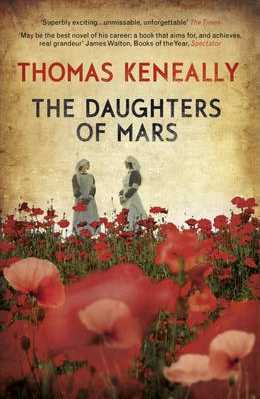
In 1915, two spirited Australian sisters join the war effort as nurses, escaping the confines of their father's dairy farm and carrying a guilty secret with them. Used to tending the sick as they are, nothing could have prepared them for what they confront, first in the Dardanelles, then on the Western Front. Yet they find courage in the face of extreme danger and become the friends they never were before. And eventually they meet the kind of men worth giving up their precious independence for - if only they all survive. At once epic in scope and extraordinarily intimate, The Daughters of Mars brings the First World War to vivid life from an unusual perspective. Profoundly moving, it pays tribute to the men and women who voluntarily risked their lives for peace.

528 pages, Paperback

First published June 1, 2012

409 people are currently reading
9290 people want to read

About the author

Thomas Keneally

112 books1,265 followers
Thomas Michael Keneally, AO (born 7 October 1935) is an Australian novelist, playwright and author of non-fiction. He is best known for writing Schindler's Ark, the Booker Prize-winning novel of 1982, which was inspired by the efforts of Poldek Pfefferberg, a Holocaust survivor. The book would later be adapted to Steven Spielberg's Schindler's List (1993), which won the Academy Award for Best Picture.

Often published under the name Tom Keneally in Australia.

Life and Career:

Born in Sydney, Keneally was educated at St Patrick's College, Strathfield, where a writing prize was named after him. He entered St Patrick's Seminary, Manly to train as a Catholic priest but left before his ordination. He worked as a Sydney schoolteacher before his success as a novelist, and he was a lecturer at the University of New England (1968–70). He has also written screenplays, memoirs and non-fiction books.

Keneally was known as "Mick" until 1964 but began using the name Thomas when he started publishing, after advice from his publisher to use what was really his first name. He is most famous for his Schindler's Ark (1982) (later republished as Schindler's List), which won the Booker Prize and is the basis of the film Schindler's List (1993). Many of his novels are reworkings of historical material, although modern in their psychology and style.

Keneally has also acted in a handful of films. He had a small role in The Chant of Jimmie Blacksmith (based on his novel) and played Father Marshall in the Fred Schepisi movie, The Devil's Playground (1976) (not to be confused with a similarly-titled documentary by Lucy Walker about the Amish rite of passage called rumspringa).

In 1983, he was made an Officer of the Order of Australia (AO). He is an Australian Living Treasure.

He is a strong advocate of the Australian republic, meaning the severing of all ties with the British monarchy, and published a book on the subject in Our Republic (1993). Several of his Republican essays appear on the web site of the Australian Republican Movement.

Keneally is a keen supporter of rugby league football, in particular the Manly-Warringah Sea Eagles club of the NRL. He made an appearance in the rugby league drama film The Final Winter (2007).

In March 2009, the Prime Minister of Australia, Kevin Rudd, gave an autographed copy of Keneally's Lincoln biography to President Barack Obama as a state gift.

Most recently Thomas Keneally featured as a writer in the critically acclaimed Australian drama, Our Sunburnt Country.

Thomas Keneally's nephew Ben is married to the former NSW Premier, Kristina Keneally.

Ratings & Reviews

What do you think?
Rate this book

Friends & Following

Create a free account to discover what your friends think of this book!

Community Reviews

5 stars
1,051 (22%)
4 stars
1,810 (38%)
3 stars
1,194 (25%)
2 stars
411 (8%)
1 star
179 (3%)
Displaying 1 - 30 of 909 reviews
Profile Image for TXGAL1.
391 reviews40 followers
December 23, 2020
Thomas Keneally’s masterful novel, THE DAUGHTERS OF MARS, was originally published in 2012. He tells his tale of World War I voluntary service life through the eyes of two Australian sisters serving as combat nurses—Naomi and Sally Durance.

Beginning in 1915, the Durance sisters leave Australia and find themselves serving in the Dardanelles. There is a tension between the two as they share a guilty secret. The pace of their work keeps the secret in the far recesses of their brains, but it is never forgotten. Having made friends with the other Australian nurses, their lives are forever entwined over the shared wartime experiences. The non-stop aid to injured soldiers and the battle at Gallipoli complete Part One of the book.

Part Two finds the sisters and their outfit transferred and serving at different aid locations in France. It seems that there is no rest for the weary. The arrival of wounded is unending. Also, a new flu is running rampant through the country. They remain in France through the end of the war.

I must confess it took me awhile to read this book. It was not because of the real aspects introduced about war—I am not the squeamish sort. I don’t know if it’s because of this being 2020 and what we, our loved ones, or those we know are or have experienced due to COVID. But I was only able to read a bit at a time and then would have to put the book aside for a day or two before I could pick it up again and proceed.

Keneally was a wordsmith in everything that he described. Whether it was the countryside or wounds and other war-related facets, his writing was as vivid as any camera’s output. While I read, I felt I had been transported to the location of description. And the violence was not relegated to only the soldiers. All became victims of the war in one capacity or another, forever changed.

THE DAUGHTERS OF MARS, above all, is a study of the battle tested nurses, be it in a war zone in a foreign country or the unit overrun with patients stricken with a deadly virus, who literally put their lives on the line and devote themselves to a life of service for all of us. We are forever thankful and in their debt.
Profile Image for Kim.
426 reviews540 followers
August 4, 2014

I picked up this novel from my local bookstore shortly after it was published in September last year, not because of any particular interest in or knowledge about the involvement of nurses in World War I, but because I respect Thomas Keneally as a writer and and hadn't read any of his work for a while. It took me several months to start reading the book and a hour or two of reading it to decide that I was going to like it. For the past two days I haven't wanted to put it down.

Keneally's main characters are sisters Naomi and Sally Durance, nurses from an Australian country town, who are pulled together and pushed apart by a shared family secret. When World War I breaks out, they volunteer to join the Australian Army Nursing Service, which was part of the Army's medical corps. The sisters are initially sent to Egypt and later work on a hospital ship and then on an island in the Mediterranean, caring for soldiers injured in the Gallipoli campaign in 1915. Later, they work in France: Naomi in a hospital run by an English volunteer, Sally in an Australian Army hospital and then in a casualty clearing station close to the front line. Keneally details their experiences from 1914 to 1918 and the experiences of the young men and women whom they meet and with whom they work.

This is not a cheery tale. That's not to say that it doesn't have its lighter moments, but the story is a grim one. There are some distressing scenes describing war injuries, their treatment and their effects. And while the nurses necessarily work behind the front line, they are not immune from the direct consequences of battle. Suffice to say that a number of scenes made me weep. Keneally's prose is powerful and he has a gift for describing momentous scenes in relatively few words. I read a professional review of the novel which highlighted a couple of linguistic anachronisms. While I accept that they are there, I didn't notice them as I read, which confirms how engaged I was with the characters and the story. Readers should know that Keneally does not use quotation marks for dialogue. This does not bother me at all. In fact - in this book at least - I prefer it. The prose looks clean and uncluttered on the page and it was never difficult to work out who's speaking to whom.

As I'm not a World War I expert and have no medical background, I can't assess the accuracy of Keneally's research. However, Keneally is not only a novelist. He has written a number of books on Australian history, a book on Irish history and biographies, including a biography of Abraham Lincoln. Keneally knows how to do research and he has listed his sources at the end. I am prepared to trust that he got the history right.

Several reviews on Goodreads refer to the fact that Keneally presents alternative endings to the novel as a cop-out. Neither of his alternative endings was the ending I wanted. However, I don't agree that the device is a cop-out. What the presentation of alternative endings does is illustrate one of the novels most pervasive themes: the extent to which life is a lottery with an infinite range of possible outcomes. None of us know when we wake up in the morning if the story of our day is going to end happily. How much greater the odds of an unhappy ending for those involved in or directly affected by war: five millimetres difference in the trajectory of a bullet may mean complete safety, losing the tip of an ear, or death. As one of the characters in the novel - a soldier who has incurred horrific injuries - says: "When they ask me to write my war memoirs, they'll consist of one thing. Standing in the wrong place."

In spite of the grimness of the story, I'm glad that I read this work. It's both a moving piece of literature and a powerful tribute to the nurses of World War I, whose contribution deserves more acknowledgment. 4-1/2 stars.
Profile Image for Warwick.
Author 1 book15.3k followers
May 2, 2014
I came to this after reading many books about the Western Front written by people who were actually there, and part of me found it difficult to adjust to a modern literary treatment. It struck me suddenly – unfairly – as distasteful to turn these events into the material of a story. And so I was looking hard for some kind of thematic purpose to talking about 1914–1918 beyond just using it as a source of dramatic incident.

What this book is going for is a sense of sweeping grandeur, an epic scope that reaches from dusty Australian farmsteads to the Gallipoli landings to the industrialised slaughter of the trenches. I wanted to like it, and there are some wonderful setpieces including the best shipwreck scene I can remember reading. I also (apparently unlike other reviews) quite liked the two central characters, sisters from New South Wales who join the war effort as nurses. It made a nice change to see things from this medical point of view – the war described in terms of the injuries it dealt out rather than the fighting itself, and from a female rather than a male perspective.

However, the book's style sometimes militates against its own purposes. Direct speech is given without quotation marks or any other markers, so it's hard to know where it ends and where narration begins. Unfortunately this is not exploited for any stylistic effects; it just seems like the sort of wilfully confusing idiosyncrasy some authors adopt in order to seem ‘literary’, and so it annoyed me. More fundamentally I just thought the writing was a bit average. There is a very heavy reliance on dashes, both for parenthesis and to separate clauses, which results in some rather staccato, arrhythmic prose:

The fancier the clobber – went Honora's opinion – the less fighting the bloke had done. They had time only for a few galleries – they told themselves they would be back and would devote a day entirely to the museum. Sally found herself rehearsing – in case she met Charlie Condon soon – the names of artists. She liked David – he was easy to like – and Ingres' woman with the high-waisted gown. When they emerged from the Louvre they found the day still bright with high, streaky clouds and – though it was chilly – they walked in the Tuileries Gardens where trees were still bare.


That sounds like I've just taken random examples and glued them together, but it's an actual paragraph from the book.

The ending is also a bit problematic, taking the French-Lieutenant's-Woman approach of giving you different options for how things might have worked out. Tom, there is one reality where I found this artful and beautiful, but there is another reality where I thought it was a real dereliction of duty.
Profile Image for Amy.
396 reviews5 followers
September 9, 2013
I was really looking forward to reading this but in the end I found it just okay. There were bits of absolutely beautiful writing; however, they were buried within page after page of fragmentary descriptions, bizarrely structured sentences, and quotation-less dialogue. For a "sweeping, epic book" (according to the back cover), I agree with other reviewers that the story and its characters are passionless, remote, and distant. The book slogs through the first three years of the war. The main characters all witness the terrible physical and psychological effects of war, but though there are descriptions of devastating injuries, the smell of blood and infected wounds, dirty uniforms, mud, rats, crap food, etc. reading it all was horrific, but I never felt anything - it was all described in a very clinical, detached way.

The love stories were dull; unfortunately, so was the relationship between the two sisters. The relationship was a bit prickly to begin with when the older sister moved to the city, then strained further after the death of their mother. Then the war came and they suddenly grew close with no explanation - not that one was needed but it was presented as if it were this utterly miraculous event - NOW THEY ARE SISTERS....AND FRIENDS?! - that I rolled my eyes and thought, so what? Far more interesting were their friendships with the other nurses.

So while it was interesting to learn about the experiences of nurses on the front, the characters were beyond bland and that made it difficult to care when anything happened to them.


Profile Image for MaryG2E.
395 reviews1 follower
December 16, 2015
My feelings about this book are mixed. On the one hand, I enjoyed the story, and in particular the little snippets and anecdotes which enliven the 'official' history of Anzacs during World War 1. Seeing the war through the eyes of hard-working army nurses offers fresh perspectives, which I appreciated. I greatly enjoy the brilliant, encyclopaedic mind of Thomas Keneally, one of Australia's most respected authors. On the other hand, I was frustrated by the style of the novel. By that I mean the unusual sentence structure and the non sequiturs which bob up in the prose, and the lack of marks to indicate direct speech. I found that I read this book much slower than my usual pace because I kept having to go back over sentences, to understand them in context or to simply make sense of them. I wondered if this sort-of 'stream of consciousness' style which crept into the narrative at certain points was a deliberate ploy on the part of the author, or merely a sign of poor editing. Overall, this is a worthwhile book about the remarkable women who went to the battlegrounds of Gallipoli and France, to aid the troops. I was deeply moved by the episode of the sinking of the Archimides and wondered how I would behave in such desperate circumstances. I loved the depictions of the various nurses, with Matron Mitchie being a particular favourite. What a woman! The personal issues of Naomi and Sally Durance intrigued me sometimes, but at other times I thought the author was being a bit indulgent. Where's that sub-editor when you need her!?
If it weren't for those stylistic problems that dogged my reading of this book, I would have happily scored it 4 stars. But marks are deducted for the difficulties I encountered and my overall disappointment that I did not enjoy fully a book I have long wanted to read.
Profile Image for Andrea.
1,074 reviews29 followers
May 7, 2016
I picked this as my ANZAC read - something that has become a bit of a tradition for me in recent years. It's had mixed reviews, with a lot of readers put off by the lack of quotation marks for the dialogue (true!). But I'd never read anything by Thomas Keneally before, so I thought I'd give it a try. The verdict? I really liked it.

It seemed very familiar, covering a lot of the same ground as Anzac Girls by Peter Rees, which was made into a TV series (which I loved) for the 2015 ANZAC centenary, but at the heart of it was the story of Sally and Naomi Durance - sisters, nurses, co-conspirators, friends. It was a slightly different take on the dual narrative structure that I love. At the start we were given both sisters' perspectives of the same events, but as the war dragged on, their paths diverged and therefore so did their stories.

The first part of the story took place in Australia (the Durance family was from NSW), and I was amused at Keneally's references to the Sydney/Melbourne rivalry that supposedly existed, even back in those days:
It was not a great wait, however − perhaps a week − until they were given railway tickets to the golden city, to Melbourne – the other pole to Sydney’s civic pretensions, the two cities holding each other in orbits of mutual contempt.

and later:
Melbourne was so despised in New South Wales and Sydney that contempt sent its way by Sydneysiders was itself a sort of awe – a kind of applause and a suspicion of undue sophistication.

but then, while back in Australia, Naomi's guilty pleasure:
On their one night in that city, Lieutenant Shaw took Naomi to dinner at the Windsor Hotel – once a temperance palace but now the ‘flashest pub in town’.[And high tea at the Windsor can still transport you back to that era, if you want it to.]

Both girls meet their future partners in wartime circumstances, and even Sally, more buttoned-up than Naomi in my opinion, knows it's not a time for games - plain speaking is required:
There’s no question, she said, that you’re a man amongst men.
What does that mean? he asked, smiling. Because it doesn’t mean much when you’re in an army.
Well, she said, it means my love, that’s what.
He grinned madly. It was what he had cycled all the way in hope of.
Well, he murmured. That’s a big admission for a girl like you.


The lack of quotation marks didn't bother me at all. I felt confident that I always knew who was speaking. I'm actually more surprised that readers weren't upset about the alternate endings offered by Keneally. Personally, I was grateful to have both options, as I'd struggle to nominate my favourite Durance sister, and this allowed me to imagine a life-after-war for both.
Profile Image for Phrynne.
4,023 reviews2,722 followers
November 12, 2014
On one level I did enjoy this book. It is an easy read and is very informative about what our soldiers and nurses went through in World War 1. I had a degree of interest in finding out what happened in the end to each of the characters although I was never at any time particularly invested in any of them. The author writes in a very detached manner which means the reader remains quite uninvolved throughout the book. I did not like the lack of quotation marks, nor was I comfortable with being given a choice of endings. It was probably a clever idea and it was skilfully handled but I still like to be told what actually happened rather than having to guess. So overall just an average read for me - oh and by the way it is also a bit too long!
Profile Image for Penny.
378 reviews38 followers
October 5, 2013
This is an excellent, multi-layered book about 2 sisters from Australia who volunteer to nurse in WWI.

They are somewhat estranged due to their mother dying and their individual responses to that. Both of the girls face hardship both due to their work and in their personal lives. The book is more an epic than a romance story though. The story swings from a hospital ship, to Egypt, to Gallipoli, Australia and the trenches of northern France. There is a whole host of characters that flow through the book and obviously some dont survive.


Many books have been written about WWI and this is one of the best. The writing is taut and without sentimentality - it is not a girly book about nurses and war. My first book by this author and I will read more of him.
Profile Image for thewanderingjew.
1,758 reviews18 followers
September 23, 2013
The book was beautifully written with a prose that was easy to follow and absorb. It tells the story of a group of devoted Australian nurses, during World War I. On every page, opposites coexist: beauty and ugliness, love and hate, fidelity and betrayal, fierceness and tenderness, numbness and pain, tears and smiles, sadness and laughter, the wounded and the healed, in essence, war and peace. There was no gratuitous sex to diminish the novel's relevance, although romance was a significant part of the story. The graphic details were especially hard to read, because of the agony portrayed, but I could not put the book down. It contained an elaborate description of war with all its futility; the loss, the injuries, the suffering, the courage, the bravery, the guilt, the shame, the horror and the stupidity of all of it, came off the page in images that were alive. This is a gifted writer. He has captured the message of war then and of wars now. Innocents are killed and punished to defend against fools who put them at risk because of their need for power.
When the book begins, two sisters, Sally and Naomi Durance, trained as nurses, watch as their mom suffers from incurable cervical cancer. When she dies, Sally is guilt-ridden. She had hidden morphine to end her mother’s life, in the event that her mother could no longer take the pain. She is convinced that her sister, Naomi, who came home from her nursing job in Sidney, in order to help out, found the stash and used it to prematurely end her mother's suffering. Their relationship suffers.
World War I had begun. One sister had already escaped her hometown and now the other, Sally, wants to do the same. The Durance sisters, separately, enlist in the Australian war effort, as nurses. When they are stationed in the same place, their relationship develops more deeply and their strained relationship improves. The brutality, violence and horror of the war, that they witness, is often bloodcurdling, and they take us on the journey with them. We are on ships that are torpedoed, in the water when the ship sinks, we are in trenches hiding from attack, we are caring for the injured in the operating theaters that are built, comforting the wounded and grieving for their various losses, as we watch the nurses exhibiting bravery and strength they never knew they possessed. We are with them as they are abused by the officers, treated rudely by the orderlies and even attacked by reckless soldiers. War breeds dreadful behavior and conditions everywhere, but the dedication of the nurses and the soldiers is prominent on every page of the book, and they are beyond brave, with their commitment in the face of all situations, no matter how traumatic, no matter what the danger is to themselves. They rise above their own fears to help others and support the cause of their country.
In the midst of all the ghastliness, Keneally was able to include the mundane, the ordinary daily living experience, without diminishing the impact of the story. The elucidation of relationships developing in spite of the danger, and the warmth of the romantic involvements was represented, not in any way distastefully or improperly. The field of war was prominent on every page, and yet, there were also the moments of normal behavior interjected quite comfortably beside it. As difficult as it was to read, it was worth every word. The book’s title, which literally means the daughters of war,(Mars is the Roman God of War) describes a tale shaped by war’s tragedies and triumphs.
Profile Image for Kim.
2,712 reviews12 followers
December 15, 2020
Setting: Australia & Europe; 1914-22 - Sisters Naomi and Sally Durance are the daughters of a 'cow-cocky' (dairy farmer) in northern New South Wales but both are qualified nurses, Naomi in a Sydney hospital and younger sister Sally at the local hospital. With the advent of war, both volunteer as army nurses and are accepted. Ending up initially in the Dardanelles and Egypt, caring for the wounded from the ill-conceived Gallipoli campaign, before eventually being transferred to the Western Front for the duration of the war. We get tales of horrific injuries and the treatment regimes together with personal tales of the sisters and their friends and acquaintances. Told with much detail and many characters and storylines, this perhaps should have been a gripping read yet I found my attention wandering easily and in the end was just glad to finish it. As for the 'alternative endings', that was just bizarre. However, I couldn't really rate it lower than 3* (6.5/10).
Profile Image for Carolyn.
2,740 reviews748 followers
August 3, 2014
Naomi and Sally Durance are sisters from the Macleay district of NSW, both working as nurses at the outbreak of WWI. Naomi had taken herself off to work at a big hospital in Sydney while Sally stayed home with her parents and nursed at the local District hospital. They both volunteer as military nurses at the start of the war and are sent out to Egypt to nurse on the hospital ships transporting the wounded from the Dardanelles.

The book is wonderfully descriptive of the conditions the nurses and doctors had to work under and the author has obviously fully researched the standard of medicine available at the time. The drugs and surgical techniques were very limited and basic resulting in the inability of the medical staff to save the most critically wounded patients. That many patients were treated and stabilised enough to be shipped home was a credit to the bravery and professionalism of the medical staff. It must have been extremely traumatic for the young nurses and doctors to suddenly be thrust into the horrific injuries and terrible deaths that many of their patients suffered and yet I didn't get much of a sense of that in the book. That the nurses were stressed was clear; always tired, they lost weight and ceased menstruating and many of them lost their bubbly personalities but they continued to work tirelessly to care for their charges. I can't help feeling that there must have been some who struggled and broke down under the stress and workload.

Following the withdrawal from the Dardanelles the nurses were sent on to France. Sally eventually to a clearing post a few hours from the front which served to administer acute care so the wounded could then be moved to hospital. Naomi elected to help set up a voluntary hospital by the wealthy wife of an English Viscount. Here for the first time they encounter soldiers suffering from the after effects of gas and discover that there are yet more ways to die horribly. Yet despite all this the nurses are able to fall in love and occasionally get leave to visit London or Paris to see the sights and catch up with loved ones. Naomi and Sally find themselves gaining a better understanding of each other and becoming friends as well as sisters.

Although the events of the war and the battles at Ypres and on the Somme are referred to, there is not much detail of the fighting as the novel is focused on the medical care of the wounded. This results in making the war seem a little remote even when the clearing station comes under fire itself later in the novel. Perhaps because of this remoteness I didn't really feel a strong connection with the characters. The narrative was great but there was a lack of tension and the story felt just a little flat. Nevertheless It was a very enjoyable saga. It put the events of WWI into perspective for me and gave me an idea what it would have been like to have worked in a military hospital at the time. There is also a wonderfully evoked shipwreck scene that felt entirely realistic. That the author offered two alternative endings to the book for the reader to choose between was also a nice touch.

Just a word in warning that many readers have commented that they found the lack of speech marks in the novel very annoying. It didn't bother me at all and in fact I didn't even notice until it was pointed out. I always felt is was made quite clear who was speaking but if this is likely to annoy or distract you, you might prefer to try the audio version.
Profile Image for John Needham.
Author 8 books17 followers
March 3, 2013
I came to this book quite expecting, knowing the grim subject matter, to be tremendously shocked, angered, moved. I suppose I did have all those reactions, but less so than when I read, for example, Birdsong. It took me a while to realise why. I think it was the writing style; to me it seemed flat because of the formal language and avant-garde lack of speech marks, which seemed a contradictory mixture. At times I had to really concentrate to work out when people were speaking, and I slightly resented being put to the trouble.

There seemed to be an odd lack of passion at times; you rarely heard the protagonists expressing horror about the unrelentingly hellish situation of dealing with casualties and death, so I couldn't really feel involved with them. And I can't comment about the strange ending without spoiling!

But, doubtless, the book was very well written. Keneally is an award-winning writer of long standing, after all. All the same, I wanted my emotions to be manipulated a bit more than this book did. That's what stories should do, it seems to me. I react to books viscerally rather than intellectually. But that's just me, I suppose.
Profile Image for Angela M .
1,454 reviews2,116 followers
October 17, 2013
This book was a little slow going for me at first . The story of two Australian sisters who are volunteer nurses during WW I , focused a lot in the beginning on the horrendous wounds , loss of limbs , and other injuries that sisters Sally and Naomi tended to . They seem distant from each other and distant to the reader as well .but then the story develops into more than just a story of war and I was glad that I stayed with it.

As their assignments continue and other nurses , doctors , and wounded soldiers come into their lives, Naomi and Sally become these determined, dedicated, caring and heroic women . They become more than sisters ; they become friends . The development of their characters is slow but Keneally does a wonderful job and I became truly vested in them.
A twist at the end with two possible endings did not change my overall view of this wonderful story.
I did find the lack of quotation marks annoying at first until I got used to it . All in all - a really good story .

Profile Image for Denise.
1,256 reviews15 followers
January 3, 2014
There were two sisters from Australia. They were nurses. Something happened (or maybe it didn't.) The war started. Some other things happened. Some of them were very bad. The sisters weren't the type to get emotional. There were some conversations, with no quotation marks. More things happened. The war ended. They survived (or maybe not.)
Profile Image for Jennifer (JC-S).
3,517 reviews285 followers
June 15, 2012
‘Where was the space for mourning in this air of blood and acrid wounds and unwashed men?’

In this novel (his 29th), Tom Keneally tells the story of Naomi and Sally Durance, daughters of a Macleay Valley dairy-farming family, who volunteer as nurses during the Great War. In 1914, in Sydney, Naomi and Sally sign up to serve in the war that has just broken out on the other side of the world. Each of the sisters has a reason for volunteering; a reason which creates both closeness and distance between them.

A few weeks later, Sally and Naomi form part of a large group of doctors, nurses and orderlies who set sail for Egypt. After periods in Cairo and Alexandria, they experience the horrors of Gallipoli from Lemnos and on the Red Cross hospital ship, the Archimedes. In this part of the novel, Mr Keneally captures the reality of trying to save life and reduce suffering in conditions which grow steadily worse. The number of casualties increases, while the already limited supplies of drugs and surgical supplies decrease. Estimates of how long the war will last increase and both weather and ineffective leadership exacerbate the suffering.

‘A great recycle of soldiers’ flesh was in progress.’

Towards the end of the first part of the novel, the Archimedes is beset by disaster. In the second part, Naomi and Sally and those of their colleagues who survive resume nursing in France on the Western Front. Here, war assumes new destructive forms: aerial bombardment and gas warfare; the horrors of the Somme – death and destruction, horror and heartbreak. All of the nurses are affected physically and emotionally. Some, including Naomi, are punished for caring too much and becoming too close to other staff or the patients.

‘Too busy delivering the dead to find the living.’

Naomi is invited to work at the Australian Voluntary Hospital, set up in a chateau by Lady Tarlton, the wife of a former governor-general of Australia. The descriptions of the horrors of war, the suffering of the wounded, the courage of some participants and the stupidity of others makes for harrowing reading at times.

‘These are today’s men, the matron told her. Who will nurse tomorrow’s men if you get blown to shreds?’

There is nothing romantic about this war and yet the horrors of it provide an enduring basis for friendship and companionship and, for some, the possibility of love. For those who survive.

‘There are only two choices, you know. Either die or live well. We live on behalf of thousands who don’t. Millions. So let’s not mope about it, eh?’

I found this novel intensely moving, especially the descriptions of the damage caused by the various gasses used and the depictions of the suffering caused by war. There are many different stories involved in the horrors of war: some end in tragedy, others do not. Some readers will have, as I do, relatives who fought in this war. Such connections make many of the descriptions more immediate and possibly more powerful.

I didn’t care for the double ending: I didn’t need the possibilities it offers in order to disconnect from the story. Others may think differently, once they’ve read it. With or without the ending, it’s a powerful novel and it brings to life the consequences of war from the perspective of those whose job it is to care for those injured fighting it.

Jennifer Cameron-Smith
Profile Image for Chris.
873 reviews183 followers
June 29, 2019
This epic of WWI (1914-1918) is told from the perspective of two Australian sisters & nurses who enlist to serve as Australian Army Nurses. Naomi & Sally are no longer close and even have a somewhat strained relationship after the death of their mother. They separately enlisted and have an uneasy journey together as they move into their first assignments in Egypt. This is a sweeping drama that takes them from Egypt to off the shores of Gallipoli, working on Lemnos, to the horrors of France and Belgium. What happens to them, who they meet & what they see and do, changes them. Although they are the two main characters, there are many others with which the reader will bond or become their favorite. Mine was Matron Mitchie. Much of the novel describes the wounds/injuries and the limited resources and techniques of the time to treat them. Fascinating.
Many reviewers seemed to be put off by the lack of dialogue indicating quotation marks. I have to admit I was so engrossed in the story that I didn't even notice. Keneally just painted a picture over and over that I could place myself right in the midst of the action. I wasn't riveted all the time, but I definitely wanted to keep turning the pages. As far as the ending goes, it might not have been my cup of tea, but much of life isn't. It is another wonderful piece of writing that describes how people are shaped by the horrific circumstances of WAR or MARS the God of War.
Profile Image for Seamus Mcduff.
166 reviews5 followers
March 19, 2013
I hearby formally declare Tom Keneally the master of the awkward sentence.

I really wanted to like this and I thought I would; I'd heard a lot about Tom Keneally and his Man Booker for Schindler's Ark, saw the Spielberg movie, etc, etc. But in the end -- and I hate to say this Tom, because you look like a nice smiley fellow in all your photos -- on almost every page I was troubled with the involuntary suspicion that - hmm, maybe this isn't really the greatest writing. To be honest, I struggled to square the the fact that the author has written 29 books (not sure if they're all novels now) with what seemed to me to be an amateurish try-hard writing style.

So shoot me. In all fairness I think TK deserves full marks for historical research and building the atmosphere of the time. It's just that his sentences always came across to me as overblown, overly wordy, try to sound literary, and his dialogue stinks. I just found it hard to believe that anyone would say a lot of the things that the author has his characters 'asserting'.

Anyway. It's a book, I read it, didn't really get into but was interested in the historical detail. Now I'll go and read a different book.
Profile Image for Camie.
958 reviews242 followers
August 27, 2014
After the mysterious and untimely death of their mother, sisters Sally and Naomi leave their father's Australian farm to become nurses in the European theatre of WW1. An interesting book written from the perspective of the generally unsung heroines as they cope with what is essentially the continual bloodbath of the war. This book is a saga, and became a project for me, due in part to Keneally's decision to write the entire book without quotation marks. Spoiler Alert ... More than a little frustrated that after 514 pages of high concentration required reading we are given a dual ending, really ???? A pick your own ending story ?? A NYT Bestseller from the author of Schindler's Ark the book version of Schindler's List 3 stars
Profile Image for Diane S ☔.
4,901 reviews14.6k followers
May 29, 2013
I love historical fiction and I really admired Schindler's list. This is an epic novel that seemed to go on and on. Loved the historical facts, loved the two sisters and the closeness they at times shared. So why didn't I love this novel? There is a fine line, between adding details to keep the reader interested in the story and adding details in such a quantity that it overwhelms the reader. That is what I felt happened in this story. Everytime I felt myself melding into the story it would go wandering off on some detail or tidbit that would interrupt the narrative flow. The lack of punctuation did not bother me half as much as the endless details. Yet, I cannot deny the amount of research that went into this novel. Just wish I could have enjoyed it more. So read this for the history but be prepared for skimming. ARC from publisher.
Profile Image for Mij Woodward.
159 reviews4 followers
February 13, 2013
I am in a state of astonishment. Just finished the last page of this 520-page novel.

Should I wait until a little rationality has returned to my mind to write my review, or should I attempt to bring the cells of my brain into some kind of working order and speak up right away?

To begin with, through-out a good portion of the story, I felt a little cheated, a little disappointed. That's because my very favorite sort of fiction takes one or two main characters and then has some kind of drama, some kind of problem that needs to be answered, so the reader cannot put the book down until the answer is told.

So, at first--I said to myself--well, Keneally is just setting the stage, letting the reader become acquainted with the two main characters of his story, Naomi and Sally Durance, both Australian nurses during WWI. The reader sees them at the beginning of the war, in one setting and one scene after another, and then continues as the years of the war slowly unfold.

Oh, I get it--I thought to myself--this is going to be one of those novels that is mostly a series of vignettes, a grouping of short stories brought together by a common theme. Oh well--I remembered how much I had enjoyed Let the Great World Spin--and continued reading. And those vignettes were so fascinating. Glimpses of what WWI was like to the people there on the ground. Different places, different episodes, but all with an over-arching string that ties them together.

On page 431, I came upon a quote that grabbed me, applying the thought to my own life:

"Life was so ridiculous, she knew, that it must be accepted and worshipped as it came. . . Well, the absurdity spoke for itself. . . If God were praised it should not be because there was a plan to the absurdity but because there was a divine lack of one."

I plan to frame that quote in some artful way, so I can view it everyday.

I cannot give the slightest clues to the ending of this great novel. Only, that it might leave you speechless. And forever grateful for having read it.

(Post Script: I have noticed some readers have not appreciated the ending, that it did not work for them. It totally worked for me. It could not end any other way. I cannot tell you how, because I cannot tell you anything at all about the ending. Give it a try, and see for yourself. Then send me a message and we can talk about the ending!)

Profile Image for Laura.
7,129 reviews605 followers
July 6, 2015
My rating: 3,5 stars

This is the story of two young Australian nurses, Naomi and Sally Durance, who have faced the horror of The Great War in Egypt, at Gallipoli and then in the northern Europe. In their final destiny, they work for the Australian Voluntary Hospital which was run for a visionary and eccentric Lady Tarlton.

The story is based on the journals of Australian nursing sisters and they describe in detail the first anesthesia's techniques and how they faced the Spanish flu.

About the author:
Thomas Keneally began his writing career in 1964 and has published thirty-one novels since. They include Schindler's List, which won the Booker Prize in 1982, The Chant of Jimmie Blacksmith, Gossip from the Forest, and Confederates, all of which were shortlisted for the diaries, Mitchell Library, Sydney.

5* Schindler's List
3* Blood Red, Sister Rose
3* A Victim of the Aurora
3.5* The Daughters of Mars
TR The Playmaker
TR Shame and the Captives
Profile Image for Kelly Lyn.
295 reviews
May 2, 2021
DNF AT 25%

I really wanted to like this, but it is slow as heck and there are no punctuation marks what so ever. The author warns of no commas, but no quotes around characters speaking was grating on my nerves.
Profile Image for Sallie Dunn.
883 reviews105 followers
September 4, 2025
⭐️⭐️⭐️⭐️⭐️

This was my third book written by Thomas Keneally. With the exception of his most famous work (Schindler’s List) he is relatively unknown in the USA.

I love his writing. This book was set in WWI and is about two sisters, both nurses, who volunteer to enlist as military nurses to the wounded during the Great War. First they serve in Egypt, then near Gallipoli, and lastly France. In Egypt and in the Mediterranean they served on ships that were floating hospitals. In France the medical emergency installations were, for the most part, tents.

That may sound boring to some readers. For me, it was so educational. I’ve never had a clue as to Australia’s role during that conflict. In addition, one of the ships they were stationed on was torpedoed. There was much loss of life and time spent in the water hanging on to a raft before the rescue was harrowing.

The war finally ended on 1918. With the war’s end came the Spanish Flu. Think about the advances made in medicine up to that time, and you come to realize what sacrifices the medical volunteers made to serve a greater cause.

Next up for me written by this author is The Dicken’s Boy.

ATY Goodreads Challenge - Anniversary List - 2025
2023 - a book whose author has published more than 7 books
Profile Image for Roman Clodia.
2,884 reviews4,629 followers
September 15, 2017
Keneally takes an almost documentary approach in this long book as he follows a group of Australian nurses through the First World War. There's a slow start to this so stick with the first couple of chapters but things pick up once the women board a hospital ship sailing to the Dardanelles.

Character doesn't seem to be the prime intention here (though Matron Mitchie gives a fine account of herself) and the two sisters, Sally and Naomi, who sit at the heart of the book are barely distinguishable. Instead Keneally concentrates on the work conditions and experiences of young Australians, most of whom have never left their country before, as they are suddenly faced with the realities of war.

The hospital ship background makes this a good complement to other WW1/nurses books and the first part, especially, set against the Gallipoli campaign, told me things I didn't know. The second part gets more conventional as the sisters move to the Western Front and France.

The book is perhaps overlong for its subject matter and doesn't have the same emotional impact as a couple of other Keneally books I've read set against WW2 (Shame and the Captives, The Widow And Her Hero). All the same, an extremely well-researched and detailed book that follows the war right through to the end.

I listened to the audio-book read by Jane Nolan who has an expressive voice which doesn't tire the ear.
Profile Image for Martha.
993 reviews20 followers
March 20, 2014
No doubt in my mind, Thomas Keneally is one of the best living storytellers we have. What I find most convincing is how he writes without drama about circumstances that have the capability of sending shock waves of consequence through the lives of his characters. In this case, World War I, when millions of young, vital men were fed into the great, prolonged war machine that spit most back out either dead or damaged. But the novel stays away from the front lines, viewing this war through the eyes of the nurses who tend the wounded, in this case, Australians, two sisters who tell their stories of life during the war, their own friendship which grows from it, and the lives they crossed paths with from 1914 until 1919. There was no conscription, they joined of their own free will (a concept explored here) , never expecting the brutal mess that lay ahead nor anticipating how they'd emerge a differentperson.

What I especially like about Keneally's writing is how there is no premonition, no dangling of what is to come. Moment grows on moment. I found that I needed every word of this 500+ page book to fully appreciate the experiences of his characters. I so cared about these nurses and what their fellow countrymen were experiencing and how they processed their experiences that every word counted and gave me a new appreciation of that generation who experienced that war, their broken world, and shaken faith in God and good.
109 reviews2 followers
April 12, 2013
I enjoyed this book in parts. Seeing WW1 from the perspective of nurses was interesting and some of the characters were engaging. However, the novel is dragged down by the pedestrian writing. I suspect Keneally has such a reputation that his editors do not do their jobs, they just publish what he writes. There were great swathes of material which should have been cut and which I skim read. The book should have been one hundred pages or so shorter. It often happens when a lot of research is involved - writers seem to feel obliged to cram all the research into the book

Many elements jarred, eg on several occasions the narrator refers to towns in southern NSW, Bungendore and Deniliquin comparing them to towns in France, but why when none of the characters are from within a bull's roar of that part of Australia. And the ending is a complete cop out and written even more poorly.

So 3 stars for the idea and some of the characters and descriptive scenes, zip for the rest of it.
Profile Image for Debra.
1,659 reviews79 followers
October 25, 2020
Narrated by Julie-Ann Elliott and borrowed from the National Library for the Blind and Print Disabled BARD.

Emotional look at Australian military nurses in WWI. Must have some equivalencies to nursing in a COVID ICU. The triage stress really hit me.
469 reviews2 followers
May 10, 2013
I had a hard time getting used to the lack of commas and quotation marks in this tale of two sisters who nurse for Australia during World War I. Although slow and quite lengthy, the book held my interest with details of nursing under primitive conditions during war conditions. The most interesting parts for me were the descriptions of life aboard ship on the journey to Egypt from Australia and then in the war zone of Gallipoli. The horror of war was clearly indicated in the details of battle injuries and the care available both in the Dardanelles and later in France. The tragedy of the influenza epidemic of 1919 makes up the later part of the book.
The sisters, their nurse companions and the soldiers they work with and fall in love with comprise the characters in the novel. Book groups will find many topics to discuss including class distinctions, city versus farm life, Quakers and war, biologic weaponry, courage under great duress, disfiguration and disability, and the roles of women.
Profile Image for Julie.
561 reviews312 followers
November 17, 2013
Probably closer to a 2.5, but the writing is excellent.

Better to have renamed the book The Daughters of Morpheus. A bit sleepy overall.

The premise was fascinating to me: nurses, and the front lines, in World War I.

I did not connect with any of the characters: I felt like I was viewing them through a veil; everything was foggy, insubstantial, including the raw pain of the soldiers as they lay dying. One could argue that that was Keneally's intent: to somehow anesthetize the audience: render the reader a somnambulist-voyeur, but I don't think he's that clever. In either case, whether intentional or not, it didn't work.

The dream-like quality of the story was irritating -- one never got a sense of anyone feeling anything. And although I haven't been to war, and can't say for certain, I would imagine that there is a lot of rawness, and terror, and panic, and confusion, and really anything but sleepiness.

Worst WWI book I've read.

Profile Image for Erica.
124 reviews3 followers
August 21, 2022
More like 3.5 stars but rounded down to 3 mostly because the author describes a post-coital moment as "like holding a sated child." I get what you're trying to say but literally any other way would have worked, my dude. Also what do you have against quotation marks?!
Displaying 1 - 30 of 909 reviews

Join the discussion

Can't find what you're looking for?

Get help and learn more about the design.