

What do you think?

Elizabeth of York: A Tudor Queen and Her World
Many are familiar with the story of the much-married King Henry VIII of England and the celebrated reign of his daughter, Elizabeth I. But it is often forgotten that the life of the first Tudor queen, Elizabeth of York, Henry’s mother and Elizabeth’s grandmother, spanned one of England’s most dramatic and perilous periods. Now New York Times bestselling author and acclaimed historian Alison Weir presents the first modern biography of this extraordinary woman, whose very existence united the realm and ensured the survival of the Plantagenet bloodline.
Her birth was greeted with as much pomp and ceremony as that of a male heir. The first child of King Edward IV, Elizabeth enjoyed all the glittering trappings of royalty. But after the death of her father; the disappearance and probable murder of her brothers—the Princes in the Tower; and the usurpation of the throne by her calculating uncle Richard III, Elizabeth found her world turned upside-down: She and her siblings were declared bastards.
As Richard’s wife, Anne Neville, was dying, there were murmurs that the king sought to marry his niece Elizabeth, knowing that most people believed her to be England’s rightful queen. Weir addresses Elizabeth’s possible role in this and her covert support for Henry Tudor, the exiled pretender who defeated Richard at the Battle of Bosworth and was crowned Henry VII, first sovereign of the House of Tudor. Elizabeth’s subsequent marriage to Henry united the houses of York and Lancaster and signaled the end of the Wars of the Roses. For centuries historians have asserted that, as queen, she was kept under Henry’s firm grasp, but Weir shows that Elizabeth proved to be a model consort—pious and generous—who enjoyed the confidence of her husband, exerted a tangible and beneficial influence, and was revered by her son, the future King Henry VIII.
Drawing from a rich trove of historical records, Weir gives a long overdue and much-deserved look at this unforgettable princess whose line descends to today’s British monarch—a woman who overcame tragedy and danger to become one of England’s most beloved consorts.
Her birth was greeted with as much pomp and ceremony as that of a male heir. The first child of King Edward IV, Elizabeth enjoyed all the glittering trappings of royalty. But after the death of her father; the disappearance and probable murder of her brothers—the Princes in the Tower; and the usurpation of the throne by her calculating uncle Richard III, Elizabeth found her world turned upside-down: She and her siblings were declared bastards.
As Richard’s wife, Anne Neville, was dying, there were murmurs that the king sought to marry his niece Elizabeth, knowing that most people believed her to be England’s rightful queen. Weir addresses Elizabeth’s possible role in this and her covert support for Henry Tudor, the exiled pretender who defeated Richard at the Battle of Bosworth and was crowned Henry VII, first sovereign of the House of Tudor. Elizabeth’s subsequent marriage to Henry united the houses of York and Lancaster and signaled the end of the Wars of the Roses. For centuries historians have asserted that, as queen, she was kept under Henry’s firm grasp, but Weir shows that Elizabeth proved to be a model consort—pious and generous—who enjoyed the confidence of her husband, exerted a tangible and beneficial influence, and was revered by her son, the future King Henry VIII.
Drawing from a rich trove of historical records, Weir gives a long overdue and much-deserved look at this unforgettable princess whose line descends to today’s British monarch—a woman who overcame tragedy and danger to become one of England’s most beloved consorts.
592 pages, Kindle Edition
First published December 3, 2013
About the author
Alison Weir
96 books8,723 followersLibrarian Note: There is more than one author in the GoodReads database with this name.
Alison Weir is an English writer of history books for the general public, mostly in the form of biographies about British kings and queens, and of historical fiction. Before becoming an author, Weir worked as a teacher of children with special needs. She received her formal training in history at teacher training college. She currently lives in Surrey, England, with her two children.
Alison Weir is an English writer of history books for the general public, mostly in the form of biographies about British kings and queens, and of historical fiction. Before becoming an author, Weir worked as a teacher of children with special needs. She received her formal training in history at teacher training college. She currently lives in Surrey, England, with her two children.
Ratings & Reviews
Friends & Following
Create a free account to discover what your friends think of this book!
Community Reviews
Displaying 1 - 30 of 674 reviews

March 7, 2013
The most overused words to be found in an Alison Weir non-fiction book:
"Possibly, might have been, maybe and could have been."
Bah. The main problem with any non-fiction work on Elizabeth of York is that there is so little known about Elizabeth. Yes, she lived through (and survived!) a very tumultuous period in England's history, but she was first a king's daughter (a lot of those years living in sanctuary), then as wife and queen consort to Henry VII. She was devoted to the church, husband and family - but how do you make 600 + pages of that interesting? At least with fictional novels the author has some leeway to imagine what might have been, but even with that freedom I've yet to find a book that makes her interesting. Nothing wrong with being a wife and mother and devoted to the church, it just isn't interesting. Or it wasn't interesting to me.
What you do get in this book is about 175 pages at the start with a complete rehash of the Wars of the Roses leading up to Richard III's defeat at the battle of Bosworth Field. If you've read extensively on this period, you know the drill and don't need that rehash. If you're familiar with Weir's writing, you also know that she hates Richard III and she's firmly convinced that Richard murdered the boys and/or ordered their deaths. There is no might have been when it comes to that side of the story.
After this comes Henry taking the crown, he marries Elizabeth (although he takes a few years before he decides to give her a coronation), and she proceeds to be a dutiful wife and mother. What do you do when you're writing a biography about a woman who spent so much of her life in the background? Why you dig up all the public records about her expenditures, servants, how much they were paid. You write about what books she owned, what items went into her birthing chamber and how much they cost. You write about big public celebrations and who attended and how much everything cost.
I actually enjoyed the bit on Prince Arthur's wedding to Katherine of Aragon, including how much it all cost, but I was at a loss as to why Weir needed to fast forward to the reign of younger sibling Henry VIII and his marital issues with Anne Boleyn. Wasn't this book supposed to be about Elizabeth of York?
Along with the endless lists of how much everything costs are lots and lots of verse, poems and whatnot that were written about Elizabeth say in honor of her marriage, or her son's marriage. Why, even a quote from Shakespeare's Richard III is tossed in the soup pot.
I realize that some readers do like books with lots of little facts and factoids, and this book would likely suit those to a "T". I haven't seen the finished copy, but I believe it has eye-candy images of paintings and whatnot that would likely distract from the tedious (to me) text, but unfortunately my galley copy didn't come with that luxury.
If you aren't sure, I'd recommend waiting for a library copy, then you can always buy it if you love it.
Oh, forgot I'm supposed to find something positive to say. At least in this version of Elizabeth we don't have Henry checking out the goods prior to the wedding ceremony like you'll find in The White Princess, The King's Grace and The King's Daughter.
Reviewed for Amazon Vine.
"Possibly, might have been, maybe and could have been."
Bah. The main problem with any non-fiction work on Elizabeth of York is that there is so little known about Elizabeth. Yes, she lived through (and survived!) a very tumultuous period in England's history, but she was first a king's daughter (a lot of those years living in sanctuary), then as wife and queen consort to Henry VII. She was devoted to the church, husband and family - but how do you make 600 + pages of that interesting? At least with fictional novels the author has some leeway to imagine what might have been, but even with that freedom I've yet to find a book that makes her interesting. Nothing wrong with being a wife and mother and devoted to the church, it just isn't interesting. Or it wasn't interesting to me.
What you do get in this book is about 175 pages at the start with a complete rehash of the Wars of the Roses leading up to Richard III's defeat at the battle of Bosworth Field. If you've read extensively on this period, you know the drill and don't need that rehash. If you're familiar with Weir's writing, you also know that she hates Richard III and she's firmly convinced that Richard murdered the boys and/or ordered their deaths. There is no might have been when it comes to that side of the story.
After this comes Henry taking the crown, he marries Elizabeth (although he takes a few years before he decides to give her a coronation), and she proceeds to be a dutiful wife and mother. What do you do when you're writing a biography about a woman who spent so much of her life in the background? Why you dig up all the public records about her expenditures, servants, how much they were paid. You write about what books she owned, what items went into her birthing chamber and how much they cost. You write about big public celebrations and who attended and how much everything cost.
I actually enjoyed the bit on Prince Arthur's wedding to Katherine of Aragon, including how much it all cost, but I was at a loss as to why Weir needed to fast forward to the reign of younger sibling Henry VIII and his marital issues with Anne Boleyn. Wasn't this book supposed to be about Elizabeth of York?
Along with the endless lists of how much everything costs are lots and lots of verse, poems and whatnot that were written about Elizabeth say in honor of her marriage, or her son's marriage. Why, even a quote from Shakespeare's Richard III is tossed in the soup pot.
I realize that some readers do like books with lots of little facts and factoids, and this book would likely suit those to a "T". I haven't seen the finished copy, but I believe it has eye-candy images of paintings and whatnot that would likely distract from the tedious (to me) text, but unfortunately my galley copy didn't come with that luxury.
If you aren't sure, I'd recommend waiting for a library copy, then you can always buy it if you love it.
Oh, forgot I'm supposed to find something positive to say. At least in this version of Elizabeth we don't have Henry checking out the goods prior to the wedding ceremony like you'll find in The White Princess, The King's Grace and The King's Daughter.
Reviewed for Amazon Vine.

September 9, 2013
Elizabeth of York (1466-1503) is a woman who gets a little lost in history, overshadowed by her more flamboyant relatives. Her son, Henry VIII, surrounded himself with larger-than-life drama, while her father, Edward IV, was enmeshed in the conflict of the Wars of the Roses. Her uncle was the notorious usurper Richard III, immortalized by Shakespeare as one of history’s great villains. He probably had Elizabeth’s young brothers murdered in the Tower of London, but mystery surrounds those events to this day. Her mother and grandmother were accused of witchcraft. Next to these striking characters, Elizabeth fades into the background.
Yet Elizabeth’s role in English history was pivotal even if she lacked a personality forceful enough to upstage her colorful family members. The Wars of the Roses had been raging on and off for thirty years between the houses of Lancaster (red rose) and York (white rose) when Henry Tudor took the throne in 1485 and became Henry VII. Henry had defeated the forces of Richard III, who died in the Battle of Bosworth Field, but his claim was relatively weak. Many thought Elizabeth, as the eldest surviving child of Edward IV, was the rightful heir. By marrying her, Henry conveniently took care of that objection (and prevented anyone else from marrying Elizabeth and claiming the throne through her). The houses of Lancaster and York were united at last.
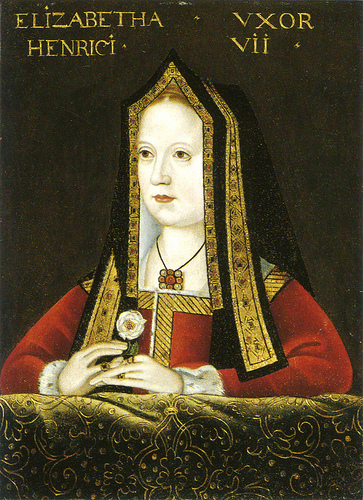
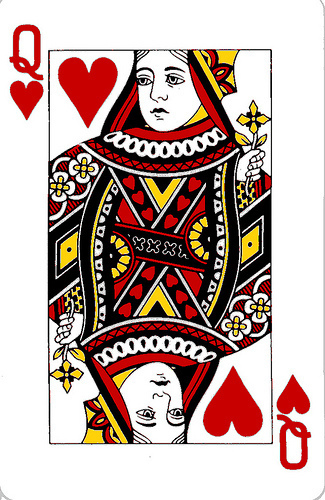
Elizabeth of York may have been the inspiration for the Queen of Hearts in the deck of playing cards
Alison Weir faces a challenge in writing Elizabeth’s biography. Like most women of the time, even high-ranking ones, Elizabeth had no political voice. She may have influenced events behind the scenes, but if so she did it quietly and discreetly. Her importance to the era’s events was largely limited to her ancestry and her ability to extend the Tudor dynasty through her children.
There are few surviving letters written by Elizabeth (though Weir does analyze one bombshell of a letter in detail that implies that Elizabeth gave serious consideration to marrying her despicable uncle Richard III). For the most part, her thoughts and feelings have to be inferred. So much of what Weir writes is conditional - Elizabeth might have, would have, could have - since the facts aren’t known with certainty. I respect Weir’s scholarship. She does not fill in historical blanks with speculation passed off as fact. Still, it can be frustrating to read, especially when there is the sense that we are on the edges of a more nuanced, personal story.
Weir’s style is exhaustive (and at times exhausting). She describes the clothing, down to the queenly undergarments or lack thereof, food, housing, account ledgers, the names of the ladies-in-waiting, and every work of art ever done of her subject.
In the midst of all this detail, though, a more human picture emerges. Elizabeth lost her father while young, throwing her life into uncertainty as murderous struggles for the crown raged around her. After her marriage, even with a more stable political situation, various pretenders claimed to be her lost brothers, motivating armed uprisings. Elizabeth lost several of her own young children. We can only guess how she felt during all this turmoil, but Weir’s picture is the most complete we are likely to have.
A copy of this book for review was provided by NetGalley/Random House.
Yet Elizabeth’s role in English history was pivotal even if she lacked a personality forceful enough to upstage her colorful family members. The Wars of the Roses had been raging on and off for thirty years between the houses of Lancaster (red rose) and York (white rose) when Henry Tudor took the throne in 1485 and became Henry VII. Henry had defeated the forces of Richard III, who died in the Battle of Bosworth Field, but his claim was relatively weak. Many thought Elizabeth, as the eldest surviving child of Edward IV, was the rightful heir. By marrying her, Henry conveniently took care of that objection (and prevented anyone else from marrying Elizabeth and claiming the throne through her). The houses of Lancaster and York were united at last.
Elizabeth of York may have been the inspiration for the Queen of Hearts in the deck of playing cards
Alison Weir faces a challenge in writing Elizabeth’s biography. Like most women of the time, even high-ranking ones, Elizabeth had no political voice. She may have influenced events behind the scenes, but if so she did it quietly and discreetly. Her importance to the era’s events was largely limited to her ancestry and her ability to extend the Tudor dynasty through her children.
There are few surviving letters written by Elizabeth (though Weir does analyze one bombshell of a letter in detail that implies that Elizabeth gave serious consideration to marrying her despicable uncle Richard III). For the most part, her thoughts and feelings have to be inferred. So much of what Weir writes is conditional - Elizabeth might have, would have, could have - since the facts aren’t known with certainty. I respect Weir’s scholarship. She does not fill in historical blanks with speculation passed off as fact. Still, it can be frustrating to read, especially when there is the sense that we are on the edges of a more nuanced, personal story.
Weir’s style is exhaustive (and at times exhausting). She describes the clothing, down to the queenly undergarments or lack thereof, food, housing, account ledgers, the names of the ladies-in-waiting, and every work of art ever done of her subject.
In the midst of all this detail, though, a more human picture emerges. Elizabeth lost her father while young, throwing her life into uncertainty as murderous struggles for the crown raged around her. After her marriage, even with a more stable political situation, various pretenders claimed to be her lost brothers, motivating armed uprisings. Elizabeth lost several of her own young children. We can only guess how she felt during all this turmoil, but Weir’s picture is the most complete we are likely to have.
A copy of this book for review was provided by NetGalley/Random House.

October 15, 2013
What did I think - not much I am sorry to say. Although Weir is not my favourite author, I am prepared to put aside my dislike to read - and objectively - what she has written - and for the record I have read a number of her books - most I have disliked, one however, I did like. This, I think I can add to the "did not like" pile.
Firstly, Elizabeth's younger years are quite shadowy but Weir manages to flesh these out by giving us a history lesson - really the first seven chapters read like a tome on the Wars of the Roses - and I have books a-plenty on this subject.
Secondly, again with very little information on her married life Weir instead references Elizabeth with the actions and events surrounding Henry Tudor, her husband. And sometimes this is all we ever have.
Thirdly, as with all her other factual accounts, we are bombarded with detail, presumption and very little substance.
I am trying very hard to fathom the amount of actual information there is on Elizabeth that was worthy of 600 odd pages - quite frankly it required barely a quarter in my opinion. The larger the book ... overcompensating for a distinct lack of anything else.
What I would have been more impressed with is a tome of quality rather than quantity.
Firstly, Elizabeth's younger years are quite shadowy but Weir manages to flesh these out by giving us a history lesson - really the first seven chapters read like a tome on the Wars of the Roses - and I have books a-plenty on this subject.
Secondly, again with very little information on her married life Weir instead references Elizabeth with the actions and events surrounding Henry Tudor, her husband. And sometimes this is all we ever have.
Thirdly, as with all her other factual accounts, we are bombarded with detail, presumption and very little substance.
I am trying very hard to fathom the amount of actual information there is on Elizabeth that was worthy of 600 odd pages - quite frankly it required barely a quarter in my opinion. The larger the book ... overcompensating for a distinct lack of anything else.
What I would have been more impressed with is a tome of quality rather than quantity.

March 8, 2013
It appears that as of late, there is a boost of interest in the reigns of Edward IV, Richard III, and Henry VII (which is certainly not a bad thing). This brings with it a curiosity in the lesser-discussed female figures of these times. One of these is Elizabeth of York. Alison Weir attempts to reveal some Henry VII’s Queen in, “Elizabeth of York: A Tudor Queen and Her World”.
The Subtitle to “Elizabeth of York” is truly fitting as Weir’s work is really about Elizabeth’s ‘world’ versus about Elizabeth, herself. Granted, not much information exists (no diaries, few letters, etc). As a result, Weir mostly describes the people and events surrounding Elizabeth instead of presenting a true biography revealing the inner psyche, as the book claims to do. Thus, what is formulated is a slow work with an emphasis on “would be”, “could have been”, “possibly”, and “maybe” phrases. “Elizabeth of York” is more speculative than Weir’s work on Mary Boleyn and is very frustrating.
“Elizabeth of York” doesn’t begin to quicken the pace until about 100 pages in. Elizabeth still feels like afterthought, but at least at this point Weir begins to describe some detective work and debunk a few myths. However, be cautious with her myth busting; as Weir’s descriptions aren’t 100% convincing or explored and takes on a sort of, “I believe it, so should you”, tone. At the same time, Weir displays less biases than usual in her work which makes “Elizabeth of York” more readable (unless you are a Ricardian because she is still anti-Richard).
Weir is also guilty of some inconsistencies and double-standards. For instance, Weir stated that a document written 20 years after an event took place is hardly credible but when another document written almost 20 years later suited her stance, she claimed that the writer’s memory could still be in tact. Hmmm…
Despite these issues with the content and format, “Elizabeth of York” flows well in terms of writing style and is a good introduction for those new to the topic but contain some debate points that a more-versed reader will be interested in (but again, these mostly concern the time period versus Elizabeth). In fact, although anything by any author of current day is debatable; Weir does make some very strong points which are well-argued and shed some light on areas in a way which readers may not have previously considered and thus resulting in ‘ah ha!’ moments.
It isn’t until approximately page 200 until Elizabeth receives more of a focus. Even then, it is more external with a look at her role and its effects (or lack thereof) instead of at her actual person. This information simply does not exist. Weir therefore supplements “Elizabeth of York” with many details of privy purse spending, household accounts, gifts received, etc. This causes the momentum to be lost and for the writing to feel stretched out. Although this is a regular trait of Weir’s writing; it isn’t as extensive as many of her other books and should thus please those who dislike details.
Towards the conclusion of “Elizabeth of York”, Weir annoyingly concludes sections with, “Elizabeth would not live to see this…” We get it! She will die soon! This is supposed to be a biography; stop with the odd foreshadowing! This is compounded by the weak ending in which Weir attempts to create a legend out of Elizabeth and show her impact but fails to do so because none of this was demonstrated throughout the hundreds of pages in the book.
On the other hand, the appendices are actually quite interesting (more so than much of the book), color plates are available (although they are at the end versus the middle and not on glossy paper), and a credible list of sources and notes are presented which strengthens the work.
Sadly, Elizabeth continues to be a mysterious figure whether due to a lack of sources or an absence of personal drama. Weir doesn’t bring her to life (hardly even mentions her in ratio to the number of pages) and “Elizabeth of York” suffers from over-speculation and tangents. I am a Weir fan of over a decade but “Elizabeth of York” is a feeble piece. The book is recommended for a Woodville/Edward IV/Henry VII refresher course but don’t expect much on Elizabeth. For those readers who are well-read on the topic: don’t rush for this one.
The Subtitle to “Elizabeth of York” is truly fitting as Weir’s work is really about Elizabeth’s ‘world’ versus about Elizabeth, herself. Granted, not much information exists (no diaries, few letters, etc). As a result, Weir mostly describes the people and events surrounding Elizabeth instead of presenting a true biography revealing the inner psyche, as the book claims to do. Thus, what is formulated is a slow work with an emphasis on “would be”, “could have been”, “possibly”, and “maybe” phrases. “Elizabeth of York” is more speculative than Weir’s work on Mary Boleyn and is very frustrating.
“Elizabeth of York” doesn’t begin to quicken the pace until about 100 pages in. Elizabeth still feels like afterthought, but at least at this point Weir begins to describe some detective work and debunk a few myths. However, be cautious with her myth busting; as Weir’s descriptions aren’t 100% convincing or explored and takes on a sort of, “I believe it, so should you”, tone. At the same time, Weir displays less biases than usual in her work which makes “Elizabeth of York” more readable (unless you are a Ricardian because she is still anti-Richard).
Weir is also guilty of some inconsistencies and double-standards. For instance, Weir stated that a document written 20 years after an event took place is hardly credible but when another document written almost 20 years later suited her stance, she claimed that the writer’s memory could still be in tact. Hmmm…
Despite these issues with the content and format, “Elizabeth of York” flows well in terms of writing style and is a good introduction for those new to the topic but contain some debate points that a more-versed reader will be interested in (but again, these mostly concern the time period versus Elizabeth). In fact, although anything by any author of current day is debatable; Weir does make some very strong points which are well-argued and shed some light on areas in a way which readers may not have previously considered and thus resulting in ‘ah ha!’ moments.
It isn’t until approximately page 200 until Elizabeth receives more of a focus. Even then, it is more external with a look at her role and its effects (or lack thereof) instead of at her actual person. This information simply does not exist. Weir therefore supplements “Elizabeth of York” with many details of privy purse spending, household accounts, gifts received, etc. This causes the momentum to be lost and for the writing to feel stretched out. Although this is a regular trait of Weir’s writing; it isn’t as extensive as many of her other books and should thus please those who dislike details.
Towards the conclusion of “Elizabeth of York”, Weir annoyingly concludes sections with, “Elizabeth would not live to see this…” We get it! She will die soon! This is supposed to be a biography; stop with the odd foreshadowing! This is compounded by the weak ending in which Weir attempts to create a legend out of Elizabeth and show her impact but fails to do so because none of this was demonstrated throughout the hundreds of pages in the book.
On the other hand, the appendices are actually quite interesting (more so than much of the book), color plates are available (although they are at the end versus the middle and not on glossy paper), and a credible list of sources and notes are presented which strengthens the work.
Sadly, Elizabeth continues to be a mysterious figure whether due to a lack of sources or an absence of personal drama. Weir doesn’t bring her to life (hardly even mentions her in ratio to the number of pages) and “Elizabeth of York” suffers from over-speculation and tangents. I am a Weir fan of over a decade but “Elizabeth of York” is a feeble piece. The book is recommended for a Woodville/Edward IV/Henry VII refresher course but don’t expect much on Elizabeth. For those readers who are well-read on the topic: don’t rush for this one.

January 6, 2022
She was the daughter of Edward IV, victor of the War of the Roses. She was sister to the young princes who vanished during their imprisonment in the Tower, and niece of Richard III, the man purported to have killed them. She was wife to Henry VII, the first Tudor king of Britain, and the mother of the much-married Henry VIII. She is a figure rarely granted attention in the later accounts of her age, which was medieval and monumental in the annuls of her country.
Alison Weir's Elizabeth of York is history as one regularly encounters it. Drawn from legal record, memoir, song, poetry, portraiture, inscription, and a wealth of household bookkeeping, it is a dry work reserved for those who take their pleasure in the details of this era. Much attention is paid to cloth and clothing, cuisine, architecture, and the customs surrounding marriage, childbirth, and funerals. The author immerses us in the day as this sovereign would have found it. She can only guess at emotion, belief, intent, and the forces at work in the dynastic tension of such a life - much as one is compelled to imagine in regard to the current Queen of England. (We're simply never going to know, no matter what the journalists tell us.)
A key element in a medieval library, or one devoted to the Tudors. This was obviously a labor to produce, and came off quite effectively.
Alison Weir's Elizabeth of York is history as one regularly encounters it. Drawn from legal record, memoir, song, poetry, portraiture, inscription, and a wealth of household bookkeeping, it is a dry work reserved for those who take their pleasure in the details of this era. Much attention is paid to cloth and clothing, cuisine, architecture, and the customs surrounding marriage, childbirth, and funerals. The author immerses us in the day as this sovereign would have found it. She can only guess at emotion, belief, intent, and the forces at work in the dynastic tension of such a life - much as one is compelled to imagine in regard to the current Queen of England. (We're simply never going to know, no matter what the journalists tell us.)
A key element in a medieval library, or one devoted to the Tudors. This was obviously a labor to produce, and came off quite effectively.

November 24, 2013
May or may not, that is the question...
At what stage does biography become pointless? I would suggest that the answer to that question is when the historical record doesn't provide enough information to allow for any real insight into or knowledge of the subject. And that, in a nutshell, is why I have abandoned this book at the halfway point.
Elizabeth of York probably had a fascinating life. She may have been in love with her husband, Henry VII. On the other hand, she may have been cruelly treated and suppressed by him. Or perhaps he loved her. Maybe she was seriously affected by the probable murders of her brothers. Or perhaps she was so ambitious for the throne that she tried to persuade Richard III, the probable murderer, to marry her. She may have conspired against Richard to bring Henry to the throne - a ballad written during Henry's reign suggests so, though that hardly seems like substantive evidence. Or perhaps she had nothing to do with it at all. She may have been influential on Henry in many ways following her marriage. Or she may have done little more than breed heirs. Interesting questions, and I was hoping for interesting answers - but there are none, as Weir freely and repeatedly asserts.
Weir has, I assume, done her best with the available material, but I'm afraid that still leaves Elizabeth as an unknown entity. In fact, I felt I knew her better from reading Thomas Penn's Winter King: Henry VII and the Dawn of Tudor England, than I do now after reading chapter after chapter of lightly supported and indecisive speculation. It's good that Weir has made clear the lack of information rather than making assertions about her own beliefs as if they were truths. Admirable - but makes for a dull and rather pointless read. And I'm afraid Weir's writing style is not sufficient to carry the book - she writes in a dry academic fashion that, for me at least, fails to bring the characters to life and makes even the most dramatic episodes into a tedious recounting of conflicting sources, including extensive quotes; much of which I felt could happily have been relegated to the notes at the back for the use of any serious historian. As a casual reader, I hope for the historian to plough through the sources on my behalf and then present me with a well argued and convincing hypothesis.
The final point where I decided that I couldn't take any more was when Weir suggested that Elizabeth 'may have been influential in the development of royal pageantry'. The 'evidence' for this is that she would have seen the Burgundian-influenced pageantry at the court of her father, Edward IV. It's that crucial word 'may', with its unspoken implication of 'or may not'. I could as easily say 'Elizabeth may have been one of the world's foremost acrobats' and bring just about the same amount of evidence to bear - i.e., she doubtless saw tumblers and fools at her father's court too. And I'm afraid 'may' is one of the words most used in the book. (338 times, according to the Kindle search facility.)
So in conclusion this book 'may' be of interest to some people - in fact, clearly it is since it is garnering positive reviews. But I'm afraid I'm not one of them. Perhaps at some point I'll try one of Weir's books about a later period in history where enough evidence exists for the word 'may' to be replaced by something a little more substantial. In the meantime, I will assume, based on the evidence of this book, that Elizabeth of York may have to remain an enigmatic figure about whom too little is known to allow for an interesting biography to be written.
NB This book was provided for review by the publisher, Random House.
At what stage does biography become pointless? I would suggest that the answer to that question is when the historical record doesn't provide enough information to allow for any real insight into or knowledge of the subject. And that, in a nutshell, is why I have abandoned this book at the halfway point.
Elizabeth of York probably had a fascinating life. She may have been in love with her husband, Henry VII. On the other hand, she may have been cruelly treated and suppressed by him. Or perhaps he loved her. Maybe she was seriously affected by the probable murders of her brothers. Or perhaps she was so ambitious for the throne that she tried to persuade Richard III, the probable murderer, to marry her. She may have conspired against Richard to bring Henry to the throne - a ballad written during Henry's reign suggests so, though that hardly seems like substantive evidence. Or perhaps she had nothing to do with it at all. She may have been influential on Henry in many ways following her marriage. Or she may have done little more than breed heirs. Interesting questions, and I was hoping for interesting answers - but there are none, as Weir freely and repeatedly asserts.
Weir has, I assume, done her best with the available material, but I'm afraid that still leaves Elizabeth as an unknown entity. In fact, I felt I knew her better from reading Thomas Penn's Winter King: Henry VII and the Dawn of Tudor England, than I do now after reading chapter after chapter of lightly supported and indecisive speculation. It's good that Weir has made clear the lack of information rather than making assertions about her own beliefs as if they were truths. Admirable - but makes for a dull and rather pointless read. And I'm afraid Weir's writing style is not sufficient to carry the book - she writes in a dry academic fashion that, for me at least, fails to bring the characters to life and makes even the most dramatic episodes into a tedious recounting of conflicting sources, including extensive quotes; much of which I felt could happily have been relegated to the notes at the back for the use of any serious historian. As a casual reader, I hope for the historian to plough through the sources on my behalf and then present me with a well argued and convincing hypothesis.
The final point where I decided that I couldn't take any more was when Weir suggested that Elizabeth 'may have been influential in the development of royal pageantry'. The 'evidence' for this is that she would have seen the Burgundian-influenced pageantry at the court of her father, Edward IV. It's that crucial word 'may', with its unspoken implication of 'or may not'. I could as easily say 'Elizabeth may have been one of the world's foremost acrobats' and bring just about the same amount of evidence to bear - i.e., she doubtless saw tumblers and fools at her father's court too. And I'm afraid 'may' is one of the words most used in the book. (338 times, according to the Kindle search facility.)
So in conclusion this book 'may' be of interest to some people - in fact, clearly it is since it is garnering positive reviews. But I'm afraid I'm not one of them. Perhaps at some point I'll try one of Weir's books about a later period in history where enough evidence exists for the word 'may' to be replaced by something a little more substantial. In the meantime, I will assume, based on the evidence of this book, that Elizabeth of York may have to remain an enigmatic figure about whom too little is known to allow for an interesting biography to be written.
NB This book was provided for review by the publisher, Random House.

July 27, 2025
Interesting topic to read about Elizabeth Of York but not a book that feelt very intruiging to read. Hard to explain. dDidn't enjoy reading it very much even if it had interesting things to say

March 7, 2013
There are times when I want to scream at an author Stop! Stop writing! Unfortunately, Alison Weir keeps churning out these Tudor biographies and novels, and this time she went too far even for me -- this was a biography that took its subject and sucked all the life and interest out of it, leaving behind bare trivia about account books, endless repetition of details, and more than six hundred pages of heavily padded material. I actually fell asleep during this one, and given my passion for Tudor history, that's a serious thing. Only thing worthwhile in this one is the insert of colour plates of all sorts of things associated with Henry VII and Elizabeth of York.
Just barely three stars here, and not recommended at all.
For the longer review, please go here:
http://www.epinions.com/review/elizab...
Just barely three stars here, and not recommended at all.
For the longer review, please go here:
http://www.epinions.com/review/elizab...

January 13, 2014
If you like conjecture, assumptions and unfounded generalizations, this is the book for you! When I heard that Alison Weir was writing a biography of Elizabeth of York, I was excited. At the same time, I wondered, How could anyone write a book about Elizabeth of York? So little is known about her. The answer is: by making stuff up.
Alison Weir has a definite perspective on the Wars of the Roses, and she doesn't let the facts or unknowns stand in the way of her opinions! By page 50, I was troubled by some of the biases revealed in this book, but I decided to give Weir a chance because I loved her biography of Eleanor of Aquitaine. By page 100 of Elizabeth of York, I was dismayed. I forced myself to finish this book to get credit for it on my Goodreads challenge.
This book is chock full of crazy, unfootnoted generalizations. For example:
+ "It is inconceivable that Richard, knowing that Elizabeth Wydeville had not hesitated to plot his overthrow, would have entrusted the princes to her care anyway, let alone in a house less than twenty miles from the coast, whence their escape to the continent could easily have been arranged, even if that house did belong to one of his trusted retainers." Inconceivable? Or unlikely?
Weir is rabidly anti-Richard III, going so far as to paste in a webmd.-type description of the effects of scoliosis: "Severe scoliosis... can also lead to serious emotional and behavioral problems, such as low self-esteem, mood swings, depression, difficulty in sleeping, poor sexual relationships and interpersonal skills." (125) That may be the case today, but was it the case then? I bet a lot of people had untreated scoliosis back then. Also, courtiers might overlook a disability in the king's brother.
Alison Weir's claim to fame is that she relies heavily on period sources for her research. And yet, when a person is writing about the middle ages, it seems as though it would be natural to take those sources with a grain of salt. The section on "The Song of Lady Bessy" makes me wonder if Alison Weir could get a passing grade on a DBQ in an AP history class in the US. Data-based Questions train students to weigh the value and limitations of different historical sources. Weir questions no source that furthers her pro-Tudor agenda. She writes, "A near contemporary metrical chronicle, 'The Song of Lady Bessy,' describes Elizabeth's involvement in the momentous events of 1485. Although the earliest surviving text dates from ca. 1600..." (143) Weir appears to take this text at face value, going so far as to say, "She is so pleased to see Brereton safely returned that she kisses him three times--a detail Brereton is unlikely to have included were it not true." Seriously? This is a medieval ballad! I wouldn't assume much of it was true at all.
If one takes "The Song of Lady Bessy" at face value, Elizabeth of York is a wily conniver like her mother. Nothing in the rest of Elizabeth's life makes it appear that this is so. It seems far more likely to me that she was caught between two powerful personalities: her mother Elizabeth Wydeville and Henry Tudor's mother, Margaret Beaufort. And yet, according to "the Song of Lady Bessy," she was incahoots with Lord Stanley for some time, hoping to bag Henry Tudor. If this is the case, she underwent quite a personality change after her marriage.
Speaking of Elizabeth's marriage:
"Thus Henry's motives in marrying Elizabeth seem to have been largely political. But there was more to it than that, on both sides. ...Stanley knew Elizabeth well, so his testimony is good evidence that her heart was involved as well as her ambitions; this being so, it is easier to understand her future relations with Henry. Loving him, she was all the more prepared to mold herself to what he wanted her to be...." What!? The only footnote in this paragraph is after Stanley's statement before Parliament. In other words, we know she loved Henry VII because his stepdad, who had much to gain from this union, said so?
Other exciting generalizations:
"Also, he was a faithful and loving husband to Elizabeth." (192) No footnote. No examples of why this might be thought to be so.
"And although there is evidence that, after years of faithful marriage, he was attracted to another lady, that was almost certainly as far as it went." (196) Almost certainly? Why? How would we know?
Weir mentions two reports home from Spanish ambassadors that indicate tensions between Elizabeth of York and her mother-in-law, Margaret Beaufort. Though independent sources describe Margaret's control of Henry VII and subjection of the queen. Weir writes, " Yet there is much evidence to show that the relationship between the two women was outwardly one of companionship and cooperation..." This argument would be more compelling had Weir bothered to provide any evidence to support her claims. Instead, she tells us, "Apart from these isolated observations, all the signs show that Elizabeth and Margaret Beaufort were close." (208) Oh, ok. If you say so.
Page 213 contains an embarrassing factual error. Elizabeth's cousin Cecily Neville is the daughter of Richard Neville, Earl of Salisbury, not Ralph. Ralph was her grandfather, and he was the Earl of Westmorland. This odd error causes the reader to wonder if Weir knows what she is talking about.
This book is so pro-Tudor, I found myself wondering: Is Alison Weir descended from Henry VII? How did she become his apologist?
"In decking out Katherine so lavishly, Henry no doubt wished to impress her kinsman James IV, who had just then become betrothed to Margaret Tudor -- and maybe it pleased him to adorn her beauty too, or even to fantasize about the body he was so bountifully decking out. If Elizabeth had any cause for disquiet over her husband's interest in Lady Katherine, there is no record of it, and later evidence suggests that husband and wife remained close. That Henry showed warm personal friendship toward Katherine is corroborated by speculation after Elizabeth's death that they would marry." (336) Would Elizabeth be so stupid as to make her feelings about the King's relationship with Katherine Huntly public? That doesn't mean she didn't mind. The fact that the king considered marrying Katherine Huntly after the queen's death is evidence that he had friendly feelings for her?
Weir cannot contain her prejudices and opinions when it comes to the story of the Princes of the Tower, Elizabeth's little brothers. At one point, she states that the best evidence that the princes died in the tower are the two small skeletons that were found under a staircase 200 years later. No other historical source I have read finds that those skeletons provide any sort of conclusive evidence about the princes deaths. And yet, Weir concludes, "Not a stone's throw away from the chapel where Elizabeth reposed in state lay buried the chest in which the bones that almost certainly belonged to her lost brothers were rotting away." (429)
In general:
"It is also clear that, far from being in subjection to Henry VII and Margaret Beaufort, she enjoyed a generally happy relationship with both of them..." (445) Is it? Weir reveals no facts to support this claim.
In the end, Weir dumps one final awesome piece of conjecture: "...It has been suggested that [Elizabeth of York's sister Bridget] had a bastard daughter... It is possible that Agnes was an orphan whose wardship was administered by Dartford Priory, but until Elizabeth of York's death... she was maintained by the crown. ...It is not inconceivable that the teenage Bridget, pushed into the convent at the age of 7, and perhaps not very bright anyway, had no vocation for the religious life and embarked on an affair that resulted in a child..." (451) Suddenly, the queen's youngest sister is a simpleton/slut. Conversely, Elizabeth's fascinating daughter, Margaret Tudor, warrants a scant paragraph.
I'm a little sorry to have to give this book even one star.
Alison Weir has a definite perspective on the Wars of the Roses, and she doesn't let the facts or unknowns stand in the way of her opinions! By page 50, I was troubled by some of the biases revealed in this book, but I decided to give Weir a chance because I loved her biography of Eleanor of Aquitaine. By page 100 of Elizabeth of York, I was dismayed. I forced myself to finish this book to get credit for it on my Goodreads challenge.
This book is chock full of crazy, unfootnoted generalizations. For example:
+ "It is inconceivable that Richard, knowing that Elizabeth Wydeville had not hesitated to plot his overthrow, would have entrusted the princes to her care anyway, let alone in a house less than twenty miles from the coast, whence their escape to the continent could easily have been arranged, even if that house did belong to one of his trusted retainers." Inconceivable? Or unlikely?
Weir is rabidly anti-Richard III, going so far as to paste in a webmd.-type description of the effects of scoliosis: "Severe scoliosis... can also lead to serious emotional and behavioral problems, such as low self-esteem, mood swings, depression, difficulty in sleeping, poor sexual relationships and interpersonal skills." (125) That may be the case today, but was it the case then? I bet a lot of people had untreated scoliosis back then. Also, courtiers might overlook a disability in the king's brother.
Alison Weir's claim to fame is that she relies heavily on period sources for her research. And yet, when a person is writing about the middle ages, it seems as though it would be natural to take those sources with a grain of salt. The section on "The Song of Lady Bessy" makes me wonder if Alison Weir could get a passing grade on a DBQ in an AP history class in the US. Data-based Questions train students to weigh the value and limitations of different historical sources. Weir questions no source that furthers her pro-Tudor agenda. She writes, "A near contemporary metrical chronicle, 'The Song of Lady Bessy,' describes Elizabeth's involvement in the momentous events of 1485. Although the earliest surviving text dates from ca. 1600..." (143) Weir appears to take this text at face value, going so far as to say, "She is so pleased to see Brereton safely returned that she kisses him three times--a detail Brereton is unlikely to have included were it not true." Seriously? This is a medieval ballad! I wouldn't assume much of it was true at all.
If one takes "The Song of Lady Bessy" at face value, Elizabeth of York is a wily conniver like her mother. Nothing in the rest of Elizabeth's life makes it appear that this is so. It seems far more likely to me that she was caught between two powerful personalities: her mother Elizabeth Wydeville and Henry Tudor's mother, Margaret Beaufort. And yet, according to "the Song of Lady Bessy," she was incahoots with Lord Stanley for some time, hoping to bag Henry Tudor. If this is the case, she underwent quite a personality change after her marriage.
Speaking of Elizabeth's marriage:
"Thus Henry's motives in marrying Elizabeth seem to have been largely political. But there was more to it than that, on both sides. ...Stanley knew Elizabeth well, so his testimony is good evidence that her heart was involved as well as her ambitions; this being so, it is easier to understand her future relations with Henry. Loving him, she was all the more prepared to mold herself to what he wanted her to be...." What!? The only footnote in this paragraph is after Stanley's statement before Parliament. In other words, we know she loved Henry VII because his stepdad, who had much to gain from this union, said so?
Other exciting generalizations:
"Also, he was a faithful and loving husband to Elizabeth." (192) No footnote. No examples of why this might be thought to be so.
"And although there is evidence that, after years of faithful marriage, he was attracted to another lady, that was almost certainly as far as it went." (196) Almost certainly? Why? How would we know?
Weir mentions two reports home from Spanish ambassadors that indicate tensions between Elizabeth of York and her mother-in-law, Margaret Beaufort. Though independent sources describe Margaret's control of Henry VII and subjection of the queen. Weir writes, " Yet there is much evidence to show that the relationship between the two women was outwardly one of companionship and cooperation..." This argument would be more compelling had Weir bothered to provide any evidence to support her claims. Instead, she tells us, "Apart from these isolated observations, all the signs show that Elizabeth and Margaret Beaufort were close." (208) Oh, ok. If you say so.
Page 213 contains an embarrassing factual error. Elizabeth's cousin Cecily Neville is the daughter of Richard Neville, Earl of Salisbury, not Ralph. Ralph was her grandfather, and he was the Earl of Westmorland. This odd error causes the reader to wonder if Weir knows what she is talking about.
This book is so pro-Tudor, I found myself wondering: Is Alison Weir descended from Henry VII? How did she become his apologist?
"In decking out Katherine so lavishly, Henry no doubt wished to impress her kinsman James IV, who had just then become betrothed to Margaret Tudor -- and maybe it pleased him to adorn her beauty too, or even to fantasize about the body he was so bountifully decking out. If Elizabeth had any cause for disquiet over her husband's interest in Lady Katherine, there is no record of it, and later evidence suggests that husband and wife remained close. That Henry showed warm personal friendship toward Katherine is corroborated by speculation after Elizabeth's death that they would marry." (336) Would Elizabeth be so stupid as to make her feelings about the King's relationship with Katherine Huntly public? That doesn't mean she didn't mind. The fact that the king considered marrying Katherine Huntly after the queen's death is evidence that he had friendly feelings for her?
Weir cannot contain her prejudices and opinions when it comes to the story of the Princes of the Tower, Elizabeth's little brothers. At one point, she states that the best evidence that the princes died in the tower are the two small skeletons that were found under a staircase 200 years later. No other historical source I have read finds that those skeletons provide any sort of conclusive evidence about the princes deaths. And yet, Weir concludes, "Not a stone's throw away from the chapel where Elizabeth reposed in state lay buried the chest in which the bones that almost certainly belonged to her lost brothers were rotting away." (429)
In general:
"It is also clear that, far from being in subjection to Henry VII and Margaret Beaufort, she enjoyed a generally happy relationship with both of them..." (445) Is it? Weir reveals no facts to support this claim.
In the end, Weir dumps one final awesome piece of conjecture: "...It has been suggested that [Elizabeth of York's sister Bridget] had a bastard daughter... It is possible that Agnes was an orphan whose wardship was administered by Dartford Priory, but until Elizabeth of York's death... she was maintained by the crown. ...It is not inconceivable that the teenage Bridget, pushed into the convent at the age of 7, and perhaps not very bright anyway, had no vocation for the religious life and embarked on an affair that resulted in a child..." (451) Suddenly, the queen's youngest sister is a simpleton/slut. Conversely, Elizabeth's fascinating daughter, Margaret Tudor, warrants a scant paragraph.
I'm a little sorry to have to give this book even one star.

January 13, 2014
Elizabeth of York was the first Tudor Queen and the dullest. But she had been a very different princess. As Alison Weir reminds us, her young life was filled with scandal and violence.
When Elizabeth was born England was being torn apart by a family quarrel that became known as the Wars of the Roses. Weir claims contemporaries called it the ‘Cousins War’, which certainly describes what was happening, namely a power struggle between the royal cousins of the ‘red rose’ House Lancaster and the rival white rose House of York.
In 1470, when Elizabeth was four, her father, the ‘white king’ Edward IV, was overthrown and she had to go into hiding with her mother and siblings. It was her first direct experience of the horror of being caught up in the royal vendettas. Only a few months later, after Edward IV had won a key victory, the Lancastrian king, Henry VI, was found dead in the Tower, where he was being held prisoner. It left only a boy of bastard Lancastrian descent, Henry Tudor, to represent the enemy cause.
As the fourteen-year old Henry fled into exile, the House of York looked secure. But when Elizabeth’s father caught a cold and died in 1483, the family of the white rose turned on each other. Her uncle Richard, Duke of Gloucester, overthrew her brothers, aged twelve and nine, imprisoned them, and seized the throne as Richard III.
Weir has no doubt that Richard then murdered the so-called ‘princes in the Tower’. More controversially she also believes Richard later killed his sickly wife, hoping to marry the now beautiful, eighteen year old, Elizabeth of York. This makes it all the more shocking when Weir suggests that Elizabeth was encouraging her homicidal uncle, writing that she longed to be his.
Weir defends Elizabeth’s actions, observing that becoming Richard’s wife was the best way she could help her sisters, and ensure they were well married. It’s a bold argument and Weir has other dramatic claims to make. According to Weir, when Richard was forced to drop his plan to marry Elizabeth in the face of public disapproval, he sent her to live in the household of Henry Tudor’s stepfather, Lord Stanley. There, Elizabeth now encouraged Stanley to back Henry in overthrowing Richard, hoping that when Henry became King she could marry him instead.
This is lively stuff. But would Richard really have given Elizabeth so easy an opportunity to plot Henry Tudor’s victory with his stepfather? Weir’s evidence is slight - a Tudor era ballad. Elsewhere her arguments are undermined by what Ben Goldacre’s Bad Science has termed ‘referenciness’. Her footnotes are so vague as to be almost useless. Sometimes she offers no supporting evidence at all. We are never told where contemporaries wrote of a ‘cousins war’ - supposedly the basis for re-naming an entire era. Modern readers, who argue over controversial ‘facts’ on Tudor websites, expect more.
There is also, however, much to admire in Weir’s biography. After Richard is killed, Elizabeth marries the victorious Henry, and a strong picture of the first Tudor Queen emerges. Elizabeth left few words of her own to give us any sense of what she thought or felt. The information about her comes largely from descriptions of royal occasions and from household accounts. Yet her love for her family comes across powerfully.
Through a difficult – if ultimately successful – marriage Elizabeth worked hard to protect her sisters and York cousins from her ever-suspicious Tudor husband, while also being a loyal and loving wife. It is in Elizabeth’s love of family that Weir reconciles the plotting princess who emerges from the ‘Cousins War’ with the seemingly placid peacemaker who bore the first children of the Tudor dynasty.
Elizabeth may not have been the most exciting Tudor Queen, but as Weir’s detailed account makes clear, for England dullness was the key to her success. After decades of war and insecurity the English loved Elizabeth of York for her generosity, humility and for providing the stable foundations of a new royal era.
An edited version of this review was published in the Mail on Sunday Nov 2013
When Elizabeth was born England was being torn apart by a family quarrel that became known as the Wars of the Roses. Weir claims contemporaries called it the ‘Cousins War’, which certainly describes what was happening, namely a power struggle between the royal cousins of the ‘red rose’ House Lancaster and the rival white rose House of York.
In 1470, when Elizabeth was four, her father, the ‘white king’ Edward IV, was overthrown and she had to go into hiding with her mother and siblings. It was her first direct experience of the horror of being caught up in the royal vendettas. Only a few months later, after Edward IV had won a key victory, the Lancastrian king, Henry VI, was found dead in the Tower, where he was being held prisoner. It left only a boy of bastard Lancastrian descent, Henry Tudor, to represent the enemy cause.
As the fourteen-year old Henry fled into exile, the House of York looked secure. But when Elizabeth’s father caught a cold and died in 1483, the family of the white rose turned on each other. Her uncle Richard, Duke of Gloucester, overthrew her brothers, aged twelve and nine, imprisoned them, and seized the throne as Richard III.
Weir has no doubt that Richard then murdered the so-called ‘princes in the Tower’. More controversially she also believes Richard later killed his sickly wife, hoping to marry the now beautiful, eighteen year old, Elizabeth of York. This makes it all the more shocking when Weir suggests that Elizabeth was encouraging her homicidal uncle, writing that she longed to be his.
Weir defends Elizabeth’s actions, observing that becoming Richard’s wife was the best way she could help her sisters, and ensure they were well married. It’s a bold argument and Weir has other dramatic claims to make. According to Weir, when Richard was forced to drop his plan to marry Elizabeth in the face of public disapproval, he sent her to live in the household of Henry Tudor’s stepfather, Lord Stanley. There, Elizabeth now encouraged Stanley to back Henry in overthrowing Richard, hoping that when Henry became King she could marry him instead.
This is lively stuff. But would Richard really have given Elizabeth so easy an opportunity to plot Henry Tudor’s victory with his stepfather? Weir’s evidence is slight - a Tudor era ballad. Elsewhere her arguments are undermined by what Ben Goldacre’s Bad Science has termed ‘referenciness’. Her footnotes are so vague as to be almost useless. Sometimes she offers no supporting evidence at all. We are never told where contemporaries wrote of a ‘cousins war’ - supposedly the basis for re-naming an entire era. Modern readers, who argue over controversial ‘facts’ on Tudor websites, expect more.
There is also, however, much to admire in Weir’s biography. After Richard is killed, Elizabeth marries the victorious Henry, and a strong picture of the first Tudor Queen emerges. Elizabeth left few words of her own to give us any sense of what she thought or felt. The information about her comes largely from descriptions of royal occasions and from household accounts. Yet her love for her family comes across powerfully.
Through a difficult – if ultimately successful – marriage Elizabeth worked hard to protect her sisters and York cousins from her ever-suspicious Tudor husband, while also being a loyal and loving wife. It is in Elizabeth’s love of family that Weir reconciles the plotting princess who emerges from the ‘Cousins War’ with the seemingly placid peacemaker who bore the first children of the Tudor dynasty.
Elizabeth may not have been the most exciting Tudor Queen, but as Weir’s detailed account makes clear, for England dullness was the key to her success. After decades of war and insecurity the English loved Elizabeth of York for her generosity, humility and for providing the stable foundations of a new royal era.
An edited version of this review was published in the Mail on Sunday Nov 2013

Read
January 8, 2014I didn't rate this one because it's one of those books that will thrill some and bore others. Tudor junkies or those writing HF in this period, will find lots of great information about expenses, dress, architecture, who was where when, etc. For the casual reader who wants some insight into Elizabeth of York, the woman, it's a long slog to get the occasional nugget/insight hidden by all the detail. I found it tedious and basically skimmed the chapters of accounts and guest lists attending the constant pageants and ceremonies. I reviewed an ARC provided by the publisher which means the parts that would put this one on my research shelf-- illustrations, maps, index, etc.--were missing, so this one will be passed on.

October 15, 2023
Alison Weir has written some wonderful historical fiction books. This is the first time I've read a pure history book written by her and I'm glad I did. Her topic is the tragically underrated Elizabeth of York. This remarkable woman, the epitome of the High Medieval Queen, had a fascinating life.
Elizabeth of York was the daughter of Queen Elizabeth Wydeville (often written as Woodville) and King Edward IV of House York. To quote:
"Elizabeth of York was important. She was a daughter, sister, niece, wife, mother, and grandmother of monarchs: daughter to King Edward IV, sister to Edward V, niece to Richard III, wife to Henry VII, mother to Henry VIII, and grandmother to Edward VI, Mary I, and Elizabeth i, and she was the mother of two queen consorts. She was also the ancestress to every English monarch since 1509, every Scots monarch since 1513, and every British monarch since 1603, including the present queen, Elizabeth II....."
This remarkable life brought her in contact with some of the most powerful and ruthless people of that time- Edward IV, Richard III, and Henry VII are just some of the major players in her life. From navigating tragedy and the heights of success, from being singularly intelligent, classy, regal, and also kind and pious.
Weir's excellent history covers the entire scope of Elizabeth's life. She does it in superb detail, yet is always a pleasure to read. I enjoyed that Weir made excellent and logical, arguments about why Richard III was most likely to have killed the Twins and used historical records and logic to show why. Many of the other myths that were common to the era before the Tudors solidified their power are also covered and shown to be mere gossip.
Well-written, detailed, yet engaging this history of Elizabeth is a must for anyone interested in the House of York and the Tudors. Highly Recommended.
Elizabeth of York was the daughter of Queen Elizabeth Wydeville (often written as Woodville) and King Edward IV of House York. To quote:
"Elizabeth of York was important. She was a daughter, sister, niece, wife, mother, and grandmother of monarchs: daughter to King Edward IV, sister to Edward V, niece to Richard III, wife to Henry VII, mother to Henry VIII, and grandmother to Edward VI, Mary I, and Elizabeth i, and she was the mother of two queen consorts. She was also the ancestress to every English monarch since 1509, every Scots monarch since 1513, and every British monarch since 1603, including the present queen, Elizabeth II....."
This remarkable life brought her in contact with some of the most powerful and ruthless people of that time- Edward IV, Richard III, and Henry VII are just some of the major players in her life. From navigating tragedy and the heights of success, from being singularly intelligent, classy, regal, and also kind and pious.
Weir's excellent history covers the entire scope of Elizabeth's life. She does it in superb detail, yet is always a pleasure to read. I enjoyed that Weir made excellent and logical, arguments about why Richard III was most likely to have killed the Twins and used historical records and logic to show why. Many of the other myths that were common to the era before the Tudors solidified their power are also covered and shown to be mere gossip.
Well-written, detailed, yet engaging this history of Elizabeth is a must for anyone interested in the House of York and the Tudors. Highly Recommended.

October 8, 2013
Alison Weir is one of my favorite authors in the historical fiction genre because she is also an historian who finds the right mix of accuracy and intrigue. There's been a trend in historical fiction lately to make interesting figures of the past considerably more controversial than they are, and I love that Alison Weir resists. So I was thrilled to receive an advance review copy of Elizabeth of York: A Tudor Queen and Her World from NetGalley in exchange for a fair and honest review.
This book does not disappoint. Elizabeth of York was right where the action was during the golden era of the Plantagenets and the rise of the Tudors. Weir fleshes her out as best she can, given the low level of attention early historians paid to the woman herself. Elizabeth was more commonly portrayed as a pawn than a queen heretofore, and I was very pleased to enjoy a richly researched and thorough account of her instead of the powerful men who were her father, uncles, husband, and son.
I'm a history wonk. The huge level of detail into family trees, longstanding feuds among the noble families of the period, dress, diet, architecture, and politics are hugely satisfying to me. I devoured this ARC. While I recommend it very highly, it's a qualified recommendation for my history-loving friends. There isn't going to be the flashy bodice-ripping content of a Philippa Gregory book to satisfy my historical romance fan friends, and there is so much historical detail that it's not the book for my friends who prefer escapist reading. But it's mother's milk to a Tudor junkie like myself and I plan to buy this as a Christmas present for several of my historical fiction book club friends.
This book does not disappoint. Elizabeth of York was right where the action was during the golden era of the Plantagenets and the rise of the Tudors. Weir fleshes her out as best she can, given the low level of attention early historians paid to the woman herself. Elizabeth was more commonly portrayed as a pawn than a queen heretofore, and I was very pleased to enjoy a richly researched and thorough account of her instead of the powerful men who were her father, uncles, husband, and son.
I'm a history wonk. The huge level of detail into family trees, longstanding feuds among the noble families of the period, dress, diet, architecture, and politics are hugely satisfying to me. I devoured this ARC. While I recommend it very highly, it's a qualified recommendation for my history-loving friends. There isn't going to be the flashy bodice-ripping content of a Philippa Gregory book to satisfy my historical romance fan friends, and there is so much historical detail that it's not the book for my friends who prefer escapist reading. But it's mother's milk to a Tudor junkie like myself and I plan to buy this as a Christmas present for several of my historical fiction book club friends.

August 19, 2020
Should be titled Living in the Royal Court from 1466 to 1503. Too many tangents, I almost forgot the titular person. Yeah I did not learn much about Elizabeth except that the period when she lived was tumultuous, female royals were marginalized to a ridiculous degree, her privy purses expenses were meticulously recorded, and that no royals were safe from deaths, diseases, civil wars, pretenders, assassinations, bad hygiene with fatal endings, child marriages, endless marriage negotiations, debts, and many, many more. Well, I guess she did deserve a credit for not breaking down into madness. Wonder what she'd say about the current royal family.
All in all, I enjoyed Alison Weir's The Life of Elizabeth I much, much better. Here there were too much fluff and fewer useful content.
And we'll never be royals
It don't run in our blood
That kind of lux just ain't for us
We crave a different kind of buzz....
All in all, I enjoyed Alison Weir's The Life of Elizabeth I much, much better. Here there were too much fluff and fewer useful content.
And we'll never be royals
It don't run in our blood
That kind of lux just ain't for us
We crave a different kind of buzz....

June 10, 2015
The Most Boring Tudor Queen
“Elizabeth is...overshadowed by her successors, the wives of Henry VIII” writes Alison Weir. And you know what? After reading this book you understand that it happened for a reason. While it is tempting to assume that Elizabeth of York was somehow unjustly pushed to the background of history in favour of her son’s marriage life or the glorious rule of her granddaughter and namesake, in reality this became possible because of Elizabeth of York herself, not because of some intentional evil design.
Thanks to reading Weir’s work one can surely learn that you can be a daughter, sister, niece, wife, mother and grandmother of the English monarchs, live through The War of The Roses period – and be extremely dull at the same time. Out of the pages emerges a portrait of conventional woman of her time, a perfect medieval template of a womanhood: quite, obedient, pious, fruitful, dutiful.Nothing wrong with that,per se . But because of such templating, the subject of the study often comes off in this book as sort of colorless or better to say insipid. One-dimensional stereotype, rather than a full-blooded personality. Something you can not possibly say about wives of Henry VIII (Catherine of Aragorn, Anne Boleyn, Catherine Howard, Catherine Parr anyone?) or Elizabeth I. Or Mary I. Or Mary, Queen of Scots. But even if you look closer to home, meaning to contemporaries of Elizabeth of York, you will surely find more exciting and far less conventional women: her own mother Elizabeth Woodville, her mother-in-law Margaret Beaufort, the enemy of her father Margaret of Anjou, Queen to Henry VI. Those women were active in politics, they were bold, they schemed, one of them even led armies. So all in all, they were all more interesting and formidable than Elizabeth of York and had a more prominent role in history.That’s why they overshadow Elizabeth of York.
And that’s one of the major problems with this non-fiction work, there is a lot to say who Elizabeth of York wasn't, but little to say who she was as a person. It turned out there is simply not enough facts and information on Elizabeth herself. Her opinions, thoughts, feelings about those more fascinating family members of hers or events around her are unknown, she never did herself anything outstanding or exciting (by anything I mean things which are supported by real facts, not Weir’s speculations or imagination of the readers), events were happening around her, but not because of her own actions. So what to do with such subject for a biography? Well, speculate, speculate and speculate.
That’s another major problem with this book, the endless, unstoppable speculations with a chorus of “might have been”, “probably”, “maybe”. While in fiction there is plenty of room for speculating and imagining some things, this is non-fiction and it is really strange to write a proper non-fictional biography almost totally built on “could have been” stuff. By bloating the book almost into 600 pages it seems Alison Weir tried to use everything and the kitchen sink (sometimes almost literally) to present us with a very thorough research on Elizabeth of York. What we got instead was a very detailed research of “Her World”, rather of who she was as person. Yes, of course it is unfair to criticize the author, if historical lady herself was rather obscure and not a vivid personality, but then why spend so many pages on biography that could have been half the size of this one? The long expenditure lists, household accounts, description of ceremonies and pageantries may have its appeal on a certain day, especially if you like such details and want to find out more about the time period. But even I, who actually like details when they are presented in proper balance with information on historical figures, stopped caring really fast when it became apparent that they were merely fillers to beef up the book and Weir didn’t have any indepth information on the Elizabeth herself. It just became very boring and very tedious, descending into a full time snooze fest.
Not to mention it seems rather lazy that Weir clearly rehashed some of her previous books on the Wars of The Roses and Princes in the Tower in this one. If you want a great example of historical details AND interesting historical figures combined in one non-fictional book, then Weir has a marvelous, balanced book like this, " Henry VIII: The King and His Court". This book on Elizabeth of York doesn't even come close to it.
Still, Alison Weir made several attempts to make Elizabeth really important, more important than she was in fact. Unfortunately, those attempts mostly fell flat and essentially thanks to Weir herself. She tried to show that Elizabeth as Queen was sometimes influential but it came as far-fetched hypotheses, based mostly on Weir's own presumptions. Apart from being some sort of royal vessel of Plantagenet genes which she passed on through her children, Weir fails to paint any real political significance of Elizabeth (significance of her own actions or decisions, not just of her general status as heiress of House of York). Weir at some points teases the readers with some sort of romantic or even angel-like portrait of Elizabeth, but then she puts out a theory that Elizabeth, before that, might have agreed to marry her own uncle, Richard III, for the sake of a crown, and since by Weir's own presentation in the book Richard III is a wicked murderer of her brothers it casts an unscrupulous image. Then Weir becomes enamored with some sort of weird foreshadowing , returning time and again to things which would happen but which Elizabeth would never live to see herself. Thus she creates the sense of futility of many Elizabeth's aspirations (and she had so few of them) and depreciates all that impact she tried to build for Elizabeth. Elizabeth was pious and devoted to religion? Well, her beloved son Henry VIII would break away from Rome and there would be dissolution of the monasteries, as well as religious uprisings and conflicts thanks to that. Elizabeth loved her relatives? Her son Henry VIII would get rid of many of those. Elizabeth provided heirs to the throne? Well, since Weir decided to go full speed into Henry VIII and his six wives (really, no, really?), the reader is reminded that despite of Henry VIII's antics to get himself a male heir, the Tudor dynasty would end on Elizabeth I as a last Tudor monarch. And so on, and so forth.
I hope that with her next non-fiction book Weir would do better.
“Elizabeth is...overshadowed by her successors, the wives of Henry VIII” writes Alison Weir. And you know what? After reading this book you understand that it happened for a reason. While it is tempting to assume that Elizabeth of York was somehow unjustly pushed to the background of history in favour of her son’s marriage life or the glorious rule of her granddaughter and namesake, in reality this became possible because of Elizabeth of York herself, not because of some intentional evil design.
Thanks to reading Weir’s work one can surely learn that you can be a daughter, sister, niece, wife, mother and grandmother of the English monarchs, live through The War of The Roses period – and be extremely dull at the same time. Out of the pages emerges a portrait of conventional woman of her time, a perfect medieval template of a womanhood: quite, obedient, pious, fruitful, dutiful.Nothing wrong with that,per se . But because of such templating, the subject of the study often comes off in this book as sort of colorless or better to say insipid. One-dimensional stereotype, rather than a full-blooded personality. Something you can not possibly say about wives of Henry VIII (Catherine of Aragorn, Anne Boleyn, Catherine Howard, Catherine Parr anyone?) or Elizabeth I. Or Mary I. Or Mary, Queen of Scots. But even if you look closer to home, meaning to contemporaries of Elizabeth of York, you will surely find more exciting and far less conventional women: her own mother Elizabeth Woodville, her mother-in-law Margaret Beaufort, the enemy of her father Margaret of Anjou, Queen to Henry VI. Those women were active in politics, they were bold, they schemed, one of them even led armies. So all in all, they were all more interesting and formidable than Elizabeth of York and had a more prominent role in history.That’s why they overshadow Elizabeth of York.
And that’s one of the major problems with this non-fiction work, there is a lot to say who Elizabeth of York wasn't, but little to say who she was as a person. It turned out there is simply not enough facts and information on Elizabeth herself. Her opinions, thoughts, feelings about those more fascinating family members of hers or events around her are unknown, she never did herself anything outstanding or exciting (by anything I mean things which are supported by real facts, not Weir’s speculations or imagination of the readers), events were happening around her, but not because of her own actions. So what to do with such subject for a biography? Well, speculate, speculate and speculate.
That’s another major problem with this book, the endless, unstoppable speculations with a chorus of “might have been”, “probably”, “maybe”. While in fiction there is plenty of room for speculating and imagining some things, this is non-fiction and it is really strange to write a proper non-fictional biography almost totally built on “could have been” stuff. By bloating the book almost into 600 pages it seems Alison Weir tried to use everything and the kitchen sink (sometimes almost literally) to present us with a very thorough research on Elizabeth of York. What we got instead was a very detailed research of “Her World”, rather of who she was as person. Yes, of course it is unfair to criticize the author, if historical lady herself was rather obscure and not a vivid personality, but then why spend so many pages on biography that could have been half the size of this one? The long expenditure lists, household accounts, description of ceremonies and pageantries may have its appeal on a certain day, especially if you like such details and want to find out more about the time period. But even I, who actually like details when they are presented in proper balance with information on historical figures, stopped caring really fast when it became apparent that they were merely fillers to beef up the book and Weir didn’t have any indepth information on the Elizabeth herself. It just became very boring and very tedious, descending into a full time snooze fest.
Not to mention it seems rather lazy that Weir clearly rehashed some of her previous books on the Wars of The Roses and Princes in the Tower in this one. If you want a great example of historical details AND interesting historical figures combined in one non-fictional book, then Weir has a marvelous, balanced book like this, " Henry VIII: The King and His Court". This book on Elizabeth of York doesn't even come close to it.
Still, Alison Weir made several attempts to make Elizabeth really important, more important than she was in fact. Unfortunately, those attempts mostly fell flat and essentially thanks to Weir herself. She tried to show that Elizabeth as Queen was sometimes influential but it came as far-fetched hypotheses, based mostly on Weir's own presumptions. Apart from being some sort of royal vessel of Plantagenet genes which she passed on through her children, Weir fails to paint any real political significance of Elizabeth (significance of her own actions or decisions, not just of her general status as heiress of House of York). Weir at some points teases the readers with some sort of romantic or even angel-like portrait of Elizabeth, but then she puts out a theory that Elizabeth, before that, might have agreed to marry her own uncle, Richard III, for the sake of a crown, and since by Weir's own presentation in the book Richard III is a wicked murderer of her brothers it casts an unscrupulous image. Then Weir becomes enamored with some sort of weird foreshadowing , returning time and again to things which would happen but which Elizabeth would never live to see herself. Thus she creates the sense of futility of many Elizabeth's aspirations (and she had so few of them) and depreciates all that impact she tried to build for Elizabeth. Elizabeth was pious and devoted to religion? Well, her beloved son Henry VIII would break away from Rome and there would be dissolution of the monasteries, as well as religious uprisings and conflicts thanks to that. Elizabeth loved her relatives? Her son Henry VIII would get rid of many of those. Elizabeth provided heirs to the throne? Well, since Weir decided to go full speed into Henry VIII and his six wives (really, no, really?), the reader is reminded that despite of Henry VIII's antics to get himself a male heir, the Tudor dynasty would end on Elizabeth I as a last Tudor monarch. And so on, and so forth.
I hope that with her next non-fiction book Weir would do better.

March 3, 2015
This should have been called speculative fiction. Almost everything is based on "this is hypothetical" or "this is speculative" or "maybe this happened" or "one can imagine that." It appears that Weir has a desire to adulate Elizabeth of York, so we keep hearing over and over and over again how wonderful she is - but there's nothing there to support this except Weir's own statements about how wonderful she is (and occasional comments made by lackeys of Henry VII). I have nothing against Elizabeth of York - in fact, I read this book because I know so little about her and wanted to learn about her. Instead, I came away with the picture of a young woman who was willing to marry anyone who would make her a queen, and who then had many babies. That's about it. Weir keeps saying that she really had influence on politics and such, but she doesn't give any evidence for this beyond her own supposition.
And sloppy, in her baseless assertions, too. One that jumped out at me - Weir said that Elizabeth was not fluent in French, so could not talk to ambassadors in that language, but used a translator. 30 pages later, she says that Elizabeth was delighted to hear that Princess Katherine (of Aragon) was making good progress in learning to speak French, because "it meant she would be able to converse more easily with the daughter-in-law whose arrival she so eagerly anticipated." Not really important, but just sloppy.
And, along with failing in providing any insights or basis for opinions other than Weir's own speculative assertions, the book was tedious. Way too many lists of every person in the household and exactly how much they were paid - presumably, because this was the only real information that Weir had. I didn't come away with any feel at all for the people involved, who they really were, what they were really like.
This was particularly disappointing because I have read and enjoyed other books by Weir, both the historical fiction and the "straight history" and did not come away with a feeling of having utterly wasted my time by reading them.
And sloppy, in her baseless assertions, too. One that jumped out at me - Weir said that Elizabeth was not fluent in French, so could not talk to ambassadors in that language, but used a translator. 30 pages later, she says that Elizabeth was delighted to hear that Princess Katherine (of Aragon) was making good progress in learning to speak French, because "it meant she would be able to converse more easily with the daughter-in-law whose arrival she so eagerly anticipated." Not really important, but just sloppy.
And, along with failing in providing any insights or basis for opinions other than Weir's own speculative assertions, the book was tedious. Way too many lists of every person in the household and exactly how much they were paid - presumably, because this was the only real information that Weir had. I didn't come away with any feel at all for the people involved, who they really were, what they were really like.
This was particularly disappointing because I have read and enjoyed other books by Weir, both the historical fiction and the "straight history" and did not come away with a feeling of having utterly wasted my time by reading them.

May 8, 2016
In another of her stellar biographies, Weir presents the reader with a detailed account of an essential actor in the Tudor Dynasty, Elizabeth of York. The tome explores the origins of this significant woman, mother to Henry VIII and grandmother to Elizabeth I, but also posits that she was essential to the English line of succession in her own right. While Elizabeth was a supporter of her Tudor family, when the reader explores Weir's research and what is known in history, the one-time Queen of England emerged as a much more complex and interesting player in history. Presumptive heir to the throne at a time when women were not seen as likely rulers, her role became a chess piece on the larger English monarchical board to create a set of interesting events that pulled the Tudor name into the line of succession. Weir presents three significant perspectives of Elizabeth's life, which help the reader to better understand her importance among English monarchs in the late 15th and early 16th centuries. Elizabeth was an important and sought after princess, a distinct monarch as Queen of England, and a passionate woman in her own right. Weir uses a plethora of sources to support this well-crafted biography that allows the reader much information on which to form their own decisions about this woman's place in English history.
Elizabeth of York's place in the English monarchy might not be well-known to the reader, aside from marrying Henry Tudor (King Henry VII). She was born to Edward IV in 1466 and did have the illustrious title of heir to the English Throne before her brother blossomed on the family tree. While chaos and drama befell the family, Elizabeth grew up in a household full of love and her upbringing prepared her to serve a key role in monarchical matches, making her much sought-after in her marriageable years. At one time promised to the French Dauphin, she was seen as been a means to bind the political alliance between France and England, an event that was by no means unique to her. The same attempts were made in an alliance with Portugal, though nothing came from either suggestion. With the death of Edward IV, Elizabeth's importance grew domestically and her role at Court was solidified. Elizabeth's brothers, too young to reign, were left to hand over their power to a consort, their uncle Richard of Gloucester. When the boys went missing, the consort rose to the Throne and sought to reign in his own fashion, even as rumours swirled that he had murdered his nephews to ascend to the throne. Weir addresses this at length within the middle chapters of the biography, while also seeking to better understand why Elizabeth never ascended to the throne herself, being the eldest child (and there being no male heir remaining). As mentioned earlier, women were not seen as presumptive heirs, able to rule over men, which might explain some of the accepted decision to crown Richard III. Young Elizabeth briefly contemplated life as a potential bride for her uncle, which would have been one means by which she could become queen. However, in an act that some might have called ludicrous, Elizabeth also entertained marrying Henry Tudor, a distant relation and central figure in the House of Lancaster, enemies of the Plantagenets, of whom Elizabeth's family was descended. This larger clash, referred to as the War of the Roses, might have nullified any Tudor ascendency or possibility of Elizabeth marrying Henry, had Richard III not been a key figure in the murder of the young princes. With the chance to serve as Queen of England, it mattered only which man Elizabeth would be sent to marry, thereby solidifying which branch would receive support and could flourish. That Weir places much importance in Elizabeth of York's time and role as princess cannot be discounted in the larger narrative.
While her role as a princess was important, Elizabeth's marriage to Henry Tudor and time on the English Throne proved very fruitful as well. As mentioned above, the War of the Roses saw two factions in a long and drawn-out battle, pitting the White Rose Plantagenets against the Red Rose House of Lancaster. Henry's marriage to Elizabeth created the formidable Tudor Rose, a symbol that would become synonymous with the Tudor name. While Henry took a period of time to marry Elizabeth, their union did bring about much peace within the realm and allowed Elizabeth to move into a world of piety and peace, but also permitted her to play a quasi-political role in securing Henry's validity to the realm. Elizabeth was forced to learn additional patience in the early years of her marriage as Margaret Beaufort, her mother-in-law, played a prominent role at court and sought to instil maternal influence over Henry VII. While Henry VII took control of the political and social wellbeing of the realm, Elizabeth used her strong written skills to assist in negotiating marriages for her children. Weir documents numerous letters in which Elizabeth wrote to key figures to solidify unions for her children, which would strengthen England's protection throughout Europe. The marriage of Arthur was most important and, as the knowledgeable reader will know, Katherine of Aragon's hand was secured after much negotiating with Spain. Elizabeth strongly supported her eldest son in his union and sought to ensure not only that England were safe, but also that those of high-rank within the ecclesiastical hierarchy knew of the union and cleared any obstacles. As Weir notes throughout the early years of Henry VII's reign, there were at least two examples of "pretenders to the throne", those claiming to be Elizabeth's brother, said to have been murdered in the Tower of London. While taxing on Elizabeth, as she was forced to come to terms with the loss of her brother's again, it was also a temporary impediment to the smooth rule of Henry VII, leading the monarch to deal swiftly and harshly with both men. Elizabeth remained focussed on supporting her husband and keeping peace within the realm, though she was not the powerful monarch that her granddaughter would be, even if she did have a righteous claim to rule over England for a time. Weir's depiction of Elizabeth of York as a prominent monarch serves as a second key perspective in the larger life of this woman.
The role most wives of a reigning monarch would undertake is the final perspective Weir presents in this tome. After her marriage to Henry Tudor, Elizabeth wasted no time in her queenly duties, a yoke left to all wives; giving birth to a son, which is all the more important when the realm requires an heir to the throne. Elizabeth brought forth Arthur, who would be the professed next in the line of succession. However, her wifely duties did not end there, as she bore seven additional children. Her three eldest have received the most discussion in history, predominantly because they reached the age of maturity and could play key roles in Elizabeth's duties of marriage negotiator, as mentioned above. Elizabeth suffered much pain as a mother throughout her time as queen, losing numerous children in infancy. This did not deter her to continue having children, though there is no doubt that the strain took its toll. Weir speculates that Elizabeth did mourn in a way appropriate for the time, though her fertile womb was not without child for any significant period of time. It was the death of Prince Arthur that Weir uses to show the depths of Elizabeth's sorrow, where she not only lost her first-born, but also the heir to the throne. Additionally, Weir draws effective parallels between Elizabeth's loss and that her mother suffered when the princes were presumably murdered in the Tower of London. Although she did conceive another child soon after his death, this would be her last, as she succumbed to complications after the birth and perished on her 36th birthday. The mourning undertaken within the court upon her death was significant and Weir chronicles the pomp invested in her funeral services. Weir also denotes that both Henry VII and Henry VIII memorialised her in their own ways, erecting monuments and speaking fondly of her throughout their reigns. While locked into the life of a monarch, Elizabeth of York never lost touch with her materialistic or sentimental side, even if her second son lacked the compassion she presented during their years together.
Taking the entire biography into account, Weir does an effective job at not only recounting a thorough story of Elizabeth of York, but utilises a number of documents to augment the story and arguments she presents. Weir is known for her strong narrative and revealing new truths not yet part of the general historical discussion. Her tedious work researching a number of documents and piecing parallels together offer the reader new insight into events previously seen as moving in another direction. Research related to the murders ordered by Richard III and the sentiments Elizabeth felt were vague, though Weir sought to pull them into the forefront of their respective parts of the tome. With a clear presentation and chapters that pull together poignant pieces of the story, Weir offers the reader a full biography of a woman who lived only a short time, though perhaps on par with her contemporaries, who were known to die in childbirth. The book captivates the curious reader while offering much insight and new dialogue into a time that preceded some of the important years of the English monarchy, those being Henry VIII's long and dramatic rule over the realm.
Kudos, Madam Weir for this wonderful biography. I found myself able to answer some of the earlier questions I had about the Tudors, as well as curious about a number of other characters, whose lives intersect with your other biographical subjects.
Like/hate the review? An ever-growing collection of others appears at:
http://pecheyponderings.wordpress.com/
Elizabeth of York's place in the English monarchy might not be well-known to the reader, aside from marrying Henry Tudor (King Henry VII). She was born to Edward IV in 1466 and did have the illustrious title of heir to the English Throne before her brother blossomed on the family tree. While chaos and drama befell the family, Elizabeth grew up in a household full of love and her upbringing prepared her to serve a key role in monarchical matches, making her much sought-after in her marriageable years. At one time promised to the French Dauphin, she was seen as been a means to bind the political alliance between France and England, an event that was by no means unique to her. The same attempts were made in an alliance with Portugal, though nothing came from either suggestion. With the death of Edward IV, Elizabeth's importance grew domestically and her role at Court was solidified. Elizabeth's brothers, too young to reign, were left to hand over their power to a consort, their uncle Richard of Gloucester. When the boys went missing, the consort rose to the Throne and sought to reign in his own fashion, even as rumours swirled that he had murdered his nephews to ascend to the throne. Weir addresses this at length within the middle chapters of the biography, while also seeking to better understand why Elizabeth never ascended to the throne herself, being the eldest child (and there being no male heir remaining). As mentioned earlier, women were not seen as presumptive heirs, able to rule over men, which might explain some of the accepted decision to crown Richard III. Young Elizabeth briefly contemplated life as a potential bride for her uncle, which would have been one means by which she could become queen. However, in an act that some might have called ludicrous, Elizabeth also entertained marrying Henry Tudor, a distant relation and central figure in the House of Lancaster, enemies of the Plantagenets, of whom Elizabeth's family was descended. This larger clash, referred to as the War of the Roses, might have nullified any Tudor ascendency or possibility of Elizabeth marrying Henry, had Richard III not been a key figure in the murder of the young princes. With the chance to serve as Queen of England, it mattered only which man Elizabeth would be sent to marry, thereby solidifying which branch would receive support and could flourish. That Weir places much importance in Elizabeth of York's time and role as princess cannot be discounted in the larger narrative.
While her role as a princess was important, Elizabeth's marriage to Henry Tudor and time on the English Throne proved very fruitful as well. As mentioned above, the War of the Roses saw two factions in a long and drawn-out battle, pitting the White Rose Plantagenets against the Red Rose House of Lancaster. Henry's marriage to Elizabeth created the formidable Tudor Rose, a symbol that would become synonymous with the Tudor name. While Henry took a period of time to marry Elizabeth, their union did bring about much peace within the realm and allowed Elizabeth to move into a world of piety and peace, but also permitted her to play a quasi-political role in securing Henry's validity to the realm. Elizabeth was forced to learn additional patience in the early years of her marriage as Margaret Beaufort, her mother-in-law, played a prominent role at court and sought to instil maternal influence over Henry VII. While Henry VII took control of the political and social wellbeing of the realm, Elizabeth used her strong written skills to assist in negotiating marriages for her children. Weir documents numerous letters in which Elizabeth wrote to key figures to solidify unions for her children, which would strengthen England's protection throughout Europe. The marriage of Arthur was most important and, as the knowledgeable reader will know, Katherine of Aragon's hand was secured after much negotiating with Spain. Elizabeth strongly supported her eldest son in his union and sought to ensure not only that England were safe, but also that those of high-rank within the ecclesiastical hierarchy knew of the union and cleared any obstacles. As Weir notes throughout the early years of Henry VII's reign, there were at least two examples of "pretenders to the throne", those claiming to be Elizabeth's brother, said to have been murdered in the Tower of London. While taxing on Elizabeth, as she was forced to come to terms with the loss of her brother's again, it was also a temporary impediment to the smooth rule of Henry VII, leading the monarch to deal swiftly and harshly with both men. Elizabeth remained focussed on supporting her husband and keeping peace within the realm, though she was not the powerful monarch that her granddaughter would be, even if she did have a righteous claim to rule over England for a time. Weir's depiction of Elizabeth of York as a prominent monarch serves as a second key perspective in the larger life of this woman.
The role most wives of a reigning monarch would undertake is the final perspective Weir presents in this tome. After her marriage to Henry Tudor, Elizabeth wasted no time in her queenly duties, a yoke left to all wives; giving birth to a son, which is all the more important when the realm requires an heir to the throne. Elizabeth brought forth Arthur, who would be the professed next in the line of succession. However, her wifely duties did not end there, as she bore seven additional children. Her three eldest have received the most discussion in history, predominantly because they reached the age of maturity and could play key roles in Elizabeth's duties of marriage negotiator, as mentioned above. Elizabeth suffered much pain as a mother throughout her time as queen, losing numerous children in infancy. This did not deter her to continue having children, though there is no doubt that the strain took its toll. Weir speculates that Elizabeth did mourn in a way appropriate for the time, though her fertile womb was not without child for any significant period of time. It was the death of Prince Arthur that Weir uses to show the depths of Elizabeth's sorrow, where she not only lost her first-born, but also the heir to the throne. Additionally, Weir draws effective parallels between Elizabeth's loss and that her mother suffered when the princes were presumably murdered in the Tower of London. Although she did conceive another child soon after his death, this would be her last, as she succumbed to complications after the birth and perished on her 36th birthday. The mourning undertaken within the court upon her death was significant and Weir chronicles the pomp invested in her funeral services. Weir also denotes that both Henry VII and Henry VIII memorialised her in their own ways, erecting monuments and speaking fondly of her throughout their reigns. While locked into the life of a monarch, Elizabeth of York never lost touch with her materialistic or sentimental side, even if her second son lacked the compassion she presented during their years together.
Taking the entire biography into account, Weir does an effective job at not only recounting a thorough story of Elizabeth of York, but utilises a number of documents to augment the story and arguments she presents. Weir is known for her strong narrative and revealing new truths not yet part of the general historical discussion. Her tedious work researching a number of documents and piecing parallels together offer the reader new insight into events previously seen as moving in another direction. Research related to the murders ordered by Richard III and the sentiments Elizabeth felt were vague, though Weir sought to pull them into the forefront of their respective parts of the tome. With a clear presentation and chapters that pull together poignant pieces of the story, Weir offers the reader a full biography of a woman who lived only a short time, though perhaps on par with her contemporaries, who were known to die in childbirth. The book captivates the curious reader while offering much insight and new dialogue into a time that preceded some of the important years of the English monarchy, those being Henry VIII's long and dramatic rule over the realm.
Kudos, Madam Weir for this wonderful biography. I found myself able to answer some of the earlier questions I had about the Tudors, as well as curious about a number of other characters, whose lives intersect with your other biographical subjects.
Like/hate the review? An ever-growing collection of others appears at:
http://pecheyponderings.wordpress.com/

December 12, 2013
Alison Weir uses her admittedly formidable researching skills to give us another book on an obscure figure of Tudor royalty, this time about Elizabeth of York, the mother of Henry VIII.
What emerges is a picture of a queen who should have been very interesting because of her life experiences during the turbulent times she lived in, but whose main characteristic is a frustrating silence.
The content of the first four chapters of this book will be familiar to anyone who has read Ms. Weir’s earlier book “The Princes in the Tower,” which deals with the disappearance and alleged murder of Elizabeth of York’s brothers by Richard III during the Wars of the Roses. Elizabeth spent much of this time hiding in sanctuary with her mother and sisters, but the sources are silent as to the effect these experiences had on her.
We don’t get our first quote from Elizabeth until Chapter Five, and then only indirectly in a letter. She is directly quoted in Chapter Six in “The Song of Lady Bessy,” a poem chronicling her involvement in the plot to put the Lancastrian claimant Henry Tudor on the throne. However, these quotes could have been invented, which was customary in writing at this time.
Her active participation in this plot is the last bit of initiative that Elizabeth displays in the book, at least according to the historical sources. After she marries Henry VII, she again sinks back into obscurity.
There are several reasons for this. Partly it was because Henry VII deliberately made Elizabeth play a subordinate role as queen consort instead of queen regnant, because he did not want his subjects to think he owed his claim to the throne through his marriage to her (although in large part he did).
Since she was not a reigning monarch in her own right, the sources had no need to mention her thoughts and feelings on important events during the reign, such as the appearance of several pretenders to the throne who impersonated her dead brothers.
Another reason for the lack of insight into Elizabeth’s personality and mind is because it was not customary at the time to document the domestic lives of British rulers. It took the marital adventures of Elizabeth’s second son, Henry VIII, to make the sources begin the detailed recording of every aspect of royal marriages that continues to this day.
Finally, as Ms. Weir attempts to show in the book through implication, there is a good chance that Elizabeth of York was a naturally quiet, gentle, unassuming person who was not interested in politics and intrigue and confined her influence to the domestic, religious, and charitable spheres.
So all of this leaves Ms. Weir with very little information on which to base a “biography.” She does try, by making connections between such things as Privy Purse expenses, monetary gifts, obscure sentences in letters, and subsequent events to tease out supposed details about Elizabeth’s life.
But in the end, as in her last book “Mary Boleyn: Mistress of Kings,” what we get is mostly speculation, not a definitive character portrait. Also, the long lists of expenses and descriptions of clothes can be tedious reading to someone who is not a history buff.
I wish Alison Weir would confine her books to well-documented figures and periods of history. When she has sufficient source material to work with, she can make even historical non-fiction read like a novel, such as in her earlier book “The Six Wives of Henry VIII.”
In fact, she might have been better off writing a historical fiction novel about Elizabeth of York, where she would have had the license to invent interesting things that “could have” happened because it is, after all, fiction. In the book she has written, though, we just have to take her word for it.
What emerges is a picture of a queen who should have been very interesting because of her life experiences during the turbulent times she lived in, but whose main characteristic is a frustrating silence.
The content of the first four chapters of this book will be familiar to anyone who has read Ms. Weir’s earlier book “The Princes in the Tower,” which deals with the disappearance and alleged murder of Elizabeth of York’s brothers by Richard III during the Wars of the Roses. Elizabeth spent much of this time hiding in sanctuary with her mother and sisters, but the sources are silent as to the effect these experiences had on her.
We don’t get our first quote from Elizabeth until Chapter Five, and then only indirectly in a letter. She is directly quoted in Chapter Six in “The Song of Lady Bessy,” a poem chronicling her involvement in the plot to put the Lancastrian claimant Henry Tudor on the throne. However, these quotes could have been invented, which was customary in writing at this time.
Her active participation in this plot is the last bit of initiative that Elizabeth displays in the book, at least according to the historical sources. After she marries Henry VII, she again sinks back into obscurity.
There are several reasons for this. Partly it was because Henry VII deliberately made Elizabeth play a subordinate role as queen consort instead of queen regnant, because he did not want his subjects to think he owed his claim to the throne through his marriage to her (although in large part he did).
Since she was not a reigning monarch in her own right, the sources had no need to mention her thoughts and feelings on important events during the reign, such as the appearance of several pretenders to the throne who impersonated her dead brothers.
Another reason for the lack of insight into Elizabeth’s personality and mind is because it was not customary at the time to document the domestic lives of British rulers. It took the marital adventures of Elizabeth’s second son, Henry VIII, to make the sources begin the detailed recording of every aspect of royal marriages that continues to this day.
Finally, as Ms. Weir attempts to show in the book through implication, there is a good chance that Elizabeth of York was a naturally quiet, gentle, unassuming person who was not interested in politics and intrigue and confined her influence to the domestic, religious, and charitable spheres.
So all of this leaves Ms. Weir with very little information on which to base a “biography.” She does try, by making connections between such things as Privy Purse expenses, monetary gifts, obscure sentences in letters, and subsequent events to tease out supposed details about Elizabeth’s life.
But in the end, as in her last book “Mary Boleyn: Mistress of Kings,” what we get is mostly speculation, not a definitive character portrait. Also, the long lists of expenses and descriptions of clothes can be tedious reading to someone who is not a history buff.
I wish Alison Weir would confine her books to well-documented figures and periods of history. When she has sufficient source material to work with, she can make even historical non-fiction read like a novel, such as in her earlier book “The Six Wives of Henry VIII.”
In fact, she might have been better off writing a historical fiction novel about Elizabeth of York, where she would have had the license to invent interesting things that “could have” happened because it is, after all, fiction. In the book she has written, though, we just have to take her word for it.
This entire review has been hidden because of spoilers.

January 26, 2015
This is a good, well researched work. Yet, it was not a good read. Regularly the author provides us with the details of her research. These summaries of the trustworthiness of past chroniclers, as well as their supposed biases read as apologies for what is recorded. Given that most of the work is presented as a factual narrative, the presence of each discussion serves instead to disrupt the flow of the story. In other places, the author evidences the depth of the research by long lists of minutia rather than succinctly exhibiting why. In all cases, footnotes or appendices would serve better to maintain the flow of the narrative. Finally, the author regularly reminds us that Elizabeth will die young and her son will lead the dissolution of the monasteries. These and other passages both vary the narrative focus between a chronological telling and topical nature, as well as seemingly emphasize the futility of their actions. In all, I am glad to understand better this period, yet wish for a different work to have aided me.

August 23, 2013
3 - 3.5
Disclaimer: Copy read via Netgalley.
Note: I cannot stress how much better this book is compared to Nancy Harvey' biogrpahy of Elizabeth of York. I feel the 3-3.5 stars belies the above fact.
Elizabeth of York is a shadowy figure. She is mother of Great Harry. She is the wife of that miser Henry VII. She is the grandmother of the beloved Virgin Queen. She is the sister of those tragic princes. She is the product of a love match.
She is a puzzle and cipher. She simply is, and her seemingly passive nature is also a moat that keeps people out.
Alison Weir does a good job of guiding the reader to what might be the keep behind that moat. It’s not perfect. Sometimes I felt that Weir used the phrase “Elizabeth must of felt” a bit too often. How does Weir know, how can she know? But considering how quiet, the quiet Queen is in history, Weir deserves praise for this rather balanced and mostly readable account.
It should be noted that while Weir is basically even handed in dealing with Richard III, her opinion of his involvement in the deaths of his nephews has not changed. In short, if you a diehard Richard supporter, you might want to skip a few passages. Additionally, at times it feels as if Weir focuses on cost and expenditure because there is no other evidence of Elizabeth at that time then her out lies. At times, this focus is a bit under-whelming for the general reader. It is also the reason why I found this book to be less riveting than the Weir’s book about Anne Boleyn in the Tower.
That aside, the book is an excellent study, complete with endnotes, of Elizabeth of York. Instead of focusing on just Elizabeth’s husband and her father, Weir does focus on the influences that her Wydeville relatives, including her mother, might have had on her. Weir also takes a closer look at the relationship between Margret Beaufort and her daughter-in-law. It might be less soap opera material than today’s historical fiction best seller, but it paints a far more nuanced picture of the paths that royal women had to work. Margaret Beaufort also becomes more than the dominating mother figure that she is often portrayed as.
The difficulty in writing about historical figures that do not leave much writing behind is getting to reader to feel as if she knows the person in question. Weir doesn’t quite succeed in this, but she does come very close. There is a better understanding, or attempt at understanding, of Elizabeth of York. Instead of focusing on her husband, Henry VII, or Elizabeth in terms of her husband, Weir presents Elizabeth as Elizabeth. The look at what Elizabeth may have done during the reign of her uncle, Richard III was interesting. The depth of the analysis also impacts Elizabeth’s relationship with her husband. Weir shows the path that Elizabeth had to tread, highlighting the possible dangers that might have occurred. In short, she illustrates why this quiet Queen was so quiet and why she is more than simply is. In doing so, Weir also makes an effective argument that Elizabeth of York should be as well remembered as her more famous successors.
Disclaimer: Copy read via Netgalley.
Note: I cannot stress how much better this book is compared to Nancy Harvey' biogrpahy of Elizabeth of York. I feel the 3-3.5 stars belies the above fact.
Elizabeth of York is a shadowy figure. She is mother of Great Harry. She is the wife of that miser Henry VII. She is the grandmother of the beloved Virgin Queen. She is the sister of those tragic princes. She is the product of a love match.
She is a puzzle and cipher. She simply is, and her seemingly passive nature is also a moat that keeps people out.
Alison Weir does a good job of guiding the reader to what might be the keep behind that moat. It’s not perfect. Sometimes I felt that Weir used the phrase “Elizabeth must of felt” a bit too often. How does Weir know, how can she know? But considering how quiet, the quiet Queen is in history, Weir deserves praise for this rather balanced and mostly readable account.
It should be noted that while Weir is basically even handed in dealing with Richard III, her opinion of his involvement in the deaths of his nephews has not changed. In short, if you a diehard Richard supporter, you might want to skip a few passages. Additionally, at times it feels as if Weir focuses on cost and expenditure because there is no other evidence of Elizabeth at that time then her out lies. At times, this focus is a bit under-whelming for the general reader. It is also the reason why I found this book to be less riveting than the Weir’s book about Anne Boleyn in the Tower.
That aside, the book is an excellent study, complete with endnotes, of Elizabeth of York. Instead of focusing on just Elizabeth’s husband and her father, Weir does focus on the influences that her Wydeville relatives, including her mother, might have had on her. Weir also takes a closer look at the relationship between Margret Beaufort and her daughter-in-law. It might be less soap opera material than today’s historical fiction best seller, but it paints a far more nuanced picture of the paths that royal women had to work. Margaret Beaufort also becomes more than the dominating mother figure that she is often portrayed as.
The difficulty in writing about historical figures that do not leave much writing behind is getting to reader to feel as if she knows the person in question. Weir doesn’t quite succeed in this, but she does come very close. There is a better understanding, or attempt at understanding, of Elizabeth of York. Instead of focusing on her husband, Henry VII, or Elizabeth in terms of her husband, Weir presents Elizabeth as Elizabeth. The look at what Elizabeth may have done during the reign of her uncle, Richard III was interesting. The depth of the analysis also impacts Elizabeth’s relationship with her husband. Weir shows the path that Elizabeth had to tread, highlighting the possible dangers that might have occurred. In short, she illustrates why this quiet Queen was so quiet and why she is more than simply is. In doing so, Weir also makes an effective argument that Elizabeth of York should be as well remembered as her more famous successors.

December 8, 2013
This is not a biography of Elizabeth of York. It is a brief history of the War of the Roses, followed by the chronological events of Henry VII's kingship. As far as information pertaining to Elizabeth goes we are basically presented with an account of Elizabeth's privy purse expenditure; figures and sums all about her wardrobe, her servants, her gifts and various important events. If you like that sort of thing then great, this book is full of it, but for me I found it totally boring. I wanted to know about Elizabeth of York as a person. However history is frustratingly mute on the matter. Weir even admits when discussing Elizabeth and Henry's relationship and his fear of Yorkist claimants to the throne that "how she rose to these challenges we do not know". No wonder there has never been a biography of Elizabeth before.
Anyone who has previously read Weir's non-fiction will be aware of her views on Richard III and his guilt concerning the deaths of his nephews, Elizabeth's brothers, the "Princes in the Tower". It is all in here and her views haven't changed, so don't be surprised by that. This is not to say that she totally ignores all other viewpoints in her book, she doesn't, but she does give her lists of reasons to negate them. Again, anyone who has read her non-fiction book "The Princes in the Tower" will be all too familiar and may not wish for the re-cap.
For someone who is new to the period however Weir's writing style is easy to follow and she is concise and to the point when describing events both political and familial. Aside from all of the boring figures, this wouldn't necessarily be a bad book for a beginner to the period to read. It starts off with a condensed version of her book "The War of the Roses", including Richard III's kingship, and then on to Henry VII and his reign. Included are the events pertaining to the 'pretenders' to the throne Simnel and Warbeck, and also the marriage to the Spanish Infanta, who later become known as Catherine of Aragon. Weir concludes her book with a short synopsis of Elizabeth's son Henry VIII and his reign. A great overview of everything, but (again) not a biography of Elizabeth of York.
A few interesting things that are peppered throughout the book are songs and poems inspired by Elizabeth. She was a well-loved Queen, if not a particularly interesting one, and Weir includes some of them to portray this. "The Song of Lady Bessy" may be highly exaggerated in it's content but Weir uses it, among others, to show how highly she was regarded as the daughter of Edward IV and the Yorkist heir to the throne. It seems a shame to me that Elizabeth does not seem to have regarded this herself.
Anyone who has previously read Weir's non-fiction will be aware of her views on Richard III and his guilt concerning the deaths of his nephews, Elizabeth's brothers, the "Princes in the Tower". It is all in here and her views haven't changed, so don't be surprised by that. This is not to say that she totally ignores all other viewpoints in her book, she doesn't, but she does give her lists of reasons to negate them. Again, anyone who has read her non-fiction book "The Princes in the Tower" will be all too familiar and may not wish for the re-cap.
For someone who is new to the period however Weir's writing style is easy to follow and she is concise and to the point when describing events both political and familial. Aside from all of the boring figures, this wouldn't necessarily be a bad book for a beginner to the period to read. It starts off with a condensed version of her book "The War of the Roses", including Richard III's kingship, and then on to Henry VII and his reign. Included are the events pertaining to the 'pretenders' to the throne Simnel and Warbeck, and also the marriage to the Spanish Infanta, who later become known as Catherine of Aragon. Weir concludes her book with a short synopsis of Elizabeth's son Henry VIII and his reign. A great overview of everything, but (again) not a biography of Elizabeth of York.
A few interesting things that are peppered throughout the book are songs and poems inspired by Elizabeth. She was a well-loved Queen, if not a particularly interesting one, and Weir includes some of them to portray this. "The Song of Lady Bessy" may be highly exaggerated in it's content but Weir uses it, among others, to show how highly she was regarded as the daughter of Edward IV and the Yorkist heir to the throne. It seems a shame to me that Elizabeth does not seem to have regarded this herself.
April 12, 2014
This is the seventh non-fiction book I have read from Alison Weir, and the only one I cannot recommend.
Elizabeth of York has a tantalizing resume for a biography: daughter of one king, sister to one king, niece to one king, husband to one king, mother of the most famous king, and grandmother of one king and two queens. As it turns out, though, she is a terrible subject for biography - at least one that is 450 pages long - for two reasons: (1) there is not enough source material about her and (2) she is not very interesting.
Perhaps the lack of source material is because she was not very interesting, or perhaps she only seems uninteresting because of the lack of source material. Either way, she cannot alone sustain a book of this length.
The lack of source material makes for constant conjecture from Weir. There are some interesting portions where she reasons her way to a different conclusion from some historians, and logically so. But there are seemingly endless portions where we have only the contents of Elizabeth's "privy purse" showing who she paid and for what - often just a list of clothing or other ordinary items she purchased. Imagine you were reading a biography of Einstein, based largely on his checkbook register.
"Ordinary" also can be used to describe Elizabeth herself. Unlike the subjects of certain other Weir books, she does not have a strong, assertive personality (e.g., Elizabeth I), or constitute a secret power behind the throne with policy-making influence (e.g., Eleanor of Aquitaine). She is, basically, a woman who fit right smack in the middle of the roles women were forced to assume in her time and place. She did not break any molds; she excelled at being invisible, mostly. She hid from danger, married who she was told to marry, and commenced to giving birth over and over and over until she died.
She was the daughter of Edward IV, but there isn't much evidence they were close or even knew each other particularly well. Edward IV died fairly suddenly, and young. This portion of the book is more about the War of the Roses (a separate book from Weir) than it is about Elizabeth specifically. At one point in the book I asked myself, "Where is Elizabeth in all of this?" before coming upon a paragraph that said something like this (paraphrase): We can imagine what a strain this must have placed on Elizabeth. And that's all we can do...imagine.
She was the sister of Edward V, but of course, he never did anything as king since he was murdered as a teenager (another separate book from Weir). She did not spend much time with him when they were children, and we know almost nothing about their relationship.
She was the niece of Richard III, but Richard murdered her brothers, which tends to place a strain on a relationship. There are a couple of pages here about whether she reconciled with Richard with hopes to marry him, but it all seems a little wishy-washy. I was left unclear about whether Weir believed those rumors or thought they had been misconstrued.
Elizabeth was married to Henry VII, and this relationship is the the dominant one in the book. We learn that they seem to have been relatively close, but also that Henry did not look to her for much of anything other than being the source of heirs. She was deliberately kept out of policy-making, and I cannot recall a single instance in the book where Weir asserts that Henry sought Elizabeth's opinion on anything.
She was the mother of Henry VIII (another separate book from Weir), but Henry did not live at court as a boy, and apart from knowing she visited him from time to time, there is no opportunity to learn whether she had any mothering or teaching skills. There's no evidence she influenced Henry in any way.
Finally, she was the grandmother of Edward VI, Mary I and Elizabeth I (another separate book from Weir), but she died long before any of them were born.
Consequently, perhaps as much as 75% of this book is about the events surrounding Elizabeth, and only 25% about Elizabeth herself, much of which is conjecture. For that reason, readers are better off seeking out other Weir books that focus specifically on events during Elizabeth's lifetime. From the subtitle of the book, the focus is on "Her World." Perhaps the subtitle holds another clue, for Elizabeth is just "a" Tudor queen. Nothing special, just another queen.
At the end of the book, Weir says "Certainly the sources show that, as Queen, she played a greater political role than that with which most historians have credited her, and that she was active within her traditional areas of influence." To me, this sounds like a watered-down version of the theme Weir wrote before she started the book, and perhaps part of the "pitch" to the publisher. The book, however, does not support any conclusion of a significant political role - it could only be "greater" if "greater" means "a smidgen," and even then I am not sure that follows from the book.
I kept thinking that this was like the first long paper I had to write in middle school, where I struggled to find a topic, finally settled on one, and then when I started researching, discovered I had a really bad topic. I remember not having time to change topics before the deadline, turning it in anyway, and receiving a middling grade. Perhaps Weir initially thought she would find Elizabeth to be influential over the monarchs with whom she had a relationship, only to find she did not. Yet, she had a publishing contract to fulfill, and perhaps is aware that her book would probably sell anyway. She modified the theme with the concept that Elizabeth's political role was "greater...than that which most historians have credited her," - but not actually great or significant. Weir then watered down the theme further by saying Elizabeth was "active within her traditional areas of influence" - which is to say, she served a traditional female role in English society of the period, by maintaining finery and producing heirs.
The last line of the book praises Elizabeth for "her integrity, her sweet good nature, and her many kindnesses," which is a nice thing to say about a person, but does not make for a compelling read.
Elizabeth of York has a tantalizing resume for a biography: daughter of one king, sister to one king, niece to one king, husband to one king, mother of the most famous king, and grandmother of one king and two queens. As it turns out, though, she is a terrible subject for biography - at least one that is 450 pages long - for two reasons: (1) there is not enough source material about her and (2) she is not very interesting.
Perhaps the lack of source material is because she was not very interesting, or perhaps she only seems uninteresting because of the lack of source material. Either way, she cannot alone sustain a book of this length.
The lack of source material makes for constant conjecture from Weir. There are some interesting portions where she reasons her way to a different conclusion from some historians, and logically so. But there are seemingly endless portions where we have only the contents of Elizabeth's "privy purse" showing who she paid and for what - often just a list of clothing or other ordinary items she purchased. Imagine you were reading a biography of Einstein, based largely on his checkbook register.
"Ordinary" also can be used to describe Elizabeth herself. Unlike the subjects of certain other Weir books, she does not have a strong, assertive personality (e.g., Elizabeth I), or constitute a secret power behind the throne with policy-making influence (e.g., Eleanor of Aquitaine). She is, basically, a woman who fit right smack in the middle of the roles women were forced to assume in her time and place. She did not break any molds; she excelled at being invisible, mostly. She hid from danger, married who she was told to marry, and commenced to giving birth over and over and over until she died.
She was the daughter of Edward IV, but there isn't much evidence they were close or even knew each other particularly well. Edward IV died fairly suddenly, and young. This portion of the book is more about the War of the Roses (a separate book from Weir) than it is about Elizabeth specifically. At one point in the book I asked myself, "Where is Elizabeth in all of this?" before coming upon a paragraph that said something like this (paraphrase): We can imagine what a strain this must have placed on Elizabeth. And that's all we can do...imagine.
She was the sister of Edward V, but of course, he never did anything as king since he was murdered as a teenager (another separate book from Weir). She did not spend much time with him when they were children, and we know almost nothing about their relationship.
She was the niece of Richard III, but Richard murdered her brothers, which tends to place a strain on a relationship. There are a couple of pages here about whether she reconciled with Richard with hopes to marry him, but it all seems a little wishy-washy. I was left unclear about whether Weir believed those rumors or thought they had been misconstrued.
Elizabeth was married to Henry VII, and this relationship is the the dominant one in the book. We learn that they seem to have been relatively close, but also that Henry did not look to her for much of anything other than being the source of heirs. She was deliberately kept out of policy-making, and I cannot recall a single instance in the book where Weir asserts that Henry sought Elizabeth's opinion on anything.
She was the mother of Henry VIII (another separate book from Weir), but Henry did not live at court as a boy, and apart from knowing she visited him from time to time, there is no opportunity to learn whether she had any mothering or teaching skills. There's no evidence she influenced Henry in any way.
Finally, she was the grandmother of Edward VI, Mary I and Elizabeth I (another separate book from Weir), but she died long before any of them were born.
Consequently, perhaps as much as 75% of this book is about the events surrounding Elizabeth, and only 25% about Elizabeth herself, much of which is conjecture. For that reason, readers are better off seeking out other Weir books that focus specifically on events during Elizabeth's lifetime. From the subtitle of the book, the focus is on "Her World." Perhaps the subtitle holds another clue, for Elizabeth is just "a" Tudor queen. Nothing special, just another queen.
At the end of the book, Weir says "Certainly the sources show that, as Queen, she played a greater political role than that with which most historians have credited her, and that she was active within her traditional areas of influence." To me, this sounds like a watered-down version of the theme Weir wrote before she started the book, and perhaps part of the "pitch" to the publisher. The book, however, does not support any conclusion of a significant political role - it could only be "greater" if "greater" means "a smidgen," and even then I am not sure that follows from the book.
I kept thinking that this was like the first long paper I had to write in middle school, where I struggled to find a topic, finally settled on one, and then when I started researching, discovered I had a really bad topic. I remember not having time to change topics before the deadline, turning it in anyway, and receiving a middling grade. Perhaps Weir initially thought she would find Elizabeth to be influential over the monarchs with whom she had a relationship, only to find she did not. Yet, she had a publishing contract to fulfill, and perhaps is aware that her book would probably sell anyway. She modified the theme with the concept that Elizabeth's political role was "greater...than that which most historians have credited her," - but not actually great or significant. Weir then watered down the theme further by saying Elizabeth was "active within her traditional areas of influence" - which is to say, she served a traditional female role in English society of the period, by maintaining finery and producing heirs.
The last line of the book praises Elizabeth for "her integrity, her sweet good nature, and her many kindnesses," which is a nice thing to say about a person, but does not make for a compelling read.

September 19, 2013
Confession time. I enjoyed this book more than I thought I would.
Alright, maybe that's not saying much since it did spend some time on my "never-gonna-happen" shelf. I received this book for Christmas and it popped up as a group read, so happen it did.
The opening chapters of this book were almost as annoying as I thought they would be. Toning down her anti-Richard tone, she retells her Princes in the Tower theory. Yes, she still casts Richard III as the villain, but she sounds slightly more like a historian and less like a prosecuting attorney this time.
Throughout this book, Weir continues her habit of using words like "certainly" and "there is no doubt" - really none? Cuz I'm feeling doubtful. She interprets people's motives in a way that make me want to throw the book across the room. For example, at one point she is discussing how unlikely that Richard would do something. Therefore, he clearly didn't do it. I would just like to point out that Richard III did plenty of things that seem unlikely and don't make sense to us. (Trusting the Stanleys, not punishing Margaret Beaufort and others for their treason...) That's why so many people are still discussing him over half a millennia after his death. Stop assuming and just present the information. Present your theory as a theory and leave me to determine my own.
I also abhor the habit of presenting sources that support said theories as if they are more reliable than they are, but dismissing sources that do not line up with her predetermined conclusion. The reader is told that they can consider rumors that Richard killed his nephews, basically because rumors become rumors for a reason. When rumors later circulate about Henry, the reader is flatly informed that no support for these rumors exist. I mean, "The Song of Bessy" as a source?
Now that I have that out of my system....
There were parts of this biography that I truly enjoyed. Weir has a talent for presenting information that is compelling to read and not as textbookish as other nonfiction writers. Some sections were still skim-worthy (see section on "The Song of Bessy"), but once she got past Elizabeth's marriage, I found some interesting tidbits.
This biography is much more in-depth than Amy Licence's recent EoY biography. Depending on how deep you want to go, I guess you can determine which is better for you. The most interesting part for me, that wasn't even mentioned in Licence's bio, was the discussion of Elizabeth's final year. Did she speak to Tyrell at the Tower when he made his confession? Why did she go on her one progress without Henry and visit places like the former homes of Katherine Plantagenet (RIII's illegitimate daughter) and Francis Lovell? Very interesting, and I had never before read that she had done these things. While no conclusion can be reached, it gave me something new to think about.
As other reviewers have stated, there are pages of detailed descriptions of purchases and building projects which may make the eyes glaze over (or some people may love that kind of thing). I appreciated that it was the most comprehensive look at Elizabeth that I have read.
Alright, maybe that's not saying much since it did spend some time on my "never-gonna-happen" shelf. I received this book for Christmas and it popped up as a group read, so happen it did.
The opening chapters of this book were almost as annoying as I thought they would be. Toning down her anti-Richard tone, she retells her Princes in the Tower theory. Yes, she still casts Richard III as the villain, but she sounds slightly more like a historian and less like a prosecuting attorney this time.
Throughout this book, Weir continues her habit of using words like "certainly" and "there is no doubt" - really none? Cuz I'm feeling doubtful. She interprets people's motives in a way that make me want to throw the book across the room. For example, at one point she is discussing how unlikely that Richard would do something. Therefore, he clearly didn't do it. I would just like to point out that Richard III did plenty of things that seem unlikely and don't make sense to us. (Trusting the Stanleys, not punishing Margaret Beaufort and others for their treason...) That's why so many people are still discussing him over half a millennia after his death. Stop assuming and just present the information. Present your theory as a theory and leave me to determine my own.
I also abhor the habit of presenting sources that support said theories as if they are more reliable than they are, but dismissing sources that do not line up with her predetermined conclusion. The reader is told that they can consider rumors that Richard killed his nephews, basically because rumors become rumors for a reason. When rumors later circulate about Henry, the reader is flatly informed that no support for these rumors exist. I mean, "The Song of Bessy" as a source?
Now that I have that out of my system....
There were parts of this biography that I truly enjoyed. Weir has a talent for presenting information that is compelling to read and not as textbookish as other nonfiction writers. Some sections were still skim-worthy (see section on "The Song of Bessy"), but once she got past Elizabeth's marriage, I found some interesting tidbits.
This biography is much more in-depth than Amy Licence's recent EoY biography. Depending on how deep you want to go, I guess you can determine which is better for you. The most interesting part for me, that wasn't even mentioned in Licence's bio, was the discussion of Elizabeth's final year. Did she speak to Tyrell at the Tower when he made his confession? Why did she go on her one progress without Henry and visit places like the former homes of Katherine Plantagenet (RIII's illegitimate daughter) and Francis Lovell? Very interesting, and I had never before read that she had done these things. While no conclusion can be reached, it gave me something new to think about.
As other reviewers have stated, there are pages of detailed descriptions of purchases and building projects which may make the eyes glaze over (or some people may love that kind of thing). I appreciated that it was the most comprehensive look at Elizabeth that I have read.

October 13, 2013
With this biography Ms. Weir has written a very engaging, readable look at the end of the War of the Roses and the beginnings of the Tudor Dynasty. Unfortunately, as with some of her recent biographies of medieval women, there does not appear to be enough primary sources to justify her conclusions or a full biography. This results in a look at history of the times, based on where Elizabeth was rather than a good solid look at the person she was and the effect she had on the events surrounding her.
That said Ms. Weir does do a good job of looking at the end of Edward IV’s reign and the controversy of Richard III and the Princes in the Tower. In telling the story of Richard III, she will never be mistaken for a Richardian. She hasn’t changed her opinion that Richard had his nephews murdered; she has softened a little in his motives from her previous books. She does allow that after he seized the throne, he really couldn’t have left them alive. Power politics in the medieval world was a deadly business.
In dealing with the rumors that Richard wanted to marry Elizabeth, Ms. Weir seems unable to make up her mind about the motivations. Was it Elizabeth’s idea or Richards, the author doesn’t present a conclusion. She also presents an Elizabeth who while all the marriage talk with Richard is going on, is still not disavowing the purposed marriage with Henry Tudor – the future Henry VII and eventually her husband.
With the downfall of Richard and the ascension of Henry to the throne, the portrait of Elizabeth is that of a model Medieval Queen – fertile and docile. She doesn’t seem to have had much input into Henry’s policies. While the marriage was definitely a political one, Henry needed to reconcile the feuding English nobility and to reinforce his claim to the throne. There seems to have been genuine feelings between the two and with her death, Henry seemed disconsolate.
Just a couple of comments about the way Ms. Weir uses sources in this book. If it supports her conclusions not matter how tenuous or second hand, they are above reproach. If they don’t, they can’t be trusted.
On the whole a very engaging look at the end medieval Britain, but there is really not enough sources for her conclusions. I would rate this book 3.75 stars – rounded up to 4 for good reads
That said Ms. Weir does do a good job of looking at the end of Edward IV’s reign and the controversy of Richard III and the Princes in the Tower. In telling the story of Richard III, she will never be mistaken for a Richardian. She hasn’t changed her opinion that Richard had his nephews murdered; she has softened a little in his motives from her previous books. She does allow that after he seized the throne, he really couldn’t have left them alive. Power politics in the medieval world was a deadly business.
In dealing with the rumors that Richard wanted to marry Elizabeth, Ms. Weir seems unable to make up her mind about the motivations. Was it Elizabeth’s idea or Richards, the author doesn’t present a conclusion. She also presents an Elizabeth who while all the marriage talk with Richard is going on, is still not disavowing the purposed marriage with Henry Tudor – the future Henry VII and eventually her husband.
With the downfall of Richard and the ascension of Henry to the throne, the portrait of Elizabeth is that of a model Medieval Queen – fertile and docile. She doesn’t seem to have had much input into Henry’s policies. While the marriage was definitely a political one, Henry needed to reconcile the feuding English nobility and to reinforce his claim to the throne. There seems to have been genuine feelings between the two and with her death, Henry seemed disconsolate.
Just a couple of comments about the way Ms. Weir uses sources in this book. If it supports her conclusions not matter how tenuous or second hand, they are above reproach. If they don’t, they can’t be trusted.
On the whole a very engaging look at the end medieval Britain, but there is really not enough sources for her conclusions. I would rate this book 3.75 stars – rounded up to 4 for good reads

July 23, 2015
Weir keeps writing books about topics I am interested in, and I read them all, even though I know that there is not enough knowledge of Elizabeth to get a bio out of it. Which leaves Her World, and Weir's insights into that are not worth reading either. Nothing makes this more obviously true than her treatment of the Buck letter. According to Weir, the letter 1) existed and 2) was an obviously acceptable missive for a woman Weir describes as "nice", "gentle" and "good" with monotonous regularity to write, despite the fact that if true, she ended it with the hopeful idea that Uncle Richard III's wife would hurry up and kick so that he could marry her. My problem isn't that she couldn't have written it --- at this stage, nothing anyone in the English royal family did between about 1450 and 1550 should surprise anyone --- but that Weir expends torturous amount of prose attempting to psychoanalyze Elizabeth to make it possible for us to know what she was thinking when she wrote it. If she wrote it. See what I mean? On the other hand, if you want to know the name of Elizabeth of York's barge master, this is the book you're pining for.

February 26, 2015
Alright, I know that very little is known about Elizabeth of York, but my goodness I was rather board reading all the lists of her expenses, the lists of the people who served her and how much they were paid, each item that went into her birthing chamber, etc. The sad thing is I usually like the nitpicky research, but this was a bit much. The interesting parts all ended with saying something along the line of "it is not known what Elizabeth's feeling were about..." and then Weir would go Ito great detail on what she supposed would have been Elizabeth of York's feeling. Being a nonfiction novel I could have done without quite so much speculation; I can imagine for myself what she must have felt, and when I do it then it won't feel as though it is trying to be presented as fact. Overall, parts of Elizabeth of York were an interesting read, but it could have been really condensed down.

September 20, 2013
I can not even begin to imagine the extensive research that went into this novel... fact is just as exciting as fiction when it comes to England's Medieval Royals!!! Elizabeth of York lived a life that seems unimaginable... I really enjoyed the first half of this but started skimming the second half due to all the meticulous details!!! I did like how Weir would raise questions many people still have today about events surrounding the Plantagenets downfall and the Tudors rise!!! She definitely is not a fan of Richard III so I kinda took those opinions in stride!!! All in all... a good, well researched biography with a lot of interesting information!!! 3.5 stars...

August 25, 2020
Thoughts soon.

September 9, 2013
I received this early copy from NetGalley.
I'm having trouble deciding exactly what I thought of this book. Alison Weir was the historian who introduced me to my favorite medieval figure, Eleanor of Aquitaine. I also greatly respect her biography on Isabella of France. When I heard she was writing a biography on Elizabeth of York I was intrigued. Not much is known about this elusive queen, despite her being at the center of the storm during the latter half of the Wars of the Roses. The primary sources for her life are extremely few, she left no writings of her own except for a few letters written after her marriage to Henry VII. After reading Weir;s biography on Kathryn Swynford I knew Weir could write a compelling biography on a someone so shadowy. Weir partially succeeded I believe. As I said Elizabeth of York left virtually no personal records behind, yet Weir is constantly saying "Elizabeth surely felt" or flat out attributing emotions to Elizabeth that have no basis in fact. This is especially true during the section on Richard III and the battle for the throne. At times it seemed as if Weir was giving us several different Elizabeth's. One who was in deep mourning for her family, one who desperately wanted to be queen, one who was in love with her uncle, and one who actively plotted his downfall when he spurned her. This section had me extremely confused about who I was reading about at times. Once Elizabeth does marry Henry VII, another problem asserts itself. Once again records of Elizabeth are few, and those we do have often consist of receipts and expenditure report. At times, entire sections of chapters were a recitation of every detail in these receipts. I know this type of information is often an essential part of a biography, but it seemed too much.
I wanted more of her relationship with Henry VII, as well. All we get is don't believe the rumours, they obviously loved each other very much. The other big problem I had with this book was the constant foreshadowing of events, often inserted at the end of a section for dramatic effect. Richard III is presented as a shadowy, lurking figure who is constantly grasping for more, leading to his being crowned king. Towards the end of the book, almost every section ends with something along the lines of "Elizabeth wouldn't live to see it," or "this would be the last Christmas." The dramatic effect is lessened after the first 2 times. After that I was just waiting for her to die.
While I wasn't happy with this book, I would recommend it to people who are interested in this time period. We have so few books written about Elizabeth, that this definitely should be on your reading list. Especially if all your information is coming from badly written historical fantasy romance.
I'm having trouble deciding exactly what I thought of this book. Alison Weir was the historian who introduced me to my favorite medieval figure, Eleanor of Aquitaine. I also greatly respect her biography on Isabella of France. When I heard she was writing a biography on Elizabeth of York I was intrigued. Not much is known about this elusive queen, despite her being at the center of the storm during the latter half of the Wars of the Roses. The primary sources for her life are extremely few, she left no writings of her own except for a few letters written after her marriage to Henry VII. After reading Weir;s biography on Kathryn Swynford I knew Weir could write a compelling biography on a someone so shadowy. Weir partially succeeded I believe. As I said Elizabeth of York left virtually no personal records behind, yet Weir is constantly saying "Elizabeth surely felt" or flat out attributing emotions to Elizabeth that have no basis in fact. This is especially true during the section on Richard III and the battle for the throne. At times it seemed as if Weir was giving us several different Elizabeth's. One who was in deep mourning for her family, one who desperately wanted to be queen, one who was in love with her uncle, and one who actively plotted his downfall when he spurned her. This section had me extremely confused about who I was reading about at times. Once Elizabeth does marry Henry VII, another problem asserts itself. Once again records of Elizabeth are few, and those we do have often consist of receipts and expenditure report. At times, entire sections of chapters were a recitation of every detail in these receipts. I know this type of information is often an essential part of a biography, but it seemed too much.
I wanted more of her relationship with Henry VII, as well. All we get is don't believe the rumours, they obviously loved each other very much. The other big problem I had with this book was the constant foreshadowing of events, often inserted at the end of a section for dramatic effect. Richard III is presented as a shadowy, lurking figure who is constantly grasping for more, leading to his being crowned king. Towards the end of the book, almost every section ends with something along the lines of "Elizabeth wouldn't live to see it," or "this would be the last Christmas." The dramatic effect is lessened after the first 2 times. After that I was just waiting for her to die.
While I wasn't happy with this book, I would recommend it to people who are interested in this time period. We have so few books written about Elizabeth, that this definitely should be on your reading list. Especially if all your information is coming from badly written historical fantasy romance.

December 21, 2015
I'm sure 'Elizabeth of York' would not be an easy biography to complete. Therefore not an easy review to write. As Alison Weir writes on p200, "Later writers had little to say about her, though. 'Besides her dutifulness to her husband, and fruitfulness in her children, little can be extracted of her personal character,' observed Thomas Fuller in the 1660's, and his words sum up a problem faced by her biographers today, because much about her has to be inferred from external evidence."
There were two biographies published in 2013, 'Elizabeth of York' was also covered by Amy Licence and that review states, "Surviving the bloodbath of the reign of her uncle, Richard III, she slipped easily into the roles of devoted wife and queen to Henry VII and mother to his children, and has been venerated ever since for her docility and beauty. Yet was she as placid as history has suggested? In fact, she may have been a deeply cultured and intelligent survivor who learnt to walk a difficult path through the twists and turns of fortune. Perhaps she was more of a modern woman than historians have given her credit for."
Clearly after five hundred years, from the age of a male dominated monarchy, any portrait of the female gender is going to be constructed with surmise and assumption. I don't think Alison Weir or any other historian should be criticised on those points.
Where hard facts are hidden behind the mists of time, Weir's perceptions are compelling and fairly reliable, in view of her place as one of the foremost historians of the Tudor period.
There were two biographies published in 2013, 'Elizabeth of York' was also covered by Amy Licence and that review states, "Surviving the bloodbath of the reign of her uncle, Richard III, she slipped easily into the roles of devoted wife and queen to Henry VII and mother to his children, and has been venerated ever since for her docility and beauty. Yet was she as placid as history has suggested? In fact, she may have been a deeply cultured and intelligent survivor who learnt to walk a difficult path through the twists and turns of fortune. Perhaps she was more of a modern woman than historians have given her credit for."
Clearly after five hundred years, from the age of a male dominated monarchy, any portrait of the female gender is going to be constructed with surmise and assumption. I don't think Alison Weir or any other historian should be criticised on those points.
Where hard facts are hidden behind the mists of time, Weir's perceptions are compelling and fairly reliable, in view of her place as one of the foremost historians of the Tudor period.
Displaying 1 - 30 of 674 reviews