

What do you think?
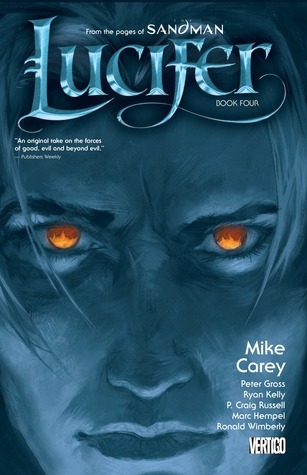
Lucifer
Lucifer, Book Four
Cast out of Heaven, thrown down to rule in Hell, Lucifer Morningstar has resigned his post and abandoned his kingdom for the mortal city of Los Angles. Emerging from the pages of writer Neil Gaiman's award-winning series The Sandman, the former Lord of Hell is now enjoying a quiet retirement as the propretor of Lux, L.A.'s most elite piano bar.
A deadly new threat to all of Creation emerges and battles lines are drawn. As forces in Hell and on Earth prepare for a final struggle for supremacy, we venture across time and space and even places in between to follow the path of the players in the battle to come.
Collects Lucifer #46-61.
A deadly new threat to all of Creation emerges and battles lines are drawn. As forces in Hell and on Earth prepare for a final struggle for supremacy, we venture across time and space and even places in between to follow the path of the players in the battle to come.
Collects Lucifer #46-61.
392 pages, Paperback
First published August 26, 2014
About the author
Mike Carey
1,153 books3,002 followersLibrarian Note: There is more than one author in the GoodReads database with this name. See this thread for more information.
Mike Carey was born in Liverpool in 1959. He worked as a teacher for fifteen years, before starting to write comics. When he started to receive regular commissions from DC Comics, he gave up the day job.
Since then, he has worked for both DC and Marvel Comics, writing storylines for some of the world's most iconic characters, including X-MEN, FANTASTIC FOUR, LUCIFER and HELLBLAZER. His original screenplay FROST FLOWERS is currently being filmed. Mike has also adapted Neil Gaiman's acclaimed NEVERWHERE into comics.
Somehow, Mike finds time amongst all of this to live with his wife and children in North London. You can read his blog at www.mikecarey.net.
Mike Carey was born in Liverpool in 1959. He worked as a teacher for fifteen years, before starting to write comics. When he started to receive regular commissions from DC Comics, he gave up the day job.
Since then, he has worked for both DC and Marvel Comics, writing storylines for some of the world's most iconic characters, including X-MEN, FANTASTIC FOUR, LUCIFER and HELLBLAZER. His original screenplay FROST FLOWERS is currently being filmed. Mike has also adapted Neil Gaiman's acclaimed NEVERWHERE into comics.
Somehow, Mike finds time amongst all of this to live with his wife and children in North London. You can read his blog at www.mikecarey.net.
Ratings & Reviews
Friends & Following
Create a free account to discover what your friends think of this book!
Community Reviews
Displaying 1 - 30 of 83 reviews

October 7, 2017
This is the Fourth Volume in the Lucifer series and I am running out of accolades for this superb story. So suffice it to say "This is excellent" and on to my review of the story.
In the wake of the events of Volume 3- Elaine Beloc is charged with cleaning out the immortals in Lucifer's creation. This is happening in the background of the rather touching story called "The Weaving" (a subtle jab at the whole "love/mating" mess many people involve themselves in).The "Lilith" story is superb as we witness the birth of the Illim and Lilith's anger at God. The artwork for this story is also exceptional.
The rest of this story revolves around Lilith, some of the rogue angels and Lucifer's bunch. There is a lot going on as we see the development of Lilith and how her children factor into the fall of heaven. There is also the tale of Fenris and the forces of Chaos that have been unleashed.
More than that I shall not say. This superb book needs to be read without spoilers.
This is a truly wonderful series. Top notch storytelling, with interesting characters and great prose. Mike Carey's Lucifer is truly one of the finest comics I've read in awhile.
In the wake of the events of Volume 3- Elaine Beloc is charged with cleaning out the immortals in Lucifer's creation. This is happening in the background of the rather touching story called "The Weaving" (a subtle jab at the whole "love/mating" mess many people involve themselves in).The "Lilith" story is superb as we witness the birth of the Illim and Lilith's anger at God. The artwork for this story is also exceptional.
The rest of this story revolves around Lilith, some of the rogue angels and Lucifer's bunch. There is a lot going on as we see the development of Lilith and how her children factor into the fall of heaven. There is also the tale of Fenris and the forces of Chaos that have been unleashed.
More than that I shall not say. This superb book needs to be read without spoilers.
This is a truly wonderful series. Top notch storytelling, with interesting characters and great prose. Mike Carey's Lucifer is truly one of the finest comics I've read in awhile.

April 22, 2018
I'm a big fan of Elaine. God's granddaughter, Lucifer's niece, is a trip. I loved seeing her play surrogate god to Lucifier's universe, getting entangled in Destiny's wheel, and feeling the nastiness of everything that Fenrir has brought to the table.
It's only the end of all the universes, man.
Add a bit of the world-tree, some literal world-building, and some of the funniest changes to hell yet, and the beginning of a huge Lilith arc storming the Silver City, and I can honestly say I love this series.
Lucifer playing mentor is not a bad thing when it's the fate of all things. It's him he's saving, too. :)
Again, I love Elaine. :)
It's only the end of all the universes, man.
Add a bit of the world-tree, some literal world-building, and some of the funniest changes to hell yet, and the beginning of a huge Lilith arc storming the Silver City, and I can honestly say I love this series.
Lucifer playing mentor is not a bad thing when it's the fate of all things. It's him he's saving, too. :)
Again, I love Elaine. :)

January 28, 2018
The weakest of the series.
The main reasons being a lack of Lucifer and some change in the artwork at the beginning.
This volume seemed to have a lot of Sandman influence via the background characters being able to tell their own story with the focus on these characters and not Lucifer.
Seems to be back on track by the end. Good, just not near as great as previous volumes.
The main reasons being a lack of Lucifer and some change in the artwork at the beginning.
This volume seemed to have a lot of Sandman influence via the background characters being able to tell their own story with the focus on these characters and not Lucifer.
Seems to be back on track by the end. Good, just not near as great as previous volumes.

June 11, 2021
This volume starts tying up all the story lines that have been woven through all of the previous arcs of this epic. I think every character that can still make an appearance does. I enjoy and admire this crazy-complex storytelling, but also find it overwhelming, since I can’t always remember the details of what’s happened before, and I’ve been reading the series via the library so I don’t have the earlier volumes to refer back to. (Plus the story is so dark, I’m not sure I want to reread it, even though I think it would be rewarding to do so from the perspective of knowing what happens later.) This story is thrilling and full of Big Ideas, but also grim and gory. I have no idea how it’s going to be resolved.
Slightly spoilericious comments below:
My biggest problem with this collection was how one character is illustrated. She is a 12-year-old girl. And yet she is shown on Page 29 (also used as the back cover illustration) in a sexually inviting pose with a come-hither expression. I nearly slammed the book closed at that point. Maybe this seems acceptable to the typical male comics reader, but speaking as someone who has been a 12-year-old girl, NO IT IS NOT. This is a child. Let her have her childhood. Make it a goal to let ALL female children have safe childhoods, without the terrifying and genuinely dangerous threat that comes from portraying children as being sexual and having sexual agency. Then as the story progresses, she’s drawn less and less like a young girl, and more and more like someone between 19 and 25. I wondered positively, and negatively, “Do the men who read this comic want to think of this character sexually, and so the art is catering to that? EWWWW!”
So I’m giving this 4 stars for the story, since I zoomed through this volume in no time at all, it was so surprising and gripping. But I’m deeply unsettled by what some of this artwork appears to say about comics and the people who read them.
Also, if anyone knows what font was used for the introduction, please let me know. I can’t match it to anything.
Slightly spoilericious comments below:
My biggest problem with this collection was how one character is illustrated. She is a 12-year-old girl. And yet she is shown on Page 29 (also used as the back cover illustration) in a sexually inviting pose with a come-hither expression. I nearly slammed the book closed at that point. Maybe this seems acceptable to the typical male comics reader, but speaking as someone who has been a 12-year-old girl, NO IT IS NOT. This is a child. Let her have her childhood. Make it a goal to let ALL female children have safe childhoods, without the terrifying and genuinely dangerous threat that comes from portraying children as being sexual and having sexual agency. Then as the story progresses, she’s drawn less and less like a young girl, and more and more like someone between 19 and 25. I wondered positively, and negatively, “Do the men who read this comic want to think of this character sexually, and so the art is catering to that? EWWWW!”
So I’m giving this 4 stars for the story, since I zoomed through this volume in no time at all, it was so surprising and gripping. But I’m deeply unsettled by what some of this artwork appears to say about comics and the people who read them.
Also, if anyone knows what font was used for the introduction, please let me know. I can’t match it to anything.

November 19, 2022
Lucifer Book 4 collects issues 46-61 of the DC Vertigo series written by Mike Carey with art by Peter Gross, Ryan Kelly, P. Craig Russell, Marc Hempel, and Ronald Wimberly.
The host has vacated the Primum Mobile in heaven leaving creation without a god. In the vacuum, forces fight to become the new God.
Another fantastic volume where with each subsequent arc the stakes become more and more dire. The way Carey weaves this tale is incredible. The art throughout the series has been strong and adds to the story being told.
The host has vacated the Primum Mobile in heaven leaving creation without a god. In the vacuum, forces fight to become the new God.
Another fantastic volume where with each subsequent arc the stakes become more and more dire. The way Carey weaves this tale is incredible. The art throughout the series has been strong and adds to the story being told.

June 10, 2021
Following the Titan rebellion, Lucifer decides to evict all immortals from his Creation. Meanwhile, the disastrous ramifications of God's abdication become increasingly clear: As His Word fades, everything in His Creation will dissolve, since His Will is what keeps everything in existence. This volume was especially light on the main character, and in many ways, this is the quintessential penultimate installment of any series; the one that gathers up any remaining loose threads and gives backstories in order to prepare for the climax. It collects Stichglass Slide (four issues), Lilith (an extra-sized 50th issue celebration that finally reveals the origins of Lucifer's and Mazikeen's relationship), The Wolf Beneath the Tree (four issues), The Eighth Sin (single issue), Crux (two issues), The Yahweh Dance (single issue), and The Breach (three issues).
Christian and Norse mythologies are once again interwoven when Fenris, the Norse wolf of destruction, shows up to help speed the dissolution of Yahweh's Creation along, Destiny and Delirium of the Endless make appearances, and Elaine learns how to control and apply her demiurgic powers while Lilith masses the army of her children to march on the Silver City. The plot thickens even more and jumps all over the place; characters whose arcs I assumed to be concluded somehow turn out to still be relevant, while other things come seemingly out of nowhere. I still can't fathom where Carey is going to take this, but by the end of this book, it is clear that the stakes have never been higher and the final showdown is just around the corner... or so I hope. There have been so many averted apocalypses in this series that they're starting to get boring, and it's probably a bad sign when you start to root for the end of Creation...
—————
My other Lucifer reviews:
01: Book One · ★★
02: Book Two · ★★
03: Book Three · ★★
04: Book Four · ★★
05: Book Five · ★★★
Christian and Norse mythologies are once again interwoven when Fenris, the Norse wolf of destruction, shows up to help speed the dissolution of Yahweh's Creation along, Destiny and Delirium of the Endless make appearances, and Elaine learns how to control and apply her demiurgic powers while Lilith masses the army of her children to march on the Silver City. The plot thickens even more and jumps all over the place; characters whose arcs I assumed to be concluded somehow turn out to still be relevant, while other things come seemingly out of nowhere. I still can't fathom where Carey is going to take this, but by the end of this book, it is clear that the stakes have never been higher and the final showdown is just around the corner... or so I hope. There have been so many averted apocalypses in this series that they're starting to get boring, and it's probably a bad sign when you start to root for the end of Creation...
—————
My other Lucifer reviews:
01: Book One · ★★
02: Book Two · ★★
03: Book Three · ★★
04: Book Four · ★★
05: Book Five · ★★★

March 1, 2016
And to think they turned this into a police procedural... I haven't watched the show, so I don't know how it stands up. But as I'm reading this collection, with its story arcs built around Ragnarok, an emotion-spinning spider, Lilith's army and a siege on the crystal city, I can't imagine how this could ever have become a police procedural. Of course Lucifer is mainly the catalyst; he's rarely the main character. Instead, most of the time is spent with the other characters; Elaine, Mazikeen, Gaudium, Jill, and more, and all of them are as fascinating as ever, with their stories and actions intertwining in some ways. Elaine creating her own universe, to 'practice,' the story of the building of the Crystal City and the cruelty inherent to it, all of it makes for fascinating, massive stories still told on a personal scale. I hope the show does bring people to the books. It's a completely different creation, but definitely worth visiting. Which I guess you could say is true for Lucifer's Universe too...

January 29, 2019
Well I guess I am looking at this book and thinking it is the perfect example of a "penultimate" instalment.
You see there is a huge climax to this series (and even without my "no spoilers" rule screaming stop all you would need to do is read the back page of each instalment) and this book really is the part which draws all the strings together ready for that show down.
I guess with any multi-instillment series you have the various parts which introduce, explain, draw together, confront and then conclude and this series is no different.
Do not get me wrong the dialogue and artwork and eye catching - the use of different artist styles (intentional or not) to represent different parts of parallel storylines is a great idea - however you know that you are just getting to the real bite to the story only to realise that the pages are rapidly running out.
So I guess there is no disagreement that when I finished this book I had the next (and last) instalment sitting by me ready to go and I am already a considerable way through it?
You see there is a huge climax to this series (and even without my "no spoilers" rule screaming stop all you would need to do is read the back page of each instalment) and this book really is the part which draws all the strings together ready for that show down.
I guess with any multi-instillment series you have the various parts which introduce, explain, draw together, confront and then conclude and this series is no different.
Do not get me wrong the dialogue and artwork and eye catching - the use of different artist styles (intentional or not) to represent different parts of parallel storylines is a great idea - however you know that you are just getting to the real bite to the story only to realise that the pages are rapidly running out.
So I guess there is no disagreement that when I finished this book I had the next (and last) instalment sitting by me ready to go and I am already a considerable way through it?

September 8, 2018
This book is the darkest in the series so far. You can feel the weight of helplessness and despair. My heart goes out to Mazikeen. The book had its unexpected moments but then predictability came marching in. So I took off a star. Lucifer is full of surprises in this book. The book goes a full circle and connects with parts of the first book. The book depicts the hunger for power and the sacrifices that come with it.

August 21, 2019
And the plot thickens.

May 9, 2022
Again, one in a series, each book has lots of smaller story arcs, often with different artwork to help them become distinct stories. But, as a whole, these books have a single overall story arc, so I find it a bit difficult to review them separately.
One of the things I really enjoyed about this book was how Elain Belloc became a more major character. In the beginning of the book Lucifer decides he no longer wants any immortals in his alternative universe and he deputises her and a small team of her choosing to make the immortals all leave. This story arc ties in with one that I had read before; the story of the stitchglass weaver and I think that one is a GREAT story! I love the way the character is so individualised and yet so not-human. It makes you step a little sideways in your head and wonder what other animals - like insects - going about there business weaving a nest, what they MIGHT be thinking of themselves?
Anyhow, Elain moving toward her godhood is great. The story of the beginning of the silver city, I was what was needed to advance the overall story arc in a general way but while it did not blow me away, it was interspersed with plenty of smaller stories that did. Especially, the one where Elain Belloc is goaded by Lucifer into learning how to create a world and how intervention in the lives of it's subjects, however well intended, can lead to them being in a prison and rebelling against it. GREAT stuff Mike Carey, brilliant.
Anyway, I will have to wait to get my hands on the #5, but I am definitely looking forward to it.
One of the things I really enjoyed about this book was how Elain Belloc became a more major character. In the beginning of the book Lucifer decides he no longer wants any immortals in his alternative universe and he deputises her and a small team of her choosing to make the immortals all leave. This story arc ties in with one that I had read before; the story of the stitchglass weaver and I think that one is a GREAT story! I love the way the character is so individualised and yet so not-human. It makes you step a little sideways in your head and wonder what other animals - like insects - going about there business weaving a nest, what they MIGHT be thinking of themselves?
Anyhow, Elain moving toward her godhood is great. The story of the beginning of the silver city, I was what was needed to advance the overall story arc in a general way but while it did not blow me away, it was interspersed with plenty of smaller stories that did. Especially, the one where Elain Belloc is goaded by Lucifer into learning how to create a world and how intervention in the lives of it's subjects, however well intended, can lead to them being in a prison and rebelling against it. GREAT stuff Mike Carey, brilliant.
Anyway, I will have to wait to get my hands on the #5, but I am definitely looking forward to it.

July 24, 2018
Looking at the series as a whole so far, it’s exceptional. It is without a doubt a masterful work. I think, and this makes obvious sense, that only the sandman can compare to the quality of this book. There really is nothing else like this in written mediums. It’s so well done I’m not even sure what to say. Just read them! Also, Elaine Belloc, mazikeen, Lucifer, and some others are some of the best characters in comics. It’s beyond comprehension to me how mike Carey could have possibly created something like this on purpose. It’s so perfect and expansive I have to believe that it was an accident. 5 stars all the way. If you don’t read this, or you do and you don’t like it, well...then, you’re an idiot!

Read
January 4, 2017I enjoyed this volume but I wasn't completely in love with it. Not that there is anything wrong or lacking in it, in fact, when I think back upon it the storylines might be my favourite in the series. I think the issue is that I read it slowly over several weeks rather than binging it over a day or two like I usually do. I think Lucifer might work best for me as a binge.
Probably not a super helpful review. If you liked the previous three books, though, you're gonna like this one too :)
Probably not a super helpful review. If you liked the previous three books, though, you're gonna like this one too :)

June 11, 2020
I liked the cameos from The Endless, and Christopher Rudd has had one of my favorite arcs ever. Elaine Belloc is coming into her own as God, Lillith is set to take heaven and destroy the throne of Yaweh. I can make some predictions on where things will eventually end up, but I have no idea what's going to happen next and I'm so excited by that.

April 4, 2017
Closing in on the home stretch. Another solid set of stories - just didn't knock me down and roll me over. So to speak.

November 7, 2016
I feel like this is the weakest volume of the quintet. It introduces two new antagonists - one whose presence has been hinted at since day one, and whose connection to the ongoing events makes their appearance both surprising and inevitable; the other who seems to more or less come out of nowhere and have little function beyond the plot needing someone to fill a particular role.
It's still very good, but there's a lot of backstory in this volume - which is as well written as the rest, and needed in the story, but dropped in very large chunks. It slows down the action at a time when things are racing toward a climax. That said, by this volume's end, the race is well and truly on, and the stakes have never been higher.
It's still very good, but there's a lot of backstory in this volume - which is as well written as the rest, and needed in the story, but dropped in very large chunks. It slows down the action at a time when things are racing toward a climax. That said, by this volume's end, the race is well and truly on, and the stakes have never been higher.

August 19, 2014
A Lucifer book that's quite light on the Lucifer, to be honest. That said, it shows the strength of the vast amount of characters that Mike Carey has built up around the Morningstar that not having around doesn't hurt the story at all. Of course, when he is there, everything's even better, but there are times when this volume goes 5 or 6 issues without seeing him, and the story continues to barrel towards its conclusion. The stakes are getting higher and higher, and with new players and new twists coming thick and fast, I'm glad I waited until I had volumes 4-5 together to finish the series off.

October 10, 2019
The whole series is great, this one was particularly interesting. The myth, the scope, the amazing storytelling. This is a book worth checking out. In this book, we see the consequences of God leaving. Why we do not know. We see Lucifer trying to stop the Fenrir wolf. And the Fenrir wolf trying to devour creation. Throw in a few other players and you have a recipe for the war to end all war. The art is great, including some nice variations that are different from your standard run of the mill comic art.

September 9, 2014
Everything about this book seems to suggest some great, massive conclusion--a battle between the Lilim and Heaven's armies or something of that order. I'm knocking off one star for the pitiable end that this great story actually gives us. Unless--could there be a Book Five in the offing?

January 14, 2016
It's probably a bad sign for a series when you start rooting for the end of the world.

June 7, 2016
By far the best collection of Lucifer and when things really hit their stride.

October 25, 2016
If there is a problem with this series, it is that there are too many apocalypses and they start to feel boring.
I still can't believe this comic was adapted into a police procedural.
I still can't believe this comic was adapted into a police procedural.

January 10, 2017
There's a lot going on in this volume. Characters whose arcs I thought concluded end up being relevant still, and this makes perfect sense, since all stories have neither beginnings nor endings.

November 17, 2022
I loved this volume, can't wait to read the ending of this great series!

June 1, 2026
Lucifer Book 4 is a tablesetting book for the climax of the story, or at least that's how it feels. God has departed the cosmos, and accordingly his signature on all creation is fading. As Heaven tries to comprehend its unbecoming and Lucifer plans to watch from the cheap seats, forces of nihilism and revolution begin to sense their moment has arrived.
So given that, I guess I'm not too surprised that this felt as uneven to me on a reread as it did the first time I thumbed through Books 8 and 9 of Lucifer a decade ago. A big chunk of the comic's run is spent introducing Lilith, Mazikeen's mother and (for that matter) mother of the entire Lillim species. Another big chunk is teeing up Lillith's co-conspirator Fenris, the Wolf.
Here's the thing though: Neither of these elements fully work in this book. What they tee up for the finale is excellent, and I've no qualms with how the story ultimately concludes. But Fenris' plot is long on exposition and vibes, and very short indeed on foreshadowing elsewhere in the comic's run. Yet it kills at least one central character with little warning and in a way that kind of robs a long expected confrontation of its bite. Fenris' overall design is also...not great. In wolf form and in his less human moments he looks great. But his default appearance is underwhelming and never seems to match the awful power he holds.
Similarly, Lilith is portrayed as embittered and hiding in Lucifer's creation, waiting for her moment to emerge and claim the throne. Far too many things seem to happen far too quickly from that point (Presto! Among our mustering pieces on the board a whole SECOND army emerges with almost no warning! Screw time, we can do what we want to in the "soft places" outside of it. Why do they all look like their father instead of poor Briadach? Who knows?). Her whole characterization also feels a little jagged. Not quite maternal, even though all others react as if it should be. It just feels like a piece that should've been on the board far sooner for how central a role she ultimately takes in the story alongside Elaine.
Against that...well against those two there's the arc of Elaine Belloc, which bookends the story, and the ongoing revolution of Hell. It's one of those rare studies in character growth that every writer should review when they're working on their own additions to an established canon. By the end of the book Elaine has Michael's compassion, Lucifer's will, and none of the omniscience of Yahweh to hold her back. Elaine's great. Similarly, the revolution in Hell arc continues to build to a natural conclusion, and while it's a little speedy in some ways it works well enough and in contrast to Fenris and Lilith does a great job of building on what came before to advance the story.
On the whole this might be the weakest of the books, but it's still essential reading to an overall masterpiece.
So given that, I guess I'm not too surprised that this felt as uneven to me on a reread as it did the first time I thumbed through Books 8 and 9 of Lucifer a decade ago. A big chunk of the comic's run is spent introducing Lilith, Mazikeen's mother and (for that matter) mother of the entire Lillim species. Another big chunk is teeing up Lillith's co-conspirator Fenris, the Wolf.
Here's the thing though: Neither of these elements fully work in this book. What they tee up for the finale is excellent, and I've no qualms with how the story ultimately concludes. But Fenris' plot is long on exposition and vibes, and very short indeed on foreshadowing elsewhere in the comic's run. Yet it kills at least one central character with little warning and in a way that kind of robs a long expected confrontation of its bite. Fenris' overall design is also...not great. In wolf form and in his less human moments he looks great. But his default appearance is underwhelming and never seems to match the awful power he holds.
Similarly, Lilith is portrayed as embittered and hiding in Lucifer's creation, waiting for her moment to emerge and claim the throne. Far too many things seem to happen far too quickly from that point (Presto! Among our mustering pieces on the board a whole SECOND army emerges with almost no warning! Screw time, we can do what we want to in the "soft places" outside of it. Why do they all look like their father instead of poor Briadach? Who knows?). Her whole characterization also feels a little jagged. Not quite maternal, even though all others react as if it should be. It just feels like a piece that should've been on the board far sooner for how central a role she ultimately takes in the story alongside Elaine.
Against that...well against those two there's the arc of Elaine Belloc, which bookends the story, and the ongoing revolution of Hell. It's one of those rare studies in character growth that every writer should review when they're working on their own additions to an established canon. By the end of the book Elaine has Michael's compassion, Lucifer's will, and none of the omniscience of Yahweh to hold her back. Elaine's great. Similarly, the revolution in Hell arc continues to build to a natural conclusion, and while it's a little speedy in some ways it works well enough and in contrast to Fenris and Lilith does a great job of building on what came before to advance the story.
On the whole this might be the weakest of the books, but it's still essential reading to an overall masterpiece.

February 19, 2025
fantastic, fun read!
Lucifer Book 4 continues the series’ tradition of tackling weighty theological and philosophical concepts without ever feeling heavy-handed. It’s a striking blend of cosmic scope and intimate storytelling that forces you to question conventional notions of order and chaos. The artwork elevates the narrative, with each panel reinforcing the sense that there’s something vast and unknowable simmering beneath every scene.
What stands out most is the way this volume seamlessly extends the overarching mythology: it introduces new layers of cosmic intrigue while staying true to the characters’ ongoing arcs. There’s an underlying tension between destiny and free will that lingers long after you turn the last page. It’s one of those rare reads that sparks bigger conversations about morality, existence, and the delicate balance of the universe.
If you’ve been enjoying the series so far, you’ll appreciate how Book 4 pushes the boundaries even further, offering deeper insight into Lucifer’s motivations and the fragile interplay between divine and mortal realms. It’s a bold, thought-provoking addition and a must-read for anyone who loves their comics with a dash of cosmic wonder.
Lucifer Book 4 continues the series’ tradition of tackling weighty theological and philosophical concepts without ever feeling heavy-handed. It’s a striking blend of cosmic scope and intimate storytelling that forces you to question conventional notions of order and chaos. The artwork elevates the narrative, with each panel reinforcing the sense that there’s something vast and unknowable simmering beneath every scene.
What stands out most is the way this volume seamlessly extends the overarching mythology: it introduces new layers of cosmic intrigue while staying true to the characters’ ongoing arcs. There’s an underlying tension between destiny and free will that lingers long after you turn the last page. It’s one of those rare reads that sparks bigger conversations about morality, existence, and the delicate balance of the universe.
If you’ve been enjoying the series so far, you’ll appreciate how Book 4 pushes the boundaries even further, offering deeper insight into Lucifer’s motivations and the fragile interplay between divine and mortal realms. It’s a bold, thought-provoking addition and a must-read for anyone who loves their comics with a dash of cosmic wonder.

July 24, 2026
Another Excellent Entry!
It seems as if every additional book of Mike Carey's Lucifer series impresses me even more than the last. I love the way the individual stories intertwine in unexpected ways, how characters and events from earlier books (who I might have forgotten about!) suddenly make an appearance that makes everything clear, or something that was said in one of the earlier collections suddenly makes sense in a new light following a revelation in this latest book. The artists can convey so much through the panel illustrations, and the story itself is absolutely gripping. Lucifer is such a deeply nuanced and compelling character. He is hard to classify, because even as an antihero, so much of what he does is self-serving, but I love the way Carey plays the line that has you believing there is a part of Lucifer that does care for these people and places, no matter how cold, aloof, and detached he portrays himself to be. At this point I also engrossed and invested in this story. I have no idea what will come next or how the eventual pay off will play out, but I'm both excited and sad to be starting the final book of Carey's run and discovering how this leg of Lucifer's story comes up a close. Highly recommended.
It seems as if every additional book of Mike Carey's Lucifer series impresses me even more than the last. I love the way the individual stories intertwine in unexpected ways, how characters and events from earlier books (who I might have forgotten about!) suddenly make an appearance that makes everything clear, or something that was said in one of the earlier collections suddenly makes sense in a new light following a revelation in this latest book. The artists can convey so much through the panel illustrations, and the story itself is absolutely gripping. Lucifer is such a deeply nuanced and compelling character. He is hard to classify, because even as an antihero, so much of what he does is self-serving, but I love the way Carey plays the line that has you believing there is a part of Lucifer that does care for these people and places, no matter how cold, aloof, and detached he portrays himself to be. At this point I also engrossed and invested in this story. I have no idea what will come next or how the eventual pay off will play out, but I'm both excited and sad to be starting the final book of Carey's run and discovering how this leg of Lucifer's story comes up a close. Highly recommended.

March 29, 2018
http://leiturasdelaura.blogspot.com.b...
No quarto volume de Lucifer somos apresentados a mais dois novos/velhos antagonistas, e a história vira uma espécie de épico pela supremacia no céu e no inferno. Como eu já repeti na resenha do volume anterior, os problemas que mais me incomodam na saga permanecem, e de alguma forma se aprofundam ainda mais.
Fiquei chocada de forma negativa o jeito que o autor trabalhou com os dois antagonistas. Fenris ainda faz algum sentido dentro do universo torto (perto do original de Sandman) apresentado em Lucifer. Mas Lilith... um desperdício total de personagem. Perto de todas as ideias originais que o autor apresentou até o momento, Lilith é a coisa mais clichê (do jeito mais negativo possível) que ele fez até o momento. Só foi a maior demonstração até o momento que o autor não trabalha bem personagens femininos. Triste.
Pelo menos agora só falta um volume pra acabar.
No quarto volume de Lucifer somos apresentados a mais dois novos/velhos antagonistas, e a história vira uma espécie de épico pela supremacia no céu e no inferno. Como eu já repeti na resenha do volume anterior, os problemas que mais me incomodam na saga permanecem, e de alguma forma se aprofundam ainda mais.
Fiquei chocada de forma negativa o jeito que o autor trabalhou com os dois antagonistas. Fenris ainda faz algum sentido dentro do universo torto (perto do original de Sandman) apresentado em Lucifer. Mas Lilith... um desperdício total de personagem. Perto de todas as ideias originais que o autor apresentou até o momento, Lilith é a coisa mais clichê (do jeito mais negativo possível) que ele fez até o momento. Só foi a maior demonstração até o momento que o autor não trabalha bem personagens femininos. Triste.
Pelo menos agora só falta um volume pra acabar.

September 19, 2020
The story slows a bit as it expands, but it's worth it in the end. Amidst some new stuff that comes sort of out of nowhere, this volume also contains some of the best moments of the series, particularly concerning the hard-earned growth of the character Elaine Belloc—for whom the series could also easily have been named.
Anyway, if you've made it this far, it's because you've realize this story is going somewhere, getting to a larger point, and will indeed satisfy your curiosities.
Anyway, if you've made it this far, it's because you've realize this story is going somewhere, getting to a larger point, and will indeed satisfy your curiosities.
January 10, 2026
Beautiful ugly dense confusion
The variation of artists is the norm but there is one who needs to go back to painting parking lots luckily it's a quick read for those minimalist stories and the act of smearing black on white to represent events gets old but there are some good pieces but artistically empty I'm hoping the next book goes somewhere this one left me feeling hanging.
The variation of artists is the norm but there is one who needs to go back to painting parking lots luckily it's a quick read for those minimalist stories and the act of smearing black on white to represent events gets old but there are some good pieces but artistically empty I'm hoping the next book goes somewhere this one left me feeling hanging.
Displaying 1 - 30 of 83 reviews