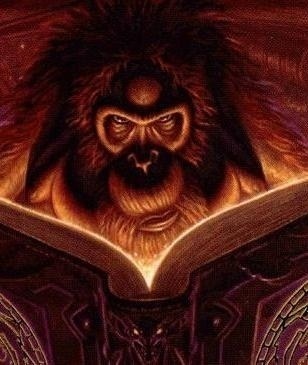
Back in the late 90s, there was a whole slew of "Science Of...." books. The science of Star Trek, X-Files, Star Wars, all of them did their best to explain the fantastic in terms of what we already knew about science. They weren't trying to disprove these worlds - saying that warp speed is impossible, for example, or how The Force violates any number of natural laws - but rather they tried to figure out how we could explain these things, and perhaps, someday, make them real.
This isn't that sort of book.
The Discworld, as the writers say straight out, runs on stories, on some mysterious element that we might call Narrativium. Things happen a certain way because that's how they're supposed to happen. The eighth son of an eighth son HAS to become a wizard, even if he turns out to be a daughter. And a million-to-one shot HAS to come off, because the Story demands it.
In this story, the wizards at the Unseen University at Ankh-Morpork have a little problem. Their thaumic reactor, built in the middle of the squash court, is pumping out dangerous levels of magic - enough to turn most of the Ankh-Morpork plains into the playground of horrible betentacled Things from the Dungeon Dimension. So, in order to siphon off the massive amounts of magic being generated from splitting the thaum, they channel the extra energy into the Roundworld Project. Essentially they create a universe where magic - and Narrativium - do not exist. It's a place that works on its own laws but, unlike the Discworld, it does not work towards any particular end.
Our universe, as it turns out.
The wizards watch our world form, try to figure out the rules, and watch it progress. They see life emerge, make its best effort towards intelligence, and then get wiped out. Over and over.
The wizards give us an interesting perspective - the creation of the universe and the evolution of intelligent life collapsed down to about a week. They're able to use a kind of magical VR to watch things in real time, but still, they have a wide view of Earth history that allows commentary on the other part of the book....
Interleaved with the Discworld story about the Project, Stewart and Cohen talk about the science that the wizards are watching. Where the stars came from, how the moon got formed, what primeval Earth might have looked like, how life arose and, most importantly, how it managed to stick around for so long.
Viewed on a long scale, the Earth is not really a very hospitable place. Giant rocks and snowballs falling from the sky every few million years, ice ages and volcanic catastrophes, disasters of nearly every imaginable magnitude. Species rising, flourishing and vanishing without so much as a ripple in the fossil record.... Nice, pleasant weather, like we have now, is relatively rare.
As Rincewind says, "This world is an anvil. Everything here is between a rock and a hard place. Every single thing on it is the descendant of creatures that have survived everything the world could throw at them. I just hope they never get angry...."
Pratchett is a fantastic writer, as we all know, and somehow Stewart and Cohen manage to keep up with him. The chapters on hard science are just as interesting and entertaining as those with the wizards. They illuminate the concepts that the wizards don't understand ("There are no turtles anywhere!") and set you up for what will come next. It's a rare book that can educate and entertain with consistency, and this book achieves it.
Next up will be the followup books. Let's see how they hold up....