

What do you think?

Colliding Worlds: How Cutting-Edge Science Is Redefining Contemporary Art
In recent decades, an exciting new art movement has emerged in which artists utilize and illuminate the latest advances in science. Some of their provocative creations a live rabbit implanted with the fluorescent gene of a jellyfish, a gigantic glass-and-chrome sculpture of the Big Bang (pictured on the cover) can be seen in traditional art museums and magazines, while others are being made by leading designers at Pixar, Google s Creative Lab, and the MIT Media Lab. In Colliding Worlds, Arthur I. Miller takes readers on a wild journey to explore this new frontier. Miller, the author of Einstein, Picasso and other celebrated books on science and creativity, traces the movement from its seeds a century ago when Einstein s theory of relativity helped shape the thinking of the Cubists to its flowering today. Through interviews with innovative thinkers and artists across disciplines, Miller shows with verve and clarity how discoveries in biotechnology, cosmology, quantum physics, and beyond are animating the work of designers like Neri Oxman, musicians like David Toop, and the artists-in-residence at CERN s Large Hadron Collider.
From NanoArt to Big Data, Miller reveals the extraordinary possibilities when art and science collide."
From NanoArt to Big Data, Miller reveals the extraordinary possibilities when art and science collide."
352 pages, Hardcover
First published June 16, 2014
Ratings & Reviews
Friends & Following
Create a free account to discover what your friends think of this book!
Community Reviews
Displaying 1 - 8 of 8 reviews

July 24, 2014
sciart :: art inspired or influenced by science.
artist or scientist? um, both. are art and science one? some would argue yes though it is the artists who blur the distinction most. the art establishment isn't impressed and i couldn't help but wonder why. studying bone formation to make better buildings or making a gold-plated pair of wings from pig cells is impressive. science driven artists are some pretty cool weirdos.
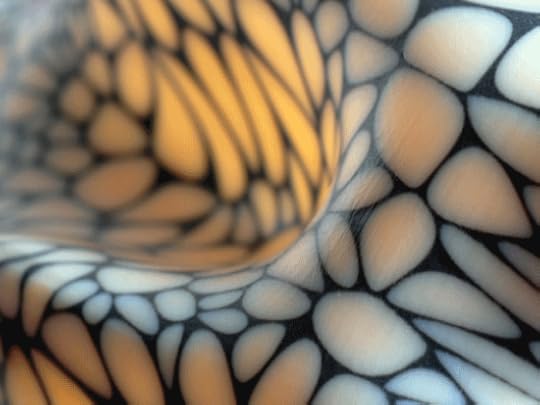
also, check out the work of neri oxman:
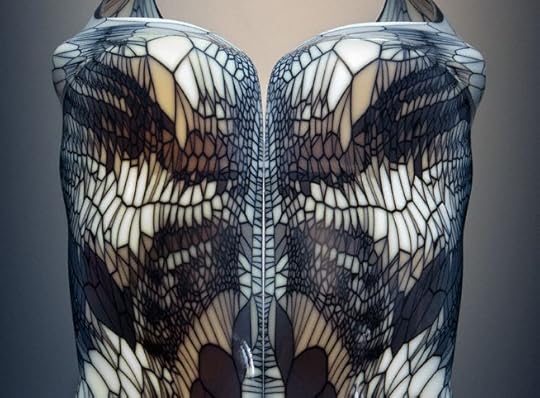

artist or scientist? um, both. are art and science one? some would argue yes though it is the artists who blur the distinction most. the art establishment isn't impressed and i couldn't help but wonder why. studying bone formation to make better buildings or making a gold-plated pair of wings from pig cells is impressive. science driven artists are some pretty cool weirdos.
also, check out the work of neri oxman:

September 20, 2019
This is an interesting but exasperating book. I concur with other Goodreads reviewers who consider it works best as a handbook or a reference volume. The wealth of information on contemporary artists working across the art-science divide is at the heart of the high value this book provides for any reader interested in such topics. Having said this, its major weaknesses are its disjointedness, the tendency to skip back and forth in time, and the annoying brief “personal interest” cameos on the artists which are written according to set formulas, which often include such irrelevancies as to what the artist was wearing when interviewed by the author:
The book is divided into twelve chapters. The first chapter, In search of the invisible briefly describes the, in general, increasingly estranged relationship between art and science from the discovery of the rules of perspective in the Renaissance to the early nineteenth century when, according to Miller’s rather polemical statement:
The second chapter, Montmartre in New York jumps to the 1960s when the (unlikely) collaboration between the neo-Dadaist artist Jean Tinguely and the Bell Labs engineer Billy Klüwer in “Homage to New York” opened up a world of possibilities which could become an answer to C.P. Snow’s plea to bridge the gap between the two cultures of Art and Humanities on the one hand, and Science and Technology on the other, by working:
Chapter 3, The Computer Meets Art tries to document in much more detail the development of computer, electronic and systems art from the pioneering 1950s work of Ben F. Laposky with oscilloscopes and Richard Hamilton and Kathleen Londale’s Growth and Form London exhibition , followed by 1960s work by A. Michael Noll and Béla Julesz in New York, Frieder Nake and Georg Nees generative art in Germany to work by Victor Pasmore, Roy Ascott, Nicholas Schöffer, Gustav Metzger, Harold Cohen, Ernest Edmonds, Stroud Cornock and Edward Iknatotowicz, Miller claims that:
In chapter 5, Visualizing the Invisible, Miller deals with artists working alongside physicists, and “attempting to make the invisible visible”, by which he means producing art based on or inspired by physical realities, problems and theories. Thus, how can an artist help the public “see” the ambiguous wave/particle nature of matter, the Big Bang, quantum entanglement, black holes, wormholes, superstrings, the curved four dimensional structure of space-time, high-energy physics. CERN sponsored exhibitions and artist-in-residence programs, as Miller carefully points out, have played an important part in reaching out to art from physics -and these experiences, as described by Miller, are in fact the closest in spirit to the actual title of the book. This chapter also devotes some time to art inspired by medical imaging, which is of course, another way of understanding what “visualizing the invisible” means.
Miller takes a chapter off his breakneck review of artists and rather bombastically entitles chapter 6 IntermezzoL How Science Helped Resolve the World’s Greatest Art Scandal. This is a refreshing chapter that has little to do with the rest of the book and narrates a case of Jackson Pollock forgeries, partly uncovered by the somewhat convoluted application of fractal characterizations of Pollock’s paintings. Miller hypes this up to be the “world’s greatest art scandal”, but in reality it would have to top a great many art scandals as anyone who, even casually, has followed BBC’s great “Fake or Fortune” series is well aware. The application of scientific forensic techniques to uncover art world frauds has a long and distinguished history. Pigments and canvases can be analyzed and dated to find out whether they correspond to the time and place in which they were supposedly painted, and corresponding analysis can be carried out for stone, wood and clay. The authenticity of a work of art is determined by its scientific, forensic evidence, by art historians considered judgment and by its provenance, that is to say a paper trail linking the painter to its most recent owner. The most original aspect of the Pollock case is its use of an algorithmic analysis of the disposition of painting’s characteristic line-drip “patterns”.
Chapter 7, Imagining and Designing Life, is on art inspired by biology and includes , in my opinion, the scariest and creepiest sections in the book which focus on artists who genetically engineer new forms of life in vitro or in bioreactors, or exploring the frontiers between life and death, such as:
I found chapter 8, Hearing as seeing on sound art is undoubtedly one of the more interesting in the book. I would particularly recommend reading this chapter in front of a good Internet connection in order to search for, reproduce and listen to the works mentioned, since without listening to them most of the ideas ar left hanging in the air. Actually, reading most chapter would benefit from being able to look up digital reproductions of the works mentioned.
Chapter 9, The Art of Visualizing Data is another example of a rather misleading title. While Miller does cover the topic of big data, data mining and data and information visualization, albeit in a rather shallow, incompletely and eclectic way, he also delves into such unrelated topics as nano-art -for example inscribing an image of President Obama on 150 million carbon microtubules-, and genetic algorithms. Scientific visualization is an important topic in its own right and is the subject of more than a few books, so trying to shoehorn it into one chapter is really a task doomed to failure.
In several chapters, Miller remarks on the difficulties of finding galleries willing to sell, fund and preserve art-sci works, especially digital art works. Chapter 10, Comrades in Arms: Encouraging, Funding and Housing Artscistudies these problems in more detail and describes funding programs, galleries and other innovative business models catering to the creators of these new forms of art.
Chapter 11, In the Eye of the Beholder? tries to look into what constitute the aesthetics of these new art forms. Miller briefly mentions the existence of the new field of neuro-aestherics , but in the end prefers to quote the artists he interviewed for this book on their “metrics” for aesthetics in their work, In my opinion, the shapelessness, tentative and fragmentary nature of this chapter probably would have been better served by including it as an appendix.
The last chapter, The Coming of a Third Culture is a final reflection on whether the work chronicled in the book shows art and science tentatively reaching out for each or drifting further apart. It would certainly benefit from the spate of more recent US National Academy conferences and publications that study interdisciplinary research and education on STEMM and the arts.
As I mentioned at the beginning of this review, Arthur J. Miller has written an exasperating book. Indubitably it was a brave and ambitious undertaking which provides much valuable information and much food for thought across two cultures which must be encouraged to keep trying to build bridges between them, fragile as they may seem now. Art can help to appreciate the beauty in science, and science can provide new tools, challenges and vistas for art; in some cases one can only hope that the both cultures rise successfully to meet new challenges in aesthetics, truth and ethics.
I first came across Roy Ascott at a symposium at the University of Plymouth, where he is a professor. His lecture was more a performance, presented with feet on desk, covering everything from his journey through art theory and art practice, to Zen Buddhism and consciousness studies. Short and stocky with an air of great confidence, he exudes a genuine and disarming friendliness.or
I first met Domnitch and Gelfand when I interviewed them -for six hours!- at Ars Electronica in Linz in September 2011. Domniitch has a shaved head with nothing but an S-shaped Mohican on top, while Gelfand is fashionably dressed down in cap and T-shirt. They are a handsome couple, both of Russian origin.The book’s title and subtitle are not particularly apt either. The two fields are not really colliding, so much as artists are exploring, coming to terms and helping spread key ideas in contemporary science. Miller works hard at tring to determine whether this is a two way street, but finds little in contemporary arts that is impinging on science -with the possible exception of soundscaping.
The book is divided into twelve chapters. The first chapter, In search of the invisible briefly describes the, in general, increasingly estranged relationship between art and science from the discovery of the rules of perspective in the Renaissance to the early nineteenth century when, according to Miller’s rather polemical statement:
...science was to be considered the serious pursuit of truth, while art was seen as merely decorative.Miller considers that from 1830 on the flow of ideas between science and art began to be “renewed with great vigor.” In the rest of the chapter he describes the evolution of art and science from the late nineteenth century to the 1930s, touching upon the discovery of radioactivity, x-rays and electrons, the development of the theories of relativity, wave-particle duality and quantum mechanics, psychoanalysis, and the invention of Cubism, Fauvism, Orphism, Surrealism, Futurism, Dadaism, Suprematism and Constructivism and the percolation of these scientific ideas and discoveries into the world of art. This chapter gives a strong idea of the serendipitous and haphazard way in which the two worlds were drawn to each other in this rich and complex period.
The second chapter, Montmartre in New York jumps to the 1960s when the (unlikely) collaboration between the neo-Dadaist artist Jean Tinguely and the Bell Labs engineer Billy Klüwer in “Homage to New York” opened up a world of possibilities which could become an answer to C.P. Snow’s plea to bridge the gap between the two cultures of Art and Humanities on the one hand, and Science and Technology on the other, by working:
...to remove the boundary between engineering and the arts in a way that benefitted both artist and engineer, both of whom were essential for a true art-technology project.As Klüwer tantalizingly put it:
The artost’s work is like that of a scientist. It is an investigation which may or may not yield meaningful results… What I am suggesting is that the use of the engineer by the artist will stimulate new ways of looking at technology and dealing with life in the future.The chapter ends by narrating the preparation, mise-en-scene and impact of the enormously influential 1966 9 Evenings: Theater and Engineering Armory show with its unprecedented mix of theater, happenings, media art, electroacoustic music and engineering, and its continuation through the activities carried out by the Experimental Arts Technnology, Inc. (E. A. T.) organization, as well as the first applications of computers and cybernetics to art and the “The Machine: As seen at the end of the Mechanical Age” exhibition at the MOMA.
Chapter 3, The Computer Meets Art tries to document in much more detail the development of computer, electronic and systems art from the pioneering 1950s work of Ben F. Laposky with oscilloscopes and Richard Hamilton and Kathleen Londale’s Growth and Form London exhibition , followed by 1960s work by A. Michael Noll and Béla Julesz in New York, Frieder Nake and Georg Nees generative art in Germany to work by Victor Pasmore, Roy Ascott, Nicholas Schöffer, Gustav Metzger, Harold Cohen, Ernest Edmonds, Stroud Cornock and Edward Iknatotowicz, Miller claims that:
The late 1970s and the early 1980s were a fallow time for computer art.Well, yes and no. Miller doesn’t mention it, but this period saw an astonishing number of breakthroughs in graphic interfaces and realistic computer graphics which rapidly made their way into the first videogame consoles and spawned the videogame arcade industry. Such classics as Pong, Space Invaders and, in 1982 Microsoft Flight Simulator date from this period and paved the way for computer animation. Also, in 1971 Dennis Gabor received the Nobel Prize in Physics for his invention and development of holographic techniques and, a fact not mentioned by Miller, the late 1960 and the 1970 saw the rise of holographic art. He does mention later developments in holographic art. Miller also forgets to mention that in 1982 Benoit Mandelbrot published The Fractal Geometry of Nature which would have a huge impact on computer art and animation. Miller later contradicts his statement on the fallowness of this period when he mentions that the first Ars Electronica festival of electronic art took place in 1979, that in 1980 Nicholas Negroponte founded the MIT Media Lab, in 1982
...the groundbreaking science fiction film called Tron hit cinema screens […] The film was one of the first to make extensive use of computer animation and included spectacular depictions of the bizarre world inside the computer.and that in 1986 New York’s School of Visual Arts instituted in 1986 an MFA degree in computer art. Of course the real explosion in computer art came in the eighties and nineties as Miller makes clear in his next chapter, Computer Art morphs into Media Art, especially once Pixar Animation Studios opened its doors, MIT Media Lab started rolling. In Chapter 4, Miller also slides into media art (forgiveable), but when writing about the MIT Media Lab, forges ahead into digital music and design biology, forgetting that these topics are covered in later chapters (chapters 8 and 7, respectively). This is part of what makes this book so exasperating.
In chapter 5, Visualizing the Invisible, Miller deals with artists working alongside physicists, and “attempting to make the invisible visible”, by which he means producing art based on or inspired by physical realities, problems and theories. Thus, how can an artist help the public “see” the ambiguous wave/particle nature of matter, the Big Bang, quantum entanglement, black holes, wormholes, superstrings, the curved four dimensional structure of space-time, high-energy physics. CERN sponsored exhibitions and artist-in-residence programs, as Miller carefully points out, have played an important part in reaching out to art from physics -and these experiences, as described by Miller, are in fact the closest in spirit to the actual title of the book. This chapter also devotes some time to art inspired by medical imaging, which is of course, another way of understanding what “visualizing the invisible” means.
Miller takes a chapter off his breakneck review of artists and rather bombastically entitles chapter 6 IntermezzoL How Science Helped Resolve the World’s Greatest Art Scandal. This is a refreshing chapter that has little to do with the rest of the book and narrates a case of Jackson Pollock forgeries, partly uncovered by the somewhat convoluted application of fractal characterizations of Pollock’s paintings. Miller hypes this up to be the “world’s greatest art scandal”, but in reality it would have to top a great many art scandals as anyone who, even casually, has followed BBC’s great “Fake or Fortune” series is well aware. The application of scientific forensic techniques to uncover art world frauds has a long and distinguished history. Pigments and canvases can be analyzed and dated to find out whether they correspond to the time and place in which they were supposedly painted, and corresponding analysis can be carried out for stone, wood and clay. The authenticity of a work of art is determined by its scientific, forensic evidence, by art historians considered judgment and by its provenance, that is to say a paper trail linking the painter to its most recent owner. The most original aspect of the Pollock case is its use of an algorithmic analysis of the disposition of painting’s characteristic line-drip “patterns”.
Chapter 7, Imagining and Designing Life, is on art inspired by biology and includes , in my opinion, the scariest and creepiest sections in the book which focus on artists who genetically engineer new forms of life in vitro or in bioreactors, or exploring the frontiers between life and death, such as:
[Pynor] created Liquid Ground 6, inspired by drowning in the Thames, depicting floating garments evoking human bodies, with organs washing about in the middle of themor
[The] Pig Wings project is a meditation on the shape a pig’s wings would take if pigs could fly. To make it, the two used stem cells from a pig’s bone marrow, [were] grown into pig tissue on a biodegradable polymer frame [… “We are] exploring the manipulation of living tissue as amedium for artistic expressionor
...the Vacanti mouse, a mouse which looked as if it had a human ear growing out of its back. The “ear” was actually a structure formed by planting cells from cow cartilage in the shape of an ear and implanting it under the mouse’s skin.or worse, Stelare’s exhibition in a show of
...a left ear growing on his left arm. To make it, some of his stem cells were seeded into into a biodegradable polymer frame shaped like an ear and implanted into his arm in a series of operations begun in 2007… Eventually a microphone will be inserted into the ear, connected to a Bluetooth system, so that the ear can “hear”...These art “experiments” are disturbing and I fear it is far to glib to simply claim that:
Their aim is to provide a platform to study ethical issues around life and the incompatibility of the way that science and society deal with it. “The function of art,” claims Catts, “is to expose areas of life that we don’t have the proper language to describe”, such as his semiliving forms: what to call them, how to deal with their dignity. He seeks out “areas of incompatibility, zones of discomfort.”Were Dr. Frankenstein putting together his monster today, he might plausibly make the same claim…
I found chapter 8, Hearing as seeing on sound art is undoubtedly one of the more interesting in the book. I would particularly recommend reading this chapter in front of a good Internet connection in order to search for, reproduce and listen to the works mentioned, since without listening to them most of the ideas ar left hanging in the air. Actually, reading most chapter would benefit from being able to look up digital reproductions of the works mentioned.
Chapter 9, The Art of Visualizing Data is another example of a rather misleading title. While Miller does cover the topic of big data, data mining and data and information visualization, albeit in a rather shallow, incompletely and eclectic way, he also delves into such unrelated topics as nano-art -for example inscribing an image of President Obama on 150 million carbon microtubules-, and genetic algorithms. Scientific visualization is an important topic in its own right and is the subject of more than a few books, so trying to shoehorn it into one chapter is really a task doomed to failure.
In several chapters, Miller remarks on the difficulties of finding galleries willing to sell, fund and preserve art-sci works, especially digital art works. Chapter 10, Comrades in Arms: Encouraging, Funding and Housing Artscistudies these problems in more detail and describes funding programs, galleries and other innovative business models catering to the creators of these new forms of art.
Chapter 11, In the Eye of the Beholder? tries to look into what constitute the aesthetics of these new art forms. Miller briefly mentions the existence of the new field of neuro-aestherics , but in the end prefers to quote the artists he interviewed for this book on their “metrics” for aesthetics in their work, In my opinion, the shapelessness, tentative and fragmentary nature of this chapter probably would have been better served by including it as an appendix.
The last chapter, The Coming of a Third Culture is a final reflection on whether the work chronicled in the book shows art and science tentatively reaching out for each or drifting further apart. It would certainly benefit from the spate of more recent US National Academy conferences and publications that study interdisciplinary research and education on STEMM and the arts.
As I mentioned at the beginning of this review, Arthur J. Miller has written an exasperating book. Indubitably it was a brave and ambitious undertaking which provides much valuable information and much food for thought across two cultures which must be encouraged to keep trying to build bridges between them, fragile as they may seem now. Art can help to appreciate the beauty in science, and science can provide new tools, challenges and vistas for art; in some cases one can only hope that the both cultures rise successfully to meet new challenges in aesthetics, truth and ethics.

June 8, 2015
Five stars because one could not find all of this information in one place otherwise. The structuring of the book is off-putting; divided into twelve chapters, each of those is broken into segments of varied lengths--one or two paragraphs to several pages--detailing the work, sometimes a work, by a single artist. Included are over 300 illustrations, including the color "insert." Some chapters: The Computer Meets Art (3), Visualizing the Invisible (5), Hearing as Seeing (8), The Art of Visualizing Data (9), The Coming of a Third Culture (12).
Several general ideas: since the works are generally reproducible, they create a problem for the mainstream art market (cf. Walter Benjamin); the collaboration between artist and scientist is fraught, i.e., collaboration generally, crediting the work, unequal distribution of ideas/inspiration; identification of what has been called "artist" as "researcher," generally the preferred title; a crisis in aesthetics/the concept of "beauty."
As one might infer from this information, much of traditional art and artistic response is at stake. At the same time, the attempt to adapt or articulate scientific discovery artistically for the observer has built-in problems, e.g., will the observer be able to see past the representation to grasp the science and its significance?
I have four 3"x5" index cards covered with tiny notes in No. 3 pencil working to defeat my vision and this review, but Miller's work is a storehouse of artists, works, and organizations which one might run down on the web. Many of the precursors and early synthesizers mentioned were artists in various fields whose work I had long appreciated: Cage and Feldman, Xenakis, Miles Davis, and Coltrane, Klee, Beuys, Mondrian.
The style is rather simplistic, and there is really only one narrative section, ch. 6: Intermezzo: How Science Helped Resolve the World's Greatest Art Scandal; the reference is to alleged Pollocks and the varied means of "proving" them fakes, including pattern recognition, one focus of this survey. The passage (pp [168]-188) shows Miller's ability to spin an engaging tale and keep the reader attentive.
Right now, I am off to surf the web for some of the events and organizations Miller identifies; you might want to do the same, but I am not reproducing his index here.
Several general ideas: since the works are generally reproducible, they create a problem for the mainstream art market (cf. Walter Benjamin); the collaboration between artist and scientist is fraught, i.e., collaboration generally, crediting the work, unequal distribution of ideas/inspiration; identification of what has been called "artist" as "researcher," generally the preferred title; a crisis in aesthetics/the concept of "beauty."
As one might infer from this information, much of traditional art and artistic response is at stake. At the same time, the attempt to adapt or articulate scientific discovery artistically for the observer has built-in problems, e.g., will the observer be able to see past the representation to grasp the science and its significance?
I have four 3"x5" index cards covered with tiny notes in No. 3 pencil working to defeat my vision and this review, but Miller's work is a storehouse of artists, works, and organizations which one might run down on the web. Many of the precursors and early synthesizers mentioned were artists in various fields whose work I had long appreciated: Cage and Feldman, Xenakis, Miles Davis, and Coltrane, Klee, Beuys, Mondrian.
The style is rather simplistic, and there is really only one narrative section, ch. 6: Intermezzo: How Science Helped Resolve the World's Greatest Art Scandal; the reference is to alleged Pollocks and the varied means of "proving" them fakes, including pattern recognition, one focus of this survey. The passage (pp [168]-188) shows Miller's ability to spin an engaging tale and keep the reader attentive.
Right now, I am off to surf the web for some of the events and organizations Miller identifies; you might want to do the same, but I am not reproducing his index here.

April 6, 2018
Miller showed the vast breadth of art integrated with science and technology. He introduces a wide variety of modern and contemporary artists and researchers, also including their individual perspectives on art and science. Miller also discusses art-sci programming, institutions, and landmark happenings. This book was primarily informative and works effectively as a reference point for further research into the artists, projects, and programs included.

February 5, 2015
Artists have been drawing inspiration from science even before science, as we think of it today, came into being. The interplay between science and the arts in the early 20th century is a subject that Arthur I. Miller explored in an earlier (and very good) book, Einstein, Picasso: Space, Time And The Beauty That Causes Havoc. Miller, an emeritus professor at University College London, has now turned his attention to the last 50 years, with a particular focus on the art-science scene today. Colliding Worlds bears witness to what Miller sees as a new phase in the history of art – one in which boundaries between disciplines have become blurred. Many of the artists Miller profiles have benefited from collaborations with scientists or engineers; a few of them are scientists themselves. One of the artists that he speaks with declares that today’s art “is an offspring of science and technology.”
In this entertaining, thorough investigation, we meet dozens of artists taking the field in a myriad of new directions. There’s Harold Cohen, for example, whose computer program, named AARON, produces much-sought-after abstract paintings; Katherine Dawson, who uses lasers to sculpt glass into biologically-accurate depictions of the human brain; and Tim Roth, who uses data from the Hubble Space Telescope to project “the heartbeat of the primordial universe” onto the sides of buildings. (There’s no getting around the impression that a few of them are oddballs: “ORLAN” is an artist whose raw materials include her own skin cells; before meeting her, Miller receives an e-mail from an assistant reminding him that her name is to be spelled in all capitals. But in all fairness, the world of science has no shortage of oddballs either.)
One question that looms in the background is whether the art-science influence flows in two directions or just one. Even that word – “influence” – is offensive to some artists. Miller recounts how, when chairing an art-science debate, he offhandedly used the phrase “science-influenced” to describe some of the artists taking part, and was immediately attacked by the panelists for suggesting “a hierarchy of disciplines – that science was above art.” The impression one is left with after reading Colliding Worlds, however, is that “influence” is a perfectly good word to describe what’s happening, and that the influence is primarily, if not exclusively, one-way: Whether the artists Miller has profiled will admit it or not, they are, in fact, deeply influenced by science, with little evidence to suggest a similar kind of influence going the other way; the book’s subtitle suggests Miller himself is sympathetic to this view.
Miller also tackles a more difficult problem: Can science explain the appeal of art? More generally, is there a scientific basis for aesthetics? He quotes from Richard Taylor, a physicist who is also an artist: Science, we might hope, will “throw a narrow beam of light into those dim corners of the mind where great paintings exert their power.” Yet there is, at this point, no consensus on the matter. Even trickier is the question of whether art and science are driven by similar motivations – perhaps, Miller suggests, by a quest for symmetry, or, more generally, for “beauty.” A fully satisfying answer is too much to hope for, especially given how hard it is to even pin down definitions of “art” and “science” that everyone can agree on; ultimately Miller leaves the issue unresolved. (Even so, an analysis of Jackson Pollock’s drip-paintings, said to exhibit a fractal structure, makes for a fascinating intermezzo mid-way though the book.)
It’s hard to doubt Miller’s assertion that a new art movement is blossoming; he presents more than enough examples to make the case. Yet his prediction that art and science are on their way to a merger – an argument he mounts in the book’s final pages – must be taken with a grain of salt. Although both art and science will surely surprise us in the years and decades ahead, I suspect they will surprise us in their own, separate ways. (Adapted from a longer version of a review that I wrote for Physics World.) (Also note: We discuss "Colliding Worlds" in Episode 3 of BookLab.)
In this entertaining, thorough investigation, we meet dozens of artists taking the field in a myriad of new directions. There’s Harold Cohen, for example, whose computer program, named AARON, produces much-sought-after abstract paintings; Katherine Dawson, who uses lasers to sculpt glass into biologically-accurate depictions of the human brain; and Tim Roth, who uses data from the Hubble Space Telescope to project “the heartbeat of the primordial universe” onto the sides of buildings. (There’s no getting around the impression that a few of them are oddballs: “ORLAN” is an artist whose raw materials include her own skin cells; before meeting her, Miller receives an e-mail from an assistant reminding him that her name is to be spelled in all capitals. But in all fairness, the world of science has no shortage of oddballs either.)
One question that looms in the background is whether the art-science influence flows in two directions or just one. Even that word – “influence” – is offensive to some artists. Miller recounts how, when chairing an art-science debate, he offhandedly used the phrase “science-influenced” to describe some of the artists taking part, and was immediately attacked by the panelists for suggesting “a hierarchy of disciplines – that science was above art.” The impression one is left with after reading Colliding Worlds, however, is that “influence” is a perfectly good word to describe what’s happening, and that the influence is primarily, if not exclusively, one-way: Whether the artists Miller has profiled will admit it or not, they are, in fact, deeply influenced by science, with little evidence to suggest a similar kind of influence going the other way; the book’s subtitle suggests Miller himself is sympathetic to this view.
Miller also tackles a more difficult problem: Can science explain the appeal of art? More generally, is there a scientific basis for aesthetics? He quotes from Richard Taylor, a physicist who is also an artist: Science, we might hope, will “throw a narrow beam of light into those dim corners of the mind where great paintings exert their power.” Yet there is, at this point, no consensus on the matter. Even trickier is the question of whether art and science are driven by similar motivations – perhaps, Miller suggests, by a quest for symmetry, or, more generally, for “beauty.” A fully satisfying answer is too much to hope for, especially given how hard it is to even pin down definitions of “art” and “science” that everyone can agree on; ultimately Miller leaves the issue unresolved. (Even so, an analysis of Jackson Pollock’s drip-paintings, said to exhibit a fractal structure, makes for a fascinating intermezzo mid-way though the book.)
It’s hard to doubt Miller’s assertion that a new art movement is blossoming; he presents more than enough examples to make the case. Yet his prediction that art and science are on their way to a merger – an argument he mounts in the book’s final pages – must be taken with a grain of salt. Although both art and science will surely surprise us in the years and decades ahead, I suspect they will surprise us in their own, separate ways. (Adapted from a longer version of a review that I wrote for Physics World.) (Also note: We discuss "Colliding Worlds" in Episode 3 of BookLab.)

September 23, 2014
I would love to read this a second time to really look into the art and science. There is so much here to blow out brain circuits. I love it when I can hear my brain crackling with ideas. The clarity of the presentation and the introduction to so many interesting artists is fantastic. Most interesting and stimulating book I've read in a long time. It's not long, but I had to keep pausing to process.

November 24, 2014
I've always thought that science and art were two fields that worked well together. They are both on the fringe of normalcy. Miller's book is about that process. How each area helps us to interpret the world in a way that we never thought possible. This book covers how that landscape has changed and is changing to create as he says the third culture .
February 8, 2015
Fascinating look at the worlds of art and science and their links and how they can feed each other. Of course in Leonardo's day there wasn't the distinction that emerged afterwards - so its great that the 2 world are now colliding again.
Displaying 1 - 8 of 8 reviews