

What do you think?

Doctor Who Target Books (Numerical Order) #72
Doctor Who and the Web of Fear
Forty years the Yeti had been quiet. A collector's item in a museum. Then without warning it awoke — and savagely murdered.
At about the same time patches of mist began to appear in Central London. People who lingered anytime in the mist were found dead, their faces smothered in cobwebs. The cobweb seeped down, penetrating the Underground System. Slowly it spread...
Then the Yeti reappeared, roaming the misty streets and cobwebbed tunnels, killing everyone in their path. Central London was gripped tight in a Web of Fear...
At about the same time patches of mist began to appear in Central London. People who lingered anytime in the mist were found dead, their faces smothered in cobwebs. The cobweb seeped down, penetrating the Underground System. Slowly it spread...
Then the Yeti reappeared, roaming the misty streets and cobwebbed tunnels, killing everyone in their path. Central London was gripped tight in a Web of Fear...
127 pages, Mass Market Paperback
First published August 19, 1976
About the author
Terrance Dicks
344 books225 followersTerrance Dicks was an English author, screenwriter, script editor, and producer best known for his extensive contributions to Doctor Who. Serving as the show's script editor from 1968 to 1974, he helped shape many core elements of the series, including the concept of regeneration, the development of the Time Lords, and the naming of the Doctor’s home planet, Gallifrey. His tenure coincided with major thematic expansions, and he worked closely with producer Barry Letts to bring a socially aware tone to the show. Dicks later wrote several Doctor Who serials, including Robot, Horror of Fang Rock, and The Five Doctors, the 20th-anniversary special.
In parallel with his television work, Dicks became one of the most prolific writers of Doctor Who novelisations for Target Books, authoring over 60 titles and serving as the de facto editor of the range. These adaptations introduced a generation of young readers to the franchise. Beyond Doctor Who, he also wrote original novels, including children’s horror and adventure series such as The Baker Street Irregulars, Star Quest, and The Adventures of Goliath.
Dicks also worked on other television programmes including The Avengers, Moonbase 3, and various BBC literary adaptations. His later work included audio dramas and novels tied to Doctor Who. Widely respected for his clarity, imagination, and dedication to storytelling, he remained a central figure in Doctor Who fandom until his death in 2019, leaving behind a vast legacy in television and children's literature.
In parallel with his television work, Dicks became one of the most prolific writers of Doctor Who novelisations for Target Books, authoring over 60 titles and serving as the de facto editor of the range. These adaptations introduced a generation of young readers to the franchise. Beyond Doctor Who, he also wrote original novels, including children’s horror and adventure series such as The Baker Street Irregulars, Star Quest, and The Adventures of Goliath.
Dicks also worked on other television programmes including The Avengers, Moonbase 3, and various BBC literary adaptations. His later work included audio dramas and novels tied to Doctor Who. Widely respected for his clarity, imagination, and dedication to storytelling, he remained a central figure in Doctor Who fandom until his death in 2019, leaving behind a vast legacy in television and children's literature.
Ratings & Reviews
Friends & Following
Create a free account to discover what your friends think of this book!
Community Reviews
Displaying 1 - 30 of 74 reviews

April 30, 2016
An iconic story in Doctor Who’s history, the yeti return atmospherically through the London Underground.
It also sees the introduction of Lethbridge-Steward (as a colonel) and UNIT to the series.
Dicks benefits with the knowledge that Lethbridge-Stewart will become a series regular, so he’s introductions handled better.
It’s a great base under siege adventure, I really like the great intelligence and Anne Travers is such a great character.
It also sees the introduction of Lethbridge-Steward (as a colonel) and UNIT to the series.
Dicks benefits with the knowledge that Lethbridge-Stewart will become a series regular, so he’s introductions handled better.
It’s a great base under siege adventure, I really like the great intelligence and Anne Travers is such a great character.

January 5, 2020
Probably one of the best base under siege stories in the history of Doctor Who. It’s tense and atmospheric. The yeti are even more terrifying here than in their first story. It’s a gripping mystery too as the audience tries to figure out who the betrayer is. Terrance Dicks once again did a wonderful job of turning the script into a proper novel.

August 20, 2021
This is a novelization of the fifth serial from the fifth season of Doctor Who, which was broadcast in February and March of 1968. Terrance Dicks wrote the adaptation, which was based on the original teleplay by Mervyn Haisman and Henry Lincoln. It's a good story, set in the claustrophobic fungus-and fog-infested London Underground, with giant Yeti robots trying to trap the Doctor at the behest of the creepy, spidery Intelligence. The story stars the second regeneration of the character, along with his two companions Jamie McCrimmon and Victoria Waterfield, and introduces Brigadier Lethbridge-Stewart, who was to become one of the main characters in years to come. (Dicks, who wrote the book a few years after the episode, added a few scenes to emphasize his importance.) Dicks was the best of the early Doctor Who writers, and his descriptions of the creatures and settings is sparse but quite evocative. Altogether, it's a fast-paced and exciting adventure.
August 28, 2025
The opening distribution of the robotic furry yeti, with its glowing yellow eyes and 7ft stature really sets the scene for the iconic Second Doctor story.
The Target novelizations were essential reads in a pre-streaming age, especially as this serial was mostly only returned to the archives in 2013.
It's that third missing episode that really jumps out here.
It's famous fir the introduction of initially a minor side character Leathbridge-Stewart who became a regular during the Third Doctor era.
Dicks adds a scene where he meets The Doctor and mentions the significance of adventures in which he would be script editor for.
This story is such a great base under seige adventure which was very much a part of the Troughton era.
The Underground setting is perfect and the reader gets a real sense of the atmosphere, whilst Dicks also includeds plenty of detail of the Yeti's previous outing in Tibet earlier in that season.
The Target novelizations were essential reads in a pre-streaming age, especially as this serial was mostly only returned to the archives in 2013.
It's that third missing episode that really jumps out here.
It's famous fir the introduction of initially a minor side character Leathbridge-Stewart who became a regular during the Third Doctor era.
Dicks adds a scene where he meets The Doctor and mentions the significance of adventures in which he would be script editor for.
This story is such a great base under seige adventure which was very much a part of the Troughton era.
The Underground setting is perfect and the reader gets a real sense of the atmosphere, whilst Dicks also includeds plenty of detail of the Yeti's previous outing in Tibet earlier in that season.

February 13, 2022
This is one I have been meaning to re-read for quite a while now, along with a lot of other target novels (expect a binge of some sort soon). What was admittedly a vague idea to revisit was propelled into a drive after I heard about the passing of Chris Achilleos, who did all the iconic target covers and was very important to the visual identity of Doctor Who in print amongst other petty things.
You could probably infer this from the previous paragraph, but 'The Web of Fear' was one of the first books I read totally on my own accord when I was very little, thanks to my Dad fuelling my still-ongoing collection of these target novelisations. I'm not too sure what it was specifically about this one, a lot of Who stories have compelling imagery but the vision of humongous yeti stalking the London Underground (which I'll have you know scared the shit out of 8 year-old-me). This is perfect in book form as the more involved format really lets the imagery linger and stick in your mind, especially when you are an impressionable young child.
This brings me to my point - the juxtaposition of modern London infrastructure with pulp sci-fi aliens is arguably the perfect Doctor Who setup/premise. With a lot of Who plots going off the rough idea of 'familiar things but alien in some form' but this stands out due how the scope is realised. By the start of the story the Great Intelligence (the ‘evil’ of this story) is already in control of England and you are practically thrown into the plot after some brief set up in the first chapter. There is a slight problem with this however; at the end of the first chapter we are told the events of months over the space of about a paragraph. I think the worst part of this is that this information could’ve been told through characters later on and would’ve been far smoother to the reader and just generally more compelling.
The one other obvious flaw that sticks out to me is the very short ending. The book spends about the last 40 pages building suspense, having the characters debate who is under alien influence, all that good stuff, just for the Doctor to say ‘sod this’ and go to the intelligence and the book just sort of ‘finishes’. I get the target word count was low but this is still quite short compared to a few others, so it could’ve been done.
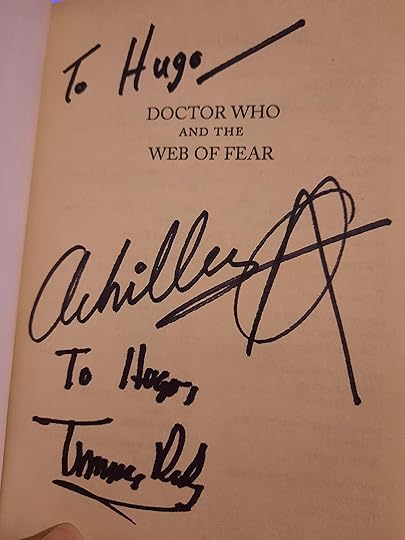
Those few negative things aside, I don’t think I'll ever not enjoy this even if a lot of it is just for the few good memories I had as a child. My copy of this is signed by Terrance Dicks and Chris Achilleos, who have both passed since. I remember them both looking very happy (especially Achilleos) to be there, which intern made me very happy and I’m glad I have something to remember everything by, even if it is just some ink in a little mass printed book that will eventually turn to rot in the sun someday in the far future.
You could probably infer this from the previous paragraph, but 'The Web of Fear' was one of the first books I read totally on my own accord when I was very little, thanks to my Dad fuelling my still-ongoing collection of these target novelisations. I'm not too sure what it was specifically about this one, a lot of Who stories have compelling imagery but the vision of humongous yeti stalking the London Underground (which I'll have you know scared the shit out of 8 year-old-me). This is perfect in book form as the more involved format really lets the imagery linger and stick in your mind, especially when you are an impressionable young child.
This brings me to my point - the juxtaposition of modern London infrastructure with pulp sci-fi aliens is arguably the perfect Doctor Who setup/premise. With a lot of Who plots going off the rough idea of 'familiar things but alien in some form' but this stands out due how the scope is realised. By the start of the story the Great Intelligence (the ‘evil’ of this story) is already in control of England and you are practically thrown into the plot after some brief set up in the first chapter. There is a slight problem with this however; at the end of the first chapter we are told the events of months over the space of about a paragraph. I think the worst part of this is that this information could’ve been told through characters later on and would’ve been far smoother to the reader and just generally more compelling.
The one other obvious flaw that sticks out to me is the very short ending. The book spends about the last 40 pages building suspense, having the characters debate who is under alien influence, all that good stuff, just for the Doctor to say ‘sod this’ and go to the intelligence and the book just sort of ‘finishes’. I get the target word count was low but this is still quite short compared to a few others, so it could’ve been done.
Those few negative things aside, I don’t think I'll ever not enjoy this even if a lot of it is just for the few good memories I had as a child. My copy of this is signed by Terrance Dicks and Chris Achilleos, who have both passed since. I remember them both looking very happy (especially Achilleos) to be there, which intern made me very happy and I’m glad I have something to remember everything by, even if it is just some ink in a little mass printed book that will eventually turn to rot in the sun someday in the far future.

June 25, 2012
It was my first 2nd Doctor experience...and I much prefer the novelization to the surviving episode & soundtrack. I find the titanic reputation of this story somewhat over-rated, but I have no quibbles about the quality of Mr. Dicks' prose at this early stage in the Target range...and I'm a big fan of the 1980s reprint cover.

March 26, 2016
In a World War Two deep level shelter a special military unit tries to protect a team of scientists working on combating an alien menace. London has been evacuated. I really loved Patrick Troughton's era on Doctor Who during my childhood even though I was born too late to see a single episode. The only Second Doctor serial I saw while still a young lad was The Krotons which was part of the Five Faces event. So it was up to the Target books to deliver up the goods. And they did. Base under siege stories I thrilled to and king among them was The Web of Fear. Some might argue that it's just a bunch of folk wandering about in some tunnels but the script by Mervin Haisman & Henry Lincoln is never boring. It's probably no exaggeration to suggest that without Terrance Dicks work for Target the series would have taken far longer to complete. He was invaluable. But the downside was that some of his novelisations were basically the script dialogue dumped onto the page with the barest amount of narrative possible. Not so with Web of Fear. It's obvious throughout that he didn't rush this one and gives it the polish it deserves. There's a great sense of us dropping into a story that is ongoing. The soldiers really seem like they've been through the mill together. They've already suffered losses. They seem like a proper unit rather than being faceless cannon fodder. Captain Knight, Staff Sergeant Arnold, Corp Lane, Corp Blake, Craftsman Weams and later Private Evans (Driver I am).
Dicks makes quite a lot of the first appearance of the Brig (still a Colonel),this time on screen so to speak, stressing how deep the association will one day become, which rather undermines the plot-line that places him as a prime suspect in the mystery of the hidden spy. The whodunit works well providing a strong paranoiac edge for first time readers. It's also fun spotting the clues for us repeat visitors. The broadcast plot is pretty much untouched with only the extra cliff hanger from the previous serial being written out to give the book a cleaner stand alone beginning and some minor tinkerings with the conclusion. He also gives the Doctor alternative ideas about the nature of The Intelligence's manipulation of the revealed spy. I was surprised at how little Dicks makes of the big episode four pitched battle. One page. The mission always did seem pretty senseless I admit and Dicks tries to suggest alternative objectives to the one stated in the broadcast version along with the Colonel's reasons for such a suicidal venture. And a U.N.I.T. shaped light-bulb brightens in the Colonel's head.
My conclusions on why this one works so well are; atmosphere, it feels like the old Quatermass serials crossed with the Gothic eeriness that Hammer excelled at, base under siege with believable soldiers, camaraderie, good dialogue, a sequel that refines the errors of the previous story, time travellers meeting folk at later stages of their lives, a strong female role in Anne Travers who trounces any and all sexism that dares to come within fifty paces, and how can you not like a story that has Yeti battling the army in the claustrophobic tunnels of the London Underground. It remains one of my favourites of the novelisations. Ten year old me would have given this 5 stars, so that remains my rating.
Dicks makes quite a lot of the first appearance of the Brig (still a Colonel),this time on screen so to speak, stressing how deep the association will one day become, which rather undermines the plot-line that places him as a prime suspect in the mystery of the hidden spy. The whodunit works well providing a strong paranoiac edge for first time readers. It's also fun spotting the clues for us repeat visitors. The broadcast plot is pretty much untouched with only the extra cliff hanger from the previous serial being written out to give the book a cleaner stand alone beginning and some minor tinkerings with the conclusion. He also gives the Doctor alternative ideas about the nature of The Intelligence's manipulation of the revealed spy. I was surprised at how little Dicks makes of the big episode four pitched battle. One page. The mission always did seem pretty senseless I admit and Dicks tries to suggest alternative objectives to the one stated in the broadcast version along with the Colonel's reasons for such a suicidal venture. And a U.N.I.T. shaped light-bulb brightens in the Colonel's head.
My conclusions on why this one works so well are; atmosphere, it feels like the old Quatermass serials crossed with the Gothic eeriness that Hammer excelled at, base under siege with believable soldiers, camaraderie, good dialogue, a sequel that refines the errors of the previous story, time travellers meeting folk at later stages of their lives, a strong female role in Anne Travers who trounces any and all sexism that dares to come within fifty paces, and how can you not like a story that has Yeti battling the army in the claustrophobic tunnels of the London Underground. It remains one of my favourites of the novelisations. Ten year old me would have given this 5 stars, so that remains my rating.

Read
April 21, 2018This was a fun little, enjoyable read

June 3, 2024
Rating: 4 stars
Maybe four stars is too much, but this was honestly just what I needed at just the right time. When I finished it, I had half a mind to turn around and start it again.
Maybe four stars is too much, but this was honestly just what I needed at just the right time. When I finished it, I had half a mind to turn around and start it again.

October 2, 2019
A fun diversion after the heavy reading I've been doing recently. Ended a bit abruptly, but then a lot of Patrick Troughton stories do, so you can't really blame Terrance Dicks (RIP King).
May 14, 2020
A really nice novelisation, very easy to read. It is easy, when writing a novelisation, to fall into the trap of making it needlessly descriptive with long and sprawling inner monologues and character flashbacks. Hat's off uncle Terry for creating a very succinct and neat read.
The story had an excellent premise - London has been taken over by a huge alien web plus poison gas plus robot yetis etc. But sadly most of the action was confined to the underground setting of the tube network. I would have loved a bit more action on the surface. I guess the TV production wanted to make full use of their underground set, but surely this is the time for a novelisation to go off kilter a little bit??? There was a lot of running back and forth (classic hallmark of sixties Who) and is it me or was it never really explained whereabouts 'The Fortress' was? I imagined it sort of opening directly onto the tracks, for anyone who cares.
The story had an excellent premise - London has been taken over by a huge alien web plus poison gas plus robot yetis etc. But sadly most of the action was confined to the underground setting of the tube network. I would have loved a bit more action on the surface. I guess the TV production wanted to make full use of their underground set, but surely this is the time for a novelisation to go off kilter a little bit??? There was a lot of running back and forth (classic hallmark of sixties Who) and is it me or was it never really explained whereabouts 'The Fortress' was? I imagined it sort of opening directly onto the tracks, for anyone who cares.

November 12, 2023
A claustrophobic thriller that takes a nearly-tired Who formula (base under siege) and still manages to make it exciting. Dicks is a great translator of screen to page and keeps it fresh. You can tell that introducing a key element of the show’s history (Lethbridge-Stewart) is just as exciting for him as it is for us.

October 8, 2018
A quick paced, enjoyable, adaption, that ensured this story was already a firm favourite of mine long before I got the chance to see the episodes.
There are a lot of very visual sequences of the story, that still work well on the page. The opening chapters especially manage to convey an eerie and spooky atmosphere, in what might otherwise have been dull descriptions of bland scenery (the concrete and cables of the London Underground, and the mundanity of stations, are hardly the most stunning of vistas) ladling on shadows and making the most out of the spectral webs and fogs spreading through London.
The private museum, especially, benefits from a Hammer-esque atmosphere, that remains taut, even as great heaps of backstory are ladled onto us, with all the subtlety of a JCB.
The alien nature of the Intelligence is effectively portrayed, with the question of who can, and can not, be trusted, and who might be under the influence, a much more effective menace than the physical dangers of the robot yeti.
It is not a perfect story, but it is well written, and although some characters are drawn in broad strokes, and a little stereotypical, some effort is made to make them feel well rounded, and believable, if not realistic. The action rattles by at such a pace, that the flaws are more likely to be noticed after you have stopped to think, than during the reading.
There are a lot of very visual sequences of the story, that still work well on the page. The opening chapters especially manage to convey an eerie and spooky atmosphere, in what might otherwise have been dull descriptions of bland scenery (the concrete and cables of the London Underground, and the mundanity of stations, are hardly the most stunning of vistas) ladling on shadows and making the most out of the spectral webs and fogs spreading through London.
The private museum, especially, benefits from a Hammer-esque atmosphere, that remains taut, even as great heaps of backstory are ladled onto us, with all the subtlety of a JCB.
The alien nature of the Intelligence is effectively portrayed, with the question of who can, and can not, be trusted, and who might be under the influence, a much more effective menace than the physical dangers of the robot yeti.
It is not a perfect story, but it is well written, and although some characters are drawn in broad strokes, and a little stereotypical, some effort is made to make them feel well rounded, and believable, if not realistic. The action rattles by at such a pace, that the flaws are more likely to be noticed after you have stopped to think, than during the reading.

April 19, 2013
The base under attack theme continues, this time in the London Underground. Not sure if my opinion of Terrance Dicks will be the same once I hit the Fourth Doctor books, but he has written a decent book.
It falls under the Target series of writing of cramming the story into the set number of pages. However, Dicks has been able to still bring the show to life in the pages. He even gives a proper introduction between Lethbridge-Stewart and the Doctor, which occurred off camera in the original series.
Overall the story moves at a good pace and the plot of the base under attack is given a good twist again. Though while reading you are relying I found myself just imaging the locations from the images left from the TV episode to get through the story, since there is not much description give to the characters or locations.
So a quick book to read to wet your apatite for the Doctor, but enough to help you "see" this story that is one of the lost stories.
It falls under the Target series of writing of cramming the story into the set number of pages. However, Dicks has been able to still bring the show to life in the pages. He even gives a proper introduction between Lethbridge-Stewart and the Doctor, which occurred off camera in the original series.
Overall the story moves at a good pace and the plot of the base under attack is given a good twist again. Though while reading you are relying I found myself just imaging the locations from the images left from the TV episode to get through the story, since there is not much description give to the characters or locations.
So a quick book to read to wet your apatite for the Doctor, but enough to help you "see" this story that is one of the lost stories.

April 12, 2008
The Doctor, Jamie and Victoria encounter killer robot Yeti again--this time with the added bonus of killer fungal growths! I love when time travellers meet people they knew at some other point in time.

May 2, 2025
Terrance Dicks in novelizing Doctor Who and the Abominable Snowmen he largely wrote it to include Buddhist philosophy closer to actual beliefs than what made it on-screen in Mervyn Haisman and Henry Lincoln’s scripts, as well as being able to generally improve the pace and depth of the story. It very much showed that Dicks could novelize a story that he had no involvement with on television, something that would eventually cement him as the main novelist for the range through much of the 1970s and 1980s. His second commission for a story he had nothing to do with was Doctor Who and the Loch Ness Monster early in 1976, but it was a no brainer that after Doctor Who and the Abominable Snowmen Dicks would be brought back to novelize The Web of Fear into Doctor Who and the Web of Fear. Now, this is another one of those novelizations that only would have had the scripts to work off, until 2013 most of the serial was missing apart from the first episode and this was even before the audit of the archive to see what survived. Now the tricky part about talking about Doctor Who and the Web of Fear is that adding depth was something Dicks set out to do with Doctor Who and the Abominable Snowmen because it was a serial that desperately needed it, but The Web of Fear on almost every level is a stronger serial. Dicks very easily could have gotten the scripts into prose format and called it a day much like he would do with later novelizations mostly due to overwork, and 1976 was very much a busy year for Dicks, between Doctor Who and the Loch Ness Monster and this Dicks had done Doctor Who and the Revenge of the Cybermen and Doctor Who and the Genesis of the Daleks.
Instead of phoning it in, Dicks actually approaches Doctor Who and the Web of Fear with the intent on making it work as a book, using the pacing of a film almost as a blueprint for the way things are paced. The depth added here isn’t the same kind of depth as Doctor Who and the Abominable Snowmen, outside of renaming the rather unfortunate Jewish stereotype in the first episode to be less so. Some of the events in the first half of the story are rearranged to flow better into one another, the misunderstanding between Victoria and the Travers’ in particular is softened and from Victoria’s perspective so the audience knows just how nervous she has been in particular, and the Doctor actually has a part to play in the adaptation of the second episode. This is the second novelization that Target had done that was adapting a story where a regular was missing from an episode, the first being Gerry Davis’ adaptation of Doctor Who and the Tenth Planet which was only hastily rewritten to accommodate William Hartnell’s illness. Dicks adds an in depth sequence of the Doctor meeting and coming to trust Colonel Lethbridge-Stewart, complete with the omniscient narrator reflecting on how this will grow and what will become UNIT will become a bigger part of the Doctor’s life. The novelization even ends with the suggestion being made off-handedly to form a sort of military organization to deal with alien threats.
Dicks as a novelist is also desperately having to compensate for the fact that he cannot emulate Douglas Camfield’s direction onto the page. This isn’t without trying, Dicks is using the scripts after all and the first chapter is a great little horror story adapting the early scenes of the Yeti coming to life, and then that quickly spiraling out of control. It wasn’t necessary to add the pieces on how long it took for the invasion to actually come in full force and brief touching on Travers being suspected in it, but it was very much appreciated. Dicks knows when to compress and when to expand because he cannot emulate Camfield’s style in prose, he’s writing very much for the action and not the horror. Dicks doesn’t really excel at horror, but the tension is there and the mystery while still probably the weakest aspect is there. The exasperation of the story still comes through with how the characters behave.
Overall, Doctor Who and the Web of Fear is an excellent novel, it would have been at least enjoyable if Terrance Dicks had phoned it in, but he doesn’t. There aren’t really plot additions, but Dicks actually had the time and care to look at how he could translate the story from the screen to the page while capturing why this was one that stuck in people’s minds for so long even when it turned out to be nearly entirely missing. 9/10.
Instead of phoning it in, Dicks actually approaches Doctor Who and the Web of Fear with the intent on making it work as a book, using the pacing of a film almost as a blueprint for the way things are paced. The depth added here isn’t the same kind of depth as Doctor Who and the Abominable Snowmen, outside of renaming the rather unfortunate Jewish stereotype in the first episode to be less so. Some of the events in the first half of the story are rearranged to flow better into one another, the misunderstanding between Victoria and the Travers’ in particular is softened and from Victoria’s perspective so the audience knows just how nervous she has been in particular, and the Doctor actually has a part to play in the adaptation of the second episode. This is the second novelization that Target had done that was adapting a story where a regular was missing from an episode, the first being Gerry Davis’ adaptation of Doctor Who and the Tenth Planet which was only hastily rewritten to accommodate William Hartnell’s illness. Dicks adds an in depth sequence of the Doctor meeting and coming to trust Colonel Lethbridge-Stewart, complete with the omniscient narrator reflecting on how this will grow and what will become UNIT will become a bigger part of the Doctor’s life. The novelization even ends with the suggestion being made off-handedly to form a sort of military organization to deal with alien threats.
Dicks as a novelist is also desperately having to compensate for the fact that he cannot emulate Douglas Camfield’s direction onto the page. This isn’t without trying, Dicks is using the scripts after all and the first chapter is a great little horror story adapting the early scenes of the Yeti coming to life, and then that quickly spiraling out of control. It wasn’t necessary to add the pieces on how long it took for the invasion to actually come in full force and brief touching on Travers being suspected in it, but it was very much appreciated. Dicks knows when to compress and when to expand because he cannot emulate Camfield’s style in prose, he’s writing very much for the action and not the horror. Dicks doesn’t really excel at horror, but the tension is there and the mystery while still probably the weakest aspect is there. The exasperation of the story still comes through with how the characters behave.
Overall, Doctor Who and the Web of Fear is an excellent novel, it would have been at least enjoyable if Terrance Dicks had phoned it in, but he doesn’t. There aren’t really plot additions, but Dicks actually had the time and care to look at how he could translate the story from the screen to the page while capturing why this was one that stuck in people’s minds for so long even when it turned out to be nearly entirely missing. 9/10.
August 18, 2022
For my second ever Doctor Who novelisation and first with the limitations of Target, The Web of Fear made perfect sense. It's my second favourite Troughton story by the man behind the best era of the series, so even if it didn't add as much to the story as Whitaker's early attempts, I'd still be able to find enjoyment in a strong writing style delivering a good story. And boy, was that enjoyment crucial in the end. I wasn't surprised to find Dicks sticking close to the script - I did my research in picking a Second Doctor novelisation (at some point, I must have decided to read a novelisation per Doctor?) - but it really can't be understated just how much this exists in service of the serial, and not as its own product.
That being said, what is new enriches the story tenfold. Most importantly (but least talked about) is the strengthened bond established in the opening with prequel story The Abominable Snowmen, as well as with the rest of this novel. We could probably figure out that Travers wouldn't be believed for his involvement with the prior tale, but an effort is made here to explain how he's still held in any regard. We equally get to see the consequences of Travers being in the wrong place at the wrong time which are glossed over in the show, even if it's only a paragraph. Slightly less crucial (but the most talked about) is that it finally shows The Doctor and later-Brigadier Lethbridge-Stewart's first meeting. We already got a good idea of how it went from the show, but since it happened off-screen, this novel is the only time we actually get to experience their exchange of words.
It's in Lethbridge-Stewart that this novelisation is given life in the scenes that appear in the show. You can tell that Dicks is excited to be able to write the iconic character's first appearance with the depth that got added on throughout the character's 70s appearances (that is to say, between this serial and this novelisation). Whether it be gleefully foreshadowing future events or simply peppering his actions, the Brigadier's presence is well worth the price of admission alone. And combined with a solid writing style that makes you feel like you're reading a novel and not just a retelling of the script, that's enough to justify reading more of these novelisations to me.
That being said, what is new enriches the story tenfold. Most importantly (but least talked about) is the strengthened bond established in the opening with prequel story The Abominable Snowmen, as well as with the rest of this novel. We could probably figure out that Travers wouldn't be believed for his involvement with the prior tale, but an effort is made here to explain how he's still held in any regard. We equally get to see the consequences of Travers being in the wrong place at the wrong time which are glossed over in the show, even if it's only a paragraph. Slightly less crucial (but the most talked about) is that it finally shows The Doctor and later-Brigadier Lethbridge-Stewart's first meeting. We already got a good idea of how it went from the show, but since it happened off-screen, this novel is the only time we actually get to experience their exchange of words.
It's in Lethbridge-Stewart that this novelisation is given life in the scenes that appear in the show. You can tell that Dicks is excited to be able to write the iconic character's first appearance with the depth that got added on throughout the character's 70s appearances (that is to say, between this serial and this novelisation). Whether it be gleefully foreshadowing future events or simply peppering his actions, the Brigadier's presence is well worth the price of admission alone. And combined with a solid writing style that makes you feel like you're reading a novel and not just a retelling of the script, that's enough to justify reading more of these novelisations to me.

July 7, 2026
This review is going to be a mess, because I am a mess.
I had such fun reading Terrance Dicks's novelisation of The Abominable Snowmen last month, not only for the fun of the story and delight of the characters that I so ADORE, but the palpable respect and love Dicks had for them too - particularly having the most respectful portrayal of Victoria I've ever read, and being accurate to lovely Jamie's loveliness.
I do wish this had been illustrated like its predecessor! But comparison is the thief of joy.
Instantly the introductory paragraph of The Doctor and Jamie had me in hysterics, especially describing Jamie as towering over him - no Doctor Who fan really knows who was taller!
Jamie's first line of dialogue? The crowd goes wild. I go wild. Keeping His accent even in print! Mwah.
I know most of my praise of this can be boiled down to praise of the brilliant story it's based on, but oh my god I could not stop giggling when The Doctor thought Jamie and Victoria were tricking him and Jamie got frustrated with him.
I had forgotten this was the Brig's first appearance, and he was only a Colonel at this point! 🫡
Jamie jumping out and saying Boo! to Evans made me laugh so hard I nearly PUKED.
Also. Have I ever mentioned I love Victoria, and I love Terrance Dicks for understanding her. Her fear for Jamie and reprimanding The Doctor for supposedly forgetting about Him is so so important to me. The Doctor then assuring Victoria that he hasn't forgotten Jamie and explaining he needs to protect everyone made me want to GNAW MY OWN ARM OFF. If you know, you know.
'Smoking's very bad for you.' 😒 (me problem)
Once again it has been a hot minute since I watched this story, but it played out quite wonderfully in my mind's eye as I read! I don't have anything else by Dicks but I hope he did more Second Doctor stories, whether based on episodes or original adventures. It really means a lot to me how he understands and respects these characters.
I had such fun reading Terrance Dicks's novelisation of The Abominable Snowmen last month, not only for the fun of the story and delight of the characters that I so ADORE, but the palpable respect and love Dicks had for them too - particularly having the most respectful portrayal of Victoria I've ever read, and being accurate to lovely Jamie's loveliness.
I do wish this had been illustrated like its predecessor! But comparison is the thief of joy.
Instantly the introductory paragraph of The Doctor and Jamie had me in hysterics, especially describing Jamie as towering over him - no Doctor Who fan really knows who was taller!
Jamie's first line of dialogue? The crowd goes wild. I go wild. Keeping His accent even in print! Mwah.
I know most of my praise of this can be boiled down to praise of the brilliant story it's based on, but oh my god I could not stop giggling when The Doctor thought Jamie and Victoria were tricking him and Jamie got frustrated with him.
I had forgotten this was the Brig's first appearance, and he was only a Colonel at this point! 🫡
Jamie jumping out and saying Boo! to Evans made me laugh so hard I nearly PUKED.
Also. Have I ever mentioned I love Victoria, and I love Terrance Dicks for understanding her. Her fear for Jamie and reprimanding The Doctor for supposedly forgetting about Him is so so important to me. The Doctor then assuring Victoria that he hasn't forgotten Jamie and explaining he needs to protect everyone made me want to GNAW MY OWN ARM OFF. If you know, you know.
'Smoking's very bad for you.' 😒 (me problem)
Once again it has been a hot minute since I watched this story, but it played out quite wonderfully in my mind's eye as I read! I don't have anything else by Dicks but I hope he did more Second Doctor stories, whether based on episodes or original adventures. It really means a lot to me how he understands and respects these characters.
February 21, 2021
Another one between 4 and 5 as the strong run continues :) The return of the Yeti and the Great Intelligence, not long after they were first introduced (feels like the first time we've had such a direct follow up in the same season). They lose a little bit of the mystery, given we learnt a lot about them in the first story, so it is less about them and more about defeating them as such, making them a bit more one dimensional, but adding to the tale the concern and suspicion around a likely agent for the Intelligence having infiltrated the base.
And definitely another base under siege one this one (as most of this season seems to have been), but another good one, and we also get to meet Alistair Lethbridge-Stewart for the first time, and the significance of this is highlighted strongly in the novel.
While I don't think this was intended as a forerunner of the Third Doctor UNIT stories, it very much feels in a similar vein, and potentially showed the showrunners how successful this sort of story could be, leading to them doing a more true forerunner in the Invasion in the next season.
Jamie and Victoria get a bit more to do in this story, and we see the return of a character from the Abominable Snowman - an unusual event as well for these early stories - plus a relation of that character. A lot of the one off characters in the story as well, but all add to the story, and nicely had a reasonable host of characters to be suspicious of.
Regarding that latter point, likely would have been different when first airing, but of course now we know it would never be Lethbridge-Stewart, but at the time I imagine we would have been a strong suspect.
Victoria does seem to make a couple of odd choices, and land in the damsel in distress role again unfortunately, which does detract a bit. Plus the book moves at a fair pace, when I think a longer page count, and more time to build the story would have made it even better.
And definitely another base under siege one this one (as most of this season seems to have been), but another good one, and we also get to meet Alistair Lethbridge-Stewart for the first time, and the significance of this is highlighted strongly in the novel.
While I don't think this was intended as a forerunner of the Third Doctor UNIT stories, it very much feels in a similar vein, and potentially showed the showrunners how successful this sort of story could be, leading to them doing a more true forerunner in the Invasion in the next season.
Jamie and Victoria get a bit more to do in this story, and we see the return of a character from the Abominable Snowman - an unusual event as well for these early stories - plus a relation of that character. A lot of the one off characters in the story as well, but all add to the story, and nicely had a reasonable host of characters to be suspicious of.
Regarding that latter point, likely would have been different when first airing, but of course now we know it would never be Lethbridge-Stewart, but at the time I imagine we would have been a strong suspect.
Victoria does seem to make a couple of odd choices, and land in the damsel in distress role again unfortunately, which does detract a bit. Plus the book moves at a fair pace, when I think a longer page count, and more time to build the story would have made it even better.
This entire review has been hidden because of spoilers.

November 23, 2024
Based on a script by Mervyn Haisman and Henry Lincoln this is number 72 in the Target catalogue. All 3 of the most prolifc Target cover artists have had a go at this one. Chris Achilleos did the first cover with the web background. Andrew Skilleter did the second without the Doctor, and Alister Pearson did the third
Pg 41
‘I am Colonel Alistair Gordon Lethbridge-Stewart ,’ said the precise, military voice.
‘How do you do? I am the Doctor.’
‘Are you now? Well then, Doctor whoever-you-are, perhaps you’d like to tell me what you’re doing in these tunnels?’
Does anything more need to be said about this book. ‘Twas a joy to read. I love the Brig. He’s so unflappable and the perfect counterpoint to the Doctor.
It’s interesting that Terrance includes 2 narrative interludes of the future relationship between the Doctor and the Brig and UNIT. It wasn’t known at the time of this episode being written how central UNIT and the Brig would become, but by the time the noveisation was written they were well entrenched. These seemed a little out of place, but I can understand why they were included.
Of the two Yeti stories this is the one I much prefer. All the elements come together much better than in the first story. Characters like Staff Sergeant Arnold and Private Evans I find much more memorable than the monks. Even Chorley, who’s a weasel I find more memorable.
Terrance has largest number of Targets by a single author and I like the way he does them. The writing is clear and concise. He sticks faithfully to the storyline. His characterisation matches the broadcast version
I might be a little over-generous with my enthusiasm for this book due to my love of the Brig, but it’s one I will happily re-read multiple times. I should probably pick up a battered reading copy so I can keep my collection ones in good condition. Reading a book doesn’t aid it’s preservation.
Pg 41
‘I am Colonel Alistair Gordon Lethbridge-Stewart ,’ said the precise, military voice.
‘How do you do? I am the Doctor.’
‘Are you now? Well then, Doctor whoever-you-are, perhaps you’d like to tell me what you’re doing in these tunnels?’
Does anything more need to be said about this book. ‘Twas a joy to read. I love the Brig. He’s so unflappable and the perfect counterpoint to the Doctor.
It’s interesting that Terrance includes 2 narrative interludes of the future relationship between the Doctor and the Brig and UNIT. It wasn’t known at the time of this episode being written how central UNIT and the Brig would become, but by the time the noveisation was written they were well entrenched. These seemed a little out of place, but I can understand why they were included.
Of the two Yeti stories this is the one I much prefer. All the elements come together much better than in the first story. Characters like Staff Sergeant Arnold and Private Evans I find much more memorable than the monks. Even Chorley, who’s a weasel I find more memorable.
Terrance has largest number of Targets by a single author and I like the way he does them. The writing is clear and concise. He sticks faithfully to the storyline. His characterisation matches the broadcast version
I might be a little over-generous with my enthusiasm for this book due to my love of the Brig, but it’s one I will happily re-read multiple times. I should probably pick up a battered reading copy so I can keep my collection ones in good condition. Reading a book doesn’t aid it’s preservation.
January 21, 2022
”The huge, furry monster reared up, as if to strike.”
What a delightful novelisation, doing what a Target is born to do in faithfully capturing the spirit of the story while also fine-tuning parts of it for prose.
Not only do we get the iconic first meeting between the Doctor and the Brigadier - something that was actually absent in the televised version - but there’s a great sense of pace and structure to each chapter, ending on a suitable cliffhanger to ratchet up the tension. It means reading this version wasn’t a chore or an obligation but a fine compliment to the televised story.
We see subtle improvements, like the sections detailing the advance of the web and mist (fleshing out something noticeably absent in the televised version), the decision to give the Intelligence its own menacing voice as opposed to using that of its hosts (which, on screen, may retrospectively have been a bit naff), removing the Jewish stereotype in the opening and tightening a few scenes here and there for sake of brevity. I adore the references to other stories and the footnotes imploring readers to check out other Target books, including some prolepsis that recognises the importance of this serial to wider Who canon. Smart business sense indeed, especially for readers in the ‘70s who may not have even seen the original serial.
All in all, he suitably conveys the tension and atmosphere we get on screen without being too laborious or self-indulgent.
What a delightful novelisation, doing what a Target is born to do in faithfully capturing the spirit of the story while also fine-tuning parts of it for prose.
Not only do we get the iconic first meeting between the Doctor and the Brigadier - something that was actually absent in the televised version - but there’s a great sense of pace and structure to each chapter, ending on a suitable cliffhanger to ratchet up the tension. It means reading this version wasn’t a chore or an obligation but a fine compliment to the televised story.
We see subtle improvements, like the sections detailing the advance of the web and mist (fleshing out something noticeably absent in the televised version), the decision to give the Intelligence its own menacing voice as opposed to using that of its hosts (which, on screen, may retrospectively have been a bit naff), removing the Jewish stereotype in the opening and tightening a few scenes here and there for sake of brevity. I adore the references to other stories and the footnotes imploring readers to check out other Target books, including some prolepsis that recognises the importance of this serial to wider Who canon. Smart business sense indeed, especially for readers in the ‘70s who may not have even seen the original serial.
All in all, he suitably conveys the tension and atmosphere we get on screen without being too laborious or self-indulgent.
August 7, 2020
Typical of Terrance Dicks, this is an enjoyable adaptation of a Troughton story that has been released on dvd only a few years ago. As each episode on the disc has it's own 'chapters' the inlay booklet was very helpful. Like a lot of the Target novels, this one had to fit 6 episodes of material into 127 pages. The end of episode 1 is on pg 36. Terrance must have found ep 2 extremely boring as he skips it altogether in the book, with episode 3 starting on pg 40 with the introduction of Colonel Lethridge Stewart. This leads into another odd bit of narration from Dicks - he goes on to explain how good friends the Doctor and the Colonel become after Troughton regenerates into Pertwee. I say this is odd, purely because it completely ignores the next time they meet during The Invasion. Despite these oddities, this is a very quick read and a fairly accurate adaptation of 5 of the episodes. I'm off now to watch ep 2 to see exactly how boring it really was. Until my review of 'Fury from the Deep', roll credits and theme music.

March 7, 2023
Where do I begin with this one? Surely this is the pinnacle of Doctor Who storytelling! An eerie, base-under-siege story with memorable monsters and enough menace to make all Who fans happy, 'The Web of Fear' is a masterpiece.
Having watched the existing episodes of this serial many times over the years since it's partial discovery in 2013, I wasn't sure whether the novelisation would offer anything substantial to me. However, Terrance Dicks' prose is so well-written, I just couldn't put the book down. The characterisations of the Doctor and his two companions are exquisite, with Jamie's Scottish accent bleeding through so clearly.
The intrigue about who is working alongside the Intelligence is compelling, even though I've seen the TV serial (and even though the original front cover of the book gives it away!) works so well. You are constantly left wondering which of the suspicious group is guilty of being possessed as it could feasibly be any of them apart from the regulars.
The attack at Covent Garden is beautifully done too. It's the sort of sequence that works well on screen when directed by Douglas Camfield, but I was worried it would not translate all that well to prose. Nevertheless, it's effectively handled and the sheer futility of the Army's attack is abundantly clear.
Lastly, the story is the introduction of Colonel (later Brigadier) Lethbridge-Stewart, played on TV by Nicholas Courtney. Whilst the TV version skirts around a proper introduction between the Colonel and the Doctor, this is fixed for the book and there is a lovely scene of the pair meeting for the first time. If you're yet to give the Target books a read, this is a great one to start with.
Having watched the existing episodes of this serial many times over the years since it's partial discovery in 2013, I wasn't sure whether the novelisation would offer anything substantial to me. However, Terrance Dicks' prose is so well-written, I just couldn't put the book down. The characterisations of the Doctor and his two companions are exquisite, with Jamie's Scottish accent bleeding through so clearly.
The intrigue about who is working alongside the Intelligence is compelling, even though I've seen the TV serial (and even though the original front cover of the book gives it away!) works so well. You are constantly left wondering which of the suspicious group is guilty of being possessed as it could feasibly be any of them apart from the regulars.
The attack at Covent Garden is beautifully done too. It's the sort of sequence that works well on screen when directed by Douglas Camfield, but I was worried it would not translate all that well to prose. Nevertheless, it's effectively handled and the sheer futility of the Army's attack is abundantly clear.
Lastly, the story is the introduction of Colonel (later Brigadier) Lethbridge-Stewart, played on TV by Nicholas Courtney. Whilst the TV version skirts around a proper introduction between the Colonel and the Doctor, this is fixed for the book and there is a lovely scene of the pair meeting for the first time. If you're yet to give the Target books a read, this is a great one to start with.

March 22, 2023
Doctor Who and the Web of Fear (1976) by Terrance Dicks is the novelisation of the fifth serial of the fifth series of Doctor Who.
The Second Doctor, Jamie and Victoria are in the TARDIS and are grabbed by a mysterious force. They then land in London forty years after the events of Doctor Who and the Abominable Snowmen. The Yetis are back and this time there is also a mysterious web that is taking over London.
The Doctor and crew meets Professor Travers who had previously met in Nepal. Travers had taken some artifacts from Nepal including some Yetis and some of their control spheres. The intelligence is using them again.
The Doctor also meets Brigadier Lethbridge-Stewart for the first time. The novelisation was written when the Brigadier’s role had become larger so Dicks gives it more importance.
Doctor Who and the Web of Fear is an OK serial. The Intelligence isn’t really a great bad guy. But the introduction of the Brigadier makes the serial noteworthy for Doctor Who fans.
The Second Doctor, Jamie and Victoria are in the TARDIS and are grabbed by a mysterious force. They then land in London forty years after the events of Doctor Who and the Abominable Snowmen. The Yetis are back and this time there is also a mysterious web that is taking over London.
The Doctor and crew meets Professor Travers who had previously met in Nepal. Travers had taken some artifacts from Nepal including some Yetis and some of their control spheres. The intelligence is using them again.
The Doctor also meets Brigadier Lethbridge-Stewart for the first time. The novelisation was written when the Brigadier’s role had become larger so Dicks gives it more importance.
Doctor Who and the Web of Fear is an OK serial. The Intelligence isn’t really a great bad guy. But the introduction of the Brigadier makes the serial noteworthy for Doctor Who fans.

April 27, 2025
Terrence Dicks is back adapting the High Intelligence in Doctor Who and the Web of Fear, and I'm sure he salivated at the chance to write the Doctor's first meeting with Brigadier (then Colonel) Lethbridge-Stewart! Already a solid military thriller, Dicks reorders some scenes to avoid Troughton's holiday onscreen, but generally to make things move more smoothly. He also gives us brief, but pithy backgrounds for most of the characters, covering in particular the interim between The Abominable Snowmen and this (with Travers). Since the Brig can't possibly be the High Intelligence stooge, he does a better job of throwing shade on other characters, and because he knows the future of the show, can't help but sow the seeds of UNIT and the Doctor/Brigadier friendship. That's something that could not have been known at the time, but is not too much of a retcon and therefore met with a smile a decade on in this novelisation.
April 18, 2018
One of my all time favourite doctor who books and tv serials. Everything about this screams gothic. I love the London Underground, I love the cobwebs and mad scientists (and women in science represented properly in the 1960’s). I love Brig left bridge - Stuart and his introduction to the doctor. I love Jamie and the yeti’s and the GI (when it really knew how to do things). The writing of the book is fantastic with just enough background to the abominable Snowman to make sure you know what’s happening and why, but not over clumping the beginning.
Onwards we get insight into the characters and the book follows the plot faithfully. No complaints, a good starter for anyone not versed in who. A true classic.
Onwards we get insight into the characters and the book follows the plot faithfully. No complaints, a good starter for anyone not versed in who. A true classic.
April 8, 2025
Terrance Dicks always was the best novelist when it came to the Target books, and The Web Of Fear doesn't fail to deliver. It keeps the claustrophobic spirit of the original story and features some welcome small additions such as the first proper meeting of the Doctor and the Brigadier, which happened off-screen in the televised serial, and a more passive reaction from the Doctor to the ending.
The chapter 'cliff-hangers' do, sadly, get a little redundant after a while since they also mostly do the same 'Uh oh! Blocked off!' thing and get resolved the same 'Ah he didn't actually see us' kind of way, but that's more the fault of the original script and Dicks still managed to make this an enjoyable read.
The chapter 'cliff-hangers' do, sadly, get a little redundant after a while since they also mostly do the same 'Uh oh! Blocked off!' thing and get resolved the same 'Ah he didn't actually see us' kind of way, but that's more the fault of the original script and Dicks still managed to make this an enjoyable read.
May 23, 2019
I did really enjoy this book, it like all Doctor Who books was good for showing an example of a philosophical fallacy, in this case the fallacy of false cause. The doctor was accused of being in league with the villain, as he was present on both occasions in Tibet and the underground in London where encounters with the yeti occurred, and because of this he was accused of being the cause of this it was interesting to see the doctors way of dealing with the issue.
Not a very sophisticated book however a fun read.
Not a very sophisticated book however a fun read.

January 22, 2026
I enjoyed this story a lot as it was a sequel of sorts for Doctor Who and the Abominable Snowman. Additionally, it marks the first appearance of Alistair Gordon Lethbridge-Stewart, one of my favorites. I also liked the fact that it takes place almost exclusively in the London Underground. It was all very nicely done; unfortunately, this is one of the missing episodes. Thankfully, only one part is still missing, which they have animated, so you can now watch it in its entirety. I will see if I can get my hands on it.

March 31, 2026
[audio] David Troughton does an absolutely fantastic job with this to the extent that his portrayal of his actual dad may be the weakest thing but that's a comment on how great the rest of it is. His Jamie is particularly stellar.
This is what I want in a novelisation/audio of a Doctor Who story - especially one with missing episodes. It fleshes it out but keeps the pacing tight and engaging, has character depth without losing story focus and feels like it's honouring the original. Terrance Dicks really was the master of his craft
This is what I want in a novelisation/audio of a Doctor Who story - especially one with missing episodes. It fleshes it out but keeps the pacing tight and engaging, has character depth without losing story focus and feels like it's honouring the original. Terrance Dicks really was the master of his craft
Displaying 1 - 30 of 74 reviews