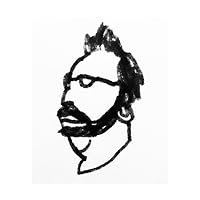
Award-winning author Gary Barwin has written poems, novels and books for children. He’s composed music, created multimedia art and performed around the world. Now he has turned his talented pen to essays. In Imagining Essays on Language, Identity and Infinity Barwin thinks deeply about big story and identity; art and death; how we communicate and why we dream. From his childhood home in Ireland to his long-time home in Hamilton, Barwin shares the thoughts that keep him up at night (literally) and the ideas that keep him creating. Filled with witty asides, wise stories and a generosity of spirit that is unmistakable, these are essays that readers will turn to again and again.
GARY BARWIN is a writer, composer, and multidisciplinary artist and the author of 21 books of poetry, fiction and books for children. His bestselling novel [Book: Yiddish for Pirates] won the 2017 Stephen Leacock Medal for Humour and was a Governor General’s Award and Scotiabank Giller Prize finalist and has recently been longlisted for the Leacock Medal. His latest poetry collection is No TV for Woodpeckers His work has appeared widely in journals, including Poetry (Chicago), The Walrus and the Paris Review blog. A finalist for the National Magazine Awards (Poetry), he is a three-time recipient of Hamilton Poetry Book of the Year, and has also received the Hamilton Arts Award for Literature. He is was Writer-in-Residence at Western University and the London Public Library and is currently Art Forms Writer-in-residence for at-risk youth and will be Writer-in Residence at McMaster University and the Hamilton Public Library in 2017-2018. Barwin lives in Hamilton, Ontario and at garybarwin.com
Magics in the Hebrew alphabet. Musics as frames for existence. Sleep and infinity. Writing and ostriches. Ephemera. Death. Diasporas. The ampersand. Humour (duh). Walking. The pleasures of the magazine. How to view the past. Brokenness.
Imagining Imagining—a collection of essays by magnificent national treasure Gary Barwin—is a quirky, sure-footed delight.
Familiar and astonishing. I kept ricocheting between those two adjectives as I read Gary Barwin’s collection Imagining Imagining: Essays on Language, Identity and Infinity. The repetition in the title and the sleight-of-hand shift from verb to noun produced by this echoing is a good indication of the profound linguistic playfulness readers can expect from these essays.
Barwin is a poet and fiction writer, perhaps best known to many readers for his award-winning novel Yiddish for Pirates. He is also a musician, greatly influenced by jazz (as many poets are) and that talent is most evident in the way he riffs on words by twisting their sound and meaning to get his point (and he does have one) across. In one essay, titled John Coltrane Was My Bar Mitzvah Teacher, he discusses at length his relationship to music. He ends one section of an essay called On Between with this little Charlie Parkeresque wail: “One person’s manbun is another’s mantra. Is it true that someone’s pain is my pain and it is only the self and society which create reasons to keep them at a distance? I want my thinking and feeling to reflect the fundamental unipanrhizomatubiquity between/of things.”
Mind. Blown.
In another essay entitled Flying Is Just Falling with Good PR: On Writing, he ends with this this stanza-like section:
“Who’s on first but What is the theory of writing. What can one write of saying? What can one say of writing? It’s like flying with bad PR. So, like falling then. So, write again and fall. Fall again. Fall better. Even silence has something to say. Some bird has just or is just about to sing.”
Really? Fall again. Fall better. Anyone who could so easily repurpose Samuel Beckett’s dictum, “Fail again. Fail better.” to suit his own needs has not only earned my respect, he’s pulled it out of his sleeve and handed it back to me as a bouquet of fresh flowers.
Did I mention that Barwin is also a visual artist? His appreciation of language as a visual medium comes right out of the gate with the book’s first essay Broken Light: the Alefbeit and What’s Missing, where he credits his early learning of Hebrew with drawing (double-entendre alert!) him into the world of language and clueing him in to their optical properties. “And Hebrew, at least in the traditional shapes, seemed to preserve the motions of ink and brush, the motions of a scribe not writing so much as drawing the letters, his hand floating above the parchment like a hovering bird.” Elsewhere, he likens the ampersand to “a miniature mother & child – the mother embracing her child, their conjunction – but also a kind of Möbius strip, a twisting ouroboros.” In Meat and Bones he describes the letter W as “also a kind of pelvis, hippy and with spaces where other things go.”
I started this review with the words “familiar” and “astonishing” and so far, I’ve only spoken of these essays in terms of the latter. As Barwin quotes neurobiologist, Suzanna Herculano-Houzel: “Brains can appear diverse, and at the same time share profound similarities.” So, let me say something on what I found familiar about the writerly points of view espoused in many of Barwin’s essays. At the centre of the ping-ponging pinball of his extraordinary imagination and far-reaching curiosity he is surprisingly grounded in his identity as a writer. To say I found this comforting, would be an understatement. To say that I felt we were, in some fashion, simpatico, again would not quite be nailing it on the head. Perhaps, it’s because after twenty-two years of floundering my way through my own journey as a “writer” – and sometimes calling myself one only in a fake-it-till-you-make-it kind of self-indoctrination – I’m now starting to actually feel like one. So, to read Barwin express the certainty of his calling with such heartfelt gravitas, is in some way akin to finding a signpost telling me that I’m on the right path. There is nothing surprising or illuminating about this discovery. It is familiar in that it is something I suspected was there all along, although I didn’t always believe it. That he describes writing as almost a way of breathing, a way of seeing and knowing, a fundamental weave in the fabric of his being (often connected to the diasporic history of his family) feels almost commonplace to read.
It feels so familiar that I can’t help but be astonished by it.
But personal revelations aside, I entreat anyone, whether you are writer or reader or some combination thereof, to dive deep into these essays from the get go. There’s no dipping your toe in to test the waters. It’s like going for a polar swim on the first day of the new year. You have to jump in without thinking, without expectations. But unlike a polar swim, once you’ve immersed yourself in Imagining Imagining, you’ll never want to come up for air.
Beautifully written essays on imagination, literature and identity. These were definitely written by someone who has faced no real tragedies and has a much more upbeat perspective on the world and human nature as a result, and it resonated with me less as a result, but I'm glad I read it and look forward to reading more of his work.