

What do you think?

Sahilde
İngiltere'nin seçkin ve varlıklı bir ailesinden, keman öğrencisi Florence ile, babası bir kasaba okulunda müdür olan Edward, evlendikleri gün Chesil sahilinde bir otele, balayını geçirmeye giderler. 60'lı yılların başında, tabuların henüz yıkılmadığı, cinsel özgürlüklerin açıkça konuşulmadığı, toplumsal baskıların kendini hissettirdiği, karşı cinsten iki kişinin ancak evlilikte birleşebildiği günlerde geçen Sahilde, aslında bir akşam yemeğinde başlayıp şafak sökerken biten uzun, sessiz ama duygu fırtınalarıyla geçen bir sahne.
İngiliz toplumunun farklı sınıflarından gelen, evliliğe ve cinselliğe farklı açılardan bakan bu iki genç, o otelde geçirdikleri birkaç saat boyunca, bulundukları ânın gerçeğine uyum sağlayabilmek için çabalarken, ister istemez geçmişlerine doğru acıtan bir yolculuğa da çıkarlar. Tiksinmekle zevk almak arasındaki gizli bağı kurcalayan, çoğumuzun içinde var olan iki kişiliğin arasındaki mesafeye yuva kuran korkuları ve içsel çelişkileri de ustalıkla anlatan ve beklenmedik, çarpıcı bir sonla biten bu küçük roman, aşkın her şeye çözüm olup olmayacağı sorusunu da yanıtlamaya çalışıyor.
Aynı zamanda, Ian McEwan ustalığıyla, dünyanın hemen her yerinde çarpıcı değişimlerin yaşandığı, '68 kuşağına götüren '60'lı yıllara derinlemesine bir bakış açısı.
İngiliz toplumunun farklı sınıflarından gelen, evliliğe ve cinselliğe farklı açılardan bakan bu iki genç, o otelde geçirdikleri birkaç saat boyunca, bulundukları ânın gerçeğine uyum sağlayabilmek için çabalarken, ister istemez geçmişlerine doğru acıtan bir yolculuğa da çıkarlar. Tiksinmekle zevk almak arasındaki gizli bağı kurcalayan, çoğumuzun içinde var olan iki kişiliğin arasındaki mesafeye yuva kuran korkuları ve içsel çelişkileri de ustalıkla anlatan ve beklenmedik, çarpıcı bir sonla biten bu küçük roman, aşkın her şeye çözüm olup olmayacağı sorusunu da yanıtlamaya çalışıyor.
Aynı zamanda, Ian McEwan ustalığıyla, dünyanın hemen her yerinde çarpıcı değişimlerin yaşandığı, '68 kuşağına götüren '60'lı yıllara derinlemesine bir bakış açısı.
152 pages, Paperback
First published April 5, 2007
About the author
Ian McEwan
156 books20k followersIan McEwan studied at the University of Sussex, where he received a BA degree in English Literature in 1970 and later received his MA degree in English Literature at the University of East Anglia.
McEwan's works have earned him worldwide critical acclaim. He won the Somerset Maugham Award in 1976 for his first collection of short stories First Love, Last Rites; the Whitbread Novel Award (1987) and the Prix Fémina Etranger (1993) for The Child in Time; and Germany's Shakespeare Prize in 1999. He has been shortlisted for the Man Booker Prize for Fiction numerous times, winning the award for Amsterdam in 1998. His novel Atonement received the WH Smith Literary Award (2002), National Book Critics' Circle Fiction Award (2003), Los Angeles Times Prize for Fiction (2003), and the Santiago Prize for the European Novel (2004). He was awarded a CBE in 2000. In 2006, he won the James Tait Black Memorial Prize for his novel Saturday and his novel On Chesil Beach was named Galaxy Book of the Year at the 2008 British Book Awards where McEwan was also named Reader's Digest Author of the Year.
McEwan lives in London.
McEwan's works have earned him worldwide critical acclaim. He won the Somerset Maugham Award in 1976 for his first collection of short stories First Love, Last Rites; the Whitbread Novel Award (1987) and the Prix Fémina Etranger (1993) for The Child in Time; and Germany's Shakespeare Prize in 1999. He has been shortlisted for the Man Booker Prize for Fiction numerous times, winning the award for Amsterdam in 1998. His novel Atonement received the WH Smith Literary Award (2002), National Book Critics' Circle Fiction Award (2003), Los Angeles Times Prize for Fiction (2003), and the Santiago Prize for the European Novel (2004). He was awarded a CBE in 2000. In 2006, he won the James Tait Black Memorial Prize for his novel Saturday and his novel On Chesil Beach was named Galaxy Book of the Year at the 2008 British Book Awards where McEwan was also named Reader's Digest Author of the Year.
McEwan lives in London.
Ratings & Reviews
Friends & Following
Create a free account to discover what your friends think of this book!
Community Reviews
Displaying 1 - 30 of 9,956 reviews

September 9, 2008
read this in one sitting (plane from LA to NYC) and it knocked my socks off and i came up with a scenario: imagine i was flying cross country for some kind of mcewanesque purpose like maybe last trip to NYC I i'd met a girl only spent a few hours with her but came back changed walked around LA all buzzed out, different, everything altered, everything colored with that heady/hearty/buzzy feeling. sounds stupid yeah but go with me (and mcewan) on this. what if i just couldn’t get her outta my head i mean what if this girl was just perfect like so ridiculously smart and funny and beautiful and just had that thing that very very very few people have and what if, prick atheist that i am, i knew this was something important?
do you behave cautiously before the impossibility and impracticality of a geographically-challenged love affair? do you cower before doubt and fear and insecurity and the unknown and the possibility of failure? or do you shove all that useless stuff aside and burst forward chest out and fists clenched and go grab one’s fate by the throat (rather than be content as attendant lord)?
well this is the stuff of mcewan’s fiction and he’s obsessed with that singular moment and with all the various possibilities which extend outward. might be the fallout from a shared glance while hanging from the dangling ropes of an ascending hot air balloon or the reaction to a disastrous night of naïve lovemaking or an attack by two canine rapists (seriously) or for me a magical but unrealistic night spent knocking around lower east side bars. and you gotta wonder what'd you do in one of these mcewanesque moments. do you go for it? smarter to think with the mind over the heart (you want what you can’t have, grass is always greener, love is a biological imperative necessary for survival of the species). yeah? would i go for it? jump on a plane? risk looking like a crazy person? risk rejection and heartbreak? smart (fuck smart) move to get involved with someone i'd rarely see in person? throw caution (fuck caution) to the wind and make some kind of grand gesture to someone i’ve only actually seen in the flesh about 60 hours in my entire life? or take the reasonable route and allow fate to determine my course? hmmm….
do you behave cautiously before the impossibility and impracticality of a geographically-challenged love affair? do you cower before doubt and fear and insecurity and the unknown and the possibility of failure? or do you shove all that useless stuff aside and burst forward chest out and fists clenched and go grab one’s fate by the throat (rather than be content as attendant lord)?
well this is the stuff of mcewan’s fiction and he’s obsessed with that singular moment and with all the various possibilities which extend outward. might be the fallout from a shared glance while hanging from the dangling ropes of an ascending hot air balloon or the reaction to a disastrous night of naïve lovemaking or an attack by two canine rapists (seriously) or for me a magical but unrealistic night spent knocking around lower east side bars. and you gotta wonder what'd you do in one of these mcewanesque moments. do you go for it? smarter to think with the mind over the heart (you want what you can’t have, grass is always greener, love is a biological imperative necessary for survival of the species). yeah? would i go for it? jump on a plane? risk looking like a crazy person? risk rejection and heartbreak? smart (fuck smart) move to get involved with someone i'd rarely see in person? throw caution (fuck caution) to the wind and make some kind of grand gesture to someone i’ve only actually seen in the flesh about 60 hours in my entire life? or take the reasonable route and allow fate to determine my course? hmmm….

September 16, 2007
The first thing you should know about this book is that, like the other Ian McEwan books I’ve read, it is about the most uncomfortable, awkward, and squirmy thing you’ll ever read. Don’t believe me? What if I told you that the book – which is 200 pages long – only covers about two hours of time: the first two hours of a newlywed couple’s honeymoon in which they fumble to consummate their marriage? And that both of them have very embarrassing sexual dysfunctions?
Well, that’s what the book is about. The reader looks on helplessly and squirmingly as two virgins, Edward and Florence, sit in a hotel room on the beach embarrassed out of their minds. It’s 1962, on the cusp of the sexual revolution, and the pair have neither the presence of mind or even the vocabulary to communicate openly with each other. There is only a handful of words spoken until the very last chapter of the book (it was tough for me not to use the word climax here, but I try to stay classy).
For the first 50 pages or so I was convinced that McEwan was just selling a freak show to us (again) – that he’s a popular author because people like reading about sex and other people’s weirdo sex problems. Who needs a plot or well-executed sentences when we could have incest, brain damage, erectile dysfunction, and a 30,000 word sex scene? Bring on other peoples’ guilt and shame!
But I kept reading and I’m glad I did. Through a number of seamless flashbacks, the history of the couple unfolded before me – so slowly and steadily and adeptly that I am now convinced that Ian McEwan is a genius. A dirty old man genius.
It made me think back to a few years ago when Ben and I were lucky enough to interview Jim Shepard, Ben’s favorite contemporary writer and a visiting author at the University of Montana (visiting because Ben requested him, no less). We sat in the Union Club sipping straight whiskeys and Jim Shepard told us that the truly great books (he was specifically talking about Marilynne Robinson’s Housekeeping) are books that are constantly revelatory.
And that’s exactly what I though about On Chesil Beach. Everyone – we’re talking about the characters and me – were learning and understanding more and more deeply with each page. It felt like a blossoming or, to be less lame and corny, like a picture very slowly coming into focus. Many times when authors reveal information it seems cheap or as if they were withholding it from you in order to keep you reading – dime mystery book stuff. But McEwan’s real gift is in the natural and subtle ways that he presents information to the reader. In fact, many of the biggest revelations in the book are never said outright, but only seep into the story until you understand each one as truth. It’s really pretty well done.
So – if you can handle cringing non-stop for three or four hours and have a strong stomach, you should pick up this book. And let me know if you can figure out exactly how McEwan does what he does, because I’d like to know about it.
Well, that’s what the book is about. The reader looks on helplessly and squirmingly as two virgins, Edward and Florence, sit in a hotel room on the beach embarrassed out of their minds. It’s 1962, on the cusp of the sexual revolution, and the pair have neither the presence of mind or even the vocabulary to communicate openly with each other. There is only a handful of words spoken until the very last chapter of the book (it was tough for me not to use the word climax here, but I try to stay classy).
For the first 50 pages or so I was convinced that McEwan was just selling a freak show to us (again) – that he’s a popular author because people like reading about sex and other people’s weirdo sex problems. Who needs a plot or well-executed sentences when we could have incest, brain damage, erectile dysfunction, and a 30,000 word sex scene? Bring on other peoples’ guilt and shame!
But I kept reading and I’m glad I did. Through a number of seamless flashbacks, the history of the couple unfolded before me – so slowly and steadily and adeptly that I am now convinced that Ian McEwan is a genius. A dirty old man genius.
It made me think back to a few years ago when Ben and I were lucky enough to interview Jim Shepard, Ben’s favorite contemporary writer and a visiting author at the University of Montana (visiting because Ben requested him, no less). We sat in the Union Club sipping straight whiskeys and Jim Shepard told us that the truly great books (he was specifically talking about Marilynne Robinson’s Housekeeping) are books that are constantly revelatory.
And that’s exactly what I though about On Chesil Beach. Everyone – we’re talking about the characters and me – were learning and understanding more and more deeply with each page. It felt like a blossoming or, to be less lame and corny, like a picture very slowly coming into focus. Many times when authors reveal information it seems cheap or as if they were withholding it from you in order to keep you reading – dime mystery book stuff. But McEwan’s real gift is in the natural and subtle ways that he presents information to the reader. In fact, many of the biggest revelations in the book are never said outright, but only seep into the story until you understand each one as truth. It’s really pretty well done.
So – if you can handle cringing non-stop for three or four hours and have a strong stomach, you should pick up this book. And let me know if you can figure out exactly how McEwan does what he does, because I’d like to know about it.

February 11, 2018
We know the story in advance from the book jacket: a disastrous wedding night. Both are virgins. Young people will find that hard to believe these days, but this is set in the 1960s.
The author tells us “the pill was only a rumor.” They had no opportunity for intimacy while dating. While in school in London he lived in a room in the house of a strict aunt. She lived in a women’s rooming house with a dorm mother keeping watch, no men allowed. Few young people had cars.

We learn about their families and upbringing; how they met and how they dated. Both are intellectuals. He’s studying to be a professor of history; her life is music and playing the violin.
They are more or less in love and they are getting married because it’s what you do. “This was still the era…when to be young was a social encumbrance, a mark of irrelevance, a faintly embarrassing condition for which marriage was the beginning of a cure.”
The woman suspects there is something wrong with her – she knew nothing about sex, just what she read in a how-to guide. She was terrified and repelled by all the talk of fluids and penetration. He’s anxious and fumbling. He mistakes her moans of disgust for signs of pleasure.
It was a good story and it kept my attention, but I found the book a bit dragged out. Maybe it should have been a short story.
Here are links to my reviews of other books by Ian McEwan, The number after the title is the rating I gave that book:
The Children Act -3
Enduring Love -4
Nutshell -4
Amsterdam -3
Saturday -3

Photo of Chesil Beach from Southampton.ac.uk
The author from theguardian.com
The author tells us “the pill was only a rumor.” They had no opportunity for intimacy while dating. While in school in London he lived in a room in the house of a strict aunt. She lived in a women’s rooming house with a dorm mother keeping watch, no men allowed. Few young people had cars.
We learn about their families and upbringing; how they met and how they dated. Both are intellectuals. He’s studying to be a professor of history; her life is music and playing the violin.
They are more or less in love and they are getting married because it’s what you do. “This was still the era…when to be young was a social encumbrance, a mark of irrelevance, a faintly embarrassing condition for which marriage was the beginning of a cure.”
The woman suspects there is something wrong with her – she knew nothing about sex, just what she read in a how-to guide. She was terrified and repelled by all the talk of fluids and penetration. He’s anxious and fumbling. He mistakes her moans of disgust for signs of pleasure.
It was a good story and it kept my attention, but I found the book a bit dragged out. Maybe it should have been a short story.
Here are links to my reviews of other books by Ian McEwan, The number after the title is the rating I gave that book:
The Children Act -3
Enduring Love -4
Nutshell -4
Amsterdam -3
Saturday -3
Photo of Chesil Beach from Southampton.ac.uk
The author from theguardian.com

September 5, 2020
“… they had so many plans, giddy plans, heaped up before them in the misty future, as richly tangled as the summer flora of the Dorset coast, and as beautiful.”
I brought two novels along with me on a recent holiday - this and another by one of my favorite writers, Wendell Berry. I forgot to pack the tissues. That was a careless oversight I won’t repeat again. On Chesil Beach served as a reminder to not let years pass between reaching for books written by some of the most brilliant authors around. Why do I do this?!
Reading this novel while observing the inexperienced love of two of my companions on this trip made it doubly moving, sweet and relevant. It also made it difficult and disconcerting when the two I furtively observed were my teenage daughter and her boyfriend. I filed away a lot of notes for future talks with my daughter about the importance of open communication in her relationships. It also further emphasized that our own discussions as mother and daughter are just as essential as I have believed them to be.
“This was still the era – it would end later in that famous decade – when to be young was a social encumbrance, a mark of irrelevance, a faintly embarrassing condition for which marriage was the beginning of a cure. Almost strangers, they stood, strangely together, on a new pinnacle of existence, gleeful that their new status promised to promote them out of their endless youth – Edward and Florence, free at last!”
Fortunately, we don’t live in a time when marriage is the ultimate goal in a young person’s life. There are still pressures and societal expectations that need to be tempered or even stamped out, but we have made advancements in our thinking. Edward and Florence, however, did not have the advantage of more enlightened norms concerning the institution of marriage. Naturally, both then and now, we bring into our relationships the good, the bad, and the ugly. The key is to understanding these things first in ourselves, and then to share them openly with our partners, friends, etc. For some baffling reason, this is often much easier said than done.
We first meet the beautiful, promising young couple the evening of their wedding. Through an omniscient narrator, we are also privy to flashbacks into their childhoods. A messy, complicated tangle of emotions and backgrounds is exposed. The disastrous tone of the beginning of the novel becomes more and more evident. What at first may have appeared to be simple wedding night jitters turns into a can of worms!
“And what stood in their way? Their personalities and pasts, their ignorance and fear, timidity, squeamishness, lack of entitlement or experience or easy manners, then the tail end of a religious prohibition, their Englishness and class, and history itself. Nothing much at all.”
What I love about McEwan is not just his penetrating analysis (sorry, couldn’t resist!), but also his ability to insert some humor into his story on occasion. On Chesil Beach is also heartbreaking, honest and perfectly told. Unshared fears, secrets, and wrong impressions can corrupt what on the surface seems simple and true. The old cliché that all you need is love is blown right out of the water. A shared life needs a much sturdier foundation.
I adored this short but insightful, powerfully written book. I vow to read McEwan again within the next few months. He’s an expert at his craft and a gifted observer of human nature.
“On Chesil Beach he could have called out to Florence…”
I brought two novels along with me on a recent holiday - this and another by one of my favorite writers, Wendell Berry. I forgot to pack the tissues. That was a careless oversight I won’t repeat again. On Chesil Beach served as a reminder to not let years pass between reaching for books written by some of the most brilliant authors around. Why do I do this?!
Reading this novel while observing the inexperienced love of two of my companions on this trip made it doubly moving, sweet and relevant. It also made it difficult and disconcerting when the two I furtively observed were my teenage daughter and her boyfriend. I filed away a lot of notes for future talks with my daughter about the importance of open communication in her relationships. It also further emphasized that our own discussions as mother and daughter are just as essential as I have believed them to be.
“This was still the era – it would end later in that famous decade – when to be young was a social encumbrance, a mark of irrelevance, a faintly embarrassing condition for which marriage was the beginning of a cure. Almost strangers, they stood, strangely together, on a new pinnacle of existence, gleeful that their new status promised to promote them out of their endless youth – Edward and Florence, free at last!”
Fortunately, we don’t live in a time when marriage is the ultimate goal in a young person’s life. There are still pressures and societal expectations that need to be tempered or even stamped out, but we have made advancements in our thinking. Edward and Florence, however, did not have the advantage of more enlightened norms concerning the institution of marriage. Naturally, both then and now, we bring into our relationships the good, the bad, and the ugly. The key is to understanding these things first in ourselves, and then to share them openly with our partners, friends, etc. For some baffling reason, this is often much easier said than done.
We first meet the beautiful, promising young couple the evening of their wedding. Through an omniscient narrator, we are also privy to flashbacks into their childhoods. A messy, complicated tangle of emotions and backgrounds is exposed. The disastrous tone of the beginning of the novel becomes more and more evident. What at first may have appeared to be simple wedding night jitters turns into a can of worms!
“And what stood in their way? Their personalities and pasts, their ignorance and fear, timidity, squeamishness, lack of entitlement or experience or easy manners, then the tail end of a religious prohibition, their Englishness and class, and history itself. Nothing much at all.”
What I love about McEwan is not just his penetrating analysis (sorry, couldn’t resist!), but also his ability to insert some humor into his story on occasion. On Chesil Beach is also heartbreaking, honest and perfectly told. Unshared fears, secrets, and wrong impressions can corrupt what on the surface seems simple and true. The old cliché that all you need is love is blown right out of the water. A shared life needs a much sturdier foundation.
I adored this short but insightful, powerfully written book. I vow to read McEwan again within the next few months. He’s an expert at his craft and a gifted observer of human nature.
“On Chesil Beach he could have called out to Florence…”

July 7, 2020
In his confined living room, Edward and his wife, Florence, dine alone on the first floor of this Georgian-style Dorset inn. The young couple offers a wedding night after the St Mary's Church ceremony in Oxford and the festive reception. What could be more beautiful and romantic than this suite in this inn, in front of the open French window, overlooking the Chesil beach with its pebbles as far as the eye can see? But, then, the four-poster bed and its pure white quilt are in the next room. This bed on which they would lie, and the fruit of their first antics. But each side dreads this moment and worries about what should happen now that the wedding has been celebrated.
In this sequel, everything will play out. In just a few hours, the lives of these newlyweds will turn upside down, and hopes and dreams, even the most shameful, will evaporate. A meeting in London while they were students, he in history, she in music. Mutual attraction. Also, what could be more natural than formalizing this love? But, at the dawn of the 60s, Edward Mayhew and Florence Ponting, aged 20, knew nothing about love in this prude England. Virgins don't know how to go about it. So what should have been an unforgettable night becomes, over the hours, grotesque. This wedding night had silences, buried desires, fear, and embarrassment; it would be enough to change things. Ian McEwan describes a relationship that is both confused and clumsy with sensitivity. The author accurately conveys each character's feelings and thoughts, slipping perfectly into a woman's skin, and highlights the difference in point of view. That's a subtle, touching, and intelligent novel about misunderstanding, ambiguity, and the unsaid: a delicate lock-up served by sensitive and meticulous writing.
In this sequel, everything will play out. In just a few hours, the lives of these newlyweds will turn upside down, and hopes and dreams, even the most shameful, will evaporate. A meeting in London while they were students, he in history, she in music. Mutual attraction. Also, what could be more natural than formalizing this love? But, at the dawn of the 60s, Edward Mayhew and Florence Ponting, aged 20, knew nothing about love in this prude England. Virgins don't know how to go about it. So what should have been an unforgettable night becomes, over the hours, grotesque. This wedding night had silences, buried desires, fear, and embarrassment; it would be enough to change things. Ian McEwan describes a relationship that is both confused and clumsy with sensitivity. The author accurately conveys each character's feelings and thoughts, slipping perfectly into a woman's skin, and highlights the difference in point of view. That's a subtle, touching, and intelligent novel about misunderstanding, ambiguity, and the unsaid: a delicate lock-up served by sensitive and meticulous writing.

May 30, 2008
This deceptively light novella describes the events of Florence and Edward’s disastrous honeymoon night in 1962, interspersed with details of their childhoods and courtship to suggest how those influenced what happened.
(Update re film at the bottom...)
It is clinical and understated from the start: “The wedding... had gone well” and the “weather... not perfect but entirely adequate” and continues in the bedroom with detailed descriptions of physical sensations of skin, muscle, and even individual hairs: “stroking... for more than one and a half minutes” (too precise).
Florence is “incapable of rudeness”, Edward “polite to a fault” and both are virgins and unable to discuss intimate things (“There were no words to name what had happened, there existed no shared language.”), leading to misunderstandings, lost opportunities and unexpected consequences.
Edward is guided by duty.
Florence is guided by guilt (though not being religious, she can’t get absolution) and has a “visceral dread” of sex, realising that “sex with Edward could not be the summation of her joy, but was the price she must pay for it”.

Photo: On Chesil Beach, April 2016: sea in front (barely visible), lagoon behind.
Destiny
A major theme is destiny, which is perhaps the converse of missed opportunities. “They regarded themselves as too sophisticated to believe in destiny”, yet it was a belief in destiny that prompted Florence to form her quartet, and Florence and Edward inferred the hand of destiny in the extreme improbability of their meeting, plus Edward wants to study and write about how powerful individuals can change destiny.
Contrasts
They are very different: Florence is a classical musician from a privileged academic city background, lacking in confidence - except where music is concerned.
Edward is quiet but (in the past) occasionally explosive, a history graduate from a rural “squalid family home” with a brain damaged mother.
Both are used to leaving things unsaid: Florence is “adept at concealing her feelings from her family” and “lived in isolation within herself”, while Edward grew up in a family that colluded in his mother’s fantasy of a well-run household by not talking about it. He secretly chose a London university instead of nearby Oxford as part of “his sense of a concealed life”.
Music is often important in McEwan's works. Florence and Edward's musical tastes are fundamentally incompatible (though they try), yet for Florence music is her “path to pleasure”, rather than physical intimacy.
Although Edward’s family home was chaotic and somewhat repressed, it was loving. He enjoys the “exotic opulence” of Florence’s home, and although not a social climber, “his desire for Florence was inseparable from the setting”.
Florence was raised by nannies, and her mother is uninterested in her, tone deaf and “had barely ever touched her daughter”. Her relationship with her father is more subtle, but perhaps more troubling. Sometimes she found him “physically repellent” and sometimes she’d hug and kiss him, and loather herself for it. She even jokes about marrying him. Although “he never touched her... in Edward’s sight”, they were “intensely aware of each other” (he did hug her sister), and took overnight trips alone together, even sharing a room on the boat.
At times, Florence feels more like the parent or child of Edward, rather than his girlfriend or wife.
Ebb and Flow
There is plenty of see-sawing in the book: the ebb and flow of the sea on the stones of Chesil Beach; of desire; of who to blame for what goes wrong (both in the minds of the characters and the readers); and Florence’s feelings about her father, and whether or not she thinks there is something wrong with Edward or herself.
Nowadays
The story, and especially the ending, would be implausible nowadays, but fits the characters and the period.
My parents married at almost exactly the same ages, in almost the same year, and I can see many similarities in aspects of my mother's upbringing and attitudes and Florence's. I'm unsure whether she'd see that (or want to).
The fact that Edward “fell away from history to live snugly in the present” seems entirely appropriate.
It is a raw and painful book in places, all the more ironic given that it is set in the allegedly “swinging 60s”. There is additional irony in the fact that Florence takes Edward’s cherry – but only at dinner (an image oddly missing from the film).
Complimentary Novels
Two were written in the 60s, about the 60s, and feature a woman struggling with sexual intimacy, against the zeitgeist of the swinging 60s:
Margaret Drabble’s The Millstone (see my review HERE).
Lynne Reid Banks' The L Shaped Room (see my review HERE).
One of my two favourite books was written in the 60s, describing the life (and awful marriage) of a man born at the turn of the century, John Williams' exquisite Stoner (see my review HERE).
Also, Julian Barnes' 1986 novel, Staring at the Sun (see my review HERE), has similarly poignant anxiety about sex, though it takes a more humorous angle.
UPDATE re Film of 2018
The film was brilliant, beautiful, and mostly true to the spirit of my memory of the book (eight years earlier) - with one HUGE caveat.
The significant difference is that there was more afterstory than I remember. That didn't feel necessary, and in particular, the fact that in the film, Florence went on to .
Florence's relationship with her father was still subtle (so much so, my husband, who hasn't read the book, was oblivious to its likely significance).
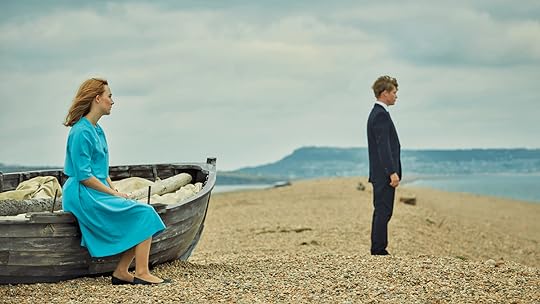
It stars the luminously vulnerable and always watchable Saoirse Ronan, who first rose to prominence in another McEwan adaptation, Atonement. The rest of the cast are good, too. See On Chesil Beach on imdb.
The dramatic views of Chesil Beach are perfect, avoiding the cliché of extreme weather, but having a vaguely brooding heaviness. You hear the crunch of the pebbles, underfoot, and as waves wash up and percolate down. The lagoon behind is still and silent. Florence and Edward are the only people in sight.
McEwan wrote the screenplay, so it's not surprising it's faithful. It certainly brought home the message that their wedding night conversations should have happened long before they married.
Go see it - but don't stay for the end!
(Update re film at the bottom...)
It is clinical and understated from the start: “The wedding... had gone well” and the “weather... not perfect but entirely adequate” and continues in the bedroom with detailed descriptions of physical sensations of skin, muscle, and even individual hairs: “stroking... for more than one and a half minutes” (too precise).
Florence is “incapable of rudeness”, Edward “polite to a fault” and both are virgins and unable to discuss intimate things (“There were no words to name what had happened, there existed no shared language.”), leading to misunderstandings, lost opportunities and unexpected consequences.
Edward is guided by duty.
Florence is guided by guilt (though not being religious, she can’t get absolution) and has a “visceral dread” of sex, realising that “sex with Edward could not be the summation of her joy, but was the price she must pay for it”.
Photo: On Chesil Beach, April 2016: sea in front (barely visible), lagoon behind.
Destiny
A major theme is destiny, which is perhaps the converse of missed opportunities. “They regarded themselves as too sophisticated to believe in destiny”, yet it was a belief in destiny that prompted Florence to form her quartet, and Florence and Edward inferred the hand of destiny in the extreme improbability of their meeting, plus Edward wants to study and write about how powerful individuals can change destiny.
Contrasts
They are very different: Florence is a classical musician from a privileged academic city background, lacking in confidence - except where music is concerned.
Edward is quiet but (in the past) occasionally explosive, a history graduate from a rural “squalid family home” with a brain damaged mother.
Both are used to leaving things unsaid: Florence is “adept at concealing her feelings from her family” and “lived in isolation within herself”, while Edward grew up in a family that colluded in his mother’s fantasy of a well-run household by not talking about it. He secretly chose a London university instead of nearby Oxford as part of “his sense of a concealed life”.
Music is often important in McEwan's works. Florence and Edward's musical tastes are fundamentally incompatible (though they try), yet for Florence music is her “path to pleasure”, rather than physical intimacy.
Although Edward’s family home was chaotic and somewhat repressed, it was loving. He enjoys the “exotic opulence” of Florence’s home, and although not a social climber, “his desire for Florence was inseparable from the setting”.
Florence was raised by nannies, and her mother is uninterested in her, tone deaf and “had barely ever touched her daughter”. Her relationship with her father is more subtle, but perhaps more troubling. Sometimes she found him “physically repellent” and sometimes she’d hug and kiss him, and loather herself for it. She even jokes about marrying him. Although “he never touched her... in Edward’s sight”, they were “intensely aware of each other” (he did hug her sister), and took overnight trips alone together, even sharing a room on the boat.
At times, Florence feels more like the parent or child of Edward, rather than his girlfriend or wife.
Ebb and Flow
There is plenty of see-sawing in the book: the ebb and flow of the sea on the stones of Chesil Beach; of desire; of who to blame for what goes wrong (both in the minds of the characters and the readers); and Florence’s feelings about her father, and whether or not she thinks there is something wrong with Edward or herself.
Nowadays
The story, and especially the ending, would be implausible nowadays, but fits the characters and the period.
My parents married at almost exactly the same ages, in almost the same year, and I can see many similarities in aspects of my mother's upbringing and attitudes and Florence's. I'm unsure whether she'd see that (or want to).
The fact that Edward “fell away from history to live snugly in the present” seems entirely appropriate.
It is a raw and painful book in places, all the more ironic given that it is set in the allegedly “swinging 60s”. There is additional irony in the fact that Florence takes Edward’s cherry – but only at dinner (an image oddly missing from the film).
Complimentary Novels
Two were written in the 60s, about the 60s, and feature a woman struggling with sexual intimacy, against the zeitgeist of the swinging 60s:
Margaret Drabble’s The Millstone (see my review HERE).
Lynne Reid Banks' The L Shaped Room (see my review HERE).
One of my two favourite books was written in the 60s, describing the life (and awful marriage) of a man born at the turn of the century, John Williams' exquisite Stoner (see my review HERE).
Also, Julian Barnes' 1986 novel, Staring at the Sun (see my review HERE), has similarly poignant anxiety about sex, though it takes a more humorous angle.
UPDATE re Film of 2018
The film was brilliant, beautiful, and mostly true to the spirit of my memory of the book (eight years earlier) - with one HUGE caveat.
The significant difference is that there was more afterstory than I remember. That didn't feel necessary, and in particular, the fact that in the film, Florence went on to .
Florence's relationship with her father was still subtle (so much so, my husband, who hasn't read the book, was oblivious to its likely significance).
It stars the luminously vulnerable and always watchable Saoirse Ronan, who first rose to prominence in another McEwan adaptation, Atonement. The rest of the cast are good, too. See On Chesil Beach on imdb.
The dramatic views of Chesil Beach are perfect, avoiding the cliché of extreme weather, but having a vaguely brooding heaviness. You hear the crunch of the pebbles, underfoot, and as waves wash up and percolate down. The lagoon behind is still and silent. Florence and Edward are the only people in sight.
McEwan wrote the screenplay, so it's not surprising it's faithful. It certainly brought home the message that their wedding night conversations should have happened long before they married.
Go see it - but don't stay for the end!

April 20, 2017
I've been in a relationship with Ian McEwan for less than a month now, and, let me tell you. . . he's driving me CRAZY!
I wonder things about him, like. . . does he have a particularly magical keyboard that only types out the right words?
Does he even bother with an editor, or do his manuscripts sprout wings and fly independently to the publishing house, where they are lovingly pressed into clever books?
Has he been in every complicated, interpersonal entanglement?
How does he do this? How does he take two virgins on their wedding night in 1962, put them in one hotel room and create a captivating novel from that one scene?
How does he make your stomach ache with anticipation and suspense without murder or violence or action. . . merely the psychological tension that exists between two humans?
And how does he manage such taut, sparse prose?!
Ahhhhhhhh!!!!!!
Mr. McEwan. . . I'm sitting up. I'm paying attention. I'm your newest fan. You've shouldered your way into the crowded room of my favorite authors, and I don't think I'm kicking you out anytime soon.
I wonder things about him, like. . . does he have a particularly magical keyboard that only types out the right words?
Does he even bother with an editor, or do his manuscripts sprout wings and fly independently to the publishing house, where they are lovingly pressed into clever books?
Has he been in every complicated, interpersonal entanglement?
How does he do this? How does he take two virgins on their wedding night in 1962, put them in one hotel room and create a captivating novel from that one scene?
How does he make your stomach ache with anticipation and suspense without murder or violence or action. . . merely the psychological tension that exists between two humans?
And how does he manage such taut, sparse prose?!
Ahhhhhhhh!!!!!!
Mr. McEwan. . . I'm sitting up. I'm paying attention. I'm your newest fan. You've shouldered your way into the crowded room of my favorite authors, and I don't think I'm kicking you out anytime soon.

September 22, 2008
Love lost through an inability to speak truth.
It is 1962. Edward and Florence have gone to a lovely seaside hotel on their wedding night, totally unprepared for the actual mechanics of sex. Both are virgins. Both have little knowledge of what can or should be done and the result is not a happy one. Still, the issue here is not about the mores of the 50’s, I believe. Is it really possible for two 20-somethings to be so ignorant, even in 1962? I suppose it is possible. But this is a novel about communication and trust more than about the uptight mores of a bygone time.

Ian McEwan - from his website
We are shown the history of their relationship via flashback. Florence came from a home bereft of physical contact. There is one scene in which it is intimated, although not conclusively, that her father may have been guilty of a crime against her youth. No wonder she is frightened. Physicality to her is a source of shame. And once given (as when she was cuddled by one of her nannies as a child) the pleasure is soon yanked away. (The nanny was let go) But the crime here is that Edward and Florence are unable to talk with each other about their problem. Had they exercised the power of speech they might have found a way out of their marital jungle. We are shown what the future holds for them. And maybe in that is a message about disparate times. Maybe, even with all the angst of changes over the last 50 years, we are in a better position to address our issues in the 21st century, even despite the divorce rate.
Two other McEwans I have had a go at, Atonement and
Saturday
It is 1962. Edward and Florence have gone to a lovely seaside hotel on their wedding night, totally unprepared for the actual mechanics of sex. Both are virgins. Both have little knowledge of what can or should be done and the result is not a happy one. Still, the issue here is not about the mores of the 50’s, I believe. Is it really possible for two 20-somethings to be so ignorant, even in 1962? I suppose it is possible. But this is a novel about communication and trust more than about the uptight mores of a bygone time.
Ian McEwan - from his website
We are shown the history of their relationship via flashback. Florence came from a home bereft of physical contact. There is one scene in which it is intimated, although not conclusively, that her father may have been guilty of a crime against her youth. No wonder she is frightened. Physicality to her is a source of shame. And once given (as when she was cuddled by one of her nannies as a child) the pleasure is soon yanked away. (The nanny was let go) But the crime here is that Edward and Florence are unable to talk with each other about their problem. Had they exercised the power of speech they might have found a way out of their marital jungle. We are shown what the future holds for them. And maybe in that is a message about disparate times. Maybe, even with all the angst of changes over the last 50 years, we are in a better position to address our issues in the 21st century, even despite the divorce rate.
Two other McEwans I have had a go at, Atonement and
Saturday
This entire review has been hidden because of spoilers.

April 28, 2020
The Independent on Sunday aptly called this novella 'Wonderful… exquisite… devastating' and I would add encompassing and actually quite funny at times, with a masterful application of realism. This is the story of how an innocent couple's honeymoon forever changes their lives because of the exchange they have on Chesil Beach. Another great piece of work by the man that captures (British?) people so well. 8 out of 12.
2011 read
2011 read

September 27, 2007
(The much longer full review can be found at the Chicago Center for Literature and Photography [cclapcenter.com].)
Regular readers know that this month CCLaP is taking an extended look at the nominees for the 2007 Booker Prize; and regular readers also know that so far I've been mostly disappointed by the nominees I've read, finding most of them to be inconsequential little wisps of stories, many of them well-written but certainly not weighty enough to be called "The Best Novel of 2007." And thus do we come to the fifth Booker nominee to be reviewed here, as well as the one easily most well-known, Ian McEwan's On Chesil Beach; and let me tell you, if a common complaint about this year's Booker nominees is of their slight and inconsequential nature, On Chesil Beach isn't helping matters at all, in that it is such a non-excuse for a novel as to almost not exist. In fact, I can literally give you the entire plot of this 200-page, paperback-sized book in literally 177 words; and this is a major spoiler alert, by the way, because I'm not kidding, I really am about to tell you the entire storyline of On Chesil Beach from beginning to end, without skipping a single detail, in 177 words. Ready?
A young middle-class couple get married in England in 1962, and spend their wedding night on Chesil Beach. He only got married because he's horny as hell and lives in middle-class 1962 England, where getting married is the only chance you're going to have to get laid, and as a result has now become a cuckold employee of his upper-class father-in-law; she despises the very idea of sex altogether, but is too much of a coward to tell her husband, instead spending months psyching herself up into performing her upcoming "wifely duties." The wedding night arrives. He gets so excited that he has a premature ejaculation on his wife's stomach. She becomes so disgusted that she flees the room in a panic. He chases her down the beach, where they have an explosive argument based on mutual misunderstanding of each other's behavior. She leaves him that night and their marriage is annulled (presumably). And he spends the rest of his life thinking about "the relationship that was never meant to be."
No, dude, seriously, that's it; that's the entire freaking plotline of the book. Which, fine, I don't necessarily mind when it's a 10,000-word short story in a literary magazine, that I'm reading on a boring Sunday afternoon down at my neighborhood cafe; but seriously, as a standalone book for 22 damn dollars? And that the Booker committee has the gall to nominate as the best novel of the entire year? Seriously? Are you kidding me? It's hard for me to...
Regular readers know that this month CCLaP is taking an extended look at the nominees for the 2007 Booker Prize; and regular readers also know that so far I've been mostly disappointed by the nominees I've read, finding most of them to be inconsequential little wisps of stories, many of them well-written but certainly not weighty enough to be called "The Best Novel of 2007." And thus do we come to the fifth Booker nominee to be reviewed here, as well as the one easily most well-known, Ian McEwan's On Chesil Beach; and let me tell you, if a common complaint about this year's Booker nominees is of their slight and inconsequential nature, On Chesil Beach isn't helping matters at all, in that it is such a non-excuse for a novel as to almost not exist. In fact, I can literally give you the entire plot of this 200-page, paperback-sized book in literally 177 words; and this is a major spoiler alert, by the way, because I'm not kidding, I really am about to tell you the entire storyline of On Chesil Beach from beginning to end, without skipping a single detail, in 177 words. Ready?
A young middle-class couple get married in England in 1962, and spend their wedding night on Chesil Beach. He only got married because he's horny as hell and lives in middle-class 1962 England, where getting married is the only chance you're going to have to get laid, and as a result has now become a cuckold employee of his upper-class father-in-law; she despises the very idea of sex altogether, but is too much of a coward to tell her husband, instead spending months psyching herself up into performing her upcoming "wifely duties." The wedding night arrives. He gets so excited that he has a premature ejaculation on his wife's stomach. She becomes so disgusted that she flees the room in a panic. He chases her down the beach, where they have an explosive argument based on mutual misunderstanding of each other's behavior. She leaves him that night and their marriage is annulled (presumably). And he spends the rest of his life thinking about "the relationship that was never meant to be."
No, dude, seriously, that's it; that's the entire freaking plotline of the book. Which, fine, I don't necessarily mind when it's a 10,000-word short story in a literary magazine, that I'm reading on a boring Sunday afternoon down at my neighborhood cafe; but seriously, as a standalone book for 22 damn dollars? And that the Booker committee has the gall to nominate as the best novel of the entire year? Seriously? Are you kidding me? It's hard for me to...
This entire review has been hidden because of spoilers.

April 7, 2018
UPDATED: May 24, 2018, after watching the new film:
This is my second viewing of the film. I first saw it last September during the Toronto film festival. I read the book a month ago. And I rescreened the film a few days ago to review before its theatrical release. I prefer the novel, especially for the witty, all-knowing narrator. The flashbacks are handled much more subtly in the book than they are in the movie.
But the film (McEwan wrote the screenplay) captures the same tone of light comedy and tragedy. Saoirse Ronan and Billy Howle are beautifully cast (as are Samuel West and Emily Watson as Florence's parents), and it's quite something to see the actual Chesil Beach. In the film you understand that if you walk all the way out on the beach, there's only one way to come back... which is an intriguing metaphor for the central decision in the book.
The biggest difference in the movie, apart from , is the ending. As I point out in my review of the movie, film and literature are different mediums. I think we want to see certain things play out in a movie that we don't necessarily need in a book. So the ending in the film has a certain power. (I cried both times I saw it.) I love the book's ending – it's quiet, subtle and more believable than what we're given in the movie. But even though it doesn't all work , it's still very effective.
***
A note-perfect novella
On their wedding night in a seaside hotel room in 1962, a young British couple, both virgins, have a disagreement, and it has lasting implications.
On the surface, that doesn’t sound very interesting, but McEwan manages to suggest so much. There’s obviously lots of humour in the young couple’s awkward fumblings: waiters barge in and out of the room serving them their bland, proper meal (although they’re not hungry); neither the man (Edward) nor the woman (Florence) knows who should make the first move; and when they eventually start to get intimate, things like zippers don’t behave...
Furthermore, Edward desperately wants to have sex (he’s refrained from masturbating – or “self pleasure,” as the euphemism goes – all week), while Florence, intimidated by having read a dry sex manual, is dreading it. But there’s something deeper at play in their inability to say what’s bothering them – and why.
This is, remember, Britain before the sexual revolution of the late 60s and early 70s, before people talked openly about their wants and feelings to friends and therapists or on TV. And the couple’s separate backgrounds, skillfully interwoven through flashbacks from the main narrative, also play a key role.
McEwan’s omniscient, all-knowing narrator is a delight, finding just the right tone between comedy and tragedy. At one point he’ll have you chuckling about the little insecurities that bond us all, and then he’ll leave you crying at things not said, not expressed.
Plus: there's lots of subtlety in the way that McEwan describes a bit of Florence’s history that absolutely affects her attitude to sex. (Surprisingly, many of the 1 and 2 star reviews of this book fail to mention this… perhaps they missed it?)
Early on we’re introduced to the idea of fate; Edward recently graduated university with a degree in history, and he had a theory that great people determined their destinies. This becomes an intriguing theme as we’re shown how the two met, and, if we dig deeper (as we’re meant to, with McEwan), see the links that perhaps drew them together. Edward has a bit of a temper, much like Florence’s wealthy industrialist father; and Edward’s mother, who suffered brain damage from a life-altering accident at a train station, is also something of a musician, like Florence (a violinist who dreams of being in a professional string quartet).
The climax, set on the eponymous Chesil Beach, is heart-stopping. Think of the setting: a narrow stretch of shingly land surrounded by water on either side… meaning if you go down it, you have to come back the same way.
And the final few pages, which flash forward a year or two and then decades, are simply devastating. This is one of those books where, when I eventually pick it up again at a bookstore and reread the final pages, I know I’ll tear up again. (See also: The Goldfinch and Middlemarch)
As McEwan demonstrated in the more ambitious but no less affecting Atonement, lives can change in an instant: over a lie, something misunderstood or perhaps even words simply unsaid.
If you’ll excuse me, I’m going to listen to Mozart’s String Quintet in D major (K. 593). You’ll want to too, after reading this exquisite, note-perfect book.
This is my second viewing of the film. I first saw it last September during the Toronto film festival. I read the book a month ago. And I rescreened the film a few days ago to review before its theatrical release. I prefer the novel, especially for the witty, all-knowing narrator. The flashbacks are handled much more subtly in the book than they are in the movie.
But the film (McEwan wrote the screenplay) captures the same tone of light comedy and tragedy. Saoirse Ronan and Billy Howle are beautifully cast (as are Samuel West and Emily Watson as Florence's parents), and it's quite something to see the actual Chesil Beach. In the film you understand that if you walk all the way out on the beach, there's only one way to come back... which is an intriguing metaphor for the central decision in the book.
The biggest difference in the movie, apart from , is the ending. As I point out in my review of the movie, film and literature are different mediums. I think we want to see certain things play out in a movie that we don't necessarily need in a book. So the ending in the film has a certain power. (I cried both times I saw it.) I love the book's ending – it's quiet, subtle and more believable than what we're given in the movie. But even though it doesn't all work , it's still very effective.
***
A note-perfect novella
On their wedding night in a seaside hotel room in 1962, a young British couple, both virgins, have a disagreement, and it has lasting implications.
On the surface, that doesn’t sound very interesting, but McEwan manages to suggest so much. There’s obviously lots of humour in the young couple’s awkward fumblings: waiters barge in and out of the room serving them their bland, proper meal (although they’re not hungry); neither the man (Edward) nor the woman (Florence) knows who should make the first move; and when they eventually start to get intimate, things like zippers don’t behave...
Furthermore, Edward desperately wants to have sex (he’s refrained from masturbating – or “self pleasure,” as the euphemism goes – all week), while Florence, intimidated by having read a dry sex manual, is dreading it. But there’s something deeper at play in their inability to say what’s bothering them – and why.
This is, remember, Britain before the sexual revolution of the late 60s and early 70s, before people talked openly about their wants and feelings to friends and therapists or on TV. And the couple’s separate backgrounds, skillfully interwoven through flashbacks from the main narrative, also play a key role.
McEwan’s omniscient, all-knowing narrator is a delight, finding just the right tone between comedy and tragedy. At one point he’ll have you chuckling about the little insecurities that bond us all, and then he’ll leave you crying at things not said, not expressed.
Plus: there's lots of subtlety in the way that McEwan describes a bit of Florence’s history that absolutely affects her attitude to sex. (Surprisingly, many of the 1 and 2 star reviews of this book fail to mention this… perhaps they missed it?)
Early on we’re introduced to the idea of fate; Edward recently graduated university with a degree in history, and he had a theory that great people determined their destinies. This becomes an intriguing theme as we’re shown how the two met, and, if we dig deeper (as we’re meant to, with McEwan), see the links that perhaps drew them together. Edward has a bit of a temper, much like Florence’s wealthy industrialist father; and Edward’s mother, who suffered brain damage from a life-altering accident at a train station, is also something of a musician, like Florence (a violinist who dreams of being in a professional string quartet).
The climax, set on the eponymous Chesil Beach, is heart-stopping. Think of the setting: a narrow stretch of shingly land surrounded by water on either side… meaning if you go down it, you have to come back the same way.
And the final few pages, which flash forward a year or two and then decades, are simply devastating. This is one of those books where, when I eventually pick it up again at a bookstore and reread the final pages, I know I’ll tear up again. (See also: The Goldfinch and Middlemarch)
As McEwan demonstrated in the more ambitious but no less affecting Atonement, lives can change in an instant: over a lie, something misunderstood or perhaps even words simply unsaid.
If you’ll excuse me, I’m going to listen to Mozart’s String Quintet in D major (K. 593). You’ll want to too, after reading this exquisite, note-perfect book.

December 5, 2016
Having read my first McEwan, I think I can begin to understand why so many good friends feel conflicted about him, even though almost all my friends have recorded positive reviews for this particular novel - the reason I chose this one over others.
On Chesil Beach is hilariously funny, boldly intimate, and admirably candid when it describes the internal turmoil of its characters and their struggles to interpret their own truths, but taken whole I think the novel is just so so: the story, the basic premise that holds it, is very contrived and a whole lot of fillers in the shape of flashbacks have been thrown in to make it big enough to be a novel.
1962. Newly married couple. Wedding Night. Virgins. Afraid of sexual failure = our storyline. Much can be said about Florence's total lack of interest in sex, her fear of intimacy, her disgust at being touched. Okay, we know she was a 'product of her time' - a time just before the cultural change that revolutionized romance and sex in the West; - we know social conditioning had led her to view sex as dirty and corrupting, and we know there had not existed an acceptable common language to discuss those matters; and we know that she was kind of introvert with a singular aim of making it big in the world of classical music. Some of those possibilities are explored briefly, some only alluded to, but none of those make her problem convincing I hoped in vain to learn something startling at the end, something Zweig-like. But there was nothing.
Was she frigid or asexual, a claim Edward, her one-night husband, hurls at her as an accusation? Was there some other psychological reason from her past that changed her attitude towards copulation? Perhaps. She says at one point, Perhaps what I really need to to d0 is kill my mother and marry my father. - she did not seem to have an emotional attachment with either of her parent, not in the normal sense. Or was she a 'queer' and did not know about her own sexuality? I admit this last one felt like the most plausible reason. But perhaps none of it matters to the story. It is not about sex but the failure of romance, about lack of faith in one's own abilities, about missed opportunities, about the passing of time, about doing nothing. How an entire course of a life can be changed--by doing nothing.
The novel works as a basic portrait of the 1960s England with focus on London, Oxford and its vicinity, its cultural and political scene, and two young people from different classes growing up apart and coming together in an uneven relationship that ends in a horrible crash on the Chesil Beach. And that was that. Also, it gets rather treacly in the end, to make us feel sorry for the couple, enlarging on their romance post-breakup, summing up their whole lives after going separate ways in two or three pages that should not have been inflicted on the reader.
December '16
On Chesil Beach is hilariously funny, boldly intimate, and admirably candid when it describes the internal turmoil of its characters and their struggles to interpret their own truths, but taken whole I think the novel is just so so: the story, the basic premise that holds it, is very contrived and a whole lot of fillers in the shape of flashbacks have been thrown in to make it big enough to be a novel.
1962. Newly married couple. Wedding Night. Virgins. Afraid of sexual failure = our storyline. Much can be said about Florence's total lack of interest in sex, her fear of intimacy, her disgust at being touched. Okay, we know she was a 'product of her time' - a time just before the cultural change that revolutionized romance and sex in the West; - we know social conditioning had led her to view sex as dirty and corrupting, and we know there had not existed an acceptable common language to discuss those matters; and we know that she was kind of introvert with a singular aim of making it big in the world of classical music. Some of those possibilities are explored briefly, some only alluded to, but none of those make her problem convincing I hoped in vain to learn something startling at the end, something Zweig-like. But there was nothing.
Was she frigid or asexual, a claim Edward, her one-night husband, hurls at her as an accusation? Was there some other psychological reason from her past that changed her attitude towards copulation? Perhaps. She says at one point, Perhaps what I really need to to d0 is kill my mother and marry my father. - she did not seem to have an emotional attachment with either of her parent, not in the normal sense. Or was she a 'queer' and did not know about her own sexuality? I admit this last one felt like the most plausible reason. But perhaps none of it matters to the story. It is not about sex but the failure of romance, about lack of faith in one's own abilities, about missed opportunities, about the passing of time, about doing nothing. How an entire course of a life can be changed--by doing nothing.
The novel works as a basic portrait of the 1960s England with focus on London, Oxford and its vicinity, its cultural and political scene, and two young people from different classes growing up apart and coming together in an uneven relationship that ends in a horrible crash on the Chesil Beach. And that was that. Also, it gets rather treacly in the end, to make us feel sorry for the couple, enlarging on their romance post-breakup, summing up their whole lives after going separate ways in two or three pages that should not have been inflicted on the reader.
December '16

April 21, 2017
A story lives transformed by a gesture not made or a word not spoken.
This little novel is so deceptive. It's under 200 pages, and the story seems simple: the 1962 wedding night of Edward and Florence, two young, virginal people in love. Edward is ready to burst with the desire to consummate their marriage; Florence is dreading it.
But it isn't so simple. The night is a disaster, and wrought with the secret scars and fatal flaws the two people carry around. The writing is so revealing of the complexities each person brings with them to a relationship.
The crux lies in what is not done, what is unsaid, and then, painfully, what is unlived. Nothing matters except what could have been. Inconceivably, it is easier to live a whole entire life unfulfilled rather than utter one's truth or javelin over the barrier of pride. A whole life. (And my heart is wrenched without mercy.)
That McEwan captures this so poignantly in under 200 pages demonstrates his mastery of the written word and his deep understanding of the human condition. He has rapidly risen in the ranks of my favourite authors.
All she had needed was the certainty of his love, and his reassurance that there was no hurry when a lifetime lay ahead of them.
This little novel is so deceptive. It's under 200 pages, and the story seems simple: the 1962 wedding night of Edward and Florence, two young, virginal people in love. Edward is ready to burst with the desire to consummate their marriage; Florence is dreading it.
But it isn't so simple. The night is a disaster, and wrought with the secret scars and fatal flaws the two people carry around. The writing is so revealing of the complexities each person brings with them to a relationship.
The crux lies in what is not done, what is unsaid, and then, painfully, what is unlived. Nothing matters except what could have been. Inconceivably, it is easier to live a whole entire life unfulfilled rather than utter one's truth or javelin over the barrier of pride. A whole life. (And my heart is wrenched without mercy.)
That McEwan captures this so poignantly in under 200 pages demonstrates his mastery of the written word and his deep understanding of the human condition. He has rapidly risen in the ranks of my favourite authors.
All she had needed was the certainty of his love, and his reassurance that there was no hurry when a lifetime lay ahead of them.

September 19, 2011
I have a First Edition of this small hardcopy book. I read it in 2007.
There are other passionate 5 star reviews..
but I was incredibly disappointed.
I felt it could have been a short story -
I was angry that I paid full price for it.
However ..I may re- read this book soon ( it only takes a few hours) with an open mind to see if my thoughts have changed.
I’m guessing people today didn’t pay $30 for this as I had. Funny how the price bothered me so much.. and it did at the time.
There are other passionate 5 star reviews..
but I was incredibly disappointed.
I felt it could have been a short story -
I was angry that I paid full price for it.
However ..I may re- read this book soon ( it only takes a few hours) with an open mind to see if my thoughts have changed.
I’m guessing people today didn’t pay $30 for this as I had. Funny how the price bothered me so much.. and it did at the time.

May 1, 2016
Almost
A brilliant book, but such a sad one; it would be unfair not to say so up front. Ian McEwan is a master at dissecting emotions. Every page of this wonderfully-crafted novel gave me the uncanny feeling of living within the skins of the two main characters, Edward and Florence, just married as the book opens. When they fall in love, nurture ambitions, experience happiness, I feel these things too. But when happiness eludes them, the pain is unbearable, not least because the author never lets us forget by how small a margin their happiness was missed.
In his last major novel, Saturday, McEwan pulled back from the multi-decade scope of Atonement , its predecessor, choosing to confine himself to the events of a single day. Here, the essential action occupies a mere three hours, described in a book which is itself unusually compact, a mere novella of only 200 delicate pages. In an opening that is surely a homage to Matthew Arnold's "Dover Beach," the new husband and wife sit in a hotel room within sound of the sea on England's South coast. They eat a mediocre meal in one room; in the next, their bed stands waiting. They love each other, there is never any doubt about that, but they are inexperienced and secretly afraid. The book tells how they came to that moment, and what becomes of their love and fears as they move from one room into the other.
I have not known McEwan to write before in such detail about sex, but his writing is never prurient. Every detail serves to illustrate the psychological intercourse between these two talented and caring young people. On this particular night, as in a high-stakes game, their honeymoon bed becomes the board upon which all the other pieces of their relationship must be played. By going back to the early 1960s, that dark hour just before the dawn of the sexual revolution, McEwan performs the remarkable feat of undoing the modern liberation of sex from marriage and returning to a mindset in which marriage was not only a contract for sex, but sex might also be a prime reason for marriage.
But not the only reason. The focus on the bedroom also makes you consider all the other qualities that these two bring to their marriage, and before long you feel that you know them very well. [Exceptionally well in my case, since I was also born in Britain in the same year (1940), and share qualities with each of them; readers might take this into account when weighing the objectivity of my reactions.] Edward is a bright young man from the country who has recently achieved a first-class academic degree. Florence comes from a more socially sophisticated family, though she herself is naive in most things. The one exception is her calling as a violinist; here as in Saturday, McEwan is extraordinary in his use of music; the sections describing Florence's quartet playing are right up there with Vikram Seth's An Equal Music, my touchstone for sensitive writing about musicians. So both are bright, both are talented, both feel the stirring of new possibilities, but there are big differences between them, socially and culturally (Edward, for example, is into rock), and they each want different things. But the most heartbreaking things in this book are not their differences, but how often and how close they come to making new connections; just an inch more, a moment longer, and everything might be all right…. Almost.
But McEwan does not end the story in the bedroom or on the beach below. Much as in Atonement, though in only a few pages, he adds an epilogue continuing the story forward several decades. At the time, I felt it was too brief to settle all the emotions stirred up by the preceding pages, but now as I write, several hours after closing the book, I begin to see its rightness and appreciate its consolation.
======

I saw the movie last night. With one exception, though, I will have to put my comments as a spoiler, for those who haven't already read the book.
One thing I wholeheartedly admired was the music. In the book, we know that Florence is a violinist, and we see her with her quartet in concert at the end. But we cannot hear her. Not only does the film contain several scenes of her rehearsing or playing, but her music is there in the sound-track throughout: chamber music by Haydn, Mozart, Beethoven, and Schubert, all beautifully matching the emotional temperature, and music by others as well. My first reaction on coming home was to pull out one of the featured pieces and play it through with my wife, also a violinist. Through music, if not always in words or pictures, I felt I could live inside Florence, and experience something vital in her that transcended her problems. Is it any wonder that Edward seemed a little ordinary by comparison?


October 18, 2010
Having only previously read Atonement & Saturday, I was both incredibly reluctant and eager to know what the “literary device” used in On Chesil Beach was; a.k.a., why it almost won the Booker Prize. I must say that the prose is so simple as to be deceitful and I was instantly aware, as I reached its final pages, that this novel was NO Atonement. (Indeed this is the stark opposite of that new classic: it is small where Atonement is enormous & epic, simple while Atonement is complex, & Atonement is a love story while On Chesil Beach is about the absence of that particular element and the end of romance.) But there is also no reason to believe that, while taking on that same theme of crystallization of a particular moment in a human’s life, On Chesil Beach is the trash that Saturday is. That heinous novel, about a pompous neurosurgeon who believes he has literary entitlement just because he can “predict events” in his neobourgeois life, simply by knowing how the human body works, and dissecting daily minutiae into scientific (therefore, deeply unpoetic) reasoning, playing “God”--I found it incredibly irritating. Stupid. Especially having had read Atonement and thinking that a writer like McEwan would never dare disappoint the Reader. But after the popularity of the book I keep mentioning, and will continue to mention for time to come (with a strange type of fanboy fervor)-- Atonement-- I guess the author felt it comfortable to come up with simpler stories, perhaps even complete foils of the book that put McEwan at the forefront.
The play with time is what McEwan is all about, more than being a romantic, more than being a mod Londoner. And On Chesil Beach succeeds admirably in that aspect. Sure, I could care less about Florence and Edward, their being “victims of their time” seems at once cliched, even somewhat intolerable. Why should we care about characters that really don’t even know themselves? I find Briony Tallis’s lie much more compelling than this: “how an entire course of a life can be changed--by doing nothing.” (203) This theme of doing nothing, or of active non-action, is a paradigm of most English classics, even modern ones like Kazuo Ishiguro’s awesome Never Let Me Go.
The play with time is what McEwan is all about, more than being a romantic, more than being a mod Londoner. And On Chesil Beach succeeds admirably in that aspect. Sure, I could care less about Florence and Edward, their being “victims of their time” seems at once cliched, even somewhat intolerable. Why should we care about characters that really don’t even know themselves? I find Briony Tallis’s lie much more compelling than this: “how an entire course of a life can be changed--by doing nothing.” (203) This theme of doing nothing, or of active non-action, is a paradigm of most English classics, even modern ones like Kazuo Ishiguro’s awesome Never Let Me Go.

December 7, 2019
Στην ακτή του πελάγους της ευτυχίας που ονειρεύτηκε κάποια πλατωνική αγάπη, τελείται μια ασυναίσθητα συναισθηματική πορνογραφία.
Πρόκειται για ένα σύντομο μυθιστόρημα με επιτηδευμένη απειρία στην συναισθηματική εμπειρία της σάρκας, ανάμεσα σε δυο άτομα που θα υπέφεραν απο την ένταση της θέλησης
να νιώσουν ο ένας τον άλλον σε κάθε ανθρώπινο, θεϊκό, ιερό, βλάσφημο, εξευτελιστικό, ζωώδες και κτηνώδες επίπεδο ύπαρξης και πανοργασμικής ηδονής.
Όμως,,οι μάταιες προσδοκίες και οι κρυμμένοι φόβοι,παρέα με ανεπάρκειες απο
κατάλοιπα ανατροφής και παρεκκλίσεις
απο έλλειψη αγάπης, φυσικούς βιασμούς αισθήσεων
και τρυφερής απόρριψης συνδυαστικής επαφής των παιδικών απαιτήσεων,
υπερνικούν και καταποντίζουν την ηδυπάθεια, ντροπιάζουν την σαρκική επαφή,
υποτιμούν τη λαγνεία και την έλξη, τον πόθο της μέθης των αρχέγονων ενστίκτων και καταλήγουν σε μια πρώτη νύχτα γάμου με τραγική κορύφωση.
Οι σάρκες που προσπάθησαν να ερεθιστούν πριν χαθούν στα ερεβώδη βάθη της απόλαυσης.
Πριν αρχίσει η περιδίνιση προς την άβυσσο της πιο γνήσιας κατάστασης, όπου δυο σώματα ενώνονται αξεχώριστα
και κοροϊδεύουν τον θάνατο μέσα απο τους ψιθύρους μιας ανταριασμένης μέθεξης, τότε,
όλα βυθίστηκαν στα ανίερα υγρά της κορύφωσης.
Μετά την ανολοκλήρωτη διαδικασία, άρχισε να αναδύεται αναπόφευκτα απο δυο ήρωες που γνώριζαν ελάχιστα ο ένας τον άλλον και καθόλου σχεδόν τον ίδιο τον εαυτό τους η καταστροφή, το τέλος, η ατροφική συνείδηση του εγωισμού και του διαζυγίου του θεού έρωτα απο την παρθένα απροθυμία της ευαίσθητης και άπειρης μούσας.
Μέσα σε ενα βράδυ. Ανάμεσα σε δυο μοναδικά πρόσωπα εκτυλίσσεται όλη η πλοκή και εξέλιξη αυτού του μυθιστορήματος, με χρονικές εναλλαγές στο παρελθόν και το παρόν.
Για το μέλλον η σημαντική επίδραση των χαρακτήρων που χτίζονται άρτια απο τον συγγραφέα θα συγκεράσει την μοίρα και την πρέπουσα επιλογή σε λανθασμένη τροχιά του τρένου της σχέσης τους.
Η ευαίσθητη γραφή, η επιδέξια ψυχολογία,
η ενέργεια που παράγεται απο τον σχεδόν ελάχιστο διάλογο και η εμμονή των ανθρώπινων σφαλμάτων
να διαπράττουν δυστυχισμένες επαναλήψεις,
κάνει αυτό το βιβλίο άρρητα γοητευτικό και ρητά ελκυστικό.
🌈💫🌈💥🌈💫💫💥🌈🌈💫🌟🌟🌈🌈💫🌈💥💥
Καλή ανάγνωση.
Πολλούς ασπασμούς.
Πρόκειται για ένα σύντομο μυθιστόρημα με επιτηδευμένη απειρία στην συναισθηματική εμπειρία της σάρκας, ανάμεσα σε δυο άτομα που θα υπέφεραν απο την ένταση της θέλησης
να νιώσουν ο ένας τον άλλον σε κάθε ανθρώπινο, θεϊκό, ιερό, βλάσφημο, εξευτελιστικό, ζωώδες και κτηνώδες επίπεδο ύπαρξης και πανοργασμικής ηδονής.
Όμως,,οι μάταιες προσδοκίες και οι κρυμμένοι φόβοι,παρέα με ανεπάρκειες απο
κατάλοιπα ανατροφής και παρεκκλίσεις
απο έλλειψη αγάπης, φυσικούς βιασμούς αισθήσεων
και τρυφερής απόρριψης συνδυαστικής επαφής των παιδικών απαιτήσεων,
υπερνικούν και καταποντίζουν την ηδυπάθεια, ντροπιάζουν την σαρκική επαφή,
υποτιμούν τη λαγνεία και την έλξη, τον πόθο της μέθης των αρχέγονων ενστίκτων και καταλήγουν σε μια πρώτη νύχτα γάμου με τραγική κορύφωση.
Οι σάρκες που προσπάθησαν να ερεθιστούν πριν χαθούν στα ερεβώδη βάθη της απόλαυσης.
Πριν αρχίσει η περιδίνιση προς την άβυσσο της πιο γνήσιας κατάστασης, όπου δυο σώματα ενώνονται αξεχώριστα
και κοροϊδεύουν τον θάνατο μέσα απο τους ψιθύρους μιας ανταριασμένης μέθεξης, τότε,
όλα βυθίστηκαν στα ανίερα υγρά της κορύφωσης.
Μετά την ανολοκλήρωτη διαδικασία, άρχισε να αναδύεται αναπόφευκτα απο δυο ήρωες που γνώριζαν ελάχιστα ο ένας τον άλλον και καθόλου σχεδόν τον ίδιο τον εαυτό τους η καταστροφή, το τέλος, η ατροφική συνείδηση του εγωισμού και του διαζυγίου του θεού έρωτα απο την παρθένα απροθυμία της ευαίσθητης και άπειρης μούσας.
Μέσα σε ενα βράδυ. Ανάμεσα σε δυο μοναδικά πρόσωπα εκτυλίσσεται όλη η πλοκή και εξέλιξη αυτού του μυθιστορήματος, με χρονικές εναλλαγές στο παρελθόν και το παρόν.
Για το μέλλον η σημαντική επίδραση των χαρακτήρων που χτίζονται άρτια απο τον συγγραφέα θα συγκεράσει την μοίρα και την πρέπουσα επιλογή σε λανθασμένη τροχιά του τρένου της σχέσης τους.
Η ευαίσθητη γραφή, η επιδέξια ψυχολογία,
η ενέργεια που παράγεται απο τον σχεδόν ελάχιστο διάλογο και η εμμονή των ανθρώπινων σφαλμάτων
να διαπράττουν δυστυχισμένες επαναλήψεις,
κάνει αυτό το βιβλίο άρρητα γοητευτικό και ρητά ελκυστικό.
🌈💫🌈💥🌈💫💫💥🌈🌈💫🌟🌟🌈🌈💫🌈💥💥
Καλή ανάγνωση.
Πολλούς ασπασμούς.

August 13, 2017
The greatest book about a premature ejaculation ever written--now why isn't that one of the cover blurbs? Too gushing? Or is it simply not something to be wantonly splashed across the cover of a book? Perhaps novels on the subject are just so sparse that such a blurb would hardly count as praise. Were this 1962 I might have said it was a book about a man arriving too soon, but that makes it sound as if Edward Mayhew was merely early for a party. Alternative subjects for a cover blurb and/or Goodreads review: young love, constrictive heteronormativity, the perks of premarital sex, failures in communication, objects in the rearview mirror, retro appetizers--the symbolism of the cherry--and the Art of the Novella.

July 20, 2018

When words fail. When words don’t fail.
This is a distressingly sad story of promised happiness marred by the lack of words.
They barely knew each other, and never could because of the blanket of companionable near-silence that smothered their differences and blinded them as much as it bound them.
McEwan offsets the hopeless inability of the characters to communicate with each other with the splendid flow of his writing. For if the words that ought to have been said in the story falter, and those that should have been buried in silence explode, the reader is left with McEwan’s language. This novel is set with crafted, contrasting, balanced, nuanced, full-bodied, sweet and sharp words that evoke the completeness of chamber music. For music is always in McEwan’s writing.
There was however a dissonance. It seemed to me almost until the end that McEwan had been leaving a trail of word crumbs that would take us to a revealing monstrosity that would however explain the tragedy. But these were lost or dispersed by the waves or the wind in Chesil beach.
****
On the Film:
The script is by McEwan, and that ought to make the spectator tone down his/her anxieties. The visuals are beautiful, the recreation of the times, the early 1960s, and the setting Oxford, Oxfordshire and London, impeccable. The ending is however more of a pastiche than the somewhat anticlimactic ending in the book. Very well worth watching, though.

February 8, 2016
"...being in love was not a steady state, but a matter of fresh surges or waves, and he was experiencing one now."
-- Ian McEwan, On Chesil Beach

Almost no one can write about sex well in my opinion. You've got your erotic writers, fine, if your need for arousal and release comes from text rather than pictures or actual lovers. There are certainly millions of toss-n-tug novels that can certainly get things done. But these books, obviously, aren't literature.
There are writers, like Ken Follett, who seem to need to insert sex writing into a novel every 160 - 200 pages just to help drive the novel's narrative forward. Sex in these adventure, mystery, genre novels, etc., acts as almost a sign post or quick reward. "Congrats, fair reader, you made it to page 320, here is your second sex scene on a road with a monk." But as delivered, it all just seems a bit flat and not a little absurd.
Now, I'm not saying there isn't good sex writing out there, I have actually come across some. Joyce, Miller, Chopin, and Lawrence all seem to be able to walk that narrow beach of rolling bodies without twisting their ankles on the rocks. They capture the human frailty and power and awkwardness and sensuality of sex without dipping into cliché or caricature. I'm not sure why some, few, writers I can handle and most others I just despise. I'm not a prude. I get that sex is a part of life. It isn't icky. I'm not ashamed by it. I realize like food, it is a part of life and thus needs to be represented and shadowed in art and literature.
So, with all that baggage and preamble, it was still with quite a bit of trepidation that I slid into Ian McEwan's tight little novella. One reason I think this novel didn't bend me over too much with its very direct narrative about sex was Ian McEwan's mastery of language. He knew exactly what he was doing. He was aiming for an exact mood, a tension, a flick of a finger on a solo hair, an almost anti-climax, to convey the message of this novella. It required a tease, a premature crescendo, and in the end -- the cold, wet, and sticky dialogue of pain and regret.
-- Ian McEwan, On Chesil Beach
Almost no one can write about sex well in my opinion. You've got your erotic writers, fine, if your need for arousal and release comes from text rather than pictures or actual lovers. There are certainly millions of toss-n-tug novels that can certainly get things done. But these books, obviously, aren't literature.
There are writers, like Ken Follett, who seem to need to insert sex writing into a novel every 160 - 200 pages just to help drive the novel's narrative forward. Sex in these adventure, mystery, genre novels, etc., acts as almost a sign post or quick reward. "Congrats, fair reader, you made it to page 320, here is your second sex scene on a road with a monk." But as delivered, it all just seems a bit flat and not a little absurd.
Now, I'm not saying there isn't good sex writing out there, I have actually come across some. Joyce, Miller, Chopin, and Lawrence all seem to be able to walk that narrow beach of rolling bodies without twisting their ankles on the rocks. They capture the human frailty and power and awkwardness and sensuality of sex without dipping into cliché or caricature. I'm not sure why some, few, writers I can handle and most others I just despise. I'm not a prude. I get that sex is a part of life. It isn't icky. I'm not ashamed by it. I realize like food, it is a part of life and thus needs to be represented and shadowed in art and literature.
So, with all that baggage and preamble, it was still with quite a bit of trepidation that I slid into Ian McEwan's tight little novella. One reason I think this novel didn't bend me over too much with its very direct narrative about sex was Ian McEwan's mastery of language. He knew exactly what he was doing. He was aiming for an exact mood, a tension, a flick of a finger on a solo hair, an almost anti-climax, to convey the message of this novella. It required a tease, a premature crescendo, and in the end -- the cold, wet, and sticky dialogue of pain and regret.

October 13, 2017
Nice short story, fully focused on the moment things go wrong between two young, naive people on the threshold of their real life, namely during their wedding night. The issue is their diverging expectations with regard to the physical act of making love. While reading this story I was initially charmed by the humor: the naivety, the bumbling and trudging, the ambiguous psychology alternating between fear and care (let us be honest: all very recognizable, hence the humorous feeling); but gradually this turned into a sense of dismay and tragedy. And after the short epilogue I was above all left with a feeling of sadness, because two lives were really wasted. I haven’t had such a sad feeling after reading a book, since Stoner by John Williams.
I notice a slight naturalistic accent in this book: Eduard and Florence are "prisoners of their time", the early ' 60s, when the sexual taboo was still standing and young people were still as good as ignorant in this domain (though I perceive much scepticism on this in the reviews on Goodreads, I tend to follow McEwan on this). On top of this both Eduard and Florence also are prisoners of their still fledgling personalities: Florence is anxious and unsure about physical intercourse (there are hints of the author towards the cold mother and an ambiguous treatment of the father); and with Eduard it's the impetuosity and impulsiveness (maybe due to the rigid regime that his father imposed on him and the ' absent ' mother?). McEwan doesn't judge them and leaves lots of room for interpretation, and I like that; nothing can kill a story as explaining things!
In short: this a remarkable, neat and accomplished story, both literary and in content. I'm hesitating to give it 3 or 4 star-rating, so let's make it a 3.5!
I notice a slight naturalistic accent in this book: Eduard and Florence are "prisoners of their time", the early ' 60s, when the sexual taboo was still standing and young people were still as good as ignorant in this domain (though I perceive much scepticism on this in the reviews on Goodreads, I tend to follow McEwan on this). On top of this both Eduard and Florence also are prisoners of their still fledgling personalities: Florence is anxious and unsure about physical intercourse (there are hints of the author towards the cold mother and an ambiguous treatment of the father); and with Eduard it's the impetuosity and impulsiveness (maybe due to the rigid regime that his father imposed on him and the ' absent ' mother?). McEwan doesn't judge them and leaves lots of room for interpretation, and I like that; nothing can kill a story as explaining things!
In short: this a remarkable, neat and accomplished story, both literary and in content. I'm hesitating to give it 3 or 4 star-rating, so let's make it a 3.5!

February 27, 2018
McEwan's economy of language is remarkable, and it's highlighted especially in this novel/novella. He deftly examines the inner lives (and turmoil) of two young virgins in the early 1960's—this was before the freedom of sex, drugs and rock 'n' roll had gripped England and allowed for a more equitable and open conversation around physical intimacy. On top of that, Florence is asexual (though never explicitly named) and struggles with her loyalty to Edward, her new husband and true love, and her own desires, or lack thereof.
The story takes place on their wedding night but smoothly moves back and forth in time to give you glimpses of their individual lives as well as how they met, how they came to be married, and ultimately the result of a rather uncomfortable and potentially disastrous wedding night. McEwan creates such vivid characters in such a short amount of time—and if you've got 4.5 hours to spare I'd highly recommend listening to the audiobook narrated by the author himself. He's a very sympathetic author and reader, who makes an endearing read out of a topic that is traditionally taboo and awkward.
The story takes place on their wedding night but smoothly moves back and forth in time to give you glimpses of their individual lives as well as how they met, how they came to be married, and ultimately the result of a rather uncomfortable and potentially disastrous wedding night. McEwan creates such vivid characters in such a short amount of time—and if you've got 4.5 hours to spare I'd highly recommend listening to the audiobook narrated by the author himself. He's a very sympathetic author and reader, who makes an endearing read out of a topic that is traditionally taboo and awkward.

November 14, 2015
Most people have already heard of Ian McEwan's presumable masterpiece Atonement, but many of his other novels have remained underrated ever since. On Chesil Beach is a simple love story about two opposing souls - but it is no love story in a typical way. In this short book, Ian McEwan reverses the love story and tells it backwards from their wedding night, allowing those events described to find a climax which might take them into a future with each other or separate them forever.
In the beginning, Edward and Florence prepare each other for their wedding night. It is the year 1962; a time when talking about sexuality was not as easy and natural as it would be fifty years later. Both Edward and Florence are virgins; however, Florence believes Edward to be experienced with other women, and Edward doesn't know about Florence's anxiety to even think of sexual relationships, of the disgusting feeling which builds in her stomach whenever her thoughts wander off to this night she fears so much. It is a simple premise, a fact which keeps this book from becoming as interesting and masterful as the complex Atonement, yet a premise intriguing enough for me to become interested in the characters. And interesting and complex they were indeed.
Ian McEwan's prose is beautiful as ever in this novella. He belongs to those writers you only have to read a few sentences from and immediately know they have been written by him. There is something powerful behind the words he chooses, something that makes you care for the characters even if it is sometimes difficult to understand their motivations. This simple story is able to say so much about human nature: how it is mandatory to talk to each other honestly about one's fears and feelings, because remaining silent could almost never lead into a happy future.
Over the course of 200 pages, Ian McEwan spends one fateful evening with his two main characters and their wedding night, yet the only time this book feels boring is when pages and pages of background information are inserted, something which would not have been necessary, considering the precision the characters have already been developed with. But who if not Ian McEwan could have been able to talk about a wedding night for 200 pages and never make it appear senseless or as if he went rambling?
Overall, my third McEwan novel proved to be a surprisingly interesting and insightful read, though while a lot better than The Innocent, not as complex and stunning as Atonement. Recommended for everyone interested in a convincing, yet not perfect love story written by a male author, although it may not be the best novel to start with if you want to get into McEwan's writing.
In the beginning, Edward and Florence prepare each other for their wedding night. It is the year 1962; a time when talking about sexuality was not as easy and natural as it would be fifty years later. Both Edward and Florence are virgins; however, Florence believes Edward to be experienced with other women, and Edward doesn't know about Florence's anxiety to even think of sexual relationships, of the disgusting feeling which builds in her stomach whenever her thoughts wander off to this night she fears so much. It is a simple premise, a fact which keeps this book from becoming as interesting and masterful as the complex Atonement, yet a premise intriguing enough for me to become interested in the characters. And interesting and complex they were indeed.
Ian McEwan's prose is beautiful as ever in this novella. He belongs to those writers you only have to read a few sentences from and immediately know they have been written by him. There is something powerful behind the words he chooses, something that makes you care for the characters even if it is sometimes difficult to understand their motivations. This simple story is able to say so much about human nature: how it is mandatory to talk to each other honestly about one's fears and feelings, because remaining silent could almost never lead into a happy future.
Over the course of 200 pages, Ian McEwan spends one fateful evening with his two main characters and their wedding night, yet the only time this book feels boring is when pages and pages of background information are inserted, something which would not have been necessary, considering the precision the characters have already been developed with. But who if not Ian McEwan could have been able to talk about a wedding night for 200 pages and never make it appear senseless or as if he went rambling?
Overall, my third McEwan novel proved to be a surprisingly interesting and insightful read, though while a lot better than The Innocent, not as complex and stunning as Atonement. Recommended for everyone interested in a convincing, yet not perfect love story written by a male author, although it may not be the best novel to start with if you want to get into McEwan's writing.

December 26, 2019
Life is just like this story: A thread of misunderstandings, secrets, broken dreams and false expectations.
Life is also much like McEwan's writing itself: Precise, wise, masterful and merciless.
Here, On Chesil Beach I found the whole human experience condensed into 166 pages.
Mr McEwan, after this novel, Sir, I believe you have nothing else left to prove to the literary world.
Nothing can be as powerful as the right word spoken at the right time.
In life, we're all On Chesil Beach
Life is also much like McEwan's writing itself: Precise, wise, masterful and merciless.
Here, On Chesil Beach I found the whole human experience condensed into 166 pages.
Mr McEwan, after this novel, Sir, I believe you have nothing else left to prove to the literary world.
Nothing can be as powerful as the right word spoken at the right time.
In life, we're all On Chesil Beach

February 29, 2024
This is a deceptively simple novella. It focuses on one night–the tense, awkward wedding night of Florence and Edward in 1962. Yet, this single night irrevocably shapes the rest of their lives.
Edward and Florence are products of their time. They come from very different backgrounds, he from a working-class family and she from an intellectual, artistic one. Despite their clear affection for each other, the social and cultural landscape of the early 1960s weighs heavily upon them.
It is a profound exploration of intimacy, societal expectations, and the impact of personal choices. McEwan adeptly delves into the complexities of human relationships, addressing themes of sexual repression, communication breakdowns, and the consequences of societal norms.
The narrative skilfully navigates the emotional terrain of the characters, offering a thought-provoking discussion on love, identity, and the profound effects of pivotal moments in one's life. McEwan's insightful storytelling prompts readers to reflect on the lasting repercussions of decisions made in the throes of vulnerability.
The book isn't a comfortable read. It's a heartbreaking exploration of how fear and misunderstanding can sabotage love. Yet, McEwan's beautiful prose is precise and poignant. He expertly crafts a sense of mounting tension and tragic inevitability. It might be a short read, but On Chesil Beach lingers, and is a thought-provoking, subtly devastating story.
Edward and Florence are products of their time. They come from very different backgrounds, he from a working-class family and she from an intellectual, artistic one. Despite their clear affection for each other, the social and cultural landscape of the early 1960s weighs heavily upon them.
It is a profound exploration of intimacy, societal expectations, and the impact of personal choices. McEwan adeptly delves into the complexities of human relationships, addressing themes of sexual repression, communication breakdowns, and the consequences of societal norms.
The narrative skilfully navigates the emotional terrain of the characters, offering a thought-provoking discussion on love, identity, and the profound effects of pivotal moments in one's life. McEwan's insightful storytelling prompts readers to reflect on the lasting repercussions of decisions made in the throes of vulnerability.
The book isn't a comfortable read. It's a heartbreaking exploration of how fear and misunderstanding can sabotage love. Yet, McEwan's beautiful prose is precise and poignant. He expertly crafts a sense of mounting tension and tragic inevitability. It might be a short read, but On Chesil Beach lingers, and is a thought-provoking, subtly devastating story.

October 24, 2014
È strano questo libro: statico, ma soprattutto pensato. Pensano troppo i due protagonisti. Pensano ma non parlano, o parlano del tempo. Ma non parlano del tempo che passa tra loro, dei loro sogni e del loro amore, dei loro desideri e delle loro paure; e così il tempo passa, li segna e li attraversa. E li divide, lasciando nel lettore l'amaro in bocca e un senso d'impotenza, e la certezza che forse sarebbe bastato solo un gesto per non perdere tutto.
L'aver visto il film, oggi pomeriggio, mi ha fatto desiderare di rileggerlo. Ma non è tempo di riletture, questo.

L'aver visto il film, oggi pomeriggio, mi ha fatto desiderare di rileggerlo. Ma non è tempo di riletture, questo.

June 2, 2013
Yawn - interminable.
I read this book, which is more of a novella, in one day. It still seemed too long for the subject material. Surely this should have been a short story?
I read this book, which is more of a novella, in one day. It still seemed too long for the subject material. Surely this should have been a short story?

January 9, 2014
Second book I read by McEwan. A haunting story about embarrassing sexual dysfunctions, lack of communication, love, social barriers.

October 5, 2014
Ian Mc Ewan is fast becoming one of my favourite authors.
This is a short, simple story about a newly married couple called Florence and Edward and how " You can ruin everything by not speaking up"
I listened to this book which was narrated by Ian McEwan and what a wonderful experience that was.
This is one of those books that is full of hidden depth. On the surface the story may seem quite straight forward and yet there is so much depth to the characters and situations than first appears.
McEwan has a gift as a writer and he pays amazing attention to detail, his prose is beautiful and not one word is wasted in the perfectly paced novel. I love how vivid he can create characters in such a short novel . Florence and Edward are just wonderfully developed and I found myself sympathising with both of them and the tragic situation they find themselves in. Like them or not you just can't help being drawn into this story.
A great read and a book that would make for wonderful discussion in a book club.
This is a short, simple story about a newly married couple called Florence and Edward and how " You can ruin everything by not speaking up"
I listened to this book which was narrated by Ian McEwan and what a wonderful experience that was.
This is one of those books that is full of hidden depth. On the surface the story may seem quite straight forward and yet there is so much depth to the characters and situations than first appears.
McEwan has a gift as a writer and he pays amazing attention to detail, his prose is beautiful and not one word is wasted in the perfectly paced novel. I love how vivid he can create characters in such a short novel . Florence and Edward are just wonderfully developed and I found myself sympathising with both of them and the tragic situation they find themselves in. Like them or not you just can't help being drawn into this story.
A great read and a book that would make for wonderful discussion in a book club.

January 12, 2017
This was a nice, short novel about two people consummating their marriage. They are both young and unexperienced and the book follows their short love story up and past the point of marriage.
I enjoyed the book. It was simple and short with an entertaining storyline behind it.
I listened to this book on audio cd and loved the interview with the author. It really explained the story well.
I enjoyed the book. It was simple and short with an entertaining storyline behind it.
I listened to this book on audio cd and loved the interview with the author. It really explained the story well.
Displaying 1 - 30 of 9,956 reviews