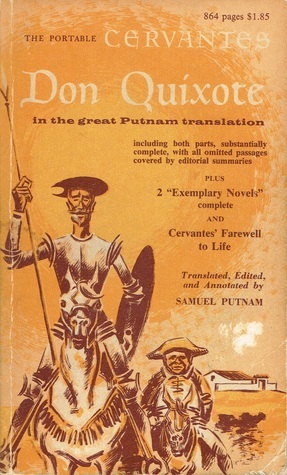
"Not less than three times in his or her life should everyone read Don Quixote," wrote Aubrey Bell in his book on Cervantes, "in youth, middle age, and old age." This novel, which has been translated into more than a hundred languages, is the first truly modern novel and one of the greatest of all time - a quickening influence on readers to this day. Before Cervantes, the narrative form had moved within a fixed orbit; he broke the mold "and introduced the element of dynamism," as Samuel Putnam observers in his introduction. The further genius of Cervantes' writing lies in its humanity, which, wedded to a soaring cosmic spirit, makes Don Quixote unique among works of literature.
The Portable Cervantes features Samuel Putnam's acclaimed translation with introduction and annotation. Also including: two "exemplary novels" and Cervantes' Farewell to Life.
Miguel de Cervantes y Cortinas, later Saavedra was a Spanish novelist, poet, and playwright. His novel Don Quixote is often considered his magnum opus, as well as the first modern novel.
It is assumed that Miguel de Cervantes was born in Alcalá de Henares. His father was Rodrigo de Cervantes, a surgeon of cordoban descent. Little is known of his mother Leonor de Cortinas, except that she was a native of Arganda del Rey.
In 1569, Cervantes moved to Italy, where he served as a valet to Giulio Acquaviva, a wealthy priest who was elevated to cardinal the next year. By then, Cervantes had enlisted as a soldier in a Spanish Navy infantry regiment and continued his military life until 1575, when he was captured by Algerian corsairs. He was then released on ransom from his captors by his parents and the Trinitarians, a Catholic religious order.
He subsequently returned to his family in Madrid. In Esquivias (Province of Toledo), on 12 December 1584, he married the much younger Catalina de Salazar y Palacios (Toledo, Esquivias –, 31 October 1626), daughter of Fernando de Salazar y Vozmediano and Catalina de Palacios. Her uncle Alonso de Quesada y Salazar is said to have inspired the character of Don Quixote. During the next 20 years Cervantes led a nomadic existence, working as a purchasing agent for the Spanish Armada and as a tax collector. He suffered a bankruptcy and was imprisoned at least twice (1597 and 1602) for irregularities in his accounts. Between 1596 and 1600, he lived primarily in Seville. In 1606, Cervantes settled in Madrid, where he remained for the rest of his life. Cervantes died in Madrid on April 23, 1616. -Copied from Wikipedia
This substantial, but abridged version of 'Don Quixote' is the only one I've read.
First, the notes were endlessly helpful. The plot is straightforward enough, but Quixote's constant references to the literature of knight-errantry, and Sancho Panza's proverbs would be nearly unintelligible without them.
At first, I thought that Don Quixote was laugh out loud funny. Quixote's soliloquies on the virtues and laws of chivalry, and the manner in which he addresses people are hilarious. Despite a few tiring digressions, the first part is a strong testament to why this classic is a top contender on many people's list for the greatest book ever written.
As for the second part, it begins strongly with the protagonists comically addressing the inconsistencies of the first part. They speak with more depth and pathos than the first book, and the first few adventures lead me to believe I was in for more of what was best in the first part. However, very quickly the worst of the first part is brought to center stage and magnified ten times over until the very bitter end. A whole cast of hum-drum characters flit in and out of the story. The whole lengthy and tiring sequence of Quixote and Panza in the company of the Duke and Dutchess (which takes up most of the second book) is not only mind-numbingly convoluted with side stories and digressions, but it makes nonsense of what we've been led to believe are the established virtues of both protagonists.
Where before Quixote was a well-intentioned but lovably foolish and side-splittingly funny "knight-errant", in the second book he is little more than a dunce, and a pawn to boot under the seemingly cruel and gratuitous pranks of his ducal hosts. For all his silliness, Don Quixote has been endearing enough that it is enough for us to laugh at his own fantasies, but no one I think wants to see him MADE the fool of. His "intelligence" is occasionally redeemed with a poignant (although maybe undeserved) monologue to Sancho Panza on governance, chivalry, or temperance, but for most of the second part, Quixote is only a ghost of the charming character we met in the first book.
As for Sancho Panza, his character becomes so confused as to be almost unrecognizable. In one instance, he is the simple, slightly greedy, but good hearted squire we know, in another he is practically a pillar of parochial wisdom and tender governance. In one moment he is as taken with the life of knight-errantry as Quixote is, in another is not only a liar (as in the episode of Clavileno), but ultimately, after he shirks the penance he promised to pay to "awaken" Dulcinela, he seems like little more than a crook.
All this coupled with a host of wearisome digressions and a whole bunch of glaring inconsistencies in plot and narrative (one note describes one error in narration as, "a confusion of ideas it would be difficult to match."), makes it very hard to say that I've just read "the greatest piece of fiction ever written".
That said, I will read the entire thing eventually, although I'm sure the increased length will only add to my list of perceived deficiencies.
“The Portable Cervantes” contains Samuel Putnam’s translation of “Don Quixote” (parts one and two), along with two short stories titled “Rinconete and Cortadillo” and “Man of Glass”. It also contains “Foot in the Stirrup”, which was Cervantes final words written days before his death.
I admit that I did not read this book from a critical literary point of view. I merely approached it as someone that enjoys reading, and as someone who heard so many interesting things about the main story of “Don Quixote”. The book is over 400 years old, and I’m certain a lot of the significance and meaning is lost on a modern reader like myself because I have no background and understanding of chivalrous writings and stories of “knight-errantry” that Cervantes was making light of in his writing. Putnam’s abridgement, notes on what he cut, and his footnotes were extremely helpful to understand some of the context.
As a word of warning, do not read the introduction first because it contains several spoilers. I did find it helpful after I finished the book as it explains the significance of the Cervantes works, provides some biographical information about Cervantes, and touches on the popularity of the book over the years. The introduction also explains how the Cervantes allowed his characters to evolve over the course of the story, which was something new and exciting for a fictional story in the 1600’s. There is a line in in the main story that pretty much sums up my experience “To those acquainted with Don Quixote’s mad whims, all this was very amusing indeed, but to the rest it seemed utter nonsense.” If it weren’t for Putnam’s footnotes and his introduction, I would have quit reading very early into the story!
I thought a lot of the story was a bit silly, but I did enjoy the banter between Don Quixote and his squire Sancho Panza. The two of them had many humorous exchanges that I still found funny today. I also enjoyed many of Sancho’s proverbs on a variety of topics as well as Don Quixote’s general wisdom that he frequently shared throughout the story with anyone that would listen to his words. I wouldn’t say this is an easy read because there are a lot of footnotes that you’ll have to reference to understand what is going on, but I’m glad I took the time given the impact this work had on writers and fiction as we know it today.
Love this translation by Samuel Putnam. It isn’t every word of “Don Quixote” but it’s most of it, and Part I is simply hilarious. There have only been a handful of novels this funny in the next 400+ years. The early conversations between Quixote and Sancho Panza will make most readers laugh out loud. Part II is usually regarded as the “better” part because it has so many “meta” levels about the “text.” And it’s terrific, too, but for pure humor you can’t beat Part I. “The Portable Cervantes” is a near perfect edition for everyone.
I liked this book initially. In places, the mad Don Quixote and his unorthodox squire Sancho are laugh-out-loud funny. But in other places, the story moves slowly and eventually I found myself skimming along through long passages, until I decided I’d had enough. I’ve got the general idea and flavour of the piece; it doesn’t feel worth my time to push on to the end. I’m glad I read the parts I did, though.
Putnam's notes made reading Don Quixote outside of a classroom manageable and even enjoyable. If you have a compulsive need to read anything considered a classic (like I do), I would recommend this version of Don Quixote
After reading off and on for six months, I might actually miss Mr. Quixote and Mr. Panza popping in and out of my life. --- Extreme Book Nerd Challenge - Book with a knight in it
A good translation and abridged edition of "Don Quixote". As a whole, Don Quixote was too episodic and repetitive for me, but at the same time, who am I to criticize Cervantes? I found myself laughing at parts, but not after 500 pages with 400 to go... Loved the metaphysical aspect of Part II and certain scenes in Part I.
Through this volume I read the abridged Putnam translation in high school; someday I'll read the unabridged Putnam translation and review it in turn. Is there anything I can say about the Knight of the Woeful Countenance that hasn't already been said by others more eloquent than myself? It's one of the fundamental works of the Western canon for a reason.
The Portable Cervantes-Don Quixote. Absolutely amusing, a great delight, makes me smile. Such an old-fashioned romantic. Full of Gallantry, Honor and Adventure and I should add misadventures. I love this book. When I finish it-I will probably read it again.
i am putting don qixote on hold til i get a non-abridged version. update: now i have an unabridged edition but the translation is all middle englishy. whatever. thanks mike.