THE BIRTH OF COMICS. From the Yellow Kid to the Captain and the Kids, these are the origins of the American comic strip, created at a time when there were no set styles or formats, when artistic anarchy helped spawn a new medium. This book features the earliest offerings (1895 to 1915) from the famous and lesser-known cartoonists who where there when comics were born-over 150 creations from more then 50 superb artists, most reprinted for the first time ever. And all in the original broadsheet size and brilliant colors. Chris Ware calls "Society Is Nix, "a mind-blowing portable museum retrospective of the raw, tangled ferocity and frustration that went into the making of America." Art Spiegelman exclaimed, ..."never thought anything like this could exist outside my dream life."
The colorful, creative chaos on Sunday morning was eye popping!
This is the second of two reviews I'm posting on a couple of my favorite oversized volumes by the folks at Sunday Press Books. Like me, these folks love vintage newspaper comic strips and, like me, they want the true classics to be more widely available to readers. So, they designed these lavish books that are supposed to be the same size as the original big newspaper pages, back when newspapers were much larger than they are today.
Earlier today, I reviewed the volume titled Forgotten Fantasy. And, in fact, over the last few years, I have made it a point to purchase all of the books produced by this publishing house. I'm a collector of classic comics, especially newspaper comic strips, and these books are such rare volumes that they instantly become collectors items.
Personally, I think that's a problem. I wish this publishing house would produce another press run of these marvelous books so that they would remain available for the original suggested list prices. I just checked Amazon as I was getting ready to post this review and some "reseller" on Amazon is listing a copy of the publisher's Krazy Kat retrospective for $670. Another reseller has a single copy of this book I'm reviewing listed at nearly $2,000. That's ridiculous! But it's a good illustration of how rare and prized these unique hardbacks are among folks who care about this niche of American media.
So, what's in this volume? (You may be able to borrow a copy through your local library.)
This is the book in this publisher's series that provides a general introduction to this genre. There's more historical reading in this volume than in others in the series and, for example, there are multiple viewpoints on who provided what innovations in the 1890s, when advances in color newspaper printing ushered in an era of competition based on who could provide the most attractive Sunday "supplements." Soon, top artists were experimenting with all manner of comics, sometimes including lavish and highly detailed full-page illustrations that, today, might remind you more of Where's Waldo in their intricate detail.
This volume has a broad sampling of those early comics from, as the title says, 1895-1915. There are some one-off gems and there also are a lot of examples of the "big names" in that era: The anarchic Yellow Kid, Buster Broiwn, Happy Hooligan, and the slapstick Katzenjammer Kids.
This volume's title comes from a weary character in the Katzenjammer comic strip who despairs over the chaos caused by those mischievous imps. He finally declares in the broken German-American slang of that comic strip: "Mit does kids—society is nix!"
As I pointed out in my previous review of another volume in this series, these comics astonish people today. I know because I've given group talks about the early history of newspaper comics and I display actual pages from vintage newspapers. People can't believe the Sunday comics once were so large—and so elaborately illustrated!
I'm glad to see that these books have been "bought out" by fans who are eager to own and save and savor these unique volumes, but I'm also sad that the publishing house hasn't kept issuing reprints to keep the prices more reasonable for other readers.
For now, if you're intrigued by these 2 reviews today, ask your library if there's a copy you can borrow. And be sure to have a strong arm handy to lug this home. These volumes I have just reviewed weigh in at 8 pounds each!
Sunday Press re-releases Society is Nix: Gleeful Anarchy at the Dawn of the American Comic Strip 1895-1915 as a revised and expanded edition. I don't have the original, so not clear which strips have been added to the collection to up the page count by a dozen or so pages. Collected here is an assortment of early comic strips from over 75 cartoonists, sampling the truly diverse range and quality of comic strips that were being released before the medium really even begun to take shape. The big names like George Herriman, Winsor McCay, R.F. Outcault and more are represented in here, though this collection really is for representing more of the lesser known names who didn't have as lengthy or as prolific strips but were still undeniably influential on the early pioneers in the medium. A truly gorgeous collection, printed on thick high-quality broadsheet, Society is Nix is blissful eye candy from start to finish.
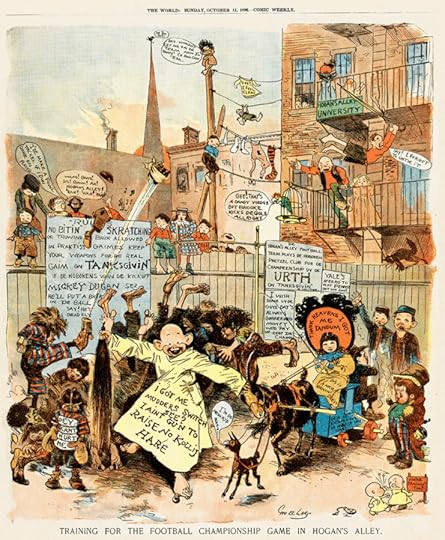
The first Yellow Kid strip by George Luks, October 11, 1896, The New York World
The innovative use of page with respect to compositions and layouts are routinely pushed to increasing heights during this era, something that makes one wonder if it has become something of a lost form in the contemporary comics industry.
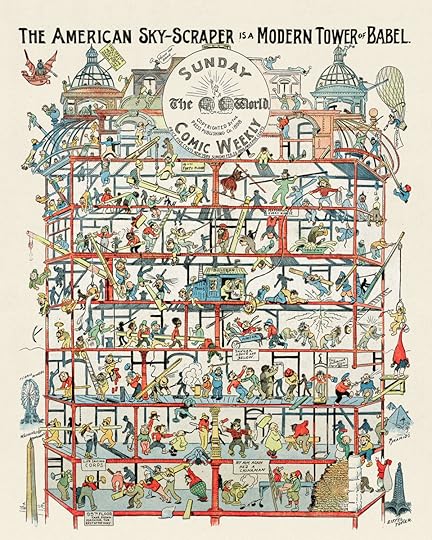
Dan McCarthy's spoof of progress and technology, February 20, 1898, The New York World
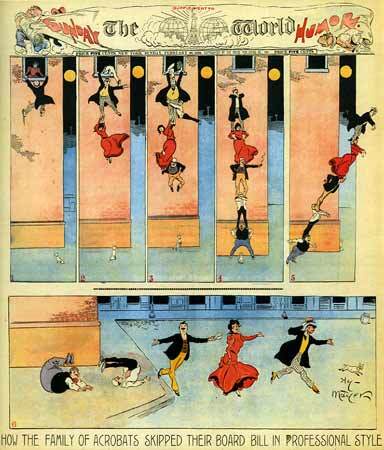
Hy Mayor experiments with fluidity in the sequential layouts of comics, February 26, 1899, The New York World
Genre and concept were regular experimentations across the breadth of comic strips released in the early 20th century, with cartoonists varying in their serialization and episodic storytelling. The clear idea was always that any strip could be the reader's first, so they must be accessible.
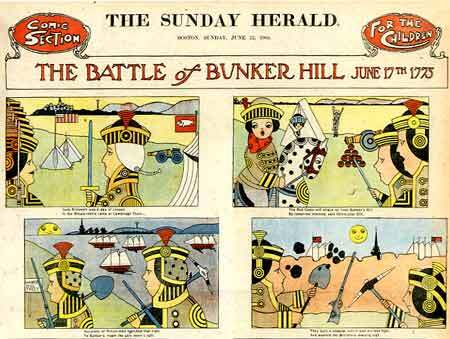
Augustus Jansson's rigorous chronicling of the American Revolution, June 12, 1904, The Sunday Herald.
The sheer number of gems here are too many to tabulate - Society is Nix is best appreciated over numerous sittings such that new (but really, old) wonders can be (re)discovered each time. The immense wealth of the comics medium has never been more apparent than the way it has been presented in this hefty tome.
Amazing! This isn't a coffee table book; This is a boardroom meeting table book. The thing is huge! What we have here are Sunday newspaper comics from the late 1800's/early 1900's printed at the size they originally ran. The book is a Who's Who of early comic strips. We've got Dirks, Outcault, Swinnerton, Opper, Gus Mager, pre-Krazy Kat Herriman, pre-Bringing Up Father McManus, pre-Nemo McKay, early Sydney Smith, Rube Goldberg ... just page after jaw-dropping page of wonderful work. These were created back in the days when there were no rules; newspaper comics were a brand-new medium and just about anything was tried. Heck, there's even an example of a strip created by modeling each panel in clay and photographing them. I wouldn't have believed it if I hadn't seen it with my own eyes. And there are jam strips. Since many early creators shared studio space they would cheerfully collaborate on strips, and there are many fine examples here. Yes, there are some unfortunate racist stereotypes in a few strips. It was the era, after all, but that shouldn't dim the magnificence of the rest of the book. The only real drawback to the prodigious size of this book is how difficult it is to read comfortably. It really wants its own dedicated lectern, which I managed to improvise by using a small folding table as a book rest. Yes, some of these strips have been reprinted before--some of them were familiar from Bill Blackbeard's excellent The Smithsonian Book of Newspaper Comics, and McKay's Little Nemo In Slumberland has been reprinted often--but most of them should be new to all but the most ardent scholars of the form. And you've never seen them at this size before. Lovely stuff! Highly recommended if you've any love for old comic strips.
A wonderful resource and a rare chance to see early American comics presented clearly and at large size. At least in the hardback edition. I read a digital version on Hoopla which was not scanned at high-enough resolution to read all of the text. This wasn't much of a problem for the actual comics, since their crude, repetitive, and often offensive stories are better to skim over. But even the textual essays were hard to read. I hope the resolution is better in the Kindle version, otherwise it is hard to justify the $70 price.
I read this at the same time that I was reading "Huckleberry Finn" for the first time. The bad boy rascals, casual racism and violence, badly-behaving adults, and disrespect for authority and the rules of society, share a lot in common with Twain's story; a point brought up in one of the essays.
The most creative were probably the works of Winsor McCay, and the various collaborative "Quilt" comics, where multiple artists would intertwine multiple strips with their distinct characters and styles snaking through each other in a full page. Yet even the best of those don't hold my interest like today's works.
The most strange was "Little Denny Mud" by C.A. Beatty, a comic strip created by taking photographs of sculpted mud!
The only problem with Sunday Press' books is that the company doesn't publish one often enough. Definitely a case where the package makes the material, the republication of Sunday comics in their original dimension creates a reading experience unlike any other. The introductory material is extensive and ranges from excellent history to self-evident musings that don't add much to the printed strips, though they certainly do not detract from the full-color wonders that follow. The strips are weird and chaotic in the way only a new medium can be, reminiscent of early film or early comic books, a kingdom without rules or conventions. Over the course of the samples collected though, one can see formula creeping in, especially in the Katzenjammer Kids and their cousins across town, as though chaos can only be sustained for so long. My favorite strip in the collection is the single example of Woozlebeasts, which I would love to see in its own high-quality, Sunday Press collection.
This is a beautiful collection with informative essays. Must read for anyone interested in comics. Many of early Sunday comics are way more beautiful than most mainstream comics. They experiment beautifully with the comics form. Also great to see how comics' grammar developed. It did not take more than a few year! "Sunday comics' two popular themes were dreams and modern art." Paul Tumey's review at the Comics Journal is well written. http://www.tcj.com/reviews/society-is...
Amazing large format book composed of 150 pages of beautiful (and a little anarchic) Sunday comic pages from the earliest days of the art form. The seven articles that preface the book are well researched and informative, and the art itself is a revelation. You'll better understand where such artists as Maurice Sendak and Chris Ware get their inspiration from.
It's not an easy book to handle (it reproduces the Sunday comic pages of Pulitzer and Hearst full-scale), but sit it down on a coffeetable and immerse yourself into it.
Wow. As much a lesson in comic strip history as it is a collection of vintage strips from the Platinum Age of Comics, Society Is Nix is required reading for anyone who wants to know how it all began. There is a lengthy introduction which traces the origin of the newspaper strip to England and Germany in the 19th century, showing numerous examples as well as the origin of the comic book, which was originally a way for publishers to reprint newspaper strips in book format. These were also the very first collected editions, if you will.
There are many of these strips that I would love to see full blown collections of, such as Buster Brown and Pore Lil' Mose. Due to the racist caricatures found in those strips, it will likely never happen. Folks could never look past that and see these for the historical curiosities that they are. There are several examples in this book of racist caricatures which were common occurrences in newspaper strips of the day, and it seems like something out of The Twilight Zone. Those who believe that race relations have not progressed need look no further than examples found here to see how far things have come.
The comic jam and crossovers, things which I loathe and associate with the worst of modern comic fandom, actually originated during this era. Granted the crossovers were limited to characters within the same newspaper, but happen they did. The more things change...
As this was the dawn of the artform, the rules were made up as they went along. Some of the early strips had numbered panels so that people could understand how to follow along, a tradition continued in the early Golden Age comic books.
There are some brilliant artists in this book. F.M. Howarth's bizarre big-headed characters and thick black lines. Jack Bryans' silhouette style of storytelling. R.F. Outcault is another seemingly forgotten genius. A.D. Reed, whose style was a precursor if not direct influence on Robert Crumb and the underground “comix” of the 1960s. Ed Carey's Simon Simple, which is worthy of it's own line of books. Of course no overview of this era would be complete without a handful of examples of Winsor McCay's genius. Norman E. Jennett is an artist whose work needs to be rediscovered and collected. Penny Ross' Mamma's Angel Child is also brilliant. I can go on and on and on but won't. Suffice it to say that I want to see more of this stuff.
The Katzenjammer Kids are the most represented in the book, which makes sense since they were also among the most popular of the day as well as the longest running of these strips. I love the melting pot aspect of the early strips, with artists catering to the various immigrants in their respective cities.
I am beyond thankful for the people who thought to save what was essentially disposable entertainment. If not for the collectors and pack rats of the world this stuff would have been lost entirely. As it is, much of it is gone forever. This book certainly belongs in your collection.
This anthology collects a wide variety of comic strips from the very earliest in the late 1800s through 1915. The sampling contains a range of styles from over 75 creators at a time when they were making up the rules, the language of comic art. It was a time when newspapers were large broadsheets that could accommodate detailed, intricate art. At the same time, a modern reader may have to squint to read the inconsistent text in word balloons and narration (especially if one reads the ebook version that shrinks the artwork). The strips in this collection include works from well known artists such as R. F. Outcault, Winsor McCay, and George Herriman, but most of the artists have unfortunately been long forgotten, so it's great to see them (some for the first time in over a century). Every artist in this collection contributed in some way to the evolution of comics, and the editors do a good job of showing this with informative essays and biographies. In addition to seeing some fabulous artwork, readers get to see how people lived at the turn of the century.
I own the original hardcover edition of this book but chose to read this revised edition as an ebook for convenience. I know the hardcover better recreates the experience of reading these strips. Sunday Press (now part of Fantagraphics) always does a superb job with book design and quality.