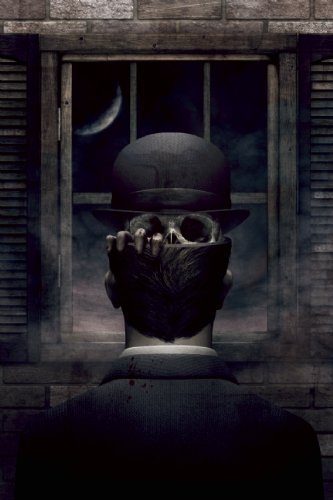
Sherlock Holmes...Interdimensional demons...Aliens...Killers and child predators...Time travelers...Vampires...Even the end of the world, in more ways than one, all are contained within these pages. From the darkest corners of imagination to the precipice of human achievement, William F. Nolan delivers the goods in this assortment of recent works: his first all-new collection in his long and storied career. Working with editor Jason V Brock (Milton's Children), Nolan brings to shocking life not only debauched murderers and depraved loners, but also fascinating portraits of personal reflection; the heroes of yore in poetry; pages from Nolan's notebook; and an exclusive, intimate interview with his beloved friend, the late Richard Matheson (I Am Legend). "For ardent readers of Nolan's work, this collection is a must-have." - Hellnotes
Contents: • Introduction: The Inner World of William F. Nolan (essay by Jason V. Brock) • The Blood Countess (novelette by William F. Nolan) • Dread Voyage (short story by William F. Nolan) • Flight to Legend (short story by William F. Nolan) • Getting Along Just Fine (short story by William F. Nolan) • Exchange (short story by Jason V. Brock and William F. Nolan) • My Girl Name Is Elly (short story by William F. Nolan) • The Recluse (short story by William F. Nolan) • Dysfunctional (poem by William F. Nolan) • Descent (short story by William F. Nolan) • Ashland (short story by William F. Nolan) • Millikin's Machine (short story by William F. Nolan) • The End: A Final Dialogue (short story by William F. Nolan) • The Beach (short story by Jason V. Brock and William F. Nolan) • A Lot Like the Joker (short story by William F. Nolan) • With the Dark Guy: A Conversation (short story by William F. Nolan) • A New Man (short story by William F. Nolan) • Like a Dead Man Walking (short story by William F. Nolan) • Goodbye, Old Pal (essay by William F. Nolan) • Rich (essay by William F. Nolan) • What Dreams May Come: A Discussion with Richard Matheson and William F. Nolan (interview by Jason V. Brock) • Excerpts from the Notebooks of William F. Nolan (short story by William F. Nolan)
William F. Nolan is best known as the co-author (with George Clayton Johnson) of Logan's Run -- a science fiction novel that went on to become a movie, a television series and is about to become a movie again -- and as single author of its sequels. His short stories have been selected for scores of anthologies and textbooks and he is twice winner of the Edgar Allan Poe Special Award from the Mystery Writers of America.
Nolan was born in 1928 in Kansas City Missouri. He attended the Kansas City Art Institute and worked as an artist for Hallmark Cards. He moved to California in the late 1940s and studied at San Diego State College. He began concentrating on writing rather than art and, in 1952, was introduced by fellow Missouri native (and established writer) Ray Bradbury to another young up-and-coming author, Charles Beaumont. Moving to the Los Angeles area in 1953, Nolan became along with Bradbury, Beaumont, and Richard Matheson part of the "inner core" of the soon-to-be highly influential "Southern California Group" of writers. By 1956 Nolan was a full-time writer. Since 1951 he has sold more than 1500 stories, articles, books, and other works.
Although Nolan wrote roughly 2000 pieces, to include biographies, short stories, poetry, and novels, Logan’s Run retains its hold on the public consciousness as a political fable and dystopian warning. As Nolan has stated: “That I am known at all is still astonishing to me... "
He passed away at the age of 93 due to complications from an infection.
Friend and contemporary of such genre luminaries as Charles Beaumont, Ray Bradbury and Richard Matheson, over decades William F. Nolan has produced his own substantial and well-regarded body of work. This is a collection of mostly original stories, as well as his touching farewell letters to Bradbury and Matheson, a lengthy round-table discussion between Nolan, Matheson, and editor Jason V. Brock, and some excerpts from Nolan’s notebooks.
The introduction turns out to be a fascinating interview of sorts between Brock and Nolan, a biographical look at Nolan and his writing.
After this, the first story begins. The stories are the bulk of the book, and in terms of the quality of the prose, they’re a mixed bag. A lot of the dialogue tends to be expositional and distances the reader from the story. Much of it sounds unnatural, at times even anachronistic, the speech of the characters unbefitting of both their ages and the era they’re living in. Whether intentional or not, it’s ubiquitous and bears mentioning.
Nolan compensates, though, with a true gift for storytelling. Each story has a propulsion that grabs the reader and takes them right into the fray, not letting go until the final word. Some are derivative, but all have the distinct voice that Nolan has long been cultivating.
The Blood Countess is a strong piece to kick off the collection with. In the note preceding it, Nolan and Brock ask if vampires can still be frightening today, and going by this story, the answer is yes. Nolan sets this atmospheric tale of Bathory in the present day and drapes it in classic gothic styling.
Dread Voyage is an evocative prose poem that serves as a companion piece of sorts to Virgil’s Aeneid. For those unfamiliar with Virgil’s work, Nolan’s take on it serves in its own right as a short and entertaining sword and sorcery tale.
Flight to Legend is a brief, humorous piece that riffs on the origins of a famous detective and the current whereabouts of his arch-nemesis.
Getting Along Just Fine is a slice-of-life vignette about an aging artist separated from his remaining family and friends, his train of thought running its course from lament to acceptance.
Co-written with Jason V. Brock, Exchange is a crime story told in epistolary form through a series of emails between two friends, with a clever twist.
My Girl Name is Elly is a vividly rendered sci-fi shocker about a displaced and curious girl who spends her time on Earth looking inside people to see what makes them tick.
The Recluse is a bittersweet tale concerning a fictionalized version of Howard Hughes, and the lengths some people will go to feed their own egos, emotional casualties be damned.
Dysfunctional is an experimental bit of flash fiction. Nolan does an impressive job here of paring his prose to the bone to give us a nasty, darkly satisfying little story.
For Descent, Brock asked Nolan to write something outside of his comfort zone, and as it turns out it’s one of the strongest stories in the collection. It’s a fast-paced, free-falling ride through the last thoughts of a man who’s in the wrong place at the wrong time.
Next is Ashland, a surreal story that could easily have found a home in The Twilight Zone, in which a selfish rich man unwittingly becomes the guest of honor at a most unusual party.
Millikin’s Machine is a story of time travel gone horribly awry, all for the sake of trying to collect a piece of the past.
The End: A Final Dialogue, told entirely through dialogue, is the final conversation between a married couple who have full foreknowledge of their impending deaths.
The Beach, co-written with Brock, is a poignant story about the horrors of war and the relationship of a married couple torn apart by it.
A Lot Like the Joker is about a young comic book fan who crosses paths with something sinister while heading to the city to spend the summer with his father. The atmosphere of burgeoning dread here is well-evoked.
A New Man is a sci-fi crime piece that explores some intriguing questions concerning the “digitization” of humanity. It’s a character-driven tale at its core, and a moving one at that.
Like a Dead Man Walking concludes the stories. This one runs in a classic horror vein. A writer, trying to dispel belief in the supernatural, decides to do a stranger a favor and is thrust headlong into the inexplicable.
Next is What Legends May Come: A Discussion with William F. Nolan and Richard Matheson, and it covers a lot of ground. They discuss “The Group” (a collective of likeminded writers and friends), writing for film, Charles Beaumont, Serling and The Twilight Zone, and astrology, among other things. It has the feel of an informal discussion between a pair of old and dear friends, which is precisely what it is.
Following the interview are a variety of scanned excerpts from Nolan’s notebooks, beginning with the first two pages of his first (unpublished) novel, and ranging from his thoughts on reading and writing to some poetry and diary entries. These excerpts provide a brief but intriguing glimpse into the mind of the author, in a way readers don’t normally get the chance to experience.
When it comes down to it, there are other collections of Nolan’s stories that would better serve as introduction to those unfamiliar with his work. The other material is a wonderful touch, and the book as a whole is well-structured and very impressive aesthetically. For ardent readers of Nolan’s work, this collection is a must-have.
William F. Nolan’s Like a Dead Man Walking and Other Shadow Tales is a remarkable book on several levels. First, it is being issued to commemorate the occasion of Mr. Nolan’s 85th birthday—a remarkable age at which to still be most active in the writing community and to be producing the sheer volume of quality work that he does.
Next is the concept. This book is like a literary quilt, incorporating never before seen short stories by this horror icon, as well as poetry, an interview, verse, miscellaneous handwritten jottings, and formal good-byes to Ray Bradbury and Richard Matheson.
For those who have always hungered to know more about the enigma that is William F. Nolan, now is your chance. The book contains much that is biographical—but not the dry, dull stating of fact on fact. No, this is much more subtle, as the reader is shown rather than told about this world-famous author. His opinions, ideas, and feelings abound, but in stories, in commentary and in verse, making them interesting and easy to turn over in your mind as the curtain slowly draws back to reveal the kind of man anyone would be proud to know.
Finally, the stories—as remarkable as the man is:
The Blood Countess: a story of old sweethearts, a haunted house and an obsession that ends badly.
Flight to Legend: when boasting spirals out of control.
Getting Along Just Fine: This story moves from the bitterness that can come of isolation, aging and watching one’s lifelong friends die to a decision to be grateful for every day remaining. Biographical. If you’re over 50, you’ll understand exactly what he means, and if you are under 50, you’ll know what you’re in for.
Exchange: written with Jason V Brock, this story is comprised of email exchanges between two friends. The differing points of view and the horrifying way the story ends make this an ultra-streamlined storytelling vehicle that speeds like a bullet to the heart.
My Girl Name is Elly: Elly is somewhat reminiscent of Theres, the main character in John Ajvide Lindqvist’s novel, Little Star. Both characters have a similar penchant when it comes to human anatomy, only Nolan’s story has his signature sci-fi twist.
The Recluse: A story based on Howard Hughes, and his brilliance and his decline. It is illustrative of how genius is held prisoner both by a deteriorating physical shell and by those intellectually and morally inferior. Horrifying. One of my two favorites.
Descent: Written outside of Nolan’s “comfort zone,” this is one story that will rip your heart out. I won’t say anything more, as to do so would spoil it. A must read. The other of my two favorites.
Ashland: Some party people just never know when to go home. Millikin’s Machine: This was such fun. Like The Time Machine with a sense of humor.
The End: A Final Dialogue: A last conversation of a couple in love. Heartbreaking. I’d have given this last story placement.
The Beach: World War II, a devastating letter, and its aftermath. Tragic.
A Lot like the Joker: Always accompany your child on a trip far from home…even if he thinks he’s old enough to go by himself.
A New Man: Robotic life in the future is not free from glitches.
Like a Dead Man Walking: Philip Dexter is a paranormal debunker who investigates the “return” of a famous sculptor. An homage to Lovecraft.
The book ends with emotional farewells to Ray Bradbury and Richard Matheson, followed by a chatty interview with William F. Nolan, Jason V Brock, and Richard Matheson—all bittersweet and informative reads for fans.
This is a very eclectic collection of Nolan's work. His stories cover a range of genres and some were stronger than others. Nolan's poetry was a pleasant surprise, and I enjoyed his interview with Matheson. Nolan is among my favorites and this collection is a strong representation of his imaginative skill.
This collection by Nolan just didn't grab me; it seemed like half of the stories were half-finished ideas that he then rushed through to make it into the book.
I thought this was a pretty strong anthology from a master of the short story form. Nolan doesn't confine himself to any one genre here. There's a little horror, a little science fiction, and a little general fiction. But the crown jewel of the book is an interview with the great Richard Matheson, conducted by both Nolan and his editor Jason Brock. Nolan and Matheson were long-time friends, and that comes through in the relaxed, informal tone of the piece. Matheson discusses a variety of topics, including his early career, his friendships with other science fiction and fantasy authors, his work on The Twilight Zone and his relationship with Rod Serling. And at the end of the interview there are a couple of funny stories about William Shatner, which were fun to read. It was a very interesting interview and I enjoyed learning a little bit about this legendary writer.
I devoured this book up. It was amazing. These are short stories that kept my interest and I plowed through this book like it was nothing. I highly recommend, but get your own copy because I am not loaning mine out. :)
Unique stories that keep you thinking long after. I would be reading one story and thinking about the last. All stories and interviews were great even the poetry.