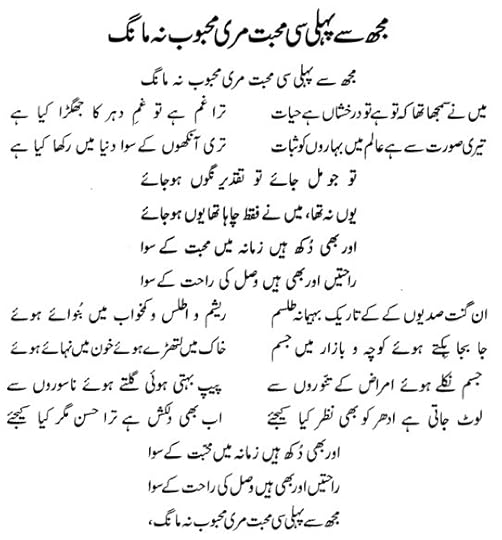
The book is a selection of Faiz's most popular poems, translated in a language and style which will appeal to a wide cross section. It is also special because it will have the Urdu original as well as romanised version for non-Urdu readers.
Faiz Ahmad Faiz [فيض ١حمد فيض] was born on February 13, 1911, in Sialkot, British India, which is now part of Pakistan. He had a privileged childhood as the son of wealthy landowners Sultan Fatima and Sultan Muhammad Khan, who passed away in 1913, shortly after his birth. His father was a prominent lawyer and a member of an elite literary circle which included Allama Iqbal, the national poet of Pakistan.
In 1916, Faiz entered Moulvi Ibrahim Sialkoti, a famous regional school, and was later admitted to the Skotch Mission High School where he studied Urdu, Persian, and Arabic. He received a Bachelor's degree in Arabic, followed by a master's degree in English, from the Government College in Lahore in 1932, and later received a second master's degree in Arabic from the Oriental College in Lahore.After graduating in 1935, Faiz began a teaching career at M.A.O. College in Amritsar and then at Hailey College of Commerce in Lahore.
Faiz's early poems had been conventional, light-hearted treatises on love and beauty, but while in Lahore he began to expand into politics, community, and the thematic interconnectedness he felt was fundamental in both life and poetry. It was also during this period that he married Alys George, a British expatriate, with whom he had two daughters. In 1942, he left teaching to join the British Indian Army, for which he received a British Empire Medal for his service during World War II. After the partition of India in 1947, Faiz resigned from the army and became the editor of The Pakistan Times, a socialist English-language newspaper.
On March 9, 1951, Faiz was arrested with a group of army officers under the Safety Act, and charged with the failed coup attempt that became known as the Rawalpindi Conspiracy Case. He was sentenced to death and spent four years in prison before being released. Two of his poetry collections, Dast-e Saba and Zindan Namah, focus on life in prison, which he considered an opportunity to see the world in a new way. While living in Pakistan after his release, Faiz was appointed to the National Council of the Arts by Zulfikar Ali Bhutto's government, and his poems, which had previously been translated into Russian, earned him the Lenin Peace Prize in 1963.
In 1964, Faiz settled in Karachi and was appointed principal of Abdullah Haroon College, while also working as an editor and writer for several distinguished magazines and newspapers. He worked in an honorary capacity for the Department of Information during the 1965 war between India and Pakistan, and wrote stark poems of outrage over the bloodshed between Pakistan, India, and what later became Bangladesh. However, when Bhutto was overthrown by Zia Ul-Haq, Faiz was forced into exile in Beirut, Lebanon. There he edited the magazine Lotus, and continued to write poems in Urdu. He remained in exile until 1982. He died in Lahore in 1984, shortly after receiving a nomination for the Nobel Prize.
Throughout his tumultuous life, Faiz continually wrote and published, becoming the best-selling modern Urdu poet in both India and Pakistan. While his work is written in fairly strict diction, his poems maintain a casual, conversational tone, creating tension between the elite and the common, somewhat in the tradition of Ghalib, the reknowned 19th century Urdu poet. Faiz is especially celebrated for his poems in traditional Urdu forms, such as the ghazal, and his remarkable ability to expand the conventional thematic expectations to include political and social issues.
Well! I think its a good collection of poems by Faiz. the good thing about this book is that it contains poems in three different languages i.e Urdu, Roman Urdu and Translation In English. I enjoyed it very much.
Faiz: Fifty Poems is a magnificent tribute to one of the greatest voices in Urdu literature, Faiz Ahmad Faiz. This curated collection of 50 poems captures the essence of his poetic brilliance—an intricate balance of emotion, resistance, and timeless beauty. Faiz designs intensely layered patterns in his poetry that make each verse resonate with both depth and elegance. His words are never just poetry—they are acts of defiance, empathy, and vision.
A distinguishing strength of Faiz’s work lies in his ability to challenge the injustices of his time with unwavering grace. His poetry refuses to stay silent in the face of oppression, and yet it remains hauntingly lyrical, steeped in romance, sorrow, and revolution. Among the many masterpieces in this volume, Tanhai and Raqeeb Se are my personal favorites—each a profound reflection of inner solitude and complex love.
What I cherish most is how Faiz’s poetry feels eternally fresh. No matter how often I return to his words, they awaken something new in me each time. This collection is not just a read; it’s an experience—deeply personal and endlessly resonant. 💫