Beginning in 1884, Virginia follows Virginia Pendleton through her life as she struggles to adapt to the changing role of women in the post-Civil War south. Ellen Glasgow is known for her chronicling of Virginia social history. She later won a Pulitzer Prize for her novel In This Our Life.
American writer Ellen Anderson Gholson Glasgow won a Pulitzer Prize for In This Our Life (1941), her realistic historical novel of Virginia.
Born into an upper-class Virginian family, Glasgow at an early age rebelled against traditional expectations of women and authored 20 bestselling novels. Southern settings of the majority of her novels reflect her awareness of the enormous social and economic changes, occurring in the South in the decades before her birth and throughout her own life.
Virginia is raised to believe that women are wives and mothers, but shouldn't be clever or intelligent or intellectual. She never realizes that this might not be true, even when her life falls essentially into ruins. Written by a woman whom I think of as an American post-Civil War Bronte or Austen, Glasgow's writing is strong, and her characters believable. She's actually a contemporary of Wharton (b. 1873, Virginia was published in 1913), and she won a Pulitzer Prize for In This Our Life, published in 1941.
If you want to read Glasgow (and you like Austen, et al), you should start with this book and move on to some of her others (Barren Ground, Vein of Iron, etc). As a huge fan of the Austen/Bronte/Wharton-type work, I think Virginia fits well with the genre, but Glasgow's later works remind me more of Wharton's later works (The Reef, Glimpses of the Moon, versus something like House of Mirth)--they explore more of the psychology of the characters and their inner emotions, and the dynamic of relationships, rather than looking at the mechanics of society and the way characters fit within the framework of it.
Probably not the best novel to finish on Mother's Day weekend. This book is Glasgow's narrative against the self-sacrificing wife/mother figure in the post-Civil War South. The novel follows the woman who lives up to her womanly ideal perfectly by being the sacrificial wife and mother with no identity outside of satisfying the needs of others. Unsurprisingly, it doesn't work out that well for her. There was a nice surprise at the very end of the book that took some of the sting out of this tragedy, but still . . . not a happy book.
I read this book for my “Best of 1913” project, but I have more than a few sentences to say about it. Why is this masterpiece completely forgotten while people are reading all this garbage by William Faulkner? Could it be the clanking, undying machinery of sheer sexism?
Virginia tells the story of a woman who lives in the ignorant backwater of Dinwiddie, Virginia. It opens in the 1880’s when Virginia has just graduated from the Dinwiddie Academy for Young Ladies and she’s eager to fall in love and enjoy life to the fullest. Ellen Glasgow paints a very compelling picture of a town whose white citizens are willing to lay down their lives for Southern ideals a) which they don’t understand and b) the ideals are completely stupid. Still, Glasgow likes these benighted people and presents them as loveable. I really did feel for these characters. Virginia has received a terrible education that was designed to make her obedient and well-mannered, and she doesn’t realize that she shares the fate of her mother and all the other women she knows, of throwing her life away in service to some man. Then she crosses paths with the first young man she has ever met who is handsome, intelligent, and not her cousin. (This has been a common theme of the books of 1913 that I’ve read so far—marrying the first eligible man you lay your eyes on. We are so lucky that today we get to meet lots of people and do ordinary things like go to school with them.) After Virginia and her beloved meet five times, they become engaged.
The man in question, Oliver, is an interesting character. He’s from out of town and he’s different from everyone in Dimwittie because he believes in art and science while they believe in Christianity, how awesome they were during the Civil War, keeping up appearances, and making a buck. His greatest dream is to be a writer; he scorns money and working; and he reads things like The Origin of Species. Although he’s intelligent and original, he’s also very selfish and basically has no empathy or insight into other people’s feelings. Don’t we all know people just like this? What a fully realized character! He resists falling in love with Virginia because he can see that supporting a wife will hamper his wannabe Bohemian lifestyle, but
The foil to Virginia’s simplicity and self-effacing nature is her best friend, Susan. Susan is naturally curious and forceful and thinks for herself. Her dream is to go to college, but her father won’t hear of it. (“Father, I want to go to college.” “If you want something to occupy you, you’d better start about helping your mother with her preserving.” “I put up seventy-five jars of strawberries.” “Well, the blackberries are coming along.”) I really admire Ellen Glasgow’s writing. I wish I could write like her. Not just that I wish I could write such wonderful descriptions and could chivvy the plot along like she does while revealing meaningful things about the human condition. I wish I were “allowed” to write like her, with an omniscient third person narrator that tells you what’s right and wrong while letting you to see into the character’s hearts. If only that were still the fashion!
Glasgow rips aside the veil and shows us that there’s little or no meaning to life but still we have to march along and invent meaning if we can. One of Virginia’s daughters leads a very different life from her mother because she goes to college, loves learning, has “modern ideas,” and scorns the feminine tradition of self-sacrifice. Too bad she’s also completely selfish and doesn’t care about her mother. Glasgow portrays the daughter’s modern views as correct but too late and of no help to someone like Virginia who is mired in tradition. Although the novel’s ending is grim, I was glad there was a ray of hope for Virginia.
The Achilles heel of this novel is exactly what you would expect of a novel about Southern life in the late nineteenth and early twentieth century: racism. When describing the African-American characters (all minor characters), there’s a lot of “primitive” this, “savage” that, “wild animal” this, such-and-such “creature.” Also some speech rendered in offensive dialect and one use of a racial slur (in dialogue or maybe a letter, not from the narrator’s POV.) The sad thing is that clearly Ellen Glasgow was liberal-minded and held the progressive views of her day, when a big civil rights issue was trying to get someone in power to do anything at all to stop lynching. So basically this kind of racist claptrap was as anti-racist as a book by a white person got at the time.
Here’s a spoiler for you—
In conclusion, I thought this book was terrific and I think it deserves a greater reputation than it has. A lot of other books (by men) with some creepy racist elements are still regarded as worth reading so why not this one? I read the Penguin Classic edition and after I was done I read the introduction, which was, as always, somewhat bananas. This academic, in 1989, really thought it was totally fine to use the word “mulatto”? But I learned a few interesting tidbits about Ellen Glasgow and her family. Her sister Cary led a cheerless existence and after her husband (and her brother) died by suicide she devoted her life to reading books her husband had liked so that when they were reunited in the afterlife they would have something to talk about. Whaaat? But then I thought about it some more, and it makes as much sense as anything else. What are you supposed to do in that situation? Why am I reading the books of 1913? Why does anyone do anything?
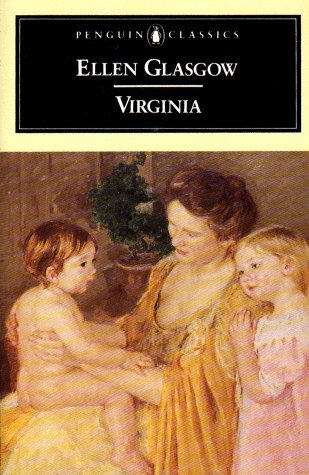
Book design and all that: It looks like all the Penguin Classics of the pre-2002 template with the red top of the spine that means it’s in English. The cover art, a painting by Mary Cassatt, is very appropriate. Some typos.
Other book similar to this: The Life and Death of Harriet Frean by May Sinclair.
Theme song: The Ballad of Lucy Jordan by Marianne Faithfull
I tried my best with this one, I really did but having read 120 pages of it I realised that I was never going to enjoy it. Glasgow was an educated woman, lamenting the lack of education and opportunities for women of her era however she is one of 'those' writers who cannot appreciate that her readers (or reviewers for that matter) have the intelligence to pick up on the various themes in their novels without mentioning that theme every single time it crops up in the narrative. For me, this has the effect of reminding me that I am reading a book and jerking my attention away from the quality of the writing and enjoyment of reading. It is a bit like being repeatedly poked whilst you are trying to read and became so annoying that I lost interest in finishing it. So, in a nutshell, the main character Virginia is an emblem both for women in Virginia and for Virginia itself in a period of transition. Others may read it and enjoy it but it was sadly not for me.
Luckily for me, Ellen Glasgow never disappoints. This may be because I tend to have a preference for novels that are solidly in the vein of realism, which focus on idealistic young characters who live out their lives and are bitterly disappointed with what they actually get, but who (usually, but not always) find an unexpected well of strength within themselves for life as they do get it. Now, granted, this is only the third novel of Glasgow’s that I have read, and that is over a long stretch of time between each one, but I do not think that I am going to wait that much longer to read more. I read The Sheltered Life as an undergraduate, and I liked it so much that I chose to use it in one of the assignments of the course, a comparative analysis in which I combined Fitzgerald’s Tender is the Night, Hemingway’s The Sun also Rises, and Glasgow to discuss early 20th century disillusionment [a grade of 97 and encouraging words from the instructor as to my scholarly potential]. Twenty years later, I read Vein of Iron. I also found this one to be quite powerful. Virginia may not quote rank with these two, but it is still very good. A young woman, whose name is Virginia, and who lives in Dinwiddie, Virginia, is the delicately cultivated representative of southern womanhood, the daughter of the local pastor and the lightly educated sort of eye candy meant for any of the best beaus of the rising generation. Unfortunately, one of the best families has produced a young man with literary ambitions, a well read and idealistic dreamer who is certain he can write plays that will open the eyes and minds of Americans. Both characters are interesting people (yes, even Virginia, to her limited degree), but anyone could tell that they are not two people who would be good for one another. . .so, of course, they fall in love and the rest of the novel is about their slowly growing apart as they age and raise children. I do not want to be a spoiler here, so I will just say that their lives are not disastrous, yet still unfortunate as they both wake up over the course of 20+ years.
Beautifully written, as one expects of Ellen Glasgow, though the story does suffer from repetition. It's as if the author is so intent upon making a point, she thinks she must make it more than once. The main character, who dominates the novel first to last, is Virginia Pendleton. We meet her as a young woman, and when the novel concludes, she is middle-aged. What comes between, it must be admitted, is a tale short on originality, about a marriage. Virginia marries Oliver, and they have two daughters and a son. I won't spoil the plot here, if I haven't already by calling it unoriginal. The book's real weakness is one so common, it is surprising a writer of Ms. Glasgow's caliber makes it. Virginia has no flaws. She is the Southern lady in the years after the Civil War. She lives for others. Forgetting oneself is, of course, the surest route to contentment in life, but Virginia can do this and still have an errant impulse now and then, can't she? Nope. Into her happy home inevitably comes an intruder. (Again, no use spoiling the plot, so I won't identify the intruder.) This is a strong novel, but another of the author's stories, "In This Our Life," is better. It's the tale of a family, too, but the plot is more sophisticated, and the main character is the father. Not every writer can cross the gender line, but Ms. Glasgow does, superbly, in this story. One final observation about "Virginia." Do not read the last page until you reach it.
It took me a while to finish. I’d read & then abandon it for a few weeks, repeat. Only bc it was the type of book that required me to be in a certain mood to enjoy. So much of the last 1/4 of the book was poignant for me (as a 43 year old divorcee who often wonders if the best years of my life aren’t already behind me) & more than once I shed a tear for the way Virginia’s simple life expectations were so harshly crushed by a mostly uncaring family who took her for granted. The final sentences of the book did leave me with a happy tear though.
An absolutely terrific 500 page story about a woman who cared only for her children and slowly turned into a doormat. Pitied by her children and her husband who trades her in for an actress! Of course I loved it - so sentimental. I kept wanting to scream "Virginia for Christ's sake think of yourself for once - have a 'me day' or two."
This entire review has been hidden because of spoilers.
Didn't bother finishing it. It had some nice descriptive passages, but was overall boring and racist; sure Glasgow was a product of her time, but awful anyway.
Glasgow and her gal pal Mary Johnston published novels in 1913 which bear their protagonist's names: Virginia and Hagar. Where Johnston often overlooks the psychology shaping her character's choices, Glasgow delves deeply into the motivations of the women surrounding her protagonista. Can't wait to see how it ends!!!
The copy I read had been remaindered to a second hand store, perhaps reflecting the depressing albeit it accurate portraysl of women's position in society.