"Was there a telephone here in your day?"
"No," I replied. "It might have made a great difference if there had been."
Leo Colston, a man in his sixties, returns in 1952 to the place where his life began ... and ended ... all of it during a brief interlude of glorious summer days, such as England, and Master Leo, has never seen since. With the help of the intimate journal he kept during his 1900 journey to Brandham Hall in Norwich County, Leo Colston re-examines the events that had such a traumatic ('arrested development', anyone?) effect on his innocent mind. As the introduction notes, Hartley wrote the book as a memoir, as an act of atonement, and as a manifesto against the decay brought by two world wars and a social order turned upside down.
It allowed him to evoke a past, a time half a century earlier, a golden age, as he saw it, of Victorian morals and manners, an age of innocence in the short time before its shattering.
What the introduction is less clear about, and what the reader can only discover by jumping right into the text, like the young boy dipping into the blue waters of a pond in summertime, is how full of beauty and sadness, how exquisitely written this trip down memory lane is.
The past is a foreign country: they do things differently there.
One of the most memorable first lines I have come across in my long years of reading, and a moving evocation of a fraught coming of age at the tail end of a pious, rigid yet prosperous Victorian society. Invited down for the summer to the opulent Brandham Hall by Marcus (a friend from his public school), Leo feels both enthralled by the prospect of mingling with the rich Maudsley family and anxious about his own social status.
I was between twelve and thirteen, and I wanted to think of myself as a man.
also,
I was acutely aware of social inferiority. I felt utterly out of place among these smart rich people, and a misfit everywhere.
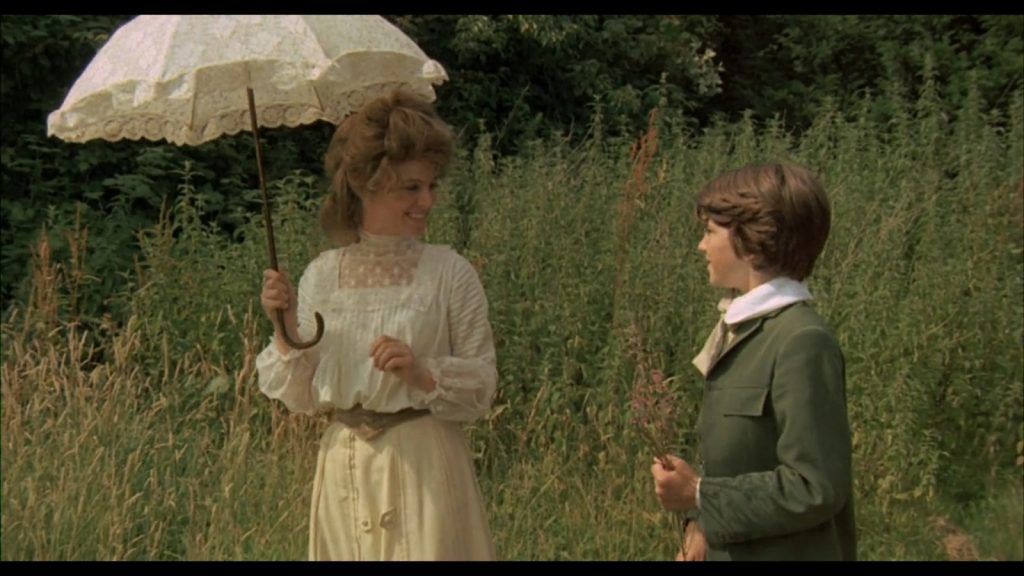
Leo has managed to find his place among his peers at school, escaping the obligatory bullying and even gaining a reputation as an amateur spell caster. Yet this new world of immaculate green lawns, formal dinners, white suits and dresses, tennis and cricket and evening dances has him flustered, out of his depth, enchanted. Most of all he is attracted by the older sister of Marcus, the beautiful Miss Marian Maudsley, who herself seems to be taking an interest in the young boy.
What did we talk about that has left me with an impression of wings and flashes, as of air displaced by the flight of a bird? Of swooping and soaring, of a faint iridescence subdued to the enfolding brightness of the day? [...] My spiritual transformation took place in Norwich: it was there that, like an emerging butterfly, I was first conscious of my wings.
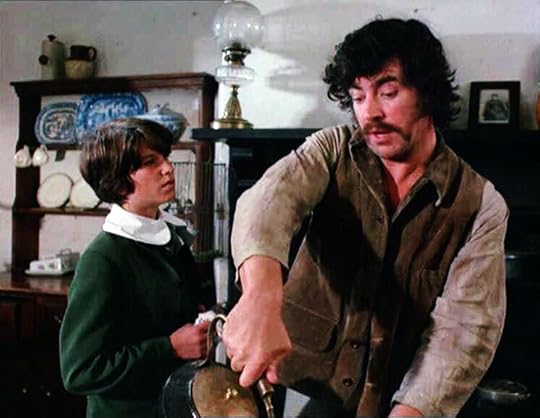
With help from Marian, Leo is out of his chrysalis (his inappropriate cold weather clothes and heavy boots), Leo is now decked in a highly fashionable summer suit in bright green colour, and can take his place among the revelers. On a trip to an improvised swimming pool he meets another adult that would have a major impact on his summer days: Ted Burgess is not a member of the Brandham Hall social circle, he is just a farmer out for a quick dip in the water, yet his physical presence is arresting.
Without going into one too many plot details, Leo ends up visiting Ted at his farm and becomes a bearer of secret messages between him and Miss Marian. His innocence fails to spot the obvious reason for the illicit dialogue and Leo revels instead in the attention he is paid by the two people he admires the most. Like many a young boy at that age, what he doesn't know is replaced by flights of fancy.
Without knowing it, I was crossing the rainbow bridge from reality to dream. I now felt that I belonged to the Zodiac, not to Southdown Hill School; and that my emotions and my behaviour must illustrate this change. My dream had become my reality; my old life was a discarded husk.
Yet how long can this pretending game continue while real life happens all around Leo? For a moment he is on top of the world – when he saves the day at the annual cricket match between the Hall and the village teams, or when he sings a Psalm at the game's afterparty accompanied on piano by Miss Marian. But the higher you fly, the most painful is the coming back down.
What an Eden Brandham Hall had been before this serpent entered it!
Master Colston begins to suspect that Ted and Marian are using him and that they care little about his own feelings, either praising or threatening him in order to get what they want from him. The Biblical references are intentional, with knowledge of the real world being blamed for Leo's expulsion from Paradise and with the connotations of sexual awakening in Leo as puberty hits. As older Leo inserts himself into the memoir, he even holds an imaginary conversation with his 12 y.o. self:
"Well, it was you who let me down, and I will tell you how. You flew too near to the sun, and you were scorched. This cindery creature is what you made me."
Again, I don't want to go into specific plot points about what went down at the end of that atypical spell of sunny days in East England, but it must have been the defining moment for the author of this book, an admirer of the old class system and a misfit among the trenches of the twentieth century.
I was a conformist: it never occurred to me that because I suffered, there was something wrong with the system, or with the human heart.
Leo the conformist to the Victorian values is mostly in evidence on the day of the annual meeting between the Lords and the Peasants with the occasion of the game.
Cricket is more than a game, they say, or used to say: it is an attitude of the mind, a point of view. I don't know about that. You can think of it as a set of ritual movements, or as a ballet, a ballet in a green field, a ballet of summer, which you can enjoy without knowing what it's about or what it means.
Cricket is also a stand-in for class warfare, with Lord Trimigham the refined war hero on one side and Ted Burgess the animal on the other, while Miss Marian standing on the sidelines to reward the winner.
Dimly I felt that the contrast represented something more than the conflict between Hall and village. It was that, but it was also a struggle between order and lawlessness, between obedience to tradition and defiance of it, between social stability and revolution, between one attitude to life and another.
Older Leo feels betrayed by the selfishness and the brutality of the new age, a brutality he feels he is partly responsible for after poisoning the Eden he remembers Brandham Hall to have been. In a book rich in metaphor and foreshadowing, Leo is obsessed by a wild weed growing in a shady corner of the Brandham stables. Belladona comes to signify for him both passion in its wild, secret growing, and poison in its effects on other people. He is wiser now, but he mourns for the enthusiasm and the hope that he lost along the way.
Knowledge may be power, but it is not resilience, or resourcefulness, or adaptability to life, still less is it instinctive sympathy with human nature; and those were qualities I possessed in 1900 in far greater measure than I possess them in 1952.
Indeed, before he was exiled from Paradise, the young boy was putting down in his diary some very thoughtful lines about ethics and religion and politics (the Boer War in that period).
Why should we call ourselves sinners? Life was life, and people acted in a certain way, which sometimes caused one pain.
or,
Wrong was not a word I had much use for; the idea of Right and Wrong as two gigantic eavesdroppers spying on my movements was most distasteful to me. But surely something which might end in murder must be wrong.
This dilemma between his intentions and the results of his go-between actions in the summer of 1900 will haunt Leo Colston for the rest of his life, until he is ready to revisit the place in 1952.
In my eyes the actors in my drama had been immortals, inheritors of the summer and of the coming glory of the twentieth century.
So whichever way I looked, towards the world of experience or the world of the imagination, my gaze returned empty. I could make no contact with either, and lacking the nourishment that these umbilical cords convey, I shrank into myself.
The tragic vibe of the account of the summer of 1900 is balanced somewhat by the returning visit of 1952. This reader feels that the author was not satisfied with the bitterness of his own failed life, of his trampled sensibility, and he wanted another voice to give an account of that summer:
Do you remember what that summer was like? how much more beautiful than any since? Well, what was the most beautiful thing in it? Wasn't it us, and our feelings for each other? [...] We did have sorrows, bitter sorrows, but they weren't our fault – they were the fault of this hideous century we live in, which has denaturated humanity and planted death and hate where love and living were. [...] Tell him there's no spell or curse except an unloving heart.
This epilogue raised the book from a simple five star rating to a place among my favorites. Now I'm ready for a re-watch of the movie version.
—«»—«»—«»—
I left out a long passage describing the relationship between young Leo and powerful Ted, something that has been used in some accounts to justify a homosexual interpretation. I don't see it, given the stated initial innocence of Leo and the obvious interest they both have in the beautiful Marian, but then I may have my own baggage of emotions and experience I am bringing to the lecture. To each his own. To me the quote serves to paint Ted Burgess as a role model and not as a crush.
I liked Ted Burgess in a reluctant, half-admiring, half-hating way. When I was away from him I could think of him objectively as a working farmer whom no one at the Hall thought much of. But when I was with him his mere physical presence cast a spell on me; it established an ascendancy that I could not break. He was, I felt, what a man ought to be, what I should like to be when I grew up. At the same time I was jealous of his power over Marian, little as I understood its nature, jealous of whatever it was he had that I had not. He came between me and my image of her. In my thoughts I wanted to humiliate him, and sometimes did. But I also identified myself with him, so that I could not think of his discomfiture without pain; I could not hurt him without hurting myself. He fitted into my imaginative life, he was my companion of the greenwood, a rival, an enemy, a friend – I couldn't be sure which.