Jim Woodring started having hallucinations at a pretty early age. He also kept what he called an auto-journal, which was also his dream journal, out of which he started to self-publish Jim in the mid-eighties. He had a drinking problem for several years. Maybe drugs, too. He followed Hindu philosophy. All this is part of the world that he creates (and partly creates him?).
Woodring's most famous character is Frank, the main character in a wordless comic that has spun out many books. Read The Frank Book and you have the basic collection of Frank stuff. I guess the best way to describe Woodring's work is surrealism, though I am not sure what the right category is. Jim is an alter-ego for Woodring himself, possibly (in part? mostly?), so you wonder the extent to which his auto-journal is really a memoir of dreams/fantasies/nightmares. Auto-journal connotes "automatic writing" for me, too, and the stories are wildly associational, sometimes funny, sometimes bizarre, always unique.
The Frank Book is silent; his Jim stuff has words, featuring a character that looks like him. Some of this includes prose stories, texts from early zines, handwritten psychotic stories that are not even illustrated. There's ads in here. It's nice to get words after I've read so much of the wordless Frank stuff, and actually "see" Jim, but if you begin to read it and assume this is finally Jim Woodring talking, well, you're gonna get in trouble there. Though you do get some insight into his larger hallucinatory world through his use of words here. And/or Woodring's very active and crazy and colorful dream world.
Is Woodring's work "art comics"? Is it "underground" or "alternative" comics? Both? What separates this from the work that Crumb was doing on acid? Or Crumb's Trouble with Women? Or Charles Burns in Black Hole or his Hive trilogy? Or Michael DeForge's Lose work? I tend to separate out "conceptual" work like Ware's Building Stories or Richard McGuire's Here from "alt-comics" or underground comics, one proceeding from what I assume is a conscious focus on a concept or series of related concepts and the other a sort of unconscious stream of ideas. But the categories bleed into each other, are a false dichotomy. Who knows for any of us where ideas proceed from? What's conscious or unconscious art? If we need categories for art, I tend to put Woodring's stuff in the unconscious category, with Crumb, who also claimed he never knew where a lot of his ideas came from.
Here's a few things from his work:
"I don't belive in atoms."
Story titles: "Seafood Platter from Hell," "When the Lobster Whistles on the Hill," "Boyfriend of the Weather".
Ad: "Record Your Dreams: You are Not your Body."
A longish fishing story, with Jim and a buddy.
A recurrent nightmare image of a frog runs throughout.
I can say if you are just looking for fun comics, this is not your stuff to read, because it has a paranoid, anti-capitalist feel to it, it proceeds out of some fear and darkness and not from joy, though this is not to say you will get no joy from appreciating its explosive imaginative force. It's still pretty amazing to me, as art, (think Dali and surrealism and dada for pure invention) if it's not most people's cup of tea.
Personal note: Since I have a son who suffers (and I mean now) from some similar "issues" that has fueled Woodring's art, I have become more interested in this world Woodring creates. Also I revised this review today because I am re-reading Foucault's Madness and Civilization and think this book tells me something about madness and society. I read some of the Jim stuff years ago, but this book I read first in April 2015 and looked through it again the last couple days.

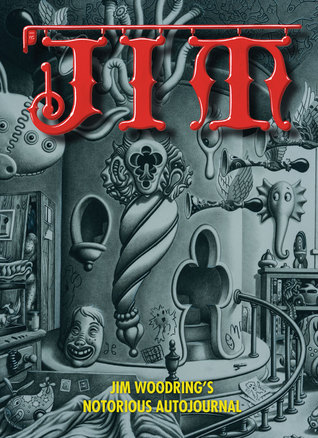
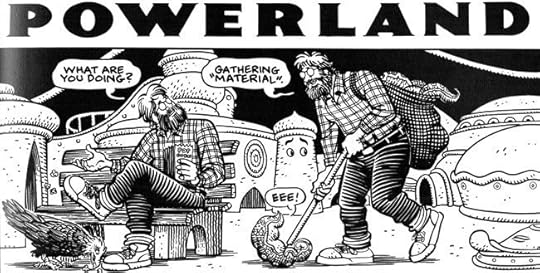 Unlike a lot of Woodring fans, I got into his work through his "auto-journal" comics collected here, most of which feature Jim himself (actually it's his dream alter-ego.) The b&w artwork may not be as refined as his Frank cartoons, but the stories here are every bit as fun and tripped-out.