Jump to ratings and reviews
Rate this book

The Complete Peanuts #1

The Complete Peanuts, 1950-1952

Rate this book
The first volume in the bestselling archival series collecting the most beloved comic strip ever. Many of these formative strips have never been collected or reprinted anywhere else. Introduction by Garrison Keillor.

This first volume, covering the first two and a quarter years of the strip, will be of particular fascination to Peanuts aficionados worldwide: Although there have been literally hundreds of Peanuts books published, many of the strips from the series' first two or three years have never been collected before―in large part because they showed a young Schulz working out the kinks in his new strip and include some characterizations and designs that are quite different from the cast we're all familiar with. (Among other things, three major cast members―Schroeder, Lucy, and Linus―initially show up as infants and only "grow" into their final "mature" selves as the months go by. Even Snoopy debuts as a puppy!) Thus The Complete Peanuts offers a unique chance to see a master of the art form refine his skills and solidify his universe, day by day, week by week, month by month.

This volume is rounded out with Garrison Keillor's introduction, a biographical essay by David Michaelis (Schulz and Peanuts) and an in-depth interview with Schulz conducted in 1987 by Gary Groth and Rick Marschall, all wrapped in a gorgeous design by award-winning cartoonist Seth. Black-and-white comic strips throughout

360 pages, Paperback

First published May 1, 2004

3682 people are currently reading
4546 people want to read

About the author

Charles M. Schulz

3,037 books1,629 followers
Charles Monroe Schulz was an American cartoonist, whose comic strip Peanuts proved one of the most popular and influential in the history of the medium, and is still widely reprinted on a daily basis.
Schulz's first regular cartoons, Li'l Folks, were published from 1947 to 1950 by the St. Paul Pioneer Press; he first used the name Charlie Brown for a character there, although he applied the name in four gags to three different boys and one buried in sand. The series also had a dog that looked much like Snoopy. In 1948, Schulz sold a cartoon to The Saturday Evening Post; the first of 17 single-panel cartoons by Schulz that would be published there. In 1948, Schulz tried to have Li'l Folks syndicated through the Newspaper Enterprise Association. Schulz would have been an independent contractor for the syndicate, unheard of in the 1940s, but the deal fell through. Li'l Folks was dropped from the Pioneer Press in January, 1950.
Later that year, Schulz approached the United Feature Syndicate with his best strips from Li'l Folks, and Peanuts made its first appearance on October 2, 1950. The strip became one of the most popular comic strips of all time. He also had a short-lived sports-oriented comic strip called It's Only a Game (1957–1959), but he abandoned it due to the demands of the successful Peanuts. From 1956 to 1965 he contributed a single-panel strip ("Young Pillars") featuring teenagers to Youth, a publication associated with the Church of God.
Peanuts ran for nearly 50 years, almost without interruption; during the life of the strip, Schulz took only one vacation, a five-week break in late 1997. At its peak, Peanuts appeared in more than 2,600 newspapers in 75 countries. Schulz stated that his routine every morning consisted of eating a jelly donut and sitting down to write the day's strip. After coming up with an idea (which he said could take anywhere from a few minutes to a few hours), he began drawing it, which took about an hour for dailies and three hours for Sunday strips. He stubbornly refused to hire an inker or letterer, saying that "it would be equivalent to a golfer hiring a man to make his putts for him." In November 1999 Schulz suffered a stroke, and later it was discovered that he had colon cancer that had metastasized. Because of the chemotherapy and the fact he could not read or see clearly, he announced his retirement on December 14, 1999.
Schulz often touched on religious themes in his work, including the classic television cartoon, A Charlie Brown Christmas (1965), which features the character Linus van Pelt quoting the King James Version of the Bible Luke 2:8-14 to explain "what Christmas is all about." In personal interviews Schulz mentioned that Linus represented his spiritual side. Schulz, reared in the Lutheran faith, had been active in the Church of God as a young adult and then later taught Sunday school at a United Methodist Church. In the 1960s, Robert L. Short interpreted certain themes and conversations in Peanuts as being consistent with parts of Christian theology, and used them as illustrations during his lectures about the gospel, as he explained in his bestselling paperback book, The Gospel According to Peanuts, the first of several books he wrote on religion and Peanuts, and other popular culture items. From the late 1980s, however, Schulz described himself in interviews as a "secular humanist": “I do not go to church anymore... I guess you might say I've come around to secular humanism, an obligation I believe all humans have to others and the world we live in.”

Ratings & Reviews

What do you think?
Rate this book

Friends & Following

Create a free account to discover what your friends think of this book!

Community Reviews

5 stars
5,264 (58%)
4 stars
2,433 (27%)
3 stars
1,006 (11%)
2 stars
154 (1%)
1 star
99 (1%)
Displaying 1 - 30 of 576 reviews
Profile Image for Jakob J. 🎃.
275 reviews116 followers
August 21, 2025
If I could measure joy in panels, it would be in such pages, and I might even be able to come to the tentative conclusion that I am experiencing the elusive emotion, for few things bring me closer to what I believe is something approximating unadulterated joy than the classic Peanuts strips.

It is not a nostalgic joy, at least not exclusively. It is a much more timeless sense of identifiable ebullience. One might feel nostalgic having grown up in the era represented, and I did grow up watching the holiday specials, but I never felt connected to the material or the characters—Charlie Brown in particular—until I read the early work as an adult and was confronted with the existential depth of a toddler troupe with minuscule parental supervision pondering the purpose of it all, yet not knowing how to manage their burgeoning feelings of anxiety, rage, rejection, and sadness.
Profile Image for Alejandro.
1,304 reviews3,777 followers
February 5, 2018
Good grief! Here we go!


AND THERE WERE THREE

This is the first volume of the Complete Peanuts, created by Charles M. Schulz, starting in 1950 and reaching until 1952.

This first volume is quite amusing to read, since in this first three years of the comic strip, Peanuts still isn’t in its most known and popular status quo.

You have only three kids and even one of them won’t be seen again when the comic strip would settle in its recognized presentation.

There is Charlie Brown, of course, the heart and soul of the comic strip, and you have Patty (not Peppermint but the other Patty) and Shermy (who is the kid that you won’t hear about him later).

But even Charlie Brown and Patty aren’t like the ones that you’d be more familiarized later.

Charlie Brown is quite happy and even cynical, he likes to make pranks to his friends and he doesn’t have any trouble talking to girls even about romantic issues.

Patty is essentially what Lucy would be eventually on the more recognized format.


ENTER: SNOOPY

Soon, Snoopy, one of the most famous dogs in comic strips and media, and in many cases, the most recognizable character of the whole comic strip.

However, he is still in a development process in this first volume.

Snoopy still walks in four paws like a regular dog and his behaviour (while some unusual) still can be considered like the one of a regular dog too.

It’s odd that sometimes is not clear who is the owner of Snoopy, since you would assume that it’s Charlie Brown and eventually you find the dog house on Charlie Brown’s yard, but in some of the first strips, you find Charlie Brown visiting the house of other friends and Snoopy appears there as if he was belonging there.

Even in some strips you can “hear” Snoopy’s thoughts as if he would be talking that it’s quite unusual.


VIOLETS AREN’T BLUE HERE

Along with Charlie Brown, Patty, Shermy and Snoopy, you get soon enough Violet too, and since they’re younger than the usual age that you’d be more familiarized with them, Violet, while basically what you could expect from her, there are also some aspect according with her pre-school age like playing with mud pies.


LUCY, SHROEDER AND LINUS, BUT…

Quite advanced in this first volume, finally appears Lucy, Shroeder and Linus…

BUT

…they are not exactly like the ones that you’d recognized and even there is a very odd time displacement with them…

…since Lucy and Shroeder are quite younger than Charlie Brown and the rest. Shroeder already has his musical facet and he’s fan of Beethoven alright, but definitely he’s younger that the other kids, and Lucy even can’t read yet and she still sleeps in a cradle, which is quite odd (for being mild in this strange situation) since in the Peanuts most recognizable period, Shroeder and Lucy would be classmates of the rest of the gang that noticing the difference of age, it would make this impossible.

Linus appears in very few strips here, and he’s a baby that still don’t talk. Also, quite odd since he’d be Charlie Brown’s best friend sharing the same age in the most known era of the comic strip.

I guess Schulz will ask for the assistance of The Doctor or Marty McFly to fix this odd time displacement in these first three years of the popular comic strip.

Profile Image for Dave Schaafsma.
Author 6 books32.1k followers
June 8, 2020
So this is Peanuts at the beginning, a little meaner and leaner and more roughly sketched. And you get an intro from Garrison Keillor and a long analytical essay and an interview with the sometimes crusty Schulz, who, as it turns out, HATED the title he was forced to accept, Peanuts, which he said lacked "dignity" and depth, which is what (and I agree) his work and humor and insights afforded the reader, even from the start. All of the characters are sort of more blunt, and more direct than we knew them to be by the time the sixties rolled around, as editors "urged" him to soften that approach to his world a bit, make it a bit warmer and sweeter than you see it in these early days.

In the interview he is hard on the industry, and on editors who controlled what he could and could not publish (the avoidance of politics, for instance), though he is also grateful for what the comics world gave him, such as fame and recognition. And a living! The interview and the other materials help you appreciate his rich artistic purposes in the work.

I liked the somewhat darker tone and find it interesting. It was great to see the series from the beginning, always strong work, right from the first, as he sort of worked out what he wanted to do with it, artistically and in terms of character development. Amazing to go back and witness the daily, serial creation of this world so many came to love and appreciate, and to see how it began to be sustained (and to sustain us!) for so long.
Profile Image for Carmen.
2,025 reviews2,425 followers
February 7, 2017
Peanuts in 1950-1952 is not the Peanuts we usually think about today. Snoopy walks on all fours and actually looks and acts like a beagle. Charlie Brown is actually a bit mean to some people, he's not always the put-upon or the butt of the joke. Lucy, Schroeder, and Linus are 'babies' and Charlie, Violet, Patty, and Shermy are the "older" kids - aged 4.

Even though this are little children.... not even big children, little children... they are actually little adults. Which, I guess, is the joke. Cynical, depressed, and just trying to get through one day at a time - this definitely - although enjoyed by children - isn't written for them. Charlie and his friends date, throw parties, gossip, and play endless rounds of golf. (Golf seems to have been dropped from the modern interpretation).

You get to witness a lot of firsts here: the first Snoopy dance, the first time Lucy pulls the football away from Charlie Brown before he can kick it (AND you get an explanation for it... it's not what you think!!!). You get to witness the "birth" of Schroeder and Linus in the comic. They both start out as babies in diapers. Lucy also "grows up" from a baby-talking one and two-year-old to a sharp-thinking, manipulative three year old.

Some of the best in this collection deal with the depressed children who are just slogging through their day-to-day life. In one, Shermy and Charlie are sitting on the curb, looking dejected. For three panels. The same thing. Then in the last panel, Shermy says, without even looking at Charlie Brown, "Yup!... Well,... That's the way it goes!" That's the whole joke. The boys still have the same depressed expressions on their faces. That's the whole comic. The strip itself is almost existentialist at times. That comic was not in reference to anything, nor was it in relation to a previous comic. It's simply their world.

Other strips that brought laughs play on different things: how girls are no sweeter nor nicer than boys; how excited the girls get when they hear Schroeder is bringing his cute friend to the party - only to reveal it's a brass bust of Beethoven!; Charlie Brown rejoicing in a rainy day: "Gee, I'm glad it's raining today..." he remarks to Patty. "Now I can stay inside and read."

"Couldn't you stay inside and read even if it wasn't raining?" Patty wonders.

"Whenever the sun is shining, I feel obligated to play outside!" says Charlie, a frustrated expression on his face.

There were a few I just didn't "get," but overall it was fun looking at what Charlie Brown was over 60 years ago, knowing what it would become.
Profile Image for Louie the Mustache Matos.
1,427 reviews138 followers
February 12, 2023
I had gone on one of those free websites where you can read comic online. I know I'm saying it weird, but there's a reason why I say it like that. Anyway, the site's opening page had boasted that they had just uploaded the entire catalog of the Charles Schulz newspaper strip. There are 26 volumes of the collected works compiled into hardcover copies by Fantagraphics. Immediately, it drew my attention. As a kid, I religiously read the two comics pages in the New York Daily News and especially the Sunday pullout. What I'm trying to say is that I was a fan even though I haven't even thought of the Peanuts gang in many years. So when I saw the advertisement, I went directly to the Peanuts page and started in on volume 1. And what a surprise, did I see? Really Charlie Brown is a together kid, unafraid of talking to girls, playing pranks on his friends: Patty and Shermy. That's right folks. Peanuts was all about 3 kids with adult insights communicated in funny ways. It's only after the strip began were the characters of Snoopy, Violet, Lucy, Schroeder, and Linus added, and those characters all underwent vast transformations in age and concept design. In Volume 1 there's an especially kind introduction written by media critic, and reviewer Garrison Keillor; an appendix with some biographical information about Charles Schulz by David Michaelis; and an extensive interview. I was thoroughly moved with the fact that the day that Schulz officially retired is the very day that his final cartoon was published and it is also the day he passed away. I'm going to keep reading these. I highly recommend them. #1 of 10 Graphic Novel / Trade Paperbacks for year 2023 goal.
Profile Image for Jo .
930 reviews
February 17, 2019
As a loyal fan of "Peanuts"I must say, I've never actually came across these comic strips. As a child, I was surrounded with these books, as my Dad was also a fan. When I began reading, I realised that this is not the Peanuts that I think of today. The characters are rather different, and the ages of the characters seem more varied. For instance, Charlie Brown is rather ill-mannered to his friends and the beloved Snoopy actually walks on all fours. They are essentially little adults in childrens bodies. They deal with depression, distress and do many things that adults do, such as go shopping, attend parties and many other things, too. What I enjoyed mainly about reading this book, is kind of reminiscing on my childhood, and discovering the very early Charlie Brown, already knowing just what he's become.
Profile Image for Dan.
3,205 reviews10.8k followers
February 7, 2021
The Complete Peanuts Volume 1 collects all the Peanuts strips from the beginning in October 1950 through the end of 1952.

I'm a child of the 1980s so my opinion of the strip is low due to using the characters to hock MetLife insurance. Bill Watterson lists Peanuts as one of his primary influences so I decided to go back to the beginning. I was not disappointed.

This strip is surprisingly dark in its beginnings. Charlie Brown isn't a tremendous doormat like he would later become for several decades, rather acting like Calvin from C&H minus the rich fantasy life.. Shermie, Violet, and Patty (not to be confused with Peppermint Patty) are his friends.Snoopy acts like a real dog. Schroeder and Lucy are toddlers and Linus is an infant.

There are lots of landmarks in this tome. The football gag is introduced but with Violet being the asshole rather than Lucy. Lucy, Linus, and Schroeder are introduced and Shermie and Patty are already on their way out the door. Charlie Brown is already the butt of jokes and bad at sports but still has some life life left in him.

The art style isn't as polished and is a lot more varied than what the strip would become later. The characters all have more than two poses and a lot more black ink is used. For my money, the strip had a lot more life in it in the early days. Schultz was still developing his art style rather than just coasting for forty years.

While I never paid much attention to its later years, Peanuts in its embryonic form is right in my wheelhouse. Four out of five stars.
Profile Image for Marc *Dark Reader with a Thousand Young! Iä!*.
1,500 reviews313 followers
March 25, 2025


(Desktop site required to view images)

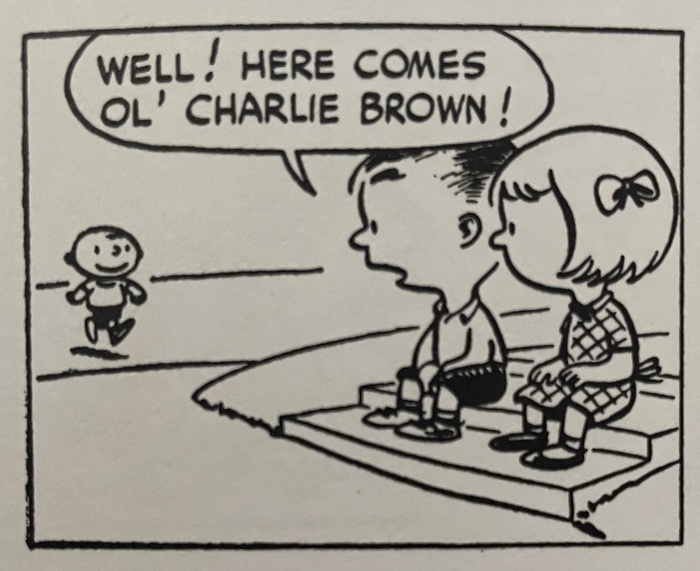
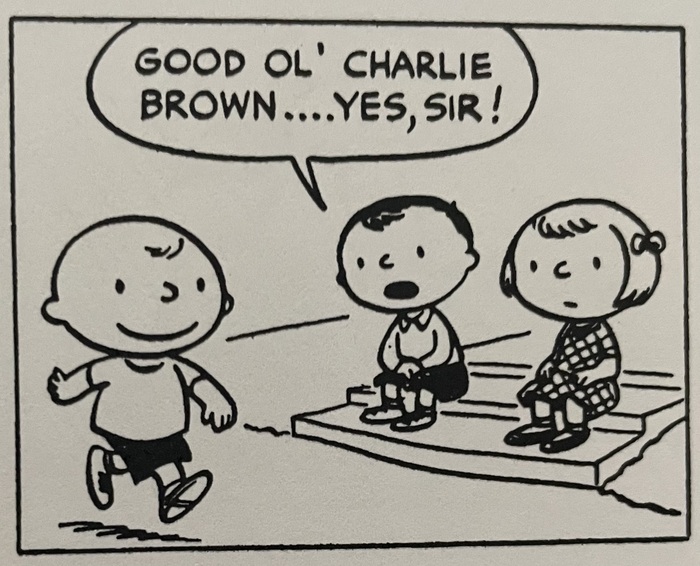
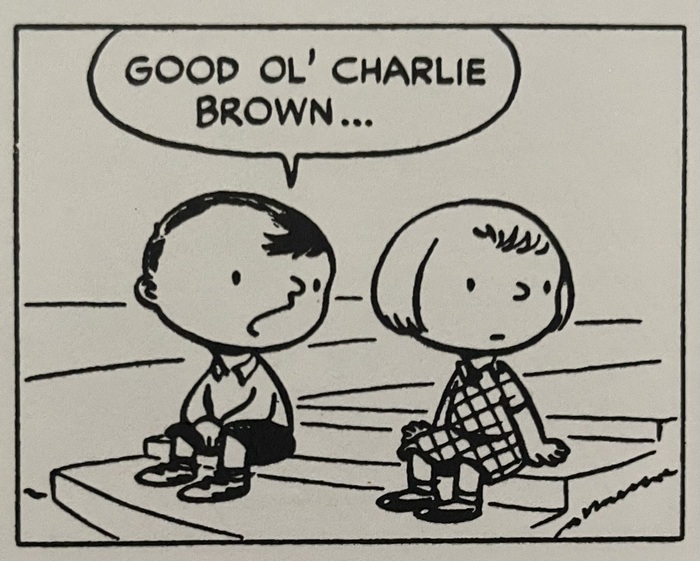
So began 50 years of the worldwide most popular comic strip of the 20th century. I love the subversion and casual cruelty on display here, signaling the unforgiving social landscape these characters would have to navigate over the ensuing decades.

Well, two out of three of these characters. Charlie Brown, of course, endures, but Shermy and Patty (different from Peppermint Patty who would appear only much later) eventually faded out of vogue. But for the first several months of this strip, readers had only these three, caught in a playing-as-adults love triangle, plus Snoopy as a silent but expressive puppy. They would soon be joined by mud pie-slinging Violet, then an infant, hairless Schroeder (whose prime characteristic thankfully quickly appeared), then a toddler Lucy with off-putting pie plate eyes (shrunken to dots after a few months), then her infant brother Linus, whose personality does not appear in this volume. For so much of those 50 years, the strip's iconic characters didn't change, and it's odd to see them in their proto-forms here.

The artwork matured, heads became rounder, and the already captivating line work became even more solidified. The changes during these first two years are striking and they still have room to grow. The content would continue to grow as well; aside from the first strip, for most of those initial two years the strips leaned more towards gags and children playing at adulthood, with only occasional hints of the nihilism, depression, and dogged determinism in the face of futility that would come to define good ol' Charlie Brown and the rest.

This collection took much longer to read than another of my formative comic strip collections, started reading this month (For Better or for Worse), but in fairness those other collections only covered one year at a time and lacked most of the Sunday full-page strips. This definitive complete Peanuts collection contains three calendar years in each volume, plus an introduction from one of many notable personalities, and sometimes additional bonus material. This volume's introduction is from Schulz's fellow St. Paulite Garrison Keillor and thankfully he didn't pull any Prairie Home Companion nonsense, just a brief and high-level view of their shared roots and the strip's exposed philosophies.

This first volume doesn't cover three full years, as the strip began in the fall of 1950, so to maintain the page count for the volume to match all the others, this one includes an excerpt from what would become Schulz and Peanuts: A Biography by David Michaelis, and an extended interview with Schulz from 1989. Charles Schulz was a strange and complicated artist who seems to reveal himself in the strip in ways he could never manage to express or admit in life.

Many of the 1952 strips in particular were very familiar to me. I must have read a collection of the strips from this period in my childhood. I grew up with Peanuts comics, in various collections and newspapers and identified best with Linus. But Schulz's greatest eternal lament was how many people thought the strip was for children. It is not, and it was mostly the extensive licensing that led to that persistent impression. The strip itself is not at all about the childhood experience for all that its characters never age and no adults appear, although in these early years it hadn't yet figured out just what it was.

One of the greatest features of this book, aside from its utterly comprehensive run of the strip, often requiring deep digging in newspaper archives to find "lost" pieces, and lovingly crafted presentation, is the indices. Sparing the reader any need to make note of firsts (but you can believe I noticed them when they happened) or stand-out moments, the comprehensive index points directly to moments such as:
Snoopy, impression of shark
Snoopy, thought balloon, first
Snoopy, thought balloon, first long sequence
Charlie Brown, insults to, general
Charlie Brown, insults to, re size & shape of head
Charlie Brown, football pulled away for first time, by Violet [yes, Violet and not Lucy was the first to do this]
caramel apples
soup
spanking

Any topic you might recall from the strip is locatable here.

The original Seth-designed Fantagraphics hardcover run of these is superb and a thing of beauty. I was fortunate to catch on to them early enough to collect them all in the two-volume box sets, excepting one pair for which I unwisely attempted to save money by ordering volumes separately and ended up short one box sleeve and one of the paired volumes from a different UK imprint. One day I'll correct this oversight.
Profile Image for Teresa.
Author 9 books1,031 followers
April 18, 2018
I don’t think I’ve seen these early Peanuts strips before, at least not the majority of them. In these brand-new days, though Charlie Brown is put-upon, he’s also a jokester, running away, laughing, from his target. Snoopy is just a cute puppy: silently laughing at the humans is the most human thing he does. Lucy is eventually introduced as a toddler, a few years younger than Charlie Brown and his friends, and before too long we get the first instance of her snatching away her football as Charlie Brown goes to kick it. Later, Lucy’s baby brother appears; he is unnamed, sans blanket, and not sucking his thumb.

One of my favorite strips is of Charlie Brown (why does it seem wrong to call him by just his first name?) putting on catcher’s gear, piece by piece, and then sitting in front of the TV to watch a baseball game. Most of the time these kids talk like adults, but here Charlie Brown is a true child.

The volume includes an index, some background material and a revelatory interview with Charles Schulz. Thirty-seven years later, though grateful for his unexpected success, he’s still annoyed his strip is titled Peanuts.
Profile Image for Jerry (Rebel With a Massive Media Library).
4,895 reviews88 followers
June 11, 2020
Though I grew up on the funny pages, this was my first experience with the earliest Peanuts strips. It felt weird to not read Snoopy's thoughts, and for Schroeder (in some strips) and Linus to not be talking yet. Also, Lucy's eyes early on were a bit freaky. Still, the charm of Schulz's beloved creation is ever present here. I always prided myself back in the day in knowing the history of Garfield: how it was actually Jon's roommate Lyman--who later disappeared--who brought Odie into the Tubby Tabby's house. Now, I can also say I've experienced the origins of Peanuts as well!

A post-script: The interview with Charles Schulz at the end had some surprising details, such as how he never cared for the name of the strip--which is something I'd always wondered about myself--and how he had become a bit weak in his Christian faith. The latter was a bit shocking, given the focus on God, Jesus, and the Bible in not only many strips, but even the infamous Christmas special. I hope that he found his way back to God before his death.
Profile Image for Diana.
508 reviews56 followers
August 26, 2017
The first 2 years of Charlie Brown, Snoopy and the others. Schroeder and Linus are introduced as babies. Charlie Brown isn't quite as depressed just yet. And Snoopy as a puppy is just about the cutest thing ever.
Profile Image for Oriana.
Author 2 books3,828 followers
January 26, 2010
I guess I'm a little too young to have known better... What I though I knew of Peanuts was the tired, same-ten-or-so punch lines of this strip in the Sunday Washington Post in the '90s. I always thought it was pretty stale and insipid.

When I read this collection, however, I was blown away. These early strips are punchy, bitingly clever, hilarious, and mean -- a clear predecessor to Calvin & Hobbes, my most beloved comic strip ever. Highly impressive.
Profile Image for Lost Planet Airman.
1,283 reviews91 followers
March 7, 2018
This is the origin of Peanuts... and it's as good as the 70s version I grew up with.
But with some very interesting changes.

This is a younger set of children than you may be used to; this is the tricycle generation. Snoopy is much less a person, although has more personality, likes and dislikes than the average dog.
Early strips start with Charlie Brown, Patty (but not the Peppermint variety), Violet, Shermie, and dog Snoopy with no apparent owner. Charlie Brown gets his striped shirt within a few dozen strips, a barely verbal Schroeder (and his piano) arrive after about six months, and a much younger Lucy joins the cast within about a year. She has an infant brother Linus, sans blanket. All are a feistier, more vibrant than they will become in future years, and we do see Snoopy's thoughts on one occasion!
Profile Image for Hannah Garden.
1,053 reviews184 followers
January 11, 2018
2010: Wow! I had no idea! I always thought Peanuts was kinda take it or leave it. (Except, obviously, the movies.) But these are EXQUISITE!

2018: Excuse me but these are perfect.
Profile Image for Neil R. Coulter.
1,300 reviews150 followers
December 29, 2019
When I was growing up, the Peanuts comic strip was ubiquitous. There were always old paperback collections of the strips around the house, along with book tie-ins from the TV specials, and each Scholastic book club order form at school would feature more. In the Sunday paper, Peanuts occupied the prime outside-page real estate (Blondie on one side, Peanuts on the other). So even though I haven’t really thought about it specifically like this, I’m now pretty sure that Peanuts had a lot to do with my early love of reading and is likely a big influence on why I love reading still today.

But I was reading mostly in the 1980s, the penultimate decade of Peanuts. I don’t know that I’ve ever read the very first comics in the series, and so I was interested to pick up the first volume of the Complete Peanuts set. I found it to be a completely refreshing, surprising book! The beginning of the series is recognizable, but also so different from what it was when I read it as a kid. The cast of characters is much more limited (originally just Charlie Brown, Shermy, Patty, and Snoopy), and the kids are not all the same age (Shermy and Patty seem to be the same age, Charlie Brown a little younger, and, when they eventually appear, Lucy a little younger than that and Linus and Schroeder just babies). Snoopy is more of a normal dog than he later became. Charlie Brown sometimes gets the upper hand on his friends (“I get my laughs!”).

The deeper difference is the general tone. In the early strips, Charles Schulz expressed a very understated, subtle character in his writing, which later (as I remember it from my childhood) became a little sillier and more flippant. In an interview in 1987, Schulz said that Peanuts is “not as insulting a strip as it used to be. Of course, I’ve gotten older, and I’m not as insulting as I used to be myself” (305). I don’t know that “insulting” is exactly the right word, but he’s correct that something changed over the years. The kids in this first volume are reflective, philosophical, and very grown-up in how they interact with one another and the world around them. Maybe it’s that in the beginning, the characters are smaller and the reader is larger—that is, the child characters are drawing out aspects of the grown-up reader. Later on, as the world of Peanuts grew, the characters were more self-sufficient, not as dependent on the reader to make connections to the real world. The humor in this book is understated and sometimes bizarre—much more akin to The Far Side or Calvin and Hobbes than to later decades of Peanuts, I think—with a lot of space for connections and personal reflection. I love it.

That space for reflection is mirrored in the amount of empty space in the panels, and it indicates Schulz’s desire to let people think for themselves, rather than telling them what to think. “I hate cheap spiritual innuendo,” he said. “I’m never grinding an axe. I’m never doing it to teach anybody anything, very seldom” (328–329). In these early strips (more than in the later years), there is a subtle intensity to what the characters endure that is just the right place between mean-spiritedness and sappy-sweetness. “I think it can be funny and remain kind of innocent and yet I don’t think you have to be sugary sweet or stupid” (334–335), Schulz said.

One of the reasons the humor in this series is so attractive to me is that much of it comes out of Schulz’s self-doubt, which I understand really well, too. Given how much Schulz accomplished in his life and the integrity evident in his work, it surprises me to hear him say something like this:
I never thought I would, but the last few years, all my friends are retiring and I’m beginning to wonder if I hadn’t wasted my life. . . . Not that I don’t think I’ve done as best as I ever could with what abilities I have. I’m very happy and I’ve done more than I’ve ever dreamed I would do. Things have happened to me that I never dreamed of, and so I’ll die content, as far as that goes. But there’s still a big world out there that I don’t know anything about . . . and I’m thinking, Gosh, maybe there is more. (335–336)
I can relate to that. I know I’ve done all right with what I’ve accomplished in my life, but there is that nagging feeling that, still, maybe there’s something I’ve missed, some point at which I might have done better for myself and my family. Charlie Brown and his friends are characters who validate that kind of wondering, but never at the expense of patiently enduring whatever comes their way, and never without plenty of pleasure and enjoyment in each day.

The book itself includes an overview of Schulz’s life and work, which I found very interesting, and the 1987 interview with Schulz that I’ve been quoting here. My only criticism of the book is that I wish the strips could have been printed larger. Given Schulz’s frustration with how small the comic was printed in newspapers, it would have been a nice touch to reprint them larger.
Profile Image for Josiah.
3,485 reviews157 followers
May 9, 2017
Does any comic strip better deserve to be classified as great children's literature than Charles M. Schulz's Peanuts? Perhaps Bill Watterson's Calvin and Hobbes, but I'm not sure of any others. In the early 1950s Charles Schulz was still discovering the identity of his masterpiece daily strip, four-panel adventures populated at first only by Shermy, Patty (not Peppermint Patty), a little beagle puppy called Snoopy, and of course "Good ol' Charlie Brown", an adorable four-year-old who quickly grew into his role as star of the show. The strips in this book, beginning in October 1950 and running through December 31, 1952, are the earliest episodes of a serial that would continue until Schulz's death in the year 2000, but the humor is as on-point as if Peanuts had already been a daily fixture for years. Early Peanuts rivals Calvin and Hobbes for comedic supremacy and outdoes most other classic strips, and this treasury contains more than two years' worth of it. But where Charles Schulz distances himself from other top cartoonists (except Bill Watterson) is the insight of his daily stories, providing a lot to think and talk about for readers of any age. It's a joy to plunge into this dense compilation of the strips and enjoy the exploits of Charlie Brown and his neighborhood gang.

The book gets off to a fast start with a hilarious gag on page 1, Patty's singsongy words not exactly matching her aggressive actions. The third Peanuts strip ever is the first appearance of Snoopy, and that's part of the excitement of this first volume of The Complete Peanuts: those special days when a beloved character, phrase, or storyline were seen for the first time. Shermy and Charlie Brown deliver a big laugh on page 2 centered around a "Watch out for children" street sign, and again in the October 24, 1950 strip (page 7), Charlie Brown acting as comic foil to Shermy's declaration that the sun is what keeps us warm. Patty and Shermy are the focus when she takes a bite of what she thought was an ice cream cone in his hand (October 28, page 8), and I love the humor of the November 2 (page 10) strip, where Charlie Brown is proud of his new necktie that a salesman promised would wow the girls. We get a break from straight comedy on November 9 (page 12) with Charlie Brown admitting his apprehension over the future. Patty assures him he has a long life ahead, but that's why he's concerned. When you doubt that others like you as Charlie Brown does, what comfort is a long life? All us Charlie Browns of the world identify with the dark honesty of this particular episode.

November 25 (page 16) is a nice mix of sweet and silly, a goodbye between boy and dog that isn't what it appears to be. When you have a friend who cares about you no matter what, it's understandable if you're hesitant to part ways even for a short time. Of note here is the fact that in some early Peanuts strips, Snoopy seems to belong to Charlie Brown, and in others he clearly doesn't. It's one of the early ambiguities that settles itself over the years. December 2 (page 18) is another thought-provoker, Patty and Shermy bombarding Charlie Brown with opposing bits of advice at such a rapid rate that he hasn't time to sort and digest it. A fast-paced society will do that to you, words of wisdom that often seem contradictory shouted from every direction, and it's hard to keep up. December 21 (page 24) is a cute, laugh-out-loud episode playing on how young and uneducated Charlie Brown is (it's also the debut of his signature shirt with the black zigzag across the middle), and December 22 should ring true for dog owners. December 27 (page 25) is hilarious and thoughtful. Patty tells Shermy they haven't known each other long enough to marry, but Shermy retorts that of course they haven't known each other long, they're only a few years old! It's a satisfying rejoinder against those who spurn young love, and brought a smile to my face.

I love the January 5, 1951 (page 28) Peanuts, a blend of comedy and pathos that has Patty defending Charlie Brown against...himself. It's absurd and touching, a sublime mixture that Schulz got just right. January 19 (page 32) is another favorite. Worried that Charlie Brown has been crying all day, Patty and Shermy discuss complex theories for his upset, only to learn his problem was not that complicated. When we're in pain, the cause is usually simple to discern for people who take our emotion at face value and don't overanalyze us. January 29 (page 35) is pure comedy, and January 31 beautifully demonstrates how depression and disillusionment can be dispelled by a kind word and a smile from someone we really like. It's a lovely antidote to Charlie Brown's usual discouragement. Then comes February 7 (page 37), a red-letter day for Peanuts as the new girl arrives: Violet. She soon rivals Patty for Charlie Brown and Shermy's affections. February 10 (page 38) shows this with humor and profundity as Violet tells Charlie Brown that all he has to do to impress her is "be yourself". The punchline is amusing, but rings true. Who can help but doubt when someone says it's enough for you to "be yourself"? Trusting that is asking a lot.

May 15 (page 65) is fantastic comedy, Charlie Brown becoming the butt of the joke when he overhears an argument between Shermy and Patty. It's vintage Charles Schulz, the kind of joke that kept Peanuts on top for decades as king of the funny pages. I laughed out loud. May 30 (page 69) is another historic occasion when Patty introduces Charlie Brown to the infant who lives next door, a boy who can't speak or walk yet, a boy named...Schroeder. Yes, Schroeder is a baby at this point, though the others kind of already treat him as a friend. The June 1 strip (page 70) showing just Charlie Brown and Schroeder is a personal favorite of mine. September 7 and 8 (page 98) are comedy gold, a surprise punchline delivered by Snoopy and an unexpected final panel after Shermy coaches Charlie Brown to "Slide, Charlie Brown! Slide!" Great stuff. I'm only highlighting a few of the very best, but I could talk about hundreds of the strips in this collection. September 24 (page 103) is a life-changer for Schroeder, as Charlie Brown introduces him to his first toy piano. Predictably to Peanuts fans, Schroeder is an obvious prodigy from the first time his tiny hands touch the keys. On October 2 (page 105) Charlie Brown attempts to wean Schroeder off the toy piano to play a real one worthy of his talent, but Schroeder cries and wails until he's back in front of his favorite toy. What seems like nonsense to an outside observer can be intricate to a performer's genius, and should be respected even if the idiosyncrasy is hard to understand. Genius moves at its own pace and mustn't be rushed or made uncomfortable.

A jack-o'-lantern gag on October 30 (page 113) will be recognizable to fans of the 1966 It's the Great Pumpkin, Charlie Brown television special, and November 14 (page 117) is more Peanuts history: the first time someone holds a football for Charlie Brown to kick and yanks it away at the last second. It's Violet holding the ball, however, not a certain other dark-haired girl we've yet to meet, and Violet pulls it away only because she's nervous she'll get kicked. December 10 (page 125) is a funny sight gag taking advantage of a sketch someone drew of Charlie Brown on the sidewalk, and December 12 is an early example of Charlie Brown's creativity designing snowmen. It's a repeated theme of winter Peanuts, perhaps inspiring the playful snowmen designs in Calvin and Hobbes thirty-some years later. December 15 (page 126) is a good visual punchline where Patty begs Charlie Brown not to risk his safety to fix the roof, but he insists that "What has to be done, has to be done!" The final panel is a great laugh. When Violet, Patty, and Charlie Brown argue over who owns the snowman they built (December 20, page 128), the end panel wordlessly illustrates the shame of picking up your toys and going home mad if you don't get your way. It's better for everyone to reconcile differences and not tear apart a collaborative work of art. December 22 is another Schulz master work, comedy and affection and truth all packed together, and Charlie Brown unexpectedly bears the brunt of the joke. I love these early Schroeder episodes. January 4, 1952 (page 132) is another impressive snowman project by Charlie Brown, particularly reminiscent of Calvin's style.

History is made January 6 (page 133) with the first Sunday Peanuts strip, and January 31 (page 144) reminds me of the humor in the classic television specials, Snoopy showing off uncanny physical coordination. I like Charlie Brown's method for solving a pair of math equations on February 6 (page 146). The numbers mean little to him, but by comparing them to something he knows—sports—he easily makes sense of the math. It's a good lesson to not let anyone shame you for taking your own route to a correct answer; what matters is that you get there, not that you adhere to someone else's arbitrary rules of style. March 3 (page 158) brings arguably the most significant debut since Snoopy, when Lucy van Pelt enters the scene. She's not much more than a baby, older than Schroeder but younger than Charlie Brown. May 14 (page 188) is nearly wordless, Lucy meticulously constructing a tall tower of blocks and then kicking them over with gusto, only to carefully rebuild. It can be freeing to crash your own best work after a long time spent perfecting it. The process of building from scratch is a lot of the fun of accomplishing something remarkable. On June 20 (page 204) I particularly identify with Charlie Brown, who gripes to Violet that he's "the most stupid person that ever lived!" When Violet asks in earnest if he really believes that, he admits he doesn't. He knows he's intelligent, but, in his words, "The only trouble is that most of the time I'm so horribly stupid!" That's the refrain of many a smart individual, perceptive enough to be grieved by their own gaping flaws yet still human, and thus powerless to be anything but hopelessly imperfect. Charlie Brown's expression of that angst is spot-on.

There's a pertinent message June 27 (page 207) for those of us who revel in big reactions to nice things we do for others. Not everyone is emotionally demonstrative, and it can be frustrating. But do we do nice things because we want to be lavishly thanked, or because we care about the person? Little Lucy in her jammies at night has a propensity for exasperating her unseen parents, but they usually return her to her crib in a timely manner when she escapes. August 2 (page 222), she defies bedtime but her parents aren't right there to put her back in her crib, and Lucy is disquieted by that. Rebelling against parents is a thrilling challenge as long as they resist, but what happens when they no longer do? A midnight romp is less satisfying when no one tries to stop you. The August 2 strip hints at that deep truth. August 7 (page 225) is the first of many strips over the years that use sophisticated puns derived from classical music history. Charlie Brown channels most serious literates on September 13 (page 240) when he says he's glad it's rained all day so he can stay inside and read. If the weather's nice, he explains to Patty, he feels obligated to do something outside. That's true of a great many things, not just weather, and it's the sort of simple observation in Peanuts that hits home. And then, September 19 (page 243) is the day. The day. Lucy runs to tell Charlie Brown that her baby brother can sit up, and it's really him. Linus. The heart of Peanuts, if Charlie Brown is its soul, the kid who grew up (well, a little bit) to always have the right answer when Charlie Brown truly needed it. Peanuts wouldn't be Peanuts without Linus van Pelt.

Hilarity resumes with the October 16 (page 255) strip, a laugh-out loud play on slang speech as Charlie Brown and Lucy munch candy. Lucy's misunderstanding of how Charlie Brown uses the word "holler" is hysterically funny. November 16 (page 268), a Sunday, marks the first time Lucy dupes Charlie Brown into trying to kick the football, pulling it away at the last second twice in this episode. The theme would recur for the remainder of the strip's fifty-year run. Main characters in comic strips typically dress in a distinctive outfit that identifies them, and December 8 (page 278) is a goodnatured jab at that via the famous shirt Charlie Brown wears. Charles Schulz's humor always aged well. My last special favorite of this collection is December 23 (page 284), a thoughtful piece that shows how luck is mostly a result of perception. A kid who finds a penny on the sidewalk might grumble that he wishes it were a nickel and bemoan his bad fortune, but someone else will see him pick up the penny and consider him lucky, wondering, "Why don't things like that ever happen to me?" If you're convinced your luck is rotten, you'll likely never be dissuaded from that opinion, but luck is almost never as one-sided as the person it's happening to thinks. Even Charlie Brown isn't as beset as he allows himself to believe.

The first two years was an extraordinary start to Peanuts. General consensus is that the strip reached its prime in the 1960s and maintained it into the '70s, but 1950-52 was pretty good for a pre-prime Peanuts, a delightful muddle of clever comedy, lovable characters, and succinct philosophy. It's hard to believe Charles Schulz's magnum opus could become greater, but it did. I consider Calvin and Hobbes to be the transcendent American comic strip, but Peanuts is right there in the discussion, a storytelling paragon with appeal to just about everyone. I'd give volume one of The Complete Peanuts at least two and a half stars, probably three, and I urge connoisseurs of daily comics not to miss it. For fans of the genre such as myself, early Peanuts is a unique and indispensable treasure.
Profile Image for Susan.
3,017 reviews570 followers
January 2, 2022
As a great lover, and admirer, of the Peanuts strip, I have been meaning to read these books forever. Vol.1 brings together the very earliest of the Peanuts strips, taking the reader through 1950-1952 and so we get to see the characters from the very beginning and how they grew as the strip matured.

We begin with Charlie Brown (at first without the famous zig zags on his jumper), Shermy, Patty, Violet and Snoopy. Then a baby Schroeder, a piano prodigy even in his youngest days. Lucy appears as a toddler and later we meet her baby brother, Linus.

Lucy was always my favourite and, although she is just a little girl in these early strips, her personality is beginning to shine through. Charlie Brown, meanwhile, is not quite as unsure of himself as he becomes later, but it is fascinating to see how kind he was to baby Schroeder and Linus and helps understand their later, warm relationships.

I am looking forward to reading on and anticipate Vol.2 with great enthusiasm. Schulz himself downplayed his own influence (this book contains a potted biography and interview with him) but the characters became a part of my life as a young teen and I am keen to reaquaint myself with them.
Profile Image for Robert.
2,302 reviews258 followers
February 24, 2024

The Peanuts comics were always known for their existential humor and dry wit, yet when Schulz started the strip in 1950 things were quite different.

This volume - the first in a series of collecting everything Peanuts strip Schulz drew - contains Peanuts first three years. Thus the definitive versions of the Peanuts gang is not as we know it: Charlie Brown looks quite rough, Violet is a main character, Peppermint Patty is totally different, Lucy is an infant, Linus is a baby without his blanket, Schroeder is an infant as well (although by 1952 he's Charlie brown's age) Shermy is a major character and Snoopy looks and acts more like a dog.

The important thing is the humor and here it is cute almost whimsical, sure there are glimpses of the bleak streak that would dominate later comics but for the most part there are happy endings and smarty pants retorts.

This volume also has an introduction by Garrison Keillor, an extensive biography of Schulz and a lengthy interview: both which give insight into the making of Peanuts. As a package it's worth it but bear in mind that The peanuts gang as we know it is still a long way off.
Profile Image for Michael.
1,297 reviews155 followers
October 9, 2014
Growing up, I loved checking collections of Peanuts comic strips out of the library. During my younger years, there were two size to the Peanuts collections -- the smaller, standard size paperbacks, which rarely included the Sunday strips and the larger trade paperbacks that included more comics per page and the Sunday strips. I have found memories of reading those collections over and over again and always heading to that section of the library with the hope that a new collection was on the shelf today -- or at least one I'd only read a dozen or so times before.

Part of this love stemmed from the animated Peanuts specials and the feature length movies. And part of it came from the collection of Charlie Brown records, where dialogue from the animated specials was put onto vinyl and I could listen them over and over again. Like the books, there were two sizes -- the shorter play records that ran from eight to fifteen minutes and the LP that included pretty much the entire special in audio form. In the days before we had VHS (yes, there were such dark days. We also walked to school, against the wind both ways through snow drifts, even in the middle of summer or when I lived in climates that didn't have snow), those records helped me to enjoy the stories of Charlie Brown, Linus, Lucy and Snoopy over and over and over again.

It was always fascinating to see the strips that became some of the source material and inspiration for those various animated specials (and records).

And while I knew I wasn't reading all of the published Peanuts strips simply because my local library didn't have them all, I still felt like I was getting as much as there was available from the entire run of the classic comic strip. Turns out that isn't the case. Those collections were selected strips from the run of the Peanuts and not every strip that Charles M. Schultz ever produced during his long run.

But now I've got the chance to read all the strips thanks to this new collecting of The Complete Peanuts. And I've got admit that after one volume, it's fascinating. Yes, I'd seen the first ever Peanuts strip (I saw it in a biography I read of Schultz), but I doubt I've seen many of the other strips in this volume that covers the series run from late 1950 to the end of 1952. Watching Schultz develop his voice, style and characters over the run of these strips is fascinating. Even more fascinating is how there are certain characters who feature prominently in these early strips who later fade into the background or vanish entirely from Peanuts (I'm looking at you Shermy).

Even little details like the stripe on Charlie Brown's shirt take time to become a recurring feature and it's interesting to see Schroeder and Linus introduced as babies in the strip. Of course, one of the biggest changes is in Snoopy, who Schulz initially didn't want to give a "voice." Seeing Snoopy behave as a "normal" dog and only allowed to speak in terms of barking and body language is interesting in light of how he later becomes and it's fascinating to watch the transition in the strip. It's not fully complete by the end of this set of strips and it leaves me curious to the next installment in this series to watch it develop further (though Snoopy has begun talking on an infrequent basis by the time this volume concludes).

There are some recurring bits of Schultz's Peanuts run that are on display here. One of the biggest is Lucy's pulling the football away from Charlie Brown. But there's also some things here that don't make like an adult who is given dialogue to interact with one of the kids.

It's all fascinating but it wouldn't be so if the strips themselves didn't hold up. And they do. While this isn't exactly the Peanuts most of us think of when we hear the name of the strip, there's enough of what makes the strip great on display here. It's a chance to meet some old friends again and maybe get to know them in a different way than we know them now.

And on some level, it took me back to my younger days and my thrill at reading a collection of comic strips from my local library. That nostalgic trip down memory lane alone is worth the price of admission.
Profile Image for Fantagraphics Books.
13 reviews158 followers
July 18, 2007
[http://www.fantagraphics.com/peanuts/...]

This first volume, covering the first two and a quarter years of the strip, will be of particular fascination to Peanuts aficionados worldwide: Although there have been literally hundreds of Peanuts books published, many of the strips from the series’ first two or three years have never been collected before — in large part because they showed a young Schulz working out the kinks in his new strip and include some characterizations and designs that are quite different from the cast we’re all familiar with. (Among other things, three major cast members — Schroeder, Lucy, and Linus — initially show up as infants and only “grow” into their final “mature” selves as the months go by. Even Snoopy debuts as a puppy!) Thus The Complete Peanuts offers a unique chance to see a master of the artform refine his skills and solidify his universe, day by day, week by week, month by month.
Profile Image for Javi.
47 reviews7 followers
August 1, 2020
En esta entrega hablamos de un cómic o tal vez, las historietas de "Carlitos y Snoopy" para mi me han sacado una sonrisa, no es una historia seguida pero hay momentos que su toque de humor, hace que sonrías, las historietas están compuestas por 4 trozos. Es fácil de leer y divertida.
Después de unas 200 páginas viene un poco de historia de el creador de la trama en el que nos explica sus primeros pasos. Lo recomiendo para que sea algo diferente. Mi valoración 4/5
Profile Image for Mike (the Paladin).
3,148 reviews2,161 followers
March 31, 2010
Wow....Peanuts is actually 2 years older than I am. I had read all these before, of course. I suppose I discovered the "extra depths" of Charles Schulz comic strips in the late 60s. Since then I've read them often oh so often. These are the basic first beginnings of the strip...

This isn't the only comic with depths of wisdom hidden in the humor, but it may be the best.
Profile Image for Joseph Cognard.
Author 5 books324 followers
June 10, 2018
Not exactly sure if this is the book I read but I had a series of them. Wish I still had them. Reading them was one of the happiest memories of my childhood. I would read them for hours and the connectivity from strip to strip would keep me glued and gripped as I turned every page.
Profile Image for Andria Potter.
Author 2 books94 followers
August 31, 2025
How can I not give Charlie Brown five stars? Nostalgia at its finest and a perfect way to start off the autumn season.
Profile Image for Roy.
761 reviews4 followers
December 23, 2025
Pure Comic-Strip Genius

Charles Schulz was a brave man putting all his insecurities out to the world like he did! Reading his first strips was really rather enlightening in many different ways. I think Schulz was a very clever man too. He wrote in a way that speaks to both adults and children. He may not have specifically written to or for children and yet many, including myself (at a younger age), felt validated by much of what was said in the strips, whether we understood it all or not. For adults, even me now, it brings back memories, most with laughter and some with healing. The two articles at the very end were pretty interesting. I don't agree with about two-thirds of the first one because it largely paints Schulz as a crusader against evil politics, corporations and society. The second one was an interview between Schulz and two comics historians and shows the much more accurate portrayal of the man. He did indeed feel like society, corporations and politics were too greedy but didn't feel like it was his place to crusade for their change. He just wanted to create some laughter and joy and if somethings he wrote caused some healthy changes, so much the better, but was still not his goal. He was a man with some perspectives that could do the world a lot of good and instead of trying to force them down our throats, he just helped us all to laugh and love just a little bit more. Something that is of much greater value and causes greater change than any amount of well-meaning force.
Profile Image for Devin Bruce.
112 reviews40 followers
November 8, 2010
There's just something about the early Peanuts strips. It's a world that is saturated with depression but at the same time a lighthearted innocence, and a fun that I find lacking in the later strips (i.e., the strips I read when I was growing up in the 80s). I love the early designs of the characters before they got smaller heads and larger bodies; the tighter lines and the younger-looking characters give the darker subjects a much more sweet and hopeful feel. It's very different to hear a four-year-old say "I just can't STAND it!" than a seven-year-old. Plus, Snoopy looks and acts a lot more like a real dog in these strips, which can be a little dissonant for a kid who grew up with Snoopy fighting the Red Baron on top of his doghouse, but I rather liked it. And it's fascinating to see the genesis of some of the characters: baby Schroeder, baby Lucy, and a VERY young baby Linus get introduced while now-forgotten characters like Shermy and Patty fill a similar but more simplistic role. A really great read for those who are interested in the history of comics, and who have fond memories of the Peanuts gang.
Profile Image for Michael ♤.
33 reviews15 followers
July 9, 2019
This book was my first real introduction to the Peanuts universe. Sure, i've seen some strips in the newspaper and maybe one film or two. But they never were a thing to me. Not until I read this book.

This book introduced me to a wonderful world of childish naivety, heartwarming little stories and thoroughly smart humour. I would recommend this book to anyone who - like me - never had real contact with the peanuts.

As a (now) fan of the Peanuts I cannot wait to read the next book of the series.
Profile Image for Rebekah.
53 reviews1 follower
July 19, 2021
Even before Charlie Brown was iconic, Shulz knew how to write funny comics. It was fun to read Charlie Brown before "Charlie Brown" perse. :)
Displaying 1 - 30 of 576 reviews

Join the discussion

Can't find what you're looking for?

Get help and learn more about the design.