

What do you think?

Orlanda
One afternoon in a Paris train station, as 35-year-old literature professor Aline Berger struggles to re-read Virginia Woolf's Orlando, a novel she has never enjoyed, an odd feeling comes over her when a handsome but strange young man asks her for aspirin. Haunted by the harsh words of her domineering mother, who demanded that she suppress her tomboyish tendencies during her childhood, Aline has become a demure, passive, conventional woman. She fails to recognize the man standing before her, who the author names Orlanda. The body belongs to that of Lucien Lèfrene, a lithe 20-year-old rock journalist, but it is inhabited by her once silenced spirit, and possesses her knowledge, memories, and desires, including her love of men.
When the two meet again in Belgium, Aline subconsciously sheds her prim tendencies for more assertive behavior, as she begins to understand that the audacious and lively Orlanda was born from her psyche. The more time the two spend together, the less time they can stand to be apart.
Winner of the Prix Meacutedicis, this lyrical novel, which recalls the erudition and imagination of Michael Cunningham's The Hours, and Patricia Duncker's Hallucinating Foucault, is a stunning evocation of a woman who is forced to confront every part of her soul, and embrace herself whole.
When the two meet again in Belgium, Aline subconsciously sheds her prim tendencies for more assertive behavior, as she begins to understand that the audacious and lively Orlanda was born from her psyche. The more time the two spend together, the less time they can stand to be apart.
Winner of the Prix Meacutedicis, this lyrical novel, which recalls the erudition and imagination of Michael Cunningham's The Hours, and Patricia Duncker's Hallucinating Foucault, is a stunning evocation of a woman who is forced to confront every part of her soul, and embrace herself whole.
224 pages, Hardcover
First published January 1, 1996
About the author
Jacqueline Harpman
35 books2,451 followersJacqueline Harpman was born in Etterbeek, Belgium, in 1929. Being half Jewish, the family moved to Casablanca when the Nazis invaded, and returned home after the war. After studying French literature she started training to be a doctor, but could not complete her medical studies when she contracted tuberculosis. She turned to writing in 1954 and her first work was published in 1958. In 1980 she qualified as a psychoanalyst. She had given up writing after her fourth book was published, and resumed her career as a novelist only some twenty years later. She wrote twelve novels and won several literary prizes, most recently the Médicis for the present novel. She was married to an architect and had two children.
Ratings & Reviews
Friends & Following
Create a free account to discover what your friends think of this book!
Community Reviews
Displaying 1 - 30 of 790 reviews
July 22, 2024
i now have to learn french so i can read the rest of jacqueline harpman's works

Read
September 9, 2025This unique book took me right back to the time when, as a carefree child, I ran across fields and jumped over streams with my brother, and climbed trees and hung from their branches, never doubting I could do anything he was able to do. We were complete equals in bravery and utter recklessness—within the admittedly safe environment we were lucky to grow up in.
Thirty-five year-old Aline, the main character of Jacqueline Harpman's ingenious novel, Orlanda, remembers a similar time in her life, a carefree time when she walked with large strides and spoke her mind freely. But she remembers too that at a certain point her mother began to urge decorum, that she not burst into the room like a tornado, that she not disagree with adults, that instead she should learn to be what people expected from a person of the feminine sex.
None of this impinged on Aline's behavior until one day her mother said something that stopped her in her gallop: "Comme tu es masculine!" (how masculine you are!). The words stung like nothing had before—and it's interesting that when I checked a sample of the English translation of this novel, the mother's words were given, not as I've literally translated them, but as: "what a tomboy you are", which I think reads as a much milder reproof.
In any case, Aline was affected by her mother's stinging words, and since she also got her first period with its attendant discomforts and limitations around then, she began to realise that she couldn't stride everywhere fearlessly anymore, that she had to take smaller steps, to be more aware of her body and how it was presented, all of which brought a new self-consciousness to how she expressed herself verbally as well.
So she became a quieter person, one who brushed her unruly hair more regularly and paid more attention to her chipped finger nails. She turned away from the keen interest she used to take in maths at school and concentrated on literature instead. She had begun to absorb the lesson her mother had been trying to instill for years: that she must learn to be decorative and to please others more than herself.
So far, so familiar to many woman born in the 20th century. But that's just the beginning of Jacqueline Harpman's project for this novel which she wrote in 1996.
When the reader meets Aline on the first page of the book, she is in a café at the Gare du Nord in Paris, waiting for the train that will take her back to her home in Brussels. While she waits, she is re-reading Virginia Woolf's androgynous novel Orlando which she plans to present to the students she lectures the following week. She has reached the part in Orlando where the main character switches from being a carefree male to being a careful female, and it is while contemplating that switch that Aline finds herself revisiting, for the first time in years, the transformation her twelve-year-old self experienced at puberty.
But to be completely accurate, it is not Aline's thirty-five year-old self who revisits her pre-pubertal state. No, it is the recalcitrant twelve year-old, the one who has been locked away inside Aline for the past two decades. The twelve year-old suddenly wakes up as Aline is thinking about Orlando's transformation, and she objectively examines the quiet and unassuming adult person she has become, concluding that this can't be all there is to life. It's as if Aline's 'id', kept down for too long by her strict 'superego', finds that it needs to break away and live independently of both the ego and superego.
This is a good time to mention Jacqueline Harpmann's narrator.
The narrator, and I don't think we ever know whether they are male or female, is seemingly the writer of Aline's story, but they are the kind of writer who is continually surprised at what their characters get up to, as if it were the characters who were really dictating how the story plays out. And by 'characters', I'm mainly referring to thirty-five-year old Aline and her twelve year-old self, to whom the narrator/writer gives the name Orlanda for convenience since Orlanda has managed, in spite of the narrator not knowing how it could be possible, to escape from Aline's body!
Yes, in the early pages of the novel, that unbelievable happening happens!
Once free of Aline's body, Orlanda decides to migrate into the body of a twenty year-old man—his ID card reveals his name to be Lucien—who has been sitting across from Aline in the restaurant at the Gare du Nord where they are both waiting for the train to Brussels. Lucien has been half-heartedly eating an 'œuf à la russe', and I mention it because it is one of the delicious details in this book that feed into the main theme perfectly: an 'œuf à la russe' is a hard boiled egg which has had the yolk removed and replaced with caviar. *
The more we learn about the young man whom Orlanda has taken over, the more shell-like his former existence appears—which makes the ease with which Orlanda moves into his body more credible. And as it turns out, Orlanda is the best 'caviar' ever! They like the good things in life, sex included, and before too many pages have passed, they have their first sexual encounter.
The rest of this book is as entertaining a romp as Virginia Woolf's original Orlando. The reader gets to follow along as Orlanda stretches their wings in all sorts of new ways. The tension is ramped up via the biological bond between Orlanda and Aline: what effect has loosing a part of herself on Aline's existence? Can Orlanda successfully survive separately from Aline? What is happening to Lucien's former life now that Orlanda has camped in his body? Why is there a gun in the story? I turned over the pages faster and faster.
When I finished the book, I wondered why I hadn't read Jacqueline Harpman before. I'll definitely be reading her other books as soon as I can find them. I'll start with Moi qui n'ai pas connu les hommes, a book I'd seen around in its English translation, I Who Have Never Known Men, but had not paid much attention to it, thinking it sounded too like science-fiction. And indeed, you might be thinking the same of Orlanda.
But I didn't detect the slightest whiff of science-fiction in Orlanda—unless you count the fact that Aline had a science-fiction book in her bag on that trip from Paris to Brussels: Darkover Landfall by Marion Zimmer Bradley (about which I know nothing except that it might have had some telepathy in it). So Darkover Landfall caused me to ask myself this question: if there's a science-fiction book mentioned in a story, is it as significant as a gun?
I haven't figured out the answer yet—but there's one little detail related to Darkover Landfall that I think is particularly interesting: the book was recommended to Aline by a minor character called Jacqueline who happens to be a psychoanalyst.
Jacqueline Harpman also happens to be a psychoanalyst.
*When I looked at the opening pages again, I saw that it wasn't Lucien who was eating an œuf à la russe, though I still think it's a significant detail.
Thirty-five year-old Aline, the main character of Jacqueline Harpman's ingenious novel, Orlanda, remembers a similar time in her life, a carefree time when she walked with large strides and spoke her mind freely. But she remembers too that at a certain point her mother began to urge decorum, that she not burst into the room like a tornado, that she not disagree with adults, that instead she should learn to be what people expected from a person of the feminine sex.
None of this impinged on Aline's behavior until one day her mother said something that stopped her in her gallop: "Comme tu es masculine!" (how masculine you are!). The words stung like nothing had before—and it's interesting that when I checked a sample of the English translation of this novel, the mother's words were given, not as I've literally translated them, but as: "what a tomboy you are", which I think reads as a much milder reproof.
In any case, Aline was affected by her mother's stinging words, and since she also got her first period with its attendant discomforts and limitations around then, she began to realise that she couldn't stride everywhere fearlessly anymore, that she had to take smaller steps, to be more aware of her body and how it was presented, all of which brought a new self-consciousness to how she expressed herself verbally as well.
So she became a quieter person, one who brushed her unruly hair more regularly and paid more attention to her chipped finger nails. She turned away from the keen interest she used to take in maths at school and concentrated on literature instead. She had begun to absorb the lesson her mother had been trying to instill for years: that she must learn to be decorative and to please others more than herself.
So far, so familiar to many woman born in the 20th century. But that's just the beginning of Jacqueline Harpman's project for this novel which she wrote in 1996.
When the reader meets Aline on the first page of the book, she is in a café at the Gare du Nord in Paris, waiting for the train that will take her back to her home in Brussels. While she waits, she is re-reading Virginia Woolf's androgynous novel Orlando which she plans to present to the students she lectures the following week. She has reached the part in Orlando where the main character switches from being a carefree male to being a careful female, and it is while contemplating that switch that Aline finds herself revisiting, for the first time in years, the transformation her twelve-year-old self experienced at puberty.
But to be completely accurate, it is not Aline's thirty-five year-old self who revisits her pre-pubertal state. No, it is the recalcitrant twelve year-old, the one who has been locked away inside Aline for the past two decades. The twelve year-old suddenly wakes up as Aline is thinking about Orlando's transformation, and she objectively examines the quiet and unassuming adult person she has become, concluding that this can't be all there is to life. It's as if Aline's 'id', kept down for too long by her strict 'superego', finds that it needs to break away and live independently of both the ego and superego.
This is a good time to mention Jacqueline Harpmann's narrator.
The narrator, and I don't think we ever know whether they are male or female, is seemingly the writer of Aline's story, but they are the kind of writer who is continually surprised at what their characters get up to, as if it were the characters who were really dictating how the story plays out. And by 'characters', I'm mainly referring to thirty-five-year old Aline and her twelve year-old self, to whom the narrator/writer gives the name Orlanda for convenience since Orlanda has managed, in spite of the narrator not knowing how it could be possible, to escape from Aline's body!
Yes, in the early pages of the novel, that unbelievable happening happens!
Once free of Aline's body, Orlanda decides to migrate into the body of a twenty year-old man—his ID card reveals his name to be Lucien—who has been sitting across from Aline in the restaurant at the Gare du Nord where they are both waiting for the train to Brussels. Lucien has been half-heartedly eating an 'œuf à la russe', and I mention it because it is one of the delicious details in this book that feed into the main theme perfectly: an 'œuf à la russe' is a hard boiled egg which has had the yolk removed and replaced with caviar. *
The more we learn about the young man whom Orlanda has taken over, the more shell-like his former existence appears—which makes the ease with which Orlanda moves into his body more credible. And as it turns out, Orlanda is the best 'caviar' ever! They like the good things in life, sex included, and before too many pages have passed, they have their first sexual encounter.
The rest of this book is as entertaining a romp as Virginia Woolf's original Orlando. The reader gets to follow along as Orlanda stretches their wings in all sorts of new ways. The tension is ramped up via the biological bond between Orlanda and Aline: what effect has loosing a part of herself on Aline's existence? Can Orlanda successfully survive separately from Aline? What is happening to Lucien's former life now that Orlanda has camped in his body? Why is there a gun in the story? I turned over the pages faster and faster.
When I finished the book, I wondered why I hadn't read Jacqueline Harpman before. I'll definitely be reading her other books as soon as I can find them. I'll start with Moi qui n'ai pas connu les hommes, a book I'd seen around in its English translation, I Who Have Never Known Men, but had not paid much attention to it, thinking it sounded too like science-fiction. And indeed, you might be thinking the same of Orlanda.
But I didn't detect the slightest whiff of science-fiction in Orlanda—unless you count the fact that Aline had a science-fiction book in her bag on that trip from Paris to Brussels: Darkover Landfall by Marion Zimmer Bradley (about which I know nothing except that it might have had some telepathy in it). So Darkover Landfall caused me to ask myself this question: if there's a science-fiction book mentioned in a story, is it as significant as a gun?
I haven't figured out the answer yet—but there's one little detail related to Darkover Landfall that I think is particularly interesting: the book was recommended to Aline by a minor character called Jacqueline who happens to be a psychoanalyst.
Jacqueline Harpman also happens to be a psychoanalyst.
*When I looked at the opening pages again, I saw that it wasn't Lucien who was eating an œuf à la russe, though I still think it's a significant detail.

October 23, 2025
Oh, I really liked this.

December 6, 2025
Riffing off of Orlando by Virginia Woolf, Jacqueline Harpman's Orlanda imagines what would happen if the soul of a 35 year old woman, Aline Berger, that had been repressed since she was 12 were to split in half, with the more reckless and uninhibited parts entering the body of a 20 year old man. Thus we get the titular character, the liberated lothario who goes on to show Aline the parts of herself she's kept hidden from her oppressive mother, society, and even herself. But when their reliance on one another becomes akin to a drug addiction, a decision must be made in how they will move forward with one soul in two bodies, if they can at all.
Harpman takes Woolf's premise and flips the genders. Doing so, she asks big questions about society, like at what point do certain members of it begin to alter themselves for more palatable public consumption? Or what happens to a woman who learns to keep quiet the louder (more masculine) inner voice that would typically get her labeled 'bossy' or 'rude'? And what if she let it out?
There is a recklessness and inherent sort of 'act before thinking' that Orlanda, in the man's body, is allowed that Aline spent the last 20 years controlling. Without that part of herself, nothing for Aline has really changed, until she sees the externalized elements of herself she's learned to ignore in the form of Orlanda. From then on she must wrestle, as we all do, with the age old question of "Who am I?" Especially considering half of herself is in another body. That level of observation, to have made manifest your inner private thoughts in the form of another human being, lends itself to some interesting discussions of gender, identity, ambition, and thought versus action.
I found this book to be a perfect balance of plot and commentary. Aline and Orlanda's stories bounce back and forth in a very satisfying way that compare and contrast their very different lived experiences; and through that Harpman can say a lot about how society expects certain people to behave and how that affects their psyche.
A big theme in this is the psyche, the androgyne (from Plato's Symposium), as well as Proust's In Search of Lost Time, and of course Woolf's Orlando. I don't think you have to have read all of these, but Woolf's novel is most critical to fully engaging with this text and understanding its deeper meanings.
The ending blew me away. I thought it was so clever, simple but profound, and a sort of inevitable conclusion. Harpman's insertion of herself as the narrator from time to time mirrored Woolf's own writing in the source material, and added a levity and cheekiness I appreciated.
Harpman takes Woolf's premise and flips the genders. Doing so, she asks big questions about society, like at what point do certain members of it begin to alter themselves for more palatable public consumption? Or what happens to a woman who learns to keep quiet the louder (more masculine) inner voice that would typically get her labeled 'bossy' or 'rude'? And what if she let it out?
There is a recklessness and inherent sort of 'act before thinking' that Orlanda, in the man's body, is allowed that Aline spent the last 20 years controlling. Without that part of herself, nothing for Aline has really changed, until she sees the externalized elements of herself she's learned to ignore in the form of Orlanda. From then on she must wrestle, as we all do, with the age old question of "Who am I?" Especially considering half of herself is in another body. That level of observation, to have made manifest your inner private thoughts in the form of another human being, lends itself to some interesting discussions of gender, identity, ambition, and thought versus action.
I found this book to be a perfect balance of plot and commentary. Aline and Orlanda's stories bounce back and forth in a very satisfying way that compare and contrast their very different lived experiences; and through that Harpman can say a lot about how society expects certain people to behave and how that affects their psyche.
A big theme in this is the psyche, the androgyne (from Plato's Symposium), as well as Proust's In Search of Lost Time, and of course Woolf's Orlando. I don't think you have to have read all of these, but Woolf's novel is most critical to fully engaging with this text and understanding its deeper meanings.
The ending blew me away. I thought it was so clever, simple but profound, and a sort of inevitable conclusion. Harpman's insertion of herself as the narrator from time to time mirrored Woolf's own writing in the source material, and added a levity and cheekiness I appreciated.

November 29, 2023
“For women devoted to the good of others never seem to worry about themselves. Their life is ascetic, their generosity boundless, day after day their altruism devours them and sometimes they succumb to depression. Then they are found dead holding an empty barbiturate bottle. They have missed out on life, events have passed them by, and one day the boredom that can blot out everything else gets the better of their heroism. It is dangerous to be good.
No such danger threatened Orlanda, that is certain.”
No such danger threatened Orlanda, that is certain.”
Want to Read
May 26, 2025I'm locked in divas... In Harpman we trust
October 17, 2021
Jacqueline Harpman must be one of the best Belgian writers ever that even we, Belgians, never heard of. This is the second book I've read by her and it's another masterpiece.

November 6, 2025
This was excellent and hilarious and brilliant and wonderful I love you Jacqueline Harpman

January 4, 2026
Forget Antarctica and Mars:
“The real unknown is the opposite sex.”
Aline is a quiet, conventional, literature professor who has been rereading Virginia Woolf’s Orlando for the tenth time, with little enjoyment. She feels:
“Imprisoned in the persona of the sensible woman I’ve chosen to be for so long that I find it natural.”
Then, ‘poof’, (part of) her consciousness crosses into the body of a young hunk sitting opposite her in the café. It’s a bold concept, and Harpman doesn’t get into the mechanics of how it works:
“I’m not him, I’m occupying him.”
He hasn’t consented to anything: his mind is suppressed and oblivious, and she gives little thought to her responsibilities as she takes over, and changes, his life.
The story focuses on Aline, with her alternate self dubbed Orlanda, but with masculine pronouns. It can be confusing, especially when first-person “I” slips into the mix.
One of the first things Orlanda does is inspect his cock and have a wank. Hmm.
The ending is more dramatic than might be expected - unless you notice .
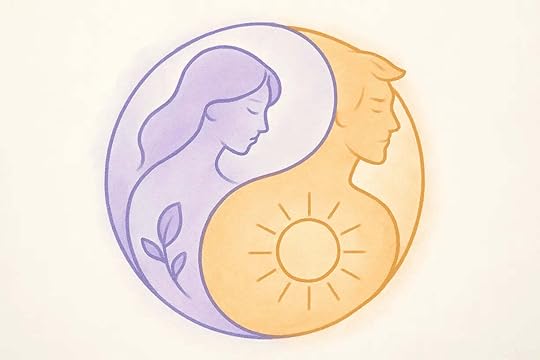
Image: Female-male yin-yang (Source)
Tomboys, gender-fluidity and sexuality
This explores interesting issues, in a somewhat original way, but it was written in 1996 and won’t sit comfortably with all contemporary readers.
Aged 12, Aline’s mother complained she was a tomboy, but then she got her period and learned to adapt to the pain and inconvenience of being a woman. This was a seminal moment, and Aline assumes it is why Orlanda has the mentality of a 12-year-old, and the knowledge of a 35-year-old, in the body of a 20-year-old. Those age gaps are awkward, and furthermore, as Aline is straight, Orlanda fancies men, even though the host is not gay!
“Do I only start to discover who I am when half of me has been removed?”
All the apparent benefits of the situation are for Aline/Orlanda, who occupies two bodies and lives two lives, including having the two talking to each other (it’s confusing). Orlanda is everything her mother didn’t want her to be. But the considerable ramifications for host (who gradually becomes aware), partners, and family are barely considered.
Bottom line: everyone would have been better off if Aline had got therapy for her Mummy-issues.
I was a tomboy, and neither encouraged or discouraged as such. But I was never sporty or macho, so drifted into womanhood, though never an especially feminine one. I can’t imagine wanting to do what Aline does, quite apart from the horrendous collateral damage.
Quotes
• “You can carelessly praise a book that is generally agreed to be a masterpiece, but you can only attack it if you are specific and know it inside out.”
• “You shouldn’t look for the meaning of a book anywhere but within the book itself.”
• “He [Orlando] never was a boy!... The seven days in bed… were puberty! It’s all allegorical and Virginia is telling her own story.”
See also
I read this because I loved Harpman’s I Who Have Never Known Men (see my review HERE) and Virginia Woolf’s Orlando (see my review HERE). This is not a bad book, but it didn’t reach the heights of either of those two.
“The real unknown is the opposite sex.”
Aline is a quiet, conventional, literature professor who has been rereading Virginia Woolf’s Orlando for the tenth time, with little enjoyment. She feels:
“Imprisoned in the persona of the sensible woman I’ve chosen to be for so long that I find it natural.”
Then, ‘poof’, (part of) her consciousness crosses into the body of a young hunk sitting opposite her in the café. It’s a bold concept, and Harpman doesn’t get into the mechanics of how it works:
“I’m not him, I’m occupying him.”
He hasn’t consented to anything: his mind is suppressed and oblivious, and she gives little thought to her responsibilities as she takes over, and changes, his life.
The story focuses on Aline, with her alternate self dubbed Orlanda, but with masculine pronouns. It can be confusing, especially when first-person “I” slips into the mix.
One of the first things Orlanda does is inspect his cock and have a wank. Hmm.
The ending is more dramatic than might be expected - unless you notice .
Image: Female-male yin-yang (Source)
Tomboys, gender-fluidity and sexuality
This explores interesting issues, in a somewhat original way, but it was written in 1996 and won’t sit comfortably with all contemporary readers.
Aged 12, Aline’s mother complained she was a tomboy, but then she got her period and learned to adapt to the pain and inconvenience of being a woman. This was a seminal moment, and Aline assumes it is why Orlanda has the mentality of a 12-year-old, and the knowledge of a 35-year-old, in the body of a 20-year-old. Those age gaps are awkward, and furthermore, as Aline is straight, Orlanda fancies men, even though the host is not gay!
“Do I only start to discover who I am when half of me has been removed?”
All the apparent benefits of the situation are for Aline/Orlanda, who occupies two bodies and lives two lives, including having the two talking to each other (it’s confusing). Orlanda is everything her mother didn’t want her to be. But the considerable ramifications for host (who gradually becomes aware), partners, and family are barely considered.
Bottom line: everyone would have been better off if Aline had got therapy for her Mummy-issues.
I was a tomboy, and neither encouraged or discouraged as such. But I was never sporty or macho, so drifted into womanhood, though never an especially feminine one. I can’t imagine wanting to do what Aline does, quite apart from the horrendous collateral damage.
Quotes
• “You can carelessly praise a book that is generally agreed to be a masterpiece, but you can only attack it if you are specific and know it inside out.”
• “You shouldn’t look for the meaning of a book anywhere but within the book itself.”
• “He [Orlando] never was a boy!... The seven days in bed… were puberty! It’s all allegorical and Virginia is telling her own story.”
See also
I read this because I loved Harpman’s I Who Have Never Known Men (see my review HERE) and Virginia Woolf’s Orlando (see my review HERE). This is not a bad book, but it didn’t reach the heights of either of those two.

Read
March 31, 2026Od pierwszej strony czuć, że autorka była psychoanalityczką 😎 Ale bardzo mi się podobała ta powieść, ach! Polecam!

May 4, 2026
Na het intrigerende, knap opgebouwde Ik die nooit een man heb gekend verraste Jacqueline Harpman mij opnieuw met een compleet andere roman. De titel verwijst uiteraard naar Virginia Woolfs populairste roman en behalve dat het er een moderne, eigenzinnige variatie op is, speelt het werk van de Britse, net als dat van Proust ook een concrete rol in het leven van hoofdpersonage Aline.
Die Brusselse jonge vrouw van 34 verliest, wachtend op haar trein in het Parijse Gard du Nord, een deel van zichzelf. En dat mag je letterlijk nemen. Het deel in kwestie ontstond in haar toen ze op twaalfjarige leeftijd onder invloed van haar moeders commentaren besloot om zich nooit meer als jongen te gedragen. En het neemt op dat Parijse terras zomaar het lichaam in van een twintigjarige jongeman. De schrijfster van dit relaas noemt dat deel Orlanda, wordt soms zelf verrast door haar eigen fictie en verder loopt er ook nog vriendin rond in de roman die zowaar Jacqueline heet.
Meer wil ik niet spoilen, maar vanaf dat moment plaatst Hartman je als lezer in een rollercoaster en een spiegelpaleis tegelijk. Fris, lichtvoetig humoristisch, filosofisch en psychologisch, spannend en gedurfd ... deze roman is met feilloze bravoure geschreven en meer nog dan aan Woolfs Orlando, deed het mij denken aan Pirandello's Iemand, niemand en honderdduizend, maar minder cerebraal, meer van vlees en bloed.
Jacqueline Hartman blijft dus een verder te ontdekken auteur die blijkbaar, zo werd me verteld door een boekhandelaarster die al jaren grote fan is, geen twee gelijkaardige boeken heeft geschreven, maar zich telkens opnieuw en met veel vrouwelijk en literair lef heruit wist te vinden. Ik ben al lang op zoek naar een Nederlandstalig exemplaar van Het strand van Oostende, want die blijft moeilijk te vinden. Alle geheimtips zijn welkom. 4,5*, want nog beter dan Ik die nooit een man heb gekend.
Die Brusselse jonge vrouw van 34 verliest, wachtend op haar trein in het Parijse Gard du Nord, een deel van zichzelf. En dat mag je letterlijk nemen. Het deel in kwestie ontstond in haar toen ze op twaalfjarige leeftijd onder invloed van haar moeders commentaren besloot om zich nooit meer als jongen te gedragen. En het neemt op dat Parijse terras zomaar het lichaam in van een twintigjarige jongeman. De schrijfster van dit relaas noemt dat deel Orlanda, wordt soms zelf verrast door haar eigen fictie en verder loopt er ook nog vriendin rond in de roman die zowaar Jacqueline heet.
Meer wil ik niet spoilen, maar vanaf dat moment plaatst Hartman je als lezer in een rollercoaster en een spiegelpaleis tegelijk. Fris, lichtvoetig humoristisch, filosofisch en psychologisch, spannend en gedurfd ... deze roman is met feilloze bravoure geschreven en meer nog dan aan Woolfs Orlando, deed het mij denken aan Pirandello's Iemand, niemand en honderdduizend, maar minder cerebraal, meer van vlees en bloed.
Jacqueline Hartman blijft dus een verder te ontdekken auteur die blijkbaar, zo werd me verteld door een boekhandelaarster die al jaren grote fan is, geen twee gelijkaardige boeken heeft geschreven, maar zich telkens opnieuw en met veel vrouwelijk en literair lef heruit wist te vinden. Ik ben al lang op zoek naar een Nederlandstalig exemplaar van Het strand van Oostende, want die blijft moeilijk te vinden. Alle geheimtips zijn welkom. 4,5*, want nog beter dan Ik die nooit een man heb gekend.
August 14, 2025
I don't know why I am in the minority here and this book didn't work for me, but what I do know is it REALLY didn't work for me.
September 4, 2025
Interesting ideas and thoughts throughout the book but a very difficult read nonetheless. Took me a long time to get through such a short book.

Read
August 7, 2026«Orlanda fala-nos da multiplicidade que pode existir dentro de cada um de nós e da maneira como a sociedade tende a abafar quaisquer expressões de identidade que não encaixem nas etiquetas que são criadas, principalmente se estivermos a falar de mulheres ou de pessoas queer. Para um livro de 1996, achei que explicava muito bem a diferença entre género, identidade de género e sexualidade — conceitos que, para nós, estão muito mais acessíveis hoje em dia do que na altura.»
Podem saber mais em: https://ritadanova.substack.com/p/orl....
Podem saber mais em: https://ritadanova.substack.com/p/orl....

November 20, 2025
this story was incredibly different from i who have never known men, and i think my expectations made orlanda a bit challenging to get into at first. however, harpman is exploring some really interesting ideas about gender roles, freedom, and the self here, and she takes a much more playful tone than i was expecting. once i oriented myself within the story i found myself really enjoying it and thinking about the different sides each of us have and how we suffer if we don’t explore them.
i love that isle mcelroy did the afterword, having read people collide which is also a body swap story. the afterword helped me to tie together themes from orlanda with i who have never known men which was helpful.
“Time kills us, second after second, and we fools continue to be impatient, Oh! for tomorrow, next week, for the moment were awaiting finally to come. But, reckless soul, it will all end! Suppose you tried instead to enjoy the present? Stop, listen. Your heart is beating, thick blood flows through your veins, you are alive, make the most of it now, don't say that the enjoyment will come later. It's here, it's happening now and it won't last long, every note of the concerto dies away. When you come to the end of the first movement, you can play the record again, but you can't restart the record of your life, for that is only played once.”
i love that isle mcelroy did the afterword, having read people collide which is also a body swap story. the afterword helped me to tie together themes from orlanda with i who have never known men which was helpful.
“Time kills us, second after second, and we fools continue to be impatient, Oh! for tomorrow, next week, for the moment were awaiting finally to come. But, reckless soul, it will all end! Suppose you tried instead to enjoy the present? Stop, listen. Your heart is beating, thick blood flows through your veins, you are alive, make the most of it now, don't say that the enjoyment will come later. It's here, it's happening now and it won't last long, every note of the concerto dies away. When you come to the end of the first movement, you can play the record again, but you can't restart the record of your life, for that is only played once.”

November 18, 2025
a jeśli powiem, że podobało mi się bardziej niż orlando virginii woolf to co
Read
January 26, 2026Ik weet weer waarom ik lees!!!! Dit boek is zo krankzinnig slim en buitengewoon speels!!!!
Drie zaken waar ik nu vurig naar verlang:
1. Een extreem neurotisch proefschrift over de focalisatie in Orlanda schrijven
2. Harpman’s zinnen permanent als broches op mijn hersenmassa spelden
3. De Nederlandse vertaling van haar volledige oeuvre tot mijn beschikking hebben (of nog beter: een even plotse als magische verbetering van mijn Franse vaardigheden)
Drie zaken waar ik nu vurig naar verlang:
1. Een extreem neurotisch proefschrift over de focalisatie in Orlanda schrijven
2. Harpman’s zinnen permanent als broches op mijn hersenmassa spelden
3. De Nederlandse vertaling van haar volledige oeuvre tot mijn beschikking hebben (of nog beter: een even plotse als magische verbetering van mijn Franse vaardigheden)

December 14, 2025
A young(ish) woman of 35 named Aline is at the train station in Paris when an aspect of her personality (strongly hinted to be the masculine part) leaves her body and occupies that of a young 20-year-old man name Lucien LeFrene. The Aline inside this young man is no longer the Aline of her female host and so the narrator concludes that this is, in some way, a new consciousness that will be called Orlanda. What follows is a story of a consciousness existing in two people, the same soul but different qualities in search of different things. Of course there is an element of gender here, specifically the idea of the male and female existing within each individual, but the book (in my opinion) does not explore that aspect (male and female) so much as the idea of experiencing opportunities which might otherwise be remote (being limited to living just one life). Of course, the book takes its name from Virginia Woolf's Orlando (a story Aline happens to be reading) and while I understood why Harpman went in this direction (a novel where a man turns into a woman and lives over many centuries), it was ultimately not necessary and, in my opinion, a mistake to ride on the back of that book's premise. This book did not need to attach itself to that work as a kind of sequel or amendment, and, in my opinion, this book is significantly better and should have stood on its own merits. Even Aline (or is it Harpman) acknowledges that Orlando isn't actually that good:
I really enjoyed this book but it has many flaws. Putting the philosophical stuff to one side for a moment, the writing is very good, fun, inventive, thoughtful, and Harpman weaves a tale which keeps the reader fascinated. The story is straight-forward (allowing the philosophical stuff to be the focus) and sees Aline and Lucien conveniently living in the same area. Almost immediately (and rather hilariously) Orlanda (Aline occupying Lucien) instantly chooses to engage in promiscuous gay sex with a random man on the train (literally in the first few pages); because this, apparently, is either what men just do or what a woman inhabiting a man would do -- take your pick. Do women really just desperately want to have endless promiscuous sex but can't unless they're in the body of a man? This stuff slightly irritated me. Eventually, between his endless gay cruising, he approaches Aline (who is oblivious to this masculine part of her soul having been removed) and reveals himself to her as her masculine counterpart. It doesn't take long for Aline to believe him and accept what he's saying. It's a fun romp and easy to read albeit with sections that drag a little and probably don't need to be there. But overall, I really did love this thing.
Then we come to the philosophical stuff. As I said at the beginning, as much as Harpman plays with the idea of gender, I really don't think that's what the book is about. It always felt more like an exploration of a life otherwise kept at arm's length, even, given the age discrepancies, an opportunity to have an early mid-life crisis. Yes, Harpman makes Aline the good one, meek, respectful, and oppressed by social norms, whereas Lucien/Oranda is confident, self-assured, and free to engage in promiscuous sex and to be himself. But to me, this felt presumptuous, cliched, and frankly a little obvious. Does Aline really want to screw countless men? Does she only avoid doing so because society judges women harshly for that? Really? It all felt a little simplistic, lazy, and silly. Even Harpman acknowledges the banality of our modern obsession with identity; and she's equally less enthralled by the gender stuff.
I honestly did feel that this book was pursuing something more interesting than that. The road not taken, those aspects of individuality which define us but are only expressed in certain settings and yes, are often cultivated or oppressed by gendered norms. But the gender stuff took second place to the idea of living two lives, having your cake and eat it, jumping from one version of existence to another without consequences. The fork in the road is more significant than the person making the actual journey. And in that regard, the book was utterly fantastic.
Additionally, there are also many questions left unanswered: what has Aline learnt from this exactly? Why do we insist on making personality traits either male or female? And, when we do, aren't we equally guilty of playing the game we claim to hate? Plus, was poor Lucien Lefrene, who was straight and had a girlfriend, a victim of repetitive sexual assault at the hands of Aline/Orlanda given that he has countless sexual encounters with men? And this goes double for the ending (eek!). I really did enjoy this and think Harpman is quite brilliant, but there were also quite a lot of flaws that I couldn't ignore and, truth be told, I find modern gender stuff (and identity navel gazing in general) rather tedious. But otherwise, this was utterly superb.
What I find exhausting is that there isn't a single line that isn't exquisitely beautiful, and yet the whole thing is horribly dull
I really enjoyed this book but it has many flaws. Putting the philosophical stuff to one side for a moment, the writing is very good, fun, inventive, thoughtful, and Harpman weaves a tale which keeps the reader fascinated. The story is straight-forward (allowing the philosophical stuff to be the focus) and sees Aline and Lucien conveniently living in the same area. Almost immediately (and rather hilariously) Orlanda (Aline occupying Lucien) instantly chooses to engage in promiscuous gay sex with a random man on the train (literally in the first few pages); because this, apparently, is either what men just do or what a woman inhabiting a man would do -- take your pick. Do women really just desperately want to have endless promiscuous sex but can't unless they're in the body of a man? This stuff slightly irritated me. Eventually, between his endless gay cruising, he approaches Aline (who is oblivious to this masculine part of her soul having been removed) and reveals himself to her as her masculine counterpart. It doesn't take long for Aline to believe him and accept what he's saying. It's a fun romp and easy to read albeit with sections that drag a little and probably don't need to be there. But overall, I really did love this thing.
Then we come to the philosophical stuff. As I said at the beginning, as much as Harpman plays with the idea of gender, I really don't think that's what the book is about. It always felt more like an exploration of a life otherwise kept at arm's length, even, given the age discrepancies, an opportunity to have an early mid-life crisis. Yes, Harpman makes Aline the good one, meek, respectful, and oppressed by social norms, whereas Lucien/Oranda is confident, self-assured, and free to engage in promiscuous sex and to be himself. But to me, this felt presumptuous, cliched, and frankly a little obvious. Does Aline really want to screw countless men? Does she only avoid doing so because society judges women harshly for that? Really? It all felt a little simplistic, lazy, and silly. Even Harpman acknowledges the banality of our modern obsession with identity; and she's equally less enthralled by the gender stuff.
Never has a woman been a man, never has a man been a woman. Each sex possesses a knowledge that they are incapable of sharing and any attempt to bridge the gap is just an illusion
I honestly did feel that this book was pursuing something more interesting than that. The road not taken, those aspects of individuality which define us but are only expressed in certain settings and yes, are often cultivated or oppressed by gendered norms. But the gender stuff took second place to the idea of living two lives, having your cake and eat it, jumping from one version of existence to another without consequences. The fork in the road is more significant than the person making the actual journey. And in that regard, the book was utterly fantastic.
Additionally, there are also many questions left unanswered: what has Aline learnt from this exactly? Why do we insist on making personality traits either male or female? And, when we do, aren't we equally guilty of playing the game we claim to hate? Plus, was poor Lucien Lefrene, who was straight and had a girlfriend, a victim of repetitive sexual assault at the hands of Aline/Orlanda given that he has countless sexual encounters with men? And this goes double for the ending (eek!). I really did enjoy this and think Harpman is quite brilliant, but there were also quite a lot of flaws that I couldn't ignore and, truth be told, I find modern gender stuff (and identity navel gazing in general) rather tedious. But otherwise, this was utterly superb.

December 28, 2025
‘i who have never known men’ is one of my favourite books, so i had huge expectations, but this book is VERY different, and i found it hard to read🫣. didn’t like the narration, and so much time was spent on the philosophy and literature references that i felt like it overpowered the story. however, so many beautifully written passages and comments on identity, gender, femininity.
i still love you jacqueline harpman.
i still love you jacqueline harpman.

July 6, 2025
the narrator panning away to a different scene every time Orlanda engaged in gay sex ruined this experience for me lmao

Read
January 22, 2026let's try to write about this book
The first time I read Orlando, I bounced off it pretty hard, I have rarely had such a negative reaction to a book, and as time has passed that reaction has, mixing metaphor hete, been more entrenched. Reading Fionnuala'review of orlanda, I was fascinated that a book with a vaguely similar premise to the other O book could sound interesting.
And it came to pass, thanks to the magic of Christmas
another try
I think I recall a Zen riddle, a student asks their teacher how they can be liberated from being tied to the cycle of
Imagine, if you will, that you are a young woman who has been brought up inside a steel cage with only your mother, who has educated you mainly through sharp and judgemental comments. You do not know men, you have never known men.
One day, mysteriously, you liberate yourself from this cage. What will you do? What do you want to do? How do you want to be in the world? Might cyndi lauper's girls just wanna have fun
There are certain stories. [Book:Jekyll and Hyde]
The first time I read Orlando, I bounced off it pretty hard, I have rarely had such a negative reaction to a book, and as time has passed that reaction has, mixing metaphor hete, been more entrenched. Reading Fionnuala'review of orlanda, I was fascinated that a book with a vaguely similar premise to the other O book could sound interesting.
And it came to pass, thanks to the magic of Christmas
another try
I think I recall a Zen riddle, a student asks their teacher how they can be liberated from being tied to the cycle of
Imagine, if you will, that you are a young woman who has been brought up inside a steel cage with only your mother, who has educated you mainly through sharp and judgemental comments. You do not know men, you have never known men.
One day, mysteriously, you liberate yourself from this cage. What will you do? What do you want to do? How do you want to be in the world? Might cyndi lauper's girls just wanna have fun
There are certain stories. [Book:Jekyll and Hyde]

June 9, 2021
Translated from the French, this bold yet subtle probing into one woman’s psyche serves as allegory, satire and social critique. Aline has stifled the more irreverent and forceful parts of her nature all her life, conforming to the demands her kindly yet rigid mother and indifferent father have set upon her.
The author widens her net to show how many people smother parts of their inner selves to deal with demanding parents and the world at large. Aline’s situation is by no means unique or uniquely French. No doubt many women will nod to themselves as they read how she stopped behaving in a rough-and-tumble manner, shut off sharp opinions or placidly accepted dull company to please a stalwart boyfriend with whom she’s endured a ten-year-old affair.
The novel shuffles giddily among the viewpoints of three main characters: Aline who becomes more and more aware of a void opening in her mind; Lucien Leftène, his mind quickly snuffed out by the invading piece of Aline’s psyche and the narrator, whose vacillating POV shifts us between these two and the inner part of Lucien that calls itself Orlanda.
Throw in a nosy neighbor, a gay lover who fights against loving someone he fears is only a temporary fancy, a needy ex-girlfriend, an alcoholic mother, intensive students and a Chekhov’s gun and we see a complex web that would make this a fine French farce if it weren’t a sublime tracing of a woman coming to terms with the fiercely repressed parts of her soul. But perhaps it’s both?
This is a novel that can support multiple interpretations, making it something to savor, linger over and re-read.
The author widens her net to show how many people smother parts of their inner selves to deal with demanding parents and the world at large. Aline’s situation is by no means unique or uniquely French. No doubt many women will nod to themselves as they read how she stopped behaving in a rough-and-tumble manner, shut off sharp opinions or placidly accepted dull company to please a stalwart boyfriend with whom she’s endured a ten-year-old affair.
The novel shuffles giddily among the viewpoints of three main characters: Aline who becomes more and more aware of a void opening in her mind; Lucien Leftène, his mind quickly snuffed out by the invading piece of Aline’s psyche and the narrator, whose vacillating POV shifts us between these two and the inner part of Lucien that calls itself Orlanda.
Throw in a nosy neighbor, a gay lover who fights against loving someone he fears is only a temporary fancy, a needy ex-girlfriend, an alcoholic mother, intensive students and a Chekhov’s gun and we see a complex web that would make this a fine French farce if it weren’t a sublime tracing of a woman coming to terms with the fiercely repressed parts of her soul. But perhaps it’s both?
This is a novel that can support multiple interpretations, making it something to savor, linger over and re-read.
January 31, 2026
Aline Berger, a 35-year-old literature professor, is sitting at a train station trying to get through Virginia Woolf’s Orlando when the oddest thing happens. A part of her soul just…leaves her, and takes up residence in a nearby young man. Dubbed “Orlanda,” this is Aline’s more wild, impulsive side, the part of herself she’s been suppressing since her mother pressured her to start acting “like a lady” as a preteen. We follow both sides of Aline/Orlanda as they make their way through the world.
The longer I sit with this book after having read it, the more I appreciate it. It’s a highly literary, slightly dense read (although much less so than the works of the author it pays homage to!) but it’s also full of humour and poignant thoughts about gender and sexuality. It was particularly interesting to follow Orlanda’s character as a gay man cruising in the 1990s, an experience that feels very particular to the time. The author as narrator frequently breaks the fourth wall, reminding us we’re reading a novel she has written, and it enriches the story rather than pulling the reader out of it.
And while I’m a Virginia Woolf stan, I think MANY readers will relate to Aline’s not untrue impression of Woolf’s work: “What I find exhausting is that there isn't a single line that isn't exquisitely beautiful, and yet the whole thing is horribly dull, she thought vaguely.”
I have another book from this author that’s been sitting on my TBR for a while, and now I’m extra eager to read it!
The longer I sit with this book after having read it, the more I appreciate it. It’s a highly literary, slightly dense read (although much less so than the works of the author it pays homage to!) but it’s also full of humour and poignant thoughts about gender and sexuality. It was particularly interesting to follow Orlanda’s character as a gay man cruising in the 1990s, an experience that feels very particular to the time. The author as narrator frequently breaks the fourth wall, reminding us we’re reading a novel she has written, and it enriches the story rather than pulling the reader out of it.
And while I’m a Virginia Woolf stan, I think MANY readers will relate to Aline’s not untrue impression of Woolf’s work: “What I find exhausting is that there isn't a single line that isn't exquisitely beautiful, and yet the whole thing is horribly dull, she thought vaguely.”
I have another book from this author that’s been sitting on my TBR for a while, and now I’m extra eager to read it!
February 17, 2026
Ik las "Orlanda" van Jacqueline Harpman.
Een ode aan Orlando van Virginia Woolf, maar nog beter.
Gewoon perfect!
Het hoofdpersonage, Aline, heeft sinds haar twaalfde altijd haar mannelijke kant verdrongen. Als zij grote stappen nam, hoorde ze haar moeder verwijtend zeggen: "Je lijkt wel een jongen".
Nu vlucht haar mannelijke helft uit haar weg en neemt bezit van het lichaam van een jongeman die ze toevallig in een station ontmoet, Lucien.
Ongecompliceerd geniet Orlanda van het leven en van seks. Ze blijft op mannen vallen, terwijl ze in een mannenlichaam zit. Zij/hij geniet van de ultieme vrijheid en ontmoet geregeld Aline, zijn vrouwelijke IK.
Die ontmoetingen zijn natuurlijk bijzonder geestig. Zij kennen elkaar door en door, want zij zijn eigenlijk dezelfde persoon. Klinkt ingewikkeld, maar je moet er als lezer gewoon in meegaan.
Harpman gaat met haar Orlanda veel verder dan Woolf met haar Orlando durfde te gaan.
De schrijfster richt zich vaak rechtstreeks tot de lezer, een stijl die ik erg prettig vind.
Ook de verwijzingen naar Virginia Woolf en naar Proust zijn leuk.
Absoluut een uniek boek.
Een ode aan Orlando van Virginia Woolf, maar nog beter.
Gewoon perfect!
Het hoofdpersonage, Aline, heeft sinds haar twaalfde altijd haar mannelijke kant verdrongen. Als zij grote stappen nam, hoorde ze haar moeder verwijtend zeggen: "Je lijkt wel een jongen".
Nu vlucht haar mannelijke helft uit haar weg en neemt bezit van het lichaam van een jongeman die ze toevallig in een station ontmoet, Lucien.
Ongecompliceerd geniet Orlanda van het leven en van seks. Ze blijft op mannen vallen, terwijl ze in een mannenlichaam zit. Zij/hij geniet van de ultieme vrijheid en ontmoet geregeld Aline, zijn vrouwelijke IK.
Die ontmoetingen zijn natuurlijk bijzonder geestig. Zij kennen elkaar door en door, want zij zijn eigenlijk dezelfde persoon. Klinkt ingewikkeld, maar je moet er als lezer gewoon in meegaan.
Harpman gaat met haar Orlanda veel verder dan Woolf met haar Orlando durfde te gaan.
De schrijfster richt zich vaak rechtstreeks tot de lezer, een stijl die ik erg prettig vind.
Ook de verwijzingen naar Virginia Woolf en naar Proust zijn leuk.
Absoluut een uniek boek.
July 15, 2025
Cackling at the absolute madness of this, especially the abrupt ending.
Definitely some duff moments - sorry Francophiles, I don't know anything about Proust and Balzac so I glazed over the parts where the characters insisted on discussing them. But as a study of identity, morality, gendered society, introjected values, etiquette, repression and sex, it absolutely rivals the book it knowingly riffs on. And it's more entertaining, too.
A 90s queer coming-of-age story by a horned-up septuagenarian Belgian woman is not the book I was anticipating joining my best reads of the year, but here we are.
Definitely some duff moments - sorry Francophiles, I don't know anything about Proust and Balzac so I glazed over the parts where the characters insisted on discussing them. But as a study of identity, morality, gendered society, introjected values, etiquette, repression and sex, it absolutely rivals the book it knowingly riffs on. And it's more entertaining, too.
A 90s queer coming-of-age story by a horned-up septuagenarian Belgian woman is not the book I was anticipating joining my best reads of the year, but here we are.

June 30, 2026
3.75/5
Do tego pieca można było jeszcze wiele dorzucić, jednak nie zmienia to faktu, że bawiłam się dobrze - szczególnie z uwagi na koncept, zgrabną psychoanalizę tematu i sposób prowadzenia narracji.
Do tego pieca można było jeszcze wiele dorzucić, jednak nie zmienia to faktu, że bawiłam się dobrze - szczególnie z uwagi na koncept, zgrabną psychoanalizę tematu i sposób prowadzenia narracji.

September 22, 2026
El titulo de la novela hace referencia, a una de las novelas mas conocidas de Virginia Woolf, siendo una variación moderna y original de esta.
La protagonista de esta historia, Aline, es una mujer de 35 años, pierde parte de si misma, y decide “apoderarse” del cuerpo de un joven de veinte años. Si, es complejo, complejo de entender y es fácil leer sin saber que está pasando, el por que de esos cambios de narrador…pero prometo que lo vas entendiendo todo según avanzas.
Una novela filosófica, psicológica, muy atrevida, con sentido del humor con una mirada bastante moderna hacia el género y la identidad, escrita de manera impecable y haciendo referencia a muchos clásicos de la literatura, y con una prosa que poc@s autores logran.
Una novela que te hace reflexionar y pensar si parte de nosotros esta reprimida por la sociedad en al que vivimos y finalmente nos adaptamos a ella, o si somos una sola persona o varias de nosotros mismos, el deseo de vivir otras vidas y la aceptación de ser quienes somos.
La protagonista de esta historia, Aline, es una mujer de 35 años, pierde parte de si misma, y decide “apoderarse” del cuerpo de un joven de veinte años. Si, es complejo, complejo de entender y es fácil leer sin saber que está pasando, el por que de esos cambios de narrador…pero prometo que lo vas entendiendo todo según avanzas.
Una novela filosófica, psicológica, muy atrevida, con sentido del humor con una mirada bastante moderna hacia el género y la identidad, escrita de manera impecable y haciendo referencia a muchos clásicos de la literatura, y con una prosa que poc@s autores logran.
Una novela que te hace reflexionar y pensar si parte de nosotros esta reprimida por la sociedad en al que vivimos y finalmente nos adaptamos a ella, o si somos una sola persona o varias de nosotros mismos, el deseo de vivir otras vidas y la aceptación de ser quienes somos.

November 17, 2025
Ależ to było dziwne, w pozytywnym znaczeniu dziwne. Fantastycznie napisana książka, bardzo mi się podobały stylistyczne zagrywki autorki. Fabularnie zostałam zachęcona do sięgnięcia po powieść Virginii Woolf, z którą nasza „Orlanda” koresponduje.

June 1, 2026
*Orlanda* é uma obra singular e que nos questiona nas nossas certezas: ousada na sua premissa, elegante na sua prosa e desafiante nas suas ambiguidades.
Este libro não é uma leitura confortável para quem exige respostas fáceisbe óbvias sobre identidade — e é precisamente por isso que continua tão atual.
Uma leitura incrível que me obrigou a questionar muito do que achava qie sabia e sentia.
Este libro não é uma leitura confortável para quem exige respostas fáceisbe óbvias sobre identidade — e é precisamente por isso que continua tão atual.
Uma leitura incrível que me obrigou a questionar muito do que achava qie sabia e sentia.
Displaying 1 - 30 of 790 reviews