

What do you think?

The Mystery of the Hidden Room
A classic mystery/detective story in the Sherlock Holmes tradition, the hidden room suggested by the title of this book does not remain a mystery for very long as the book progresses. Written in the first person, the husband of his (Carlton Davies) former lover is found dead one night at the stroke of midnight, and Davies finds his ex-lover standing over the dead body immediately after the shot was fired, with a gun in her hand. It was no secret that she never truly loved her husband, who had blackmailed her into marrying him. The jury ships Ruth to prison, and the stage is set for Davies to locate the right detective for the case, and for a series of events with twists and turns and surprises that will keep the reader guessing who was responsible for this murder. (Summary by Roger Melin)
341 pages, Kindle Edition
First published January 1, 1922
About the author
Marion Harvey
22 books5 followersMarion Harvey was a Brazilian-born American lawyer who wrote a number of detective novels and plays in the 1920s. A rather elusive figure, he practised law in Ohio before moving to Los Angeles. A discovery of innovative New York publisher, Edward J. Clode (publisher of Armitage Trail’s SCARFACE), his 1922 debut novel, THE MYSTERY OF THE HIDDEN ROOM was very well received (‘A gripping detective tale’ THE DAILY MAIL) and introduced amateur sleuth Graydon McKelvie. Five more novels and two plays followed, with performances of the latter recorded in New York, Alabama and Pennsylvania
Ratings & Reviews
Friends & Following
Create a free account to discover what your friends think of this book!
Community Reviews
Displaying 1 - 30 of 64 reviews
January 19, 2016
The Mystery of the Hidden Room is a classic mystery written in the style of Sherlock Holmes novels. It is written in the first person concerning a spirned lover who finds finds a gentleman murdered at the stroke of midnight and his X Lover with a revolver in her hand standing over him. The mystery unravles from there. I recommend this book to all who are fans of the Sherlock Holmes books.
Enjoy and Be Blessed.
Diamond
Enjoy and Be Blessed.
Diamond

May 17, 2022
Me ha gustado bastante este libro, es la típica novela clásica, en ciertos aspectos me ha recordado un poco a las novelas de Agatha Christie, la novela es un misterio de habitación cerrada, y ahí entra en juego, quién pudo ser y cómo pudo hacerlo.
La trama no es nada complicada, Philip Darwin aparece muerto en su estudio en su mansión y se acusa del crimen a su esposa Ruth, entonces su exprometido Carlton Davies contrata al detective Graydon McKelvie para que averigue la verdad, ya que está convencido de que Ruth es inocente...
La novela está dividida en 39 capítulos cortos, narrado desde el punto de vista de Carlton Davies, nos va adentrando poco a poco, en la vida de Philip Darwin y en quién podría querer asesinarle. Narrada con un estilo sencillo. la novela se lee muy rápido.
Los personajes están muy bien perfilados, aunque mi favorito es el detective McKelvie, un tipo un poco peculiar.
La trama no es nada complicada, Philip Darwin aparece muerto en su estudio en su mansión y se acusa del crimen a su esposa Ruth, entonces su exprometido Carlton Davies contrata al detective Graydon McKelvie para que averigue la verdad, ya que está convencido de que Ruth es inocente...
La novela está dividida en 39 capítulos cortos, narrado desde el punto de vista de Carlton Davies, nos va adentrando poco a poco, en la vida de Philip Darwin y en quién podría querer asesinarle. Narrada con un estilo sencillo. la novela se lee muy rápido.
Los personajes están muy bien perfilados, aunque mi favorito es el detective McKelvie, un tipo un poco peculiar.

April 17, 2018
The Mystery of the Hidden Room is one of those classic mystery novels written by Marion Harvey in 1922. This book was a mystery even before I began reading it. There it is on the front cover "The Mystery of the Hidden Room" by "Marion Harvey". But there isn't another word about Marion Harvey in the book. In fact there are very little words about Marion Harvey anywhere else I've looked at. I'm not even sure whether poor Marion is a man or a woman. Looking for him/her I came across a page of obituaries of all sorts of dead Marion Harveys and right below Marion Harvey, a husband and father of 3, we have Marion Harvey, who died at the age of 90, she was a widow her husband had died 10 years earlier. I can't remember whether there were children. I know no more than I did before, except the name is rather a common one, for men and women it seems. I do know this now:
Marion Harvey was the author of several mystery novels and plays between 1922 and 1935. The first of these was The Mystery of the Hidden Room. Others include The The Vengeance of the Ivory Skull, The Clue of the Clock, The House of Seclusion, and The Arden Mystery. (Good luck finding any of those.) Harvey's plays have been performed in New York, Alabama and Pennsylvania......
Pennsylvania?? I must have been away that day, of course there has never been a play around here except for when one school or another puts one on. And none of them were by Marion Harvey. Our local high school just performed "In the Woods" or something like that. It was confusing. And hot. Oh, but here is a site that says they have a biography! I click on it and get:
Marion Harvey is the author of "The Mystery of the Hidden Room".
That was helpful. Oh, I just got a site with a "biography" that told me Marion Harvey was an author of mysteries. Really? I have a Marion Harvey who was a world champion badminton player and here's one who was a college professor, oh there is an artist. And I will now give up (for the moment) and move on from the mystery of the author to the mystery of the book.
The book begins with our hero, Carlton Davies receiving a note from Ruth, the love of his life, to come to her. Of course he goes, after all, he is madly in love with her, so much so that he had proposed to her, she said yes, the marriage was just a few weeks from happening, and Ruth married someone else. The name of Ruth's husband is Philip Darwin, and he is not nice. No one likes him. I don't like him, Carlton doesn't like him, Ruth doesn't like him, and no one else in the book does either. But she married him. It seems her "darling" younger brother has got into a bit of trouble, ok, a lot of trouble. Ruth's father is president of a bank where Dick, her brother, works as a assistant cashier and Philip is the director. Dick looks up to the older man and is flattered by the attentions of Philip, and following Philip's teaching becomes a devotee of gambling and of drink. A few days before Ruth's surprise wedding Dick had gone with Philip to a gambling den where, under the influence of alcohol, when getting into an argument with another man shoots him. Philip gets Dick away and takes him home where he gathers some things together and with his father's and Philip's help runs away somewhere. I don't know where.
And so Dick is gone, and the police are looking for the murderer, but no one knows it is Dick, no one besides Philip who is happy to keep the secret if......Ruth marries him. And now Carlton is on his way to see her. When he arrives Ruth tells him that she is afraid of what her husband is planning to do to him. It seems that she had been so sad she had written a letter to Carlton pouring her heart out to him, but realized she shouldn't do such a thing and tore up the letter throwing it away. And now Mr. Orton, Phil's secretary enters the picture. Remember that list of people who didn't like Philip? Add Orton onto that list, on Philip's side of course. As Ruth says:
"You know I have a feeling that Mr. Orton, Phil's secretary, is always hanging around listening and spying upon me. Ugh, he makes me shiver with his prominent, near-sighted eyes, his eternal humility and mock grin. He reminds me of Uriah Heep in David Copperfield. I suppose I'm foolish, but I've been alone so much of late."
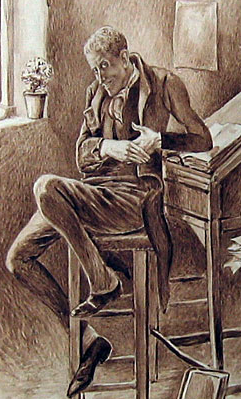
I couldn't resist.
It seems that Orton is so dedicated to watching Ruth that he goes through her trash, picks the pieces of the letter out of it, tapes it back together and gives it to Philip. Why, I can't remember, I can't really see what he would get out of this, but he did it. Of course Philip is furious, and is now threatening to revenge himself upon Philip, ruining him and breaking him, stuff like that. So when her husband goes out for the evening, wherever people like this go out to, she sends her note to Carlton. After hearing her story Carton asks her if she could get this letter and she said she thought she could, she saw Philip put it in a drawer in his desk. Then this happens:
"I saw Ruth try the door of the study and as it yielded to her hand she advanced timidly into the room, leaving the door barely ajar behind her. My view being thus effectually cut off I strained forward in an endeavor to catch the slightest sound, but was only rewarded by the most profound stillness, through which there presently echoed and re-echoed the voice of the old clock in the hall proclaiming the midnight hour. Then, as if that ancient time-piece had been the signal previously agreed upon, there rang through the house from the direction of the study the sharp report of a pistol, followed by silence, absolute, profound!
A moment I remained petrified, then with a bound I gained the study door, my one thought for Ruth. But on the threshold I stood rooted to the spot by the sight that met my eyes!
In the patch of light cast by a small lamp upon the study table, lying back in his chair with a sardonic grin on his face and an ever widening stain upon his shirt front, was Philip Darwin, while beside him as if turned to stone, stood Ruth with a pistol in her hand!
That's not really a spoiler, it happens in the second chapter, there are lots more to come. We find that the windows are locked so the murderer didn't come that way, and the door had been locked from the inside when the last person who had talked to him (Orton) had left him. He had heard Philip lock the door behind him. No one else had been there since then, and that was hours before the murder. The only person in the room was Ruth, how she got into a locked room I can't remember, the only person holding a gun was Ruth, the only suspect is Ruth, and Ruth is arrested. But there are other suspects, there's Orton, I'm naming him a suspect just because he is such a creep, then there's Dick, his and Ruth's life would be much better without Philip around to blackmail them. There is the nephew, Lee, who had lived there until he and his uncle had an argument and Philip had told him to leave. And we find that recently he had changed his will leaving his money to Cora Manning, whoever that is. I almost forgot that part altogether.
I'm almost out of things to say except that if Graydon McKelvie hadn't shown up the case still wouldn't be solved. He's a private investigator of course, and a good one, the Sherlock Holmes, Hercule Poirot type investigator. One of those people who can solve every crime. There are clues of course, a bullet, a bloody handkerchief, a clean handkerchief, a ring, the lamp, but it takes Graydon McKelvie to sort it all out. And the rest of it will be for you to sort out, I'm finished. I spent some time trying to figure out how the title of the book entered into all this. You should too. I'm feeling generous today, 4 stars. Happy reading.
Marion Harvey was the author of several mystery novels and plays between 1922 and 1935. The first of these was The Mystery of the Hidden Room. Others include The The Vengeance of the Ivory Skull, The Clue of the Clock, The House of Seclusion, and The Arden Mystery. (Good luck finding any of those.) Harvey's plays have been performed in New York, Alabama and Pennsylvania......
Pennsylvania?? I must have been away that day, of course there has never been a play around here except for when one school or another puts one on. And none of them were by Marion Harvey. Our local high school just performed "In the Woods" or something like that. It was confusing. And hot. Oh, but here is a site that says they have a biography! I click on it and get:
Marion Harvey is the author of "The Mystery of the Hidden Room".
That was helpful. Oh, I just got a site with a "biography" that told me Marion Harvey was an author of mysteries. Really? I have a Marion Harvey who was a world champion badminton player and here's one who was a college professor, oh there is an artist. And I will now give up (for the moment) and move on from the mystery of the author to the mystery of the book.
The book begins with our hero, Carlton Davies receiving a note from Ruth, the love of his life, to come to her. Of course he goes, after all, he is madly in love with her, so much so that he had proposed to her, she said yes, the marriage was just a few weeks from happening, and Ruth married someone else. The name of Ruth's husband is Philip Darwin, and he is not nice. No one likes him. I don't like him, Carlton doesn't like him, Ruth doesn't like him, and no one else in the book does either. But she married him. It seems her "darling" younger brother has got into a bit of trouble, ok, a lot of trouble. Ruth's father is president of a bank where Dick, her brother, works as a assistant cashier and Philip is the director. Dick looks up to the older man and is flattered by the attentions of Philip, and following Philip's teaching becomes a devotee of gambling and of drink. A few days before Ruth's surprise wedding Dick had gone with Philip to a gambling den where, under the influence of alcohol, when getting into an argument with another man shoots him. Philip gets Dick away and takes him home where he gathers some things together and with his father's and Philip's help runs away somewhere. I don't know where.
And so Dick is gone, and the police are looking for the murderer, but no one knows it is Dick, no one besides Philip who is happy to keep the secret if......Ruth marries him. And now Carlton is on his way to see her. When he arrives Ruth tells him that she is afraid of what her husband is planning to do to him. It seems that she had been so sad she had written a letter to Carlton pouring her heart out to him, but realized she shouldn't do such a thing and tore up the letter throwing it away. And now Mr. Orton, Phil's secretary enters the picture. Remember that list of people who didn't like Philip? Add Orton onto that list, on Philip's side of course. As Ruth says:
"You know I have a feeling that Mr. Orton, Phil's secretary, is always hanging around listening and spying upon me. Ugh, he makes me shiver with his prominent, near-sighted eyes, his eternal humility and mock grin. He reminds me of Uriah Heep in David Copperfield. I suppose I'm foolish, but I've been alone so much of late."
I couldn't resist.
It seems that Orton is so dedicated to watching Ruth that he goes through her trash, picks the pieces of the letter out of it, tapes it back together and gives it to Philip. Why, I can't remember, I can't really see what he would get out of this, but he did it. Of course Philip is furious, and is now threatening to revenge himself upon Philip, ruining him and breaking him, stuff like that. So when her husband goes out for the evening, wherever people like this go out to, she sends her note to Carlton. After hearing her story Carton asks her if she could get this letter and she said she thought she could, she saw Philip put it in a drawer in his desk. Then this happens:
"I saw Ruth try the door of the study and as it yielded to her hand she advanced timidly into the room, leaving the door barely ajar behind her. My view being thus effectually cut off I strained forward in an endeavor to catch the slightest sound, but was only rewarded by the most profound stillness, through which there presently echoed and re-echoed the voice of the old clock in the hall proclaiming the midnight hour. Then, as if that ancient time-piece had been the signal previously agreed upon, there rang through the house from the direction of the study the sharp report of a pistol, followed by silence, absolute, profound!
A moment I remained petrified, then with a bound I gained the study door, my one thought for Ruth. But on the threshold I stood rooted to the spot by the sight that met my eyes!
In the patch of light cast by a small lamp upon the study table, lying back in his chair with a sardonic grin on his face and an ever widening stain upon his shirt front, was Philip Darwin, while beside him as if turned to stone, stood Ruth with a pistol in her hand!
That's not really a spoiler, it happens in the second chapter, there are lots more to come. We find that the windows are locked so the murderer didn't come that way, and the door had been locked from the inside when the last person who had talked to him (Orton) had left him. He had heard Philip lock the door behind him. No one else had been there since then, and that was hours before the murder. The only person in the room was Ruth, how she got into a locked room I can't remember, the only person holding a gun was Ruth, the only suspect is Ruth, and Ruth is arrested. But there are other suspects, there's Orton, I'm naming him a suspect just because he is such a creep, then there's Dick, his and Ruth's life would be much better without Philip around to blackmail them. There is the nephew, Lee, who had lived there until he and his uncle had an argument and Philip had told him to leave. And we find that recently he had changed his will leaving his money to Cora Manning, whoever that is. I almost forgot that part altogether.
I'm almost out of things to say except that if Graydon McKelvie hadn't shown up the case still wouldn't be solved. He's a private investigator of course, and a good one, the Sherlock Holmes, Hercule Poirot type investigator. One of those people who can solve every crime. There are clues of course, a bullet, a bloody handkerchief, a clean handkerchief, a ring, the lamp, but it takes Graydon McKelvie to sort it all out. And the rest of it will be for you to sort out, I'm finished. I spent some time trying to figure out how the title of the book entered into all this. You should too. I'm feeling generous today, 4 stars. Happy reading.

May 25, 2019
3'5 / 5 ⭐

April 27, 2021
Good vintage mystery written and set in the 1920's. Be warned though, there are a few passing comments that would be now considered racist.
November 13, 2014
Unpredictable
this story had me guessing the whole way through the book. I have read several of the free books on my Kindle, most of which were either predictable, had corny love stories within the mystery, or both. wanting to fulfill my hunger for true mystery, I went to classics. The Mystery of the Hidden Room was just the story I needed. I cannot discuss the story, because I don't want to give away any details. I would recommend this book to anyone
this story had me guessing the whole way through the book. I have read several of the free books on my Kindle, most of which were either predictable, had corny love stories within the mystery, or both. wanting to fulfill my hunger for true mystery, I went to classics. The Mystery of the Hidden Room was just the story I needed. I cannot discuss the story, because I don't want to give away any details. I would recommend this book to anyone

July 2, 2019
Una historia muy al estilo Sherlock Holmes, que incluso es autoconsciente de ello puesto que el detective protagonista se declara fan del personaje de Conan Doyle. La novela se enmarca en el género de “crimen en habitación cerrada”, que nos suele mostrar un asesinato en un espacio cerrado del que difícilmente un asesino podría entrar o salir. Recuerda muchísimo a otras novelas de este género como “El Misterio del Cuarto Amarillo” de Gaston Leroux o “El Asesinato de Roger Ackroyd” de Agatha Christie.
Pese a haber sido escrito en 1922, es un libro moderno y fácil de leer, con muchos diálogos, giros interesantes y cierta acción. Personalmente creo que tiene algunos recursos tramposos y facilones, como que alguien no reconozca a otro personaje porque casualmente “había muy poca luz”, o el hecho de que no encuentren cierta puerta o pasadizo hasta el momento oportuno…, pero en general es una novela correcta, amena y que consigue sorprender en el desenlace.
Pese a haber sido escrito en 1922, es un libro moderno y fácil de leer, con muchos diálogos, giros interesantes y cierta acción. Personalmente creo que tiene algunos recursos tramposos y facilones, como que alguien no reconozca a otro personaje porque casualmente “había muy poca luz”, o el hecho de que no encuentren cierta puerta o pasadizo hasta el momento oportuno…, pero en general es una novela correcta, amena y que consigue sorprender en el desenlace.

August 9, 2019
“To distinguish the truth from the myriad bypaths of coincidence and false testimony is quite an art, I assure you, for do not believe in doing any man an injustice.”—Graydon McKelvie
If you are looking for something in the vein of Sherlock Holmes, Wilkie Collins, or Mary Elizabeth Braddon, The Mystery of the Hidden Room is nifty locked-room murder mystery well worth checking out. I had honestly never heard of the book or the author until I stumbled upon through some recommendations. I’m glad this novel and the author were brought to my attention. The novel has a quality that readers who love the classic mysteries with a bit of the sensationalist flair will most likely find engaging.
When a certain gentleman is found shot dead in the early chapters, it set in motion the investigation as to who could have done the crime. However, by what means could this have been done? It appears there was no possible exit for the killer to have escaped? Many odd factors surround the moments leading up to the death of one Phillip Darwin, and when a young lady becomes suspected, amateur sleuth Graydon McKelvie comes in to try to solve the case. He is much an admirer of Sherlock Holmes, as uses Holmes’ tactics as a means to try to solve the case.
This is one book where it is tough to speak about the plot without giving too much away, but suffice to say, The Mystery of the Hidden Room is packed to the brim with many surprises and twists that will keep the reader guessing. The mystery boasts so many aspects and elements: disguises, deception, blackmail, ruffians and assailants, heroes, elaborate schemes and traps, and one very intense hearing. It is a classic mystery filled to the brim with many staples of the genre and definitely fun read.
If you are looking for something in the vein of Sherlock Holmes, Wilkie Collins, or Mary Elizabeth Braddon, The Mystery of the Hidden Room is nifty locked-room murder mystery well worth checking out. I had honestly never heard of the book or the author until I stumbled upon through some recommendations. I’m glad this novel and the author were brought to my attention. The novel has a quality that readers who love the classic mysteries with a bit of the sensationalist flair will most likely find engaging.
When a certain gentleman is found shot dead in the early chapters, it set in motion the investigation as to who could have done the crime. However, by what means could this have been done? It appears there was no possible exit for the killer to have escaped? Many odd factors surround the moments leading up to the death of one Phillip Darwin, and when a young lady becomes suspected, amateur sleuth Graydon McKelvie comes in to try to solve the case. He is much an admirer of Sherlock Holmes, as uses Holmes’ tactics as a means to try to solve the case.
This is one book where it is tough to speak about the plot without giving too much away, but suffice to say, The Mystery of the Hidden Room is packed to the brim with many surprises and twists that will keep the reader guessing. The mystery boasts so many aspects and elements: disguises, deception, blackmail, ruffians and assailants, heroes, elaborate schemes and traps, and one very intense hearing. It is a classic mystery filled to the brim with many staples of the genre and definitely fun read.

February 14, 2014
"Murder afoot with a fair damsel in distress." No cussing, sex or graphic violence. No sucker punches. Pleasant after all the gory books lately. Interesting enough to keep attention up. Well-edited Kindle ver., audiobook available, free book, easy read -may be flowery for modern tastes. Considered a modern classic ©1922.

August 3, 2016
This book was a bit slow moving at the beginning and slightly confusing simply because it is an older book, but it is a very interesting read. It is a original "who did it" murder mystery with an amazing plot twist that will blow your mind.
November 15, 2017
As a mystery story along the lines of Aurther Conyn Doyle's Sherlock Holmes, it was a very good read. Although I had pretty much guessed who the murderer was before I was half way through it was highly interesting to see the how and why of it, as well as a bit of a surprise to learn the truth about the actual victims in this case, there being more then a few.

September 7, 2013
There isn't much biographical available for Marion Harvey, who was reported to have been born in 1900, but due to early publication information and some performance data, the author appears to be American and the author of several mystery novels and plays between 1922 and 1935. The first of these was "The Mystery of the Hidden Room."
Hidden Room and two other works (one novel, one play) feature Graydon McKelvie, a Sherlock Holmes-worshipping detective. In addition to noting that the criminal device employed in Hidden Room is noteworthy, SS Van Dine once noted (in "The Great Detective Stories," 1927), "The deductive work done by Graydon McKelvie is at times extremely clever."
"The Mystery Of The Hidden Room" is told from the viewpoint of Carlton Davies, whose former fiancee Ruth Darwin was blackmailed into leaving him by the man she ultimately married, powerful banker Phillip Darwin. When the husband is murdered and Carlton finds Ruth standing over him with a gun in her hand one night, she is promptly arrested, tried, and packed off to prison.
Carlton never lost his love for Ruth and is steadfast in believing her innocent of the crime, but the New York City police don't share his convictions. He decides to do his own investigating, but since his butler happens to work with Graydon McKelvie, Carlton begs for McKelvie's help, and the chase is afoot. It doesn't take long for McKelvie to learn that practically no one involved with the case is being honest about their activities on the fatal night and several of the bit players are AWOL.
The hidden room of the title makes its appearance relatively early in the story, thus it's not much of a spoiler for it to be headlined in the title. The room in which Darwin was killed appears to be a locked room scenario with burglar alarms on the windows, but even after the secret room is discovered, there remain many mysteries to solve, including a stoneless ring, a new Will naming a mystery woman as the beneficiary, Darwin's missing nephew, and puzzling sachets sprinkled along the investigative trail. McKelvie also has to solve the mystery of a second bullet that can't be found and a lamp that seems to turn on by itself.
Harvey's writing is de rigueur for her day, with cringe-worthy dialog tags now considered passe and a bit comical ("'Well, I'll be hanged!', I ejaculated"), and hints of racism regarding a black servant and some "chink" goons. But the story runs along at a relatively jaunty clip and, although the eventual culprit isn't a huge surprise if you've been paying attention, the journey to the unveiling is entertaining.
Hidden Room and two other works (one novel, one play) feature Graydon McKelvie, a Sherlock Holmes-worshipping detective. In addition to noting that the criminal device employed in Hidden Room is noteworthy, SS Van Dine once noted (in "The Great Detective Stories," 1927), "The deductive work done by Graydon McKelvie is at times extremely clever."
"The Mystery Of The Hidden Room" is told from the viewpoint of Carlton Davies, whose former fiancee Ruth Darwin was blackmailed into leaving him by the man she ultimately married, powerful banker Phillip Darwin. When the husband is murdered and Carlton finds Ruth standing over him with a gun in her hand one night, she is promptly arrested, tried, and packed off to prison.
Carlton never lost his love for Ruth and is steadfast in believing her innocent of the crime, but the New York City police don't share his convictions. He decides to do his own investigating, but since his butler happens to work with Graydon McKelvie, Carlton begs for McKelvie's help, and the chase is afoot. It doesn't take long for McKelvie to learn that practically no one involved with the case is being honest about their activities on the fatal night and several of the bit players are AWOL.
The hidden room of the title makes its appearance relatively early in the story, thus it's not much of a spoiler for it to be headlined in the title. The room in which Darwin was killed appears to be a locked room scenario with burglar alarms on the windows, but even after the secret room is discovered, there remain many mysteries to solve, including a stoneless ring, a new Will naming a mystery woman as the beneficiary, Darwin's missing nephew, and puzzling sachets sprinkled along the investigative trail. McKelvie also has to solve the mystery of a second bullet that can't be found and a lamp that seems to turn on by itself.
Harvey's writing is de rigueur for her day, with cringe-worthy dialog tags now considered passe and a bit comical ("'Well, I'll be hanged!', I ejaculated"), and hints of racism regarding a black servant and some "chink" goons. But the story runs along at a relatively jaunty clip and, although the eventual culprit isn't a huge surprise if you've been paying attention, the journey to the unveiling is entertaining.

December 13, 2013
Free Public Domain Kindle book
The first half was pretty much exactly what I was expecting from the time the book was written. Read enough mysteries of the time and you know what readers were clamouring for, this book provided them admirably. I got a couple chapters in and actually looked to mildly spoil myself before continuing. Mysteries written around this time often included one person trying to shield the person they love and not realizing that doing so could put them at risk themselves. I was really hoping that the narrator would not end up jailed in his attempts to protect his beloved, and since it's very early in the book, I don't consider it a spoiler to say here that it's not the way the story goes.
Unfortunately, while the book does a good job of building for the first 50%, following the standard lines of the time, the second half and especially the final quarter becomes a bit ridiculous. This goes from a standard locked-room murder mystery with many people who had reason to wish the murdered man harm and a hidden room to a free-for-all. The author threw in multiple kidnappings that nobody noticed, impersonations, additional hidden rooms, passageways, trap doors, and spaces, love triangles that became love quadrangles, suspicious suicide, old murders in which people have been framed, a den of thieves in Chinatown, anything she could cram in, she did, and not to the benefit of the story. In the end it was ok, the final solution which is supposed to be this big shock had occurred to me as a possibility several times throughout the reading but since she'd done nothing to support it I'd figured I must be wrong.
Important to note: it's not as bad as some books, but there are some definite cringe-worthy moments based on the year of publication. A compliment about the food that is as good "as only a Southern darkie can cook" OHNO. Horribly stereotyped Chinese characters who are vicious and referred to as "Chinks" PLEASENO. That sort of thing. I shudder away from it but am aware that the author was writing when this was absolutely standard and she is long dead now so my dismay makes no difference.
Although the author is basically a complete nonentity, she wrote several books featuring the same gentleman amateur detective, and this is one of them.
The first half was pretty much exactly what I was expecting from the time the book was written. Read enough mysteries of the time and you know what readers were clamouring for, this book provided them admirably. I got a couple chapters in and actually looked to mildly spoil myself before continuing. Mysteries written around this time often included one person trying to shield the person they love and not realizing that doing so could put them at risk themselves. I was really hoping that the narrator would not end up jailed in his attempts to protect his beloved, and since it's very early in the book, I don't consider it a spoiler to say here that it's not the way the story goes.
Unfortunately, while the book does a good job of building for the first 50%, following the standard lines of the time, the second half and especially the final quarter becomes a bit ridiculous. This goes from a standard locked-room murder mystery with many people who had reason to wish the murdered man harm and a hidden room to a free-for-all. The author threw in multiple kidnappings that nobody noticed, impersonations, additional hidden rooms, passageways, trap doors, and spaces, love triangles that became love quadrangles, suspicious suicide, old murders in which people have been framed, a den of thieves in Chinatown, anything she could cram in, she did, and not to the benefit of the story. In the end it was ok, the final solution which is supposed to be this big shock had occurred to me as a possibility several times throughout the reading but since she'd done nothing to support it I'd figured I must be wrong.
Important to note: it's not as bad as some books, but there are some definite cringe-worthy moments based on the year of publication. A compliment about the food that is as good "as only a Southern darkie can cook" OHNO. Horribly stereotyped Chinese characters who are vicious and referred to as "Chinks" PLEASENO. That sort of thing. I shudder away from it but am aware that the author was writing when this was absolutely standard and she is long dead now so my dismay makes no difference.
Although the author is basically a complete nonentity, she wrote several books featuring the same gentleman amateur detective, and this is one of them.
March 10, 2014
Very enjoyable read considering it was written in 1920s. The language is a bit stilted at times but the story is strong enough that you can overlook it. I could not figure out the murderer and was surprised at the ending. This was a free Kindle classic so I had nothing to loose and instead was pleasantly surprised by how much I enjoyed reading this mystery.

March 7, 2015
Man! I loved this book, read it in 2 days. It was so engrossing that i could not read anything else. And in no way had I expected the identity of the murderer. Blew me away! This is definitely a book I will read again.
Wish I could get her second book in kindle, but it isn't out for kindle.
Would definitely recommend this book for anyone who likes a good mystery.
Wish I could get her second book in kindle, but it isn't out for kindle.
Would definitely recommend this book for anyone who likes a good mystery.
October 20, 2013
Disappointing. Too many look-alikes, sound-alikes. Too complicated of a plot and obviously contrived. There is at least one loose end that doesn't get tied up.
There are some interesting linguistic anachronisms in this text from the 1930s.
There are some interesting linguistic anachronisms in this text from the 1930s.
October 2, 2014
What fun! This book is part of the public domain and I love mysteries so I downloaded it. It's a classic whodunit with plot twists, reminiscent nof Sherlock Holmes or Hercule Poirot. I enjoyed this very much.
If you like the mystery genre, you will be pleased.
If you like the mystery genre, you will be pleased.

July 18, 2016
A period piece from the 20s that hearkens back to the melodramas of an earlier era, but without the charm of those older tales. It required too much suspension of disbelief even for me. Recommended only for the diehard fan of mystery fiction of this era.

April 16, 2013
I like these old mysteries from the public domain. They usually are well-written and some have an interesting plot. The price is right, too!

October 4, 2013
Good mystery and interesting characters. Nice twist at the end.

November 5, 2015
For my full review click on the link below:
https://crossexaminingcrime.wordpress...
https://crossexaminingcrime.wordpress...

October 23, 2021
this book was written in 1922 and is a classic-type British mystery. One of the major characters, McKelvie, is a "follower" of Sherlock Holmes and his methods, and is quite good at figuring things out. The main character who tells the story is Carlton Davies, who is in love with Ruth Darwin. By a tangle of circumstances, Ruth must break off her engagement to Carlton and marry an odious man Philip Darwin. When Darwin appears to have been murdered, Ruth is charged and thus begins the crux of the story. Carlton pulls out all the stops, hiring McKelvie and traveling with him here and yon to discover who the culprit is. It was a good story and plot, except that it felt like to me that it was drawn out and every tiny detail elaborated a bit much for my taste. I think that is partly the 1922 style of writing. Otherwise, it's a good story.

August 2, 2021
A better than expected murder mystery set in Manhattan in the early 1920's that nevertheless has many faults. The novel is deeply indebted to Doyle's Sherlock Holmes stories - Harvey's fictional detective is constantly praising the legendary sleuth - but lacks the appeal of the original. For one thing, the plot is far too byzantine for its own good, though it does manage to keep the reader guessing the identity of the killer almost to the very end. Beyond that, the characters are strictly one-dimensional and the writing stilted. Still, the work has an undeniable period charm; it's fascinating to follow the characters as they move about a city that's soon to be dramatically transformed by the Great Depression.

May 18, 2017
3.5* I had not come across the writer before.
Interesting,well-written classic crime with Sherlockian detective, secret rooms, dastardly villain,Chinese henchmen, disguises and a love-interest.
Not too difficult to work out the murderer.
Here is a link to more information about the little-known author.
http://inreferencetomurder.typepad.co...
Interesting,well-written classic crime with Sherlockian detective, secret rooms, dastardly villain,Chinese henchmen, disguises and a love-interest.
Not too difficult to work out the murderer.
Here is a link to more information about the little-known author.
http://inreferencetomurder.typepad.co...

July 4, 2017
Good, old-fashioned fun
This story has many twists and turns. The characters were as likeable and as interesting as Sherlock Holmes. I was in the dark the entire way through the story as to who the murderer was. This was a great mystery and I highly recommend it .
This story has many twists and turns. The characters were as likeable and as interesting as Sherlock Holmes. I was in the dark the entire way through the story as to who the murderer was. This was a great mystery and I highly recommend it .

May 21, 2021
Enjoyable detective fiction, with a great detective who was willing to share his thoughts, an exciting plot, and detailed characters. I always enjoy the descriptions of New York from the time period. The casual racism, less so.
April 4, 2023
terrible racial wording, great entangled mystery
Written around WWI, this book includes language and stereotypes about Black people and Chinese people and their criminality.
It’s a shame, because the mystery is intriguing. The twists and turns many b
Written around WWI, this book includes language and stereotypes about Black people and Chinese people and their criminality.
It’s a shame, because the mystery is intriguing. The twists and turns many b

March 5, 2017
Locked room mystery
A nice locked room murder mystery. I actually didn't suspect the culprit. A good read, particularly as it is available for free.
A nice locked room murder mystery. I actually didn't suspect the culprit. A good read, particularly as it is available for free.
July 27, 2019
Good Story
Not quite Sherlock Holmes, but good mystery none the less. Went at a good pace. Reading it knowing when it was written explains some of the language
Not quite Sherlock Holmes, but good mystery none the less. Went at a good pace. Reading it knowing when it was written explains some of the language
March 20, 2020
A who-done-it in the Sherlock Holmes tradition. Be aware that no one is whom they appear to be and the end is a total surprise. All the loose ends are plausibly explained at the end.
This entire review has been hidden because of spoilers.
Displaying 1 - 30 of 64 reviews