

What do you think?
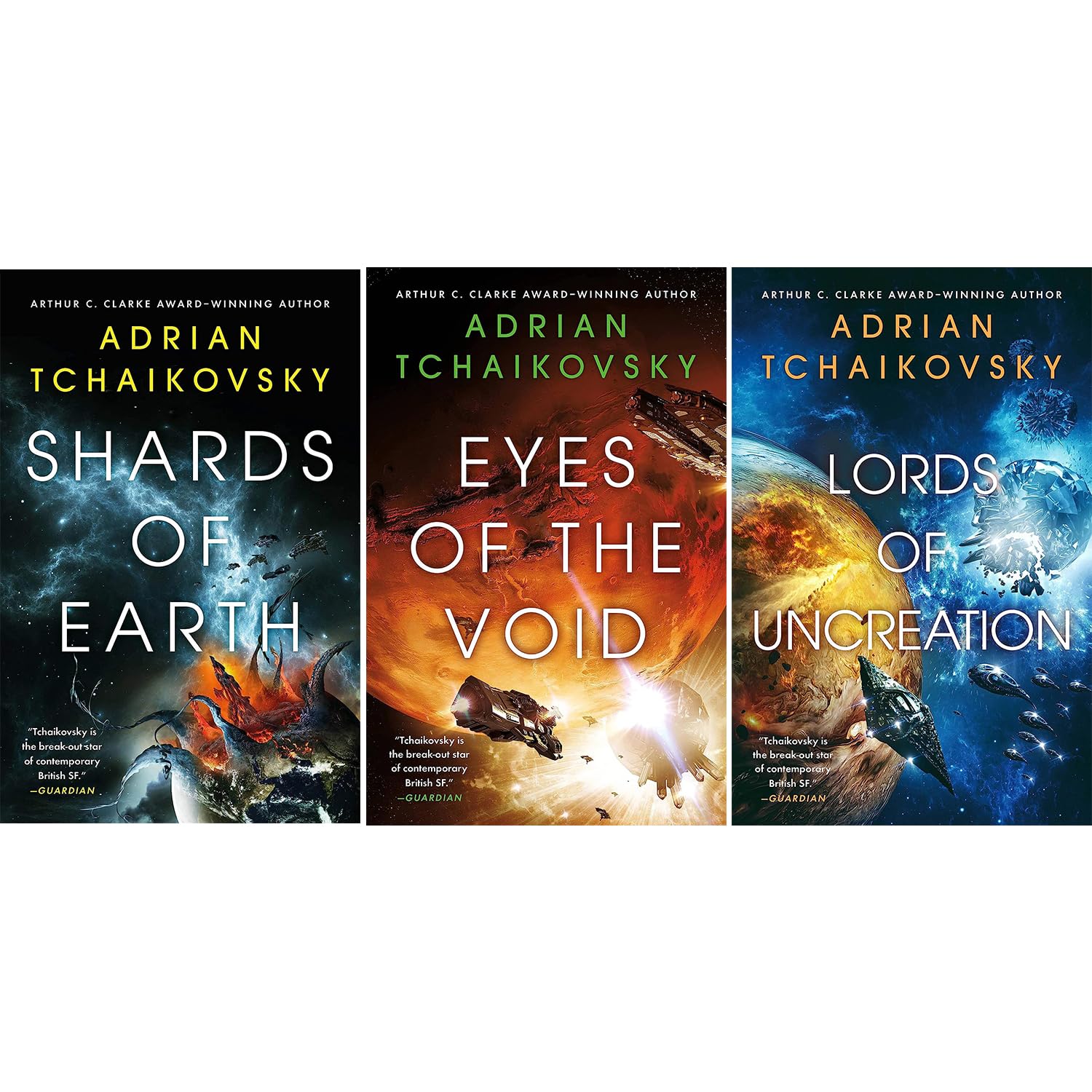
The Final Architecture #1-3
The Final Architecture Trilogy Set by Adrian Tchaikovsky
The Arthur C. Clarke award-winning author of Children of Time brings us an extraordinary space opera about humanity on the brink of extinction, and how one man's discovery will save or destroy us all. This bundle contains complete 3 books of The Final Architecture by Adrian Tchaikovsky.
The war is over. Its heroes forgotten. Until one chance discovery . . .
Idris has neither aged nor slept since they remade him in the war. And one of humanity's heroes now scrapes by on a freelance salvage vessel, to avoid the attention of greater powers.
After earth was destroyed, mankind created a fighting elite to save their species, enhanced humans such as Idris. In the silence of space they could communicate, mind-to-mind, with the enemy. Then their alien aggressors, the Architects, simply disappeared—and Idris and his kind became obsolete.
Now, fifty years later, Idris and his crew have discovered something strange abandoned in space. It's clearly the work of the Architects—but are they returning? And if so, why? Hunted by gangsters, cults and governments, Idris and his crew race across the galaxy hunting for answers. For they now possess something of incalculable value, that many would kill to obtain.
The war is over. Its heroes forgotten. Until one chance discovery . . .
Idris has neither aged nor slept since they remade him in the war. And one of humanity's heroes now scrapes by on a freelance salvage vessel, to avoid the attention of greater powers.
After earth was destroyed, mankind created a fighting elite to save their species, enhanced humans such as Idris. In the silence of space they could communicate, mind-to-mind, with the enemy. Then their alien aggressors, the Architects, simply disappeared—and Idris and his kind became obsolete.
Now, fifty years later, Idris and his crew have discovered something strange abandoned in space. It's clearly the work of the Architects—but are they returning? And if so, why? Hunted by gangsters, cults and governments, Idris and his crew race across the galaxy hunting for answers. For they now possess something of incalculable value, that many would kill to obtain.
1752 pages, Hardcover
First published January 1, 2023
About the author
Adrian Tchaikovsky
197 books20.1k followersADRIAN TCHAIKOVSKY was born in Lincolnshire and studied zoology and psychology at Reading, before practising law in Leeds. He is a keen live role-player and occasional amateur actor and is trained in stage-fighting. His literary influences include Gene Wolfe, Mervyn Peake, China Miéville, Mary Gently, Steven Erikson, Naomi Novak, Scott Lynch and Alan Campbell.
Ratings & Reviews
Friends & Following
Create a free account to discover what your friends think of this book!
Community Reviews
Displaying 1 - 15 of 15 reviews

May 1, 2024
If I were to just list pros and cons, Adrian Tchaikovsky's The Final Architecture would come off terribly. So many key aspects of this book are on the wrong side of the ledger: It has too many characters and too few of them are interesting, it's vastly overlong, and despite its length it has very little to say. Even the book's setting, initially engaging even if reminiscent of other sci-fi works, loses much of its luster when it ultimately fails to hang together or impress. Yet, even with its myriad flaws, I give it a 3/5. This is entirely thanks to Tchaikovsky's writing, which makes The Final Architecture a mildly entertaining piece of space opera action schlock. I can imagine Tchaikovsky reading/watching The Expanse and saying to himself "man, I want to write my own version of that!" and then getting to work, confident that by the time he finished he'd have written something coherent. Did he pull it off? Nope! But it wasn't an unpleasant failure. To be clear I'm never going to recommend this book to anyone, there are far better ways to spend your time, but even in 1,750 pages it never wore out its welcome, and so I can't rate it any worse than middling.
Before analyzing it in detail I want to make clear that this is not a trilogy of books, it’s one book divided into three volumes. No volume functions as a standalone story, it’s only when you finish Volume 3: Lords of Uncreation that everything slots into place (except for the parts that never do). Thus I’ll be referring to this work as The Final Architecture.
To briefly summarize the book sans spoilers, The Final Architecture is set in a future where Earth has been destroyed by the mysterious Architects, resulting in humanity fleeing throughout the galaxy to alien worlds, which the Architects in turn sporadically show up and destroy. Though humanity is at first helpless to defend itself from the Architects, eventually a class of humans called Intermediaries are discovered/engineered that can communicate with the Architects. Once contact is made the Architects cease attacking human world, and this peace has lasted for almost forty years. Idris, one of the Intermediaries that communicated with the Architects, now works on a salvage ship with a crew of fellow misfits, who discover something that may mean that the Architects have returned. Spoiler, though it’s already been spoiled for you if you’ve looked at the covers:
Sure it has hints of Halo, Firefly, The Expanse, Warhammer 40k, and other pieces of sci-fi, so it’s not strikingly original or anything, but overall I found this setup quite strong. It’s an interesting setting and immediately made me curious about a number of things, for instance the nature of the Architects, why they have returned (if they have), the “presence” that Idris feels in unspace, slightly later on , etc. Unfortunately, there are ultimately very few satisfying answers.
In fact, in retrospect, both end up being MacGuffins, as neither hold the import the characters think they do. Other key questions likewise have no answer, for instance Even the final reveal falls flat, the grand design being a sci-fi cliché on a greater scale ().
The Final Architecture’s lack of satisfying answers is made especially frustrating by the book’s insistence that it’s delivering world-shattering revelations when in fact it’s dumping some basic setting exposition. Tchaikovsky, and through him main character Idris, is seemingly addicted to revelations, dropping half a dozen of them throughout the book that largely lack impact. For example, it’s not even a spoiler that there’s some hungry entity in unspace, Idris believes it from the very beginning of the book, but it’s still treated like a surprise when it’s confirmed later on (and never really explained thereafter ). Outside of his unsatisfying revelations Idris is also an exasperating character because he’s a sad-sack far too often in the book, which, though his state of mind makes sense, doesn’t make him an endearing character. Let’s call it the Shinji Ikari problem. Also, and this is not an exaggeration, for about 700 pages straight in The Final Architecture main character Idris does the exact same thing, It’s remarkably little character development for that amount of time.
Other characters don’t fare much better. By book’s end Olli is probably the second most prominent character. She’s the aggressive take-no-bullshit type of character that can work in theory, but in this story she comes off as an asshole that is constantly complaining. At least where the character ends up is mildly interesting, but overall she’s more annoying than anything else, which I’m sure is not what Tchaikovsky intended. In general there are few standouts in the cast of characters, a cast that’s a mile wide and an inch deep. Havaer the intelligence agent initially plays catch-up too much, and never has much depth. The Uskaro family are one-dimensional villains that the protagonists inexplicably let live over and over until it’s deeply frustrating. Ash the Harbinger is a walking deus ex machina, serving to inorganically push the narrative in whatever way Tchaikovsky wants. I could go on. There are ultimately just too many of these thin characters (especially considering that a whole new group of them is introduced halfway through), so by book’s end you’ll barely remember Medvig or Barney, much less Livvo Thrennikos or Yon Robellin.
In addition to the characters being underwhelming, there’s ultimately very little to take away from The Final Architecture. A book this long should have something to say, right? But there’s remarkably little of substance here, borne in part from the fact that the factions in the setting all act so stupidly it’s impossible to take seriously. All of them are at each other’s throats even with humanity getting systematically genocided, shooting themselves in the foot over and over again instead of helping—and not in believable ways either. The intelligence officer has a monologue at the end of the book where he pleads for the assembled leaders of humanity to do the right thing, for once, which encapsulates why The Final Architecture is incapable of commenting on the real world. Here in reality, even if there are hordes of ignorant and stupid people that disagree, the truth is that most people in positions of power do in fact try to do the right thing most of the time. By creating a universe where this is not the case, Tchaikovsky cedes the ability to say anything insightful. Instead all we get are banalities, like “wow, a military dictatorship is actually a pretty scary form of government in the wrong hands.” Interesting ideas, like how a eugenics-based culture deals with “natural” humanity, are briefly touched upon but not explored.
This review is already going on too long so I’ll just say by way of wrap up that The Final Architecture’s flaws are myriad. The flat characters make their way through a coincidence-driven plot where the reveals are underwhelming and the story ultimately has very little to say. While the book is a fast read considering its length, that ultimately means that it’s a 1,750 page book that only feels like a 1,200 page book. It should have been a 900 page book that felt like a 600 page book.
With all of these problems, and especially considering its unnecessary length (a flaw that is usually a book’s death knell in my eyes), why do I not hate The Final Architecture? Up to this point this has essentially been a 1/5 review, after all. But Tchaikovsky’s writing is such that, while you’re reading The Final Architecture, you’re kept from focusing on its failings. Sure there are a lot of coincidences, but things move so fast that none of them break your suspension of disbelief. Oh, you found that fourth supposedly-mind-breaking revelation underwhelming? No time to dwell on that now, here’s an action scene! Wait, the success of the Hegemony doesn’t make any sense, and also why has no one invented a helmet or something that automatically knocks out non-intermediaries when they enter unspace? Who cares, the Architects are coming, we need to jump NOW! It’s a big, dumb piece of space opera pulp, and I’d be lying if I said it didn’t keep me entertained. Books can be so much more than entertainment, of course, but at its core that’s what fiction is to me. Because it kept me mildly amused for a whopping 1,750 pages it’s a success.
Idris diving into unspace deserves its own paragraph. In theory, it shouldn’t work. By the end of The Final Architecture Idris has dived into unspace at least thirty times, and I’d put the over-under at forty. Each time, it’s essentially the same, Idris senses a hungry, fear-inducing presence, and it ultimately doesn’t catch him. It’s a testament to Tchaikovsky that somehow these dives never get repetitive or boring. In the hands of a lesser writer they would have had me pulling my hair out by page 500, much less page 1,600, but in The Final Architecture it was just one more curve of the ride.
Given the length of this book it probably won’t surprise you that I could say a lot more, this review encompassed only about half of the notes I made while reading The Final Architecture, but if you’ve read this far into the review then I’ve already taken up enough of your time. And the question of how to best use your time is ultimately why I can’t recommend The Final Architecture despite giving it a decent score (by my standards). I don’t know who you are reading this review, but you have better things to do than getting sucked into a 1,750 page pulp sci-fi novel. Is it nice out? Go for a walk. Is it not nice out? Call someone you haven’t spoken to in a while. Are you somehow reading this while stuck on a desert island with no hope of rescue and only The Final Architecture to read? Well then give it a shot, you may be surprised by how much you like it. 3/5.
Before analyzing it in detail I want to make clear that this is not a trilogy of books, it’s one book divided into three volumes. No volume functions as a standalone story, it’s only when you finish Volume 3: Lords of Uncreation that everything slots into place (except for the parts that never do). Thus I’ll be referring to this work as The Final Architecture.
To briefly summarize the book sans spoilers, The Final Architecture is set in a future where Earth has been destroyed by the mysterious Architects, resulting in humanity fleeing throughout the galaxy to alien worlds, which the Architects in turn sporadically show up and destroy. Though humanity is at first helpless to defend itself from the Architects, eventually a class of humans called Intermediaries are discovered/engineered that can communicate with the Architects. Once contact is made the Architects cease attacking human world, and this peace has lasted for almost forty years. Idris, one of the Intermediaries that communicated with the Architects, now works on a salvage ship with a crew of fellow misfits, who discover something that may mean that the Architects have returned. Spoiler, though it’s already been spoiled for you if you’ve looked at the covers:
Sure it has hints of Halo, Firefly, The Expanse, Warhammer 40k, and other pieces of sci-fi, so it’s not strikingly original or anything, but overall I found this setup quite strong. It’s an interesting setting and immediately made me curious about a number of things, for instance the nature of the Architects, why they have returned (if they have), the “presence” that Idris feels in unspace, slightly later on , etc. Unfortunately, there are ultimately very few satisfying answers.
In fact, in retrospect, both end up being MacGuffins, as neither hold the import the characters think they do. Other key questions likewise have no answer, for instance Even the final reveal falls flat, the grand design being a sci-fi cliché on a greater scale ().
The Final Architecture’s lack of satisfying answers is made especially frustrating by the book’s insistence that it’s delivering world-shattering revelations when in fact it’s dumping some basic setting exposition. Tchaikovsky, and through him main character Idris, is seemingly addicted to revelations, dropping half a dozen of them throughout the book that largely lack impact. For example, it’s not even a spoiler that there’s some hungry entity in unspace, Idris believes it from the very beginning of the book, but it’s still treated like a surprise when it’s confirmed later on (and never really explained thereafter ). Outside of his unsatisfying revelations Idris is also an exasperating character because he’s a sad-sack far too often in the book, which, though his state of mind makes sense, doesn’t make him an endearing character. Let’s call it the Shinji Ikari problem. Also, and this is not an exaggeration, for about 700 pages straight in The Final Architecture main character Idris does the exact same thing, It’s remarkably little character development for that amount of time.
Other characters don’t fare much better. By book’s end Olli is probably the second most prominent character. She’s the aggressive take-no-bullshit type of character that can work in theory, but in this story she comes off as an asshole that is constantly complaining. At least where the character ends up is mildly interesting, but overall she’s more annoying than anything else, which I’m sure is not what Tchaikovsky intended. In general there are few standouts in the cast of characters, a cast that’s a mile wide and an inch deep. Havaer the intelligence agent initially plays catch-up too much, and never has much depth. The Uskaro family are one-dimensional villains that the protagonists inexplicably let live over and over until it’s deeply frustrating. Ash the Harbinger is a walking deus ex machina, serving to inorganically push the narrative in whatever way Tchaikovsky wants. I could go on. There are ultimately just too many of these thin characters (especially considering that a whole new group of them is introduced halfway through), so by book’s end you’ll barely remember Medvig or Barney, much less Livvo Thrennikos or Yon Robellin.
In addition to the characters being underwhelming, there’s ultimately very little to take away from The Final Architecture. A book this long should have something to say, right? But there’s remarkably little of substance here, borne in part from the fact that the factions in the setting all act so stupidly it’s impossible to take seriously. All of them are at each other’s throats even with humanity getting systematically genocided, shooting themselves in the foot over and over again instead of helping—and not in believable ways either. The intelligence officer has a monologue at the end of the book where he pleads for the assembled leaders of humanity to do the right thing, for once, which encapsulates why The Final Architecture is incapable of commenting on the real world. Here in reality, even if there are hordes of ignorant and stupid people that disagree, the truth is that most people in positions of power do in fact try to do the right thing most of the time. By creating a universe where this is not the case, Tchaikovsky cedes the ability to say anything insightful. Instead all we get are banalities, like “wow, a military dictatorship is actually a pretty scary form of government in the wrong hands.” Interesting ideas, like how a eugenics-based culture deals with “natural” humanity, are briefly touched upon but not explored.
This review is already going on too long so I’ll just say by way of wrap up that The Final Architecture’s flaws are myriad. The flat characters make their way through a coincidence-driven plot where the reveals are underwhelming and the story ultimately has very little to say. While the book is a fast read considering its length, that ultimately means that it’s a 1,750 page book that only feels like a 1,200 page book. It should have been a 900 page book that felt like a 600 page book.
With all of these problems, and especially considering its unnecessary length (a flaw that is usually a book’s death knell in my eyes), why do I not hate The Final Architecture? Up to this point this has essentially been a 1/5 review, after all. But Tchaikovsky’s writing is such that, while you’re reading The Final Architecture, you’re kept from focusing on its failings. Sure there are a lot of coincidences, but things move so fast that none of them break your suspension of disbelief. Oh, you found that fourth supposedly-mind-breaking revelation underwhelming? No time to dwell on that now, here’s an action scene! Wait, the success of the Hegemony doesn’t make any sense, and also why has no one invented a helmet or something that automatically knocks out non-intermediaries when they enter unspace? Who cares, the Architects are coming, we need to jump NOW! It’s a big, dumb piece of space opera pulp, and I’d be lying if I said it didn’t keep me entertained. Books can be so much more than entertainment, of course, but at its core that’s what fiction is to me. Because it kept me mildly amused for a whopping 1,750 pages it’s a success.
Idris diving into unspace deserves its own paragraph. In theory, it shouldn’t work. By the end of The Final Architecture Idris has dived into unspace at least thirty times, and I’d put the over-under at forty. Each time, it’s essentially the same, Idris senses a hungry, fear-inducing presence, and it ultimately doesn’t catch him. It’s a testament to Tchaikovsky that somehow these dives never get repetitive or boring. In the hands of a lesser writer they would have had me pulling my hair out by page 500, much less page 1,600, but in The Final Architecture it was just one more curve of the ride.
Given the length of this book it probably won’t surprise you that I could say a lot more, this review encompassed only about half of the notes I made while reading The Final Architecture, but if you’ve read this far into the review then I’ve already taken up enough of your time. And the question of how to best use your time is ultimately why I can’t recommend The Final Architecture despite giving it a decent score (by my standards). I don’t know who you are reading this review, but you have better things to do than getting sucked into a 1,750 page pulp sci-fi novel. Is it nice out? Go for a walk. Is it not nice out? Call someone you haven’t spoken to in a while. Are you somehow reading this while stuck on a desert island with no hope of rescue and only The Final Architecture to read? Well then give it a shot, you may be surprised by how much you like it. 3/5.
April 12, 2024
It’s a good series, except Adrian needs to restraint from writing the same thing in different way repeatedly. By the same token, some of the chapters in each book were unnecessary drag.
June 22, 2026
The Final Architecture operates at a scale that would easily lend itself to excess, yet its strength lies in the control it maintains over its central ideas.
What remains most striking is the treatment of post-war obsolescence, particularly through Idris and others like him who were engineered for a purpose that no longer exists. The narrative does not discard that premise, but instead builds upon it, allowing its implications to shape both character and conflict.
The interplay between cosmic threat, human modification, and the persistence of past decisions gives the work a sustained thematic weight. It is not simply a story of survival, but of adaptation in the aftermath of forces that have already reshaped reality.
This is a work that understands the scale of its ambition and maintains coherence within it, allowing its ideas to unfold without losing structural discipline.
What remains most striking is the treatment of post-war obsolescence, particularly through Idris and others like him who were engineered for a purpose that no longer exists. The narrative does not discard that premise, but instead builds upon it, allowing its implications to shape both character and conflict.
The interplay between cosmic threat, human modification, and the persistence of past decisions gives the work a sustained thematic weight. It is not simply a story of survival, but of adaptation in the aftermath of forces that have already reshaped reality.
This is a work that understands the scale of its ambition and maintains coherence within it, allowing its ideas to unfold without losing structural discipline.

January 17, 2024
Loved this series. Adrian Tchaikovsky is a one-of-a-kind author. Able to create not only whole new worlds but new beings, races, intelligence, cultures, you name it. I've got to admit that while I enjoyed all the characters, Oli's was by far the best. I would read a whole series just on her. This portrayal of a person with disabilities as not only capable but powerful and special was a joy to read. My youngest is in a wheelchair and it was thrilling to imagine a future where he could have such abilities.
January 28, 2026
9/10
It is rare to see a book balance both the moment to moment and the overarching experiences with such ease, making characters that feel human and individual and yet enabling a grand tale through them without leaving their grasp.
The characters are deep but without pretension, not shells concocted by an author to pry your interest but people, people that feel like people, with their goods and bads not becoming heroes or saints but making do and trying their best.
Few authors are as good as Adrian Tchaikovsky and this if anything is just more blatant proof of that fact
It is rare to see a book balance both the moment to moment and the overarching experiences with such ease, making characters that feel human and individual and yet enabling a grand tale through them without leaving their grasp.
The characters are deep but without pretension, not shells concocted by an author to pry your interest but people, people that feel like people, with their goods and bads not becoming heroes or saints but making do and trying their best.
Few authors are as good as Adrian Tchaikovsky and this if anything is just more blatant proof of that fact
February 10, 2026
Too much like hard work, longwinded, humans never stop for basic human functions (such as eating..) every character basically unlikeable and with little character development to the point I didn't care if anyone survived a situation, and a wide range of equally unlikeable aliens. Characters were suddenly safe elsewhere without explanation of how they got out of wherever they were, and I thought my Kindle must have jumped a chapter or two at the very end and how the Lords were actually dealt with seemed to be missing... It's a trilogy so there's no sequel thankfully.

August 9, 2025
I'm a big fan of Tchaikovsky, but this trilogy was not my favorite. I enjoyed the colorful and amusing characters and surprising plot twists.
I stuck with it mostly due to sunk cost in time. I found it difficult to keep track of the catalog of characters and places. While the central plot was intriguing it took a lifetime (or several of them with speed of light travel) to resolve. Some consider this series his best work-- I do not.
I stuck with it mostly due to sunk cost in time. I found it difficult to keep track of the catalog of characters and places. While the central plot was intriguing it took a lifetime (or several of them with speed of light travel) to resolve. Some consider this series his best work-- I do not.

August 1, 2023
Superb ending to the series!

August 1, 2023
Loved it overall. A few bits that were weaker than others and the plot meandered a bit, but great world building and I was sad when I finished it.
October 19, 2023
Pretty awesome. Great ideas and imagination and I love Oli's character!
May 30, 2024
Def a solid 3. Not his best work, but not bad.
I think the whole trilogy could have been a single volume/book. Alas.
I don’t recommend it but I also won’t tell you not to read it.
I think the whole trilogy could have been a single volume/book. Alas.
I don’t recommend it but I also won’t tell you not to read it.
June 12, 2024
Great material for a drinking game. Take a shot every time the narrator says "with extreme prejudice" or "save for the..."

December 21, 2024
I have no way of putting into words any sort of explanation of what I just finished reading. But it was good!
like-author-but-do-not-want-to-read
December 28, 2024Already read books individually.
October 26, 2025
I really enjoyed the characters and the politics of the world building. The factions battling each other, plotting and scheming. really I was in it for the world building. I loved the idea of real space being a thin film on unspace below and the idea of an ecosystem whence the architects come is very thoughtful. I wasn't as pleased at the conclusion, the ancient beings at the center, but it had to end somehow, so it could have been worse. very interesting metaphysics and I thought the passages taking about Idris navigating unspace where fascinating. Great speculative world building!
This entire review has been hidden because of spoilers.
Displaying 1 - 15 of 15 reviews