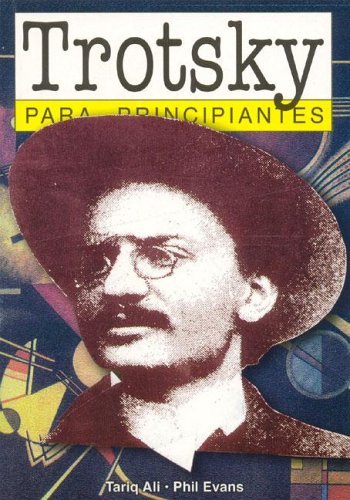
AN EASY-TO-APPROACH TO THE SOCIALIST PIONEER
This 1980 book begins with the statement, “Trotsky was the revolutionary closest to Lenin. Lenin called him ‘the ablest man in the Party…’ But it was Stalin, not Trotsky, who rose to power after Lenin’s death. Stalin tried everything to make Trotsky disappear from ‘official’ Soviet history. Censorship removed Trotsky from all pictures which showed him as a leader of the Russian Revolution next in importance to Lenin. For Stalin and his orthodox Communist followers, Trotsky became the devil incarnate. Every disaster at home, every set-back abroad could be explained away by blaming the ‘Trotskyite fascist-wreckers.’ In Moscow and Peking today the Trotskyite ‘criminal heresy’ is still regarded as the worst sin of all.” (Pg. 5-7)
It continues, “Trotsky’s real name was ‘Lev Davydovich Bronstein.’ He was born 26 October … 1879 in … a village in the southern Russian province of Kherson. His father was a reasonably well-off Jewish farmer. Only on the southern steppe were Jewish farmers treated somewhat equally. Otherwise they could not live outside the cities.” (Pg. 8)
Trotsky begins clandestine activity and organizes the South Russian Workers Union in 1897. The Tsarist police quickly hit back in 1898. Trotsky was arrested and placed in solitary confinement… In a two-year spell in prison Trotsky read Voltaire, Kant and especially Darwin… Trotsky is sentenced to four years deportation in Siberia. In prison he marries … Alexandra Sokolovskaya, who will accompany him to Siberia… In the arctic wastelands, `1902, Trotsky receives Lenin’s book, ‘What is to Be Done?’ and some copies of the revolutionary newspaper Iskra.” (Pg. 16-19) “In 1902 he says farewell to Alexandra and their two daughters born in Siberia---and escapes.” (Pg. 20)
“Trotsky’s talents are obvious. Lenin proposes he joins the Iskra editorial board. But one of the veterans on the Iskra board… blocks Trotsky’s nomination.” (Pg. 23) Lenin sends Trotsky on a lecture tour of the Russian colonies in Europe to raise money for Iskra. Trotsky’s enthusiastic guide around Paris is a Russian student, Natalia Ivanovna Sedova. Though Trotsky was legally married… Natalia became ‘Mrs. Trotsky,’ bore him two sons, and remained with him till his death.” (Pg. 24)
“In his battle against Lenin, Trotsky often resorted to vulgar personal abuse… Trotsky remained opposed to Lenin’s conception of the party for a whole decade. In ‘Our Political Tasks’ he savagely attacked many of Lenin’s formulas… Trotsky was closer to the Menshevik view of the party. But his grasp of revolutionary tactics let him further from them than even Lenin and the Bolsheviks. During every revolutionary upsurge Trotsky was closer to Lenin than many of the Bolshevik committee men.” (Pg. 29)
“Now Trotsky played a new card… Why do backward societies have to follow the same path as advanced ones? Trotsky’s ideas marked a radical break with the views of Western European socialists. He stood the accepted Marxist dogma on its head. Of course, Trotsky wasn’t the first to use the words ‘permanent revolution.” (Pg. 43)
“Trotsky escapes from Siberia, once again, in February 1907. In Vienna, 1908, he starts his own newspaper, Pravda, struggles for the unity of the party.” (Pg. 49) “Trotsky summed up this period: ‘In maintaining the standpoint of the permanent revolution during a period of fifteen years, the author nevertheless fell into effort in his estimation of the contending factions of the social-democratic movement… the author did not fully appreciate the very important circumstance that in reality… there were being grouped inflexible revolutionaries on the one side and, on the other, elements which were becoming more and more opportunist and accommodating…” (Pg. 50)
“The war drove many of these Russian intellectuals toward Bolshevism. Even Trotsky, self-confident, aware of his own talents, is forced to acknowledge that things are moving Lenin’s way in Russia. Strikes, mutiny and defeatism at the front, food shortages, peasant unrest…” (Pg. 58) “Trotsky was expelled from France as a ‘suspect alien’ and eventually came to the United States. He was in New York 10 weeks when the Russian Revolution broke out. Lenin, Trotsky and other exiles rush back as best they can!” (Pg. 59)
“Trotsky, named Commissar of Foreign Affairs, and emissaries of Soviet Russia arrive at Brest-Litovsk to negotiate peace at the end of November 1917. They confront the Generals, Princes and politicians of the German and Austro-Hungarian empires.” (Pg. 82) “Trotsky goes over to Lenin, and with the majority, acceptance of peace goes ahead.” (Pg. 85)
“Trotsky was given the responsibility of organizing the Red Army… Because his ability had already been proven by the military success of the October uprising… Trotsky moulds the Red Army into a fighting force without equal. In the years of Civil War and foreign intervention … he is the supreme strategist of the Revolution.” (Pg. 90, 92)
Lenin had written a ‘Last Testament’ which made one important demand: Stalin should be removed as General Secretary. The Politburo decided to keep quiet about the Testament. Despite bitter protests from Lenin’s widow, the Party Congress was not told. Trotsky accepted Party discipline once the decision was taken to suppress Lenin’s instructions. Trotsky did worse. He allowed himself to be talked into a compromise … He did not speak up on the Georgian question. He did not attack Stalin. His silence would prove costly.? (Pg. 111-112)
“Trotsky… understood that a real decline in class-consciousness had taken place. Revolution was defeated in Europe. In Russia, it degenerated. A new social layer arose and strengthened its grip on society as a whole.” (Pg 114) “Beginning in 1923 the Opposition found its leader in Trotsky. The bureaucratic system found its incarnation in Stalin. Beginning in 1923 an agitational campaign was launched against Trotsky… Trotsky was slandered as a criminal anti-Leninist.” (Pg. 116) “Should he have attempted a military coup? It went against Trotsky’s beliefs simply to replace bureaucratic rule by army rule.” (Pg. 117)
In 1925, “the Central Committee removes Trotsky from the Military Revolutionary Council and forbids him to engage in any new debates, But the Stalinists take the anti-Trotsky campaign to the country as a whole.” (Pg. 119) “Trotsky is handed an order authorizing his deportation in 1929.” (Pg. 134) “Trotsky will never see Russia again. He is bound for the Turkish island of Prinkipo… Trotsky’s application for asylum is refused by the German SDP government… Every European and North American state refuses him asylum… the planet is without a visa for Trotsky.” (Pg. 135-137) “In 1936, Trotsky wrote his last major work, ‘The Revolution Betrayed.’ In it he presents a complete, detailed criticism of Stalinism.” (Pg. 147) “Exiled, Trotsky went from Tukey to France, Norway, and to Mexico where he spent the last three years of his life.” ):g 162)
“Trotsky’s legacy is the unfinished struggle” for proletarian democracy, for genuine socialism and the overcoming of bureaucracy, for social revolution in the ‘Third World’ for internationalism.” (Pg. 165)
This book is a useful introduction to Trotsky’s life and ideas.