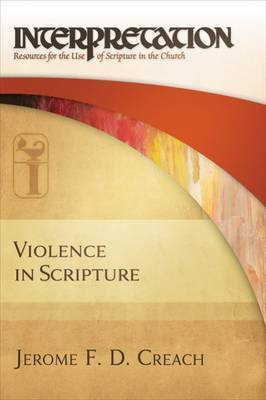
There is so much in this book that offers a fresh perspective and new approach to difficult passages; it is not the standard rehash of evangelical special pleading. This is a work from someone who takes scripture seriously but doesn't think this means taking it all literally/historically, and also someone who allows morality to have some play in his interpretations, rather than declaring that good and justice are whatever God does or commands, so if the bible says God tortures babies for fun and tells parents to rape their children, then this would be good and just, and we have no right to question and quibble.
Much could be said, below are some random reflections sparked by Jerome Creach’s fascinating argument that the Canaanites and Amalakites are intended to be understood as literary characters by Hebrew storytellers. These characters likely symbolized sin, evil, and idolatry, and not flesh and blood people.
It is obviously true that when one biblical text is read in light of other verses, the genocide stories cannot be taken as history. Certain enemies of the Israelites are like Wile E. Cayote: no matter how times he blows up and falls from the sky ( to what would be his death in reality), still in the cartoon, he is after the road runner again in the next scene. Consider how in one story in Joshua, Joshua's army goes and fights against King Jabin and the Hazorites. God commands Joshua to hamstring their horses and burn their chariots. The text says quite clearly that they killed the king, and every man, every woman, and every child, and left no one alive that breathed and destroyed all the horses and chariots. Then we open up Judges and find out, not long after, that King Jabin of Canaan, with his 900 iron chariots had oppressed Israel for 20 years, and God raises up Deborah and Barak to deliver Israel. Haha… it is pretty impressive for a people group that was completely annihilated to obtain 900 iron chariots and oppress all of Israel for 20 years! Were they an army of skeletons and ghosts?!
Then we later have those pesky Amalekites; God is like go slaughter every baby because 400 years ago, their ancestors attacked Israel. So Saul mostly obeys, and kills every single Amalekite, young and old, but does not kill the king. For this sin (lack of thoroughness in genocide, which was like the sin of witchcraft) Saul loses his kingdom. Samuel hacks Agag to pieces before the Lord, the last Amalekite alive, according to the text. But then a few chapters later, David is warring with the Amalekites and they are ever popping up again, even in Esther!
I remember being irritated by how the recent Star War movie, where Han Solo is killed by his son, has the evil empire reigning again, without any explanation of how the hell after the destruction of the death star, Darth Vadar and the empire in the previous movie, they could regroup and rule over the galaxy in a few years. Yet I see that the movie makers needed a big bad guy to make the movie work, so logic and plausibility (within that fantasy world) were completely thrown to the wind. And clearly, it was something similar for biblical authors, who want to tell a good story, and had to keep resurrecting the bad guys who were vanquished in the previous stories. They felt no need to try to logically explain or make it plausible.
I don’t like that they used actual people groups as their literary bad guys. Once people could watch fictional TV shows of Cowboys and Indians, and cheer as the Indians have shot down episode after episode. Hmm… and yet even then, the movie makers would likely have lost the sympathy of their audience if they showed a pastor claiming to have the word of the Lord, commanding the cowboys to slaughter every Indian woman and child and show no pity. Even if fiction, and even though people turned the Indians into 2D bad guys, if they watched them hacking to pieces toddlers and shooting women in the head, that might have gone a bit far. We clearly live in a very different world, for we see within their storytelling, that they so dehumanized their bad guys, that killing women and children was like trying to exterminate fleas or rodents. Even in fiction, we have our limits today, they didn’t.
I suppose that is a significant problem I have with Hebrew storytelling. They fictionalized history—including in their made-up stories, real people and people groups. It would have been so much better if they instead used a mythological genre with heroes fighting against monsters, or a fantasy realm with orcs and goblins.
Hmm… I suppose in Star Wars, few felt any sorrow as the Death Star explodes, yet here there still is something about it being sci-fi. If we retold WWII where we sent 20 nukes to destroy the major cities of Nazi Germany, I don’t think we could cheer as we did with the destruction of the death star. We would know the retelling of WWII was definitely fiction, but ugg… even with how we see Nazis as evil, we wouldn’t like a plot that has FDR rejected by God because there was one city in Germany he didn’t nuke. We wouldn't like him to be condemned because he left some German women and children alive. We likely wouldn’t be comfortable if in the next show Truman completes (in obedience to God) the genocide of Germans—sending in several more atomic bombs until it was utter ruins. What would we think if in the following movie, we have the Nazis alive and at it again and Biden contemplating using the a-bomb? What if such a movie series was an allegory and the Nazis in the retelling represented Racism? Well, yes in such an allegory, it would be bad to show mercy, and as this is an issue that keeps raising its ugly head, it will need to be faced by every generation. And this is kind of how the Amalekites and Canaanites function in Hebraic literature. If Amalekites symbolize evil and Canaanites idolatry and these issues pop up, then every generation will be fighting against the Amalekites and Idolatry, and some will be successful and others less so. Yet the problem, again, even in Allegory, they should NOT have used flesh and blood people groups to symbolize the evil that needed to be exterminated. The same principles can be expressed in stories of destroying monsters or demons.
I don’t know how coherent these reflections are. These are merely musings on how we have literary bad guys, and how the Jews like to tell stories where their heroes succeed or fail at killing their enemies. Even if they kill them all, the bad guys are oppressing them in the next round of stories. It's not history, thank goodness, God never commanded the atrocities, but even as fiction, as my modern examples are meant to illustrate, I find it all quite problematic.