This Book-of-the-Month Club Main Selection is a panoramic view of three generations of Irish people and passion. The lives of three extraordinary men are bound together by the tides of history in this sweeping tale that includes remarkable historical figures such as Oscar Wilde and Disraeli.
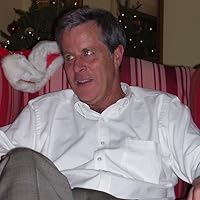
Thomas Flanagan (November 5, 1923 – March 21, 2002) was an American professor of English literature who specialized in Irish literature. He was also a successful novelist. Flanagan, who was born in Greenwich, Connecticut, graduated from Amherst College in 1945. He was a tenured full - Professor in the English Department at the University of California, Berkeley until his retirement. Flanagan died in 2002, at the age of 78, in Berkeley.
He won the National Book Critics Circle Award in 1979. The Archives and Special Collections at Amherst College holds his papers.
This is one of those rare books where I feel I let it down rather than it let me down. A recounting of the events surrounding the Fenian rising of 1867, focusing on the small village of Kilpedar which achieved a certain amount of notoriety when a police barracks was burned down and a minor skirmish in snowy woods were later transformed into an heroic battle, the book sets out to slowly introduce the characters, the place, the time, the context, the history, the landscape, the society, the organisations, the landscape, the peoples, more landscape, humanising and demythologising with a lovely, slow ponderous grace, describing and redescribing and contextualising and recontextualising and presenting different points of view and oh my God two hundred pages in and it feels like it still hasn't properly started, hopping backwards and forwards and sideways in time like a scholarly and obsessive Doctor Who. Never a sentence but a thing of beauty, never a character but complex and living, never a bit o' landscape but evoking memories and thoughts and ponderings.
Where Year Of The French shook with barely repressed rage, and the top-to-bottom portrait of a dysfunctional, unjust, self-cannibalising world that spared no-one seared the reader and welded the book to your hands, Tenants Of Time meanders sadly in a fit of melancholy, an elegaic and almost wistful meditation on futility of actions and of history and the transformations wrought by time. The rising merely sets the stage, you see, for two hundred flippin' pages, before the rise of Parnell and the Land League and the passing of the Great Houses and the decline of the Anglo Irish aristocracy in flAmes and bitterness and the odd murder here and there.
But what a slow, weary read it is, without an ounce of the urgency and energy of YOTF. Brilliantly written, no question, but I think the pace and the size clashed with my mood and it became a slog, which seems a pity.
I read this second book in the trilogy first; all three are magnificent. Growing up in a NYC Irish Catholic neighborhood I figured all Irishment were beery semi-literate drunks; it took these book to convince me that being Irish was something to be proud of and not ashamed of, not because the Irish are superior (although they're writing is) but because they never give up.
After I have read Trinity by Leon Uris, which was recommended to my by an Irish author - Jean Harrington, I could never have imagined I would read a better book about Ireland’s story.
In the first book of this series, the large amount of narrators, eight in the total, did bother me. Since I was trying to following the story of each individual narrator, sometimes I was lost into the middle of narrative.
In this second book, I got more used with the writer’s style of writing. His main virtue is to intertwine fiction with history in a brilliant way.
The plot is about the story of four men - Ned Nolan, Hugh MacMahon, Robert Delaney and Vincent Tully. who participate in the Irish Rising of 1887 and how their lives were affected by the battle of Clonbony Wood. These four friends since their boyhood, they joined the Fenian brotherhood in 1865. After that, their lives take their own destiny.
Quotations: Page 99: "So far as County Cork is concerned, the Fenian rising go 1867 began with what is known to this day as "Nolan's Raid," which took place on the night of February 20."
Page 174: "The people of these valleys , and of the valleys and hills across Ireland, died in their cabins or begging to be admitted to the workhouses, and their unconfined bodies were tipped into the famine graves. Many more took leave of their homes, and at Queenstown boarded the coffin ships for New York, where the streets are paved not with gold but with work and loneliness."
Page 224: "The Rising marked us all, all of us who had been out on that March morning, all of us save, no doubt, myself, a sedentary man who was glad enough to leave behind him his prison sentence, and the gunfire, the blazing barracks, and the men we left dead or writhing in their agony in the streets of Kilpeder...."
Page 443: "Ribbon Fenians. The success of the Land League came in good measure from the enterprise of the "Ribbon Fenians", as they were called... It was held by Fenians pur sang that land agitation was a base and vulgar distraction from the cause of an armed rebellion intended to establish a free and fully in dependent republican state."
I am looking forward to finish this magnificent trilogy.
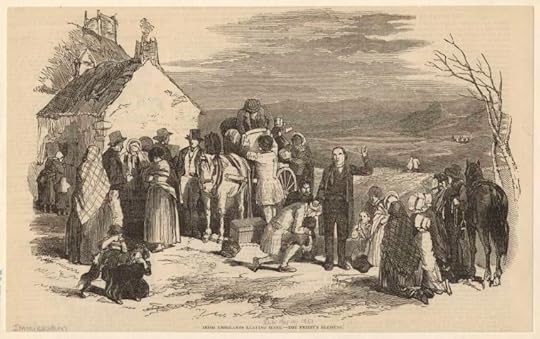
"Irish Emigrants Leaving Home - The Priest's Blessing" courtesy of New York Public Library Digital Collections.
Ponderously written, long, slow, excessively detailed. The first two hundred pages were great, culminating in the battle and the trial. The next six hundred pages felt meandering and aimless. The book was far too long, and very slow to read. Still enjoyable.
For fans of Irish history (who are willing to tackle an 800+ page book), this is a very interesting work of historical fiction, blending fictional and real characters and events. It tells the story of the spectacularly unsuccessful Fenian uprising of 1867 in a small village in Ireland, and its consequences through the balance of that century. It focuses upon three close friends involved in the uprising and how it affected the course of their lives, as pieced together by a young historian later trying to make sense of what happened. (As an aside, I hadn’t known that the word “boycott” came from the actions of the Irish Land League in the latter half of the 1800s when English land agent Captain Boycott refused to lower the rents of his Irish tenant farmers.) This is actually the second book in a trilogy of historical fiction about Ireland, and I’m planning to read the other two now as well. —Joan E. Neal
Even better than the first of the trilogy, more like a novel than the first but still not an easy read. You need to pay attention in order to keep track of all that is going on. I admire the way the author is able to move between conversations and periods of time, sometimes in the same paragraph and it is somewhat a reward to realize you are keeping up with those subtleties. Woe to you if you are not able to keep up; you would likely be lost and end up not liking the book
This may very well be my favorite novel about Ireland, and is definitely one of my favorite books of all time. Might even be one of my desert island 10
If you want to be immersed in the history of Ireland this is the book for you. It is historical fiction, and I can't fully speak to its accuracy, but of the things I looked up it was accurate. More than that it is beautifully descriptive and takes you on a journey of the Fenian Rising and the Land Wars that followed through the eyes of the men that lived it and the historian that wants to write about it. There were points that were a little over my head and it did get confusing with the multiple viewpoints especially when it was from the main viewpoint of the historian who would reflect back and then the person he was talking to would also reflect back. It also went back and forth between first and third person viewpoints, this work sometimes and sometimes it didn't. I definitely had to push myself in reading this book as it is very dense and you need to be present while reading it. That said it stuck with me from the beginning and isn't a book that I will be forgetting anytime soon. I haven't read the others in this trilogy but would say this is one you can read as a stand alone. If you want to know more I will be doing an in-depth review over on my website tibbarasden.com. I also have a YouTube channel under the same name where I will be discussing this book.
Very long but ultimately excellent historical fiction set along the border of counties Cork and Kerry in Ireland during the period between the famine years of the 1840s and the uprising of April 1916, with most of the action set between 1867 and 1892. The principal actors are a quadrumvirate of men who participated together in an ill-fated attempt at an insurrection against British rule and who are subsequently jailed, though not disabused of their rebellious ways. The novel is a little slow starting out but after about the first quarter the pace and the intrigue picks up and carries the reader along at a very brisk pace. The intricacies and tragic/comic nature of Irish political history is nicely illustrated and the prose is excellent. A strongly recommended read.
I was going to give this book 3 stars. I didn't like it because it is too political and I don't like politics. If you like politics, you might like this book. The author evidently did a lot of research, which is why I gave it 4 stars. The story also jumped back and forth in time. It was hard to decipher whether the author was talking about the present or the past. I also had trouble deciding who was speaking. I "stuck with it" (all 820 pages) because I did enjoy the scenery the author did a good job of describing.
I like "The Year of the French" more, but this is the greatest historical fiction written about Ireland. It is long, and should not be read unless you have read "The Year of the French." Flanagan's achievement is nothing less than recreating the sweep of Ireland's tragic history experienced by characters who seem real or fully realized. I've yet to read "The End of the Hunt" and surely I must.
Yet what can be said now that Irish history as depicted in this trilogy is essentially over?
4.5 stars. To my mind this was better than the first book in the trilogy. A lengthy read, detailed dense in content. This tome required a lot of patience and perseverance but found it a strangely satisfying and rewarding read. I'm surprised that the trilogy isn't more well known.
The Tenants of Time, like the last Thomas Flanagan book I read, concerns Irish history, in particular, the Fenian uprising of 1867 and the 40 years that followed. For the first three-quarters of the book, I thought it was one of the best books I had ever read. But then, the story seemed to become bogged down with too much detail about the politics of the era, with many characters introduced without much context (I kept thinking, "who is this guy now?"), and I didn't find the ending particularly satisfying. This book is 840 pages long and took me more than a month to read ... I wish the ending had been better!
I found myself delaying finishing the book because I felt like I was losing old friends, characters in the story.
It is easy to imagine. myself as the schoolmaster and his relationships with the characters involved in the Irish struggle for independence It is a novel within novel that is intriguing. The story of their semi-fictional lives set in a wonderfully described Irish town kept my interest. The authors use of multiple characters telling the story from each ones particular point of view was a wee bit challenging at first but led to deeper involvement. This could easily be a PBS( but not BBC probably) mini-series
The first and last thirds of this book rate 4 stars, but it gets a bits bogged down in the middle, at least it did for me, with a bit too much detail. However, the author does such a wonderful job of combining real and fictional characters into the events that I was transported back in time. Learned a lot about Parnell and the Fenians.
Why "saw film"----The Last September deals with the same phenom: great baronial houses abandoned and burned. By the end of the 18th century, the Dunns have moved into Culnacrutta in the Barony of Galmoy, today lumped together as Galmay-Glashare, in northernmost Kilkenny Cty.
Didn't grab me. Maybe if I'd given it more time? But honestly, Irish politics in the 19th century ... just doesn't do it for me. As I said in another post, I read in bed and this book (hardcover) was soooo heavy it was a problem. hehe Perhaps I'll go back to it someday - but ... probably not.
Not as enthralling as Year of the French, in my opinion, but certainly illuminating about the tangled history of Ireland in the late 19th century after the famine. The Land Wars, the Fenians, Parnell and all the rest are more understandable now.
A well-written and fascinating portrayal of Ireland's history in the latter part of the 19th century. this book keeps you reading and keeps you challenged.