Stone Lake is the first translation and study in a Western language of the poetry of Fan Chengda, one of the most famous Chinese poets of the twelfth century. For the nonspecialist reader the main attraction of the book will be the translations of Fan Chengda's poetry, which make up almost half of the text, and includes poems on such familiar themes as the Chinese countryside, peasant life, Buddhism, and growing old. The more technical part of the book contains a biography of the poet, a discussion of his affiliation with poets of the generation before him, a detailed analysis of his style, and discussion of the major themes of his work. This work is the first representative sampling of Fan's work in any Western language.
The bright moon silently floods the rafters of my room with moonlight; Dreams fade, and a sliver of her reflection climbs my bed. The White Lunar Lady wistfully gazes down, depressed and lonely; She delegates the wind chimes to speak her grief- all night long.
Blue tiles
Blue tiles crown the house concealed behind embroidered curtains; A green stream slants away, beyond a red-railed bridge. No breeze, but poplars and willows flood the sky with fluff; No rain, but crabapples and pears litter the ground with petals.
On the road to Hangzhou
Blossoms fall into the current, dyeing the depths and shallows red: All day long sailboats fly among these embroidered waves. Mulberry leaves, like tiny squinting eyes, suffer from the drought; The wheat's whiskers, long buffeted, can withstand any wind now. Cow and sheep paths blur and merge with a thousand mountain peaks; A single road stretches to this village where cocks and dogs hide. It wouldn't take much space to plant five willow trees for yourself here, So why bother dashing about on your nonstop journeys?
In the morning I left Ancient Cliff: shown to Zongwei and Ziwen
The wind at morning chills everything slightly; Mountain mists moisten my cap and my sandals. Overnight clouds bury the trees in blackness; An impetuous brook circles the mountain irately. A glittering radiance shakes the east, And the sun shoots forth, a dazzling gong of gold. A thousand giant peaks vanish and reappear; The agitated air swirls around me. All my life I've been obsessed with the search for the hidden, And by chance I experience something new to me. No one would guess my rice steamer is loaded only with dust, That from breakfast to lunchtime I've had nothing to eat. I'm not ashamed of my hunger-etched face And continue my quest along Ancient Cliff's road. For rice and sorghum are easy to obtain, But my craving for clouds and mist is hard to cure. There's only one way to soothe my grumbling stomach Yes, even from my shriveled belly, I can summon forth poems!
Toward the end of night I arrive at the summit of Mount Fengding
A sliver of moonlight dangles from the high mountain, When I commence my ascent of its highest peak. I raise my hand to reach out and clasp it, But I fear I'll startle all the lunar fairies. The moon's cassia tree throbs with heady perfume, Beads of dew drip earthward, harshly cold. The Northern Dipper already reclines on the ground; The Southern Dipper slants toward the end of its journey. Suddenly I am engulfed by the Absolute's music, Arising straight from the Primal Heavens above me. The bright Morning Star also shines on this scene, And the dawn lights up the east like a glowing banner. White, silken mist obscures the land beneath me, And somewhere beyond lies the world of men. I imagine I can see my friends below, Rising at dawn to burn themselves out like lamp oil. The stars all set; the sky's jade vault whitens, And the rising sun begets clouds of red damask. The moon's icy orb is still reluctant to leave, And gazes down upon me - flawlessly round.
Received opinion, widely shared by both Asian and Western critics, is that Chinese poetry reached its apogee during the Tang (T'ang, 618-907) and Song (Sung, 960-1279) dynasties. If I judge rightly, Westerners may have heard of some of the great Tang poets like Du Fu (Tu Fu) and Li Bai (Li Po), but few are familiar with even the leading Song dynasty poets. That's a shame, because even in the distorting mirror of translation their work is wonderful.
The Song dynasty was divided into the Northern and Southern Song by the invasion of the Chin (Jin or Jurchen) Tartars in 1125-1127, who pushed the Chinese below the Huai and Yangzi Rivers, with the Southern Song referring to the rule of the Song dynasty over the still sizable portion of China denied to the Jurchen. From the early Southern Song three friends, Lu You (Lu Yu), Yang Wanli (Yang Wan-li) and Fan Chengda (Fan Ch'eng-ta), are considered to be the most important poets. Some of Lu You's poetry and prose has already been the subject of one of my recent reviews.
Born a year later than Lu and a member of the same class of scholar officials, Fan Chengda (1126–1193) also experienced the trauma of the loss of China's historical heartland, and his family was obliged to flee south leaving behind their ancestral home and most of their wealth. Though he shared Lu's disgust and outrage at the execrable political and military decisions of some of the Southern Song emperors, he was a bit more politic about it than Lu and so rose to more important government positions. Indeed, when Lu was deputy prefect of a subregion of Sichuan (Szechwan) Fan was the military prefect of the entire province. Nonetheless, Fan appreciated Lu's literary and official acumen, and so they spent a great deal of time together discussing politics and poetics, exchanging poems and becoming friends during their years of posting in Sichuan.
In the estimable Stone Lake: The Poetry of Fan Chengda, 1126-1193 (1992) J.D. Schmidt not only provides translations for the largest selection of Fan's poetry I have run across, but he also relates what is known about Fan's life and then undertakes a careful and informative analysis of Fan's poetic style and his influences, including some very close reading of a few poems. Just the sort of thing that is useful for a more complete understanding of a poet's work, but particularly that of a poet so distant in time and culture. But then some poems speak so directly that no background is needed. Reading History After scheming for a lifetime for victory over others, They ended up feasting the ravens and worms. I adjust my flickering lampwick to read more clearly, My eyes blur trying to decide, who was right, who was wrong.
One of the characteristics of Song poetry that set it off against that of the Tang was a significant broadening of the range of topics considered to be poetic. I'll consider just one aspect of this here.
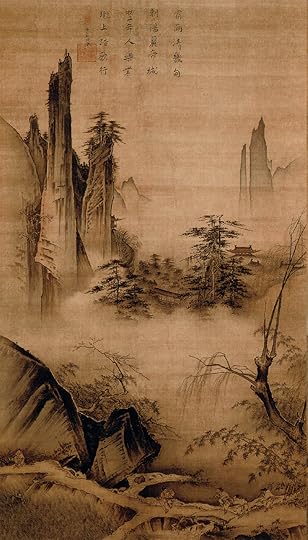
Chinese nature poetry has two distinct traditions: one is called shanshui (rivers and mountains) and is primarily occupied with untamed and awesome nature; the other, tianyuan (fields and gardens), sings the praises of tamed, domesticated nature. Though Fan certainly wrote some impressive poems in the shanshui tradition (particularly after his trip through the Yangzi Gorges and while living among the mountains of Sichuan), when he returned to his eastern home he reverted to the tianyuan tradition, but with a difference. The lives of the peasants, the overwhelming majority of the populace, had made an appearance in some High Culture poems earlier, but usually only because the author found himself, through choice or necessity, sharing their life (like Tao Yuanming) or because the author wanted to make a Confucian political point (like Bai Juyi). Without condescension Fan wrote realistic, even naturalistic poems about peasant life that focus on our common humanity. For example, he does not airbrush visible consequences of dietary deficiencies, but he emphasizes that their sufferers share the same foibles as the upper class readers of his poems. Women with goiters rush downtown to be on time for the market, Racing in dozens along the south street, where goods are for sale. Gentlemen, please don't make fun of these ugly ladies; Just see how their young boyfriends buy them silver hairpins!
Since his readers were likely to be the sorts of people who were governors and future governors, I wonder if the following poem restrained the hand of some officials. A Further Ballad on Collecting Taxes An old peasant's fields lie fallow in the autumn rain; Formerly on a high bank, they're covered by river water now. A tenant farmer like him is always starving, And he knows all too well he can't pay rent or taxes. Ever since the latest governor arrived at his post, Tax remissions have been canceled and new bills press payment. The peasant sold his family's clothes to make good his debts; Though his sickly family froze, he avoided trouble for a while. Last year the clothes were gone, and he started selling his children; He parted with his eldest daughter first, there, at the crossroads, This year his second daughter was engaged to be married, When he had to sell her off, too, for a few bushels of rice. Still his youngest daughter remains, living with him at home, He needn't fear tax collectors for another year - at least.
Many different kinds of wit come into play in Fan's work, among them the gentle humor of this self-deprecating surprise: I set off by boat and watch the sky clear above snowy peaks; The wind calms and the unseasonal cold intensifies at evening. I listen to my oars crackle like shattering jade in the water; Only then I know; the lake's surface was frozen already!
Because of Fan's wide range of topics and techniques, it is quite impossible to give a representative sampling. But due to this, reading Fan's work never becomes routine; he always keeps it fresh, and I wish more of his work were available in translation.
At one point he was a ranking member of an embassy sent by the Song court to the Chin enemy; his proud insistence on a point of protocol against the wishes of the Chin emperor nearly cost him his life.(*) But instead of quoting from the poems he wrote during that time, wherein the northern Chinese heartland is painted in colors of ash and devastation and the remaining Chinese are represented as tatooed slaves living only at the whim of their Chin masters, I'll close with a poem of affirmation written on yet another trip (one within the Song borders) carried out while on duty. Returning to Huangtan Vermilion maple leaves wither then drop; Black as mascara, the cypress stands lonely. Paddy rice glints with yellow in the evening; Hillside grass grows verdant once more in autumn. The horizon stretches before me on a long painted scroll, Revealing to my drunken eyes an infinite panorama. Sails float downward on the gold and turquoise of the river; A horse whinnies in a valley embroidered with flowers. The world we live in is adorned and embellished By a creator untainted by a hint of vulgarity. If I had not traveled on my distant journey to this land, Never, never, would I have witnessed this miraculous scene!
(*) For which he is praised by patriotic Chinese to this day.