

What do you think?

Los buscadores de loto
Al comprar una casa en la isla de Hidra, la escritora Charmian Clift cumplió un sueño largamente acariciado: echar raíces en un puertecito de aguas cristalinas, luz cegadora y costumbres sencillas, lo más parecido a un paraíso en miniatura. Allí, Clift y su marido pronto ocuparon el centro de una comunidad de artistas y bohemios, soñadores y vagabundos que buscaban en Grecia una vida barata y sin ataduras, consagrada a la creación o a la vagancia. Entre ellos destacaría un todavía desconocido Leonard Cohen, al que el matrimonio acogió e inspiró con su ejemplo. Pero, como todo paraíso terrenal, el de Clift tenía un precio. Los días se le iban en poner coto al caos doméstico y en cuidar de sus tres hijos, los ingresos que generaban los derechos de autor eran exiguos, y las tabernas y el alcohol eran una distracción constante. Después de los pobres creativos llegaron los ricos y sus yates, y un buen día una legión de norteamericanos desembarcó en Hidra para rodar una película de Hollywood. Aquel rincón idílico se había convertido en una isla chic.
Los buscadores de loto es la crónica apasionante del nacimiento y la disolución de una utopía, de una época efervescente en la que Hidra fue un laboratorio social y artístico en el que experimentar con formas de vida distintas, antes de que el turismo y la modernidad más ramplona interrumpieran un sueño que parecía eterno.
Los buscadores de loto es la crónica apasionante del nacimiento y la disolución de una utopía, de una época efervescente en la que Hidra fue un laboratorio social y artístico en el que experimentar con formas de vida distintas, antes de que el turismo y la modernidad más ramplona interrumpieran un sueño que parecía eterno.
288 pages, Paperback
First published January 1, 1959
About the author
Charmian Clift
20 books60 followersCharmian Clift was an Australian writer and essayist during the mid 20th century. She was the second wife and literary collaborator of George Johnston.
Ratings & Reviews
Friends & Following
Create a free account to discover what your friends think of this book!
Community Reviews
Displaying 1 - 30 of 101 reviews

August 22, 2023
Las memorias de Charmian Clift terminan en este repaso de aquellos años bohemios en los que escritores y pintores se refugiaban en islas griegas para dar rienda suelta a la creación.
Aunque 'Cantos de sirena' me impresionó más porque profundizaba en la vida en la isla (su cultura, pobreza, modo de vida...), este libro lo he disfrutado más o menos lo mismo. Está mucho más centrado en su familia y amigos, en la vida de todos estos artistas extranjeros que aguantaban con lo mínimo con el objetivo de crear su gran obra, o al menos "alguna" obra, pero empezaban a ser demasiado mayores y seguían sin triunfar.
Lo que más me gusta de estas memorias es lo sincera que es la autora con ella misma y con los suyos, habla siempre con humor pero no parece dejar nada de lado, ridiculiza a sus amigos, ironiza sobre su propia situación.. pero también se muestra vulnerable en momentos difíciles en los que esa vida idílica en Grecia se le resistía.
Me parece que aunque es un libro principalmente alegre, veraniego y luminoso, tiene un regusto gris, melancólico que se aprecia aunque no conozcas el triste final que tuvo la autora.
Aunque 'Cantos de sirena' me impresionó más porque profundizaba en la vida en la isla (su cultura, pobreza, modo de vida...), este libro lo he disfrutado más o menos lo mismo. Está mucho más centrado en su familia y amigos, en la vida de todos estos artistas extranjeros que aguantaban con lo mínimo con el objetivo de crear su gran obra, o al menos "alguna" obra, pero empezaban a ser demasiado mayores y seguían sin triunfar.
Lo que más me gusta de estas memorias es lo sincera que es la autora con ella misma y con los suyos, habla siempre con humor pero no parece dejar nada de lado, ridiculiza a sus amigos, ironiza sobre su propia situación.. pero también se muestra vulnerable en momentos difíciles en los que esa vida idílica en Grecia se le resistía.
Me parece que aunque es un libro principalmente alegre, veraniego y luminoso, tiene un regusto gris, melancólico que se aprecia aunque no conozcas el triste final que tuvo la autora.

February 27, 2017
It has taken me an exceedingly long time to read this small travel memoir. Why? Now that’s the million dollar question. Put simply, whilst reading this beautifully written memoir set in Hydra Greece, I was constantly being pulled in three different directions, making it impossible to read but a few pages at a time.
Firstly, I was amazed, but really shouldn’t have been, at the skilfully wrought evocation of place and the quality of the writing. Here is Clift in fine form:
“The house where we are staying has a little terrace tucked under the tall bronze mountain that curls over the town like a static wave. I sit up here wrapped up in a blanket, listening to the dialogue of donkeys, seeing shadowed wall, roof-top, tile, alley aswarm with huge slinking shapes of cats, like an emanation of the secret soul of the place.
Athena’s little owl drops two liquid notes from the mountain, and again two notes, very pure and chill. Some restless stirring in a high sheepfold is signalled by a little drift of bells. All pale and quiet the lovely houses sleep, tier upon tier folding down from the black bulk of the mountains to the black silk spread of water. Across the water the dark hills of Troezen are pricked all over with the fires of the charcoal burners like a scattering of rubies.”
Secondly, reading this memoir in the 21st century, as opposed to reading it in the late 1950s is painfully bittersweet. Most readers who have actually heard of Clift and seek this book out, and its not easy to find, (again another source of frustration) know that she killed herself, drunk and in despair back in Sydney in 1969. A far cry from the Clift at the start of this book, embarking on a magical alternative lifestyle on a Greek island. This knowledge often makes it painful to embrace, as a reader, her hopeful enthusiasm for this new life.
Thirdly, I think it was just sheer frustration at the sadness of her final years which Peel Me a Lotus reminded me of. Towards the end of this book when the reader can see the precariousness of their existence peeping through, I just wanted to shout at her, “Stop drinking at the cafe for hours on end. Leave George and the others and go back and write your novel. The children are asleep. Here’s your chance! Beat your husband at his own game and bring your past in Kiama to life before he can get at it.” Of course she doesn’t. She just keeps on drinking with her husband and her friends at the cafe by the waterfront. And that is to my mind the ultimate tragedy.
Please read her books. She is a fine writer. I can’t face reading any she wrote with her husband but her stand alone books are:
Mermaid Singing - which involves Johnston and Clift’s life in London and their decision to move to a Greek Island, Kalymnos.
Peel Me a Lotus - reviewed above
Her two works of fiction:
Walk to the Paradise Gardens set in a fictionalised version of Kiama
Honour’s Mimic set on a Greek island. She is a neglected Australian writer who deserves to be read.
Firstly, I was amazed, but really shouldn’t have been, at the skilfully wrought evocation of place and the quality of the writing. Here is Clift in fine form:
“The house where we are staying has a little terrace tucked under the tall bronze mountain that curls over the town like a static wave. I sit up here wrapped up in a blanket, listening to the dialogue of donkeys, seeing shadowed wall, roof-top, tile, alley aswarm with huge slinking shapes of cats, like an emanation of the secret soul of the place.
Athena’s little owl drops two liquid notes from the mountain, and again two notes, very pure and chill. Some restless stirring in a high sheepfold is signalled by a little drift of bells. All pale and quiet the lovely houses sleep, tier upon tier folding down from the black bulk of the mountains to the black silk spread of water. Across the water the dark hills of Troezen are pricked all over with the fires of the charcoal burners like a scattering of rubies.”
Secondly, reading this memoir in the 21st century, as opposed to reading it in the late 1950s is painfully bittersweet. Most readers who have actually heard of Clift and seek this book out, and its not easy to find, (again another source of frustration) know that she killed herself, drunk and in despair back in Sydney in 1969. A far cry from the Clift at the start of this book, embarking on a magical alternative lifestyle on a Greek island. This knowledge often makes it painful to embrace, as a reader, her hopeful enthusiasm for this new life.
Thirdly, I think it was just sheer frustration at the sadness of her final years which Peel Me a Lotus reminded me of. Towards the end of this book when the reader can see the precariousness of their existence peeping through, I just wanted to shout at her, “Stop drinking at the cafe for hours on end. Leave George and the others and go back and write your novel. The children are asleep. Here’s your chance! Beat your husband at his own game and bring your past in Kiama to life before he can get at it.” Of course she doesn’t. She just keeps on drinking with her husband and her friends at the cafe by the waterfront. And that is to my mind the ultimate tragedy.
Please read her books. She is a fine writer. I can’t face reading any she wrote with her husband but her stand alone books are:
Mermaid Singing - which involves Johnston and Clift’s life in London and their decision to move to a Greek Island, Kalymnos.
Peel Me a Lotus - reviewed above
Her two works of fiction:
Walk to the Paradise Gardens set in a fictionalised version of Kiama
Honour’s Mimic set on a Greek island. She is a neglected Australian writer who deserves to be read.
December 2, 2022
CRITIQUE:
Timeframe
This is the second of two Charmian Clift memoirs about family life in the Greek Islands.
The first was set on Kalymnos. This is set on an island that isn't named for the whole of the book, although it's known to be Hydra (pronounced "EE-thra").
The Clift and Johnston family stayed on Hydra from the winter of 1955/1956 until 1964, when they returned to Australia. This memoir purports to deal with only the nine months from February to October of their first year on the island. Thus, one thing it doesn't do is deal with the time (1960), when Leonard Cohen first visited the island and formed part of their peer group.
Instead, "Lotus" documents the purchase of "the house by the well", Charmian's pregnancy and the birth of their son (who is temporarily called Booli, but would eventually be named Jason), as well as the chaos that accompanied the shooting of the film "Island of Love" (released in 1963) and a small earthquake on the island.
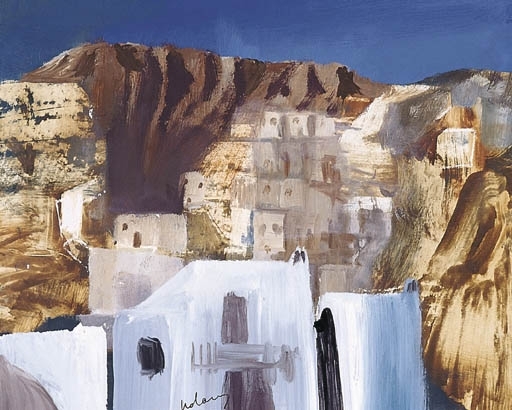
Sidney Nolan - "Hydra" Source
Friends and Family
In contrast to "Mermaid", Charmian focusses on her own family and the community of foreigners, made up mostly of Australian, Irish, American, Swedish, Austrian and French visitors.
The other Australians aren't identified as such, but it is known that the characters Henry and Ursula Trevena are actually based on the Australian painter Sidney Nolan and his wife, Cynthia Nolan, who "have been friends of ours for many years [and] came here last November largely on our recommendation of the island as a place of great beauty which was cheap enough and quiet enough for Henry to put in an undistracted winter's work".
It's Henry who advises an aspiring writer who wishes he could fly, at least metaphorically, through his writing: "Fly, then! Bloody well soar, why don't you?" It's up to us alone to capitalise on our ambition and our talent. You have to pull your finger out, if you want to succeed.
The foreigners have one thing, at least, in common:
They mutually support "the fundamental rightness of our way of living", no matter how debilitating it is at times:
Charmian compares her way of life with that in England:
Charmian gains comfort and a sense of pride from their children:
"The Bare Truth of Things"
Charmian's language is at once simple, descriptive, aesthetic and metaphysical. The place defines the people (and vice versa), at least temporarily:
Creativity, like being, is an imperative. Charmian and George are determined to fly, even if they take the risk of falling, whether or not in the same manner as Icarus.
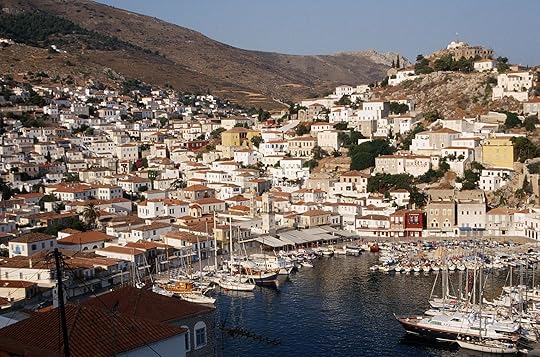
Hydra Source
Nomadic Tribes of Young American Men
Charmian also encounters a type of young man that seems to be replicating the Lost Generation between the wars:
They might have been prototypical Beats. One of the Greeks calls them "bums and perverts", while another friend labels them the "creative poor". Charmian refers to them variously, in her acutely observant way, as "the smart, penniless, immoral, clever young people", "the intellectual hoboes", "the decadents", and "the poste restante boys". They wear "cropped-hair, blue jeans and bright shirts." She suspects they must read "Film Weekly", "Encounter" and "Partisan Review", to "keep in touch with information sources":
"Apres Nous Le Deluge"
No matter how objectionable the poste restante boys are, they are no comparison with the cast and crew of the American film production which arrives one morning, almost without warning, but with the promise of generating enormous income for the inhabitants.
The producers walk around the village, calling out "Ruin that house...antique that store!", superimposing Hollywood authenticity on what is actually there already, albeit genuinely distressed and alarmed.
They fabricate "a make-believe waterfront" and a "weird dream-world" where "everyone slips into A Role". Soon, "they apologise in hushed voices for Spoiling Our Paradise...Apres nous le deluge!"
SOUNDTRACK:
Timeframe
This is the second of two Charmian Clift memoirs about family life in the Greek Islands.
The first was set on Kalymnos. This is set on an island that isn't named for the whole of the book, although it's known to be Hydra (pronounced "EE-thra").
The Clift and Johnston family stayed on Hydra from the winter of 1955/1956 until 1964, when they returned to Australia. This memoir purports to deal with only the nine months from February to October of their first year on the island. Thus, one thing it doesn't do is deal with the time (1960), when Leonard Cohen first visited the island and formed part of their peer group.
Instead, "Lotus" documents the purchase of "the house by the well", Charmian's pregnancy and the birth of their son (who is temporarily called Booli, but would eventually be named Jason), as well as the chaos that accompanied the shooting of the film "Island of Love" (released in 1963) and a small earthquake on the island.
Sidney Nolan - "Hydra" Source
Friends and Family
In contrast to "Mermaid", Charmian focusses on her own family and the community of foreigners, made up mostly of Australian, Irish, American, Swedish, Austrian and French visitors.
The other Australians aren't identified as such, but it is known that the characters Henry and Ursula Trevena are actually based on the Australian painter Sidney Nolan and his wife, Cynthia Nolan, who "have been friends of ours for many years [and] came here last November largely on our recommendation of the island as a place of great beauty which was cheap enough and quiet enough for Henry to put in an undistracted winter's work".
It's Henry who advises an aspiring writer who wishes he could fly, at least metaphorically, through his writing: "Fly, then! Bloody well soar, why don't you?" It's up to us alone to capitalise on our ambition and our talent. You have to pull your finger out, if you want to succeed.
The foreigners have one thing, at least, in common:
"Every one of us, in his own particular way, is a protestant against the rat race of modern commercialisation, against the faster and faster scuttling through an endless succession of sterile days that begin without hope and end without joy. Each of us has somehow managed to stumble off the treadmill, determined to do his own work in his own way...
"They, too, have protested, made a definite stand, refused to submit, declared for individuality, and retired from the rat race."
They mutually support "the fundamental rightness of our way of living", no matter how debilitating it is at times:
"A wistfulness fell on everybody. Now, in retrospect, those long months of difficulties, discomforts, boredom, and forced propinquity appeared singular for their richness of adventure, discovery, enthusiasm, comradeship. This fair and sunny island, glittering in its blue setting like a many-faceted jewel, was different from that island where we had waded through torrents, watched for a sail like castaways, seen great thunderstorms splitting the mountains with Homeric flashes, where we had been cold and discouraged and hungry or ablaze with the brightness of private visions, where in the pallid beam of a kerosene lantern we had talked whole nights away."
Charmian compares her way of life with that in England:
"Was it for this that I so gladly renounced the pleasures of material success? The assurance of the monthly cheque? The visible achievements? The automobile, the well-dressed wife, the comfortable apartment at a 'good' address, the tidy, well-mannered children going to tidy, well-mannered schools?"
"We are poor, but we have been poor for the last two years - poorer, indeed, than we are now, with a house of our own, and enough money to live for another six months or so even if we should earn nothing more. Those two years of poverty have been the most eventful, the most enjoyable, the most exciting of our lives; we have felt richly defiant and adventurous eating lentils and wearing darned sweaters and thumbing our noses at the jeremiahs who had said we couldn't do it."
Charmian gains comfort and a sense of pride from their children:
"I thought today how beautiful my children have become in this deeply natural world, thin, brown, hard creatures, still unconscious of their own grace or even of the extravagance of beauty in which they move and have their being: for them it is no more to be observed than the number of times their sharp little breasts rise and fall breathing it in..."
"The Bare Truth of Things"
Charmian's language is at once simple, descriptive, aesthetic and metaphysical. The place defines the people (and vice versa), at least temporarily:
"I was glad we had chosen to live in the sun. To live in the sun is reassuring. All is open, all revealed. Here are no deceptions, but the bare truth of things. I think that no beauty has ever been as true for me as this beauty of rocks and sea and the beauty of the mountains that rush up between the blue and the blue, skirted only with austere white terraces of houses simplified to the purest geometry of planes and angles.
"It seems to me that we have become simplified too, living here, as though the sun had seared off the woolly fuzz of our separate confusions: the half desires irresolutely sought, the half-fears never more than half-vanquished, the partial attainments half-rejected in perplexed dissatisfaction. Shedding so much we are stripped to our bare selves, lighter, freer, and impoverished of nothing but a few ridiculous little self-importances...
"Everything, you would say, is as it should be under the sun. Ant, gull, child, man, woman, is each fulfilling the imperative of its being."
Creativity, like being, is an imperative. Charmian and George are determined to fly, even if they take the risk of falling, whether or not in the same manner as Icarus.
Hydra Source
Nomadic Tribes of Young American Men
Charmian also encounters a type of young man that seems to be replicating the Lost Generation between the wars:
"It had never occurred to me before that there must be a whole nomadic tribe of young men which moves across Europe with the changing seasons on a defined trail where the camping places and waterholes are fixed by custom and the big-game areas clearly marked. It is clear, suddenly, that this island is one of the summer camps, a stopover place to rest and exchange stories and information about the year's trail.
"Something about Sykes Horowitz now becomes much clearer - his odd familiarity with foreign cities and foreign tongues and that gypsyish quality of being at home everywhere and nowhere that used to rather charm me...
"They have read the reviews of the latest books and the latest plays, and talk knowledgeably about action painting, erotic symbols, psychosomatic disorders, the doctrines of nihilism and existentialism, and collage...
"Their letters, I have noticed, have sometimes been re-addressed five or six times. They live poste-restante."
They might have been prototypical Beats. One of the Greeks calls them "bums and perverts", while another friend labels them the "creative poor". Charmian refers to them variously, in her acutely observant way, as "the smart, penniless, immoral, clever young people", "the intellectual hoboes", "the decadents", and "the poste restante boys". They wear "cropped-hair, blue jeans and bright shirts." She suspects they must read "Film Weekly", "Encounter" and "Partisan Review", to "keep in touch with information sources":
"So they go round and round and round, treading the same old beaten track, the clever young men, the witty young men, the careless young men, the oh-so-European young men, the sad young men, who are looking for Gertrude Stein."
"Apres Nous Le Deluge"
No matter how objectionable the poste restante boys are, they are no comparison with the cast and crew of the American film production which arrives one morning, almost without warning, but with the promise of generating enormous income for the inhabitants.
The producers walk around the village, calling out "Ruin that house...antique that store!", superimposing Hollywood authenticity on what is actually there already, albeit genuinely distressed and alarmed.
They fabricate "a make-believe waterfront" and a "weird dream-world" where "everyone slips into A Role". Soon, "they apologise in hushed voices for Spoiling Our Paradise...Apres nous le deluge!"
SOUNDTRACK:

April 10, 2021
My thanks to Muswell Press and NetGalley for a review copy of this one.
This is the second volume of memoirs by Australian writer Charmian Clift of the time she and her family spent in Greece (they lived there 14 or more years). The first, Mermaid Singing, was of their time on the island of Kalymnos while this one is of a year in Hydra. I think it is may be a little less than a year—beginning in February and ending in October. Each section is about the events in a particular month.
As the volume opens, we learn the family is in Hydra and in the process of buying a house of their own (When they moved and why Hydra was their choice is not explained). This is expensive at 120 gold pounds (thus taking away nearly all of their savings), but still a large house at this price is something they would never have been able to afford in England. Charmian is at the time expecting her third child. The first part of the book focuses on how they go about buying a house and all the work that is needed to get it in shape before they can move in. By this time, her children Martin and Shane are used to life in Greece, attend school there and play with their new friends. Unlike Kalymnos where Clift and her family were the only foreigners, Hydra has a sizeable community of expats, mostly artists and writers, and a few intellectual hobos as well as drifters and tourists who keep coming in. And while they also have their Greek friends, here their interaction is more with this community. Of these their close friends are Sean (who has come to Hydra to write) and his wife Lola, and artist Henry and his wife Ursula (all pseudonyms). Once the house is ready and the baby is born (an adventure in itself), we move on to their experiences living there, things that go wrong with the house, their interactions with others, and incidents and adventures that befall them. Like in the first volume, there is also a lot of work, with Charmian having to cook, shop, and look after the baby (though she has help) and of course write and George having to write, at times books he does not wish to for that will put food on the table (besides other work like pumping water, and even paiting the house).
This was like the first volume quite an enjoyable read—I liked Clift’s writing a lot and as in the first volume, her descriptions are vivid and her observations keen. We have an assortment of characters in this one, each colourful in their own way—whether it is Henry who must go anywhere for the sake of his art while his wife Ursula wants some stability to Sean who persists in his writing despite many rejections or his portly wife Lola who is warm and welcoming. We have three Swedish young men who are on the island, Toby and Katherine an American couple who are trying to live the ‘Greek’ way, Katharine’s domineering mother, Mrs Knip who comes for a visit to set them straight, and even a film crew which comes to make a movie on the island (and many others). They are all interesting even if not all attractive, but Clift’s (and indeed Mrs Knip’s) observations do make us wonder about them and their motivations. (The movie crew we learn in the introduction by Polly Samson who has written a novel based on Johnston and Clift’s life in Greece were filming Boy on a Dolphin starring Sophia Loren who also came there).
In the introduction to this volume, Polly Samson mentions that this is much darker than Clift’s first set of memoirs, and this is something that does stand out almost all through. Clift does for the most part enjoy the simple joys of their life in Greece (swimming every day, picnics, and conversations) but there is also understandable frustration with things going wrong with the house often, money being tight, and their responsibilities with the children weighing on them especially in the face of the fact that many of the others there are not struggling just to live and do not have like responsibilities. But yes, her dissatisfactions come to the surface more often, and one can see some disillusionment creeping in and her questioning their choice even though she does enjoy life more or less. Even her observations of the people they interacted with, their friends as well as the drifters and intellectual hobos (who talk of Kierkegaard and Dali among others), sharp though they are, also feel rather cynical. This is very different from the first volume where you could see her amusement with everything and a decided light-heartedness.
But these were still a very interesting read—a peek into life in the artists’ colony of sorts that was on Hydra where there were not only intellectual conversations but also uncertainly, not only about money but even whether they would be allowed to remain in light of the Cyprus crisis. There are a range of experiences from the film crew literally changing the face of the island to an earthquake to daily troubles like drains going wrong, making life rich even if hard.
Once again we have illustrations, this time by Lola/Nancy Dignan but also the newer ones that appeared in the previous volume—these I always enjoy.
I was really pleased to read these volumes and do see myself visiting them again.
This review is also on my blog: https://potpourri2015.wordpress.com/2...
This is the second volume of memoirs by Australian writer Charmian Clift of the time she and her family spent in Greece (they lived there 14 or more years). The first, Mermaid Singing, was of their time on the island of Kalymnos while this one is of a year in Hydra. I think it is may be a little less than a year—beginning in February and ending in October. Each section is about the events in a particular month.
As the volume opens, we learn the family is in Hydra and in the process of buying a house of their own (When they moved and why Hydra was their choice is not explained). This is expensive at 120 gold pounds (thus taking away nearly all of their savings), but still a large house at this price is something they would never have been able to afford in England. Charmian is at the time expecting her third child. The first part of the book focuses on how they go about buying a house and all the work that is needed to get it in shape before they can move in. By this time, her children Martin and Shane are used to life in Greece, attend school there and play with their new friends. Unlike Kalymnos where Clift and her family were the only foreigners, Hydra has a sizeable community of expats, mostly artists and writers, and a few intellectual hobos as well as drifters and tourists who keep coming in. And while they also have their Greek friends, here their interaction is more with this community. Of these their close friends are Sean (who has come to Hydra to write) and his wife Lola, and artist Henry and his wife Ursula (all pseudonyms). Once the house is ready and the baby is born (an adventure in itself), we move on to their experiences living there, things that go wrong with the house, their interactions with others, and incidents and adventures that befall them. Like in the first volume, there is also a lot of work, with Charmian having to cook, shop, and look after the baby (though she has help) and of course write and George having to write, at times books he does not wish to for that will put food on the table (besides other work like pumping water, and even paiting the house).
This was like the first volume quite an enjoyable read—I liked Clift’s writing a lot and as in the first volume, her descriptions are vivid and her observations keen. We have an assortment of characters in this one, each colourful in their own way—whether it is Henry who must go anywhere for the sake of his art while his wife Ursula wants some stability to Sean who persists in his writing despite many rejections or his portly wife Lola who is warm and welcoming. We have three Swedish young men who are on the island, Toby and Katherine an American couple who are trying to live the ‘Greek’ way, Katharine’s domineering mother, Mrs Knip who comes for a visit to set them straight, and even a film crew which comes to make a movie on the island (and many others). They are all interesting even if not all attractive, but Clift’s (and indeed Mrs Knip’s) observations do make us wonder about them and their motivations. (The movie crew we learn in the introduction by Polly Samson who has written a novel based on Johnston and Clift’s life in Greece were filming Boy on a Dolphin starring Sophia Loren who also came there).
In the introduction to this volume, Polly Samson mentions that this is much darker than Clift’s first set of memoirs, and this is something that does stand out almost all through. Clift does for the most part enjoy the simple joys of their life in Greece (swimming every day, picnics, and conversations) but there is also understandable frustration with things going wrong with the house often, money being tight, and their responsibilities with the children weighing on them especially in the face of the fact that many of the others there are not struggling just to live and do not have like responsibilities. But yes, her dissatisfactions come to the surface more often, and one can see some disillusionment creeping in and her questioning their choice even though she does enjoy life more or less. Even her observations of the people they interacted with, their friends as well as the drifters and intellectual hobos (who talk of Kierkegaard and Dali among others), sharp though they are, also feel rather cynical. This is very different from the first volume where you could see her amusement with everything and a decided light-heartedness.
But these were still a very interesting read—a peek into life in the artists’ colony of sorts that was on Hydra where there were not only intellectual conversations but also uncertainly, not only about money but even whether they would be allowed to remain in light of the Cyprus crisis. There are a range of experiences from the film crew literally changing the face of the island to an earthquake to daily troubles like drains going wrong, making life rich even if hard.
Once again we have illustrations, this time by Lola/Nancy Dignan but also the newer ones that appeared in the previous volume—these I always enjoy.
I was really pleased to read these volumes and do see myself visiting them again.
This review is also on my blog: https://potpourri2015.wordpress.com/2...

January 27, 2011
Peel Me a Lotus is Charmian Clift's second autobiography/travelogue that accounts for nine months in Greece. It takes place a few months after Charmian, her husband George Johnston, and their two children, leave Kalymnos and move to Hydra pre its bustling tourist days. (The book about the year on Kalymnos is called Mermaids Singing and there is the fiction book, The Sponge Divers as well). They are the first non-Greeks to buy a house on the island and the book follows the purchase of the house and, coincidentally, the nine months of Charmian's pregnancy with her son, Jason.
If you know anything about the Johnsons and their expatriate life in Greece, this book offers a fascinating and cheeky if not joyous, counter narrative to the alcoholism, poverty, extra-marital affairs and huge arguments that Clift and Johnson would have throughout their time there, as well as Johnson's battle with tuberculosis. While the story does allude to some of these things (including Clift's infamous affairs/s - or at least, the object of her affection), it is an utterly charming tale of a life that, in these fast-paced, FaceBook times, is hard to imagine. Living the life of struggling writers - quite literally - Clift and Johnson live hand to mouth, or type-writer to cheque, in an effort to eke out a living from the craft they not only love but at which they were both so talented - they write, observe, raise their children and ponder, doubt and question what they're doing. The children in the meantime, run amok in the cobbled streets of Hydra, attending Greek school and soaking up the cthonic atmosphere of the myth-soaked isles.
An utterly beautiful book, full of Clift's good humour and literary spontaneity. It is one of my favourites and I read it again, often.
If you know anything about the Johnsons and their expatriate life in Greece, this book offers a fascinating and cheeky if not joyous, counter narrative to the alcoholism, poverty, extra-marital affairs and huge arguments that Clift and Johnson would have throughout their time there, as well as Johnson's battle with tuberculosis. While the story does allude to some of these things (including Clift's infamous affairs/s - or at least, the object of her affection), it is an utterly charming tale of a life that, in these fast-paced, FaceBook times, is hard to imagine. Living the life of struggling writers - quite literally - Clift and Johnson live hand to mouth, or type-writer to cheque, in an effort to eke out a living from the craft they not only love but at which they were both so talented - they write, observe, raise their children and ponder, doubt and question what they're doing. The children in the meantime, run amok in the cobbled streets of Hydra, attending Greek school and soaking up the cthonic atmosphere of the myth-soaked isles.
An utterly beautiful book, full of Clift's good humour and literary spontaneity. It is one of my favourites and I read it again, often.
June 24, 2023
What better place to read this book than Hydra, Greece. I could sit at a cafe and read by the water, and look up and see what was so eloquently described in the book.

January 10, 2014
Kiama has two claims to fame - the Blowhole and Charmian Clift. This is a truly charming travel memoir set in the 1950s on the island of Hydra in Greece where Clift lived with her husband George Johnston and their growing band of children. It's both fond and wry; lyrical and droll. Her prose is spare and elegant. I actually felt so sad that a woman of such wit and talent suicided in her 40s. I'll be reading more of the charming Charmian.
August 16, 2025
2.75
Niełatwo mi ocenić tę książkę. Z jednej strony oddaje ona niepowtarzalny klimat greckiej wyspy pełnej artystycznej cyganerii, codziennych rytuałów i refleksji nad życiem. Z drugiej styl pisania Charmain Clift okazał się dla mnie wyjątkowo trudny w odbiorze. Ciężki, gęsty, momentami wręcz nieprzyjemny, sprawił, że przez długi czas nie mogłam przemóc się do lektury.
Podchodziłam do tej książki z nadzieją, że życie artystów na Hydrze będzie dla mnie fascynujące, pełne pasji, wolności i twórczego fermentu. Tymczasem po jej skończeniu mam wrażenie, że nikt tam tak naprawdę nie był szczęśliwy. Że mimo pięknych krajobrazów i pozornej swobody, wielu z nich marnowało swój potencjał, gubiło się w codzienności i wewnętrznych rozterkach.
To nie jest książka, którą się pochłania. To raczej lektura, która wymaga cierpliwości i gotowości na zmierzenie się z czymś surowym, nieoczywistym. Choć nie mogę powiedzieć, że mnie zachwyciła, to z pewnością zostawiła po sobie ślad.
Niełatwo mi ocenić tę książkę. Z jednej strony oddaje ona niepowtarzalny klimat greckiej wyspy pełnej artystycznej cyganerii, codziennych rytuałów i refleksji nad życiem. Z drugiej styl pisania Charmain Clift okazał się dla mnie wyjątkowo trudny w odbiorze. Ciężki, gęsty, momentami wręcz nieprzyjemny, sprawił, że przez długi czas nie mogłam przemóc się do lektury.
Podchodziłam do tej książki z nadzieją, że życie artystów na Hydrze będzie dla mnie fascynujące, pełne pasji, wolności i twórczego fermentu. Tymczasem po jej skończeniu mam wrażenie, że nikt tam tak naprawdę nie był szczęśliwy. Że mimo pięknych krajobrazów i pozornej swobody, wielu z nich marnowało swój potencjał, gubiło się w codzienności i wewnętrznych rozterkach.
To nie jest książka, którą się pochłania. To raczej lektura, która wymaga cierpliwości i gotowości na zmierzenie się z czymś surowym, nieoczywistym. Choć nie mogę powiedzieć, że mnie zachwyciła, to z pewnością zostawiła po sobie ślad.

August 23, 2015
Despite my adoration of Charmian Clift's previous book, Mermaid Singing, I left a year's gap between finishing that last August while staying on Corfu, and devouring this, Peel me a Lotus, on a 4-day trip to Paris. The intervening year has brought about massive changes in my life, but no less evocative and honest prose from Clift. This follow-up charts her family's adventures as they make a home on the Greek island of Hydra in the early 1950s, one of the first non-Greek families to settle there and thus a source of wonder and merriment to the locals. They fall in with a rag tag bunch of boho arty expats and struggle to make ends meet with their occasional writing, adding to their two tanned, wild children a new chubby baby and sinking all their savings into a tumbledown Greek house. It slightly lacked the wondrous air of comic discovery which so delighted in Mermaid Singing, and there is a distinct undercurrent of despair in Clift's post-natal powerlessness and their collective realisation that the bubble would soon burst, with the rise of the tourist trade on the Greek islands. Still, a delightful picture of early expat life on the Greek isles, and I find it so sad that Clift wasn't recognised enough for her brilliance in her own lifetime, or indeed legacy.
November 29, 2024
Skąd dość niskie oceny? Autorka pisze tak pięknie, że mogłabym przeczytać nawet o jej wyprawie do sklepu o byłabym zachwycona. A wydanie od 77 Press jest magicznie wspaniałe.

April 9, 2021
I read this courtesy of NetGalley.
You don't HAVE to read Mermaid Singing, the first of Clift's memoirs about living on a Greek island in the 1950s, in order to understand what's going on here; not least because they've moved islands, so it's a whole new crowd of people. But I think it helps, because you come with a sense of what Clift and her husband George Johnston have already experienced, why they left London, and thus can better appreciate their experiences.
Like Mermaid Singing, this is a "domesticity in the exotic" story - Clift and her family living now on Hydra, a small, largely poor Greek island, on the cusp on becoming A Destination for the Artistic, the Beautiful, and the Hangers-On. Clift and her husband/collaborator have bought a house, which brings with it large dollops of angst: partly because of the never-ending requirement for repairs, on a budget that's basically nonexistent; and partly because now they are settled, they are halfway back to being bourgeois, and many of their fellow Artistic Types can't figure out if they're jealous or derisive. Both, it seems.
Unlike Mermaid Singing, Clift is much more ambivalent here about the whole experience: both her own experience, and what island life is like. While in the first she and George are actively writing a novel together about the sponge divers, here she seems to be entirely consumed with looking after the house and the children - indeed, she is hugely pregnant as the book opens, an experience which understandably consumes a significant part of her mind and time. George gets to clatter away at the typewriters, but Clift is busy buying food, making dinner, caring for the baby and the other two children, and so on. Sometimes she seems content with this, and at other times deeply frustrated, worried she is merging into that always-has-been, always-will-be experience of motherhood that she sees all around her. So... a fairly familiar experience, no doubt, for many women who find motherhood a time of personal conflict.
Island life bounces between the seeming idyllic - the beach swim every afternoon, cheap and bountiful food, glorious landscape, interesting if infuriating neighbours (usually it's the foreigners who are infuriating) - and its opposite. There's hardly any water to be had in summer. Many people's health is poor, there are huge prowling alley cats, rubbish is dumped directly into the harbour and no one knows where the sewers drain. Clift doesn't shy away from the negatives, and also makes little effort to reconcile the two extremes; it's the reality of life, after all.
A lot of time is spent talking about the other foreigners, for whom she uses pseudonyms, and it's probably a good thing she did. Having read the introduction, though, it seems their identities are - were? - no secret; Henry and Ursula are Sidney Nolan and his wife Cynthia. Clift presents the various non-Greeks as looking for inspiration or pretending to do so, living dissolutely because they can afford to; some of them are getting allowances from parents, for instance, so they barely even need to dabble in their art. Not so for Clift and Johnston, who are trying to eke out a living on royalties. I don't even want to look up Hydra today, for fear it's exactly as Clift prophesied - fancy tourist hotels for the Beautiful People - which may or may not have had positive benefits for the people whose ancestors initially colonised the place.
In some ways I can't believe this book is more than 60 years old. Parts of it show what feels like a very modern sensibility, while other bits are clearly products of the 1950s. It's gorgeously, evocatively, provocatively written and I hope lots of people get to read it.
You don't HAVE to read Mermaid Singing, the first of Clift's memoirs about living on a Greek island in the 1950s, in order to understand what's going on here; not least because they've moved islands, so it's a whole new crowd of people. But I think it helps, because you come with a sense of what Clift and her husband George Johnston have already experienced, why they left London, and thus can better appreciate their experiences.
Like Mermaid Singing, this is a "domesticity in the exotic" story - Clift and her family living now on Hydra, a small, largely poor Greek island, on the cusp on becoming A Destination for the Artistic, the Beautiful, and the Hangers-On. Clift and her husband/collaborator have bought a house, which brings with it large dollops of angst: partly because of the never-ending requirement for repairs, on a budget that's basically nonexistent; and partly because now they are settled, they are halfway back to being bourgeois, and many of their fellow Artistic Types can't figure out if they're jealous or derisive. Both, it seems.
Unlike Mermaid Singing, Clift is much more ambivalent here about the whole experience: both her own experience, and what island life is like. While in the first she and George are actively writing a novel together about the sponge divers, here she seems to be entirely consumed with looking after the house and the children - indeed, she is hugely pregnant as the book opens, an experience which understandably consumes a significant part of her mind and time. George gets to clatter away at the typewriters, but Clift is busy buying food, making dinner, caring for the baby and the other two children, and so on. Sometimes she seems content with this, and at other times deeply frustrated, worried she is merging into that always-has-been, always-will-be experience of motherhood that she sees all around her. So... a fairly familiar experience, no doubt, for many women who find motherhood a time of personal conflict.
Island life bounces between the seeming idyllic - the beach swim every afternoon, cheap and bountiful food, glorious landscape, interesting if infuriating neighbours (usually it's the foreigners who are infuriating) - and its opposite. There's hardly any water to be had in summer. Many people's health is poor, there are huge prowling alley cats, rubbish is dumped directly into the harbour and no one knows where the sewers drain. Clift doesn't shy away from the negatives, and also makes little effort to reconcile the two extremes; it's the reality of life, after all.
A lot of time is spent talking about the other foreigners, for whom she uses pseudonyms, and it's probably a good thing she did. Having read the introduction, though, it seems their identities are - were? - no secret; Henry and Ursula are Sidney Nolan and his wife Cynthia. Clift presents the various non-Greeks as looking for inspiration or pretending to do so, living dissolutely because they can afford to; some of them are getting allowances from parents, for instance, so they barely even need to dabble in their art. Not so for Clift and Johnston, who are trying to eke out a living on royalties. I don't even want to look up Hydra today, for fear it's exactly as Clift prophesied - fancy tourist hotels for the Beautiful People - which may or may not have had positive benefits for the people whose ancestors initially colonised the place.
In some ways I can't believe this book is more than 60 years old. Parts of it show what feels like a very modern sensibility, while other bits are clearly products of the 1950s. It's gorgeously, evocatively, provocatively written and I hope lots of people get to read it.
April 6, 2016
A fascinating year spent by the author, her husband and children, on the island of Hydra in the 1950s. As artists, the story is more about other artists than the locals although having been to Hydra, she catches the physicality of the place beautifully and there are some particularly wonderful descriptions of swimming in the water and the light. The paperback version that I read also has very simpllistic but sweet black and white illustrations as well.

September 24, 2018
Clift is a somehow still underappreciated Australian writer of brilliant and beautiful memoir, essays, and fiction. Peel Me a Lotus captures the drenched, precarious life she led on the island of Hydra in the 1950s; the story haunted by what was to come (see: Nadia Wheatley's fantastic biography).

August 5, 2021
3.5 stars
This memoir of a family's life on the Greek island of Hydra begins: Today we bought the house by the well. Charmian Clift and her husband George Johnston were Australian writers who had a good deal of success in post-war London and then decided to chuck it all in for 'the simple life'. For writers who depended on their royalties, and whose income was uncertain at best, buying a house was like placing a big bet and using their entire stake to do it. It was a commitment that closed off over possibilities and throughout this memoir the author emotionally careens between the beauty and horror of this choice. She's an incredibly expressive and sensuous writer, and it's impossible to read her words without absorbing some of that hectic blend of ecstasy and despair.
This book is made up of various parts, many of them to do with the local colour: the weather, the festivals, the ocean, the Greek locals, the expatriates, the filmmakers that arrive in the summer. Clift brings the island vividly to life for someone reading about Hydra 60 years after she lived there. But there is another important theme, too, and that's about the compulsion to 'make art' (for her, by writing). Her desire to write is set against the constant domestic demands, made worse by their fairly primitive living conditions. Her husband George's desire to write is set against the financial imperative of three children and the need to support them. There is another important theme, too, and that has to do with the siren call of island life for those not born to it. Although she only rarely examines her and her husband's attraction to this expatriate 'lotus eating' life, much of the book is devoted to musing about the motives of the colourful characters who have also washed up on the shores of Hydra.
By the way, this memoir is set a few years before Leonard Cohen makes his way to the island - thus ensuring its legendary status. I wanted to read it after reading Polly Samson's A Theatre for Dreamers which features Charmian Clift as one of its main (and certainly most charismatic) characters. Polly Samson also wrote the introduction to the reissue of my edition. As Samson writes, This is a book that is inescapably haunted by what is known of its author's death. {...} Suicide throws a long shadow and it's Clift's deepest thoughts about existence that inexorably darken and bloom here like wine through water.
This is a book that aims for lightness of tone, but the undertow of darkness in it felt like the strongest note to me.
This memoir of a family's life on the Greek island of Hydra begins: Today we bought the house by the well. Charmian Clift and her husband George Johnston were Australian writers who had a good deal of success in post-war London and then decided to chuck it all in for 'the simple life'. For writers who depended on their royalties, and whose income was uncertain at best, buying a house was like placing a big bet and using their entire stake to do it. It was a commitment that closed off over possibilities and throughout this memoir the author emotionally careens between the beauty and horror of this choice. She's an incredibly expressive and sensuous writer, and it's impossible to read her words without absorbing some of that hectic blend of ecstasy and despair.
We are poor, but then we have been poor for the last two years - poorer, indeed, than we are now, with a house of our own, and enough money to live for another six months or so even if we should earn nothing more. Those two years of poverty have been the most eventful, the most enjoyable, the most exciting of our lives; we have felt richly defiant and adventurous eating lentils and wearing darned sweaters and thumbing our noses at the Jeremiahs who had said we couldn't do it. So why should one now have a hard knot in one's heart - not so much of fear, but of outrage, of the wildest indignation? What is this protesting cry of anger and disbelief that wells up in one's throat? Why, it is very simple. It is only that one has come face to face with the plain bleak realisation that perhaps we are to go on being poor!
This book is made up of various parts, many of them to do with the local colour: the weather, the festivals, the ocean, the Greek locals, the expatriates, the filmmakers that arrive in the summer. Clift brings the island vividly to life for someone reading about Hydra 60 years after she lived there. But there is another important theme, too, and that's about the compulsion to 'make art' (for her, by writing). Her desire to write is set against the constant domestic demands, made worse by their fairly primitive living conditions. Her husband George's desire to write is set against the financial imperative of three children and the need to support them. There is another important theme, too, and that has to do with the siren call of island life for those not born to it. Although she only rarely examines her and her husband's attraction to this expatriate 'lotus eating' life, much of the book is devoted to musing about the motives of the colourful characters who have also washed up on the shores of Hydra.
By the way, this memoir is set a few years before Leonard Cohen makes his way to the island - thus ensuring its legendary status. I wanted to read it after reading Polly Samson's A Theatre for Dreamers which features Charmian Clift as one of its main (and certainly most charismatic) characters. Polly Samson also wrote the introduction to the reissue of my edition. As Samson writes, This is a book that is inescapably haunted by what is known of its author's death. {...} Suicide throws a long shadow and it's Clift's deepest thoughts about existence that inexorably darken and bloom here like wine through water.
This is a book that aims for lightness of tone, but the undertow of darkness in it felt like the strongest note to me.
To accomplish anything it is obvious that a talent is not enough. You need a motive, an aim, an incentive, an overwhelming interest be it ambition or fear or curiosity or only the necessity to fill your belly. You need a star to steer by, a cause a creed, an idea, a passionate attachment. Something must beckon you or nothing is done - something about which you ask no questions.

April 25, 2021
Gorgeous. Intimate. Moving.
This book tells the true-life story of Charmian Clift and George Johnston, a married couple, both of them novelists, with two young children. Having had some modest success with several published novels under their belt, and experiencing a growing distaste for the grim predictability of their middle-class existence in Australia, the couple decide to uproot their family and move to the small and incredibly beautiful Greek island of Hydra in the year 1955.
There they complete the purchase of a house, and settle in, - their new lives rapidly becoming unrecognizable as they deal with massive culture shock and acclimatize to the ‘simpler” and more physical world they both have been longing for - ostensibly the ideal backdrop for the life of a writer.
“Living simply, living in the sun, we are at least in touch again with reality; we have bridged that chasm that separates modern life from life’s beginnings and come back to the magic and wonder of such sensible mysteries as fire, water, earth and air. And, more than this, we have no masters but ourselves”.
The writing is evocative, haunting. For anyone who has ever visited, or dreamed of visiting Greece, I can’t imagine a more fitting read. Charmian’s descriptive prose of the Island’s delights is ecstatic and luminous, including some of the most beautiful and poetic passages I have ever read, and I found myself transcribing copious phrases I want to remember.
“Warm, mad, and wonderful the nights, wearing the soft bloom of purple grapes. The water lapping dark, and a huge mad moon extinguishing behind the shark mountain edges like every dream one ever had. “
Welcomed by the island natives but finding herself connecting more viscerally with a sub-community of expats - most of them American or other European artists, novelists, and other creatives - Charmian, our narrator, chronicles her first 3 seasons in Hydra, with a moving depiction of her joys, fears, hopes, identity issues, struggles with motherhood and the ongoing crippling poverty that come to plague her family’s existence on the island.
Charmian’s quickening disdain of the majority of the “artist” set on the island eventually replaces her sense of community. With sharpening insight, the author recognizes that the beauty, the physicality of the island and the accompanying life-style can not provide the “inner transformation” her strangely-cohesive community of misfit friends returns there seasonally seeking.
“We are here, all together, on the same small island, living more or less the same way, and looking - alas!- most definitely A Foreign Group, variations on a theme of escapism.”
There are no spoilers here. There’s a lot of information available online (and of course you need to read this wonderful book) to learn more about the life and work of this incredibly talented woman.
A great big thank you to NetGalley, the publisher, and the author for a review copy of this book. All thoughts presented are my own.
This book tells the true-life story of Charmian Clift and George Johnston, a married couple, both of them novelists, with two young children. Having had some modest success with several published novels under their belt, and experiencing a growing distaste for the grim predictability of their middle-class existence in Australia, the couple decide to uproot their family and move to the small and incredibly beautiful Greek island of Hydra in the year 1955.
There they complete the purchase of a house, and settle in, - their new lives rapidly becoming unrecognizable as they deal with massive culture shock and acclimatize to the ‘simpler” and more physical world they both have been longing for - ostensibly the ideal backdrop for the life of a writer.
“Living simply, living in the sun, we are at least in touch again with reality; we have bridged that chasm that separates modern life from life’s beginnings and come back to the magic and wonder of such sensible mysteries as fire, water, earth and air. And, more than this, we have no masters but ourselves”.
The writing is evocative, haunting. For anyone who has ever visited, or dreamed of visiting Greece, I can’t imagine a more fitting read. Charmian’s descriptive prose of the Island’s delights is ecstatic and luminous, including some of the most beautiful and poetic passages I have ever read, and I found myself transcribing copious phrases I want to remember.
“Warm, mad, and wonderful the nights, wearing the soft bloom of purple grapes. The water lapping dark, and a huge mad moon extinguishing behind the shark mountain edges like every dream one ever had. “
Welcomed by the island natives but finding herself connecting more viscerally with a sub-community of expats - most of them American or other European artists, novelists, and other creatives - Charmian, our narrator, chronicles her first 3 seasons in Hydra, with a moving depiction of her joys, fears, hopes, identity issues, struggles with motherhood and the ongoing crippling poverty that come to plague her family’s existence on the island.
Charmian’s quickening disdain of the majority of the “artist” set on the island eventually replaces her sense of community. With sharpening insight, the author recognizes that the beauty, the physicality of the island and the accompanying life-style can not provide the “inner transformation” her strangely-cohesive community of misfit friends returns there seasonally seeking.
“We are here, all together, on the same small island, living more or less the same way, and looking - alas!- most definitely A Foreign Group, variations on a theme of escapism.”
There are no spoilers here. There’s a lot of information available online (and of course you need to read this wonderful book) to learn more about the life and work of this incredibly talented woman.
A great big thank you to NetGalley, the publisher, and the author for a review copy of this book. All thoughts presented are my own.

June 2, 2021
Charmian Clift’s memoir Peel Me A Lotus brings the wondrous sunshine and cobalt blue skies of Greece to life on the page. There is something life affirming about Clift’s decision to pack up a rainy, post-war London and live with her husband, writer George Johnston, and kids on an island in the Mediterranean. The location is Hydra in the mid-1950s and the couple purchase a house for 120 “gold pounds”, the last of the little savings they have, attempting to eke out a life on royalty cheques they receive intermittently as writers.
Clift’s vivid description of life on the rather off the beaten track island, once prosperous due to its position on a trading route and secondly for its sponges, is an inspiration to anyone with a smidgen of adventure in their soul. For despite the idyllic afternoons swimming and the evenings at the bar, there is a sense they were living on the edge. This was before the age of instant communication and to even go to a bank, they must trek to a neighbouring island, while the basics like water are in scarce supply, as is money. Clift is perennially concerned about how she’ll feed a family of five as her husband clatters away on his typewriter upstairs attempting his magnus opus.
Reading between the lines, there is for the author a dark side to paradise and this makes it compelling, the same time as it is tragic as Peel Me A Lotus foreshadows her suicide in 1969, when they had moved back to Australia. Here the family is portrayed on a precipice, with infidelity hinted at – Clift was unfaithful – husband and wife drinking to excess, while the island was at a similar crossroads. Hydra was going from a sleepy, unheard of destination to a place for bohemians and their attendant waifs and strays, with the boozy transience this brought of which Clift chronicles.
In many ways the book is uplifting, a paean to leaving the rat race behind with beautiful descriptive passages of night swimming and living to the full, it is just so haunting then this talented writer eventually could not face a life that had offered so many possibilities.
Clift’s vivid description of life on the rather off the beaten track island, once prosperous due to its position on a trading route and secondly for its sponges, is an inspiration to anyone with a smidgen of adventure in their soul. For despite the idyllic afternoons swimming and the evenings at the bar, there is a sense they were living on the edge. This was before the age of instant communication and to even go to a bank, they must trek to a neighbouring island, while the basics like water are in scarce supply, as is money. Clift is perennially concerned about how she’ll feed a family of five as her husband clatters away on his typewriter upstairs attempting his magnus opus.
Reading between the lines, there is for the author a dark side to paradise and this makes it compelling, the same time as it is tragic as Peel Me A Lotus foreshadows her suicide in 1969, when they had moved back to Australia. Here the family is portrayed on a precipice, with infidelity hinted at – Clift was unfaithful – husband and wife drinking to excess, while the island was at a similar crossroads. Hydra was going from a sleepy, unheard of destination to a place for bohemians and their attendant waifs and strays, with the boozy transience this brought of which Clift chronicles.
In many ways the book is uplifting, a paean to leaving the rat race behind with beautiful descriptive passages of night swimming and living to the full, it is just so haunting then this talented writer eventually could not face a life that had offered so many possibilities.
June 24, 2021
In this second book of Charmian Clift's memoirs, the family moves to another Greek island, Hydra, and they buy an old house. On top of these changes, a new family member is on the way and there is only one midwife on the island. These are the times many westerners come to the island, some to live, others to stay for some time. Clift and Johnston, now experienced expatriates have close relationships with them. These are not just families or writers, among newcomers are island-hoppers, small tourist groups of young women and men, artists and eccentrics.
Being heavily pregnant, taking care of the household and dealing with a new (old) house are getting too much for the writer. When the baby comes, things seem to be getting tougher, even with the help from the locals, and never-ending house repairs push the couple's limits. They take a breath from all these when they go for a swim in a cave close to their house, which is the most refreshing activity of their days. With keen eyes, she writes all about these and many more with some irony and wit.
In this book, every chapter is named after a month. Drawings are added as a nice touch. I found it easier to read than the first book, possibly because of a lot of colourful characters and a livelier setting. These two books can be read together or separately as they are both independent stories and a serial.
This is a memoir of following your dreams, living the consequences and witnessing the changing times. It was written decades ago and it tells about a specific time in the past, but it is still relevant and it speaks volumes to the reader who have their own ideas about escaping from big city lives.
Thanks to the publisher and NetGalley for this opportunity.
Being heavily pregnant, taking care of the household and dealing with a new (old) house are getting too much for the writer. When the baby comes, things seem to be getting tougher, even with the help from the locals, and never-ending house repairs push the couple's limits. They take a breath from all these when they go for a swim in a cave close to their house, which is the most refreshing activity of their days. With keen eyes, she writes all about these and many more with some irony and wit.
In this book, every chapter is named after a month. Drawings are added as a nice touch. I found it easier to read than the first book, possibly because of a lot of colourful characters and a livelier setting. These two books can be read together or separately as they are both independent stories and a serial.
This is a memoir of following your dreams, living the consequences and witnessing the changing times. It was written decades ago and it tells about a specific time in the past, but it is still relevant and it speaks volumes to the reader who have their own ideas about escaping from big city lives.
Thanks to the publisher and NetGalley for this opportunity.

March 18, 2026
Charmian Clift y su esposo, también escritor, se instalaron en los años cincuenta con sus hijos en una isla griega donde querían vivir lejos de los convencionalismos de su Australia natal. Allí se relacionaron con otros expatriados, artistas como ellos, que aprovechaban los bajos costes para estirar sus irregulares ingresos.
En esta novela biográfica se alternan las reflexiones de la autora sobre la vida en la isla, junto con descripciones del lugar y de los personajes con los que conviven. Esta última parte es la que me ha resultado más interesante: por un lado tenemos a los autores y sus amigos más cercanos, parejas como ellos que buscan una vida al margen (y barata, sobre todo barata) de la sociedades de las que provienen; y por otro a los bohemios que llegan a la isla estirando sus escasos ingresos, sin dar un palo al agua mientras no dejan de elucubrar sobre las obras que van a pintar o escribir... en cuanto encuentren el momento de ponerse a ello. Clift pone cuidado en distinguirse de estos artistas vagabundos, aunque reconoce las cosas que comparten.
Pero, frente a este muestrario de personajes, más interesante, están las descripciones de la isla y reflexiones sobre su vida. Supongo que si conociera (y gustara) la obra de la autora me resultarían más interesantes sus pensamientos, pero siendo lo único que he leído de ella se me ha hecho algo pesado.
En esta novela biográfica se alternan las reflexiones de la autora sobre la vida en la isla, junto con descripciones del lugar y de los personajes con los que conviven. Esta última parte es la que me ha resultado más interesante: por un lado tenemos a los autores y sus amigos más cercanos, parejas como ellos que buscan una vida al margen (y barata, sobre todo barata) de la sociedades de las que provienen; y por otro a los bohemios que llegan a la isla estirando sus escasos ingresos, sin dar un palo al agua mientras no dejan de elucubrar sobre las obras que van a pintar o escribir... en cuanto encuentren el momento de ponerse a ello. Clift pone cuidado en distinguirse de estos artistas vagabundos, aunque reconoce las cosas que comparten.
Pero, frente a este muestrario de personajes, más interesante, están las descripciones de la isla y reflexiones sobre su vida. Supongo que si conociera (y gustara) la obra de la autora me resultarían más interesantes sus pensamientos, pero siendo lo único que he leído de ella se me ha hecho algo pesado.

December 2, 2024
„Obierz mi lotos” to pierwszy tom autobiograficznego cyklu australijskiej pisarki Charmian Clift. Książka opisuje przeprowadzkę i życie pisarki na greckich wyspach, gdzie przeniosła się wraz z mężem Georg’em Johnston’em (też pisarz) i dziećmi, by rozpocząć nowe, spokojniejsze życie z dala od miejskiego zgiełku.
Podglądamy więc proces poszukiwania, zakupu i organizowania nowego domu, a także nawiązywania pierwszych pierwszych przyjaźni z Grekami i z innymi artystami, którzy również zdecydowali sie na życie na Hydrze. Małżeństwo doświadcza ogromnej gościnności lokalsów, szybko zostają przyjęci do społeczności i tak trafiają na przykład na kameralne imprezy z miejscowymi odbywające się na zapleczu małego sklepu.
Australijczycy zderzają się oczywiście z odmienną kulturą i sposobem życia. Oburzenie Greczynek na chodzenie w spodniach przez Clift czy ojcowie pięknych Greczynek próbujący wydalić z wyspy pewnego Francuza paradującego po miasteczku w rozpiętej koszuli. Perypetii jest tutaj co nie miara, dlatego książka tak mocno przypomina mi moją ukochaną „Trylogię z Korfu” Geralda Durrella, choć u Clift jest ciut poważniej, ale wciąż zabawnie.
Autorka świetnie opisuje też krajobraz i atmosferę tego miejsca. Czytając widzi się obrazy, czuje oblepiający upał, słyszy bzyczenie os latających nad słodkimi owocami i oczywiście w uszach ten ciągły grecki gwar. Opisy są bogate w detale, język jest mocno literacki, gesty, ale bardzo przystępny. Sprawdźcie same:
„Za stolikiem, przez gąszcz grabi ogrodowych i przypominającą organy konstrukcję z woskowych świec kościelnych, widzieliśmy surrealistycznie: pobrzękującą oślą karawanę, dwa karmazynowe kaiki, z których wyładowywano warzywa na rozłożone na nadbrzeżu słomiane maty, i kolorowy latawiec holujący niebo nad starymi armatami na cyplu. Po drugiej stronie gładkiej tafli wody, rozpostartej między naszą wyspą a lądem, gruba skorupa śnieżna zsuwała się przez ciemne lasy sosnowe do morza”.
Jest to wybitnie napisane i z niecierpliwością czekam na kolejn tom
Podglądamy więc proces poszukiwania, zakupu i organizowania nowego domu, a także nawiązywania pierwszych pierwszych przyjaźni z Grekami i z innymi artystami, którzy również zdecydowali sie na życie na Hydrze. Małżeństwo doświadcza ogromnej gościnności lokalsów, szybko zostają przyjęci do społeczności i tak trafiają na przykład na kameralne imprezy z miejscowymi odbywające się na zapleczu małego sklepu.
Australijczycy zderzają się oczywiście z odmienną kulturą i sposobem życia. Oburzenie Greczynek na chodzenie w spodniach przez Clift czy ojcowie pięknych Greczynek próbujący wydalić z wyspy pewnego Francuza paradującego po miasteczku w rozpiętej koszuli. Perypetii jest tutaj co nie miara, dlatego książka tak mocno przypomina mi moją ukochaną „Trylogię z Korfu” Geralda Durrella, choć u Clift jest ciut poważniej, ale wciąż zabawnie.
Autorka świetnie opisuje też krajobraz i atmosferę tego miejsca. Czytając widzi się obrazy, czuje oblepiający upał, słyszy bzyczenie os latających nad słodkimi owocami i oczywiście w uszach ten ciągły grecki gwar. Opisy są bogate w detale, język jest mocno literacki, gesty, ale bardzo przystępny. Sprawdźcie same:
„Za stolikiem, przez gąszcz grabi ogrodowych i przypominającą organy konstrukcję z woskowych świec kościelnych, widzieliśmy surrealistycznie: pobrzękującą oślą karawanę, dwa karmazynowe kaiki, z których wyładowywano warzywa na rozłożone na nadbrzeżu słomiane maty, i kolorowy latawiec holujący niebo nad starymi armatami na cyplu. Po drugiej stronie gładkiej tafli wody, rozpostartej między naszą wyspą a lądem, gruba skorupa śnieżna zsuwała się przez ciemne lasy sosnowe do morza”.
Jest to wybitnie napisane i z niecierpliwością czekam na kolejn tom
July 14, 2021
The author describes the heaven and also the hell of living primitively with her family on a Greek island in the 1950s. It’s an island as yet fairly undiscovered, unspoilt and undeveloped, with very little natural water and no cars, but its bemused locals are increasingly beginning to be infiltrated by a cosmopolitan community of artists, writers, musicians, and intellectuals, hoboes, proto-hippies, wealthy Athenians, rich and idle young global travellers, and latterly, an American film crew.
The beauty and simplicity of life on the island are described in gorgeous sensual detail. Just as vividly described is the dark side of this paradise, the hardships of a life without mod cons and the aimlessness and jaded depravities of its young ex-pat community.
It’s a perfect holiday read, I was completely transported there - travel writing at its best.
The beauty and simplicity of life on the island are described in gorgeous sensual detail. Just as vividly described is the dark side of this paradise, the hardships of a life without mod cons and the aimlessness and jaded depravities of its young ex-pat community.
It’s a perfect holiday read, I was completely transported there - travel writing at its best.
February 13, 2025
To nie jest książka o Grecji. Nie jest to tez książka podróżnicza, ani nawet książka o bohemie lat 50.
Choć te wątki w niej są. Oprócz podróżniczego. Wpisanie w recenzji, że to książka podróżniczą pokazuje tylko, że halucynacje w tekście istniały na długo przed ChatemGPT.
Jest to książka o marzeniach, o rodzicielstwie, o codzienności, którą choć różnie ubrana mieszka pod każdym adresem. Nawet tym najbardziej alternatywnym.
Choć te wątki w niej są. Oprócz podróżniczego. Wpisanie w recenzji, że to książka podróżniczą pokazuje tylko, że halucynacje w tekście istniały na długo przed ChatemGPT.
Jest to książka o marzeniach, o rodzicielstwie, o codzienności, którą choć różnie ubrana mieszka pod każdym adresem. Nawet tym najbardziej alternatywnym.

June 24, 2022
Was entranced by this story and her writing. Now I want to read her first book Mermaid Singing, and anything else she wrote. Vivid, visual, observant and analytical. Fun to try to figure out who the "real" characters were since this was a time spent on Hydra with a real group of writers, artists and characters. Was shocked by early death and the speculated circumstances.
August 23, 2022
I think this book is the beginning of an obsession with the artists of hydra and especially Charmian Clift. Unfortunately many of her books are out of print.
![Profile Image for magdalena [pani nostalgia].](https://i.gr-assets.com/images/S/compressed.photo.goodreads.com/users/1700332362i/127359732._UX200_CR0,33,200,200_.jpg)
December 23, 2024
4.5
płynęłam przez nią, wspaniała
płynęłam przez nią, wspaniała

September 2, 2024
It had a beautiful deeper contemplation but it lacked a firm storyline, which is something I need to stay engaged.

August 20, 2021
I watched a great documentary with my father the last week, called 'Marianne and Leonard', tracing Leonard Cohen's relationship with Marianne Ihlen. A large part of the documentary focused on Cohen's time at Hydra in the late 1950s, a Greek island where he formed a part of the expat community of writers, artists, poets who had all moved there, tempted by the beauty of the place and most importantly, the exchange rate of the drachma against stronger currencies. Among the celebrities mentioned was Charmian Clift, and this book sounded interesting-a memoir of her time at Hydra. After reading this book, I'm horrified that Clift isn't more famous-this is one of the best books I've read about the realities of La Vie Boheme. Clift and her husband moved to Hydra with their children, from their comfortable yuppie suburban lives in Australia, to make a go of living a life that they felt was truer to their literary pursuits, and of course, the sunshine, glorious seas and great food of Hydra certainly helped! The book's chapters are divided by month, and Clift chronicles their daily lives in Hydra, that have to adapt and change in sync with the seasons, when you're living in a place that's governed by the vagaries of weather. The changes wrought to the island by each passing season are described so evocatively, the book is worth buying just for those descriptions. The book is so much more than a travel book peopled with descriptions of gorgeous beaches and quirky locals, though-Clift has the self-awareness and perspicacity to write about the dark side of the Bohemian dream-the ones who didn't quite make it, the discomfiture of the locals at some of their ways, the many rejection slips, the uncertain political situation with the Cypriot enosis/independence movements. She doesn't elide the difficulties of living a life that's ostensibly simpler-a lot of modern conveniences make life much easier and not harder, and it's excellent that for once, we get a woman's perspective of the drudgery of the burden of constant housework. Throwing up a corporate job and devoting your time to writing is all very well, but there still have to be meals on the table, clean clothes to wear, children to look after. This burden seems to have fallen exclusively on Clift and the women of Hydra, who all had artistic talents in their own right. This book is unique in that sense, as she doesn't romanticize the experience of throwing it all up for an authentic life-she's far too clear-sighted and self-aware for that, and she skewers the artistic pretensions of some of the other expats in their community, some of whom didn't need art to sustain their lifestyle, as they were bankrolled by wealthy families! I don't know why these books aren't as famous as Peter Mayle's books about his life in throwing it all up to live in Provence-possibly because unlike those, this book ( and the preceding book, 'Mermaid singing') don't hesitate to mention the grueling economic difficulties of supporting a lifestyle through art alone, so there's an underlying tone of melancholy that creeps in, like she knows that this period of Lotus-eating in their life couldn't last forever, and was difficult enough to sustain.
Each chapter is preceded by beautiful illustrations of Hydra, done by Nancy Dignan, one of their friends and one of the main characters of the book, and they make the book an aesthetic delight, apart from a literary one. It's amazing that a re-issue was done of these books this year, I hope they find a whole new set of fans.
Each chapter is preceded by beautiful illustrations of Hydra, done by Nancy Dignan, one of their friends and one of the main characters of the book, and they make the book an aesthetic delight, apart from a literary one. It's amazing that a re-issue was done of these books this year, I hope they find a whole new set of fans.

July 9, 2019
A beautifully written story of the trails and tribulations of living on Hydra during the 1950s. A sequel to Mermaid Singing in which Charmian Clift and her husband George Johnston abandon a well paid job and apartment in London and move to the Greek island of Kalymnos where they plan to write. After a year they move to Hydra where they purchase a house and continue their writing. Their life on Hydra is described in Peel Me a Lotus. Their two (later three) children flourish as the village adopts them, but the adults struggle with the vagaries of Greek plumbing, curious and sometimes intrusive locals, irregular food supplies and lack of money. The writing is beautiful and evokes a time now passed in what were once isolated islands but have now become tourist destinations.

July 29, 2024
Cada uno de nosotros, a su manera, protesta contra la febril competitividad del mercantilismo moderno, contra esa carrera de locos cada vez más rápida para cubrir una sucesión interminable de días estériles que comienzan sin esperanza y acaban sin gozo. Cada uno de nosotros se las ha apañado de algún modo para liberarse de la bola y los grilletes y huir de ese mundo de lucro desenfrenado, decidido a hacer su propio trabajo a su manera. Sentados entre los sacos de alubias en la tienda de comestibles de una isla, nos hemos encariñado mucho los unos de los otros, de esa forma en que la gente consigue, con su mera presencia, reafirmar la convicción a veces vacilante de los demás.

August 27, 2026
Picked this up at the BIBLIOXOPA Mykonos bookstore. Adored all the little illustrations before each chapter. Was enticed by the cover with the white buildings and cats that looked like the streets I had been meandering through all morning and thought it would be a nice Greek story to read during my time there and the combination of the actual story and reflections on my times living in different countries having some expectations versus reality gaps and what happened to Clift in her final years chewed me up and broke my heart a little bit
She captures longing, hope, desire, disappointment so well and her character descriptions and observations blew me away.
But had an absolutely incredible time reading this by the pool at the Damianos hotel and will cherish my time there forever<33
I want to read more of her essay columns but I don't think my heart can take reading her book that preceded this one, Mermaid Singing
Quotes:
Intro by Polly Samson, 2021:
- "The children, though beautiful and free, weighed on her heart 'like lead, like chains, like three strong anchors bedded deep in the reality from which I can never escape.'"
- "Clift thought of herself as an Icarus, a Yeasayer, who flew close to the sun but she later referred to the period when she should have 'taken wings and started to fly' as a year when she found herself, once again, 'bound and constrained' by her domestic rites."
- "This is a book that is inescapably haunted by what is known of its author's death. It's unfortunate that, as she wrote rather prophetically in a later essay, 'a whole human life of struggle, bravery, defeat, triumph, hope, despair, might be remembered finally for one drunken escapade.'"
Book:
- "Finding happiness so late in life he loves with a touching parody of his youth's spryness, desperately willing a gulf in time."
- "There will be no rest for them anywhere in the world while Henry's impossible vision burns before him, and he pursues it, devouring space and time, beating his own stubborn trails, creating out of his urgency pillars of smoke and fire to guide his ruthless way."
- "Every one of us, in his particular way, is a protestant against the rat race of modern commercialism, against the faster and faster scuttling through an endless succession of sterile days that begin without hope and end without joy. Each of us has somehow managed to stumble off the treadmill, determined to do his own work in his own way."
- "On the dark little terrace under the dark mountains I have a childish desire to shake my fists and shout into the impossible emptiness between those wheeling stars, 'this is all very well, but who am I?'"
- "Damn nationalism, I thought. Damn all flags, damn all slogans, damn passports and permits and visas and dossiers which arbitrarily label one Friend and another Enemy, one Black and one White, and without which no one no longer has any legal right to exist at all. Damn my own naivete too for believing for a minute that one was going to dodge labels and categories on this small grey rock."
- "I had thought of the safe anonymity of the office desk, the furnished flat, the monthly salary cheque, the insurance policy, the hot, stale smell of the herd and the will-less, witless way one had shambled along in the middle of it. It had seemed a glad thing to declare against all that; to declare for individuality, for risks instead of safety, for living instead of existing, for faith in one's own ability to build a good rich life from the raw materials of the man, the woman, the children, and the talents we could muster up between us. 'We will go and live in the sun' we had said."
- "Apparently he has been drifting across Europe for many years, perhaps since the end of the war, hopelessly looking for himself in the sorrowful and anguished byways of foreign cities. He seems familiar with the most fashionable movements and the most fashionable vices."
- "But how good it was to be alive and sprawled in the sun; how fine and free to dive from the highest rock above the cavelip, willing one's arms to hold one arched in the air. It was a day to attempt the unreasonable, so close it seemed, so almost within one's power to defy the laws of gravity. Launched in an arc above the waiting sea it seemed possible that one might hang there for a moment before the downward plunge... or even soar on, on and on like a bird soaring across the brilliant gulf."
- "One can smell the long days coming, the long blue days to sail, to row, to drift, to fish, to make excursions along the cliffs and ot the islands of the gulf."
- "Was it for this I so gladly renouned the pleasures of material success? The assurance of the monthly cheque? The visible achievements? The automobile, the well-dressed wife, the comfortable apartment at a 'good' address, the tidy, well-mannered children going to tidy, well-mannered schools?"
- "Yes, but how grey it all way, and how the days stretched out ahead like a flat leaden plain, each so like the other, sterile, meaningless, and how one was filled with a nameless dread hurrying faster and ever faster on through the grey safe days, on with the unquestioning herd. For what would happen if one was left behind? Ask nothing of it and the soul retires, the flame of life flickers, burns lower, expires for want of air. Here, in the midst of all our difficulties, life burns high. Though it seems sometimes that we make not progress towards the ideal, yet the ideal exists, and our energies are directed towards it."
- "Living simply, living in the sun, we are at least intough again with reality; we have bridged the chasm that separates modern life from life's beginnings and come bvk to the magic and wonder of such sensible mysteries as fire, water, earth, and air. And more than this, we have no masters but ourselves."
- "More and more we swim very early in the morning or very late at night."
- "At night the water slides over your body warm and silky, a mysterious element, unresistant, flowing, yet incredibly buoyant. In the dark, you slop through it, unquestionably accepting the night's mood of grace and silence, a little drugged with wine, a little spellbound with the night."
- "To accomplish anything it is obvious that a talent is not enough. You need a motive, an aim, an incentive, an overwhelming interest be it ambition or fear or curiosity or only the necessity to fill your belly. You need a star to steer by, a cause, a creed, an idea, a passionate attachment,. Something must beckon you or nothing is done - something about which you ask no questions."
- "We thirst all the time for grapes and melons and peaches, for handfuls of ice, for water in frosted glasses, and live on little else but fruits and salads."
- "Oh, if only one could afford the luxury of one good wallow in despair, or the greater luxury of a moment's indolence, or even that final temptation to surrender to hysteria."
- "One day there are a thousand people on the waterfront acting out a formal delusion."
She captures longing, hope, desire, disappointment so well and her character descriptions and observations blew me away.
But had an absolutely incredible time reading this by the pool at the Damianos hotel and will cherish my time there forever<33
I want to read more of her essay columns but I don't think my heart can take reading her book that preceded this one, Mermaid Singing
Quotes:
Intro by Polly Samson, 2021:
- "The children, though beautiful and free, weighed on her heart 'like lead, like chains, like three strong anchors bedded deep in the reality from which I can never escape.'"
- "Clift thought of herself as an Icarus, a Yeasayer, who flew close to the sun but she later referred to the period when she should have 'taken wings and started to fly' as a year when she found herself, once again, 'bound and constrained' by her domestic rites."
- "This is a book that is inescapably haunted by what is known of its author's death. It's unfortunate that, as she wrote rather prophetically in a later essay, 'a whole human life of struggle, bravery, defeat, triumph, hope, despair, might be remembered finally for one drunken escapade.'"
Book:
- "Finding happiness so late in life he loves with a touching parody of his youth's spryness, desperately willing a gulf in time."
- "There will be no rest for them anywhere in the world while Henry's impossible vision burns before him, and he pursues it, devouring space and time, beating his own stubborn trails, creating out of his urgency pillars of smoke and fire to guide his ruthless way."
- "Every one of us, in his particular way, is a protestant against the rat race of modern commercialism, against the faster and faster scuttling through an endless succession of sterile days that begin without hope and end without joy. Each of us has somehow managed to stumble off the treadmill, determined to do his own work in his own way."
- "On the dark little terrace under the dark mountains I have a childish desire to shake my fists and shout into the impossible emptiness between those wheeling stars, 'this is all very well, but who am I?'"
- "Damn nationalism, I thought. Damn all flags, damn all slogans, damn passports and permits and visas and dossiers which arbitrarily label one Friend and another Enemy, one Black and one White, and without which no one no longer has any legal right to exist at all. Damn my own naivete too for believing for a minute that one was going to dodge labels and categories on this small grey rock."
- "I had thought of the safe anonymity of the office desk, the furnished flat, the monthly salary cheque, the insurance policy, the hot, stale smell of the herd and the will-less, witless way one had shambled along in the middle of it. It had seemed a glad thing to declare against all that; to declare for individuality, for risks instead of safety, for living instead of existing, for faith in one's own ability to build a good rich life from the raw materials of the man, the woman, the children, and the talents we could muster up between us. 'We will go and live in the sun' we had said."
- "Apparently he has been drifting across Europe for many years, perhaps since the end of the war, hopelessly looking for himself in the sorrowful and anguished byways of foreign cities. He seems familiar with the most fashionable movements and the most fashionable vices."
- "But how good it was to be alive and sprawled in the sun; how fine and free to dive from the highest rock above the cavelip, willing one's arms to hold one arched in the air. It was a day to attempt the unreasonable, so close it seemed, so almost within one's power to defy the laws of gravity. Launched in an arc above the waiting sea it seemed possible that one might hang there for a moment before the downward plunge... or even soar on, on and on like a bird soaring across the brilliant gulf."
- "One can smell the long days coming, the long blue days to sail, to row, to drift, to fish, to make excursions along the cliffs and ot the islands of the gulf."
- "Was it for this I so gladly renouned the pleasures of material success? The assurance of the monthly cheque? The visible achievements? The automobile, the well-dressed wife, the comfortable apartment at a 'good' address, the tidy, well-mannered children going to tidy, well-mannered schools?"
- "Yes, but how grey it all way, and how the days stretched out ahead like a flat leaden plain, each so like the other, sterile, meaningless, and how one was filled with a nameless dread hurrying faster and ever faster on through the grey safe days, on with the unquestioning herd. For what would happen if one was left behind? Ask nothing of it and the soul retires, the flame of life flickers, burns lower, expires for want of air. Here, in the midst of all our difficulties, life burns high. Though it seems sometimes that we make not progress towards the ideal, yet the ideal exists, and our energies are directed towards it."
- "Living simply, living in the sun, we are at least intough again with reality; we have bridged the chasm that separates modern life from life's beginnings and come bvk to the magic and wonder of such sensible mysteries as fire, water, earth, and air. And more than this, we have no masters but ourselves."
- "More and more we swim very early in the morning or very late at night."
- "At night the water slides over your body warm and silky, a mysterious element, unresistant, flowing, yet incredibly buoyant. In the dark, you slop through it, unquestionably accepting the night's mood of grace and silence, a little drugged with wine, a little spellbound with the night."
- "To accomplish anything it is obvious that a talent is not enough. You need a motive, an aim, an incentive, an overwhelming interest be it ambition or fear or curiosity or only the necessity to fill your belly. You need a star to steer by, a cause, a creed, an idea, a passionate attachment,. Something must beckon you or nothing is done - something about which you ask no questions."
- "We thirst all the time for grapes and melons and peaches, for handfuls of ice, for water in frosted glasses, and live on little else but fruits and salads."
- "Oh, if only one could afford the luxury of one good wallow in despair, or the greater luxury of a moment's indolence, or even that final temptation to surrender to hysteria."
- "One day there are a thousand people on the waterfront acting out a formal delusion."

June 21, 2021
'In appearance, the town today must be almost exactly what it was in the days of its merchant princes...It rises in tiers around the small, brilliant, horseshoe-shaped harbour - old stone mansions harmoniously apricot-coloured against the gold and bronze cliffs, or washed pure white and shuttered in palest grey: houses austere but exquisitely proportioned, whose great walls and heavy arched doors enclose tiled courtyards and terraced gardens. The irregular tiers are broken everywhere by steep, crooked flights of stone steps, and above the tilted rooftops of uniform red tiles rise the octagonal domes of the churches and the pierced and fretted verticles of marble spires that might have been designed by Wren.'
The companion volume to 'Mermaid Singing' is set on the island of Hydra, where writer Charmian Clift and husband George Johnston have purchased a house. Clift is pregnant with her third child. The writing mainly concerns itself with the various characters, including other writers and artists that come within the couple's compass. Some are more likeable than others.
The writing is still descriptive and paints a picture of an idyllic if chaotic way of life. One wonders what it is like today and what has changed. Towards the end of the book, a film crew arrives to disrupt the equilibrium of the island, and Clift - one senses - does not approve of their intrusion.
The couple did not remain on the island, eventually returning to Australia, where Clift died in 1969. One senses that their island was a happy place, a retreat from the modern world with its pressures and demands on one's time.
'Ask nothing of it and the soul retires, the flame of life flickers, burns lower, expires for want of air. Here, in the midst of all our difficulties, life burns high. Though it seems sometimes that we make no progress towards the ideal, yet the ideal exists, and our energies are directed towards it...Living simply, living in the sun, we are at least in touch again with reality; we have bridged that chasm that separates modern life from life's beginnings and come back to the magic and wonder of such sensible mysteries as fire, water, earth, and air. And, more than this, we have no masters but ourselves.'
The commentary seems spikier in places, perhaps because of the intrusion of modern life and the shifting moral values encountered in the behaviour of some of those described; however, there is still freshness and vitality to be found if one is prepared to look for them.
These delightful books, with their window on life in a bygone era, should be better known and I heartily recommend both.
I was sent an advance review copy of this book by Muswell Press, in return for an honest appraisal.
The companion volume to 'Mermaid Singing' is set on the island of Hydra, where writer Charmian Clift and husband George Johnston have purchased a house. Clift is pregnant with her third child. The writing mainly concerns itself with the various characters, including other writers and artists that come within the couple's compass. Some are more likeable than others.
The writing is still descriptive and paints a picture of an idyllic if chaotic way of life. One wonders what it is like today and what has changed. Towards the end of the book, a film crew arrives to disrupt the equilibrium of the island, and Clift - one senses - does not approve of their intrusion.
The couple did not remain on the island, eventually returning to Australia, where Clift died in 1969. One senses that their island was a happy place, a retreat from the modern world with its pressures and demands on one's time.
'Ask nothing of it and the soul retires, the flame of life flickers, burns lower, expires for want of air. Here, in the midst of all our difficulties, life burns high. Though it seems sometimes that we make no progress towards the ideal, yet the ideal exists, and our energies are directed towards it...Living simply, living in the sun, we are at least in touch again with reality; we have bridged that chasm that separates modern life from life's beginnings and come back to the magic and wonder of such sensible mysteries as fire, water, earth, and air. And, more than this, we have no masters but ourselves.'
The commentary seems spikier in places, perhaps because of the intrusion of modern life and the shifting moral values encountered in the behaviour of some of those described; however, there is still freshness and vitality to be found if one is prepared to look for them.
These delightful books, with their window on life in a bygone era, should be better known and I heartily recommend both.
I was sent an advance review copy of this book by Muswell Press, in return for an honest appraisal.
Displaying 1 - 30 of 101 reviews