Jump to ratings and reviews
Rate this book

The Daylight Gate

Rate this book
GOOD FRIDAY, 1612. Pendle Hill, Lancashire.

A mysterious gathering of thirteen people is interrupted by local magistrate, Roger Nowell. Is this a witches' Sabbat?

Two notorious Lancashire witches are already in Lancaster Castle waiting trial. Why is the beautiful and wealthy Alice Nutter defending them? And why is she among the group of thirteen on Pendle Hill?

Elsewhere, a starved, abused child lurks. And a Jesuit priest and former Gunpowder plotter, recently returned from France, is widely rumoured to be heading for Lancashire. But who will offer him sanctuary? And how quickly can he be caught?

This is the reign of James I, a Protestant King with an to rid his realm of twin evils, witchcraft and Catholicism, at any price...

240 pages, Kindle Edition

First published August 16, 2012

169 people are currently reading
8024 people want to read

About the author

Jeanette Winterson

124 books7,668 followers
Novelist Jeanette Winterson was born in Manchester, England in 1959. She was adopted and brought up in Accrington, Lancashire, in the north of England. Her strict Pentecostal Evangelist upbringing provides the background to her acclaimed first novel, Oranges Are Not the Only Fruit, published in 1985. She graduated from St Catherine's College, Oxford, and moved to London where she worked as an assistant editor at Pandora Press.

One of the most original voices in British fiction to emerge during the 1980s, Winterson was named as one of the 20 "Best of Young British Writers" in a promotion run jointly between the literary magazine Granta and the Book Marketing Council.

She adapted Oranges Are Not the Only Fruit for BBC television in 1990 and also wrote "Great Moments in Aviation," a television screenplay directed by Beeban Kidron for BBC2 in 1994. She is editor of a series of new editions of novels by Virginia Woolf published in the UK by Vintage. She is a regular contributor of reviews and articles to many newspapers and journals and has a regular column published in The Guardian. Her radio drama includes the play Text Message, broadcast by BBC Radio in November 2001.

Winterson lives in Gloucestershire and London. Her work is published in 28 countries.

Ratings & Reviews

What do you think?
Rate this book

Friends & Following

Create a free account to discover what your friends think of this book!

Community Reviews

5 stars
1,003 (14%)
4 stars
2,242 (32%)
3 stars
2,388 (35%)
2 stars
863 (12%)
1 star
312 (4%)
Displaying 1 - 30 of 1,111 reviews
Profile Image for s.penkevich [hiatus-will return-miss you all].
1,573 reviews14.8k followers
September 19, 2024
Only humans can know what it means to strip a human being of being human.

Witch hunts, talking skulls, torture and political violence, The Daylight Gate is a frightfully fantastic work. In my whirlwind of Winterson love this year, I held off on The Daylight Gate until I could properly read it in the dark nights of the Halloween Season and let me tell you, this was worth the wait. I had expected to enjoy it though I assumed it would be just okay. I should not have underestimated Jeanette because this book wowed me at every twist and turn. The Daylight Gate is Winterson’s take on the Pendle Witch Trials of 1612, a violent, fictional reimagining full of political intrigue and horrific torture, though in the midst of all the brutality Winterson delivers breathtakingly tender moments or love that endures all. The story follows Alice Nutter as her intervening in a local witch hunt starts to draw a target on her, especially when a London lawyer arrives in Pendel hoping for a bloody show to impress the king and the local Magistrate’s hands are tied and must act. As he tells Alice, ‘There has to be a sacrifice—don’t you understand that?’ and it is a bitter truth everyone must learn. This is a story just drenched in dread that you simply cannot put down. The Daylight Gate is much more plot-driven and direct than their usual work but proceeds with a fierce tension and tone that will have your heart racing as Winterson examines the darkest corners of the human heart with it’s thirst for power and violence and reminds us of the lasting power of love shining in spite of it all.

98AADE46-BB9A-49D6-B776-ACBEE0792443
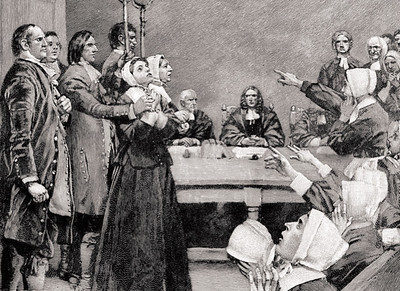
Pendel Witch Trials

For maximum review enjoyment, I highly recommend listening to this song.

This is a haunted place. The living and the dead come together on the hill.

Winterson immerses us into 1612 through her artistic spinning of real people (like John Dee), places and events into a devilishly good tale. As she explains in the introduction, the characters are real though their stories are mostly her invention, and it takes a true talent like Winterson to bring Shakespeare in for a small but effective cameo and not have it feel like a gimmick. Especially when he delivers warnings such as ‘do not be seen to stray too far from the real that is clear to others, or you may stand accused of the real that is clear to you,’ and mocks the lawmen to their own faces. Minor figures in the history get backstories, such as the critical role of Old Demdike, and suddenly the past is a literary playground. Set in Pendle Hill, Lancashire, where it is said girls are baptised twice: once in the church for God and once in the pond at the base of the hill for Satan, we find the women of two poor families accused of witchcraft after a man suffers a stroke in their presence out of fear of finding the women during dusk. For dusk, the golden hour, they believe is the ‘Daylight Gate’, a portal when the land of the living can pass into the land of the Devil.

Putting a witch to death is not murder. It is the law of the Scripture: “Thou shalt not suffer a witch to live.”

Though who needs a gateway to Hell when 1612 England boiling into a hell of its own as King James I is hungry to burn witches and catholics alike in the aftermath of the failed Gunpowder Plot in 1605 (‘remember, remember the fifth of November’). And with Winterson, history always becomes a malleable substance in which the seeds of ideas are grown, sprouting into a minor epic of lovelorn heroines and cut-out tongues. Have I mentioned the talking skull enough? Because there is a putrid, rotting, talking skull. Lancashire happens to be the suspected hiding area for the Catholics involved in the Gunpowder Plot, and for Thomas Potts there is no difference between witchcraft and Catholicism.
What is worse, sir? A High Mass or a Black Mass? To practise witchcraft or to practise the old religion? Both are high treason against the Crown.

With the sister of a certain Plotter locked up on accusations of witchcraft, he hopes to draw his adversary back to Pendle. While the novella concerns witch hunts under the Protestants, all four major western Christian denominations (the Roman Catholic, Lutheran, Calvinist and Anglican churches) persecuted witches to some extent. Witch hunting had been going on a long time, notably with the Witchcraft Act of 1541 passed under Henry VIII, and then King James I’s act in 1603 after publishing his Daeomonologie in 1597 (read it in full here). As we see clearly in The Daylight Gate, accusations of witchcraft can befall anyone if they violate social norms or have an enemy with something to gain. Here we have the unliked, poor and secretly Catholic families of Pendle, both men and women, brought to trial as a spark for a larger political push. As Mona Chollet explains in her book on witch hunts:
Women represented on average 80 of those accused and 85 percent of those condemned…men made up 20 percent of those accused, but they originated 50 percent of the appeal cases…however, the great majority of victims belonged to the lower classes.

Winterson represents history here as a war against women, but also as a war against the poor and opportunism to violently crush political enemies.
572C37AA-98D3-41C2-AD98-6ED83B651DFC
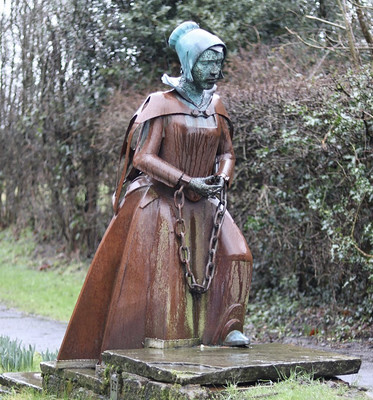
Statue of Alice Nutter in Lancashire, England.

In the middle of this all is Alice Nutter, a woman curiously young looking for her age and a mysterious past that only slowly comes to light. Inserting herself into the local politics of witch hunting has marked her, though her status keeps her safe. At least initially. Alice’s own situation is fraught with politicking, as the magistrate Nowell had previously lost a land dispute to her in court and a single woman with wealth, especially childless, tended to be prime targets to be eliminated through witchcraft accusations. Add to that the fact that the Catholic revolutionary on the run is her lover hiding in her chambers and you’ve got yourself a tense situation that we get to watch Winterson exploit with their literary magic. I mean this book just rips through scenes of tense interlocution, graphic torture, and witchery. Also a talking skull with a rotting tongue pinned inside, in case you missed that. It’s nonstop and will leave you breathless.

She was my memory. There was no one else to remember.

Winterson is first and foremost a romantic, and all the bloodshed and darkness of their novels orbits in contrast to gorgeous investigations of love.This book is vicious—be forewarned—yet in the middle of stomach turning violence and queasy tension are suddenly moments of blossoming beauty that cast the shadows back into their corners. ‘She knew that love leaves a wound that leaves a scar,’ Winterson writes, and the novel traces the lines of the scar like a lover’s finger down their partner’s back. In the backstory moments we find classic Winterson lovers tropes, adorned now in black magic and beset by sacrifices to the ‘Dark Gentleman’. While much of the novel feels like the brothel murder scene in Sexing the Cherry , there are moments that question the meaning of love that harken back to my personal favorite, The Passion . ‘He would love her if she were a wolf that tore out his heart. And he wondered what that said about love.’ The linguistic interplay of woodsy violence and romantic introspection here is so thematically succinct for the novella and is fully in Winterson’s wheelhouse of excellence. And if you've made it this far now you should probably throw on this song.

Love is as strong as death.

Framed as a historical novel, the critiques against the hunger for power and institutionalized religious oppression as a way to acquire and maintain fit perfectly in Winterson’s oeuvre. There is, of course, the hypocritical sense of using religion as a way to harm and control the poor, and Alice even calls out a comrade for losing sight of ethical standards:
Are you like all other men after all? The poor should have no justice, just as they have no food, no decent shelter, no regular livelihood? Is that how your saviour Jesus treated the poor?

Those who appeal most to the crown and cross tend to have the seediest natures, such as pedophile Tom Peeper who committed heinous deeds ‘on a Saturday night and stands in church on Sunday morning.’ We see the poor starving and backed into corners, then massacred when they act in desperation. We see them used as political pawns. We see corruption and vile deeds done for the sake of duty. And then we must ask ourselves who the real villains are, them or those who obtain dark magic to protect their community.

You are stubborn,’ said Roger Nowell.
‘I am not tame,’ said Alice Nutter


This is a perfect book for spooky season, or any other time of the year, and Winterson once again turns history into a fantastical tale that pulls at your heartstrings with a ravenous passion. While very plot-forward, this is a complex tale where each strand traverses a minefield of political and social contexts where bloodshed is all but inevitable and cruelty is the fastest route to keeping your life. While this is likely not the ideal entry point to Winterson, its as good as any though it does lack the brilliant philosophical tangents and stylistic leaps that send you into the stratosphere of her other works. Yet it still stands tall amongst the rest and is an addictively engrossing read. I’ve yet to pick my jaw up off the floor.

4.5/5

Life was an intervention. At every moment the chances change. If Jane were with him now. If they were escaping together. If James had not come to the throne. If the Gunpowder Plot had never happened. If Elizabeth had not executed Mary. If Henry had not wanted a divorce. If the Pope had not excommunicated England. If England were a Catholic country still.
All the history, all the facts, what were they but chances?
Profile Image for Candi.
706 reviews5,509 followers
October 26, 2019
4.5 stars

"Stand on the flat top of Pendle Hill and you can see everything of the county of Lancashire, and some say you can see other things too. This is a haunted place. The living and the dead come together on the hill."

We have just over a week to go before the celebration of Halloween or All Hallows Eve. If you, like me, relish grabbing an eerie selection from the bookshelf at this time of year, then put this one on your list, pronto! If you haven’t gotten around to choosing one yet, then this provocative little book will most definitely do the trick.

Based on the 1612 Lancashire Witch Trials, The Daylight Gate is a tale blending true historical details with Jeanette Winterson’s imaginative storytelling and evocative prose. It’s more horrific than any truly fantastical story as so much of this really did happen. I would not recommend this to the squeamish, however, as Winterson does not spare the reader any of the gruesome details. Squirming is an option, but skimming is not!

"The North is the dark place. It is not safe to be buried on the north side of the church and the North Door is the way of the Dead. The north of England is untamed. It can be subdued but it cannot be tamed."

The setting is simply perfect – dark, bleak and mysterious. Towers and castles loom. The characters are written with vivid detail; they come alive on the page. Some are truly evil (Thomas Potts and Tom Peeper disgusted me to no end), and many are complex, conflicted individuals (Alice Nutter, Roger Nowell, Christopher Southworth). Some are surely desperate due to poverty and hopelessness. Alice Nutter is an historical figure and the author states that she has 'taken liberties with [her] motives and [her] means'. In doing so, she has created a modern, feminist figure that is truly fascinating and entirely believable. It is her independence and hard-earned wealth that give her strength but also cloak her with secrecy. The powers that be are suspicious. A brief and witty encounter with William Shakespeare delighted this reader; the famous bard in all his wisdom warns Alice:

"But, Mistress, do not be seen to stray too far from the real that is clear to others, or you may stand accused of the real that is clear to you."

As the righteous and influential are pitted against the vulnerable, the coarse, and the unconventional, the tension heightens. Woman versus woman, dark versus light, man versus woman, Catholic versus Protestant – no one is safe from the bigotry and hatred that derive from fear and ignorance and the abuse of power.

I first discovered Jeanette Winterson last year when I read a collection of her Christmas short stories. I was impressed by her spare but striking writing then, and am now an even greater, enthusiastic fan who will continue to seek out her work.

"She thinks about Hell, and is it like this? She thinks that the punishments of the Fiend are made out of human imaginings. Only humans can know what it means to strip a human being of being human."
Profile Image for Jaidee .
765 reviews1,503 followers
July 27, 2022
5 "sublime, exquisite, breath-taking" stars !!!

8th Favorite Read of 2018 Award

Jaidee can be a stubborn bastard. Since my early twenties galpals have been urging me to read Winterson. "Jaidee- she writes the way you think and feel" one particularly earnest lipstick lesbian friend told me. I finally took the plunge and boy o boy or should I say girl o girl I have found a new favorite author.

This is a short novel that was published in 2012 and is a very loosely based historical fiction on the Lancanshire Witch events in England in 1632. Here is a very interesting little website about these events : http://www.pendlewitches.co.uk/

Winterson's writing in this book blew me away. So spare yet so rich. She pulled me in and evoked such strong emotions that included pity, disgust, dismay, primal fear and a connection to the darker forces that rule our universe. Winterson chooses each word so carefully and I deeply admire her prose and the many variations of love that exist in her novel. Her characters spring to life from the pages to ones imagination and you are immersed in 17th century England and the challenges of spiritual intolerance,poverty, misogyny and bisexual love.

"It was evening and the room was hot now and the fire was red in the furnace and we had drunk wine. I was naked but covered.
Elizabeth leaned up on one arm smiling at me. Looking into her eyes was like looking into another fire. She kissed me on the lips. She put her hand between my legs and stroked me until I had nothing on my mind but the colour of magenta.
"This is our love," she said...."


You have an earnest new fan Ms. Winterson and I am so glad to have finally made your acquaintance!!

Profile Image for Beverly.
950 reviews464 followers
March 8, 2018
Written in 2012 on the 400 year anniversary of the Lancaster Witch Trials of 1612, The Daylight Gate is an imagining of the events that lead up to the hangings. Gruesome in its description and spare and lyrical in its writing, The Daylight Gate is akin to poetry. It's like a fevered dream, evocative and eerie, it's feel for the crudeness and coarseness of the era masterful.
Profile Image for Jenny (Reading Envy).
3,876 reviews3,705 followers
September 30, 2016
During the Lancashire Witches trials of 1612, several women were charged with witchcraft. Jeanette Winterson takes these stories and imagines a new version. For once, she is not questioning their witchiness, which I thought made for a far better novel. There are some interesting notes made between Catholicism and Satanism, as far as people being put to death for either (and possibly intentionally misunderstanding one for the other)... King James was quite the anti-Catholic, you see.

Witchery popery popery witchery.

Short chapters, short novel, hard to put down. Full of violence and sordid deeds done in the foggy dark. And my first recommendation for spooky October reading!
Profile Image for astarion's bhaal babe (wingspan matters).
901 reviews4,970 followers
October 5, 2018
This was Lancashire. This was Pendle. This was witch country.”



!!trigger warnings at the bottom of the review!!


Okay, first of all, I'll never look at witches the same way ever again.
And second, I'll never look at witches the same way ever again.
The Daylight Gate is the perfect gothic tale that will have your skin crawl with its content and dark atmospere.
I must admit it took me a little to get into it, but it was mostly about the writing. In the first half of the book I found it a tad too descriptive and dull, then some sort of switch turned and the story took a highway to a whole different land.
Jeanette Winterson's characters are realistic, morally invested and driven by a strong passion. Her Alice Nutter is one of the best representations of feminism I've read about lately, especially for the period the story takes place.
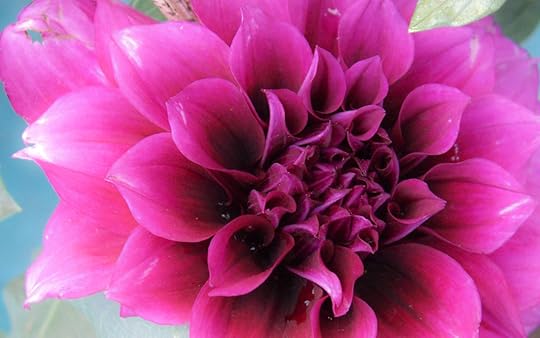
Like I said, the writing wasn't always good, but when I found my way into this little emotional corner where the writing suddenly became sublime, I couldn't stop reading. It's so vivid and direct. I love the way she uses the color magenta, I could see the image in my mind and, let me tell you, imagining this only stain of color in an otherwise grey and miserable picture is possibly more creepy than classic jump scare scenes.
I like to think of that kind of writing as the kind that goes straight to the heart without beating around the bush and, until the end, I was never disappointed by this one.
You can also appreciate not only the paranormal side of it, but the romantic and spiritual aspects, too. I know I did and I don't regret it, even if it hurt sometimes to be surrounded by so much desperation.
What I'm saying is that, with its heavy content and very dark edges, it's definitely not a book for everyone (again, please go check the trigger warning list at the bottom of the page).
However I, for one, was in the mood for something that could shake me a bit off of my comfort fluffy zone made of safe topics and YA novels and The Daylight Gate (and Swaye who was the one who suggested it) prontly delievered.
That ritual scene will give me nightmare for years.
Sometimes you need books like this one to dust off that old, suppressed chill.
Especially at this time of the year...
giphya980e5d2a454dce6.gif


Spookapalooza part 1 with my witchy buddy was a success. Can't wait for part 2.
I love October sooooo much!
Image and video hosting by TinyPic


trigger warnings: explicit violence, gore, child abuse, rape, deprecation of women, various -isms
Profile Image for Carrie.
80 reviews
January 20, 2013
Living near Pendle and having a keen interest in the history of the witch trials, I was very excited to hear about this book. I thought that a well respected writer would do a good job of re-telling the story, but I was to be very disappointed. To say that the book is based on fact is utterly misleading. The names used are the names of real people, and yes, the places are too, but that's where any research into the subject matter ends. On the 400th anniversary of the trial, there has been a call to pardon these people for the so called crimes they committed and in a more enlightened age we understand that the evidence brought against them was unreliable at best. We also know that they were not witches, but possibly Catholics practising "the old faith" as with Alice Nutter, or desperately poor , destitute and disabled women hated and feared for their differences. To suggest that they really were witches and to give them such degrading attributes (brothel keeper, for instance) is downright disrepectful to them. Had it been the 40th anniversary instead of the 400th, relatives would be suing.
As if that wasn't bad enough, the story isn't really any good. It isn't scary, haunting or chilling as it lacks atmosphere, which is quite an achievement when writing about a place so rich with it. The characters are one dimensional and the Shakespeare cameo is frankly a naff attempt to demonstrate the link between the real life witch trials and the playwright's efforts to please the king by writing plays that would appeal to his interest in the supernatural (Macbeth, The Tempest). When I saw the extracts lifted straight from Shakespeare, I imagined the character from Little Britain who is only interested in her word count.
I have previously enjoyed Ms Winterson's writing style, but this book felt clumsy and childish with its overuse of simple sentences. There are also proofreading errors, which together with the poor story, scant research and short length of the book make it feel like a rush job either to squeeze some cash out of the 400th anniversary market, or else Ms Winterson had an unexpected bill to pay off.
It doesn't work as an insight into the witch trials, Robert Neill's Mist Over Pendle does a far better job, nor does it really work as a horror story independent of the Pendle story. One to avoid.
Profile Image for Reading .
496 reviews263 followers
November 18, 2021
This one is inspired by the infamous Pendle witch trials, which took place in Lancaster over 400 years ago and resulted in nine women and two men being hanged for witchcraft on the evidence of nine-year-old girl called Jennet Device, whose entire family were among those executed.

I was pleasantly surprised by this one, it was a fascinating and intense little read.

Although for such a short read, there seemed to be too many characters and I never cared much for any of them.

There were moments that were sweet, light and delicate and then there were moments that were dark, brutal and ugly.

Moderately rated.
Profile Image for Nat K.
521 reviews232 followers
November 9, 2017
3.5★s for me.

”All the history, all the facts, what were they but chances.”

”The North is the dark place.”

I was intrigued by this book as I kept seeing so many reviews for it on GR. So of course I had to read it too.

This was a slow burn for me. The further I got into the story, the more I felt involved in it, horrified by what was unfolding.

”Witchery popery popery witchery.”

”Take heed of what you are told. Take heed what you tell.”

There is quite a menacing undertone, a layer of darkness which aptly reflects the times this book was set in.

The year is 1612, several years after the (failed) “Gunpowder Plot”. England is a hotbed of paranoia, culminating in witch hunts and manhunts for those accused of real or imagined acts of sorcery, witchery, or who remained true to the Catholic faith. Politics & faith made strange bedfellows, and enemies on both sides.

Ignorance, fear & suspicion seem to be underlying themes in this book. Along with deception.

”Born in fire. Warmed by fire. By fire to depart.”

”There are many kinds of reality. This is but one kind…do not stray too far from the real that is clear to others, or you may stand accused of the real that is clear to you.”

”There has to be a sacrifice – don’t you understand that?”

Alice Nutter is a woman of independent wealth, which she has earnt rightfully herself. As per the times, this in itself arouses suspicions as to where her riches “really” come from. Being such a self-reliant woman was unheard of, and rumours abound of witchcraft and deals with the Devil…

Alice is invited to be the thirteenth person at a supposed gathering of witches, resulting in the “trials” on Pendle Hill.

Justice is proven to be a very strange beast indeed.

Famines, pestilence, torture, the treatment of poorer classes & women are all featured in this book, oftentimes in painful detail.

”She had green eyes. Eyes like a pool in Pendle Forest. Eyes like a forest when it rains and the sky is green and the earth is green and the air is green. She had green eyes.”

”If there is another life he will find her there.”

There were passages of absolutely exquisite writing throughout the book. Simply beautiful. I loved the sections which described the flight of Alice Nutter’s falcon across the night sky, I could absolutely visualise it.

Though this is not a long book (give or take 200 pages depending on which version you read), it certainly packs a punch. Thought provoking & provocative.

Will love prove to be stronger than death? Make of it what you will.
Profile Image for Sam Quixote.
4,799 reviews13.4k followers
August 25, 2012
SPOILERS

Alice Nutter is a witch but one of the good ones who uses her powers to keep her looking young and letting the poor live on her land for free. But it turns out one of the poor wretches living on her land is one of the bad witches - who also used to be Alice’s girlfriend! But she’s all old and wrinkly because The Devil chose Alice instead of her. This might seem important but it’s a plot point that’s never really built upon so it means absolutely nothing. I mean, is youthfulness purely the only benefit of letting the Devil roger you? How about better powers like immortality?

While “The Daylight Gate” is based on real events - the Pendle Witch Trials of 1612 in Lancaster, England - Jeanette Winterson isn’t above throwing in some flashback scenes showing a couple of the characters actually doing witch-like stuff, thus giving credence to the ninnies who went around pointing their puritanical fingers at half wits and screaming WITCH! So some of the accused witches were real witches which means... they were right to stand trial? After all the bad witch does try and kill her prosecutor.

Winterson also throws in some not-sexy-at-all group sex scenes and has children being raped throughout all of which amounts to her stern message to the reader - my, things are grim aren’t they? Yes Jeanette they are. And?

There’s a not-at-all romantic sub plot involving a fictional member of the Gunpowder Plot who somehow manages to survive the brutal torture - if you enjoy lengthy descriptions of torture, you’ll love this book! - to escape to France only to return for his sister and Alice, both of whom turn him down leaving him to go to London where he stares out of a window. Effective sub-plot isn’t it? He must have a horrible personality for women to actually choose death than live with him.

The book ends with all the accused witches dying - this isn’t a spoiler, this is based on real events - and some more useless magic at the end. Seriously, why give your characters actual magical powers if they do absolutely nothing for them? What is Winterson’s message about magic - it’s real but it’s worthless? It doesn’t benefit anyone except Alice whose magical powers were the ability to have young looking skin (maybe she’s born with it...) and a falcon who rips her throat out when she wants it to.

So “The Daylight Gate” is what happens when you pay so-called literary writers to write genre fiction: a boring mess of one-dimensional characters, an uninteresting story, and some facts you could’ve looked up on Wikipedia. Witches, witch-hunters and magic are all supposed to be exciting and fun to read about in novels but Jeanette Winterson takes all of that away and leaves you with miserable Northerners doing horrible things to one another - and you still don’t care! If you want to read good books about witches try: Shirley Jackson’s “We Have Always Lived in the Castle” and “The Witchcraft of Salem Village” (this one is non-fiction but still worth a look) or even Roald Dahl’s “The Witches”; don’t bother with “The Daylight Gate”, it doesn’t make sense and it isn’t a good novel.
Profile Image for Dee.
457 reviews150 followers
July 1, 2023
This was the 2nd piece of writting i have read from winterson and it was even more crazy than the first.
This writter is not shy in holding back on the most wild, out there and sometimes completely repulsive imagery within her stories.
She has a way of keeping us focused on her idea and going whatever road it may end up leading. There is no denying she has an amazing way with words. Her imagery has you almost seing, smelling and cringing at some of the things said within this story.

This short story of the lancashire witch trials will have you repulsed and saddend at the issues raised. The madness of the accusations of the witch trials alone and the barbaric treatment of women(and some men) at this time is more than the mind would like to take.
Winterson has no fear of just getting it out there on paper.
I find her work fascinating or interesting. Even tho, from what i have read so far is on a other level.
Profile Image for Hugh.
1,293 reviews49 followers
March 3, 2022
I am not sure what to make of this, not least because it was published by Hammer and their influence is obvious - it is an entertaining but rather silly mixture (dare I use the term YA) of history and fantasy centred on the Lancashire witch trials of the 17th century that draws in the likes of John Dee and Shakespeare. One for Winterson completists only.
Profile Image for Jean-Luke.
Author 3 books483 followers
July 6, 2021
Hmmm. Intriguing but not quite spellbinding. Not like The Passion, which is both a good and a bad thing. Maybe because it's not narrated in the first person, possibly because it is incredibly brief, or simply because it deals with less lofty themes--but what would be the point of writing the same book twice? So many authors make a career out of it, and I admire writers like Winterson who aren't afraid of trying something new, regardless of whether it pays off in the end. The subject matter is interesting, the Pendle Witch Trials of 1612, but the book itself is almost cinematic in the way it flits from one brief scene to the next. Two of the women are in love, but I was never truly invested in their love story. It is unapologetic in it's brutality, and reminds me of Muriel Spark's The Finishing School in its brevity, especially near the end, almost as if it was a parody, or a draft. I really wanted to believe in the magick, and for a minute there I thought I did.
Profile Image for Paltia.
633 reviews109 followers
October 14, 2019
Madwomen leaping with wild eyes, calm compelling Alice Nutter, magic, familiars, spells, elixirs, Shakespeare and that nasty King Jimmy with his henchmen. Seek mystery and reclaim your own wise vision with this story. Be on the lookout for those missing the third finger of their left hand.
Profile Image for Mariana.
422 reviews1,913 followers
February 26, 2022
Una agradable sorpresa. Hace tiempo que tenía ganas de encontrar un libro que pudiera leer de un jalón y, de no ser por obligaciones de la vida adulta, este quizá lo hubiera acabado sin pausa. La historia se centra en los juicios de brujería de 1612 en Lancashire, la protagonista es Alice Nutter una mujer rica que fue encontrada culpable y asesinada por brujería al lado de otras mujeres que eran de un estrato social más bajo. Si bien está basado en hechos reales, la autora nos indica que mucho de esto es ficción, sobre todo los encuentros de Alice con personajes como John Dee y Shakespeare. Tiene unos momentos muy perturbadores, tales como la profanación de tumbas para lograr que la cabeza de un muerto hable, pero también hay descripciones explícitas de tortura y violación. Me hiciera gustado que fuera más largo para desarrollar más la relación de Alice con Elizabeth, pues se siente un poco apresurada y con falta de profundidad. Fuera de eso me pareció un gran libro sobre brujas, con gran atmósfera y, aunque sabemos el destino de Alice desde el inicio, me angustió mucho porque quería que todo le saliera bien. Recomendado.
Profile Image for Craig Laurance.
Author 29 books163 followers
July 26, 2013
The Daylight Gate exists at a crossroads, between fact and fiction, reality and fantasy, and prose and poetry. Jeanette Winterson uses History to spin a mediation on persecution, feminism, polyamory, power, religion and abuse.

The history she uses this time is that of the Pendle witch trials in the 1600s of Britain. A group of women and men were hanged for witchcraft, and using everything from flights of fantasy to ribald humor to Grand Guignol horror, Winterson tells their tales. The main protagonist is Alice Nutter, a wealthy and independent woman who gained her wealth by creating a a unique magenta dye. She is at the center of several circles. She owns the land where the accused witches live. She also is the lover of a banished Catholic who (allegedly) tried to assassinate King James. In the past, she worked with Queen Elizabeth’s court mathematician/magician John Dee, and through him, met her other lover, the beautiful Elizabeth Device—who is the matriarch of the accused Pendle witches. Nutter is the central piece of the kaleidoscopic text, which includes the priggish chief lawyer Thomas Potts, a cameo by Shakespeare and the points of view of the other accused people.

The real star, though, is Winterson’s marvelous prose. Each sentence sparkles with invention. Her imagery is magical, brutal, funny and terrifying—often at the same time. The story is multilayered and full of symbolism, but it is also fun. The Daylight Gate could be read as a dark gothic fantasy, a feminist parable, a lesbian fairytale or a prose poem.

Profile Image for Alex Hammond.
Author 10 books17 followers
September 30, 2012
Jeanette Winterson is one of my favourite authors. However, The Daylight Gate felt a little thin. Yes, it is a novella, so it's intended to be a shorter work, but it felt stretched out. The Passion, one of her earlier novellas, which this piece is in some ways reminiscent of being also supernaturally themed, felt more like a larger work bulging against its length. The Daylight Gate feels at times like the opposite, that it should do more, go further.

Winterson has the profound ability to construct beautiful, evocative sentences which she does many times in The Daylight Gate. Rather it is the motivation and character development that felt undercooked. This is particularly pertinent as it is set during witch trials where accusations and motive are key. The novella rockets forwards through a series of tableaux-like chapters. May of these are only a 2-3 pages long so there is little time for the reader to get to grips with the characters before we move on. In fact the more successful chapters are longer, where character and motivation are lead out and where we are afforded the opportunity to form an emotional connection with the protagonist, Alice Nutter.

It's a shame, as the core setting of this book is ripe with possibility: 1612, the north of England under James 1, witches, Papists, heresy... all published under the banner of Hammer Horror. What I was left with was the sense of a missed opportunity. The stars had aligned but somehow the portents were missed.
Profile Image for Sally Whitehead.
209 reviews7 followers
September 22, 2012
Incredibly disappointing. I’m a fan of Winterson, and I am very interested in the Pendle Witch Trials...so where does “The Daylight Gate” go SO wrong?

Well, if I hadn’t been told who had written it I would never have guessed it was Jeanette Winterson as I don’t associate her with such a simplistic style. I wondered at times if I was reading a children’s book, but some of the content is far too graphic, and besides I’ve read Winterson’s “Tanglewreck” and it’s clever and really well written. The dialogue is clunky, the description sparse and lacking in any real sense of atmosphere. The only sections which are described in any detail are those depicting torture, and even these are done with an almost blood-thirsty lust. I’m not squeamish, but I’d prefer to see these depraved, inhumane acts depicted in a more intelligent manner if they are to truly depict this shameful period of history.

And herein lies my biggest problem with this book. The fictionalised lives of those accused. I don’t mind Winterson’s playing around with the past and developing nuggets of historical hearsay about the likes of Shakespeare, or how Alice Nutter acquired her relative wealth and status, and explored her lesbian tendencies; this is all quite good fun. No, what really made me uncomfortable was the “magic” in the book, the implication that these social outcasts didn’t just dabble in the occult but that they were full on spell-casting, grave robbing, poppet-stabbing well, um, witches.

Speaking severed heads, elixirs of youth, transmogrification and shape shifting all have their place in horror, but this for me just begs the question; does historical fiction such as this REALLY need any fantasy adding to it...isn’t the story itself horrifying enough?
Profile Image for Barbara K.
702 reviews198 followers
January 22, 2025
As I've mentioned before, the phrase "strong stuff" always comes to mind when I read Jeanette Winterson's books. Powerful, and generally not for the faint of heart. Bourbon, not white wine.

In many respects this is a remarkable book, one that I could not put down even though from reading the actual circumstances of this case I knew the outcome. Of course, it IS historical fiction and Winterson invented an elaborate backstory for the central character, Agnes Nutter, with no basis in actual fact. But somehow I didn't think, as I read, that she would change the ending.

The book abounds with alchemy and witchery and religious conflict. The early 17th century was a particularly grim time for anyone in England to espouse the Catholic faith, and James I of England (aka James VI of Scotland) chose to direct the energies of his reign against demons - and witches, almost always women.

Generally, these were poor and helpless women, and Winterson's vivid descriptions of their plight is challenging reading, being accurately and acutely wrought. The visits to the Jacobean torture chambers are equally sad and harrowing.

Fortunately these grim realities are balanced with brilliant storytelling, especially as Agnes relays her history to a lover. I was swept up with the richness of the imagery as she described people and places and events in her past.

In Agnes, Winterson has created for us a woman of whom we can be in awe. One who has made a life for herself using her clear-headed intelligence, her love and her compassion.

“You are stubborn,’ said Roger Nowell. ‘I am not tame,’ said Alice Nutter.”

“He scarred her arm...but she did not care because she loved him and she knew that love leaves a wound that leaves a scar.”

“Are you like all other men after all? The poor should have no justice, just as they have no food, no decent shelter, no regular livelihood? Is that how your saviour Jesus treated the poor?”

The novella length of this book is ideal. Another author might have attempted to stretch out the story to a full length novel, but that would have done the story a disservice. Winterson has created something that can fit in a shotglass, not delicate stemware.
Profile Image for Rand.
481 reviews116 followers
February 10, 2016
TRIGGER WARNING, details below beneath the "spoiler" tag.

Historical fiction can be hit or miss, depending upon one's interest in the given subject and the author's abilities and execution. For those who are fascinated by witchcraft and/or the waning of Queen Elizabeth's influences on England (Gunpowder Plot, anyone?) this is a quick and enjoyable read.


Winterson has some great lines in this one; one of my favorites is the phrase witchery popery popery witchery which was recited by the McCarthy-esque government goon named Potts. The structure of the narrative employs some use of flashback although it is not nearly as intricate as Winterson's Gut Symmetries, which I also enjoyed (although I am hesitant to make any concrete comparisons between the two without rereading both after completing Winterson's published catalog). Suffice it to say that if you enjoy her writing (for either themes or style) than you will love this book, as it is certainly a tightly-honed little package that will leave you breathlessly contemplating the briefest glimmers at dusk.
Profile Image for Leah.
634 reviews74 followers
July 20, 2013
Neat, sparse prose in a very short book about the Pendle witch trials, by a woman. This is unusual in itself, as men seem to be the ones generally fascinated by the horrific persecution of poverty-stricken women in recently excommunicated England.

The handling of the characters is delicate and complex - on the one hand, they are desperately pitiable, filthy and poor with no possible hope of relief. On the other, they are nasty, vicious women (and a young man) who have no compassion for Alice Nutter, seemingly the only person with any feeling at all for them.

But then, in fairness, Winterson's Alice Nutter really is a witch, having been sold in a pact with the Dark Gentleman for the soul of her friend and lover, Elizabeth Device. She keeps herself youthful by alchemical means and believes in no god, does not fear the men who control her world, and harbours her Catholic lover without a thought of giving him up to save herself. She is an atheist, a Papist-sympathiser, a land-owning widow with a self-sufficient income from her own inventions. In short, a veritable nightmare to all the men around her. Of course she deserves to be hanged.

This book is visceral in its imagery, the filth of the prison and the witches squalor in Malkin Tower, the warmth and comfort of Alice's home, the chill of Pendle Forest, the dark dubious warmth of Tom Peeper's inn. The unsafe comfort of Roger Nowell's home, hinting at what could have been had Alice been less determined to be independent.

Without any fat, without any superfluous words, Winterson manages to tell a sharp and difficult story with a strong undercurrent of magic in a completely matter-of-fact way. Alice Nutter has dealt with the Dark Gentleman, and does use an elixir to preserve her youth. Demdike and her brood do attempt to cast spells, pin poppets to torture men, dig up graves to use the bones and rotting flesh in their craft. They believe they are witches, Alice says to Roger, and what is the harm in that?

A vicious and haunting book.
Profile Image for Xfi.
546 reviews89 followers
November 21, 2018
No es una maravilla de libro , pero tampoco es horrible.
Un intento de recrear un tiempo muy, muy oscuro con un batido de fantasía y rigor histórico.
Por supuesto, esas dos cosas no pegan ni con cola y el resultado no funciona.
Mezcla de géneros y pretensiones: denuncia de la intolerancia, recreación histórica, fanatismo, historia de amor, traiciones, magía, espiritismo... todo ello en menos de 200 páginas y descrito de una forma un tanto atropellada.
Le salva la concreción, la ausencia de pretensiones estilísticas y la forma cruda de recrear unos hechos que hacen que me avergüence de la "humanidad".
Profile Image for Ends of the Word.
543 reviews143 followers
February 21, 2017
In the past years, Hammer Film Studios have attempted to return to the glories of old with a number of new horror movies, including the atmospheric film version of Susan Hill’s The Woman in White. Parallelly, Hammer has diversified into the publishing business, commissioning not just film tie-ins but also new horror stories by established authors. These have included fine ghostly tales by Helen Dunmore and Sophie Hannah, but the most self-consciously “literary” contribution is probably Jeanette Winterson’s “The Daylight Gate”.

Inspired by the notorious Lancashire witch-trials of 1612 and cannily issued to coincide with the 400th anniversary of the tragic events, this slim book is a bold reimagining of history, using real characters and places woven into an intriguing blend of fact and fiction.

The early 17th century was a dark period of British history. James I, having survived a number of treasonous plots (both real and, possibly, imagined) was clamping down on segments of the population deemed “dangerous”, including Catholics. This paranoia infected the population and outsiders could easily be branded as “witches” or “dabblers in the occult” as a pretext for prosecution (and persecution). Indeed, some historians now believe that the Lancashire witch trials were merely an exercise in anti-Catholic propaganda.

Winterson is brilliant at evoking this threatening, oppressive setting. Not for her the detailed descriptions historical novelists are wont to resort to in order to conjure up the past. What we get instead is a lean, almost biblical narrative voice which fits the epoch being portrayed, but is also timeless. It seems to suggest that terror does not lie in the supernatural but in the misery which Man is capable of inflicting on Man. And more unsettling still, that history can repeat itself and political oppression is not restricted to a particular time or place.

So far so good. But Winterson seems undecided whether to stick to writing a historical novel with subtle supernatural overtones or to opt for a straightforward piece of diablerie. That’s where the book starts to lose its focus.

“Popery witchery witchery popery” claims Thomas Potts – the real-life chronicler who acted as reporting clerk for the Crown. Winterson quotes his mantra in her introduction and argues that this was the typical reasoning of a reign where “witchery” was a convenient excuse to proceed against uncomfortable political figures. Yet, one of the characters in her story is, precisely, a Jesuit who, having survived torture without renouncing his faith, is not above embarking on a sexual liaison with an alchemist/occultist. With a cleric and a witch as bedfellows, Thomas Pott’s allegations do not appear so far-fetched. Again, the initial chapters suggest that the suspects in the trials are, at best, wrongfully accused outsiders who are being denied a fair trial or, at worst, a bunch of deluded dabblers in superstitious rituals. As the novel progresses however, we learn darker secrets about them and our sympathy towards them starts to wane.

My quibble is not about whether this portrayal is true to history or not – the problem is that Winterson’s approach undermines the very thrust of the novel. It almost seems as if there were two books rolled into one, each struggling to gain the upper hand.

“The Daylight Gate” is certainly a well-written read and the narrative style is gripping enough to lead you on despite the novella’s inconsistencies. However, it’s difficult not to feel that this could have been a more convincing work.
Profile Image for DeeLee.
49 reviews4 followers
March 12, 2015
Don't be fooled, people- this is a horror story. And I mean that as praise.

The Daylight Gate is a snapshot of the events leading up to the famous trial of the Pendle witches. It's not a straight history, but Winterson has obviously done her research.

I've not read Winterson before now, so had no expectations of her writing. In this book I was struck by the prose. She writes very lean, but still manages to evoke a time and a place, and convey a real sense of dread. Most modern authors who attempt the macabre fail, in my opinion- it usually just ends up coming across as lurid or silly.

In this story, however, there are some genuinely creepy scenes:


Having read this book I'm annoyed once more over the ideological rift between Literature and Genre Fiction (can't we all just get along?) This novella is most definitely a work of Serious Literature, yes. But it is also a Horror Story and I won't hear otherwise. It's a shame though, that many horror fans probably won't ever encounter this book when looking for something new to read, because if the publisher sold it as a horror story, it would lose its literary credentials. It reminds me of how Margaret Atwood keeps writing SciFi, while denying that what she writes is SciFi.

As well as being a gripping horror story and a work of Serious Literature, this book raises some interesting questions about the fictionalisation of history. At university I took a course on the European witch trials and have a good understanding of the subject. The witchcraze is often assumed to have been caused by the mass hysteria of the peasantry, but in reality it was a political phenomenon- driven by men of the well-educated and cynical ruling classes. The craze arose from the class relationships between men and women, between the elites and the peasantry, and from the radical shifts in the economic landscape at the time. This context cannot be overstated.

I'm sure Winterson is aware of all that, and so it's interesting that she decided to tell this type of story, . It's got me thinking - do authors have a duty to history (especially when that particular history is so often misinterpreted already)? Or is their only duty to the craft of telling a good story? Thorny questions, no easy answers!

Profile Image for Paula.
577 reviews260 followers
August 2, 2016
Jeanette Winterson ha sabido recrear una época oscura de la historia de Inglaterra tomando un hecho real, los juicios de brujas en la Inglaterra del siglo XVII, y creando una historia de brujería, superstición, limpieza religiosa (el exterminio de la religión católica en la isla) y fanatismo. Aunque al principio pensé que el relato tenía una cierta falta de fluidez enseguida me di cuenta de que en realidad no era tal cosa sino que la autora no regalaba palabras a la ligera. Winterson no alardea de frases floridas y textos recargados sino que va al grano y habla al lector con mucha franqueza....

Leer reseña completa
Profile Image for CaseyTheCanadianLesbrarian.
1,362 reviews1,878 followers
October 17, 2019
I'm not sure how I feel about this. For the most part it was pretty brutal and ugly, which is perhaps just the truth about a lot of life in England under the rule of King James I. Despite the interesting subject (the events leading up to real witch trials and execution in 1612) and Winterson's trademark beautiful spare writing, it never really grabbed me. I liked that Shakespeare had a cameo and that the main character was a real witch and queer though.

Content warning for rape, child abuse, incest, suicide, and a whole bunch of physical assault.
Profile Image for Ieva Andriuskeviciene.
242 reviews130 followers
March 17, 2021
Jeanette Winterson mus nukelia į 1612uosius, žymiausią dokumentuotą Anglijos Lancashire raganų teismą. 20 žmonių, iš kurių 16 moterų, buvo teisiami už raganystes. Išlikęs dalyvavusio liudininko teismo aprašymas. Pagrindinė liudininke Jennet Device buvo tiesiog devynerių metų mergaitė liudijusi prieš savo mamą. Knygoje to nėra, bet suaugusi Jennet buvo nuteista mirties bausme dėl raganysčių
Istorija seka turtingos moters Alice Nutter likimą. Ar tikrai ji buvo ragana? Kodėl ji tokia graži ir tokia turtinga? Ir ar jai pavyks išvengti kankinimų ir kartuvių? Kokios aukos bus iš jos pareikalauta?
Literatūrine prasme gal ir ne šedevras, trumpa knygutė kuri istoriškai labai arti tiesos. Su pagražinimais ir spekuliacijomis, bet visai vaizdingai nukelia į magijos ir tuometinio teismo pasaulį. Netgi feministinė nes tiprios ir savarankiškos moterys iš karto nuteisiamos.
Visos vietovės tikros, netgi kaltinamųjų pavardės tikros. Tikrai rekomenduoju besidomintiems raganų tema
Ir atsargiai su raganystėmis, nežinia kaip gali pasibaigti!
Kas norit plačiau ir ne grožinės informacijos ta tema, yra visas tinklapis:
http://www.pendlewitches.co.uk/
Labai įdomi dokumentika:
https://youtu.be/MATKIhrDZSc


Profile Image for Swaye.
334 reviews35 followers
October 6, 2018
4 GOTHIC STARS! ★★★★

A surprisingly good Spooktober buddy read with this very pretty pigeon. 💚

This was the only Winterson book I hadn't read because I am a bit of a scaredy cat but I'm so glad I finally did. I had heard of Alice Nutter before but I'm really glad this was my first proper introduction to her story. True to style, The Daylight Gate was magically atmospheric and engaging, especially the second half of the book which is what really launched it into 4 star status for me. I was a little put off initially by the change of writing style from her previous books but as the story progressed, and as I became more invested in the characters, I began to appreciate it. It was sparse and poetic and what could have been a very boring historical fiction was instead an eerie glimpse into what it must have really been like to live in the middle ages in all its perverse gruesomeness.
Profile Image for jaz ₍ᐢ.  ̫.ᐢ₎.
276 reviews221 followers
May 8, 2025
Disappointing to be honest, watched a documentary prior to reading this about the Pendle Hill witch trials (which is what this novel is based off) and there is no similarities apart from names. Almost came off disrespectful in a way with how these women are depicted in this story. I am not deterred I still plan on picking up another Janette Winterson, I will not let this be my only impression of her writing.
Displaying 1 - 30 of 1,111 reviews

Can't find what you're looking for?

Get help and learn more about the design.