James Patterson is the most popular storyteller of our time and the creator of such unforgettable characters and series as Alex Cross, the Women’s Murder Club, Jane Smith, and Maximum Ride. He has coauthored #1 bestselling novels with Bill Clinton, Dolly Parton, Michael Crichton, and Viola Davis, as well as collaborated on #1 bestselling nonfiction, including The Idaho Four, Walk in My Combat Boots, and Filthy Rich. Patterson has told the story of his own life in the #1 bestselling autobiography James Patterson by James Patterson. He is the recipient of an Edgar Award, ten Emmy Awards, the Literarian Award from the National Book Foundation, and the National Humanities Medal.
As a person who loves to read, it is really hard for me when I have a kid come into the library looking for a book because their parents or teachers have said they need to read, but they don't like to read. Middle School: Save Rafe! is exactly the type of book I would give to one of those kids. This is book 6 in the Middle School series, and I haven't read the majority of the books before it, but I did not feel like I was missing anything major. If there was an aspect of the book that needed that background, Rafe presented it to the reader. The story was fun, the humor was great and I liked that there were references to pop-culture, and despite the fact I am not a teenage boy, I was able to relate to Rafe and his feelings.
The only part of the story that really bothered me was how Carmen just backed off immediately when Rafe told her to pack her own things because they were even in regards to favors. She spent the entire first part of camp forcing him to do her work, I feel like the fact she just backed off did not match the personality that was originally presented to the reader.
I also enjoyed the fact that Rafe had stopped just thinking about himself by the end of the story. He had truly started working with the other campers as part of a team, and the letter to his future self showed that he was thinking a lot about his Mom and making her proud.
While I would not say this is the best Juv/YA book I have read so far this year, it is enjoyable and is a wonderful book to recommend to any child or teen who is a reluctant reader. This is also a great series to nudge kids towards if they enjoy Diary of a Wimpy Kid or Dork Diaries.
Another humorous story about Rafe. In this one he is sent to a wilderness survival camp for a week. Can he survive? Fans of humor like Diary of a Wimpy Kid or Dork Diaries should enjoy this one.
This entire review has been hidden because of spoilers.
What doesn't kill you, makes you stronger.....You appreciate the good things in life when you struggle through the hard things..... These are just a few things that ran through my mind as my kids and I read this book. Rafe, because of his mixed up middle school attitude, is being forced to complete a summer survival camp in order to be considered to be readmitted to HVMS. Camp? How hard can that be! He's in for the surprise of his life when he realizes this camp isn't for the faint of heart. The life lessons and struggles he learns and goes through are priceless. I enjoyed reading about them, but I don't know if this camp is something I'd ever want to do!
January Book Review Save Rafe! James Patterson Rafe was kicked out of Hills Village and Airbrook Arts is closing, so he needs to go back to Hills Village, but that will be a challenge for him. His two least favorite people are the principals and sisters at Hills Village. They send him to The Program which has Rafe doing challenges that he couldn't possibly imagine. He has to do these challenges for a week then he could get back into Hills Village. Do you think Rafe can do it?
The theme of this book is to never give up. Rafe had to do these really hard challenges that he didn't want to do, but he never gave up. He wanted to do it for his mom, so she didn't have to worry then she did already. Rafe wanted to give up on the program mid way, but he didn't.
Funny and humorous is not the best way to call this book. Each page on the book is way to cheesy and cringeworthy in my opinion. To call this book "funny" just doesn't feel right. I regret reading the whole book. The fact that this is the sixth book in the series, just makes me want to stop reading any other book in the "Middle School" series. Sure the book might have been funny if you were in first grade. Considering that the book title and the book is literally all about middle school, it just doesn't feel anything like middle school. Matter of fact, the book should be renamed to "Elementary School". Compared to any other James Patterson books, this one just doesn't have it. Looking for a cheesy and cringeworthy book? Then Middle School: Save Rafe is the book for you.
Rafe Khatchadorian, a middle school trouble maker wanted to have a good start to his new school year after a terrible summer. But, when he came to school they told him he was held back a year. So he tried his best to not get held back. Then all he had to do is go on an outdoor survival trip, and he must pass it t o not get held back. This book is about confidence, perseverance, and determination.
I realy liked this book its one of the best.It has lots of events and it's about this boy named Rafe that he has to move to his old school but he has to go to the camp in order to get back in to his school.The ending is a really big twist and left me hanging. but over all its really good and you should defently read it.
I gave this book four stars out of five because it really brought me into the story and really made me want to read more. Save Rafe by James Patterson in a realistic fiction comic book that haves a middle school kid go to a camp to get him readmitted at his old school (HMVS). This book really made me want to jump in and help him out to get readmitted so it would take stress off of his mother. It was an overall fantastic book. This book was one of the best books that made me want to jump in to the story. Every time someone made Rafe mad I wanted to jump in and punch the bad person. Many people were rood to Rafe even if they think they were not. The person Rafe disliked the most was Mrs. Striker the Principle! Even though Rafe did not see eye to eye with her he had to semi “respect” her because she was the principle of the school and was in charge of anything and everything. This is the most frustrating thing when you want to help the character but you can't. This book was entertain because it kept me on the edge of my seat and wanting to read more. It particularly made me want to read more at the camp and the girl that he thought was weird at first liked him. This book was also entertaining because in the previous books he was at a school that he loved and that school got closed so, the only other option was HMVS which he dearly hated. He went to the school in the summer to be readmitted but the principle said that he did some bad things at HMVS in his previous year so he would have to do this seven day camp to be considered to being readmitted. This basically shows you how cruel the school was and how hard it was for rafe to get back in. James Patterson made me feel alive in this book and wasting to read more. He really described every scene and what was happening. He even put in everyone's thoughts. The best part about this seris is that Rafe has and imaginary twin brother that died when he was born and James Patterson really makes his brother alive any time he can and always involves him. Patterson also makes Rafe seem like a real life friend of the reader because he connects with the readers in so may ways which is how he makes me feel so alive. This book was an amazing realistic fiction that made me not only want to read more but be in the book. James Patterson s such a great author and makes you feel so alive reading any of his books. I want you to read this book because this is the life of a middle school kid that has some hard times and has to dig himself out of it to have some fun and live life.
I gave this book four stars out of five because it really brought me into the story and really made me want to read more. Save Rafe by James Patterson is a realistic fiction comic book that has a middle school kid go to a camp to get him readmitted at his old school (HMVS). This book really made me want to jump in and help him out to get readmitted so it would take stress off of his mother. It was an overall fantastic book with many interesting scenes. This book was one of the best books of the series that made me want to jump in to the story. Every time someone made Rafe mad I wanted to get involved and stick up for him. Many people were rude to Rafe even if they don admit it. The person Rafe disliked the most was Mrs. Striker the Principle! Even though Rafe did not see eye to eye with her he had to semi “respect” her because she was the principle of the school and was in charge of anything and everything. This is the most frustrating thing when you want to help the character but you can't. This book was entertaining because it kept me on the edge of my seat and wanting to read more. It particularly made me want to read more at the camp and the girl that he thought was weird at first liked him. This book was also entertaining because in the previous books he was at a school that he loved and that school got closed so, the only other option was HMVS which he dearly hated. He went to the school in the summer to be readmitted but the principle said that he did some bad things at HMVS in his previous year so he would have to do this seven day camp to be considered to being readmitted. This basically shows you how cruel the school was and how hard it was for Rafe to get back in. James Patterson made me feel alive in this book and wanting to read more. He really described every scene and what was happening. He even put in everyone's thoughts. The best part about this series is that Rafe has an imaginary twin brother that died when he was born and James Patterson really makes his brother alive any time he can and always involves him. Patterson also makes Rafe seem like a real life friend of the reader because he connects with the readers in so may ways which is how he makes me feel so alive. This book was an amazing realistic fiction that made me not only want to read more but be in the book. James Patterson is such a great author and makes you feel so alive reading any of his books. I want you to read this book because this is the life of a middle school kid that has some hard times and has to dig himself out of it to have some fun and live life to the fullest.
The book I read was Middle School:save rafe the author being James patterson. After a rough summer, Rafe is heading back to the dreaded Middle School, the place of the worst years of his life. And as if that's not bad enough, he's learned that he's going to be held back a year unless he can prove himself on an outdoor adventurer. He has to go through things like dangerous white-water rafting, rock climbing, and strict counselors. Rafe and some other troublemaking kids, some worst than others woods. And the instructors are strict and don’t tolerate anything but the best. Can Rafe come out of the woods like he was before he went in or will he go home as the same troublemaking kid? This book had a really good plot and it was not confusing to what was happening in the book, I would give it 3 stars. Wasn’t the best nor was it worst book I have ever read. People that would like this book would probably be interested in pulling good pranks and aggravating the teachers. I am using this for fantasy fiction because it is not real.
Sou fã assumida desta série, pronto. Rio-me imenso com as peripécias do Rafe Katchadorian, e aprecio a forma como o autor brinca com os primeiros amores da adolescência, tornando o assunto leve sem o ignorar. Leio para o meu filho de 10 anos e é tempo de qualidade que passamos juntos.
I think this book is amazing and I would definitely recommend it to every one mainly of the age 7-15 . My favourite bit is when Rafe escapes from the camp ,which he hates, and robs the shops so he can afford food .
This entire review has been hidden because of spoilers.
As a survivor of the troubled teen industry, I am appalled that James Patterson wrote a book that shows a wilderness troubled teen industry program in a positive light. Kids have died in those programs. Also, kids go through every type of abuse imaginable. A lot of girls who were in the first program I was dumped in as a teen unalived themselves to escape the abuse memories and permanent consequences of the abuse. A lot of us who are still alive are disabled because of the abuse. A lot of wilderness program survivors have spine/back issues as adults because we were forced to carry stuff that was too heavy for us when we were in the wilderness program as kids. There are also a large number of troubled teen industry survivors who have a lot of medical stuff going on as adults because of the trauma, including conditions like POTS, MCAS, Hashimoto’s thyroiditis, fibromyalgia, chronic fatigue symptom, and so many others. There are other survivors who ended up in a wheelchair eventually as an adult just like I did.
I picked up this book, because another troubled teen industry survivor on Reddit mentioned it and said they thought it mentioned a wilderness program in a positive way. Before my body finally shut down on me too badly to even survive part time work anymore, I worked in book stores and libraries and also did some volunteer work in two different libraries. I still recommend books sometimes to family and friends and I didn’t want to recommend this author if he actually did write a book that makes the troubled teen industry look good.
I almost didn’t get through it because of how triggering it was, even though it was tame compared to what kids actually go through in programs like that. He forgot to mention all the physical abuse, sexual abuse, emotional abuse, medical neglect, gaslighting, brainwashing, lack of proper K-12 education despite false claims of accreditation, starvation/underfeeding, unsanitary food/water, and sometimes even hard physical labor if it’s a long term wilderness program like mine was. He also forgot to mention that some kids are only there because they are foster kids and there are no homes that can take them. Those foster kids didn’t necessarily do anything wrong to end up there, and sometimes they get warehoused in programs from as young as age 10 or 12 until they turn 18. Also, foster kids often face the worst abuse in there, because staff think they can get away with it more easily since they think no one cares about those kids. A psychiatrist was literally sexually abusing some of those kids in one of the programs that I was in. Some kids who end up in troubled teen industry programs come from abusive families where they should have been taken out by CPS but weren’t. Parents sometimes dump kids in places like that to get rid of them, cover up abuse, or because they don’t want to be a parent. A lot of those kids go no contact or low contact with those parents as soon as they reach adulthood. Good parents who legitimately made a mistake and were duped by those programs to send their kids there are rare. I only know of three cases where the parents are legitimately good people, and all three cases were from programs that were different from the ones I was dumped in. In the programs I was in, I only met one person who was court ordered, and kids can get court ordered for something as simple as truancy, which might be something out of their control if they rely on their parent(s) for transportation to school and the parent isn’t parenting.
Being labeled troubled teens means that no one takes us seriously when we mention the abuse (mentioning the abuse to outside people can get kids punished in those programs) and it makes outside people scared of kids from those places when they run away, because they think the kids are criminals, when in reality, most aren’t. That fear means no outside people help the kids. Yes, some kids develop negative coping mechanisms like attempts to unalive themselves, self harm, anorexia, running away, or other things like that, but those negative coping mechanisms don’t happen in a vacuum. Kid brains are not meant to handle abuse/neglect, and those kinds of coping mechanisms are what happens when kids are trapped in abusive situations with no help and no way out. Being dumped in abusive troubled teen industry programs may appear to work at first because the kid is doing what abusive adults want to minimize the abuse they face, but in reality, it doesn’t fix anything. Some of those kids end up committing suicide when they get home because of the trauma. Some end up doing worse things like hard drugs to escape the abuse memories. Some kids end up as broken adults who end up eventually having their world crash down on them when their body finally shuts down on them after a lifetime of being stuck in fight or flight because of years or even decades of abuse. A lot of us end up in abusive relationships as adults, because we were brainwashed into believing that the abuse that was done to us in the troubled teen industry program was “treatment” and that we deserved it because we are bad people. Decades later, a lot of us are still unlearning those lies we learned in those troubled teen programs and learning how to recognize signs of toxic behavior in relationships.
The worst thing is that some states protect our abusers and make it impossible for survivors to hold our abusers accountable. Also, the same abusers who abused us sometimes end up working in troubled teen industry programs for decades abusing multiple generations of kids and getting away with it, because local law enforcement and politicians are complicit. Troubled teen industry programs are often built in areas with limited employment opportunities, and since they are the main job providers in the area, nobody wants to shut them down. People turn a blind eye to abuse. Need a recent example? Google “Pathway Owens Cross Roads Alabama news” and read the news articles that have come out over the past few months and the past year and a half. That place used to be Three Springs New Beginnings and was finally closed for abuse when it was under the name Sequel Owens Cross Roads, and yet it was allowed to reopen under a new name and new shell company with a former Three Springs upper level staff member as CEO (which they openly admitted on the Pathway Inc website since they know they can get away with it), a fake AI generated photo of the director of the Madison County Owens Cross Roads facility (the real director has grey hair, side burns, and is a skinny white guy who is a liar and a horrible person) on the Pathway Inc website, and some of the same staff who have been working there since 20+ years ago when it was Three Springs New Beginnings. Kids keep running away and no one helps them and the politicians don’t shut down that place. Kids don’t just run away for no reason. As an added bonus, Google “Three Springs Paint Rock Valley abuse” if you want to read true survivor accounts of the horrible things that happen in a long term wilderness program. If you want to learn more about abusive short term wilderness programs like what James Patterson did a terrible job portraying in his book, Google “Second Nature abuse”. I personally know two girls who went through the program at Second Nature, and both are physically disabled now and still traumatized by it and other programs they were dumped in after that. Most kids don’t go straight home after those short term wilderness programs. They usually are dumped into a long term wilderness program or a long term indoor program after they complete the short term wilderness program, and that was true for both of my friends. The sad truth is that if you graduate one of the long term programs, you still might get sent to another program instead of going home, especially if you are a foster kid or your parents dumped you in there to get rid of you or because they don’t feel like being parents. The kids that did go home were often a shell of themselves after they got home, often went through worse abuse at home than they left, since programs often give parents instructions for home which are abusive, and a lot of kids try to appear okay until they can get themselves out of that abusive home after they turn 18. Sometimes kids end up in psych wards repeatedly after they get home or get sent to other programs, because that stuff is normalized and they learn that doing crazy stuff to get institutionalized is how they earn the love they never felt at home. Also, after being institutionalized for years (it took 18-24 months for most kids to graduate the two programs I was dumped in), kids don’t know how to function in the real world. Kids who get out by aging out end up having to face adulthood completely unprepared and have to learn a lot of life skills alone without help. That often ends badly for a lot of those kids who age out at 18 and enter the adult world abruptly. A lot of troubled teen industry survivors end up homeless as adults.
What James Patterson wrote about was more like a Disney version of a troubled teen program. Just like Disney’s Mary Poppins movie was clearly meant to be like the original books by P.L. Travers but ended up being very different from the books (Mary Poppins was waaaay too nice in the movie, there were only two kids instead of four, etc…), Save Rafe showed something that was clearly meant to be like a wilderness troubled teen industry program but it ended up being very different than the real thing (too nice, less abuse, shorter timeframe, etc…). I mean, if you’re going to be that unrealistic, why not add unicorns farting rainbows and glitter?! It’s insulting to those of us who have actually lived through the abuse in troubled teen industry programs and are still picking up the pieces of our lives that were broken in there.
Save Rafe is the sixth book in the Middle School series. It is about Rafe being sent to boot camp to get back into school. While trying to survive all the challenges, he also has to deal with some crazy leaders. I rate this book 4 stars because it was an easy read, but really good at the same time. I liked that he had so many crazy challenges.
This entire review has been hidden because of spoilers.
This book was very good but quite childish because I have lots of pictures it's very easy to read with no hard words in it so I'll give it four stars because it was very good anyway
In this book, the main character is a middle school boy named Rafe Khatchadorian. The story is set in the U.S. during current times, mostly in the state of Colorado. The problem of the story is that Rafe has been expelled from one school and his old school is closing, so he has to go to the school he was expelled from. But,the only way that the principle and vice-principle of that school will let him re-enroll is if he successfully completes a course called The Program, which a very intense outdoor camp for trouble-kids, like himself. Even though he hates HVMS, the school he is trying to get back into, he is determined not to let his mom down by failing and to prove the principles of HVMS wrong, as they don't think he will make it. One thing that I liked in this book was how even though Rafe kind of seemed like a kid who doodled a lot and didn't pay attention and got in trouble, he was so determined to not let his mom down again that he persevered and got through The Program. Another thing I liked was how by the end, all the people in The Program figured out that the only way they were going to complete the camp was to try to get along, and work together. Something else I liked was the fact that Rafe gave up some of his doodles to use as a fire starter, and then saw that thinking of others can be a really good thing, because he could just redraw the comics that were burned, and he knew he was appreciated, because other people in The Program thanked him for giving up something he really liked. One thing I didn't like in the story was how even though it was resolved in the end, for part of the time, Carmen use Rafe, and Rafe gave in to her and did her work for her (and himself). I think that this book would be good for anyone who can read chapter books up to about 5th or 6th grade, and who likes adventure and realistic fiction.
I read this with my son, Max. We always enjoy the Middle School books. Max loves books set in a school environment.
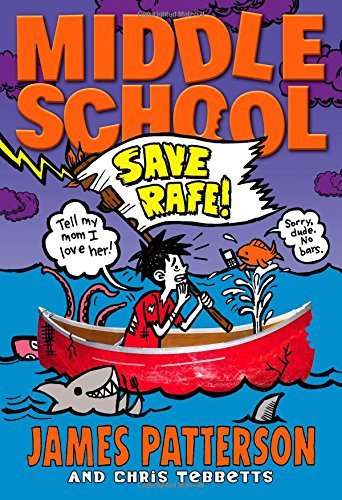
Rafe Khatchadorian is back. The Arts school he was attending is closing and guess what... he will have to go back to Hills Village Middle School. Yep, the place where these stories started and the place Rafe was happy to be expelled from. But, Mrs. Ida P. Stricker is now the principal and the new vice-principal is her sister Charlotte P. Stonecase. Needless to say, neither of them are happy with the idea of Rafe returning to their school. So, they have a condition... Rafe must attend and successfully complete a week in The Program.
When Rafe looks at the brochure, he realizes this is no fun week at camp. In fact, the brochure says in boldface letters, "The hardest week of your life is about to begin."
My opinion: I enjoyed this book. I always like reading with my son. :)
Recommended to: This book is great for kids in grades 3 - 8; I think any kids who enjoy realistic fiction or humorous stories will enjoy it. Patterson's writing is easy to read and there are plenty of pictures throughout the book which are very funny.
Similar Books: The rest of the Middle School series by James Patterson The I Funny series also by James Patterson
Well, everything has finally come back to haunt Rafe! Unfortunately, he is going to have to leave the special art school he was attending and return back to his regular public middle school, but that becomes interesting when the principal says he is going to have to attend a discipline/adventure camp over the summer before he is even allowed to return.
When he arrives, he finds a totally knew group of kids, and they are not really the type he usually has as friends. All of them are kids who have gotten in trouble, and they have been sent to camp to learn to behave. Through a series of challenges and teamwork, they are going to have to earn points in order to stay at the camp under the leadership of a very difficult "drill sergeant."
I actually liked this one quite a bit. While a little predictable, it was nice to see Rafe really take some of the things he has done wrong in past books seriously. Like we already know, he is actually not all that bad when compared to his campmates, but Patterson and Tebbetts have arranged for no shortage of physical and psychological challenges to keep them busy ... and hopefully help them back into being pretty good kids.
Fans of the series will definitely like this addition.
Perfect series read -- characters we already know, new characters that are like people we all know, in a new, interesting situation. I'll put this on my list of "Somewhat Graphic" chapter books, the ones that bridge kids from graphic novels to more text. Rafe's comic, Loozer Loses Again, and the other illustrations by Linda Park add plenty of visual support and add to the humor. I included this in my booktalks for sixth graders on the "What's next from favorite authors and series" page, and I'm sure that's all the advertising it will need to spend it's summer vacation in many different houses, cars, sleeping bags... Reading teachers needing to find a chapter book of a certain length, where the main character shows growth will welcome this. The assignment that Rafe is given, to write a letter to his future self, readily lends itself to a classroom extension. Thanks to the publisher for providing a copy, so my library copy could get out in circulation right away. Rafe will be paired up with Charlie Joe Jackson in our Summer Reading Prize showcase now.
This book was adorable for middle school children - told through the POV of Rafe, who is clearly more interesting than the 'good' sister, there's plenty of humor and bizarre antics following him around as he finds out his school closed down and now he's forced to attend his old school. But there's a catch - a big one. He must complete a week for troublemaker children in the wilderness. There he'll either pass or fail and not be able to attend public school. Cute jokes, his comics drawn are present, fun illustrations, moral lessons, and worthy characters for this age group.
I'm not sure if I'd want my student to attend that hard week, but then again, it worked out well in the end. Those reading this won't grow bored.
This picture drawn of the United States and Florida especially made me chuckle -